

Two-dimensional gas of massless Dirac fermions in graphene
Open accessThe DOI matches its Crossref record; 32 of the 32 references it cites were found in a registry or an index; 12 of the 52 sources its claims cite were checked for support.
Abstract
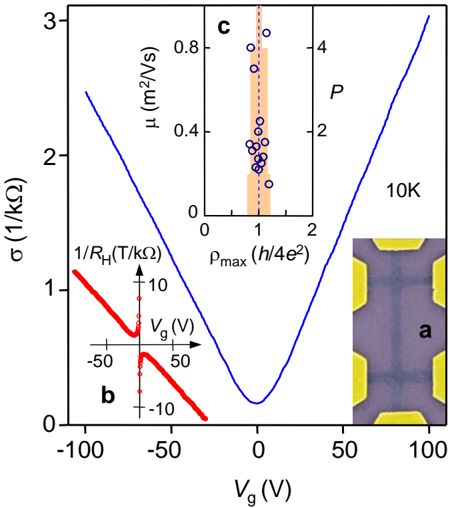
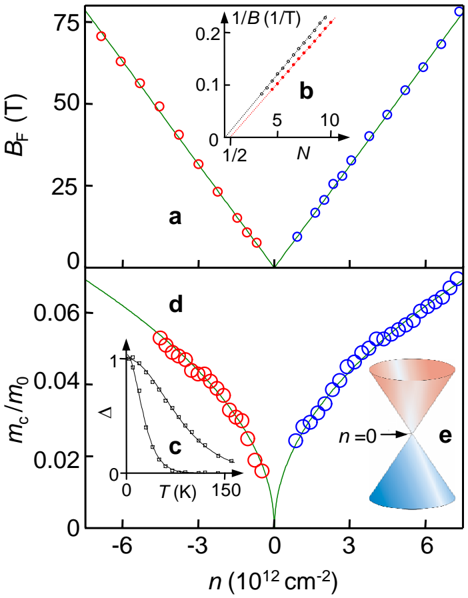
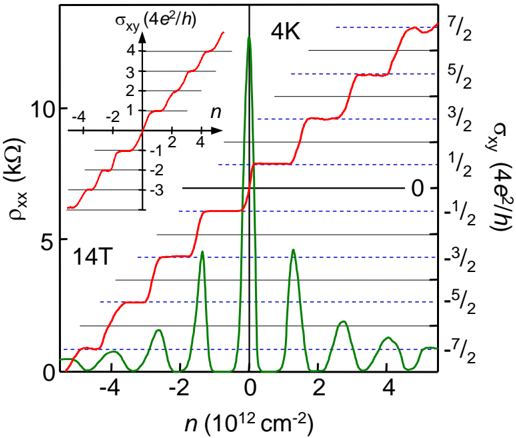
Quantum electrodynamics (resulting from the merger of quantum mechanics and relativity theory) has provided a clear understanding of phenomena ranging from particle physics to cosmology and from astrophysics to quantum chemistry. The ideas underlying quantum electrodynamics also influence the theory of condensed matter, but quantum relativistic effects are usually minute in the known experimental systems that can be described accurately by the non-relativistic Schrödinger equation. Here we report an experimental study of a condensed-matter system (graphene, a single atomic layer of carbon) in which electron transport is essentially governed by Dirac's (relativistic) equation. The charge carriers in graphene mimic relativistic particles with zero rest mass and have an effective ‘speed of light’ c* ≈ 106 m s-1. Our study reveals a variety of unusual phenomena that are characteristic of two-dimensional Dirac fermions. In particular we have observed the following: first, graphene's conductivity never falls below a minimum value corresponding to the quantum unit of conductance, even when concentrations of charge carriers tend to zero; second, the integer quantum Hall effect in graphene is anomalous in that it occurs at half-integer filling factors; and third, the cyclotron mass mc of massless carriers in graphene is described by E = mcc*2. This two-dimensional system is not only interesting in itself but also allows access to the subtle and rich physics of quantum electrodynamics in a bench-top experiment.
Overview
CoChat Summary
TL;DR
Graphene is a two-dimensional gas of massless Dirac fermions with linear dispersion and an effective speed of light \(c^* \approx 10^6\) m/s. Transport measurements reveal an anomalous half-integer quantum Hall effect, a minimum conductivity, cyclotron mass \(m_c = E/c^{*2}\), and a \(\pi\) Berry-phase shift in Shubnikov–de Haas oscillations.
Key findings
- Graphene’s charge carriers behave as massless Dirac fermions: the data imply \(E = \hbar k c^*\) for both electrons and holes, with \(c^* \approx 1 \times 10^6\) m/s; the cyclotron mass varies between \(\approx 0.02\) and \(0.07\,m_0\) and follows \(m_c \propto n^{1/2}\).
- The integer quantum Hall effect is anomalous: plateaux occur at half-integer \(\nu\), with sequence \((4e^2/h)(N+\tfrac12)\) and the first plateau at \(2e^2/h\); two-layer graphene returns to the normal integer sequence.
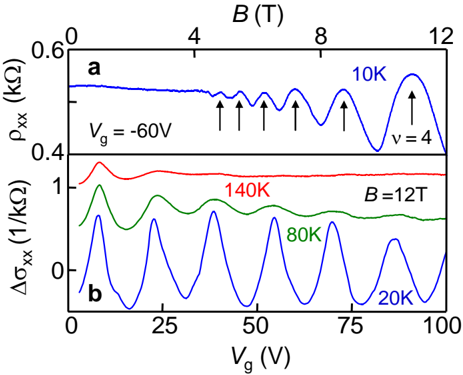
- Shubnikov–de Haas oscillations show a single set for electrons and holes, with \(B_F = \beta n\), \(\beta \approx 1.04 \times 10^{-15}\) T·m\(^2\) (\(\pm 2\%\)), yielding degeneracy \(f=4\); the oscillations exhibit a phase shift of \(\pi\) attributed to Berry’s phase.
- Conductivity never falls below a minimum: \(\rho_{\max} \approx 6.5\) k\(\Omega\) in 15 devices (experimental error \(\approx 15\%\)), associated with \(h/fe^2 = 6.45\) k\(\Omega\), independent of mobility (which varied by a factor of 10) and of temperature between 4 and 100 K.
Methods
- Graphene samples were obtained by micromechanical cleavage of graphite, followed by identification and selection of monolayers using optical, scanning-electron, and atomic-force microscopies; selected films were processed into multi-terminal devices, with some devices made from 2 or 3 layers.
- Transport measurements included the electric field effect, Hall coefficient, Shubnikov–de Haas oscillations, and quantum Hall effect in magnetic fields; mobility was measured between 10 and 100 K, minimum conductivity between 4 and 100 K, and SdHO up to 140 K and room temperature.
- Analysis used fan diagrams to determine \(B_F\), fits of SdHO amplitude to \(T/\sinh(2\pi^2 k_B T m_c / h eB)\), and semiclassical expressions \(B_F = (h/2\pi e)S(E)\) and \(m_c = (h^2/2\pi)\partial S(E)/\partial E\) to infer \(E \propto k\).
Limitations
- The paper has no dedicated limitations section; stated caveats include that mobility was “probably still limited by defects in parent graphite,” that the two-layer finite-mass result is “to be published elsewhere,” and that most theories suggest a minimum conductivity of \(\approx e^2/\pi h\), in disagreement with the experiment.
- Evident from the text: devices are unprotected from the environment (though stable under ambient conditions), some measured devices consisted of 2 or 3 graphene layers, and the transition region was often shifted from zero \(V_g\) due to chemical doping, although annealing normally eliminated the shift.
- The inference of linear dispersion relies on a semiclassical model that the paper says is justified by recent theory, so the experimental conclusion depends on that theoretical framework.
Model-written summary. Check it against the paper before relying on it.
Integrity signals
Registry
Cites
Statistics
Figures
Verification
Claims the paper makes
3 Valid · 5 Not valid · 11 Not checked · 51 Own results and interpretations
The cited sources support only part of this claim — read each source’s verdict below.
In the paper
“d) Shubnikov-de Haas oscillations in graphene exhibit a phase shift of π due to Berry's phase”
- Also stated in: § Two-Dimensional Gas of Massless Dirac Fermions in Graphene · plain
“The shift is due to Berry's phase [9,15].”
What the sources say
- Partly supportedcites [9] Berger, C. et al. Ultrathin epitaxial graphite: 2D electron gas properties and a route toward graphene-based nanoelectronics. J. Phys. Chem. B 108, 19912–19916 (2004) sourceExperimental — accuracy not yet measured
The Figure 2 caption (p. 3) reports Shubnikov–de Haas oscillations in an epitaxial graphene sample. The discussion on pp. 3–4 addresses their occurrence and period, but does not report a π phase shift or attribute one to Berry’s phase. (LLM, conf=0.85)
- Partly supportedcites [15] Gusynin, V. P. & Sharapov, S. G. Unconventional integer quantum Hall effect in grapheme. Preprint at http://xxx.lanl.gov/abs/cond-mat/0506575 (2005). sourceExperimental — accuracy not yet measured
Our copy (Introduction, p. 1) does state that 'the phase of de Haas van Alphen and Shubnikov de Haas oscillations for Dirac quasiparticles is shifted ... compared to the phase of non-relativistic quasiparticles' (citing Refs. 7-10), so the existence of a phase shift in graphene is supported; the magnitude symbol itself is lost in our copy's undecoded formulas. What is NOT supported is the causal attribution to Berry's phase: no passage of our copy mentions Berry's phase at all (searched: 'Berry phase pseudospin topological phase π', 'oscillation phase factor'). Instead the paper explains the unconventional magneto-transport phenomena by the quantum anomaly of the n = 0 Landau level — its halved degeneracy and B-independent energy (p. 1 and p. 3) — and relates the oscillation minima to fillings ν_B = 2n+1 (p. 3). (LLM, conf=0.75)
plainstates a cause- Asserted: passes — The authors put it forward as true.
- Checkable: passes — It can be checked against evidence.
- Load-bearing: passes — The paper’s conclusions depend on it.
- Based: passes — The paper gives a reason why it holds.
- Also stated in: § Two-Dimensional Gas of Massless Dirac Fermions in Graphene · plain
The cited sources that could be checked couldn’t confirm or dispute this claim.
In the paper
“we invoke the formal expression [9-12] for the energy of massless relativistic fermions in quantized fields, EN =[2 e h c ∗ 2 B ( N +½ ± ½)] 1/2”
What the sources say
- Could not verifycites [9] Berger, C. et al. Ultrathin epitaxial graphite: 2D electron gas properties and a route toward graphene-based nanoelectronics. J. Phys. Chem. B 108, 19912–19916 (2004) sourceExperimental — accuracy not yet measured
The discussion of magnetoconductance (p. 3) says Shubnikov–de Haas oscillations indicate quantization of the electron energy spectrum, but it gives no energy formula. Searches for massless relativistic fermions, Landau levels, and the N + 1/2 ± 1/2 term found no passage stating the claimed expression. (LLM, conf=0.76)
- Not checked — no full text of the sourcecites [10] Bunch, J. S., Yaish, Y., Brink, M., Bolotin, K. & McEuen, P. L. Coulomb oscillations and Hall effect in quasi-2D graphite quantum dots. Nano Lett. 5, 287–290 (2005) source
- Not checked — no full text of the sourcecites [11] Dresselhaus, M. S. & Dresselhaus, G. Intercalation compounds of graphite. Adv. In Phys. 51, 1–186 (2002) source
- Not matchedcites [12] Brandt, N. B., Chudinov, S. M. & Ponomarev, Y. G. Semimetals 1: Graphite and Its Compounds (North-Holland, Amsterdam, 1988)
We searched by its title and found no matching paper.
plain- Asserted: passes — The authors put it forward as true.
- Checkable: passes — It can be checked against evidence.
- Load-bearing: passes — The paper’s conclusions depend on it.
- Based: passes — The paper gives a reason why it holds.
- Could not verify
The cited sources that could be checked couldn’t confirm or dispute this claim.
In the paper
“The employed semiclassical model is fully justified by a recent theory for graphene [9], which shows that SdHO's amplitude can indeed be described by the above expression T /sinh(2 π 2 k B Tm c / h eB ) with m c = E / c ∗ 2 .”
What the sources say
- Could not verifycites [9] Berger, C. et al. Ultrathin epitaxial graphite: 2D electron gas properties and a route toward graphene-based nanoelectronics. J. Phys. Chem. B 108, 19912–19916 (2004) sourceExperimental — accuracy not yet measured
The discussion of magnetoconductance (pp. 3–4) reports observed Shubnikov–de Haas oscillations, but does not give a theory for their amplitude. Searches for the temperature-dependent amplitude expression and m_c = E/c*² found no passage addressing either, so our copy cannot verify the attributed claim. (LLM, conf=0.76)
boostedstates a cause- Asserted: passes — The authors put it forward as true.
- Checkable: passes — It can be checked against evidence.
- Load-bearing: passes — The paper’s conclusions depend on it.
- Based: passes — The paper gives a reason why it holds.
- Could not verify
The cited sources that could be checked couldn’t confirm or dispute this claim.
In the paper
“The latter can be viewed as a direct consequence of the Atiyah-Singer index theorem that plays an important role in quantum field theory and the theory of superstrings [13,14].”
What the sources say
- Not checked — no full text of the sourcecites [13] Vonsovsky, S. V. & Katsnelson, M. I. Quantum Solid State Physics (Springer, New York, 1989) source
- Could not verifycites [14] Gusynin, V. P. & Sharapov, S. G. Magnetic oscillations in planar systems with the Dirac-like spectrum of quasiparticle excitations. Phys. Rev. B 71, 125124 (2005) sourceExperimental — accuracy not yet measured
Our copy of Gusynin & Sharapov II gives the relativistic Landau-level spectrum with n = 0, 1, ... in the Introduction (p. 1) and discusses the lowest level E_1 and its crossing of the Fermi surface (Discussion, p. 6; Sect. II.B, p. 6), but it never invokes or discusses the Atiyah-Singer index theorem, topology, or zero-mode counting as the reason for a level pinned at E = 0. Searches on 'Atiyah-Singer index theorem zero-energy Landau level', 'index theorem topological zero modes chiral anomaly', and 'zero-energy Landau level n=0 degeneracy independent of field strength' returned only the spectrum/quantization-condition passages. Since the index-theorem grounding is simply not addressed in our copy (and no alternative work is credited for it there), the attribution can be neither confirmed nor contradicted. (LLM, conf=0.68)
plainstates a cause- Asserted: passes — The authors put it forward as true.
- Checkable: passes — It can be checked against evidence.
- Load-bearing: unclear — It is unclear whether the paper’s conclusions depend on it.
- Based: passes — The paper gives a reason why it holds.
The cited sources that could be checked couldn’t confirm or dispute this claim.
In the paper
“in agreement with band structure calculations [6,7]”
What the sources say
- Could not verifycites [6] Novoselov, K. S. et al. Two dimensional atomic crystals. Proc. Natl Acad. Sci. USA 102, 10451–10453 (2005) sourceExperimental — accuracy not yet measured
The discussion of graphene transport in “Two Dimensional Atomic Crystals” (p. 3) reports carrier concentrations and mobilities, but not a fitted c* or a comparison with band-structure calculations. Searches for the velocity, its approximate value, and band-structure calculations found no passage addressing that comparison. (LLM, conf=0.76)
- Could not verifycites [7] Novoselov, K. S. et al. Electric field effect in atomically thin carbon films. Science 306, 666–669 (2004) sourceExperimental — accuracy not yet measured
The discussion on p. 2 says graphene is expected to have linear energy dispersion and massless carriers, but gives no calculated velocity to compare with c* ≈ 1·10^6 m/s. Searches for the velocity and band-structure comparison found no passage in our copy establishing the claimed agreement. (LLM, conf=0.73)
plainstates an association- Asserted: passes — The authors put it forward as true.
- Checkable: passes — It can be checked against evidence.
- Load-bearing: passes — The paper’s conclusions depend on it.
- Based: passes — The paper gives a reason why it holds.
- Could not verify
34 more claims
Create a free account to see all 70 claims and to verify the 10 references still open.
- It may state two separate claims as one. 27
- Probably not a substantial claim. 8
Claims other papers make about this one
Each is checked against this paper’s own text: does it say what the citing paper says it does?
The source backs part of the claim, not all of it — or backs it for a different population, condition or comparison.
In the citing paper
“Recently, the non-relativistic electrons in graphene monolayer were found to obey the massless relativistic dispersion known as the Dirac cone, leading to the realization of analogies to Zitterbewegung and Klein tunneling in low-energy condensed-matter physics and atom optics 4 -19 .”
From Observation of interaction-induced phenomena of relativistic quantum mechanics (2021) · cites this paper as [4]
Experimental — accuracy not yet measuredThe source backs part of the claim, not all of it — or backs it for a different population, condition or comparison.
In the citing paper
“Dirac points in graphene1–3 or photonic graphene12 belong to the first type, which occur in lattices with unbroken T. These occur in pairs and are stabilized by a symmetry of the underlying lattice.”
From Observation of an unpaired photonic Dirac point (2020) · cites this paper as [1]
Experimental — accuracy not yet measuredThe cited source says what the claim attributes to it.
In the citing paper
“The energy spectrum of ˆ H 1 is E n = sgn( n ) ℏ Ω √ | n | , where n = 0 , ± 1 , . . . , see Fig. 1.”
From Theory of electron Zitterbewegung in graphene probed by femtosecond laser pulses (2009) · cites this paper as [36]
The cited source says what the claim attributes to it.
In the citing paper
“Around Dirac cones, conduction and valence bands intersect linearly at a degenerate point resulting in the linear energy band and massless relativistic transport of electrons as quasiparticles [4].”
From Observing movement of Dirac cones from single-photon dynamics (2021) · cites this paper as [4]
The check wasn’t confident either way, so it gives no verdict — never disputed.
In the citing paper
“photonic Dirac points are known to occur in pairs in “photonic graphene” and other similar photonic crystals”
From Observation of an unpaired photonic Dirac point (2020) · cites this paper as [1]
Experimental — accuracy not yet measured
3 more claims about this paper
Create a free account to see every claim other papers make about this one.
Citations
Cites
Electric Field Effect in Atomically Thin Carbon Films
Novoselov, K. S., Geim, A. K., Morozov, S. V., Jiang, D., Zhang, Y., Dubonos, S. V., Grigorieva, I. V., & Firsov, A. A. (2004) · Science · doi:10.1126/science.1102896 · Cited by 66,834
Self-citationTwo-dimensional atomic crystals
Novoselov, K. S., Jiang, D., Schedin, F., Booth, T. J., Khotkevich, V. V., Morozov, S. V., & Geim, A. K. (2005) · Proceedings of the National Academy of Sciences · doi:10.1073/pnas.0502848102 · Cited by 11,788
Self-citationScaling Theory of Localization: Absence of Quantum Diffusion in Two Dimensions
Abrahams, E., Anderson, P. W., Licciardello, D. C., & Ramakrishnan, T. V. (1979) · Physical Review Letters · doi:10.1103/physrevlett.42.673 · Cited by 6,134
Berger, C., Song, Z., Li, T., Li, X., Ogbazghi, A. Y., Feng, R., Dai, Z., Marchenkov, A. N., Conrad, E. H., First, P. N., et al. (2004) · The Journal of Physical Chemistry B · doi:10.1021/jp040650f · Cited by 3,548
The Universe in a Helium Droplet
Volovik, G. E. (2009) · doi:10.1093/acprof:oso/9780199564842.001.0001 · Cited by 2,632
Intercalation compounds of graphite
Dresselhaus, M. S., & Dresselhaus, G. (2002) · Advances in Physics · doi:10.1080/00018730110113644 · Cited by 2,139
Geometry, Topology and Physics
Nakahara, M. (1990) · doi:10.1887/0750306068 · Cited by 1,620
Geometry, Topology and Physics
Nakahara, M. (2018) · CRC Press eBooks · doi:10.1201/9781315275826 · Cited by 1,505
Unconventional Integer Quantum Hall Effect in Graphene
Gusynin, V. P., & Sharapov, S. G. (2005) · Physical Review Letters · doi:10.1103/physrevlett.95.146801 · Cited by 1,374
Field Theories of Condensed Matter Systems
Fradkin, E. (2007) · Medical Entomology and Zoology · Cited by 1,118
Research works printed but not linked: 1
- Mott, N.F. & Davis, E.A. Electron Processes in Non-Crystalline Materials (Clarendon Press, Oxford, 1979).
Cited by
Items 19,801–19,900 of 21,614
Hydrodynamics of charged Dirac electrons
Pongsangangan, K. (2022) · Utrecht University Repository (Utrecht University) · doi:10.33540/1417
The first principle calculation of two-dimensional Dirac materials
Lu, J. (2017) · IOP Conference Series Earth and Environmental Science · doi:10.1088/1755-1315/100/1/012053
Breakdown of the Quantum Hall Regime in a ‘Confined’ Graphene
Morita, Y. (2012) · Advances in science and technology · doi:10.4028/www.scientific.net/ast.77.276
Amaki, E., Mahdavifar, Z., Pitié, S., et al. (2025) · ChemistrySelect · doi:10.1002/slct.202501993
Robust topological properties in Zr-doped graphene under strain regulation
Yatong, W. A. N. G., Yue-fang, H., Yuan, D., et al. (2026) · Acta Physica Sinica · doi:10.7498/aps.75.20251487
Structure électronique et propriétés de réseaux cohérents de nanocristaux semi-conducteurs
Tadjine, A. (2018) · theses.fr (ABES) · doi:10.70675/1bd87bffzd23ez475dz93d6z291d403413b6 · Cited by 1
Surface morphology engineering of Cu for nanoscale strain control in graphene
Kim, D.-J., Jeon, C., Kim, B., et al. (2025) · Surfaces and Interfaces · doi:10.1016/j.surfin.2025.106646
Green’s Functions and Ab Initio Quantum Transport in the Landauer–Büttiker Formalism
Torres, L. E. F. F., Roche, S., & Charlier, J. (2020) · Cambridge University Press eBooks · doi:10.1017/9781108664462.015
Designation of Intra-layer and Intercalated High Entropy Quasi-2D CompoundsPreprint
Chen, H., Li, S., Huang, S. X., Li, A., Liu, S., Tang, F., Fang, Y. Z., & Dai, P. Q. (2021) · arXiv (Cornell University) · doi:10.48550/arxiv.2102.10306
Diabolical points in multi-scatterer optomechanical systemsPreprint
Chesi, S., Wang, Y.-D., & Twamley, J. (2014) · arXiv (Cornell University) · doi:10.48550/arxiv.1402.0926
Transparent and Foldable Electronics Enabled by Si Nanomembranes
Jang, H., Das, T., Lee, W., et al. (2016) · doi:10.1002/9783527691005.ch3
Li, Y., Xie, B., & Nie, Y. (2026) · Journal of Alloys and Compounds · doi:10.1016/j.jallcom.2026.188548
Analysis of Current Hysteresis in Graphene Field Effect TransistorPreprint
Yao, Y. (2018) · arXiv (Cornell University) · doi:10.48550/arxiv.1804.05542
Zhu, G., Li, W., & Zhang, Y. (2024) · Journal of Physics Condensed Matter · doi:10.1088/1361-648x/ad5d37
Mono-layer C-face epitaxial graphene for high frequency electronics
Guo, Z. (2014) · SMARTech Repository (Georgia Institute of Technology)
Light-induced unconventional Landau levels of ultracold fermions in a trilayer honeycomb lattice
Hou, J.-M. (2010) · Science China Physics Mechanics and Astronomy · doi:10.1007/s11433-010-0075-4
Simulation of the Diffusion of Copper Atom on Graphene by Molecular Dynamics
Khudyakov, S. V., Колесников, С. В., & Saletsky, A. M. (2024) · Поверхность Рентгеновские синхротронные и нейтронные исследования · doi:10.31857/s1028096024020077
Melillo, A., Navalón, S., Herance, J. R., et al. (2022) · Royal Society of Chemistry eBooks · doi:10.1039/9781839164620-00150
Inamdar, A. N., Jha, P. K., & Kurzydłowski, K. J. (2026) · Applied Surface Science · doi:10.1016/j.apsusc.2026.168218
Optical Properties of Multilayer GraphenePreprint
Kamada, M., Sasaki, K.-I., & Matsui, T. (2024) · SSRN Electronic Journal · doi:10.2139/ssrn.4866062
Introduction of Microporous Membranes
Zou, X., & Zhu, G. (2019) · doi:10.1002/9783527343997.ch1
Theory of the Structural, Electronic and Transport Properties of Graphene
Masir, M. R., Leenaerts, O., Partoens, B., & Peeters, F. M. (2016) · Series in materials science and engineering · doi:10.1201/b19623-3
Zhang, D. (2021) · Deep Blue (University of Michigan) · doi:10.7302/2728
Brajpuriya, R. (2016) · International Conference on Advances in Electrical, Electronic and Systems Engineering · doi:10.1109/icaees.2016.7888067
Yan, H., Lv, J. H., & Yuan, R. (2014) · Nano-Micro Letters · doi:10.5101/nml.v6i2.p153-162
Li, M.-S., Chen, K., Fu, Y.-X., Mo, D.-C., & Lyu, S.-S. (2019) · AIP Advances · doi:10.1063/1.5113973 · Cited by 2
Waduge, P. (2017) · Digital Repository Service (Northeastern University) · doi:10.17760/d20251580
Non-Hermitian topological metamaterials to manipulate the acoustic wave propagation
Guo, T. (2024) · theses.fr (ABES) · doi:10.70675/7b6d061dzd77az4ba7z9eeezb96bc40916e5
Yimiti, A., & Qu, X. (2026) · The Journal of Physical Chemistry Letters · doi:10.1021/acs.jpclett.6c02728
Isobe, H. (2017) · Springer theses · doi:10.1007/978-981-10-3743-6_1
Two-Dimensional Electronics - Prospects and Challenges
Schwierz, F. (2016) · MDPI eBooks · doi:10.3390/books978-3-03842-250-1
Effect of Interlayer Shear to Graphene ResonatorsPreprint
Liu, Y., Xu, Z., & Zheng, Q. (2010) · arXiv (Cornell University) · doi:10.48550/arxiv.1012.0766
Fabrication of p–n–p Graphene Structure and Observation of Current Oscillation
Konishi, K., & Yoh, K. (2011) · Japanese Journal of Applied Physics · doi:10.1143/jjap.50.06ge13
Dependence of spin states on thermoelectric quantities in a single-layer FeCl2
Prayitno, T. B., & Susanti, D. (2024) · Journal of Physics Conference Series · doi:10.1088/1742-6596/2908/1/012011
Suspended Graphene Devices for Nanoelectromechanics and for the Study of Quantum Hall Effect
Singh, V., & Deshmukh, M. M. (2012) · Wiley eBooks · doi:10.1002/9783527651122.ch6
Mustapha, M. J. (2019) · Malaysian journal of microscopy/Malaysian Journal of Microscopy
Symmetry-broken induced phase transitions in double nodal-ring semimetals
Sun, Y., & Pan, H. (2025) · Physics Letters A · doi:10.1016/j.physleta.2025.131153
Behavior of Iron Deposition on the Surface Structure and Electrical Properties of Crbr3 by Stm/SPreprint
Huang, B.-W., Chang, Y.-J., Lo, Y., et al. (2023) · SSRN Electronic Journal · doi:10.2139/ssrn.4648489
High-pressure Raman study of graphene: a spectroscopic evidence for the diamondol
Martins, L. G. P. (2015) · Americanae (AECID Library)
High-mobility graphene nano-rectifiers and transistors for high frequency applications
Auton, G. H. (2016) · Research Explorer (The University of Manchester)
Energy storage applications of plant derived carbon nanomaterials
Chandran, A., Athulya, K. R., Rasheed, R. F., & Kumar, A. C. (2025) · Elsevier eBooks · doi:10.1016/b978-0-323-95126-5.00014-7
Graphene-based active plasmonic metamaterials
Aznakayeva, D. E. (2018) · Research Explorer (The University of Manchester)
A universal method to grow and etch graphene film
Deng, N., Tian, H., Zhao, H., et al. (2016) · Proceedings, IEEE micro electro mechanical systems · doi:10.1109/memsys.2016.7421653
Yang, Y.-R., Chang, Z.-Y., Meng, Y., Zun, X., Liu, Z., & Liu, Y. (2025) · Applied Physics Letters · doi:10.1063/5.0267866
Algebraic classification of crossing points in band structure
Anonymous, Hu, Z., Li, Z., & Zhang, Z. (2026) · Physical review. B./Physical review. B · doi:10.1103/9my4-rkv3
Croissance des molécules aromatiques sur substrat d'Au(111)
Kari, H. E. (2024) · theses.fr (ABES) · doi:10.70675/947d3398zbc9dz4549zac8ez362f1ded439e
Manipulating exciton transport in a two-dimensional transition metal dichalcogenide semiconductor
Wong, Y. R. (2022) · DR-NTU (Nanyang Technological University) · doi:10.32657/10356/164294
Cielinska, K., Verkhovtsev, A. V., Souza, C. P., et al. (2026) · The European Physical Journal D · doi:10.1140/epjd/s10053-026-01242-8
“Its mass-less Dirac-like charge carriers [7,8], exceptionally high carrier mobility [6,9–11], large thermal conductivity a e-mail: f.fantuzzi@kent.ac.uk (corresponding author) [12–14], mechanical robustness [15,16], and maximal surface-to-volume ratio [17] have made it a central platform for the…”
Electronic transport in order–disorder coupled bilayer graphene
Lu, Y. Y., Mu, Z. N., Huang, Y., et al. (2026) · Journal of Applied Physics · doi:10.1063/5.0324952
İyikanat, F. (2013) · İYTE (İZMİR YÜKSEK TEKNOLOJİ ENSTİTÜSÜ)
Reduction of detection volume in total internal reflection fluorescence microscopy using graphene
Uddin, S. Z., & Talukder, M. A. (2016) · International Conference on Electrical and Computer Engineering (ICECE) · doi:10.1109/icece.2016.7853876
Topological Phase Transition in Two-Dimensional Magnetic Material CrI3 Bilayer Intercalated with Mo
Yin, C.-E., Huang, A., & Jeng, H. (2025) · Materials · doi:10.3390/ma18204751
Chen, M.-L., Huang, Y. C., Chen, R. B., et al. (2009) · Physica E Low-dimensional Systems and Nanostructures · doi:10.1016/j.physe.2009.11.137
Bamba, A. N. M., Diez‐Varga, A., Costa, L., et al. (2025) · ACS Applied Nano Materials · doi:10.1021/acsanm.5c04461
Sukhovii, N. O., Lyahova, N., Masol, I. V., et al. (2018) · Реєстрація зберігання і обробка даних · doi:10.35681/1560-9189.2018.20.3.158511
Chemical Exfoliation of Black Phosphorus for Nanoelectronics Applications
Min, M., Saenz, G. A. L., Qiu, G., et al. (2017) · MRS Advances · doi:10.1557/adv.2017.341
Li, S., & Tang, H. (2021) · Communications in Computational Physics · doi:10.4208/cicp.oa-2020-0226
Transport dépendant du spin dans le graphène
Dlubak, B. (2011) · theses.fr (ABES) · doi:10.70675/594f0399z9832z4c0ez8ee4z53ef4bae2689
Mirzadeh, M., & Farjam, M. (2015) · International Journal of Modern Physics B · doi:10.1142/s0217979215501982
Molecular Precursors-Induced Surface Reconstruction at Graphene/Pt(111) InterfacesPreprint
Wang, Q., Pang, R., & Shi, X. (2015) · arXiv (Cornell University) · doi:10.48550/arxiv.1507.03368
Coating of Graphene on ITO Via Cyclic Voltammetry
Pillai, R., Chhabra, V. A., & Sharma, A. (2023) · Lecture notes in networks and systems · doi:10.1007/978-981-99-1946-8_37
Activated Migration of Localized Ligand-Field Excitons in Atomically Thin CrCl3
Kim, H., Liu, R., Yoon, S., Lim, H., Taniguchi, T., Watanabe, K., Kim, J., Lee, C., & Ryu, S. (2026) · Journal of the American Chemical Society · doi:10.1021/jacs.6c12269
Yonaga, K. (2022) · Springer theses · doi:10.1007/978-981-16-9166-9_1
Edges, nanoribbons and quantum dots
Katsnelson, M. I. (2012) · Cambridge University Press eBooks · doi:10.1017/cbo9781139031080.006
Self-citationDan, H. K., Thuy, H. T. P., Long, L. P., et al. (2026) · RSC Advances · doi:10.1039/d6ra02224c
Photoluminescence from Suspended and Supported Graphene
Zhou, G. Y., & Shen, F. (2019) · Diffusion and defect data, solid state data. Part B, Solid state phenomena/Solid state phenomena · doi:10.4028/www.scientific.net/ssp.298.197
Probing the Electrical Properties of Overlapped Graphene Grain Boundaries by Raman spectroscopyPreprint
Rao, R. S., Pierce, N. A., & Harutyunyan, A. R. (2014) · arXiv (Cornell University) · doi:10.48550/arxiv.1406.1555
Landau quantization of Dirac fermions in graphene and its multilayerPreprint
Yin, L., Bai, K.-K., Wang, W.-X., et al. (2017) · arXiv (Cornell University) · doi:10.48550/arxiv.1703.04241
Extremely large range regulation of thermal conductivity of penta-BCN by tensile strain
Chu, H., Zhao, P., Dong, X., Zhang, J., Liu, Z., & Zhang, H. (2025) · Physica B Condensed Matter · doi:10.1016/j.physb.2025.417460
Vibrational properties of substitutional hexagonal boron nitride sheets
Soni, H. R., Bhojani, A. K., & Jha, P. K. (2020) · AIP conference proceedings · doi:10.1063/5.0017531
Graham, C. (2024) · UPCommons institutional repository (Universitat Politècnica de Catalunya) · doi:10.5821/dissertation-2117-406403
ANOMALOUS INTEGER QUANTUM HALL EFFECT NEAR 1/2 FLUX QUANTA PER PLAQUETTE
Schweitzer, L. (2007) · International Journal of Modern Physics B · doi:10.1142/s0217979207038332
Functionalized graphene nanocomposites for energy storage and electrocatalysis
Bosmi, M. (2023) · theses.fr (ABES) · doi:10.70675/41fca819z23f0z43dbz8d4dz11c7666ee13d
Localized Electronic States of Graphene on a Substrate with a Terrace-Stepped Sructure
Krasyukov, G. A., & Pavlovsky, O. V. (2025) · Vestnik Moskovskogo Universiteta Seriya 3 Fizika Astronomiya · doi:10.55959/msu0579-9392.80.2510102
Procedure for Fabrication and Characterization of Van-der-Waals Heterostructures
Shevchun, A. F., Prokudina, M., Egorov, S. V., et al. (2024) · Поверхность Рентгеновские синхротронные и нейтронные исследования · doi:10.31857/s1028096024060117
Ballistic conductivity of graphene channel with p-n junction on ferroelectric domain wallPreprint
Morozovska, A. N., Eliseev, E. А., & Strikha, M. V. (2016) · arXiv (Cornell University) · doi:10.48550/arxiv.1603.02519
Oliveira, R. R. (2025) · The European Physical Journal A · doi:10.1140/epja/s10050-025-01751-x
Performance investigation of uniaxially strained phosphorene n-MOSFETs
Jung, S., Seo, J., Heo, S., et al. (2017) · International Conference on Simulation of Semiconductor Processes and Devices · doi:10.23919/sispad.2017.8085334
Hissi, N. E. H., Mokhtari, B., Shabat, M. M., et al. (2018) · Applied Physics A · doi:10.1007/s00339-018-1988-4
Interface Modifications with Atomic Monolayer
Lahiri, J. (2010) · Digital Commons - University of South Florida (University of South Florida)
Graphene—Synthesis and Quality Optimization
Nguyen, D., Hsieh, Y., & Hofmann, M. (2019) · Handbook of Graphene · doi:10.1002/9781119468455.ch2
Bueno, M. J., Garcia, G. Q., Carvalho, A. M. D. M., et al. (2025) · SSRN Electronic Journal · doi:10.2139/ssrn.5178852
Nanomaterials: Conducting Polymers and Sensing
Ateş, M. (2017) · CRC Press eBooks · doi:10.1081/e-ebppc-120049912
Davydov, A. S., Krasnov, A., & Kuzmin, V. A. (2021) · Theoretical and Mathematical Physics · doi:10.1134/s0040577921070096
Anomaly non-renormalization in interacting Weyl semimetalsPreprint
Giuliani, A., Mastropietro, V., & Porta, M. (2019) · arXiv (Cornell University) · doi:10.48550/arxiv.1907.00682
Impact of Temperature on Seebeck Coefficient of Nodal Line Semimetal in Molecular Conductor
Suzumura, Y. (2024) · Crystals · doi:10.3390/cryst14070601
Magnetic energy bands of a 2D graphite layer in the spatially modulated magnetic field
Chiu, Y. H., Lai, Y., Ho, J. H., Chuu, D.-S., & Lin, M. (2007) · Physica E Low-dimensional Systems and Nanostructures · doi:10.1016/j.physe.2007.09.072
Li, S., & Tang, H. (2020) · arXiv (Cornell University) · doi:10.48550/arxiv.2011.00934
“Since entering the 21st century, the Dirac equation is used to study the structures and dynamical properties of the two-dimensional (2D) materials such as graphene and graphite [34, 8, 1, 17] and the relativistic effects in molecules in super intense lasers [18] etc.”
MethodOptical perspective on the time-dependent Dirac oscillator
Tsutsui, T. T., Silva, A. A., de Castro, A. S. M., & Andrade, F. M. (2026) · Frontiers in Physics · doi:10.3389/fphy.2026.1772868
- Retracted
Topological Properties of Graphene and Photo-induced Effects
Oka, T., & Aoki, H. (2011) · Hyomen Kagaku · doi:10.1380/jsssj.32.196
Synthesis of One- and Two-Dimensional Carbon Nitrides on Cu(111)
Zhou, Y., Li, D., Gao, Z., et al. (2026) · Chinese Physics Letters · doi:10.1088/0256-307x/43/5/050712
Structural and electrical properties of solid-source MBE-grown graphene/Ge(001) heterostructures
Aouassa, M., Mastropasqua, C., Florea, I., et al. (2026) · Nanoscale · doi:10.1039/d6nr00146g
Vila, M. (2021) · Springer theses · doi:10.1007/978-3-030-86114-8_1
Cao, L., Li, A., Xie, H., et al. (2026) · SSRN Electronic Journal · doi:10.2139/ssrn.6507261
Temperature dependence of static spin conductivity of gapped graphene
Rezania, H., Moradian, R., & Marvi, S. (2018) · Computational Condensed Matter · doi:10.1016/j.cocom.2018.e00313
Electronic and optical properties of the buckled and puckered phases of phosphorene and arsenenePreprint
Hernández, J. M. G., Fernandez‐Escamilla, H. N., Guerrero-Sánchez, J., et al. (2022) · Research Square · doi:10.21203/rs.3.rs-2006878/v1
Metadata
- Authors
- Novoselov, K. S., Geim, A. K., Morozov, S. V., Jiang, D., Katsnelson, M. I., Grigorieva, I. V., Dubonos, S. V., & Firsov, A. A.
- Affiliations
- University of Manchester (GB)
- Institute of Microelectronics Technology and High Purity Materials (RU)
- Radboud University Nijmegen (NL)
- Corresponding author
- Novoselov, K. S.
- Geim, A. K.
- Venue
- Nature
- Published
- 2005-11
- Volume
- 438
- Issue
- 7065
- Pages
- 197-200
- ISSN
- 0028-0836 (ISSN-L)
- 1476-4687
- OpenAlex
- W2125284466
- Semantic Scholar
- 228e604ea7c1333a99663b6b547cf47b98e721e7
- Cited by
- 21,611
- References
- 32
- Citations by year
- 2026: 442 · 2025: 677 · 2024: 798 · 2023: 924 · 2022: 992 · 2021: 1082 · 2020: 1230 · 2019: 1268 · 2018: 1350 · 2017: 1395 · 2016: 1501 · 2015: 1473 · 2014: 1387 · 2013: 1382 · 2012: 1375
- FWCI
- 217.72
- Type
- journal article
- Language
- en
- Open access
- green
- arxiv.org
- Licence
- www.springer.com/tdm (tdm)
- Locations
- Nature (publishedVersion)
- PubMed (publishedVersion)
- arXiv (Cornell University) (submittedVersion)
- RePEc: Research Papers in Economics (submittedVersion)
- Research Explorer (The University of Manchester) (submittedVersion)
- Radboud Repository (Radboud University) (submittedVersion)
- arXiv (Cornell University)
- Topics
- Physical Sciences › Materials Science › Materials Chemistry › Graphene research and applications
- Physical Sciences › Physics and Astronomy › Condensed Matter Physics › Topological Materials and Phenomena
- Physical Sciences › Physics and Astronomy › Atomic and Molecular Physics, and Optics › Quantum Electrodynamics and Casimir Effect
- Keywords
- graphene, massless Dirac fermions, two-dimensional Dirac fermions, quantum Hall effect, cyclotron mass, electron transport, relativistic electrons
About these checks
Registry, retraction, Cites and statistics results are computed, not judged, with one exception: a printed reference that no index lists is read once by a model before it counts as a citation error. Claims are extracted by a model and kept only when their quote appears verbatim in the text; each cited source is then checked, with a model’s help, for whether it says what the claim relies on. Those verdicts can be wrong — read the claim’s quote and the cited source before relying on one.
The claim verdicts this report counts are experimental: their accuracy is not yet measured.
A language model drew the claims from the paper on 2026-10-10, under version 3 of the claim definition (model deepseek-v4.1-flash, prompt extract-v3).
A second model labelled each claim on 2026-10-10 (model jev-1.13-20260917, definition revision gold-guideline-v0.2).
Cited sources are checked with a language model’s help (gpt-6-sol and qwen3.8-omni-flash).
Statistics and arithmetic are recomputed, not judged.
Confidence bands are shown only for fields calibrated on our annotated test set. None is calibrated yet, so no band is shown.
What counts as a claim ›How we measure confidence ›How we check this ›
Are you an author, or do you see a problem with this page? Request a review
Data sources
Bibliographic data: Semantic Scholar, OpenAlex, Crossref.
Contains information from the Semantic Scholar Academic Graph Datasets, made available under the ODC Attribution License (ODC-BY 1.0).
Semantic Scholar’s data is described in: Kinney, R., et al. (2023). The Semantic Scholar Open Data Platform. arXiv:2301.10140.
