

Two-dimensional gas of massless Dirac fermions in graphene
Open accessThe DOI matches its Crossref record; 32 of the 32 references it cites were found in a registry or an index; 12 of the 52 sources its claims cite were checked for support.
Abstract
Quantum electrodynamics (resulting from the merger of quantum mechanics and relativity theory) has provided a clear understanding of phenomena ranging from particle physics to cosmology and from astrophysics to quantum chemistry. The ideas underlying quantum electrodynamics also influence the theory of condensed matter, but quantum relativistic effects are usually minute in the known experimental systems that can be described accurately by the non-relativistic Schrödinger equation. Here we report an experimental study of a condensed-matter system (graphene, a single atomic layer of carbon) in which electron transport is essentially governed by Dirac's (relativistic) equation. The charge carriers in graphene mimic relativistic particles with zero rest mass and have an effective ‘speed of light’ c* ≈ 106 m s-1. Our study reveals a variety of unusual phenomena that are characteristic of two-dimensional Dirac fermions. In particular we have observed the following: first, graphene's conductivity never falls below a minimum value corresponding to the quantum unit of conductance, even when concentrations of charge carriers tend to zero; second, the integer quantum Hall effect in graphene is anomalous in that it occurs at half-integer filling factors; and third, the cyclotron mass mc of massless carriers in graphene is described by E = mcc*2. This two-dimensional system is not only interesting in itself but also allows access to the subtle and rich physics of quantum electrodynamics in a bench-top experiment.
Overview
CoChat Summary
TL;DR
Graphene is a two-dimensional gas of massless Dirac fermions with linear dispersion and an effective speed of light \(c^* \approx 10^6\) m/s. Transport measurements reveal an anomalous half-integer quantum Hall effect, a minimum conductivity, cyclotron mass \(m_c = E/c^{*2}\), and a \(\pi\) Berry-phase shift in Shubnikov–de Haas oscillations.
Key findings
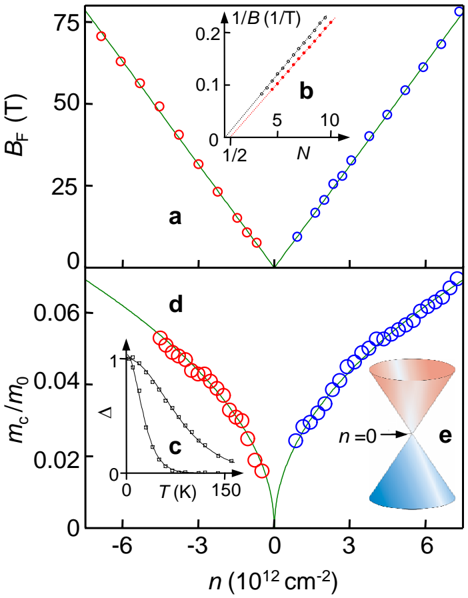
- Graphene’s charge carriers behave as massless Dirac fermions: the data imply \(E = \hbar k c^*\) for both electrons and holes, with \(c^* \approx 1 \times 10^6\) m/s; the cyclotron mass varies between \(\approx 0.02\) and \(0.07\,m_0\) and follows \(m_c \propto n^{1/2}\).
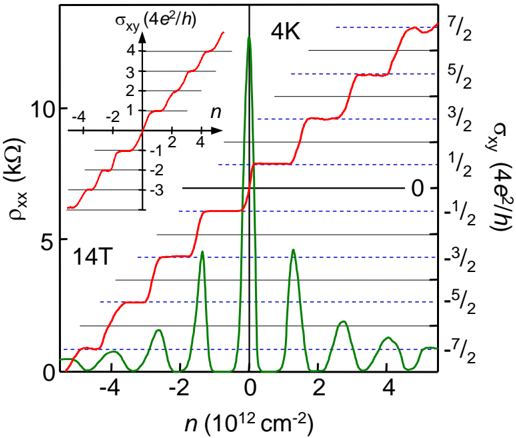
- The integer quantum Hall effect is anomalous: plateaux occur at half-integer \(\nu\), with sequence \((4e^2/h)(N+\tfrac12)\) and the first plateau at \(2e^2/h\); two-layer graphene returns to the normal integer sequence.
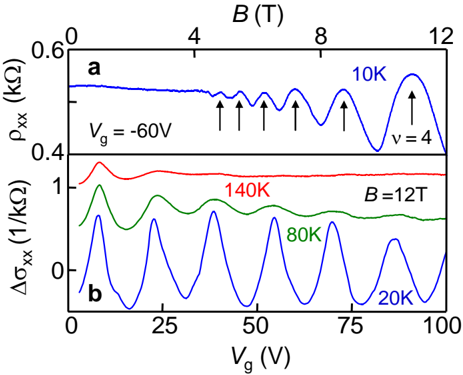
- Shubnikov–de Haas oscillations show a single set for electrons and holes, with \(B_F = \beta n\), \(\beta \approx 1.04 \times 10^{-15}\) T·m\(^2\) (\(\pm 2\%\)), yielding degeneracy \(f=4\); the oscillations exhibit a phase shift of \(\pi\) attributed to Berry’s phase.
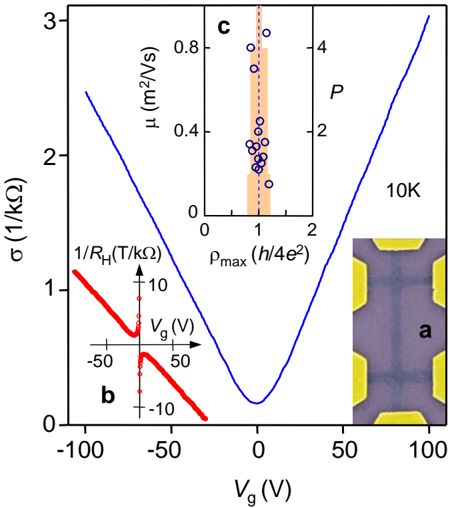
- Conductivity never falls below a minimum: \(\rho_{\max} \approx 6.5\) k\(\Omega\) in 15 devices (experimental error \(\approx 15\%\)), associated with \(h/fe^2 = 6.45\) k\(\Omega\), independent of mobility (which varied by a factor of 10) and of temperature between 4 and 100 K.
Methods
- Graphene samples were obtained by micromechanical cleavage of graphite, followed by identification and selection of monolayers using optical, scanning-electron, and atomic-force microscopies; selected films were processed into multi-terminal devices, with some devices made from 2 or 3 layers.
- Transport measurements included the electric field effect, Hall coefficient, Shubnikov–de Haas oscillations, and quantum Hall effect in magnetic fields; mobility was measured between 10 and 100 K, minimum conductivity between 4 and 100 K, and SdHO up to 140 K and room temperature.
- Analysis used fan diagrams to determine \(B_F\), fits of SdHO amplitude to \(T/\sinh(2\pi^2 k_B T m_c / h eB)\), and semiclassical expressions \(B_F = (h/2\pi e)S(E)\) and \(m_c = (h^2/2\pi)\partial S(E)/\partial E\) to infer \(E \propto k\).
Limitations
- The paper has no dedicated limitations section; stated caveats include that mobility was “probably still limited by defects in parent graphite,” that the two-layer finite-mass result is “to be published elsewhere,” and that most theories suggest a minimum conductivity of \(\approx e^2/\pi h\), in disagreement with the experiment.
- Evident from the text: devices are unprotected from the environment (though stable under ambient conditions), some measured devices consisted of 2 or 3 graphene layers, and the transition region was often shifted from zero \(V_g\) due to chemical doping, although annealing normally eliminated the shift.
- The inference of linear dispersion relies on a semiclassical model that the paper says is justified by recent theory, so the experimental conclusion depends on that theoretical framework.
Model-written summary. Check it against the paper before relying on it.
Integrity signals
Registry
Cites
Statistics
Figures
Verification
Claims the paper makes
3 Valid · 5 Not valid · 11 Not checked · 51 Own results and interpretations
The cited sources support only part of this claim — read each source’s verdict below.
In the paper
“d) Shubnikov-de Haas oscillations in graphene exhibit a phase shift of π due to Berry's phase”
- Also stated in: § Two-Dimensional Gas of Massless Dirac Fermions in Graphene · plain
“The shift is due to Berry's phase [9,15].”
What the sources say
- Partly supportedcites [9] Berger, C. et al. Ultrathin epitaxial graphite: 2D electron gas properties and a route toward graphene-based nanoelectronics. J. Phys. Chem. B 108, 19912–19916 (2004) sourceExperimental — accuracy not yet measured
The Figure 2 caption (p. 3) reports Shubnikov–de Haas oscillations in an epitaxial graphene sample. The discussion on pp. 3–4 addresses their occurrence and period, but does not report a π phase shift or attribute one to Berry’s phase. (LLM, conf=0.85)
- Partly supportedcites [15] Gusynin, V. P. & Sharapov, S. G. Unconventional integer quantum Hall effect in grapheme. Preprint at http://xxx.lanl.gov/abs/cond-mat/0506575 (2005). sourceExperimental — accuracy not yet measured
Our copy (Introduction, p. 1) does state that 'the phase of de Haas van Alphen and Shubnikov de Haas oscillations for Dirac quasiparticles is shifted ... compared to the phase of non-relativistic quasiparticles' (citing Refs. 7-10), so the existence of a phase shift in graphene is supported; the magnitude symbol itself is lost in our copy's undecoded formulas. What is NOT supported is the causal attribution to Berry's phase: no passage of our copy mentions Berry's phase at all (searched: 'Berry phase pseudospin topological phase π', 'oscillation phase factor'). Instead the paper explains the unconventional magneto-transport phenomena by the quantum anomaly of the n = 0 Landau level — its halved degeneracy and B-independent energy (p. 1 and p. 3) — and relates the oscillation minima to fillings ν_B = 2n+1 (p. 3). (LLM, conf=0.75)
plainstates a cause- Asserted: passes — The authors put it forward as true.
- Checkable: passes — It can be checked against evidence.
- Load-bearing: passes — The paper’s conclusions depend on it.
- Based: passes — The paper gives a reason why it holds.
- Also stated in: § Two-Dimensional Gas of Massless Dirac Fermions in Graphene · plain
The cited sources that could be checked couldn’t confirm or dispute this claim.
In the paper
“we invoke the formal expression [9-12] for the energy of massless relativistic fermions in quantized fields, EN =[2 e h c ∗ 2 B ( N +½ ± ½)] 1/2”
What the sources say
- Could not verifycites [9] Berger, C. et al. Ultrathin epitaxial graphite: 2D electron gas properties and a route toward graphene-based nanoelectronics. J. Phys. Chem. B 108, 19912–19916 (2004) sourceExperimental — accuracy not yet measured
The discussion of magnetoconductance (p. 3) says Shubnikov–de Haas oscillations indicate quantization of the electron energy spectrum, but it gives no energy formula. Searches for massless relativistic fermions, Landau levels, and the N + 1/2 ± 1/2 term found no passage stating the claimed expression. (LLM, conf=0.76)
- Not checked — no full text of the sourcecites [10] Bunch, J. S., Yaish, Y., Brink, M., Bolotin, K. & McEuen, P. L. Coulomb oscillations and Hall effect in quasi-2D graphite quantum dots. Nano Lett. 5, 287–290 (2005) source
- Not checked — no full text of the sourcecites [11] Dresselhaus, M. S. & Dresselhaus, G. Intercalation compounds of graphite. Adv. In Phys. 51, 1–186 (2002) source
- Not matchedcites [12] Brandt, N. B., Chudinov, S. M. & Ponomarev, Y. G. Semimetals 1: Graphite and Its Compounds (North-Holland, Amsterdam, 1988)
We searched by its title and found no matching paper.
plain- Asserted: passes — The authors put it forward as true.
- Checkable: passes — It can be checked against evidence.
- Load-bearing: passes — The paper’s conclusions depend on it.
- Based: passes — The paper gives a reason why it holds.
- Could not verify
The cited sources that could be checked couldn’t confirm or dispute this claim.
In the paper
“The employed semiclassical model is fully justified by a recent theory for graphene [9], which shows that SdHO's amplitude can indeed be described by the above expression T /sinh(2 π 2 k B Tm c / h eB ) with m c = E / c ∗ 2 .”
What the sources say
- Could not verifycites [9] Berger, C. et al. Ultrathin epitaxial graphite: 2D electron gas properties and a route toward graphene-based nanoelectronics. J. Phys. Chem. B 108, 19912–19916 (2004) sourceExperimental — accuracy not yet measured
The discussion of magnetoconductance (pp. 3–4) reports observed Shubnikov–de Haas oscillations, but does not give a theory for their amplitude. Searches for the temperature-dependent amplitude expression and m_c = E/c*² found no passage addressing either, so our copy cannot verify the attributed claim. (LLM, conf=0.76)
boostedstates a cause- Asserted: passes — The authors put it forward as true.
- Checkable: passes — It can be checked against evidence.
- Load-bearing: passes — The paper’s conclusions depend on it.
- Based: passes — The paper gives a reason why it holds.
- Could not verify
The cited sources that could be checked couldn’t confirm or dispute this claim.
In the paper
“The latter can be viewed as a direct consequence of the Atiyah-Singer index theorem that plays an important role in quantum field theory and the theory of superstrings [13,14].”
What the sources say
- Not checked — no full text of the sourcecites [13] Vonsovsky, S. V. & Katsnelson, M. I. Quantum Solid State Physics (Springer, New York, 1989) source
- Could not verifycites [14] Gusynin, V. P. & Sharapov, S. G. Magnetic oscillations in planar systems with the Dirac-like spectrum of quasiparticle excitations. Phys. Rev. B 71, 125124 (2005) sourceExperimental — accuracy not yet measured
Our copy of Gusynin & Sharapov II gives the relativistic Landau-level spectrum with n = 0, 1, ... in the Introduction (p. 1) and discusses the lowest level E_1 and its crossing of the Fermi surface (Discussion, p. 6; Sect. II.B, p. 6), but it never invokes or discusses the Atiyah-Singer index theorem, topology, or zero-mode counting as the reason for a level pinned at E = 0. Searches on 'Atiyah-Singer index theorem zero-energy Landau level', 'index theorem topological zero modes chiral anomaly', and 'zero-energy Landau level n=0 degeneracy independent of field strength' returned only the spectrum/quantization-condition passages. Since the index-theorem grounding is simply not addressed in our copy (and no alternative work is credited for it there), the attribution can be neither confirmed nor contradicted. (LLM, conf=0.68)
plainstates a cause- Asserted: passes — The authors put it forward as true.
- Checkable: passes — It can be checked against evidence.
- Load-bearing: unclear — It is unclear whether the paper’s conclusions depend on it.
- Based: passes — The paper gives a reason why it holds.
The cited sources that could be checked couldn’t confirm or dispute this claim.
In the paper
“in agreement with band structure calculations [6,7]”
What the sources say
- Could not verifycites [6] Novoselov, K. S. et al. Two dimensional atomic crystals. Proc. Natl Acad. Sci. USA 102, 10451–10453 (2005) sourceExperimental — accuracy not yet measured
The discussion of graphene transport in “Two Dimensional Atomic Crystals” (p. 3) reports carrier concentrations and mobilities, but not a fitted c* or a comparison with band-structure calculations. Searches for the velocity, its approximate value, and band-structure calculations found no passage addressing that comparison. (LLM, conf=0.76)
- Could not verifycites [7] Novoselov, K. S. et al. Electric field effect in atomically thin carbon films. Science 306, 666–669 (2004) sourceExperimental — accuracy not yet measured
The discussion on p. 2 says graphene is expected to have linear energy dispersion and massless carriers, but gives no calculated velocity to compare with c* ≈ 1·10^6 m/s. Searches for the velocity and band-structure comparison found no passage in our copy establishing the claimed agreement. (LLM, conf=0.73)
plainstates an association- Asserted: passes — The authors put it forward as true.
- Checkable: passes — It can be checked against evidence.
- Load-bearing: passes — The paper’s conclusions depend on it.
- Based: passes — The paper gives a reason why it holds.
- Could not verify
34 more claims
Create a free account to see all 70 claims and to verify the 10 references still open.
- It may state two separate claims as one. 27
- Probably not a substantial claim. 8
Claims other papers make about this one
Each is checked against this paper’s own text: does it say what the citing paper says it does?
The source backs part of the claim, not all of it — or backs it for a different population, condition or comparison.
In the citing paper
“Recently, the non-relativistic electrons in graphene monolayer were found to obey the massless relativistic dispersion known as the Dirac cone, leading to the realization of analogies to Zitterbewegung and Klein tunneling in low-energy condensed-matter physics and atom optics 4 -19 .”
From Observation of interaction-induced phenomena of relativistic quantum mechanics (2021) · cites this paper as [4]
Experimental — accuracy not yet measuredThe source backs part of the claim, not all of it — or backs it for a different population, condition or comparison.
In the citing paper
“Dirac points in graphene1–3 or photonic graphene12 belong to the first type, which occur in lattices with unbroken T. These occur in pairs and are stabilized by a symmetry of the underlying lattice.”
From Observation of an unpaired photonic Dirac point (2020) · cites this paper as [1]
Experimental — accuracy not yet measuredThe cited source says what the claim attributes to it.
In the citing paper
“The energy spectrum of ˆ H 1 is E n = sgn( n ) ℏ Ω √ | n | , where n = 0 , ± 1 , . . . , see Fig. 1.”
From Theory of electron Zitterbewegung in graphene probed by femtosecond laser pulses (2009) · cites this paper as [36]
The cited source says what the claim attributes to it.
In the citing paper
“Around Dirac cones, conduction and valence bands intersect linearly at a degenerate point resulting in the linear energy band and massless relativistic transport of electrons as quasiparticles [4].”
From Observing movement of Dirac cones from single-photon dynamics (2021) · cites this paper as [4]
The check wasn’t confident either way, so it gives no verdict — never disputed.
In the citing paper
“photonic Dirac points are known to occur in pairs in “photonic graphene” and other similar photonic crystals”
From Observation of an unpaired photonic Dirac point (2020) · cites this paper as [1]
Experimental — accuracy not yet measured
3 more claims about this paper
Create a free account to see every claim other papers make about this one.
Citations
Cites
Electric Field Effect in Atomically Thin Carbon Films
Novoselov, K. S., Geim, A. K., Morozov, S. V., Jiang, D., Zhang, Y., Dubonos, S. V., Grigorieva, I. V., & Firsov, A. A. (2004) · Science · doi:10.1126/science.1102896 · Cited by 66,834
Self-citationTwo-dimensional atomic crystals
Novoselov, K. S., Jiang, D., Schedin, F., Booth, T. J., Khotkevich, V. V., Morozov, S. V., & Geim, A. K. (2005) · Proceedings of the National Academy of Sciences · doi:10.1073/pnas.0502848102 · Cited by 11,788
Self-citationScaling Theory of Localization: Absence of Quantum Diffusion in Two Dimensions
Abrahams, E., Anderson, P. W., Licciardello, D. C., & Ramakrishnan, T. V. (1979) · Physical Review Letters · doi:10.1103/physrevlett.42.673 · Cited by 6,134
Berger, C., Song, Z., Li, T., Li, X., Ogbazghi, A. Y., Feng, R., Dai, Z., Marchenkov, A. N., Conrad, E. H., First, P. N., et al. (2004) · The Journal of Physical Chemistry B · doi:10.1021/jp040650f · Cited by 3,548
The Universe in a Helium Droplet
Volovik, G. E. (2009) · doi:10.1093/acprof:oso/9780199564842.001.0001 · Cited by 2,632
Intercalation compounds of graphite
Dresselhaus, M. S., & Dresselhaus, G. (2002) · Advances in Physics · doi:10.1080/00018730110113644 · Cited by 2,139
Geometry, Topology and Physics
Nakahara, M. (1990) · doi:10.1887/0750306068 · Cited by 1,620
Geometry, Topology and Physics
Nakahara, M. (2018) · CRC Press eBooks · doi:10.1201/9781315275826 · Cited by 1,505
Unconventional Integer Quantum Hall Effect in Graphene
Gusynin, V. P., & Sharapov, S. G. (2005) · Physical Review Letters · doi:10.1103/physrevlett.95.146801 · Cited by 1,374
Field Theories of Condensed Matter Systems
Fradkin, E. (2007) · Medical Entomology and Zoology · Cited by 1,118
Research works printed but not linked: 1
- Mott, N.F. & Davis, E.A. Electron Processes in Non-Crystalline Materials (Clarendon Press, Oxford, 1979).
Cited by
Items 20,801–20,900 of 21,614
Progress in Surface Properties and the Surface Testing of Graphene
Dai, J., Wang, G., & Wu, C.-K. (2016)
Hot electron dynamics in graphene
Ling, M.-C., & USDOE Office of Science (SC) (2011) · OSTI OAI (U.S. Department of Energy Office of Scientific and Technical Information) · doi:10.2172/1048505
Paul, D., Deb, J., & Sarkar, U. (2024) · SSRN Electronic Journal · doi:10.2139/ssrn.4901882
Magnetic Ordering and Bonding in Ln3TiBi5 (Ln = Pr, Nd, Gd)
Wu, K., Sokratov, D., Kumar, R., Long, H. A., Paglione, J., & Klepov, V. V. (2026) · ACS Materials Au · doi:10.1021/acsmaterialsau.6c00162 · Cited by 1
Алисултанов, З. З., & Kavokin, A. V. (2026) · Physical review. B./Physical review. B · doi:10.1103/mptf-ypln
“The exploration of graphene’s exceptional electronic properties has unveiled a plethora of novel transport phenomena, with ballistic conduction standing as a hallmark of its high quality and weak electron-phonon coupling [1, 2].”
Kovalenko, S. L., Pavlova, T. V., Andryushechkin, B. V., et al. (2020) · Journal of Experimental and Theoretical Physics Letters · doi:10.1134/s0021364020100100
Fabrication of p–n–p Graphene Structure and Observation of Current Oscillation
Konishi, K., & Yoh, K. (2011) · Japanese Journal of Applied Physics · doi:10.7567/jjap.50.06ge13
Tu, J.-S., & Cho, C. (2026) · Electrochimica Acta · doi:10.1016/j.electacta.2026.148190
S-Duality in Topological Supergravity
Eckehard, W., & Maggiolo, A. A. R. (2012) · InTech eBooks · doi:10.5772/34769 · Cited by 1
Ambient-Pressure Organic Dirac Electron State in α -(BETS) 2 AuCl 2
Kobayashi, T., Yoshimi, K., Nishimoto, A., Michimura, S., & Taniguchi, H. (2026) · Journal of the Physical Society of Japan · doi:10.7566/jpsj.95.043701
Two-dimensional materials for future photonic integration
Hu, Z., Fu, Q., Wang, J., Mingxin, 张. Z., Chen, J., Zhang, Y., Lin, T., Yang, M., Lu, J., & Ni, Z. (2026) · Photonics Insights · doi:10.3788/pi.2026.r12
First-principles study of two-dimensional MoP2Si2Z2 (Z=N, P, As) monolayer
Ji, Y., Li, L., Liu, L., et al. (2023) · Physica B Condensed Matter · doi:10.1016/j.physb.2023.415175
The Renaissance of GermaniumPreprint
Zandvliet, H. J. W. (2024) · SSRN Electronic Journal · doi:10.2139/ssrn.4841435
Chemistry of graphene quantum dots and their nano-electro-mechanical applications
Patwary, M. A. M., Awal, A., Rahman, M. S., Islam, M. Z., Rahman, M. R., & Qin, C. (2026) · Advances in chemical pollution, environmental management and protection · doi:10.1016/bs.apmp.2026.02.009
Graphene and carbon nanotube photonics
Xia, F., Mueller, T., Stelner, M., et al. (2009) · IEEE International Conference on Group IV Photonics (GFP) · doi:10.1109/group4.2009.5338384
Quasi-bound states of Dirac electrons in electric and magnetic quantum dots
Matulis, A. (2012) · Lithuanian Journal of Physics · doi:10.3952/lithjphys.52206
Plasmon-Graphene Hybrids for Ultrafast Surface CatalysisPreprint
Ding, Q., Chen, M., Shi, Y., et al. (2015) · arXiv (Cornell University)
Xue, C., Diao, S., Cheng, H., et al. (2026) · Optics Letters · doi:10.1364/ol.610023
Monolayer and bilayer graphene
McCann, E. (2022) · Elsevier eBooks · doi:10.1016/b978-0-323-90800-9.00019-6 · Cited by 1
Tilted Dirac cones and their topology in holographic materials
Seo, J.-W., Yuk, T., & Sang-jin Sin, A. (2026) · Journal of High Energy Physics · doi:10.1007/jhep03(2026)079
“which gives a Dirac cone, and its tip is called the Dirac point [1, 25, 26].”
Hybrid lasers and modulator on silicon in the near- and mid-infrared region
Hu, X. (2017) · DR-NTU (Nanyang Technological University) · doi:10.32657/10356/72468
Plasmonic Nanoplatforms for Biochemical Sensing and Medical Applications
Ahmadivand, A. (2018) · FIU - Digital Commons (Florida International University) · doi:10.25148/etd.fidc004068 · Cited by 2
Evidence Against Klein Paradox in GraphenePreprint
Dragoman, D. (2007) · arXiv (Cornell University) · doi:10.48550/arxiv.quant-ph/0701083
Ab initio and multiscale quantum transport in graphene-based materials
Torres, L. E. F. F., Roche, S., & Charlier, J. (2014) · Cambridge University Press eBooks · doi:10.1017/cbo9781139344364.008
Wafer-scale single-crystalline graphene transferred from SiC exhibiting Landau quantization
Huhtasaari, J., Palakulam, J. J., Salha, A., et al. (2026) · Carbon · doi:10.1016/j.carbon.2026.121963
“Extrapolating to 1 / 𝐵 𝑁 = 0 yields the intercept 𝑁 ≈ − 12 reflecting the Berry phase of 𝜋 in monolayer graphene ( 46, 47 ).”
Masilamani, N. (2017) · Research Online (University of Wollongong) · Cited by 2
Synthesis, characterization and applications of two dimensional nanosheets
Zeng, Z. (2012) · DR-NTU (Nanyang Technological University) · doi:10.32657/10356/50866
Ornigotti, M., Ornigotti, L., & Biancalana, F. (2021) · APL Photonics · doi:10.1063/5.0049678 · Cited by 11
Васильевич, Ф. Д., Shamarina, A. A., & Popov, V. V. (2025) · Journal of Experimental and Theoretical Physics Letters · doi:10.1134/s0021364025608498
Rkky Interaction in Triangular Graphene NanobubblePreprint
Zhang, B., Ma, T., & Gong, W. (2025) · SSRN Electronic Journal · doi:10.2139/ssrn.5226371
Adsorption of Toxic Gases on Transition-Metal-Doped Janus MoSTe Monolayers: A First-Principles Study
Xu, B., Yang, M., Zhao, W., et al. (2026) · Langmuir · doi:10.1021/acs.langmuir.6c01279
Study of strain-mediated Dirac point shift in monolayer SbSSn by second harmonic generation
Liu, Y. Q., Xi, Y., & Si, M. (2025) · Physica Scripta · doi:10.1088/1402-4896/ae08f8 · Cited by 1
The Graphene-on-Diamond Structure with Ni-Catalyzed Under High TemperaturePreprint
Yuan, X., Liu, J., Liu, J., et al. (2024) · SSRN Electronic Journal · doi:10.2139/ssrn.4902206
Chemical technology and engineering. Proceedings
(2021) · Chemical technology and engineering. Proceedings · doi:10.23939/cte2021.01
Graphene-Like Massless Dirac Fermions in Harper Systems
Claro, F. H., & Robles, P. (2018) · Springer eBooks · doi:10.1007/978-3-319-72374-7_4
Zaid, N. S. K. A., Nasser, M. S., & Onaizi, S. A. (2026) · Nano Today · doi:10.1016/j.nantod.2026.103151
Skvortsov, D., & Konobeeva, N. N. (2020) · Springer proceedings in physics · doi:10.1007/978-3-030-58868-7_58
Ni, Z., Matsumoto, T., Ifuku, R., et al. (2020) · IEEE International Interconnect Technology Conference (IITC) · doi:10.1109/iitc47697.2020.9515642
Zhylkybayeva, N., Mussabek, G., Baktygerey, S., Sadikov, G. K., Lysenko, V., & Lisnyak, V. V. (2021) · Recent Contributions to Physics · doi:10.26577/rcph.2021.v79.i4.08
Jablan, M., Soljačić, M., & Buljan, H. (2013)
Coherence and Local Quantum Fisher Information in Tilted Dirac Systems With Reservoir Memory
Mouatasim, A. E., Houri, A. E., Houari, B. E., & Houça, R. (2026) · Annalen der Physik · doi:10.1002/andp.70285
Zhu, R. (2024) · SSRN Electronic Journal · doi:10.2139/ssrn.4789120
Goto, Y., Murata, M., Usui, H., Ono, K., Heremans, J. P., Terashima, T., & Lee, C. (2025) · Physical review. B./Physical review. B · doi:10.1103/physrevb.111.075163
Hydrogen-mediated CVD epitaxy of Graphene on SiC: growth mechanism and atomic configurationPreprint
Jabra, Z. B., Berbézier, I., Michon, A., et al. (2021) · arXiv (Cornell University) · doi:10.48550/arxiv.2102.00913
Nanostructures and Characteristics of Carbon Nanofibers
Kaul, A. B., Lee, J., & Feng, P. X. ‐. (2015) · Springer eBooks · doi:10.1007/978-94-007-6178-0_101008-1
The Hubbard model and the absolute negative conductivity of graphenePreprint
Belonenko, M. B., Lebedev, N. G., Shakirzyanov, M. M., et al. (2010) · arXiv (Cornell University) · doi:10.48550/arxiv.1003.2896
He, S. X., Zhang, Y., Yao, H., et al. (2022) · SSRN Electronic Journal · doi:10.2139/ssrn.4193396
Graphene-Based Metamaterial Absorbers
Wu, B., & Zhao, Y. (2024) · Springer eBooks · doi:10.1007/978-981-99-7914-1_5
Anonymous, Jagiełło, J., Reddig, W., et al. (2026) · Physical Review Applied · doi:10.1103/xdmg-zbky
Design and analysis of highly nonlinear graphene multimode waveguides
Wang, C., Wang, Y., Lei, L., Zhang, R., Qiao, Y., Liu, M., & Xue, C. (2026) · Optics Communications · doi:10.1016/j.optcom.2026.133067
Ju, C.-Y., Möller, G., & Tzeng, Y.-C. (2026) · Journal of Applied Physics · doi:10.1063/5.0325267 · Cited by 2
Structural and electrical characterization of doped graphene and carbon nanotube networks
Iqbal, M. Z. (2014) · UPCommons institutional repository (Universitat Politècnica de Catalunya) · doi:10.5821/dissertation-2117-95426 · Cited by 1
Tuning the Transport Properties of Penta-graphene NanoribbonsPreprint
Wang, L., Bao, R., Wang, Z. L., et al. (2025) · SSRN Electronic Journal · doi:10.2139/ssrn.5991010
Quantum Transport: General Concepts
Torres, L. E. F. F., Roche, S., & Charlier, J. (2020) · Cambridge University Press eBooks · doi:10.1017/9781108664462.006
Polymer nanocomposites reinforced with carbonaceous nanofillers and their piezoresistive behavior
Chen, P., & Wong, S. (2010) · Elsevier eBooks · doi:10.1533/9780857090249.2.404
Graphene High-Temperature Sensors Based on Segmented Annealing ProcessPreprint
Li, Y., Yuan, H., Liu, Q., et al. (2025) · SSRN Electronic Journal · doi:10.2139/ssrn.5958232
Beyond edge injection: area effects in graphene–metal contact resistance
Park, J., Lee, J. S., & Lee, S. J. (2026) · Journal of the Korean Physical Society · doi:10.1007/s40042-026-01579-8 · Cited by 1
Holwill, M. (2019) · Springer theses · doi:10.1007/978-3-030-18529-9_1
Scientific zero to one: Some common properties of highly-influential papers
Yekta, M. M. J. (2021) · Malaysian Journal of Library & Information Science · doi:10.22452/mjlis.vol26no3.1 · Cited by 1
“…noting that after the deployment of the Scotch tape technique of Geim by Kim’s group and their studying of mono-layers in early 2005, the two papers (Novoselov et al. 2005 [18,200] and Zhang et al. 2005 [12,590]) describing the observation of Dirac fermions in mono-layer graphene, submitted…”
MethodGraphene-based Mid-infrared Photodetectors and Spin Transport Devices
Machida, T., Masubuchi, S., Onuki, M., et al. (2014) · Journal of the Vacuum Society of Japan · doi:10.3131/jvsj2.57.451
Rapid basal-plane-uniform epoxy functionalization of graphene by 172 nm excimer irradiation
Haidari, M. M., Jang, D. J., Kang, D. J., et al. (2026) · Applied Surface Science · doi:10.1016/j.apsusc.2026.166766
Ball, P. (2017) · Nature Materials · doi:10.1038/nmat4933
Terahertz and Infrared Plasmonics with Unconventional Materials
D’Apuzzo, F., Autore, M., Pietro, P. D., Giorgianni, F., Limaj, O., Vecchio, I. L., Starace, A., & Lupi, S. (2016) · Springer eBooks · doi:10.1007/978-94-017-9780-1_100978
Systematic Determination of Eigenfields in Frequency Domain
Banova, T., Ackermann, W., & Weiland, T. (2016) · Mathematics in industry · doi:10.1007/978-3-319-30399-4_5
Pierantoni, L., Rozzi, T., Mencarelli, D., et al. (2026) · SSRN Electronic Journal · doi:10.2139/ssrn.6139861
Insight into Electron–Phonon Coupling in Doped Graphene
Yokoya, T. (2015) · JPSJ News and Comments · doi:10.7566/jpsjnc.12.01
Introduction to epigraphene and overview
Berger, C., Conrad, E. H., & de Heer, W. A. (2018) · Springer eBooks · doi:10.1007/978-3-662-53908-8_164
Sruthi, T., & Tarafder, K. (2019) · arXiv (Cornell University) · doi:10.48550/arxiv.1912.08563
Relativistic Phases in Condensed Matter
Louvet, T. (2018) · theses.fr (ABES) · doi:10.70675/5fe80bbfzda57z476fz81f4zdc06f0c87719 · Cited by 1
Sharifi, S. (2017) · Louisiana State University · doi:10.31390/gradschool_theses.4416 · Cited by 1
Jamil, M. F., Jony, M. S. A. M., Akash, T. S., et al. (2020) · arXiv (Cornell University) · doi:10.48550/arxiv.2006.07699
“Graphene demonstrates different extra-ordinary properties like atypical quantum Hall effect [2], outstanding crystal quality[3], higher electron mobility [4], superconductivity [5], etc.”
BackgroundHigh-efficiency light manipulation using a single layer of folded graphene microribbons
Han, X., & Wang, W. (2024) · Physica Scripta · doi:10.1088/1402-4896/ad28e1
Masood, K. B., Mir, A., Bhat, M. A., et al. (2026) · Journal of Alloys and Compounds · doi:10.1016/j.jallcom.2026.188916
Comparative Analysis on Crystallographic Presentation of WS2 Polymorphs by VESTA Software
Somveer, S., Singh, D., & Ahlawat, D. S. (2023) · Springer Proceedings in Materials · doi:10.1007/978-981-99-4685-3_67
Dirac points and inverse problems of quantum graphs associated with Archimedean tilings
Jatulan, E. O., & Law, C. (2024) · Journal of Physics A Mathematical and Theoretical · doi:10.1088/1751-8121/ad88bf
“They move with a fast speed of order 10 6 m s − 1 [33, 34].”
Champo, A. D. J. E., & Naumis, G. G. (2025) · SSRN Electronic Journal · doi:10.2139/ssrn.5383213
Proteomics study of the cellular function in response to nanomaterials
Yuan, J. (2012) · DR-NTU (Nanyang Technological University) · doi:10.32657/10356/50579
Avetissian, A. K., Ghazaryan, A. G., Sedrakian, K. V., et al. (2017) · arXiv (Cornell University) · doi:10.48550/arxiv.1710.03682
Additive Manufacturing of Graphene-based Patterns
Jabari, E. (2016) · UWSpace (University of Waterloo)
Yamamoto, M. (2023) · Elsevier eBooks · doi:10.1016/b978-0-323-90800-9.00104-9
Anomalous Phase-Coherence Scaling in a Quantum-Critical Dirac Semimetal
Nakamichi, S., Kobara, R., Unozawa, Y., Kawasugi, Y., Hiramoto, S., Funatsu, K., Naito, T., Tamura, M., Kato, R., Nishio, Y., et al. (2026) · Journal of the Physical Society of Japan · doi:10.7566/jpsj.95.063703
Modified graphene conductivity modeling for the application of optical based plasmonic devices
Rana, M. M., Quader, M. A., & Tishan, M. (2015) · International Conference on Electrical & Electronic Engineering (ICEEE) · doi:10.1109/ceee.2015.7428292
A Wide Optical-Gap in Fully sp3-Like Hydrogenated Monolayer GraphenePreprint
Apponi, A., Castellano, O., Paoloni, D., et al. (2026) · SSRN Electronic Journal · doi:10.2139/ssrn.6297127
Improvement of Dispersibility of Graphene Oxide by Surface Modification with Rare EarthsPreprint
Li, Y., Zhou, J., Yu, H., et al. (2022) · SSRN Electronic Journal · doi:10.2139/ssrn.4045352
Role of the polymeric structure and nanocomposites in tissue engineering
Chattopadhyay, D., & Das, B. (2024) · Elsevier eBooks · doi:10.1016/b978-0-323-96114-1.00011-2 · Cited by 1
Adireddy, S. R. (2013) · ScholarWorks @ The University of New Orleans (The University of New Orleans)
Penta-C52: A semimetallic carbon allotrope with a topological nodal loop
Song, Y., Zhang, W., Wang, Y., & Cui, W. (2026) · Diamond and Related Materials · doi:10.1016/j.diamond.2026.113673
GRAPHENE CONDUCTIVITY VARIATION DURING DRYING OF SUSPENSION DROPLETS ON THE SURFACE OF GRAPHENE FILM
Andryushchenko, V. A., Bogomolova, A. I., Sorokin, D. V., et al. (2025) · Interfacial phenomena and heat transfer · doi:10.1615/interfacphenomheattransfer.2025057486
Functionalization of graphene by intercalation: A theoretical insight
Urso, V. (2025) · Characterization and Application of Nanomaterials · doi:10.24294/can10326
“Graphene is an exception [27–30]: its charge carriers behave like relativistic particles and therefore it is more natural to describe them with the Dirac equation rather than the Schrödinger equation [31] (see Figure 4 ).”
Kawano, Y. (2016) · Hyomen Kagaku · doi:10.1380/jsssj.37.586
Analytical Description of Strain-Controlled Transport Anisotropy in Graphene
Lazzús, J. A., & Palma-Chilla, L. (2026) · Symmetry · doi:10.3390/sym18060995
“Graphene has attracted sustained interest due to its unique electronic properties, characterized by a linear energy dispersion near the Dirac points and massless Dirac fermion behavior [1–3].”
Metadata
- Authors
- Novoselov, K. S., Geim, A. K., Morozov, S. V., Jiang, D., Katsnelson, M. I., Grigorieva, I. V., Dubonos, S. V., & Firsov, A. A.
- Affiliations
- University of Manchester (GB)
- Institute of Microelectronics Technology and High Purity Materials (RU)
- Radboud University Nijmegen (NL)
- Corresponding author
- Novoselov, K. S.
- Geim, A. K.
- Venue
- Nature
- Published
- 2005-11
- Volume
- 438
- Issue
- 7065
- Pages
- 197-200
- ISSN
- 0028-0836 (ISSN-L)
- 1476-4687
- OpenAlex
- W2125284466
- Semantic Scholar
- 228e604ea7c1333a99663b6b547cf47b98e721e7
- Cited by
- 21,611
- References
- 32
- Citations by year
- 2026: 442 · 2025: 677 · 2024: 798 · 2023: 924 · 2022: 992 · 2021: 1082 · 2020: 1230 · 2019: 1268 · 2018: 1350 · 2017: 1395 · 2016: 1501 · 2015: 1473 · 2014: 1387 · 2013: 1382 · 2012: 1375
- FWCI
- 217.72
- Type
- journal article
- Language
- en
- Open access
- green
- arxiv.org
- Licence
- www.springer.com/tdm (tdm)
- Locations
- Nature (publishedVersion)
- PubMed (publishedVersion)
- arXiv (Cornell University) (submittedVersion)
- RePEc: Research Papers in Economics (submittedVersion)
- Research Explorer (The University of Manchester) (submittedVersion)
- Radboud Repository (Radboud University) (submittedVersion)
- arXiv (Cornell University)
- Topics
- Physical Sciences › Materials Science › Materials Chemistry › Graphene research and applications
- Physical Sciences › Physics and Astronomy › Condensed Matter Physics › Topological Materials and Phenomena
- Physical Sciences › Physics and Astronomy › Atomic and Molecular Physics, and Optics › Quantum Electrodynamics and Casimir Effect
- Keywords
- graphene, massless Dirac fermions, two-dimensional Dirac fermions, quantum Hall effect, cyclotron mass, electron transport, relativistic electrons
About these checks
Registry, retraction, Cites and statistics results are computed, not judged, with one exception: a printed reference that no index lists is read once by a model before it counts as a citation error. Claims are extracted by a model and kept only when their quote appears verbatim in the text; each cited source is then checked, with a model’s help, for whether it says what the claim relies on. Those verdicts can be wrong — read the claim’s quote and the cited source before relying on one.
The claim verdicts this report counts are experimental: their accuracy is not yet measured.
A language model drew the claims from the paper on 2026-10-10, under version 3 of the claim definition (model deepseek-v4.1-flash, prompt extract-v3).
A second model labelled each claim on 2026-10-10 (model jev-1.13-20260917, definition revision gold-guideline-v0.2).
Cited sources are checked with a language model’s help (gpt-6-sol and qwen3.8-omni-flash).
Statistics and arithmetic are recomputed, not judged.
Confidence bands are shown only for fields calibrated on our annotated test set. None is calibrated yet, so no band is shown.
What counts as a claim ›How we measure confidence ›How we check this ›
Are you an author, or do you see a problem with this page? Request a review
Data sources
Bibliographic data: Semantic Scholar, OpenAlex, Crossref.
Contains information from the Semantic Scholar Academic Graph Datasets, made available under the ODC Attribution License (ODC-BY 1.0).
Semantic Scholar’s data is described in: Kinney, R., et al. (2023). The Semantic Scholar Open Data Platform. arXiv:2301.10140.
