

Two-dimensional gas of massless Dirac fermions in graphene
Open accessThe DOI matches its Crossref record; 32 of the 32 references it cites were found in a registry or an index; 12 of the 52 sources its claims cite were checked for support.
Abstract
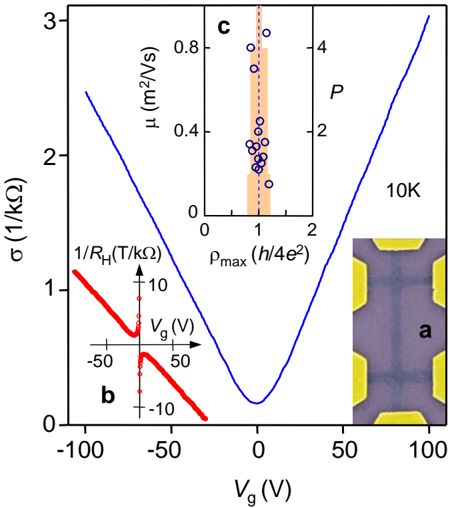
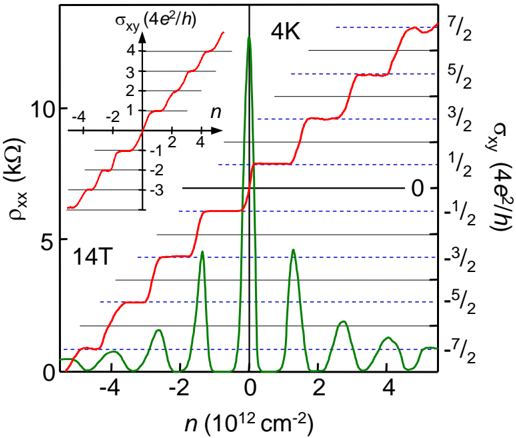
Quantum electrodynamics (resulting from the merger of quantum mechanics and relativity theory) has provided a clear understanding of phenomena ranging from particle physics to cosmology and from astrophysics to quantum chemistry. The ideas underlying quantum electrodynamics also influence the theory of condensed matter, but quantum relativistic effects are usually minute in the known experimental systems that can be described accurately by the non-relativistic Schrödinger equation. Here we report an experimental study of a condensed-matter system (graphene, a single atomic layer of carbon) in which electron transport is essentially governed by Dirac's (relativistic) equation. The charge carriers in graphene mimic relativistic particles with zero rest mass and have an effective ‘speed of light’ c* ≈ 106 m s-1. Our study reveals a variety of unusual phenomena that are characteristic of two-dimensional Dirac fermions. In particular we have observed the following: first, graphene's conductivity never falls below a minimum value corresponding to the quantum unit of conductance, even when concentrations of charge carriers tend to zero; second, the integer quantum Hall effect in graphene is anomalous in that it occurs at half-integer filling factors; and third, the cyclotron mass mc of massless carriers in graphene is described by E = mcc*2. This two-dimensional system is not only interesting in itself but also allows access to the subtle and rich physics of quantum electrodynamics in a bench-top experiment.
Overview
CoChat Summary
TL;DR
Graphene is a two-dimensional gas of massless Dirac fermions with linear dispersion and an effective speed of light \(c^* \approx 10^6\) m/s. Transport measurements reveal an anomalous half-integer quantum Hall effect, a minimum conductivity, cyclotron mass \(m_c = E/c^{*2}\), and a \(\pi\) Berry-phase shift in Shubnikov–de Haas oscillations.
Key findings
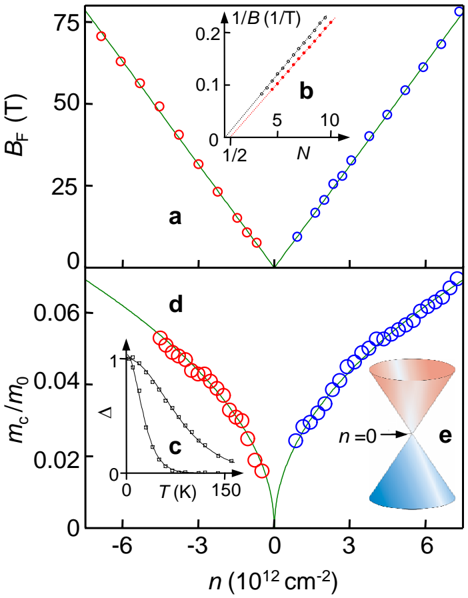
- Graphene’s charge carriers behave as massless Dirac fermions: the data imply \(E = \hbar k c^*\) for both electrons and holes, with \(c^* \approx 1 \times 10^6\) m/s; the cyclotron mass varies between \(\approx 0.02\) and \(0.07\,m_0\) and follows \(m_c \propto n^{1/2}\).
- The integer quantum Hall effect is anomalous: plateaux occur at half-integer \(\nu\), with sequence \((4e^2/h)(N+\tfrac12)\) and the first plateau at \(2e^2/h\); two-layer graphene returns to the normal integer sequence.
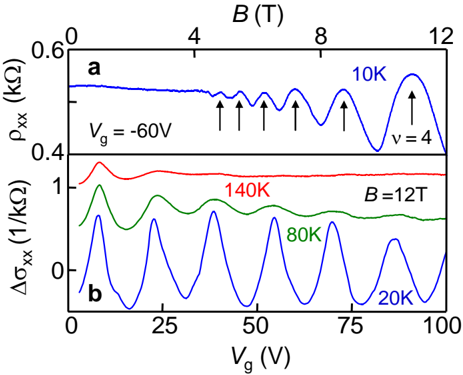
- Shubnikov–de Haas oscillations show a single set for electrons and holes, with \(B_F = \beta n\), \(\beta \approx 1.04 \times 10^{-15}\) T·m\(^2\) (\(\pm 2\%\)), yielding degeneracy \(f=4\); the oscillations exhibit a phase shift of \(\pi\) attributed to Berry’s phase.
- Conductivity never falls below a minimum: \(\rho_{\max} \approx 6.5\) k\(\Omega\) in 15 devices (experimental error \(\approx 15\%\)), associated with \(h/fe^2 = 6.45\) k\(\Omega\), independent of mobility (which varied by a factor of 10) and of temperature between 4 and 100 K.
Methods
- Graphene samples were obtained by micromechanical cleavage of graphite, followed by identification and selection of monolayers using optical, scanning-electron, and atomic-force microscopies; selected films were processed into multi-terminal devices, with some devices made from 2 or 3 layers.
- Transport measurements included the electric field effect, Hall coefficient, Shubnikov–de Haas oscillations, and quantum Hall effect in magnetic fields; mobility was measured between 10 and 100 K, minimum conductivity between 4 and 100 K, and SdHO up to 140 K and room temperature.
- Analysis used fan diagrams to determine \(B_F\), fits of SdHO amplitude to \(T/\sinh(2\pi^2 k_B T m_c / h eB)\), and semiclassical expressions \(B_F = (h/2\pi e)S(E)\) and \(m_c = (h^2/2\pi)\partial S(E)/\partial E\) to infer \(E \propto k\).
Limitations
- The paper has no dedicated limitations section; stated caveats include that mobility was “probably still limited by defects in parent graphite,” that the two-layer finite-mass result is “to be published elsewhere,” and that most theories suggest a minimum conductivity of \(\approx e^2/\pi h\), in disagreement with the experiment.
- Evident from the text: devices are unprotected from the environment (though stable under ambient conditions), some measured devices consisted of 2 or 3 graphene layers, and the transition region was often shifted from zero \(V_g\) due to chemical doping, although annealing normally eliminated the shift.
- The inference of linear dispersion relies on a semiclassical model that the paper says is justified by recent theory, so the experimental conclusion depends on that theoretical framework.
Model-written summary. Check it against the paper before relying on it.
Integrity signals
Registry
Cites
Statistics
Figures
Verification
Claims the paper makes
3 Valid · 5 Not valid · 11 Not checked · 51 Own results and interpretations
The cited sources support only part of this claim — read each source’s verdict below.
In the paper
“d) Shubnikov-de Haas oscillations in graphene exhibit a phase shift of π due to Berry's phase”
- Also stated in: § Two-Dimensional Gas of Massless Dirac Fermions in Graphene · plain
“The shift is due to Berry's phase [9,15].”
What the sources say
- Partly supportedcites [9] Berger, C. et al. Ultrathin epitaxial graphite: 2D electron gas properties and a route toward graphene-based nanoelectronics. J. Phys. Chem. B 108, 19912–19916 (2004) sourceExperimental — accuracy not yet measured
The Figure 2 caption (p. 3) reports Shubnikov–de Haas oscillations in an epitaxial graphene sample. The discussion on pp. 3–4 addresses their occurrence and period, but does not report a π phase shift or attribute one to Berry’s phase. (LLM, conf=0.85)
- Partly supportedcites [15] Gusynin, V. P. & Sharapov, S. G. Unconventional integer quantum Hall effect in grapheme. Preprint at http://xxx.lanl.gov/abs/cond-mat/0506575 (2005). sourceExperimental — accuracy not yet measured
Our copy (Introduction, p. 1) does state that 'the phase of de Haas van Alphen and Shubnikov de Haas oscillations for Dirac quasiparticles is shifted ... compared to the phase of non-relativistic quasiparticles' (citing Refs. 7-10), so the existence of a phase shift in graphene is supported; the magnitude symbol itself is lost in our copy's undecoded formulas. What is NOT supported is the causal attribution to Berry's phase: no passage of our copy mentions Berry's phase at all (searched: 'Berry phase pseudospin topological phase π', 'oscillation phase factor'). Instead the paper explains the unconventional magneto-transport phenomena by the quantum anomaly of the n = 0 Landau level — its halved degeneracy and B-independent energy (p. 1 and p. 3) — and relates the oscillation minima to fillings ν_B = 2n+1 (p. 3). (LLM, conf=0.75)
plainstates a cause- Asserted: passes — The authors put it forward as true.
- Checkable: passes — It can be checked against evidence.
- Load-bearing: passes — The paper’s conclusions depend on it.
- Based: passes — The paper gives a reason why it holds.
- Also stated in: § Two-Dimensional Gas of Massless Dirac Fermions in Graphene · plain
The cited sources that could be checked couldn’t confirm or dispute this claim.
In the paper
“we invoke the formal expression [9-12] for the energy of massless relativistic fermions in quantized fields, EN =[2 e h c ∗ 2 B ( N +½ ± ½)] 1/2”
What the sources say
- Could not verifycites [9] Berger, C. et al. Ultrathin epitaxial graphite: 2D electron gas properties and a route toward graphene-based nanoelectronics. J. Phys. Chem. B 108, 19912–19916 (2004) sourceExperimental — accuracy not yet measured
The discussion of magnetoconductance (p. 3) says Shubnikov–de Haas oscillations indicate quantization of the electron energy spectrum, but it gives no energy formula. Searches for massless relativistic fermions, Landau levels, and the N + 1/2 ± 1/2 term found no passage stating the claimed expression. (LLM, conf=0.76)
- Not checked — no full text of the sourcecites [10] Bunch, J. S., Yaish, Y., Brink, M., Bolotin, K. & McEuen, P. L. Coulomb oscillations and Hall effect in quasi-2D graphite quantum dots. Nano Lett. 5, 287–290 (2005) source
- Not checked — no full text of the sourcecites [11] Dresselhaus, M. S. & Dresselhaus, G. Intercalation compounds of graphite. Adv. In Phys. 51, 1–186 (2002) source
- Not matchedcites [12] Brandt, N. B., Chudinov, S. M. & Ponomarev, Y. G. Semimetals 1: Graphite and Its Compounds (North-Holland, Amsterdam, 1988)
We searched by its title and found no matching paper.
plain- Asserted: passes — The authors put it forward as true.
- Checkable: passes — It can be checked against evidence.
- Load-bearing: passes — The paper’s conclusions depend on it.
- Based: passes — The paper gives a reason why it holds.
- Could not verify
The cited sources that could be checked couldn’t confirm or dispute this claim.
In the paper
“The employed semiclassical model is fully justified by a recent theory for graphene [9], which shows that SdHO's amplitude can indeed be described by the above expression T /sinh(2 π 2 k B Tm c / h eB ) with m c = E / c ∗ 2 .”
What the sources say
- Could not verifycites [9] Berger, C. et al. Ultrathin epitaxial graphite: 2D electron gas properties and a route toward graphene-based nanoelectronics. J. Phys. Chem. B 108, 19912–19916 (2004) sourceExperimental — accuracy not yet measured
The discussion of magnetoconductance (pp. 3–4) reports observed Shubnikov–de Haas oscillations, but does not give a theory for their amplitude. Searches for the temperature-dependent amplitude expression and m_c = E/c*² found no passage addressing either, so our copy cannot verify the attributed claim. (LLM, conf=0.76)
boostedstates a cause- Asserted: passes — The authors put it forward as true.
- Checkable: passes — It can be checked against evidence.
- Load-bearing: passes — The paper’s conclusions depend on it.
- Based: passes — The paper gives a reason why it holds.
- Could not verify
The cited sources that could be checked couldn’t confirm or dispute this claim.
In the paper
“The latter can be viewed as a direct consequence of the Atiyah-Singer index theorem that plays an important role in quantum field theory and the theory of superstrings [13,14].”
What the sources say
- Not checked — no full text of the sourcecites [13] Vonsovsky, S. V. & Katsnelson, M. I. Quantum Solid State Physics (Springer, New York, 1989) source
- Could not verifycites [14] Gusynin, V. P. & Sharapov, S. G. Magnetic oscillations in planar systems with the Dirac-like spectrum of quasiparticle excitations. Phys. Rev. B 71, 125124 (2005) sourceExperimental — accuracy not yet measured
Our copy of Gusynin & Sharapov II gives the relativistic Landau-level spectrum with n = 0, 1, ... in the Introduction (p. 1) and discusses the lowest level E_1 and its crossing of the Fermi surface (Discussion, p. 6; Sect. II.B, p. 6), but it never invokes or discusses the Atiyah-Singer index theorem, topology, or zero-mode counting as the reason for a level pinned at E = 0. Searches on 'Atiyah-Singer index theorem zero-energy Landau level', 'index theorem topological zero modes chiral anomaly', and 'zero-energy Landau level n=0 degeneracy independent of field strength' returned only the spectrum/quantization-condition passages. Since the index-theorem grounding is simply not addressed in our copy (and no alternative work is credited for it there), the attribution can be neither confirmed nor contradicted. (LLM, conf=0.68)
plainstates a cause- Asserted: passes — The authors put it forward as true.
- Checkable: passes — It can be checked against evidence.
- Load-bearing: unclear — It is unclear whether the paper’s conclusions depend on it.
- Based: passes — The paper gives a reason why it holds.
The cited sources that could be checked couldn’t confirm or dispute this claim.
In the paper
“in agreement with band structure calculations [6,7]”
What the sources say
- Could not verifycites [6] Novoselov, K. S. et al. Two dimensional atomic crystals. Proc. Natl Acad. Sci. USA 102, 10451–10453 (2005) sourceExperimental — accuracy not yet measured
The discussion of graphene transport in “Two Dimensional Atomic Crystals” (p. 3) reports carrier concentrations and mobilities, but not a fitted c* or a comparison with band-structure calculations. Searches for the velocity, its approximate value, and band-structure calculations found no passage addressing that comparison. (LLM, conf=0.76)
- Could not verifycites [7] Novoselov, K. S. et al. Electric field effect in atomically thin carbon films. Science 306, 666–669 (2004) sourceExperimental — accuracy not yet measured
The discussion on p. 2 says graphene is expected to have linear energy dispersion and massless carriers, but gives no calculated velocity to compare with c* ≈ 1·10^6 m/s. Searches for the velocity and band-structure comparison found no passage in our copy establishing the claimed agreement. (LLM, conf=0.73)
plainstates an association- Asserted: passes — The authors put it forward as true.
- Checkable: passes — It can be checked against evidence.
- Load-bearing: passes — The paper’s conclusions depend on it.
- Based: passes — The paper gives a reason why it holds.
- Could not verify
34 more claims
Create a free account to see all 70 claims and to verify the 10 references still open.
- It may state two separate claims as one. 27
- Probably not a substantial claim. 8
Claims other papers make about this one
Each is checked against this paper’s own text: does it say what the citing paper says it does?
The source backs part of the claim, not all of it — or backs it for a different population, condition or comparison.
In the citing paper
“Recently, the non-relativistic electrons in graphene monolayer were found to obey the massless relativistic dispersion known as the Dirac cone, leading to the realization of analogies to Zitterbewegung and Klein tunneling in low-energy condensed-matter physics and atom optics 4 -19 .”
From Observation of interaction-induced phenomena of relativistic quantum mechanics (2021) · cites this paper as [4]
Experimental — accuracy not yet measuredThe source backs part of the claim, not all of it — or backs it for a different population, condition or comparison.
In the citing paper
“Dirac points in graphene1–3 or photonic graphene12 belong to the first type, which occur in lattices with unbroken T. These occur in pairs and are stabilized by a symmetry of the underlying lattice.”
From Observation of an unpaired photonic Dirac point (2020) · cites this paper as [1]
Experimental — accuracy not yet measuredThe cited source says what the claim attributes to it.
In the citing paper
“The energy spectrum of ˆ H 1 is E n = sgn( n ) ℏ Ω √ | n | , where n = 0 , ± 1 , . . . , see Fig. 1.”
From Theory of electron Zitterbewegung in graphene probed by femtosecond laser pulses (2009) · cites this paper as [36]
The cited source says what the claim attributes to it.
In the citing paper
“Around Dirac cones, conduction and valence bands intersect linearly at a degenerate point resulting in the linear energy band and massless relativistic transport of electrons as quasiparticles [4].”
From Observing movement of Dirac cones from single-photon dynamics (2021) · cites this paper as [4]
The check wasn’t confident either way, so it gives no verdict — never disputed.
In the citing paper
“photonic Dirac points are known to occur in pairs in “photonic graphene” and other similar photonic crystals”
From Observation of an unpaired photonic Dirac point (2020) · cites this paper as [1]
Experimental — accuracy not yet measured
3 more claims about this paper
Create a free account to see every claim other papers make about this one.
Citations
Cites
Electric Field Effect in Atomically Thin Carbon Films
Novoselov, K. S., Geim, A. K., Morozov, S. V., Jiang, D., Zhang, Y., Dubonos, S. V., Grigorieva, I. V., & Firsov, A. A. (2004) · Science · doi:10.1126/science.1102896 · Cited by 66,834
Self-citationTwo-dimensional atomic crystals
Novoselov, K. S., Jiang, D., Schedin, F., Booth, T. J., Khotkevich, V. V., Morozov, S. V., & Geim, A. K. (2005) · Proceedings of the National Academy of Sciences · doi:10.1073/pnas.0502848102 · Cited by 11,788
Self-citationScaling Theory of Localization: Absence of Quantum Diffusion in Two Dimensions
Abrahams, E., Anderson, P. W., Licciardello, D. C., & Ramakrishnan, T. V. (1979) · Physical Review Letters · doi:10.1103/physrevlett.42.673 · Cited by 6,134
Berger, C., Song, Z., Li, T., Li, X., Ogbazghi, A. Y., Feng, R., Dai, Z., Marchenkov, A. N., Conrad, E. H., First, P. N., et al. (2004) · The Journal of Physical Chemistry B · doi:10.1021/jp040650f · Cited by 3,548
The Universe in a Helium Droplet
Volovik, G. E. (2009) · doi:10.1093/acprof:oso/9780199564842.001.0001 · Cited by 2,632
Intercalation compounds of graphite
Dresselhaus, M. S., & Dresselhaus, G. (2002) · Advances in Physics · doi:10.1080/00018730110113644 · Cited by 2,139
Geometry, Topology and Physics
Nakahara, M. (1990) · doi:10.1887/0750306068 · Cited by 1,620
Geometry, Topology and Physics
Nakahara, M. (2018) · CRC Press eBooks · doi:10.1201/9781315275826 · Cited by 1,505
Unconventional Integer Quantum Hall Effect in Graphene
Gusynin, V. P., & Sharapov, S. G. (2005) · Physical Review Letters · doi:10.1103/physrevlett.95.146801 · Cited by 1,374
Field Theories of Condensed Matter Systems
Fradkin, E. (2007) · Medical Entomology and Zoology · Cited by 1,118
Research works printed but not linked: 1
- Mott, N.F. & Davis, E.A. Electron Processes in Non-Crystalline Materials (Clarendon Press, Oxford, 1979).
Cited by
Items 20,401–20,500 of 21,614
Chen, Y., Yeh, C., He, J., et al. (2014)
Chantngarm, P., & Yamada, K. (2018) · ECTI Transactions on Computer and Information Technology (ECTI-CIT) · doi:10.37936/ecti-cit.2018121.95891
de Haas-van Alphen effect of correlated Dirac states in kagome metal Fe3Sn2
Ye, L., Chan, M. K., McDonald, R., Graf, D. E., Kang, M., Liu, J., Suzuki, T., Comin, R., Fu, L., & Checkelsky, J. G. (2019) · Nature Communications · doi:10.1038/s41467-019-12822-1 · Cited by 18
Ultra-precision Figured 4H-SiC(0001) Surfaces
Hattori, A. N., Okamoto, T., Sadakuni, S., et al. (2010) · Hyomen Kagaku · doi:10.1380/jsssj.31.466
Emergence of resonating valence-bond correlations in stretched graphene
Azadi, S., Principi, A., Kühne, T. D., & Bahramy, M. S. (2026) · Physical review. B./Physical review. B · doi:10.1103/96cl-xq62
P-type Doping of Pulsed Laser Deposited WS2 with Nb
Egede, E. J. (2017) · doi:10.12794/metadc1062806
Lü, X.-L., Yang, J.-E., & Xie, H. (2025) · iScience · doi:10.1016/j.isci.2025.113354 · Cited by 2
Foundations of Multiphysics at the Nanoscale
Munoz, S. G. (2026) · Springer theses · doi:10.1007/978-3-032-14271-9_2
Chen, Z., Hu, X., Hu, Y., Pang, J., Ye, Y., & Zhang, S. (2026) · Computational Materials Science · doi:10.1016/j.commatsci.2026.115118
Progress of Quantum Hall Research for Disseminating the Redefined SI
Rigosi, A. F., Kruskopf, M., Panna, A. R., et al. (2022) · Springer eBooks · doi:10.1007/978-981-19-1550-5_17-1
Ultrafast nonlinear absorption of Haldane model quantum dots
Magar, K. R., & Apalkov, V. (2025) · Journal of Physics Condensed Matter · doi:10.1088/1361-648x/adf0d1
“Such behavior is consistent with the behavior of the bandgap (figure 3) and the dipole matrix element D ( x ) 27 , 28 (figure 6), which illustrates the fact that the electron dynamics is mainly determined by transitions between the levels 27 and 28.”
Graphene FET for Microwave and Terahertz Applications
Joshi, N. (2023) · BENTHAM SCIENCE PUBLISHERS eBooks · doi:10.2174/9789815165647123010008
Little, R. B. (2008) · The Open Inorganic Chemistry Journal · doi:10.2174/1874098700802010090 · Cited by 1
Otsuji, T. (2015) · Springer eBooks · doi:10.1007/978-4-431-55372-4_8
No substrate required: electron-beam-enabled, single-atom-thick 2D metals and metal oxides
Bachmatiuk, A., Yang, X., Zdończyk, M., et al. (2026) · RSC Applied Interfaces · doi:10.1039/d6lf00009f
2d Suspended Fet Technology: Overcoming Scattering Effect For Ultrasensitive Reliable Biosensor
Masurkar, N. (2019) · Human Biology
Belonenko, M. B., Lebedev, N. G., & YANYUSHKINA, N. N. (2010) · Russian Journal of Physical Chemistry B · doi:10.1134/s1990793110050039
Light–Matter Interaction in Metal–Semiconductor Structures
Toropov, A. A., & Shubina, T. V. (2015) · Oxford University Press eBooks · doi:10.1093/acprof:oso/9780199699315.003.0007
Renormalization group approach to the elastic properties of graphene bilayers
Delzescaux, L., & Mouhanna, D. (2026) · Physical review. B./Physical review. B · doi:10.1103/3rlc-zj8p
Engineering Low Dimensional Materials with van der Waals Interaction
Jin, C. (2017) · eScholarship (California Digital Library)
Direct Observation of the Zigzag Edge States of a Supramolecular Diatomic Kagome Lattice
Nemoto, R., Meng, X., Mortezapour, B., Weismann, A., Nakano, S., Tsuchiizu, M., Arafune, R., Takagi, N., 章, 中., Wakabayashi, K., et al. (2026) · Nano Letters · doi:10.1021/acs.nanolett.6c03195
Transverse plasmon mode in a screened two-dimensional electron system
Васильевич, Ф. Д., Melnikova, V. S., & Popov, V. V. (2015) · Semiconductors · doi:10.1134/s1063782615020074
Low-Energy Physical Properties of Edge States in Nanographite Systems
Wakabayashi, K. (2007) · Springer series in solid-state sciences · doi:10.1007/978-3-540-72632-6_5
Coherent State Wave Functions on the TorusPreprint
Fremling, M. (2014) · arXiv (Cornell University) · doi:10.48550/arxiv.1401.6834 · Cited by 4
Magnetic and Optical Properties of Graphene Materials with Porous Defects
Hatanaka, M. (2019) · Handbook of Graphene · doi:10.1002/9781119468455.ch41
The VdW Heterostructure Interface Physics
Zhang, G., Ou, Y., Li, P., & Liao, Q. (2022) · Wiley eBooks · doi:10.1002/9783527833887.ch5
Strain effects on the electronic properties of cobalt-based coordination nanosheets
Nishigomi, K., Yi, Y., Adhikary, S., Tsukagoshi, K., & Wakabayashi, K. (2025) · Nanoscale Advances · doi:10.1039/d5na00385g
The Elemental Layered Solids: Group IV and V Materials
Majid, A., & Jabeen, A. (2023) · Engineering materials · doi:10.1007/978-981-99-6299-0_4 · Cited by 1
Liu, M. (2017) · Springer theses · doi:10.1007/978-981-10-5181-4_1
On the possibility of current amplification by random inhomogeneities in graphene
Belonenko, M. B., Lebedev, N. G., & YANYUSHKINA, N. N. (2013) · Russian Physics Journal · doi:10.1007/s11182-013-9930-x
Gao, B., & Zhang, L. (2023) · Solid State Communications · doi:10.1016/j.ssc.2023.115314
Quantum Oscillations of the Energy Loss Rate of Hot Electrons in Graphene at Strong Magnetic Fields
Tsaousidou, M., & Kubakaddi, S. S. (2023) · Materials · doi:10.3390/ma16062274
“The discovery of graphene [1,2], a two-dimensional plane of carbon atoms in a hexagonal lattice, has sparked a tremendous interest in understanding its unusual fundamental physical properties [3,4].”
BackgroundRewari, S. (2026) · Applied Physics A · doi:10.1007/s00339-026-10153-9
“Graphene exhibits outstanding electrical proper - ties, including high carrier mobility, excellent electrical conductivity, and efficient charge transport, owing to its two-dimensional lattice structure and linear energy dispersion near the Dirac point [49, 50 ].”
Analog quantum simulation of Dirac Hamiltonians in circuit QED using Rabi-driven qubits
Gumpel, G., Kang, J., Blumenthal, E., Klevansky, A., Kim, E., & Hacohen-Gourgy, S. (2025) · Physical Review A · doi:10.1103/wn7t-pyrq · Cited by 1
Performance-enhanced biosensors constructed using one-dimensional nanostructured materials
Zang, J. (2009) · DR-NTU (Nanyang Technological University) · doi:10.32657/10356/18693
Zhukovsky, V. C. (2021) · Symmetry · doi:10.3390/sym13020210
Quantum Spin Transport Characteristics in Graphene Field Effect Transistor
Abdelrazek, A. S., El-Banna, M. M., & Phillips, A. H. (2015)
Harmonic and intermodulation performance of MoS2FET- and GFET-based amplifiers
Abuelma’atti, M. T. (2013) · Analog Integrated Circuits and Signal Processing · doi:10.1007/s10470-013-0068-0
Scattering mechanisms and transport properties
Katsnelson, M. I. (2012) · Cambridge University Press eBooks · doi:10.1017/cbo9781139031080.012
Self-citationTwo-dimensional material-based nanosensors for detection of low-molecular-weight molecules
Zhu, Y. (2018) · Columbia Academic Commons (Columbia University) · doi:10.7916/d8bk2qvn
Synthesis of 2D Janus Crystals and their Superlattices
Sayyad, M. Y. (2020) · Arizona State University Library Digital Repository (Arizona State University)
Zhang, J., Wang, J., & Cai, Q. (2026) · Applied Physics Letters · doi:10.1063/5.0335175
Schaefer, H. ‐. (2010) · Springer eBooks · doi:10.1007/978-3-642-10559-3_3
Karaman, O. (2021) · European Journal of Science and Technology · doi:10.31590/ejosat.932871
Krstić, V., Glerup, M., Hansel, S., et al. (2009) · physica status solidi (RRL) - Rapid Research Letters · doi:10.1002/pssr.200903102
Ghazaryan, A. G., & Sedrakian, K. V. (2019) · arXiv (Cornell University) · doi:10.48550/arxiv.1907.10673
Kim, B. J., Jeong, B. J., Oh, S., et al. (2022) · SSRN Electronic Journal · doi:10.2139/ssrn.4136070
A Recent Progress in Nanocarbon Research and Development
Shinohara, H. (2017) · Seikei-Kakou · doi:10.4325/seikeikakou.30.2
Starke, U. (2010) · MRS Proceedings · doi:10.1557/proc-1246-b10-01
Graphene Thermal Functional Device and Its Property Characterization
Wang, H., Takamatsu, H., & Zhang, X. (2019) · Handbook of Graphene · doi:10.1002/9781119468455.ch82
Quantum interference-driven transport in graphene junctions with tilted Dirac cones
Raggui, M., Habti, O., Chentouf, I., Kamal, A., & Choubabi, E. B. (2026) · Physica Scripta · doi:10.1088/1402-4896/ae784d · Cited by 1
“Graphene, a single atomic layer of carbon atoms arranged in a hexagonal lattice, has attracted considerable attention owing to its exceptional physical properties and its wide range of potential applications in electronics, sensing, and nanoelectronics [1].”
Stacking Dependent Optical Conductivity of Bilayer GraphenePreprint
Wang, Y., Ni, Z., Liu, L., et al. (2010) · arXiv (Cornell University) · doi:10.48550/arxiv.1005.4734
Chang, C.-S., Cheng, H.-C., Han, C.-F., et al. (2019) · Vacuum · doi:10.1016/j.vacuum.2019.109037
Application of Nanomaterials in Detection of Food Contaminants
Dhiman, S., Singh, P., Kumar, A., & Mukherjee, G. (2023) · Wiley eBooks · doi:10.1002/9781394229116.ch13
Tobaldi, D. M., Lajaunie, L., Dvoranová, D., et al. (2020) · ChemRxiv · doi:10.26434/chemrxiv.11890194
Chakraborty, D., & Chattaraj, P. K. (2015) · Molecular Physics · doi:10.1080/00268976.2015.1059511
Singh, S. A., Kalam, M. A., Sayyed, M. B., Selvin, R., Hsu, H.-L., Shaikh, S. F., & More, P. S. (2024) · Journal of Materials Science Materials in Electronics · doi:10.1007/s10854-024-13139-6 · Cited by 2
Zhou, Q., Ju, W., Liu, Y., et al. (2020) · Journal of Magnetism and Magnetic Materials · doi:10.1016/j.jmmm.2020.167325
Huang, W., Zhong, J., & Sheng, W. (2024) · Journal of Applied Physics · doi:10.1063/5.0226011
Kılıç, M. E., & Lee, K. R. (2022) · SSRN Electronic Journal · doi:10.2139/ssrn.3999030
Ramey, B., Mashak, D., & Alexander, S. A. (2026) · Genetic and Evolutionary Computation Conference Companion (GECCO Companion) · doi:10.1145/3795101.3805403
“Two-dimensional (2D) materials provide a versatile platform for novel electronic, mechanical, and quantum phenomena, with applications ranging from nanoelectronics to energy technologies [4, 8, 16].”
Ion Acceleration by the Coulomb Explosion of Graphene
Chen, M., Lin, Z., Wang, Y., et al. (2010) · Japanese Journal of Applied Physics · doi:10.1143/jjap.49.045103
Single‐wall carbon nanotubes: spintronics in the Luttinger liquid phase
Dóra, B., Gulácsi, M., Rusznyák, Á., et al. (2009) · physica status solidi (b) · doi:10.1002/pssb.200982301
Fullerenes, the Building Blocks
(2010) · Royal Society of Chemistry eBooks · doi:10.1039/9781849731133-00109
and modeling of graphene field-effect d
Shepard, L. A., Meric, I., & Kim, P. (2008)
Current status of the dc resistance standard and a perspective on graphene as a new standard
Fukuyama, Y., & Kaneko, N. (2010) · Carbon · doi:10.1016/j.carbon.2010.06.072
Kengo, F., Solihin, S., Ukhtary, M. S., et al. (2024) · Physica Scripta · doi:10.1088/1402-4896/ad23b1
Catalyst Materials for Oxygen Reduction Reaction
Li, Y., He, C., & Shen, P. K. (2021) · Springer eBooks · doi:10.1007/978-981-33-6077-8_4 · Cited by 1
Liu, H. L., Zhang, A., Qiu, S., Liu, H. L., Chang, Y., & Gao, J. (2026) · The Journal of Physical Chemistry Letters · doi:10.1021/acs.jpclett.6c00962
Growth of Ordered Graphene Ribbons by Sublimation Epitaxy
Cai, S., Liu, X., Zheng, X. L., et al. (2018) · Crystals · doi:10.3390/cryst8120449
Modulation of crystal and electronic structures in topological insulators by rare-earth dopingPreprint
Yue, Z., Zhao, W., Cortie, D. L., et al. (2019) · arXiv (Cornell University) · doi:10.48550/arxiv.1907.03930
Santana, J. E., Hernández-Hernández, I. J., Antonio, J. E., et al. (2026) · Physica B Condensed Matter · doi:10.1016/j.physb.2026.419383
Substrate-Induced Interfacial Coupling between Graphene and Copper
Zhao, C., Liu, Q., Zhang, Z., et al. (2026) · Precision Chemistry · doi:10.1021/prechem.6c00002
Quantum transport in graphene Hall bars: Effects of side gates
Petrović, M. D., & Peeters, F. M. (2017) · Solid State Communications · doi:10.1016/j.ssc.2017.03.012
Sharma, N., Verma, A., Kishor, K., et al. (2026) · Physica E Low-dimensional Systems and Nanostructures · doi:10.1016/j.physe.2026.116624
Nanotechnology: Novel Emerging Concepts
Pavlović, M. D. (2014) · Springer eBooks · doi:10.1007/978-3-319-10798-1_19
Ground state energy of current carriers in graphene
Ratnikov, P. V., & Silin, A. P. (2008) · Bulletin of the Lebedev Physics Institute · doi:10.1007/s11953-008-1007-1
Gul, F., & Rahim, K. (2023) · Physics Letters A · doi:10.1016/j.physleta.2022.128619
Adorno, D. P. (2020) · Springer eBooks · doi:10.1007/978-3-030-52923-9_16
Wang, X., Wang, J., Ma, T., et al. (2020) · Micro and Nanosystems · doi:10.2174/1876402912666200313110650
Topographical Study of Symmetry in Single-Crystal Graphene Grown via Chemical Vapor Deposition
Nanayakkara, T., Razia, E., Wijewardena, U. K., et al. (2026) · Journal of Electronic Materials · doi:10.1007/s11664-026-12809-x
1. Physical parameters of the energy barrier of graphene/p-CdTe Schottky diodes
(2023) · Functional materials · doi:10.15407/fm30.01.12
Graphene: A Hobby Horse for Studying Topology
Basu, S. (2023) · Springer eBooks · doi:10.1007/978-981-99-5321-9_4
Chang, X., Li, H., & Liang, S. (2026) · Computational Condensed Matter · doi:10.1016/j.cocom.2026.e01437
Perspectives in nanoscience and nanotechnology
Moreno-Mosquera, A., & Alvarez-Polo, Y. (2021) · Visión electrónica · doi:10.14483/22484728.18578
Giant magnetism in punched zigzag-edged triangular-shaped graphene nanodisks
Agrawal, B. K., & Agrawal, S. (2015) · Journal of Nanoparticle Research · doi:10.1007/s11051-014-2857-5
Développement de dispositifs à base de graphène pour des applications hautes fréquences
Mele, D. (2014) · theses.fr (ABES) · doi:10.70675/d86c39bdz4d41z4d9ez9ceazc756690f09b4 · Cited by 2
Arise, I., & Abe, T. (2026) · Journal of Materials Chemistry C · doi:10.1039/d5tc04154f
Torres, L. E. F. F., Roche, S., & Charlier, J. (2020) · Cambridge University Press eBooks · doi:10.1017/9781108664462.001
Characteristic nonlinear electromagnetic response of a Dirac RingPreprint
Lee, C. H., Zhang, X., & Guan, B. (2015) · arXiv (Cornell University)
Electrical Conductivity Comparison Between Two Preparing Methods for Graphene/Copper Composite
Xu, R., Zhou, M., Zhou, Y., Wang, H., Luo, Y., Fechner, T., Ding, Y., Han, Y., Zhu, Z., & Bai, J. (2023) · IEEE International Conference on Electrical Materials and Power Equipment (ICEMPE) · doi:10.1109/icempe57831.2023.10139608
“Graphene is also a two-dimensional material that exhibits massless Dirac fermions and a high charge carrier mobility, making it a promising material for electronic devices such as transistors [4], [5].”
BackgroundStrain enhanced inplane ferroelectricity in few layer SnS
Du, Y. (2020) · Journal of Physics Conference Series · doi:10.1088/1742-6596/1593/1/012045
“Also, they are famous for their novel properties like superconductivity, spin waves, spin hall effect due to the dimension reduce caused by quantum confinement in the thickness dimension [1-10].”
BackgroundZhang, Z. J., Zhou, Y. N., Liu, H., et al. (2015) · Materials science forum · doi:10.4028/www.scientific.net/msf.815.583
In-situ TEM characterization of nanomaterials and devices
Kim, M. J., Park, S., Cha, D. K., et al. (2011) · IEEE Nanotechnology Materials and Devices Conference (NMDC) · doi:10.1109/nmdc.2011.6155318
Josephson current in a double ferromagnetic layer SG/F1/F2/SG graphene sandwich
Soodchomshom, B., Tang, I., & Hoonsawat, R. (2009) · Physica C Superconductivity · doi:10.1016/j.physc.2009.11.048
Zhang, S., Wang, T., Dai, X., et al. (2020) · Europhysics Letters (EPL) · doi:10.1209/0295-5075/129/47003
Chong, C., & Kevrekidis, P. G. (2018) · SpringerBriefs in physics · doi:10.1007/978-3-319-77884-6_7
Circularly Polarized Light on Graphene with Trigonal Warping
Akay, D. (2020) · Bitlis Eren Üniversitesi Fen Bilimleri Dergisi · doi:10.17798/bitlisfen.592947
Metadata
- Authors
- Novoselov, K. S., Geim, A. K., Morozov, S. V., Jiang, D., Katsnelson, M. I., Grigorieva, I. V., Dubonos, S. V., & Firsov, A. A.
- Affiliations
- University of Manchester (GB)
- Institute of Microelectronics Technology and High Purity Materials (RU)
- Radboud University Nijmegen (NL)
- Corresponding author
- Novoselov, K. S.
- Geim, A. K.
- Venue
- Nature
- Published
- 2005-11
- Volume
- 438
- Issue
- 7065
- Pages
- 197-200
- ISSN
- 0028-0836 (ISSN-L)
- 1476-4687
- OpenAlex
- W2125284466
- Semantic Scholar
- 228e604ea7c1333a99663b6b547cf47b98e721e7
- Cited by
- 21,611
- References
- 32
- Citations by year
- 2026: 442 · 2025: 677 · 2024: 798 · 2023: 924 · 2022: 992 · 2021: 1082 · 2020: 1230 · 2019: 1268 · 2018: 1350 · 2017: 1395 · 2016: 1501 · 2015: 1473 · 2014: 1387 · 2013: 1382 · 2012: 1375
- FWCI
- 217.72
- Type
- journal article
- Language
- en
- Open access
- green
- arxiv.org
- Licence
- www.springer.com/tdm (tdm)
- Locations
- Nature (publishedVersion)
- PubMed (publishedVersion)
- arXiv (Cornell University) (submittedVersion)
- RePEc: Research Papers in Economics (submittedVersion)
- Research Explorer (The University of Manchester) (submittedVersion)
- Radboud Repository (Radboud University) (submittedVersion)
- arXiv (Cornell University)
- Topics
- Physical Sciences › Materials Science › Materials Chemistry › Graphene research and applications
- Physical Sciences › Physics and Astronomy › Condensed Matter Physics › Topological Materials and Phenomena
- Physical Sciences › Physics and Astronomy › Atomic and Molecular Physics, and Optics › Quantum Electrodynamics and Casimir Effect
- Keywords
- graphene, massless Dirac fermions, two-dimensional Dirac fermions, quantum Hall effect, cyclotron mass, electron transport, relativistic electrons
About these checks
Registry, retraction, Cites and statistics results are computed, not judged, with one exception: a printed reference that no index lists is read once by a model before it counts as a citation error. Claims are extracted by a model and kept only when their quote appears verbatim in the text; each cited source is then checked, with a model’s help, for whether it says what the claim relies on. Those verdicts can be wrong — read the claim’s quote and the cited source before relying on one.
The claim verdicts this report counts are experimental: their accuracy is not yet measured.
A language model drew the claims from the paper on 2026-10-10, under version 3 of the claim definition (model deepseek-v4.1-flash, prompt extract-v3).
A second model labelled each claim on 2026-10-10 (model jev-1.13-20260917, definition revision gold-guideline-v0.2).
Cited sources are checked with a language model’s help (gpt-6-sol and qwen3.8-omni-flash).
Statistics and arithmetic are recomputed, not judged.
Confidence bands are shown only for fields calibrated on our annotated test set. None is calibrated yet, so no band is shown.
What counts as a claim ›How we measure confidence ›How we check this ›
Are you an author, or do you see a problem with this page? Request a review
Data sources
Bibliographic data: Semantic Scholar, OpenAlex, Crossref.
Contains information from the Semantic Scholar Academic Graph Datasets, made available under the ODC Attribution License (ODC-BY 1.0).
Semantic Scholar’s data is described in: Kinney, R., et al. (2023). The Semantic Scholar Open Data Platform. arXiv:2301.10140.
