

Two-dimensional gas of massless Dirac fermions in graphene
Open accessThe DOI matches its Crossref record; 32 of the 32 references it cites were found in a registry or an index; 12 of the 52 sources its claims cite were checked for support.
Abstract
Quantum electrodynamics (resulting from the merger of quantum mechanics and relativity theory) has provided a clear understanding of phenomena ranging from particle physics to cosmology and from astrophysics to quantum chemistry. The ideas underlying quantum electrodynamics also influence the theory of condensed matter, but quantum relativistic effects are usually minute in the known experimental systems that can be described accurately by the non-relativistic Schrödinger equation. Here we report an experimental study of a condensed-matter system (graphene, a single atomic layer of carbon) in which electron transport is essentially governed by Dirac's (relativistic) equation. The charge carriers in graphene mimic relativistic particles with zero rest mass and have an effective ‘speed of light’ c* ≈ 106 m s-1. Our study reveals a variety of unusual phenomena that are characteristic of two-dimensional Dirac fermions. In particular we have observed the following: first, graphene's conductivity never falls below a minimum value corresponding to the quantum unit of conductance, even when concentrations of charge carriers tend to zero; second, the integer quantum Hall effect in graphene is anomalous in that it occurs at half-integer filling factors; and third, the cyclotron mass mc of massless carriers in graphene is described by E = mcc*2. This two-dimensional system is not only interesting in itself but also allows access to the subtle and rich physics of quantum electrodynamics in a bench-top experiment.
Overview
CoChat Summary
TL;DR
Graphene is a two-dimensional gas of massless Dirac fermions with linear dispersion and an effective speed of light \(c^* \approx 10^6\) m/s. Transport measurements reveal an anomalous half-integer quantum Hall effect, a minimum conductivity, cyclotron mass \(m_c = E/c^{*2}\), and a \(\pi\) Berry-phase shift in Shubnikov–de Haas oscillations.
Key findings
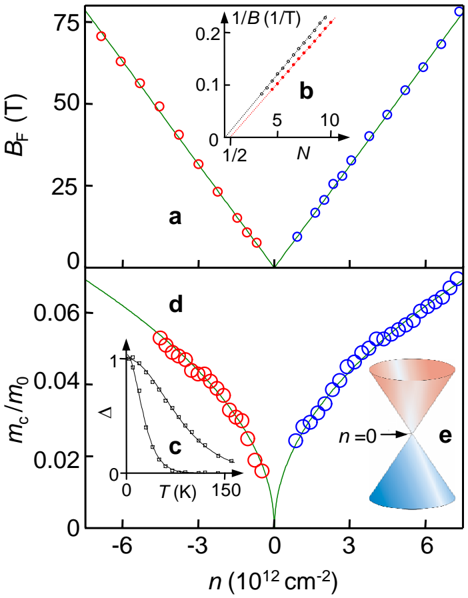
- Graphene’s charge carriers behave as massless Dirac fermions: the data imply \(E = \hbar k c^*\) for both electrons and holes, with \(c^* \approx 1 \times 10^6\) m/s; the cyclotron mass varies between \(\approx 0.02\) and \(0.07\,m_0\) and follows \(m_c \propto n^{1/2}\).
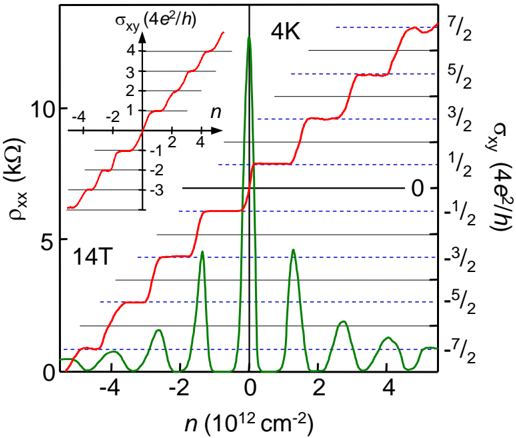
- The integer quantum Hall effect is anomalous: plateaux occur at half-integer \(\nu\), with sequence \((4e^2/h)(N+\tfrac12)\) and the first plateau at \(2e^2/h\); two-layer graphene returns to the normal integer sequence.
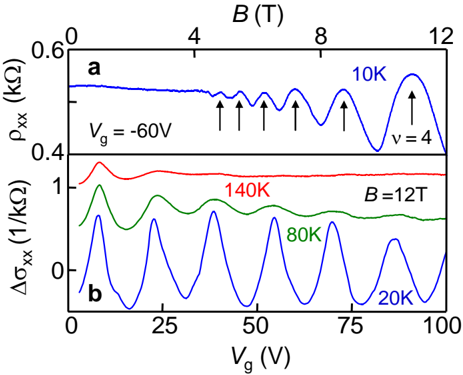
- Shubnikov–de Haas oscillations show a single set for electrons and holes, with \(B_F = \beta n\), \(\beta \approx 1.04 \times 10^{-15}\) T·m\(^2\) (\(\pm 2\%\)), yielding degeneracy \(f=4\); the oscillations exhibit a phase shift of \(\pi\) attributed to Berry’s phase.
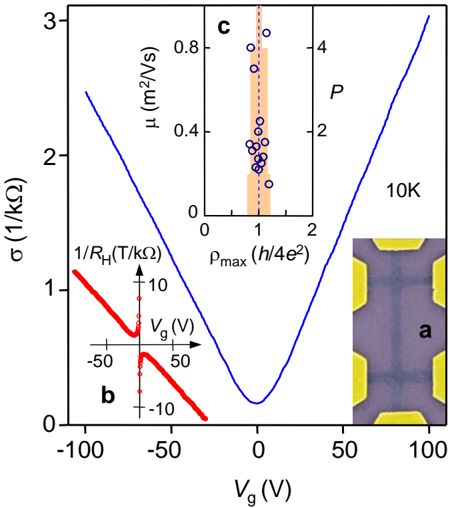
- Conductivity never falls below a minimum: \(\rho_{\max} \approx 6.5\) k\(\Omega\) in 15 devices (experimental error \(\approx 15\%\)), associated with \(h/fe^2 = 6.45\) k\(\Omega\), independent of mobility (which varied by a factor of 10) and of temperature between 4 and 100 K.
Methods
- Graphene samples were obtained by micromechanical cleavage of graphite, followed by identification and selection of monolayers using optical, scanning-electron, and atomic-force microscopies; selected films were processed into multi-terminal devices, with some devices made from 2 or 3 layers.
- Transport measurements included the electric field effect, Hall coefficient, Shubnikov–de Haas oscillations, and quantum Hall effect in magnetic fields; mobility was measured between 10 and 100 K, minimum conductivity between 4 and 100 K, and SdHO up to 140 K and room temperature.
- Analysis used fan diagrams to determine \(B_F\), fits of SdHO amplitude to \(T/\sinh(2\pi^2 k_B T m_c / h eB)\), and semiclassical expressions \(B_F = (h/2\pi e)S(E)\) and \(m_c = (h^2/2\pi)\partial S(E)/\partial E\) to infer \(E \propto k\).
Limitations
- The paper has no dedicated limitations section; stated caveats include that mobility was “probably still limited by defects in parent graphite,” that the two-layer finite-mass result is “to be published elsewhere,” and that most theories suggest a minimum conductivity of \(\approx e^2/\pi h\), in disagreement with the experiment.
- Evident from the text: devices are unprotected from the environment (though stable under ambient conditions), some measured devices consisted of 2 or 3 graphene layers, and the transition region was often shifted from zero \(V_g\) due to chemical doping, although annealing normally eliminated the shift.
- The inference of linear dispersion relies on a semiclassical model that the paper says is justified by recent theory, so the experimental conclusion depends on that theoretical framework.
Model-written summary. Check it against the paper before relying on it.
Integrity signals
Registry
Cites
Statistics
Figures
Verification
Claims the paper makes
3 Valid · 5 Not valid · 11 Not checked · 51 Own results and interpretations
The cited sources support only part of this claim — read each source’s verdict below.
In the paper
“d) Shubnikov-de Haas oscillations in graphene exhibit a phase shift of π due to Berry's phase”
- Also stated in: § Two-Dimensional Gas of Massless Dirac Fermions in Graphene · plain
“The shift is due to Berry's phase [9,15].”
What the sources say
- Partly supportedcites [9] Berger, C. et al. Ultrathin epitaxial graphite: 2D electron gas properties and a route toward graphene-based nanoelectronics. J. Phys. Chem. B 108, 19912–19916 (2004) sourceExperimental — accuracy not yet measured
The Figure 2 caption (p. 3) reports Shubnikov–de Haas oscillations in an epitaxial graphene sample. The discussion on pp. 3–4 addresses their occurrence and period, but does not report a π phase shift or attribute one to Berry’s phase. (LLM, conf=0.85)
- Partly supportedcites [15] Gusynin, V. P. & Sharapov, S. G. Unconventional integer quantum Hall effect in grapheme. Preprint at http://xxx.lanl.gov/abs/cond-mat/0506575 (2005). sourceExperimental — accuracy not yet measured
Our copy (Introduction, p. 1) does state that 'the phase of de Haas van Alphen and Shubnikov de Haas oscillations for Dirac quasiparticles is shifted ... compared to the phase of non-relativistic quasiparticles' (citing Refs. 7-10), so the existence of a phase shift in graphene is supported; the magnitude symbol itself is lost in our copy's undecoded formulas. What is NOT supported is the causal attribution to Berry's phase: no passage of our copy mentions Berry's phase at all (searched: 'Berry phase pseudospin topological phase π', 'oscillation phase factor'). Instead the paper explains the unconventional magneto-transport phenomena by the quantum anomaly of the n = 0 Landau level — its halved degeneracy and B-independent energy (p. 1 and p. 3) — and relates the oscillation minima to fillings ν_B = 2n+1 (p. 3). (LLM, conf=0.75)
plainstates a cause- Asserted: passes — The authors put it forward as true.
- Checkable: passes — It can be checked against evidence.
- Load-bearing: passes — The paper’s conclusions depend on it.
- Based: passes — The paper gives a reason why it holds.
- Also stated in: § Two-Dimensional Gas of Massless Dirac Fermions in Graphene · plain
The cited sources that could be checked couldn’t confirm or dispute this claim.
In the paper
“we invoke the formal expression [9-12] for the energy of massless relativistic fermions in quantized fields, EN =[2 e h c ∗ 2 B ( N +½ ± ½)] 1/2”
What the sources say
- Could not verifycites [9] Berger, C. et al. Ultrathin epitaxial graphite: 2D electron gas properties and a route toward graphene-based nanoelectronics. J. Phys. Chem. B 108, 19912–19916 (2004) sourceExperimental — accuracy not yet measured
The discussion of magnetoconductance (p. 3) says Shubnikov–de Haas oscillations indicate quantization of the electron energy spectrum, but it gives no energy formula. Searches for massless relativistic fermions, Landau levels, and the N + 1/2 ± 1/2 term found no passage stating the claimed expression. (LLM, conf=0.76)
- Not checked — no full text of the sourcecites [10] Bunch, J. S., Yaish, Y., Brink, M., Bolotin, K. & McEuen, P. L. Coulomb oscillations and Hall effect in quasi-2D graphite quantum dots. Nano Lett. 5, 287–290 (2005) source
- Not checked — no full text of the sourcecites [11] Dresselhaus, M. S. & Dresselhaus, G. Intercalation compounds of graphite. Adv. In Phys. 51, 1–186 (2002) source
- Not matchedcites [12] Brandt, N. B., Chudinov, S. M. & Ponomarev, Y. G. Semimetals 1: Graphite and Its Compounds (North-Holland, Amsterdam, 1988)
We searched by its title and found no matching paper.
plain- Asserted: passes — The authors put it forward as true.
- Checkable: passes — It can be checked against evidence.
- Load-bearing: passes — The paper’s conclusions depend on it.
- Based: passes — The paper gives a reason why it holds.
- Could not verify
The cited sources that could be checked couldn’t confirm or dispute this claim.
In the paper
“The employed semiclassical model is fully justified by a recent theory for graphene [9], which shows that SdHO's amplitude can indeed be described by the above expression T /sinh(2 π 2 k B Tm c / h eB ) with m c = E / c ∗ 2 .”
What the sources say
- Could not verifycites [9] Berger, C. et al. Ultrathin epitaxial graphite: 2D electron gas properties and a route toward graphene-based nanoelectronics. J. Phys. Chem. B 108, 19912–19916 (2004) sourceExperimental — accuracy not yet measured
The discussion of magnetoconductance (pp. 3–4) reports observed Shubnikov–de Haas oscillations, but does not give a theory for their amplitude. Searches for the temperature-dependent amplitude expression and m_c = E/c*² found no passage addressing either, so our copy cannot verify the attributed claim. (LLM, conf=0.76)
boostedstates a cause- Asserted: passes — The authors put it forward as true.
- Checkable: passes — It can be checked against evidence.
- Load-bearing: passes — The paper’s conclusions depend on it.
- Based: passes — The paper gives a reason why it holds.
- Could not verify
The cited sources that could be checked couldn’t confirm or dispute this claim.
In the paper
“The latter can be viewed as a direct consequence of the Atiyah-Singer index theorem that plays an important role in quantum field theory and the theory of superstrings [13,14].”
What the sources say
- Not checked — no full text of the sourcecites [13] Vonsovsky, S. V. & Katsnelson, M. I. Quantum Solid State Physics (Springer, New York, 1989) source
- Could not verifycites [14] Gusynin, V. P. & Sharapov, S. G. Magnetic oscillations in planar systems with the Dirac-like spectrum of quasiparticle excitations. Phys. Rev. B 71, 125124 (2005) sourceExperimental — accuracy not yet measured
Our copy of Gusynin & Sharapov II gives the relativistic Landau-level spectrum with n = 0, 1, ... in the Introduction (p. 1) and discusses the lowest level E_1 and its crossing of the Fermi surface (Discussion, p. 6; Sect. II.B, p. 6), but it never invokes or discusses the Atiyah-Singer index theorem, topology, or zero-mode counting as the reason for a level pinned at E = 0. Searches on 'Atiyah-Singer index theorem zero-energy Landau level', 'index theorem topological zero modes chiral anomaly', and 'zero-energy Landau level n=0 degeneracy independent of field strength' returned only the spectrum/quantization-condition passages. Since the index-theorem grounding is simply not addressed in our copy (and no alternative work is credited for it there), the attribution can be neither confirmed nor contradicted. (LLM, conf=0.68)
plainstates a cause- Asserted: passes — The authors put it forward as true.
- Checkable: passes — It can be checked against evidence.
- Load-bearing: unclear — It is unclear whether the paper’s conclusions depend on it.
- Based: passes — The paper gives a reason why it holds.
The cited sources that could be checked couldn’t confirm or dispute this claim.
In the paper
“in agreement with band structure calculations [6,7]”
What the sources say
- Could not verifycites [6] Novoselov, K. S. et al. Two dimensional atomic crystals. Proc. Natl Acad. Sci. USA 102, 10451–10453 (2005) sourceExperimental — accuracy not yet measured
The discussion of graphene transport in “Two Dimensional Atomic Crystals” (p. 3) reports carrier concentrations and mobilities, but not a fitted c* or a comparison with band-structure calculations. Searches for the velocity, its approximate value, and band-structure calculations found no passage addressing that comparison. (LLM, conf=0.76)
- Could not verifycites [7] Novoselov, K. S. et al. Electric field effect in atomically thin carbon films. Science 306, 666–669 (2004) sourceExperimental — accuracy not yet measured
The discussion on p. 2 says graphene is expected to have linear energy dispersion and massless carriers, but gives no calculated velocity to compare with c* ≈ 1·10^6 m/s. Searches for the velocity and band-structure comparison found no passage in our copy establishing the claimed agreement. (LLM, conf=0.73)
plainstates an association- Asserted: passes — The authors put it forward as true.
- Checkable: passes — It can be checked against evidence.
- Load-bearing: passes — The paper’s conclusions depend on it.
- Based: passes — The paper gives a reason why it holds.
- Could not verify
34 more claims
Create a free account to see all 70 claims and to verify the 10 references still open.
- It may state two separate claims as one. 27
- Probably not a substantial claim. 8
Claims other papers make about this one
Each is checked against this paper’s own text: does it say what the citing paper says it does?
The source backs part of the claim, not all of it — or backs it for a different population, condition or comparison.
In the citing paper
“Recently, the non-relativistic electrons in graphene monolayer were found to obey the massless relativistic dispersion known as the Dirac cone, leading to the realization of analogies to Zitterbewegung and Klein tunneling in low-energy condensed-matter physics and atom optics 4 -19 .”
From Observation of interaction-induced phenomena of relativistic quantum mechanics (2021) · cites this paper as [4]
Experimental — accuracy not yet measuredThe source backs part of the claim, not all of it — or backs it for a different population, condition or comparison.
In the citing paper
“Dirac points in graphene1–3 or photonic graphene12 belong to the first type, which occur in lattices with unbroken T. These occur in pairs and are stabilized by a symmetry of the underlying lattice.”
From Observation of an unpaired photonic Dirac point (2020) · cites this paper as [1]
Experimental — accuracy not yet measuredThe cited source says what the claim attributes to it.
In the citing paper
“The energy spectrum of ˆ H 1 is E n = sgn( n ) ℏ Ω √ | n | , where n = 0 , ± 1 , . . . , see Fig. 1.”
From Theory of electron Zitterbewegung in graphene probed by femtosecond laser pulses (2009) · cites this paper as [36]
The cited source says what the claim attributes to it.
In the citing paper
“Around Dirac cones, conduction and valence bands intersect linearly at a degenerate point resulting in the linear energy band and massless relativistic transport of electrons as quasiparticles [4].”
From Observing movement of Dirac cones from single-photon dynamics (2021) · cites this paper as [4]
The check wasn’t confident either way, so it gives no verdict — never disputed.
In the citing paper
“photonic Dirac points are known to occur in pairs in “photonic graphene” and other similar photonic crystals”
From Observation of an unpaired photonic Dirac point (2020) · cites this paper as [1]
Experimental — accuracy not yet measured
3 more claims about this paper
Create a free account to see every claim other papers make about this one.
Citations
Cites
Electric Field Effect in Atomically Thin Carbon Films
Novoselov, K. S., Geim, A. K., Morozov, S. V., Jiang, D., Zhang, Y., Dubonos, S. V., Grigorieva, I. V., & Firsov, A. A. (2004) · Science · doi:10.1126/science.1102896 · Cited by 66,834
Self-citationTwo-dimensional atomic crystals
Novoselov, K. S., Jiang, D., Schedin, F., Booth, T. J., Khotkevich, V. V., Morozov, S. V., & Geim, A. K. (2005) · Proceedings of the National Academy of Sciences · doi:10.1073/pnas.0502848102 · Cited by 11,788
Self-citationScaling Theory of Localization: Absence of Quantum Diffusion in Two Dimensions
Abrahams, E., Anderson, P. W., Licciardello, D. C., & Ramakrishnan, T. V. (1979) · Physical Review Letters · doi:10.1103/physrevlett.42.673 · Cited by 6,134
Berger, C., Song, Z., Li, T., Li, X., Ogbazghi, A. Y., Feng, R., Dai, Z., Marchenkov, A. N., Conrad, E. H., First, P. N., et al. (2004) · The Journal of Physical Chemistry B · doi:10.1021/jp040650f · Cited by 3,548
The Universe in a Helium Droplet
Volovik, G. E. (2009) · doi:10.1093/acprof:oso/9780199564842.001.0001 · Cited by 2,632
Intercalation compounds of graphite
Dresselhaus, M. S., & Dresselhaus, G. (2002) · Advances in Physics · doi:10.1080/00018730110113644 · Cited by 2,139
Geometry, Topology and Physics
Nakahara, M. (1990) · doi:10.1887/0750306068 · Cited by 1,620
Geometry, Topology and Physics
Nakahara, M. (2018) · CRC Press eBooks · doi:10.1201/9781315275826 · Cited by 1,505
Unconventional Integer Quantum Hall Effect in Graphene
Gusynin, V. P., & Sharapov, S. G. (2005) · Physical Review Letters · doi:10.1103/physrevlett.95.146801 · Cited by 1,374
Field Theories of Condensed Matter Systems
Fradkin, E. (2007) · Medical Entomology and Zoology · Cited by 1,118
Research works printed but not linked: 1
- Mott, N.F. & Davis, E.A. Electron Processes in Non-Crystalline Materials (Clarendon Press, Oxford, 1979).
Cited by
Items 20,501–20,600 of 21,614
Gauge fields and strain engineering
Katsnelson, M. I. (2020) · Cambridge University Press eBooks · doi:10.1017/9781108617567.012
Self-citationZhang, L., & Shen, L. (2025) · International Conference on Optoelectronic Materials and Devices (ICOMD) · doi:10.1117/12.3058821
“The hafnium oxide insulating layer is then deposited on it, The insulating layer is then patterned etched and the Ti-Au electrode is evaporated [20] .”
Abdelrahman, A., Erchiqui, F., & Nedil, M. (2022) · SSRN Electronic Journal · doi:10.2139/ssrn.4188604
Kamboj, V. S., Braeuninger‐Weimer, P., Kidambi, P. R., et al. (2016) · Proceedings of SPIE, the International Society for Optical Engineering/Proceedings of SPIE · doi:10.1117/12.2209724
de Sousa, J. S. (2023) · Elsevier eBooks · doi:10.1016/b978-0-323-90800-9.00089-5
A Critical Review: Spinning Methodologies, Properties and Applications of Graphene Fibre
Fan, Y., null, Y. L., & Liu, X. (2017) · Journal of Fiber Bioengineering and Informatics · doi:10.3993/jfbim00260
Zhang, B., & Cui, T. (2012) · Solid-State Sensors, Actuators, and Microsystems Workshop (Hilton Head Workshop) · doi:10.31438/trf.hh2012.2
Anisotropic deformation of strongly bent graphene: A study from machine learning
Zhou, S.-C., Zheng, J., Bao, Z.-Q., et al. (2026) · APL Computational Physics · doi:10.1063/5.0315652
Rezania, H., & Abdi, A. (2025) · Molecular Crystals and Liquid Crystals · doi:10.1080/15421406.2025.2512612
Jabr, H. S., & Ali, R. H. A. (2022) · Acta Scientifica Naturalis · doi:10.2478/asn-2022-0009
Energy Selective Tunneling in Doped Graphene Ribbons
Cresti, A., Grosso, G., & Parravicini, G. P. (2008) · IEEE Conference on Nanotechnology (IEEE NANO) · doi:10.1109/nano.2008.72
Transport properties of boron-carbon and boron-nitride quantum dot device
Li, G. (2010) · Acta Physica Sinica · doi:10.7498/aps.59.4985
Biomolecules and Pure Carbon Aggregates: An Application Towards “Green Electronics”
Srivastava, R. (2018) · InTech eBooks · doi:10.5772/intechopen.73177
Pourhasan, R. (2014) · UWSpace (University of Waterloo)
(2015) · Oxford University Press eBooks · doi:10.1093/acprof:oso/9780199699315.002.0006
Quantum transport of Dirac fermions in graphene nanostructures
Dollfus, P., Nguyễn, V. H., Do, V. N., et al. (2010) · International Workshop on Computational Electronics · doi:10.1109/iwce.2010.5677935
Pallecchi, E., Lafont, F., Cavaliere, V., et al. (2014) · arXiv (Cornell University) · doi:10.48550/arxiv.1403.5059
Electronic states and transport properties of carbon crystalline: Graphene, nanotube, and graphite
Iye, Y. (2011) · Elsevier eBooks · doi:10.1016/b978-0-323-96027-4.10004-x · Cited by 1
Quantum Metric and Topology in the exploration of photonic Dirac systems
Leblanc, C. (2022) · theses.fr (ABES) · doi:10.70675/c5502e40za2b9z4621za8c2z494e6b5fab3e
Decay Dynamics of Hydrogen Clusters on Surfaces of Graphene and Stone–Wales Graphene
Подливаев, А. И. (2020) · Physics of the Solid State · doi:10.1134/s1063783420120227
Organic conductors and semiconductors: recent achievements and modeling
Pierantoni, L., & Lugli, P. (2014) · Cambridge University Press eBooks · doi:10.1017/cbo9781139343459.009
FNM-Based Supercapacitor in Futuristic Application
Jha, S., & Prasanth, R. (2023) · Materials horizons · doi:10.1007/978-981-99-3021-0_27
Graphene Raman G Scattering Kinematics
Melkonyan, S., Melkonyan, S., Zalinyan, T. A., et al. (2025) · Journal of Raman Spectroscopy · doi:10.1002/jrs.70046
Electrodynamics of Metal Structures
Toropov, A. A., & Shubina, T. V. (2015) · Oxford University Press eBooks · doi:10.1093/acprof:oso/9780199699315.003.0002
ICMMS2: Molecular Modeling Study for Graphene modified with CH3, COOH, NH2 and O2
Mohamed, A. A., Salah, L. M., & Ibrahim, M. (2021) · Egyptian Journal of Chemistry · doi:10.21608/ejchem.2021.56380.3212
Bound states of Fermions in one dimension
Tian, B. (2019) · D-Scholarship@Pitt (University of Pittsburgh)
Linearly dispersing carriers in atomically thin NdTe3
Zheliuk, O., Kreminska, Y., Pizzirani, D., et al. (2026) · Nature Communications · doi:10.1038/s41467-026-76268-y
“…is a well-established strategy for engineering new physical phenomena, as exempli fi ed by the emergence of mass-less Dirac fermions in graphene 1,9,10 , band structure reconstruction in layered semiconductors 18 – 21 , enhanced correlation effects, and the formation of moiré superlattices 22 –…”
Probing and manipulating the interlayer coupling in 2D structures
Hennighausen, Z. (2019) · doi:10.17760/d20321698
Sharif, T., Ahmad, S., Khan, J. A., Ali, T., Shah, S. I., Shah, N. S., Al‐Anazi, A., & Viscusi, G. (2026) · Emergent Materials · doi:10.1007/s42247-026-01455-y
Investigating the Impact of Growth Time and Methane Flow on Graphene Synthesis using Nickel Foil
Bozkaya, M., Altuntepe, A., Ateş, H., et al. (2021) · Journal of Polytechnic · doi:10.2339/politeknik.869535
Marques, A. C., Santos, M. F., Santos, W. O., et al. (2026) · ACS Omega · doi:10.1021/acsomega.6c01767
Optoelectronic properties of h-BN/InSe heterostructures with different twist angles
Li, C., Zhang, J., Yang, X., Ji, S., Liu, Y., Wang, F., & Liu, Y. (2026) · Computational and Theoretical Chemistry · doi:10.1016/j.comptc.2026.115838
Electronic Structure Calculations: The Many-Body Perturbation Theory (MBPT)
Torres, L. E. F. F., Roche, S., & Charlier, J. (2020) · Cambridge University Press eBooks · doi:10.1017/9781108664462.014
Lacaze, P. C., & Lacroix, J. C. (2021) · Wiley eBooks · doi:10.1002/9781119881599.refs
Review: Electronic Band Structure and Interface Properties
Roy, K. (2020) · Springer theses · doi:10.1007/978-3-030-59627-9_2
Rycerz, A. (2012) · Acta Physica Polonica A · doi:10.12693/aphyspola.121.1242 · Cited by 5
Kushwaha, M. S. (2026) · Solid state physics · doi:10.1016/bs.ssp.2025.11.001
Data-driven band gap and band alignment prediction of 2D material heterostructures
Chen, X., Su, Q., Mo, T., Xu, J., Li, F., Zhang, R., Gao, Y., Zhang, Y., Xie, L., Zhang, W., et al. (2026) · Materials Today Chemistry · doi:10.1016/j.mtchem.2026.103999 · Cited by 1
Dynamical Masses and Confinement in Graphene
Hernández-Ortíz, S., & Raya, A. (2013) · Journal of Physics Conference Series · doi:10.1088/1742-6596/468/1/012010
First-principles exploration of novel two-dimensional CrAl2S4 monolayer with high spin polarization
Huang, H., Liu, Z., Yang, M., et al. (2025) · Physica E Low-dimensional Systems and Nanostructures · doi:10.1016/j.physe.2025.116296
Weighted average effective band structure of disordered solids
Abdollahi, A. (2023) · Computational Materials Science · doi:10.1016/j.commatsci.2023.112584
Transport and driven-dissipative localization in exciton-polariton lattices
Real, B. (2022) · theses.fr (ABES) · doi:10.70675/0050a89bze45dz4676z8cbbz920f53ac4338
Electron-phonon interactions in double layer graphene superfluids
Estrada, Z. (2012) · Illinois Digital Environment for Access to Learning and Scholarship (University of Illinois at Urbana-Champaign)
Inducing and manipulating magnetization in 2D zinc–oxide by strain and external voltage
Taivansaikhan, P., Tsevelmaa, T., Rhim, S. H., et al. (2018) · Journal of Physics Condensed Matter · doi:10.1088/1361-648x/aab283
Mahmud, S., Bhattacharjee, U., & Mahmud, M. T. (2026) · Results in Materials · doi:10.1016/j.rinma.2026.101006
Katsnelson, M. I. (2020) · Cambridge University Press eBooks · doi:10.1017/9781108617567.018
Giant Drag Fluctuations in Graphene-Based Electronic Double-Layer Systems
Zhang, C., Zhu, L., Li, L., et al. (2025) · Chinese Physics Letters · doi:10.1088/0256-307x/42/11/110707
X-ray photoelectron spectroscopy characterization of amorphous and nanosized thin carbon films
Avramova, I. A., Dikovska, A. O., Valcheva, E. P., et al. (2019) · doi:10.1117/12.2516243
Gate-tunable Kerr nonlinearity of graphene in the mid-infrared
Patwardhan, G., Jadidi, M., Lee, B. S., et al. (2020) · Conference on Lasers and Electro-Optics · doi:10.1364/cleo_qels.2020.fth1q.6
Hofstadter butterfly in graphene
Yang, W., & Zhang, G. (2023) · Elsevier eBooks · doi:10.1016/b978-0-323-90800-9.00054-8
Jhajharia, S. K., Verma, T. S., Bejger, G., Krishnamurty, S., Selvaraj, K., Rost, C. M., & Mahajan, R. L. (2026) · SSRN Electronic Journal · doi:10.2139/ssrn.6174282
Probing quantum geometric phase via scanning tunneling microscopy
Yan, C., Gao, M.-W., Zhao, Y., & Yin, J.-X. (2026) · Acta Physica Sinica · doi:10.7498/aps.75.20251800
“In monolayer graphene, massless relativistic Dirac fermions traversing a closed orbit acquire a Berry phase of π 29-31 , a feature that has been experimentally verified via the anomalous quantum Hall effect.”
Improving Superior Characteristics of Glass using Graphene- Coated
Dhivya Christo Anitha., S., Lakshmi., V., & Mary Jenila., R. (2022) · International Journal of Scientific Research in Science Engineering and Technology · doi:10.32628/ijsrset229255
Samandari, H., Movlarooy, T., & Baghsiyahi, F. B. (2025) · International Journal of Modern Physics B · doi:10.1142/s0217979225502789
Single Crystal Growth and Nano-Structure Study in a Topological Dirac Metal, CoTe2-δ
Chen, L., Zhao, W., & Zheng, R. (2023) · Crystals · doi:10.3390/cryst14010046
Anomalous Low-Temperature Transport in Ni-Catalyzed Graphene/Diamond HeterostructuresPreprint
Yuan, X., Ren, F., Hao, S., et al. (2026) · SSRN Electronic Journal · doi:10.2139/ssrn.6873730
Semiclassical treatment of transport and spin relaxation in spin-orbit coupled systems
Lüffe, M. C. (2012) · Universitätsbibliothek der FU Berlin Hochschulschriftenstelle u. Dokumentenserver · doi:10.17169/refubium-7946
Structure and electronic properties of Ge-based 2D crystals
Sciacca, D. (2021) · theses.fr (ABES) · doi:10.70675/25ecc9afz250ez4822z9a55z0e498a16c23b
Review: Optoelectronic Response and van der Waals Materials
Roy, K. (2020) · Springer theses · doi:10.1007/978-3-030-59627-9_3
Amplification of terahertz radiation by plasmons in graphene with a planar Bragg grating
Polischuk, O. V., Popov, V. V., Никитов, С. А., et al. (2013) · CAOL . International Conference on Advanced Optoelectronics and Lasers · doi:10.1109/caol.2013.6657574
Behera, T. K., Pradhan, S., Behera, P. P., Satapathy, P. K., & Mohapatra, P. (2022) · Asian Journal of Chemistry · doi:10.14233/ajchem.2022.23648
Magnetotransport through ac driven ferromagnetic graphene nanoribbons
Kang, Y.-Z., Zhang, Z., Lu, G., & Ding, K.-H. (2019) · Physics Letters A · doi:10.1016/j.physleta.2019.05.041
Sign-changeable spin-filter efficiency in linear carbon atomic chain
Zheng, J., Xu, C., Wang, L., et al. (2012) · Physica E Low-dimensional Systems and Nanostructures · doi:10.1016/j.physe.2012.12.009
Graphene in energy harvesting devices
Sawangphruk, M. (2025) · Elsevier eBooks · doi:10.1016/b978-0-443-26627-0.00008-7
Ohfuchi, M., Harada, N., Ito, M., et al. (2008) · Conference digest · doi:10.1109/drc.2008.4800757
Papa, L. (2017) · Digital Library of Theses and Dissertations (Universidade de São Paulo) · doi:10.11606/d.46.2017.tde-19062017-083751
SiC substrate-facilitated lithium-ion migration to modulate Kekulé-O graphene
Xia, M., Liu, H., Bao, S., Zhang, G., Zhao, J., & Gao, J. (2024) · Applied Physics Letters · doi:10.1063/5.0196905
Xavier, S. F. (2022) · Wiley eBooks · doi:10.1002/9781119865544.ch6
Microporous Materials for Separation Membranes for Chromatography
Ghuge, M. S. G., Thakare, M. V. R., Kohale, N. B., et al. (2023) · International Journal of Advanced Research in Science Communication and Technology · doi:10.48175/ijarsct-8679
Angle-resolved photoemission spectroscopic studies ontwo-dimensional materials
Xiaodong, Q., Wang, K., Chen, P., & Zhang, Y. (2023) · Zhongguo kexue. Wulixue Lixue Tianwenxue · doi:10.1360/sspma-2022-0305
Stacking engineering of heterostructures of WS 2 homolayers
Wu, Z., Shi, L., Guo, H., Xu, Q., Xu, X., & Xian, L. (2026) · Journal of Physics Condensed Matter · doi:10.1088/1361-648x/ae54f2
Localized Degenerate Solutions to the Massless Dirac and Weyl Equations
Tsigaridas, G., Kechriniotis, A. I., Tsonos, C., & Delibasis, K. K. (2025) · Annalen der Physik · doi:10.1002/andp.202500529 · Cited by 2
“These solutions could be associated with virtual particles appearing in materials supporting massless charged particles [ 9– 35 Finally, we would like to emphasize that the purpose of the present work is to identify and characterize new families of exact, localized solutions to the massless Dirac…”
InfluentialMapping Local Structural and Electronic Properties of 2D Materials by Multi-dimensional STEM
Zachman, M. J., & Chi, M. (2019) · Microscopy and Microanalysis · doi:10.1017/s1431927619005531
Ishimaru, A. (2017) · doi:10.1002/9781119079699.refs
Tunable wave localization at the Dirac frequency in a metallic photonic crystal cavity
Hu, L., Wang, E., Xia, J., Du, W., Qu, G., Wang, Y., Li, S., Xu, F. Y., Liu, Y., Yu, B., et al. (2024) · Optics Express · doi:10.1364/oe.525384
Fractional Quantum Hall Effect in Graphene, a Topological Approach
Jacak, J. E. (2019) · Wiley eBooks · doi:10.1002/9781119468455.ch32
Nguyen, H. T. (2023) · SSRN Electronic Journal · doi:10.2139/ssrn.4648598
2D Hexagonal boron nitride epitaxy on epigraphene for electronics
Ottapilakkal, V. (2024) · theses.fr (ABES) · doi:10.70675/079e1a9ezc1b2z4c3ez98b0zef871edbd1c0 · Cited by 1
Novel materials-based devices to mitigate challenges
Behera, S., Dash, G. N., Jena, M. R., & Pattanaik, S. R. (2023) · Elsevier eBooks · doi:10.1016/b978-0-323-91832-9.00006-3
Influence of Dimensionality on the Charge Density Wave Phase of 2H‐TaSe2
Chowdhury, S., Rigosi, A. F., Hill, H. M., et al. (2022) · Advanced Theory and Simulations · doi:10.1002/adts.202100329
Ahmad, H., Ghadiry, M., & AbdManaf, A. (2016) · Indian Journal of Physics · doi:10.1007/s12648-016-0856-3
Aspects of the theory of graphene
Orman, B. Y. N., Orgenstern, J. M., & Oring, H. (2016)
Structures and Electronic Properties of Graphene with Vacancy Defects
SUGIMOTO, J., & SHINTANI, K. (2014) · MRS Proceedings · doi:10.1557/opl.2014.500
Use of the adsorption properties of graphene to create metamaterials
Nukhov, A. K., Bulatov, M. F., & Churikov, D. V. (2020) · Journal of Physics Conference Series · doi:10.1088/1742-6596/1461/1/012122
Mott and Wiedemann Franz Law for Monolayer Graphene for Different Scattering Mechanisms
Ray, P., & Sarkar, K. (2024) · Springer proceedings in physics · doi:10.1007/978-981-96-0828-7_3 · Cited by 4
Cho, E. H., Song, W. G., Park, C.-J., et al. (2015)
Graphene: relativistic physics in 2D
Veligura, A., & MOSTOVOY, M. V. (2007)
Morimoto, T., Avishai, Y., & Aoki, H. (2011) · Journal of Physics Conference Series · doi:10.1088/1742-6596/334/1/012045
Liu, H.-D., Zhang, W.-Y., Fu, Z., Wang, B., Lu, H., Song, H., Hao, N., & Zhang, P. (2025) · Physical review. B./Physical review. B · doi:10.1103/5vv3-qfzr
Development of a Synthetic Pathway Toward a Bowl-Shaped C 27H12 Polycyclic Aromatic Hydrocarbon
Sun, Y.-S. (2013) · The Research Repository @ WVU (West Virginia University) · doi:10.33915/etd.6741
Metadata
- Authors
- Novoselov, K. S., Geim, A. K., Morozov, S. V., Jiang, D., Katsnelson, M. I., Grigorieva, I. V., Dubonos, S. V., & Firsov, A. A.
- Affiliations
- University of Manchester (GB)
- Institute of Microelectronics Technology and High Purity Materials (RU)
- Radboud University Nijmegen (NL)
- Corresponding author
- Novoselov, K. S.
- Geim, A. K.
- Venue
- Nature
- Published
- 2005-11
- Volume
- 438
- Issue
- 7065
- Pages
- 197-200
- ISSN
- 0028-0836 (ISSN-L)
- 1476-4687
- OpenAlex
- W2125284466
- Semantic Scholar
- 228e604ea7c1333a99663b6b547cf47b98e721e7
- Cited by
- 21,611
- References
- 32
- Citations by year
- 2026: 442 · 2025: 677 · 2024: 798 · 2023: 924 · 2022: 992 · 2021: 1082 · 2020: 1230 · 2019: 1268 · 2018: 1350 · 2017: 1395 · 2016: 1501 · 2015: 1473 · 2014: 1387 · 2013: 1382 · 2012: 1375
- FWCI
- 217.72
- Type
- journal article
- Language
- en
- Open access
- green
- arxiv.org
- Licence
- www.springer.com/tdm (tdm)
- Locations
- Nature (publishedVersion)
- PubMed (publishedVersion)
- arXiv (Cornell University) (submittedVersion)
- RePEc: Research Papers in Economics (submittedVersion)
- Research Explorer (The University of Manchester) (submittedVersion)
- Radboud Repository (Radboud University) (submittedVersion)
- arXiv (Cornell University)
- Topics
- Physical Sciences › Materials Science › Materials Chemistry › Graphene research and applications
- Physical Sciences › Physics and Astronomy › Condensed Matter Physics › Topological Materials and Phenomena
- Physical Sciences › Physics and Astronomy › Atomic and Molecular Physics, and Optics › Quantum Electrodynamics and Casimir Effect
- Keywords
- graphene, massless Dirac fermions, two-dimensional Dirac fermions, quantum Hall effect, cyclotron mass, electron transport, relativistic electrons
About these checks
Registry, retraction, Cites and statistics results are computed, not judged, with one exception: a printed reference that no index lists is read once by a model before it counts as a citation error. Claims are extracted by a model and kept only when their quote appears verbatim in the text; each cited source is then checked, with a model’s help, for whether it says what the claim relies on. Those verdicts can be wrong — read the claim’s quote and the cited source before relying on one.
The claim verdicts this report counts are experimental: their accuracy is not yet measured.
A language model drew the claims from the paper on 2026-10-10, under version 3 of the claim definition (model deepseek-v4.1-flash, prompt extract-v3).
A second model labelled each claim on 2026-10-10 (model jev-1.13-20260917, definition revision gold-guideline-v0.2).
Cited sources are checked with a language model’s help (gpt-6-sol and qwen3.8-omni-flash).
Statistics and arithmetic are recomputed, not judged.
Confidence bands are shown only for fields calibrated on our annotated test set. None is calibrated yet, so no band is shown.
What counts as a claim ›How we measure confidence ›How we check this ›
Are you an author, or do you see a problem with this page? Request a review
Data sources
Bibliographic data: Semantic Scholar, OpenAlex, Crossref.
Contains information from the Semantic Scholar Academic Graph Datasets, made available under the ODC Attribution License (ODC-BY 1.0).
Semantic Scholar’s data is described in: Kinney, R., et al. (2023). The Semantic Scholar Open Data Platform. arXiv:2301.10140.
