

Two-dimensional gas of massless Dirac fermions in graphene
Open accessThe DOI matches its Crossref record; 32 of the 32 references it cites were found in a registry or an index; 12 of the 52 sources its claims cite were checked for support.
Abstract
Quantum electrodynamics (resulting from the merger of quantum mechanics and relativity theory) has provided a clear understanding of phenomena ranging from particle physics to cosmology and from astrophysics to quantum chemistry. The ideas underlying quantum electrodynamics also influence the theory of condensed matter, but quantum relativistic effects are usually minute in the known experimental systems that can be described accurately by the non-relativistic Schrödinger equation. Here we report an experimental study of a condensed-matter system (graphene, a single atomic layer of carbon) in which electron transport is essentially governed by Dirac's (relativistic) equation. The charge carriers in graphene mimic relativistic particles with zero rest mass and have an effective ‘speed of light’ c* ≈ 106 m s-1. Our study reveals a variety of unusual phenomena that are characteristic of two-dimensional Dirac fermions. In particular we have observed the following: first, graphene's conductivity never falls below a minimum value corresponding to the quantum unit of conductance, even when concentrations of charge carriers tend to zero; second, the integer quantum Hall effect in graphene is anomalous in that it occurs at half-integer filling factors; and third, the cyclotron mass mc of massless carriers in graphene is described by E = mcc*2. This two-dimensional system is not only interesting in itself but also allows access to the subtle and rich physics of quantum electrodynamics in a bench-top experiment.
Overview
CoChat Summary
TL;DR
Graphene is a two-dimensional gas of massless Dirac fermions with linear dispersion and an effective speed of light \(c^* \approx 10^6\) m/s. Transport measurements reveal an anomalous half-integer quantum Hall effect, a minimum conductivity, cyclotron mass \(m_c = E/c^{*2}\), and a \(\pi\) Berry-phase shift in Shubnikov–de Haas oscillations.
Key findings
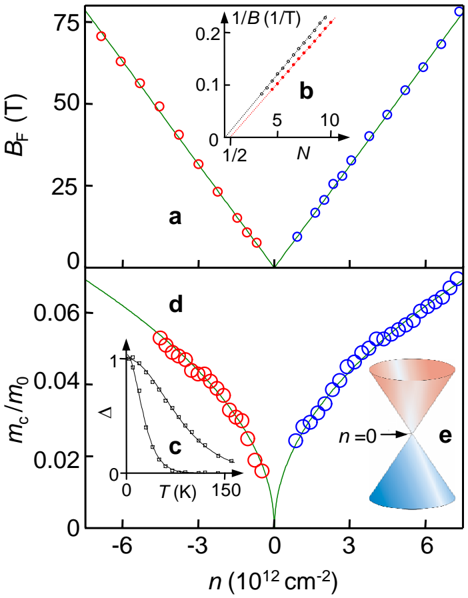
- Graphene’s charge carriers behave as massless Dirac fermions: the data imply \(E = \hbar k c^*\) for both electrons and holes, with \(c^* \approx 1 \times 10^6\) m/s; the cyclotron mass varies between \(\approx 0.02\) and \(0.07\,m_0\) and follows \(m_c \propto n^{1/2}\).
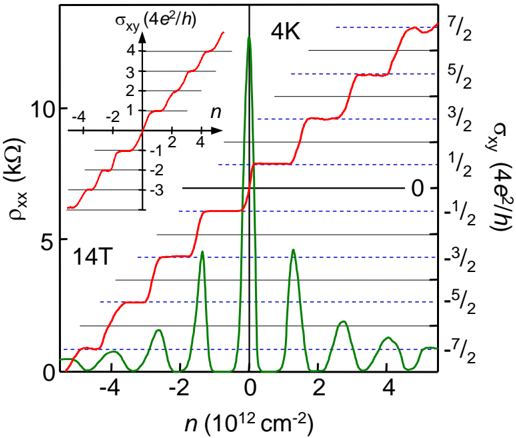
- The integer quantum Hall effect is anomalous: plateaux occur at half-integer \(\nu\), with sequence \((4e^2/h)(N+\tfrac12)\) and the first plateau at \(2e^2/h\); two-layer graphene returns to the normal integer sequence.
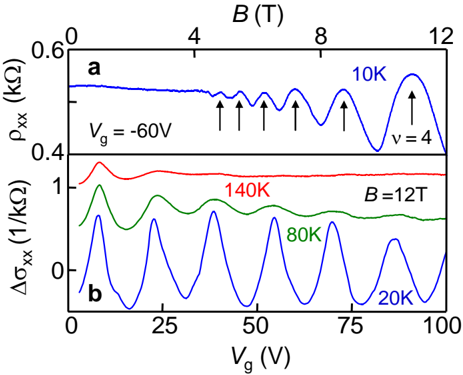
- Shubnikov–de Haas oscillations show a single set for electrons and holes, with \(B_F = \beta n\), \(\beta \approx 1.04 \times 10^{-15}\) T·m\(^2\) (\(\pm 2\%\)), yielding degeneracy \(f=4\); the oscillations exhibit a phase shift of \(\pi\) attributed to Berry’s phase.
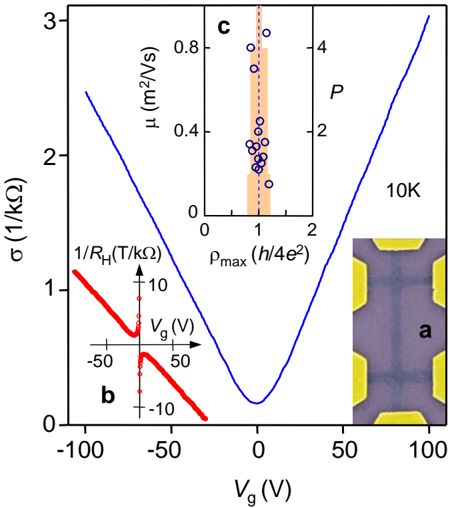
- Conductivity never falls below a minimum: \(\rho_{\max} \approx 6.5\) k\(\Omega\) in 15 devices (experimental error \(\approx 15\%\)), associated with \(h/fe^2 = 6.45\) k\(\Omega\), independent of mobility (which varied by a factor of 10) and of temperature between 4 and 100 K.
Methods
- Graphene samples were obtained by micromechanical cleavage of graphite, followed by identification and selection of monolayers using optical, scanning-electron, and atomic-force microscopies; selected films were processed into multi-terminal devices, with some devices made from 2 or 3 layers.
- Transport measurements included the electric field effect, Hall coefficient, Shubnikov–de Haas oscillations, and quantum Hall effect in magnetic fields; mobility was measured between 10 and 100 K, minimum conductivity between 4 and 100 K, and SdHO up to 140 K and room temperature.
- Analysis used fan diagrams to determine \(B_F\), fits of SdHO amplitude to \(T/\sinh(2\pi^2 k_B T m_c / h eB)\), and semiclassical expressions \(B_F = (h/2\pi e)S(E)\) and \(m_c = (h^2/2\pi)\partial S(E)/\partial E\) to infer \(E \propto k\).
Limitations
- The paper has no dedicated limitations section; stated caveats include that mobility was “probably still limited by defects in parent graphite,” that the two-layer finite-mass result is “to be published elsewhere,” and that most theories suggest a minimum conductivity of \(\approx e^2/\pi h\), in disagreement with the experiment.
- Evident from the text: devices are unprotected from the environment (though stable under ambient conditions), some measured devices consisted of 2 or 3 graphene layers, and the transition region was often shifted from zero \(V_g\) due to chemical doping, although annealing normally eliminated the shift.
- The inference of linear dispersion relies on a semiclassical model that the paper says is justified by recent theory, so the experimental conclusion depends on that theoretical framework.
Model-written summary. Check it against the paper before relying on it.
Integrity signals
Registry
Cites
Statistics
Figures
Verification
Claims the paper makes
3 Valid · 5 Not valid · 11 Not checked · 51 Own results and interpretations
The cited sources support only part of this claim — read each source’s verdict below.
In the paper
“d) Shubnikov-de Haas oscillations in graphene exhibit a phase shift of π due to Berry's phase”
- Also stated in: § Two-Dimensional Gas of Massless Dirac Fermions in Graphene · plain
“The shift is due to Berry's phase [9,15].”
What the sources say
- Partly supportedcites [9] Berger, C. et al. Ultrathin epitaxial graphite: 2D electron gas properties and a route toward graphene-based nanoelectronics. J. Phys. Chem. B 108, 19912–19916 (2004) sourceExperimental — accuracy not yet measured
The Figure 2 caption (p. 3) reports Shubnikov–de Haas oscillations in an epitaxial graphene sample. The discussion on pp. 3–4 addresses their occurrence and period, but does not report a π phase shift or attribute one to Berry’s phase. (LLM, conf=0.85)
- Partly supportedcites [15] Gusynin, V. P. & Sharapov, S. G. Unconventional integer quantum Hall effect in grapheme. Preprint at http://xxx.lanl.gov/abs/cond-mat/0506575 (2005). sourceExperimental — accuracy not yet measured
Our copy (Introduction, p. 1) does state that 'the phase of de Haas van Alphen and Shubnikov de Haas oscillations for Dirac quasiparticles is shifted ... compared to the phase of non-relativistic quasiparticles' (citing Refs. 7-10), so the existence of a phase shift in graphene is supported; the magnitude symbol itself is lost in our copy's undecoded formulas. What is NOT supported is the causal attribution to Berry's phase: no passage of our copy mentions Berry's phase at all (searched: 'Berry phase pseudospin topological phase π', 'oscillation phase factor'). Instead the paper explains the unconventional magneto-transport phenomena by the quantum anomaly of the n = 0 Landau level — its halved degeneracy and B-independent energy (p. 1 and p. 3) — and relates the oscillation minima to fillings ν_B = 2n+1 (p. 3). (LLM, conf=0.75)
plainstates a cause- Asserted: passes — The authors put it forward as true.
- Checkable: passes — It can be checked against evidence.
- Load-bearing: passes — The paper’s conclusions depend on it.
- Based: passes — The paper gives a reason why it holds.
- Also stated in: § Two-Dimensional Gas of Massless Dirac Fermions in Graphene · plain
The cited sources that could be checked couldn’t confirm or dispute this claim.
In the paper
“we invoke the formal expression [9-12] for the energy of massless relativistic fermions in quantized fields, EN =[2 e h c ∗ 2 B ( N +½ ± ½)] 1/2”
What the sources say
- Could not verifycites [9] Berger, C. et al. Ultrathin epitaxial graphite: 2D electron gas properties and a route toward graphene-based nanoelectronics. J. Phys. Chem. B 108, 19912–19916 (2004) sourceExperimental — accuracy not yet measured
The discussion of magnetoconductance (p. 3) says Shubnikov–de Haas oscillations indicate quantization of the electron energy spectrum, but it gives no energy formula. Searches for massless relativistic fermions, Landau levels, and the N + 1/2 ± 1/2 term found no passage stating the claimed expression. (LLM, conf=0.76)
- Not checked — no full text of the sourcecites [10] Bunch, J. S., Yaish, Y., Brink, M., Bolotin, K. & McEuen, P. L. Coulomb oscillations and Hall effect in quasi-2D graphite quantum dots. Nano Lett. 5, 287–290 (2005) source
- Not checked — no full text of the sourcecites [11] Dresselhaus, M. S. & Dresselhaus, G. Intercalation compounds of graphite. Adv. In Phys. 51, 1–186 (2002) source
- Not matchedcites [12] Brandt, N. B., Chudinov, S. M. & Ponomarev, Y. G. Semimetals 1: Graphite and Its Compounds (North-Holland, Amsterdam, 1988)
We searched by its title and found no matching paper.
plain- Asserted: passes — The authors put it forward as true.
- Checkable: passes — It can be checked against evidence.
- Load-bearing: passes — The paper’s conclusions depend on it.
- Based: passes — The paper gives a reason why it holds.
- Could not verify
The cited sources that could be checked couldn’t confirm or dispute this claim.
In the paper
“The employed semiclassical model is fully justified by a recent theory for graphene [9], which shows that SdHO's amplitude can indeed be described by the above expression T /sinh(2 π 2 k B Tm c / h eB ) with m c = E / c ∗ 2 .”
What the sources say
- Could not verifycites [9] Berger, C. et al. Ultrathin epitaxial graphite: 2D electron gas properties and a route toward graphene-based nanoelectronics. J. Phys. Chem. B 108, 19912–19916 (2004) sourceExperimental — accuracy not yet measured
The discussion of magnetoconductance (pp. 3–4) reports observed Shubnikov–de Haas oscillations, but does not give a theory for their amplitude. Searches for the temperature-dependent amplitude expression and m_c = E/c*² found no passage addressing either, so our copy cannot verify the attributed claim. (LLM, conf=0.76)
boostedstates a cause- Asserted: passes — The authors put it forward as true.
- Checkable: passes — It can be checked against evidence.
- Load-bearing: passes — The paper’s conclusions depend on it.
- Based: passes — The paper gives a reason why it holds.
- Could not verify
The cited sources that could be checked couldn’t confirm or dispute this claim.
In the paper
“The latter can be viewed as a direct consequence of the Atiyah-Singer index theorem that plays an important role in quantum field theory and the theory of superstrings [13,14].”
What the sources say
- Not checked — no full text of the sourcecites [13] Vonsovsky, S. V. & Katsnelson, M. I. Quantum Solid State Physics (Springer, New York, 1989) source
- Could not verifycites [14] Gusynin, V. P. & Sharapov, S. G. Magnetic oscillations in planar systems with the Dirac-like spectrum of quasiparticle excitations. Phys. Rev. B 71, 125124 (2005) sourceExperimental — accuracy not yet measured
Our copy of Gusynin & Sharapov II gives the relativistic Landau-level spectrum with n = 0, 1, ... in the Introduction (p. 1) and discusses the lowest level E_1 and its crossing of the Fermi surface (Discussion, p. 6; Sect. II.B, p. 6), but it never invokes or discusses the Atiyah-Singer index theorem, topology, or zero-mode counting as the reason for a level pinned at E = 0. Searches on 'Atiyah-Singer index theorem zero-energy Landau level', 'index theorem topological zero modes chiral anomaly', and 'zero-energy Landau level n=0 degeneracy independent of field strength' returned only the spectrum/quantization-condition passages. Since the index-theorem grounding is simply not addressed in our copy (and no alternative work is credited for it there), the attribution can be neither confirmed nor contradicted. (LLM, conf=0.68)
plainstates a cause- Asserted: passes — The authors put it forward as true.
- Checkable: passes — It can be checked against evidence.
- Load-bearing: unclear — It is unclear whether the paper’s conclusions depend on it.
- Based: passes — The paper gives a reason why it holds.
The cited sources that could be checked couldn’t confirm or dispute this claim.
In the paper
“in agreement with band structure calculations [6,7]”
What the sources say
- Could not verifycites [6] Novoselov, K. S. et al. Two dimensional atomic crystals. Proc. Natl Acad. Sci. USA 102, 10451–10453 (2005) sourceExperimental — accuracy not yet measured
The discussion of graphene transport in “Two Dimensional Atomic Crystals” (p. 3) reports carrier concentrations and mobilities, but not a fitted c* or a comparison with band-structure calculations. Searches for the velocity, its approximate value, and band-structure calculations found no passage addressing that comparison. (LLM, conf=0.76)
- Could not verifycites [7] Novoselov, K. S. et al. Electric field effect in atomically thin carbon films. Science 306, 666–669 (2004) sourceExperimental — accuracy not yet measured
The discussion on p. 2 says graphene is expected to have linear energy dispersion and massless carriers, but gives no calculated velocity to compare with c* ≈ 1·10^6 m/s. Searches for the velocity and band-structure comparison found no passage in our copy establishing the claimed agreement. (LLM, conf=0.73)
plainstates an association- Asserted: passes — The authors put it forward as true.
- Checkable: passes — It can be checked against evidence.
- Load-bearing: passes — The paper’s conclusions depend on it.
- Based: passes — The paper gives a reason why it holds.
- Could not verify
34 more claims
Create a free account to see all 70 claims and to verify the 10 references still open.
- It may state two separate claims as one. 27
- Probably not a substantial claim. 8
Claims other papers make about this one
Each is checked against this paper’s own text: does it say what the citing paper says it does?
The source backs part of the claim, not all of it — or backs it for a different population, condition or comparison.
In the citing paper
“Recently, the non-relativistic electrons in graphene monolayer were found to obey the massless relativistic dispersion known as the Dirac cone, leading to the realization of analogies to Zitterbewegung and Klein tunneling in low-energy condensed-matter physics and atom optics 4 -19 .”
From Observation of interaction-induced phenomena of relativistic quantum mechanics (2021) · cites this paper as [4]
Experimental — accuracy not yet measuredThe source backs part of the claim, not all of it — or backs it for a different population, condition or comparison.
In the citing paper
“Dirac points in graphene1–3 or photonic graphene12 belong to the first type, which occur in lattices with unbroken T. These occur in pairs and are stabilized by a symmetry of the underlying lattice.”
From Observation of an unpaired photonic Dirac point (2020) · cites this paper as [1]
Experimental — accuracy not yet measuredThe cited source says what the claim attributes to it.
In the citing paper
“The energy spectrum of ˆ H 1 is E n = sgn( n ) ℏ Ω √ | n | , where n = 0 , ± 1 , . . . , see Fig. 1.”
From Theory of electron Zitterbewegung in graphene probed by femtosecond laser pulses (2009) · cites this paper as [36]
The cited source says what the claim attributes to it.
In the citing paper
“Around Dirac cones, conduction and valence bands intersect linearly at a degenerate point resulting in the linear energy band and massless relativistic transport of electrons as quasiparticles [4].”
From Observing movement of Dirac cones from single-photon dynamics (2021) · cites this paper as [4]
The check wasn’t confident either way, so it gives no verdict — never disputed.
In the citing paper
“photonic Dirac points are known to occur in pairs in “photonic graphene” and other similar photonic crystals”
From Observation of an unpaired photonic Dirac point (2020) · cites this paper as [1]
Experimental — accuracy not yet measured
3 more claims about this paper
Create a free account to see every claim other papers make about this one.
Citations
Cites
Electric Field Effect in Atomically Thin Carbon Films
Novoselov, K. S., Geim, A. K., Morozov, S. V., Jiang, D., Zhang, Y., Dubonos, S. V., Grigorieva, I. V., & Firsov, A. A. (2004) · Science · doi:10.1126/science.1102896 · Cited by 66,834
Self-citationTwo-dimensional atomic crystals
Novoselov, K. S., Jiang, D., Schedin, F., Booth, T. J., Khotkevich, V. V., Morozov, S. V., & Geim, A. K. (2005) · Proceedings of the National Academy of Sciences · doi:10.1073/pnas.0502848102 · Cited by 11,788
Self-citationScaling Theory of Localization: Absence of Quantum Diffusion in Two Dimensions
Abrahams, E., Anderson, P. W., Licciardello, D. C., & Ramakrishnan, T. V. (1979) · Physical Review Letters · doi:10.1103/physrevlett.42.673 · Cited by 6,134
Berger, C., Song, Z., Li, T., Li, X., Ogbazghi, A. Y., Feng, R., Dai, Z., Marchenkov, A. N., Conrad, E. H., First, P. N., et al. (2004) · The Journal of Physical Chemistry B · doi:10.1021/jp040650f · Cited by 3,548
The Universe in a Helium Droplet
Volovik, G. E. (2009) · doi:10.1093/acprof:oso/9780199564842.001.0001 · Cited by 2,632
Intercalation compounds of graphite
Dresselhaus, M. S., & Dresselhaus, G. (2002) · Advances in Physics · doi:10.1080/00018730110113644 · Cited by 2,139
Geometry, Topology and Physics
Nakahara, M. (1990) · doi:10.1887/0750306068 · Cited by 1,620
Geometry, Topology and Physics
Nakahara, M. (2018) · CRC Press eBooks · doi:10.1201/9781315275826 · Cited by 1,505
Unconventional Integer Quantum Hall Effect in Graphene
Gusynin, V. P., & Sharapov, S. G. (2005) · Physical Review Letters · doi:10.1103/physrevlett.95.146801 · Cited by 1,374
Field Theories of Condensed Matter Systems
Fradkin, E. (2007) · Medical Entomology and Zoology · Cited by 1,118
Research works printed but not linked: 1
- Mott, N.F. & Davis, E.A. Electron Processes in Non-Crystalline Materials (Clarendon Press, Oxford, 1979).
Cited by
Items 21,301–21,400 of 21,614
The Effective Potential of Scalar Pseudo-Quantum Electrodynamics in (2 + 1)D
Nascimento, L. O., Carlos, A. P. C., & Santos, J. R. (2024) · Condensed Matter · doi:10.3390/condmat9020025 · Cited by 1
“The experimental realization of two-dimensional materials [1–4] in condensed matter physics has attracted the interest of the community in high energy physics, due to the emergence of Dirac cones and the possibility of observing some interacting effects [5], such as the Fermi velocity…”
BackgroundNanostructures and Characteristics of Carbon Nanofibers
Kaul, A. B., Lee, J., & Feng, P. X. ‐. (2016) · Springer eBooks · doi:10.1007/978-94-017-9780-1_101008
JUNÇÕES MOLECULARES DE NANOFITAS DE GRAFENO E PHAGRAPHENO: UM ESTUDO VIA DFT E EHT/NEGF.
Nisioka, K. R., Felipe, R. F., Correa, S. M., et al. (2017) · ABM Proceedings · doi:10.5151/1516-392x-30270
Scanning tunneling microscopy study of h-BN thin films grown on Cu foils
Xu, D., Yin, J., Sun, H., Guan-Yong, W., Dong, Q., Guan, D., Li, Y., Guo, W., Liu, C., & Jia, J. (2016) · Acta Physica Sinica · doi:10.7498/aps.65.116801
Ma, Y., & Chen, L. (2024) · Numerical Methods for Partial Differential Equations · doi:10.1002/num.23128 · Cited by 1
“This attention is particularly focused on investigating the structures of two-dimensional (2D) materials [19, 38], specifically graphite and graphene [1, 39].”
Sethy, S. K., Suman, S., Sankaran, K. J., et al. (2026) · Advanced Materials Technologies · doi:10.1002/admt.202501912
Bilayer Graphene as the Material for Study of the Unconventional Fractional Quantum Hall Effect
Jacak, J. E. (2017) · InTech eBooks · doi:10.5772/67550
Topological phenomena in Josephson tunnel junction circuits
Peyruchat, L. (2022) · theses.fr (ABES) · doi:10.70675/2400c719zf074z48a1z9063zc3f2307a62db · Cited by 2
Electrophoretic Deposition of Graphene Oxide on Carbon Steel
Nagu, M., Wahab, H. M., Huwaiji, A. K., et al. (2025) · Materials Performance · doi:10.5006/mp2025_64_1-32
From the integer to the fractional quantum hall effect in graphene
Goerbig, M. O. (2023) · Elsevier eBooks · doi:10.1016/b978-0-323-90800-9.00106-2 · Cited by 7
Pourkhiabi, M., & Kazemi, A. S. (2024) · Applied Physics A · doi:10.1007/s00339-024-07508-5
Le, L. N., & Tran, B. T. N. (2024) · SSRN Electronic Journal · doi:10.2139/ssrn.4861989
Modulation of the electric properties of SnSe bi/mono-layer by strain and electrical field
Han, R., Zhang, Z., Zhang, P., et al. (2017) · International Conference on Electronic Packaging Technology (ICEPT) · doi:10.1109/icept.2017.8046702
All-electrical ferromagnet-free spin injection, detection, and manipulation at room temperature
Lim, H., Seo, G., Lee, T., Jin, T., Sung, K., Goo, D., Kim, J., Lee, S., Cho, J., Watanabe, K., et al. (2025) · Journal of Physics D Applied Physics · doi:10.1088/1361-6463/adfe7b
“The carrier density [34] in a bare graphene regime and the heterojunction of graphene/WTe 2 are gate-controlled together [34, 47].”
InfluentialYogalakshmi, K., & Easwaramoorthy, D. (2026) · Results in Engineering · doi:10.1016/j.rineng.2026.109645
Berry curvature and energy bands of graphene
Farajollahpour, T., Rezvani, A., Khodarahmi, M. R., et al. (2013) · International journal of nanodimension. · doi:10.7508/ijnd.2012.04.010
Twisting graphene into correlation and topology
Yang, S.-Y., & Shen, C. (2026) · National Science Review · doi:10.1093/nsr/nwag363 · Cited by 1
“Crystalline graphene has exhibited topological behaviors, such as quantum Hall effect under magnetic field [48 ,49 ] or Berry curvature hotspot for valley electrons under broken inversion symmetry [50 ,51 ].”
Shirakawa, T., & Yunoki, S. (2022) · Physical review. B./Physical review. B · doi:10.1103/physrevb.105.184110
“, 2pz orbitals perpendicular to the graphene plane, and the resulting energy band exhibits the Dirac linear dispersion across the Fermi level [28].”
BackgroundSi 2 Br 2 Nanostructures with Tunable Dimensionality for Next-Generation Quantum Nanodevices
Azevedo, D. L., Santos, W. O., Barbosa, L. S., et al. (2026) · ACS Applied Nano Materials · doi:10.1021/acsanm.6c01348
Banerjee, P. S., Marathe, R., & Ghosh, S. (2024) · Physica Scripta · doi:10.1088/1402-4896/ad9c23 · Cited by 1
Quantum transport in molecular devices and graphene
Heersche, H. B. (2006) · Research Repository (Delft University of Technology) · Cited by 1
Ming, X., Wang, Y., He, L., Cao, M., Zhan, J., Sun, H., Pang, K., Li, P., Liu, Y., Xu, Z., et al. (2026) · Nanoscale Horizons · doi:10.1039/d6nh00168h · Cited by 1
Electron in Magnetic Field: Quantum Hall Effect
Srivastav, S. K. (2024) · Springer theses · doi:10.1007/978-3-031-67051-0_2
Co-doping of 2D-ZnS monolayers designed for high-conductivity transparent electrodes
Es-Smairi, A., Masrour, R., Krimi, Y. E., et al. (2026) · Materials Chemistry and Physics · doi:10.1016/j.matchemphys.2026.132469
Processamento de grafeno oxidado na forma de filmes ultrafinos e aplicações em sensores
dos Santos, F. A. (2013) · Digital Library of Theses and Dissertations (Universidade de São Paulo) · doi:10.11606/d.88.2013.tde-14042015-090739 · Cited by 2
Out-of-bound hydrodynamics in holographic anisotropic Dirac semimetals
Bahamondes, S., Landea, I. S., & Soto-Garrido, R. (2026) · Journal of High Energy Physics · doi:10.1007/jhep03(2026)021
“This has been clear since the experimental realization of graphene [1], since its tunable electronic and energy transport properties through methods like doping have sparked great interest in its use of modern technologies [2].”
Bhatia, D., Chauhan, N., Sharma, D., Sharma, S., & Upadhyay, R. K. (2026) · Next Materials · doi:10.1016/j.nxmate.2026.102775
Novel properties of low-dimensional materials
Cheng, H., Tang, D., Zou, X., & Zhang, L. (2024) · Elsevier eBooks · doi:10.1016/b978-0-443-29046-6.00011-0
Kohlenstoffgruppe: Elemente der vierten Hauptgruppe
Sicius, H. (2023) · Springer eBooks · doi:10.1007/978-3-662-65664-8_4
Jalar, A., Bahru, R., Atiqah, A., et al. (2024) · SSRN Electronic Journal · doi:10.2139/ssrn.4871102
Electrical And Optical Studies Of Nanoscale Structures
Shi, S. (2012) · eCommons (Cornell University)
Magnetocapacitance and dissipation factor of epitaxial graphene Hall bars
Schurr, J., Kalmbach, C.-C., Kruskopf, M., et al. (2016) · Conference on Precision Electromagnetic Measurements · doi:10.1109/cpem.2016.7540651
Size Effect Of Electronic States In Graphene Quantum Disk
Li, X., & Feng, X. (2016) · doi:10.2991/mmeceb-15.2016.60
Quantum Time Sliding by CDW Instantons in Nanoscale NbS3 and TaS3
Fukuda, Y., Urushihara, K., Ebana, A. S., et al. (2023) · doi:10.7566/jpscp.38.011181
The Theoretical Calculation of Carrier Mobility for Two-Dimensional Material
Li, S. (2018) · IOP Conference Series Materials Science and Engineering · doi:10.1088/1757-899x/394/3/032011
Majorana-Weyl fermions in (2+1)-dimensional superconductors
Nobukane, H., Tokuno, A., Matsuyama, T., et al. (2012) · Journal of Physics Conference Series · doi:10.1088/1742-6596/400/2/022084
11 Chern-Simons Theory of Fractional Quantum Hall Effect in (Pseudo) Massless Dirac ElectronsPreprint
Zeng, H.-B. (2016)
Crystal Orientation Control of Hexagonal Boron Nitride/Graphene Heterostructure
Taniyasu, Y., & Wang, S. (2022) · Vacuum and Surface Science · doi:10.1380/vss.65.190
Landau level transition and magnetophonon resonance in a twisted bilayer graphene
DeCapua, M. C., Wu, Y., Taniguchi, T., et al. (2023) · Solid State Communications · doi:10.1016/j.ssc.2023.115265
Computational Exploration of Two-dimensional (2D) Materials for Solar Energy Applications
Matta, S. K. (2019) · Queensland University of Technology · doi:10.5204/thesis.eprints.134244 · Cited by 1
Nurwantoro, P., Yunitasari, S., Prayogi, H., et al. (2024) · International Journal of Computational Materials Science and Engineering · doi:10.1142/s2047684124500040
Charge and Spin Carrier Transport in Graphene and its Derivatives.
Borysenko, K. M. (2011) · NCSU Libraries Repository (North Carolina State University Libraries)
Emergent momentum-space topological pseudospin defects in non-Hermitian systems
Hu, Y. M. R., Ostrovskaya, E. A., Yakimenko, A. I., & Estrecho, E. (2026) · Optics Express · doi:10.1364/oe.591803 · Cited by 2
“The first model we consider is a non-Hermitian generalization of the well-known two-dimensional Dirac model, which is applicable to a wide range of physical systems, from describing the conical diffraction of circularly-polarized optical beams [74, 75] to the band structure of graphene[76–79].”
Advancing Carbon Nanoribbons: Structural and Electronic PropertiesPreprint
Borges, F., Gonçalves, J. A., Batista, R. J. C., et al. (2026) · SSRN Electronic Journal · doi:10.2139/ssrn.6276046
Isothermal compressibility in Fermi gases in an optical lattice
Liang, C.-G., Huang, Y.-X., Liu, F.-H., Zhang, Y., Guo, G., & Gong, M. (2019) · Physical Review A · doi:10.1103/physreva.99.023624
Göbel, E. O., & Siegner, U. (2015) · doi:10.1002/9783527680887.ch5
RKKY interaction in triangular graphene nanobubble
Zhang, B., Ma, T., & Gong, W. (2025) · Physica E Low-dimensional Systems and Nanostructures · doi:10.1016/j.physe.2025.116315
Wei, Z., & Ma, T. (2026) · International Journal of Modern Physics C · doi:10.1142/s0129183127501312
Asymmetric nano graphene model applied to graphite-like room-temperature ferromagnetismPreprint
Ota, N., Gorjizadeh, N., & Kawazoe, Y. (2011) · arXiv (Cornell University) · doi:10.48550/arxiv.1101.4079
Dirac fermions on a surface with localized strain
Almeida, S. B. B., Silva, J. E. G., & Almeida, C. A. S. (2026) · Annals of Physics · doi:10.1016/j.aop.2026.170385
Chowdhury, P. P., Chowdhury, P. P., Chatterjee, T., Mukherjee, A., Chatterjee, T., & Mukherjee, A. (2020) · General Chemistry · doi:10.21127/yaoyigc20190034
“[6-11] Several types of chemical reactions have already been demonstrated on graphene.”
BackgroundMoS2 Nanoribbons Thermoelectric GeneratorsPreprint
Arab, A., & Li, Q. (2015) · arXiv (Cornell University) · doi:10.48550/arxiv.1503.05903 · Cited by 1
(2013) · Pan Stanford Publishing eBooks · doi:10.1201/b14396-2
On the Quantization of AB Phase in Nonlinear Systems
Liu, X., Wang, Q., & Gong, J. (2022) · Entropy · doi:10.3390/e24121835
Dispersion of Flexural Modes in Soft 2D Lattices
Ipatov, A. N., Паршин, Д. А., & Conyuh, D. A. (2022) · Journal of Experimental and Theoretical Physics · doi:10.1134/s1063776121120098
Dedkov, Y. S., & Voloshina, E. N. (2017) · Elsevier eBooks · doi:10.1016/b978-0-12-409547-2.14170-8
Well-defined plateaus of the conductance in two-terminal device of nonsuspended graphene
Kang, H., Kim, K., Woo, B.-C., et al. (2010) · IEEE International Conference on Nanotechnology (IEEE-NANO) · doi:10.1109/nano.2010.5697932
Wang, J., Yu, Q., 郭, H. 辉. G., et al. (2026) · Chinese Physics B · doi:10.1088/1674-1056/ae5a15
Mode locked oscillation in ultrafast fiber laser using bilayer graphene saturable absorbers
Hassan, A., Hossain, N., & Shaikat, A. (2014) · International Conference on Informatics, Electronics & Vision (ICIEV) · doi:10.1109/iciev.2014.6850724
Surface conductivity evaluation of CVD graphene up to 2.5 THz
Katsounaros, A., & Hao, Y. (2013) · European Microwave Conference (EuMC)
Stability of single-atom iron complexes on graphene double vacancy
Karpenko, O. S., Лобанов, В. В., & Kartel, M. T. (2023) · Poverhnostʹ · doi:10.15407/surface.2023.15.003
Structural and electronic properties of rectangular CdTe nanowire: A DST study
Khan, M. S., Bhatia, M., & Srivastava, A. (2018) · AIP conference proceedings · doi:10.1063/1.5033311
Liu, P., Han, J., & Liu, Q. (2021) · arXiv (Cornell University)
Compton Effect in Graphene and in the Graphene-Like Dielectric Medium
Pardy, M. (2015) · InTech eBooks · doi:10.5772/61342
Alsalmi, O., Dakhlaoui, H., Belhadj, W., & Ungan, F. (2023) · Physica Scripta · doi:10.1088/1402-4896/acdb06
Fermionic quantum gas at finite temperature within a Lorentz-violating background
Costa, R. L. J., & Sobreiro, R. F. (2024) · Europhysics Letters (EPL) · doi:10.1209/0295-5075/ad229d
Graphite surface modification by quasi-periodically structured diazonium monolayer
Trung, H. T. M., & Hai, P. T. (2023) · Vietnam Journal of Catalysis and Adsorption · doi:10.62239/jca.2023.073
A Study on the Characteristics of the Thermal conductivity of Nanofluids Containing Graphene
Park, S.-S., Jeon, Y.-H., & Kim, N. (2012) · Journal of the Korean Solar Energy Society · doi:10.7836/kses.2012.32.6.093
Intrinsic Decoherence and Field‐Controlled Quantum Correlations in Buckled Silicene
Oussarhan, Y., Ghani, H. E., Essaadi, F., Asri, S. E., Mouslih, S., Jakha, M., Taj, S., & Manaut, B. (2026) · Annalen der Physik · doi:10.1002/andp.70243
Mamindla, R., Chakraborty, S., & Niranjan, M. K. (2026) · Physical Chemistry Chemical Physics · doi:10.1039/d5cp04280a
Micromagnetic Sensors and Dirac Fermions in HgTe Heterostructures
Büttner, B. (2012) · Cited by 1
Dimer Lines-Dependent Bandgap and Mechano-Electronic Correlations in Nanoribbons of 2d MaterialsPreprint
Moteria, M. R., Pandya, A., Sangani, K., et al. (2025) · SSRN Electronic Journal · doi:10.2139/ssrn.5179073
Radiative Effects in Low-Dimensional Effective Fermion Field Theory with Compactification
Zhukovsky, V. C. (2023) · Symmetry · doi:10.3390/sym15101867
Electron-phonon coupling in Kekulé-ordered graphene
Szczęśniak, D. (2025) · Physical review. B./Physical review. B · doi:10.1103/6cst-xp7s · Cited by 2
Magnetic Bilayer Qubits and Two-Qubit Entanglement ControlsPreprint
Saragih, C. S., Pham, D. V., Lin, J., et al. (2024) · SSRN Electronic Journal · doi:10.2139/ssrn.4760540
Fabrication of Nano-scale Electronic Devices Based on Single-layer Graphene
Machida, T., Masubuchi, S., Masashi, O. N. O., Arai, M., & Yamaguchi, T. (2010) · Journal of the Vacuum Society of Japan · doi:10.3131/jvsj2.53.94
Microwave-induced transitions between weak localization and weak antilocalization in graphene
Navarro-Giraldo, J., Santana, V. T., Laguta, O. V., Bloos, D., Bauernfeind, A., Scheffler, M., Laguta, V. V., Gaskill, D. K., & Neugebauer, P. (2026) · Physical review. B./Physical review. B · doi:10.1103/8nz6-xgg5 · Cited by 1
Kosior, A., Lewenstein, M., & Celi, A. (2018) · SciPost Physics · doi:10.21468/scipost.report.622
Electronic States of Graphene-Based Ferromagnets
Hatanaka, M. (2011) · InTech eBooks · doi:10.5772/20774
Waste-Derived Carbon Nanomaterials (WD-CNMs): Synthesis and Characterization
Singh, K., Sawini, S., & Kumar, D. (2025) · Nanostructure science and technology · doi:10.1007/978-3-031-75247-6_1 · Cited by 2
Exploring Quantized Entropy Production Strength in Mesoscopic Irreversible Thermodynamics
Sonnino, G. (2025) · International Workshop on Bayesian Inference and Maximum Entropy Methods in Science and Engineering (MaxEnt) · doi:10.3390/psf2025012007
Graphene Supported Palladium Nanocatalyst for Cross-Coupling Reactions
Kumar, M., Solanki, M. S., & Sharma, S. (2023) · BENTHAM SCIENCE PUBLISHERS eBooks · doi:10.2174/9789815050899123010011 · Cited by 1
Absorption spectra of asymmetric bilayer graphene nanoribbons
Li, T. S., & Lin, M. F. (2013) · Synthetic Metals · doi:10.1016/j.synthmet.2013.07.006
Microemulsion-Mediated Synthesis of Graphdiyne with Hollow Nanosphere andNanoflower ArchitecturePreprint
Chen, M., Liu, Q., Li, X. J., et al. (2025) · SSRN Electronic Journal · doi:10.2139/ssrn.5985563
Madmeli, A., Madmeli, K., & Ganji, J. (2026) · Electric Power Systems Research · doi:10.1016/j.epsr.2026.112851
Exotic tunneling resistance in graphene/topological insulator vertical junctionPreprint
Zhang, L., Yan, Y. J., Wu, H., et al. (2015) · arXiv (Cornell University)
Zhen, D.-D., Gu, W.-F., Wang, L., et al. (2018) · doi:10.1117/12.2320076
Electrical Transport in Suspended Two-Dimensional Materials
Wang, F. (2015) · eScholarship (California Digital Library)
Graphene-based post-cmos architecture
Tanachutiwat, S. (2012) · doi:10.54014/hg03-waaq
Zhu, L., Sarkar, S., Ye, S., et al. (2015) · Synthesis and Reactivity in Inorganic Metal-Organic and Nano-Metal Chemistry · doi:10.1080/15533174.2013.865234
Ball, P. (2015) · Nature Materials · doi:10.1038/nmat4373
A Self-Adaptive Umbrella Model for Vibration Analysis of Graphene
Chu, L., Shi, J., Yu, H., et al. (2018) · Materials · doi:10.3390/ma11122497
Cipriani, F., Shundalau, M. B., & Lamberti, P. (2026) · doi:10.3390/engproc2026133130
Atomic-Scale Modelling of Folding and Filling in 2D Nanostructures
Impellizzeri, A. (2020) · theses.fr (ABES) · doi:10.70675/568448c0z8284z4e67zbd89z5da079ac70a0
Electronic structure calculations: the many-body perturbation theory (MBPT)
Torres, L. E. F. F., Roche, S., & Charlier, J. (2014) · Cambridge University Press eBooks · doi:10.1017/cbo9781139344364.011
Metadata
- Authors
- Novoselov, K. S., Geim, A. K., Morozov, S. V., Jiang, D., Katsnelson, M. I., Grigorieva, I. V., Dubonos, S. V., & Firsov, A. A.
- Affiliations
- University of Manchester (GB)
- Institute of Microelectronics Technology and High Purity Materials (RU)
- Radboud University Nijmegen (NL)
- Corresponding author
- Novoselov, K. S.
- Geim, A. K.
- Venue
- Nature
- Published
- 2005-11
- Volume
- 438
- Issue
- 7065
- Pages
- 197-200
- ISSN
- 0028-0836 (ISSN-L)
- 1476-4687
- OpenAlex
- W2125284466
- Semantic Scholar
- 228e604ea7c1333a99663b6b547cf47b98e721e7
- Cited by
- 21,611
- References
- 32
- Citations by year
- 2026: 442 · 2025: 677 · 2024: 798 · 2023: 924 · 2022: 992 · 2021: 1082 · 2020: 1230 · 2019: 1268 · 2018: 1350 · 2017: 1395 · 2016: 1501 · 2015: 1473 · 2014: 1387 · 2013: 1382 · 2012: 1375
- FWCI
- 217.72
- Type
- journal article
- Language
- en
- Open access
- green
- arxiv.org
- Licence
- www.springer.com/tdm (tdm)
- Locations
- Nature (publishedVersion)
- PubMed (publishedVersion)
- arXiv (Cornell University) (submittedVersion)
- RePEc: Research Papers in Economics (submittedVersion)
- Research Explorer (The University of Manchester) (submittedVersion)
- Radboud Repository (Radboud University) (submittedVersion)
- arXiv (Cornell University)
- Topics
- Physical Sciences › Materials Science › Materials Chemistry › Graphene research and applications
- Physical Sciences › Physics and Astronomy › Condensed Matter Physics › Topological Materials and Phenomena
- Physical Sciences › Physics and Astronomy › Atomic and Molecular Physics, and Optics › Quantum Electrodynamics and Casimir Effect
- Keywords
- graphene, massless Dirac fermions, two-dimensional Dirac fermions, quantum Hall effect, cyclotron mass, electron transport, relativistic electrons
About these checks
Registry, retraction, Cites and statistics results are computed, not judged, with one exception: a printed reference that no index lists is read once by a model before it counts as a citation error. Claims are extracted by a model and kept only when their quote appears verbatim in the text; each cited source is then checked, with a model’s help, for whether it says what the claim relies on. Those verdicts can be wrong — read the claim’s quote and the cited source before relying on one.
The claim verdicts this report counts are experimental: their accuracy is not yet measured.
A language model drew the claims from the paper on 2026-10-10, under version 3 of the claim definition (model deepseek-v4.1-flash, prompt extract-v3).
A second model labelled each claim on 2026-10-10 (model jev-1.13-20260917, definition revision gold-guideline-v0.2).
Cited sources are checked with a language model’s help (gpt-6-sol and qwen3.8-omni-flash).
Statistics and arithmetic are recomputed, not judged.
Confidence bands are shown only for fields calibrated on our annotated test set. None is calibrated yet, so no band is shown.
What counts as a claim ›How we measure confidence ›How we check this ›
Are you an author, or do you see a problem with this page? Request a review
Data sources
Bibliographic data: Semantic Scholar, OpenAlex, Crossref.
Contains information from the Semantic Scholar Academic Graph Datasets, made available under the ODC Attribution License (ODC-BY 1.0).
Semantic Scholar’s data is described in: Kinney, R., et al. (2023). The Semantic Scholar Open Data Platform. arXiv:2301.10140.
