

Two-dimensional gas of massless Dirac fermions in graphene
Open accessThe DOI matches its Crossref record; 32 of the 32 references it cites were found in a registry or an index; 12 of the 52 sources its claims cite were checked for support.
Abstract
Quantum electrodynamics (resulting from the merger of quantum mechanics and relativity theory) has provided a clear understanding of phenomena ranging from particle physics to cosmology and from astrophysics to quantum chemistry. The ideas underlying quantum electrodynamics also influence the theory of condensed matter, but quantum relativistic effects are usually minute in the known experimental systems that can be described accurately by the non-relativistic Schrödinger equation. Here we report an experimental study of a condensed-matter system (graphene, a single atomic layer of carbon) in which electron transport is essentially governed by Dirac's (relativistic) equation. The charge carriers in graphene mimic relativistic particles with zero rest mass and have an effective ‘speed of light’ c* ≈ 106 m s-1. Our study reveals a variety of unusual phenomena that are characteristic of two-dimensional Dirac fermions. In particular we have observed the following: first, graphene's conductivity never falls below a minimum value corresponding to the quantum unit of conductance, even when concentrations of charge carriers tend to zero; second, the integer quantum Hall effect in graphene is anomalous in that it occurs at half-integer filling factors; and third, the cyclotron mass mc of massless carriers in graphene is described by E = mcc*2. This two-dimensional system is not only interesting in itself but also allows access to the subtle and rich physics of quantum electrodynamics in a bench-top experiment.
Overview
CoChat Summary
TL;DR
Graphene is a two-dimensional gas of massless Dirac fermions with linear dispersion and an effective speed of light \(c^* \approx 10^6\) m/s. Transport measurements reveal an anomalous half-integer quantum Hall effect, a minimum conductivity, cyclotron mass \(m_c = E/c^{*2}\), and a \(\pi\) Berry-phase shift in Shubnikov–de Haas oscillations.
Key findings
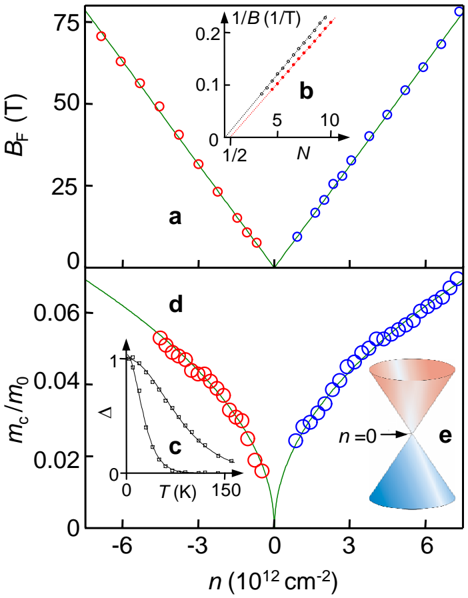
- Graphene’s charge carriers behave as massless Dirac fermions: the data imply \(E = \hbar k c^*\) for both electrons and holes, with \(c^* \approx 1 \times 10^6\) m/s; the cyclotron mass varies between \(\approx 0.02\) and \(0.07\,m_0\) and follows \(m_c \propto n^{1/2}\).
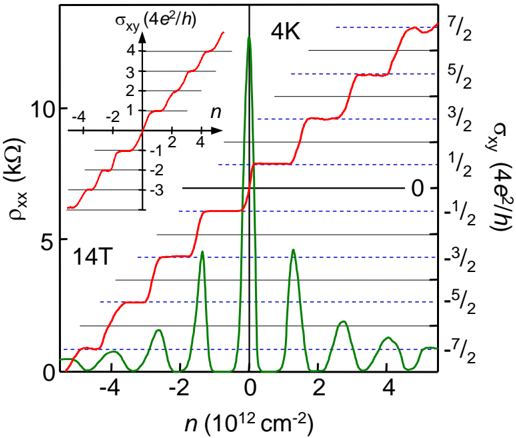
- The integer quantum Hall effect is anomalous: plateaux occur at half-integer \(\nu\), with sequence \((4e^2/h)(N+\tfrac12)\) and the first plateau at \(2e^2/h\); two-layer graphene returns to the normal integer sequence.
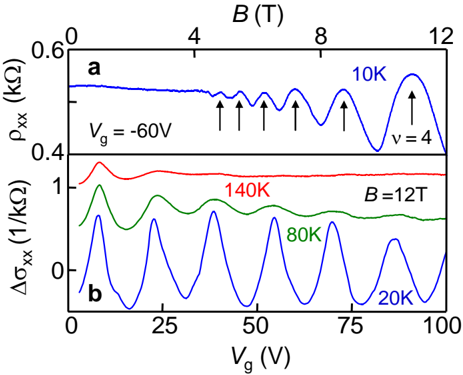
- Shubnikov–de Haas oscillations show a single set for electrons and holes, with \(B_F = \beta n\), \(\beta \approx 1.04 \times 10^{-15}\) T·m\(^2\) (\(\pm 2\%\)), yielding degeneracy \(f=4\); the oscillations exhibit a phase shift of \(\pi\) attributed to Berry’s phase.
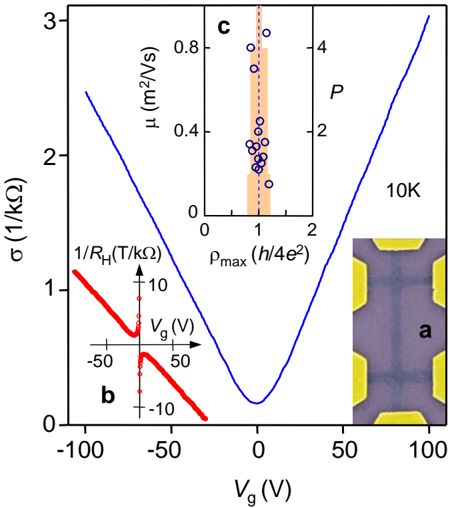
- Conductivity never falls below a minimum: \(\rho_{\max} \approx 6.5\) k\(\Omega\) in 15 devices (experimental error \(\approx 15\%\)), associated with \(h/fe^2 = 6.45\) k\(\Omega\), independent of mobility (which varied by a factor of 10) and of temperature between 4 and 100 K.
Methods
- Graphene samples were obtained by micromechanical cleavage of graphite, followed by identification and selection of monolayers using optical, scanning-electron, and atomic-force microscopies; selected films were processed into multi-terminal devices, with some devices made from 2 or 3 layers.
- Transport measurements included the electric field effect, Hall coefficient, Shubnikov–de Haas oscillations, and quantum Hall effect in magnetic fields; mobility was measured between 10 and 100 K, minimum conductivity between 4 and 100 K, and SdHO up to 140 K and room temperature.
- Analysis used fan diagrams to determine \(B_F\), fits of SdHO amplitude to \(T/\sinh(2\pi^2 k_B T m_c / h eB)\), and semiclassical expressions \(B_F = (h/2\pi e)S(E)\) and \(m_c = (h^2/2\pi)\partial S(E)/\partial E\) to infer \(E \propto k\).
Limitations
- The paper has no dedicated limitations section; stated caveats include that mobility was “probably still limited by defects in parent graphite,” that the two-layer finite-mass result is “to be published elsewhere,” and that most theories suggest a minimum conductivity of \(\approx e^2/\pi h\), in disagreement with the experiment.
- Evident from the text: devices are unprotected from the environment (though stable under ambient conditions), some measured devices consisted of 2 or 3 graphene layers, and the transition region was often shifted from zero \(V_g\) due to chemical doping, although annealing normally eliminated the shift.
- The inference of linear dispersion relies on a semiclassical model that the paper says is justified by recent theory, so the experimental conclusion depends on that theoretical framework.
Model-written summary. Check it against the paper before relying on it.
Integrity signals
Registry
Cites
Statistics
Figures
Verification
Claims the paper makes
3 Valid · 5 Not valid · 11 Not checked · 51 Own results and interpretations
The cited sources support only part of this claim — read each source’s verdict below.
In the paper
“d) Shubnikov-de Haas oscillations in graphene exhibit a phase shift of π due to Berry's phase”
- Also stated in: § Two-Dimensional Gas of Massless Dirac Fermions in Graphene · plain
“The shift is due to Berry's phase [9,15].”
What the sources say
- Partly supportedcites [9] Berger, C. et al. Ultrathin epitaxial graphite: 2D electron gas properties and a route toward graphene-based nanoelectronics. J. Phys. Chem. B 108, 19912–19916 (2004) sourceExperimental — accuracy not yet measured
The Figure 2 caption (p. 3) reports Shubnikov–de Haas oscillations in an epitaxial graphene sample. The discussion on pp. 3–4 addresses their occurrence and period, but does not report a π phase shift or attribute one to Berry’s phase. (LLM, conf=0.85)
- Partly supportedcites [15] Gusynin, V. P. & Sharapov, S. G. Unconventional integer quantum Hall effect in grapheme. Preprint at http://xxx.lanl.gov/abs/cond-mat/0506575 (2005). sourceExperimental — accuracy not yet measured
Our copy (Introduction, p. 1) does state that 'the phase of de Haas van Alphen and Shubnikov de Haas oscillations for Dirac quasiparticles is shifted ... compared to the phase of non-relativistic quasiparticles' (citing Refs. 7-10), so the existence of a phase shift in graphene is supported; the magnitude symbol itself is lost in our copy's undecoded formulas. What is NOT supported is the causal attribution to Berry's phase: no passage of our copy mentions Berry's phase at all (searched: 'Berry phase pseudospin topological phase π', 'oscillation phase factor'). Instead the paper explains the unconventional magneto-transport phenomena by the quantum anomaly of the n = 0 Landau level — its halved degeneracy and B-independent energy (p. 1 and p. 3) — and relates the oscillation minima to fillings ν_B = 2n+1 (p. 3). (LLM, conf=0.75)
plainstates a cause- Asserted: passes — The authors put it forward as true.
- Checkable: passes — It can be checked against evidence.
- Load-bearing: passes — The paper’s conclusions depend on it.
- Based: passes — The paper gives a reason why it holds.
- Also stated in: § Two-Dimensional Gas of Massless Dirac Fermions in Graphene · plain
The cited sources that could be checked couldn’t confirm or dispute this claim.
In the paper
“we invoke the formal expression [9-12] for the energy of massless relativistic fermions in quantized fields, EN =[2 e h c ∗ 2 B ( N +½ ± ½)] 1/2”
What the sources say
- Could not verifycites [9] Berger, C. et al. Ultrathin epitaxial graphite: 2D electron gas properties and a route toward graphene-based nanoelectronics. J. Phys. Chem. B 108, 19912–19916 (2004) sourceExperimental — accuracy not yet measured
The discussion of magnetoconductance (p. 3) says Shubnikov–de Haas oscillations indicate quantization of the electron energy spectrum, but it gives no energy formula. Searches for massless relativistic fermions, Landau levels, and the N + 1/2 ± 1/2 term found no passage stating the claimed expression. (LLM, conf=0.76)
- Not checked — no full text of the sourcecites [10] Bunch, J. S., Yaish, Y., Brink, M., Bolotin, K. & McEuen, P. L. Coulomb oscillations and Hall effect in quasi-2D graphite quantum dots. Nano Lett. 5, 287–290 (2005) source
- Not checked — no full text of the sourcecites [11] Dresselhaus, M. S. & Dresselhaus, G. Intercalation compounds of graphite. Adv. In Phys. 51, 1–186 (2002) source
- Not matchedcites [12] Brandt, N. B., Chudinov, S. M. & Ponomarev, Y. G. Semimetals 1: Graphite and Its Compounds (North-Holland, Amsterdam, 1988)
We searched by its title and found no matching paper.
plain- Asserted: passes — The authors put it forward as true.
- Checkable: passes — It can be checked against evidence.
- Load-bearing: passes — The paper’s conclusions depend on it.
- Based: passes — The paper gives a reason why it holds.
- Could not verify
The cited sources that could be checked couldn’t confirm or dispute this claim.
In the paper
“The employed semiclassical model is fully justified by a recent theory for graphene [9], which shows that SdHO's amplitude can indeed be described by the above expression T /sinh(2 π 2 k B Tm c / h eB ) with m c = E / c ∗ 2 .”
What the sources say
- Could not verifycites [9] Berger, C. et al. Ultrathin epitaxial graphite: 2D electron gas properties and a route toward graphene-based nanoelectronics. J. Phys. Chem. B 108, 19912–19916 (2004) sourceExperimental — accuracy not yet measured
The discussion of magnetoconductance (pp. 3–4) reports observed Shubnikov–de Haas oscillations, but does not give a theory for their amplitude. Searches for the temperature-dependent amplitude expression and m_c = E/c*² found no passage addressing either, so our copy cannot verify the attributed claim. (LLM, conf=0.76)
boostedstates a cause- Asserted: passes — The authors put it forward as true.
- Checkable: passes — It can be checked against evidence.
- Load-bearing: passes — The paper’s conclusions depend on it.
- Based: passes — The paper gives a reason why it holds.
- Could not verify
The cited sources that could be checked couldn’t confirm or dispute this claim.
In the paper
“The latter can be viewed as a direct consequence of the Atiyah-Singer index theorem that plays an important role in quantum field theory and the theory of superstrings [13,14].”
What the sources say
- Not checked — no full text of the sourcecites [13] Vonsovsky, S. V. & Katsnelson, M. I. Quantum Solid State Physics (Springer, New York, 1989) source
- Could not verifycites [14] Gusynin, V. P. & Sharapov, S. G. Magnetic oscillations in planar systems with the Dirac-like spectrum of quasiparticle excitations. Phys. Rev. B 71, 125124 (2005) sourceExperimental — accuracy not yet measured
Our copy of Gusynin & Sharapov II gives the relativistic Landau-level spectrum with n = 0, 1, ... in the Introduction (p. 1) and discusses the lowest level E_1 and its crossing of the Fermi surface (Discussion, p. 6; Sect. II.B, p. 6), but it never invokes or discusses the Atiyah-Singer index theorem, topology, or zero-mode counting as the reason for a level pinned at E = 0. Searches on 'Atiyah-Singer index theorem zero-energy Landau level', 'index theorem topological zero modes chiral anomaly', and 'zero-energy Landau level n=0 degeneracy independent of field strength' returned only the spectrum/quantization-condition passages. Since the index-theorem grounding is simply not addressed in our copy (and no alternative work is credited for it there), the attribution can be neither confirmed nor contradicted. (LLM, conf=0.68)
plainstates a cause- Asserted: passes — The authors put it forward as true.
- Checkable: passes — It can be checked against evidence.
- Load-bearing: unclear — It is unclear whether the paper’s conclusions depend on it.
- Based: passes — The paper gives a reason why it holds.
The cited sources that could be checked couldn’t confirm or dispute this claim.
In the paper
“in agreement with band structure calculations [6,7]”
What the sources say
- Could not verifycites [6] Novoselov, K. S. et al. Two dimensional atomic crystals. Proc. Natl Acad. Sci. USA 102, 10451–10453 (2005) sourceExperimental — accuracy not yet measured
The discussion of graphene transport in “Two Dimensional Atomic Crystals” (p. 3) reports carrier concentrations and mobilities, but not a fitted c* or a comparison with band-structure calculations. Searches for the velocity, its approximate value, and band-structure calculations found no passage addressing that comparison. (LLM, conf=0.76)
- Could not verifycites [7] Novoselov, K. S. et al. Electric field effect in atomically thin carbon films. Science 306, 666–669 (2004) sourceExperimental — accuracy not yet measured
The discussion on p. 2 says graphene is expected to have linear energy dispersion and massless carriers, but gives no calculated velocity to compare with c* ≈ 1·10^6 m/s. Searches for the velocity and band-structure comparison found no passage in our copy establishing the claimed agreement. (LLM, conf=0.73)
plainstates an association- Asserted: passes — The authors put it forward as true.
- Checkable: passes — It can be checked against evidence.
- Load-bearing: passes — The paper’s conclusions depend on it.
- Based: passes — The paper gives a reason why it holds.
- Could not verify
34 more claims
Create a free account to see all 70 claims and to verify the 10 references still open.
- It may state two separate claims as one. 27
- Probably not a substantial claim. 8
Claims other papers make about this one
Each is checked against this paper’s own text: does it say what the citing paper says it does?
The source backs part of the claim, not all of it — or backs it for a different population, condition or comparison.
In the citing paper
“Recently, the non-relativistic electrons in graphene monolayer were found to obey the massless relativistic dispersion known as the Dirac cone, leading to the realization of analogies to Zitterbewegung and Klein tunneling in low-energy condensed-matter physics and atom optics 4 -19 .”
From Observation of interaction-induced phenomena of relativistic quantum mechanics (2021) · cites this paper as [4]
Experimental — accuracy not yet measuredThe source backs part of the claim, not all of it — or backs it for a different population, condition or comparison.
In the citing paper
“Dirac points in graphene1–3 or photonic graphene12 belong to the first type, which occur in lattices with unbroken T. These occur in pairs and are stabilized by a symmetry of the underlying lattice.”
From Observation of an unpaired photonic Dirac point (2020) · cites this paper as [1]
Experimental — accuracy not yet measuredThe cited source says what the claim attributes to it.
In the citing paper
“The energy spectrum of ˆ H 1 is E n = sgn( n ) ℏ Ω √ | n | , where n = 0 , ± 1 , . . . , see Fig. 1.”
From Theory of electron Zitterbewegung in graphene probed by femtosecond laser pulses (2009) · cites this paper as [36]
The cited source says what the claim attributes to it.
In the citing paper
“Around Dirac cones, conduction and valence bands intersect linearly at a degenerate point resulting in the linear energy band and massless relativistic transport of electrons as quasiparticles [4].”
From Observing movement of Dirac cones from single-photon dynamics (2021) · cites this paper as [4]
The check wasn’t confident either way, so it gives no verdict — never disputed.
In the citing paper
“photonic Dirac points are known to occur in pairs in “photonic graphene” and other similar photonic crystals”
From Observation of an unpaired photonic Dirac point (2020) · cites this paper as [1]
Experimental — accuracy not yet measured
3 more claims about this paper
Create a free account to see every claim other papers make about this one.
Citations
Cites
Electric Field Effect in Atomically Thin Carbon Films
Novoselov, K. S., Geim, A. K., Morozov, S. V., Jiang, D., Zhang, Y., Dubonos, S. V., Grigorieva, I. V., & Firsov, A. A. (2004) · Science · doi:10.1126/science.1102896 · Cited by 66,834
Self-citationTwo-dimensional atomic crystals
Novoselov, K. S., Jiang, D., Schedin, F., Booth, T. J., Khotkevich, V. V., Morozov, S. V., & Geim, A. K. (2005) · Proceedings of the National Academy of Sciences · doi:10.1073/pnas.0502848102 · Cited by 11,788
Self-citationScaling Theory of Localization: Absence of Quantum Diffusion in Two Dimensions
Abrahams, E., Anderson, P. W., Licciardello, D. C., & Ramakrishnan, T. V. (1979) · Physical Review Letters · doi:10.1103/physrevlett.42.673 · Cited by 6,134
Berger, C., Song, Z., Li, T., Li, X., Ogbazghi, A. Y., Feng, R., Dai, Z., Marchenkov, A. N., Conrad, E. H., First, P. N., et al. (2004) · The Journal of Physical Chemistry B · doi:10.1021/jp040650f · Cited by 3,548
The Universe in a Helium Droplet
Volovik, G. E. (2009) · doi:10.1093/acprof:oso/9780199564842.001.0001 · Cited by 2,632
Intercalation compounds of graphite
Dresselhaus, M. S., & Dresselhaus, G. (2002) · Advances in Physics · doi:10.1080/00018730110113644 · Cited by 2,139
Geometry, Topology and Physics
Nakahara, M. (1990) · doi:10.1887/0750306068 · Cited by 1,620
Geometry, Topology and Physics
Nakahara, M. (2018) · CRC Press eBooks · doi:10.1201/9781315275826 · Cited by 1,505
Unconventional Integer Quantum Hall Effect in Graphene
Gusynin, V. P., & Sharapov, S. G. (2005) · Physical Review Letters · doi:10.1103/physrevlett.95.146801 · Cited by 1,374
Field Theories of Condensed Matter Systems
Fradkin, E. (2007) · Medical Entomology and Zoology · Cited by 1,118
Research works printed but not linked: 1
- Mott, N.F. & Davis, E.A. Electron Processes in Non-Crystalline Materials (Clarendon Press, Oxford, 1979).
Cited by
Items 21,401–21,500 of 21,614
First-principles study of magnetic and transport properties in pristine MnBr2 nanoribbons
de Jesus, G. C. C., Hadad, I. H. R. D. O., Vasconcelos, R. D. C., de Souza, P. E. N., & Gargano, R. (2026) · Physica E Low-dimensional Systems and Nanostructures · doi:10.1016/j.physe.2026.116553
Yin, Z., Li, X., & Dong, J. (2026) · SSRN Electronic Journal · doi:10.2139/ssrn.7023163
Zebrev, G. I., & Shostachenko, S. A. (2019) · IOP Conference Series Materials Science and Engineering · doi:10.1088/1757-899x/475/1/012013
Structure and properties of graphene nano disks (GND) with and without edge-dopants
Ratana-arsanarom, P. (2011) · Digital Commons - Michigan Tech (Michigan Technological University) · doi:10.37099/mtu.dc.etds/29
Conical Point Crossing in Orthorhombic and Monoclinic Lattices
Ishibashi, Y., & Iwata, M. (2015) · Journal of the Physical Society of Japan · doi:10.7566/jpsj.84.064705
Heat capacity in doped graphene under magnetic fields: the role of spin splitting
Escudero, F., Ardenghi, J. S., & Jasen, P. (2020) · Journal of Physics Condensed Matter · doi:10.1088/1361-648x/ababe0
Electronic Structure of Silicene with Dirac Fermion and Recipe for Its Synthesis
Shiraishi, K., & Hatsugai, Y. (2014) · Journal of the Vacuum Society of Japan · doi:10.3131/jvsj2.57.423
Topological states in double monolayer graphene
Wu, Y.-H. (2022) · SciPost Physics · doi:10.21468/scipostphys.13.4.094 · Cited by 1
Electron dynamics in layered materials
Dong, J. (2021) · theses.fr (ABES) · doi:10.70675/67a6c7f9z8b1dz4c4dza8b1zdd590574c485 · Cited by 1
Boron-doped, lithium-decorated graphene layer for hydrogen storage technologies
Shomenov, T., Kenzhebek, M., Myrzakhmetov, B., Sultanov, F. R., Mentbayeva, A., & Wang, Y. (2026) · International Journal of Hydrogen Energy · doi:10.1016/j.ijhydene.2026.154314 · Cited by 1
Генерация массы фермионов и индуцированный ток в низкоразмерных моделях с нетривиальной топологией
Жуковский, В. Ч., & Stepanov, E. A. (2015) · Теоретическая и математическая физика · doi:10.4213/tmf8726
Interlayer excitons in WSO/MoSi2N4 heterostructures
Li, Y., & Wang, S. (2024) · Results in Physics · doi:10.1016/j.rinp.2024.107815
Little, R. B. (2007) · arXiv (Cornell University) · doi:10.48550/arxiv.0705.1909
Design of graphene spin beam splitter based on Brewster’s law
Yang, X., Chen, X., Zhang, R., Jian, S., & Song, Y. J. (2023) · Journal of Applied Physics · doi:10.1063/5.0145161
Quantum transport in gapped graphene under strain and laser–electrostatic barriersPreprint
Jellal, A. (2026) · SSRN Electronic Journal · doi:10.2139/ssrn.6329522
Superconducting quantum interference effect in NbSe2/NbSe2 van der Waals junctions
Yu, J., Feng, Q., Zhong, J., et al. (2022) · Journal of Physics Condensed Matter · doi:10.1088/1361-648x/ac825f
Wu, J. Z. (2018) · Wiley eBooks · doi:10.1002/9783527804603.ch3_2
Overview of charge trapping memory devices—Tunnel band engineering
Nayfeh, A. M., & El‐Atab, N. (2020) · Elsevier eBooks · doi:10.1016/b978-0-12-822342-0.00002-x
Fabrication and Characterization of Tunneling Oxides on Graphene
Belete, M. (2013) · KTH Publication Database DiVA (KTH Royal Institute of Technology)
Edge density of bulk states due to relativity
Horner, M. D., & Pachos, J. K. (2021) · Physical review. B./Physical review. B · doi:10.1103/physrevb.104.l081402
Enhanced Heat Dissipation for Macroscopic Metals Achieved by a Single-Layer GraphenePreprint
fang, J., Xu, X., Zhang, Y., et al. (2023) · SSRN Electronic Journal · doi:10.2139/ssrn.4534074
Generalized Beth–Uhlenbeck Approach to the (2+1)-Dimensional Gross–Neveu Model
Mahato, B., & Blaschke, D. B. (2026) · Particles · doi:10.3390/particles9020056 · Cited by 1
“The low-energy excitations near the high-symmetry points in the Brillouin zone (Dirac cone) of graphene behave as massless Dirac particles [9].”
Fabrication of graphene device and gate-voltage characterization
Tsukagoshi, K., & Miyazaki, H. (2010) · Carbon · doi:10.1016/j.carbon.2010.06.070
Graphene and Other Monolayer Structures
Myhra, S., & Rivière, J. C. (2012) · CRC Press eBooks · doi:10.1201/b12176-14
Surface Structure and Surface State of a Tight-Binding Model on a Diamond Lattice
Kubo, K. (2025) · Journal of the Physical Society of Japan · doi:10.7566/jpsj.94.074701 · Cited by 1
From LHC physics to Dirac-Weyl materials
Raya, A. (2016) · Journal of Physics Conference Series · doi:10.1088/1742-6596/761/1/012080
Design and simulation of a dual-layer graphene-based slot waveguide electro–optic modulator
Nogorani, M. K., Soroosh, M., Maleki, M. J., et al. (2026) · Optical and Quantum Electronics · doi:10.1007/s11082-026-09119-1
“Characteristics such as high charge carrier mobility, low scattering rate at room temperature, and a linear band structure at the Dirac point enable significant changes in the structure’s effective refractive index (Novoselov et al. 2005 , Neto et al. 2009).”
Quantum Hydrodynamics of Charge Carriers in Graphene
Andreev, P. A. (2012)
On the Stability of the Mott Phase in Excitonic Double LayersPreprint
Ziegler, K., & Kezerashvili, R. Y. (2025) · SSRN Electronic Journal · doi:10.2139/ssrn.5390630
Photochemistry of graphene and its optoelectronic application
Said, K. A. B. M., Asif, S., Rahman, M. R., et al. (2026) · Advances in chemical pollution, environmental management and protection · doi:10.1016/bs.apmp.2025.12.004
Local Spin Induced Magnetism In The Monolayer Nanographene
Yıldız, Y. G. (2019) · Cumhuriyet Science Journal · doi:10.17776/csj.568903
pak, M., Nikbakht, H., Behroodi, E., et al. (2015)
Science and Technology of Graphene
Seyller, T. K. (2017) · Annalen der Physik · doi:10.1002/andp.201700322
An invariant measure of chiral quantum transport
Ziegler, K. (2024) · Journal of Physics A Mathematical and Theoretical · doi:10.1088/1751-8121/ad38ef
Guerra, P., Duda, H., & Takimi, A. (2026) · Research Square · doi:10.21203/rs.3.rs-9801875/v2
Effect of spin–orbit coupling on strained T-graphene: A tight-binding model approach
Frota, H. O., Gusmão, M., Bittencourt, A. C., et al. (2026) · Physica B Condensed Matter · doi:10.1016/j.physb.2026.418666
Srivastav, R. K., & Kundu, M. (2026) · Physical review. E · doi:10.1103/lfjf-g5n5 · Cited by 1
“The importance of graphene is recognized due to its distinct thermal, optical, mechanical, and electrical characteristics; and there has been a significant increase in scientific interest in it [31–33].”
Adsorption of 1,3,5-Triphenylbenzene Molecules and Growth of Graphene Nanoflakes on Cu(100) Surface*
Liu, Q., Song, J., Cai, Y., Qiao, D., Jing, L.-W., He, P., & Zhang, H. (2017) · Chinese Physics Letters · doi:10.1088/0256-307x/34/11/116801
Elektryczne przewodnictwo grafenu
Trzaska, Z. W. (2013) · Elektronika : konstrukcje, technologie, zastosowania
Hafez, H. A., Al-Naib, I. A. I., Dignam, M. M., et al. (2015) · doi:10.1364/cleo_at.2015.jw2a.63
The effect of spin mixing on the quantum Hall effect in graphene
Sheng, L., Sheng, D. N., & Xing, D. Y. (2009) · Journal of Physics Condensed Matter · doi:10.1088/0953-8984/21/40/405501
Fabrication of Artificial Graphene in a GaAs Quantum HeterostructurePreprint
Scarabelli, D., Wang, S., Kuznetsova, Y. Y., et al. (2015) · arXiv (Cornell University) · doi:10.48550/arxiv.1507.04390
Electron Energies of Two-Dimensional Lithium with the Dirac Equation
Garcı́a-Llamas, R., Valenzuela-Sau, J. D., Gaspar-Armenta, J. A., et al. (2026) · Crystals · doi:10.3390/cryst16020079
Appearance of Negative Differential Conductivity in Graphene Nanoribbons at High-Harmonics
Musah, R., Mensah, S. Y., & Abukari, S. S. (2013) · Graphene · doi:10.4236/graphene.2013.22009
Local Measurements of Shubnikov-de Haas Oscillations in Graphene SystemsPreprint
Ren, Y.-N., Zhang, M., Yan, C., et al. (2021) · arXiv (Cornell University) · doi:10.48550/arxiv.2101.01840
“Therefore, the SdH oscillations become the most wellknown magneto-oscillations to characterize a wide range of 2D systems [3-14].”
BackgroundGraphene and Its Derivative for EMI Shielding
Koo, C. M., Sambyal, P., Iqbal, A., et al. (2021) · doi:10.1002/9783527829828.ch4
Khan, F., Rahil, M., Awasthi, C., et al. (2025) · APL Electronic Devices · doi:10.1063/5.0297196
Bimodal growth of Fe islands on graphene
Gu, Y.-S., Yu, Q.-Y., Liu, D., et al. (2024) · Chinese Physics B · doi:10.1088/1674-1056/ad322f
Dynamics and Effective Masses of Polarons and Bipolarons in Bilayer Armchair Graphene Nanoribbons
Logrado, A. L., Cassiano, T. D. S. A., Silva, G. M. E., et al. (2026) · The Journal of Physical Chemistry C · doi:10.1021/acs.jpcc.6c03415
Electronic and optical properties of ultra-wide gap two-dimensional germanium dioxide
Reis, R. F. R., Araújo, G. E. G., Kuritza, D., Padilha, J. E., Dias, A. C., da Rosa, A. L., & Pontes, R. B. (2026) · Journal of Physics Condensed Matter · doi:10.1088/1361-648x/ae3af7 · Cited by 3
Cyclotron Emission From Dirac Electrons in HgCdTe Alloys For Tunable THz Sources
But, D. B., Conséjo, C., Teppe, F., Yavorskiy, D., Ivonyak, Y., & Knap, W. (2025) · International Workshop on Mobile Terahertz Systems (IWMTS) · doi:10.1109/icmmts62835.2025.10926021
“The resurgence of interest in magnetically tunable THz sources has been stimulated by the appearance of gapless and "massless" semiconductor materials that exhibit linear (Dirac-like) energy band dispersion, such as zero-gap HgCdTe alloys [7,8] and graphene [6].”
Active Plasmonic Metamaterials and Greatly Enhanced Light Absorption by Monolayer Graphene
Lu, Z., Zhao, W., & Shi, K. (2013) · Frontiers in Optics · doi:10.1364/fio.2013.ftu5e.3
Gajurel, P. (2021) · The Research Repository @ WVU (West Virginia University) · doi:10.33915/etd.7994
Wang, C., Zhang, P., Li, Y., et al. (2024) · Physics Letters A · doi:10.1016/j.physleta.2024.130191
Mah, E. S., Chiah, Z., Ismail, A. Z. M., & Ong, W. (2026) · Nano Materials Science · doi:10.1016/j.nanoms.2026.03.015
Graphene‐Analogous Monolayer Boron Pnictides for High‐Mobility Electronics
Ji, H., Geng, L., Zhao, Y., et al. (2026) · Advanced Functional Materials · doi:10.1002/adfm.78386
First steps of silicene growth on an insulating thin-film: effect of the substrate temperature
Quertite, K., Enriquez, H., Trcera, N., et al. (2023) · The European Physical Journal Applied Physics · doi:10.1051/epjap/2023230004
High crystallinity graphene synthesis from graphene oxide
Obata, S. (2016) · TANSO · doi:10.7209/tanso.2016.171
Zhao, G.-M., Wang, J., Ren, Y., et al. (2011) · InTech eBooks · doi:10.5772/17335
Multi-layered Parallel Plate Waveguide with Electrically and Magnetically Biased Graphene Walls
Mohaghegh, M., Arand, B. A., & Shahabadi, M. (2019) · Photonics & Electromagnetics Research Symposium - Fall (PIERS-Fall) · doi:10.1109/piers-fall48861.2019.9021366
Zhang, Q., Chen, Y., Wang, M., et al. (2026) · Physical Chemistry Chemical Physics · doi:10.1039/d6cp00892e
Sun, C. Q. (2020) · Springer eBooks · doi:10.1007/978-981-15-3176-7_7
Transport in 2DEGs and Graphene: Electron Spin vs. Sublattice Spin
Trushin, M., & Schliemann, J. (2008) · Advances in solid state physics · doi:10.1007/978-3-540-85859-1_11
Bandgap engineering of porous graphene toward straintronics
Shokri, A., & Safari, E. K. (2025) · Results in Physics · doi:10.1016/j.rinp.2025.108562
Dirac Points and Topological Modes in Photonic Nanostructures
Deng, H., & Ye, F. (2021) · Metamaterials science and technology · doi:10.1007/978-981-13-0261-9_42-1
BEZPRĄDOWE OSADZANIE NANOCZĄSTEK MIEDZI NA POWIERZCHNI TLENKU GRAFENU
Wojnicki, M. (2016) · RUDY I METALE NIEŻELAZNE · doi:10.15199/67.2016.1.4
Ab-Initio Calculation of the Magnetic Properties of Metal-Doped Boron-Nitrogen Nanoribbon
Rufinus, J. (2017) · Journal of Physics Conference Series · doi:10.1088/1742-6596/903/1/012027
Identifying signatures of the electron-phonon interaction in 2D and 3D Dirac-like materials
Pavlovic, B. (2015) · The Atrium (University of Guelph)
Otsuji, T., & Ryzhii, V. (2023) · doi:10.1117/12.2675027
“…l, has been at tracting cont inued attentions since its discovery of self-standing existence in real world [1] due to its novel electronic, photonic, plasmonic, thermal, and mechanical properties that promise industrial revolutionization towards sustainable, resilient, super-smart societies [2,3].”
BackgroundIshraq, S. (2024) · The Research Repository @ WVU (West Virginia University) · doi:10.33915/etd.12515
Transmission of Dirac Electrons Through Graphene Multilayers with Gaussian Profile
Aguilar-Hernandez, J. R., Madrigal-Melchor, J., Martı́nez-Orozco, J. C., et al. (2012) · MRS Proceedings · doi:10.1557/opl.2012.175
Junaid, M., Khir, M. H. M., Witjaksono, G., et al. (2021) · International Conference on Intelligent and Advanced Systems · doi:10.1109/icias49414.2021.9642698
Synthesis and Applications of Carbon Nanotubes and Graphene
Maruyama, S., & Chiashi, S. (2013) · Journal of the Japan Society for Precision Engineering · doi:10.2493/jjspe.79.297
Averkov, Y. O., Tarapov, S. I., Yakovenko, V. M., et al. (2015) · Journal of Experimental and Theoretical Physics · doi:10.1134/s1063776115020016
The past, present, and future of low-dimensional materials
Cheng, H., Tang, D., Zou, X., & Zhang, L. (2024) · Elsevier eBooks · doi:10.1016/b978-0-443-29046-6.00013-4
Influence of carrier density and disorder on the quantum Hall plateau widths in epitaxial graphene
Figueruelo‐Campanero, I., Baba, Y., Jimeno‐Pozo, A., et al. (2025) · Institutional Repository of IMDEA Nanociencia · doi:10.1063/5.0279212
Sano, E., & Otsuji, T. (2011) · Japanese Journal of Applied Physics · doi:10.1143/jjap.50.115101
Peng, Q. (2019) · Crystals · doi:10.3390/cryst9120636
Effect of insulator layer in graphene plasmonic metamaterials for infrared detection
Ogawa, S., Fujisawa, D., Shimatani, M., et al. (2017) · Proceedings of SPIE, the International Society for Optical Engineering/Proceedings of SPIE · doi:10.1117/12.2262057
Alonso-Núñez, G., Avalos‐Borja, M., Lara‐Romero, J., Berhault, G., & Márquez‐Lucero, A. (2011) · Materials Research Bulletin · doi:10.1016/j.materresbull.2011.01.024
Yu, L., Lin, J., Feng, X., et al. (2025) · Results in Physics · doi:10.1016/j.rinp.2025.108402
Structure and band structure of epitaxial graphene on hexagonal silicon carbide
Berger, C., Conrad, E. H., & de Heer, W. A. (2018) · Springer eBooks · doi:10.1007/978-3-662-53908-8_167
Encapsulation-Assisted TEM Resolves the Intrinsic Surface Structure of 2D Material MnBi 2 Te 4
Luo, M., 高, J. 婧. G., Huang, G., et al. (2026) · Chinese Physics Letters · doi:10.1088/0256-307x/43/5/050713
Succi, S., & Licata, I. (2016) · MDPI eBooks · doi:10.3390/books978-3-03842-307-2
K, B. T., & Lee, S. (2023) · ChemRxiv · doi:10.26434/chemrxiv-2023-5pxq7
Shikin, A. M., Rybkina, A. A., Rybkin, A. G., et al. (2013) · arXiv (Cornell University) · doi:10.48550/arxiv.1312.6999
Chishtie, F. A., Roberts, K., Jisrawi, N., Valluri, S. R., Soni, A., & Deshmukh, P. C. (2026) · Results in Engineering · doi:10.1016/j.rineng.2026.112238 · Cited by 2
Stabilized Graphene Oxide Assisted Surfactants and Its Capacitance Performance
Disa, N. M. (2020) · IntechOpen eBooks · doi:10.5772/intechopen.91927
“In 2004, Graphene (GE) has evolved as an interesting two-dimensional gapless semiconductor material [1].”
BackgroundFinite-size scaling properties of classical random walk on various two-dimensional lattices
Sharma, N., & Nag, T. (2026) · The European Physical Journal B · doi:10.1140/epjb/s10051-026-01169-4
Properties of photochlorinated graphene
Wu, D., Li, B., Zhou, L., et al. (2011) · IEEE Nanotechnology Materials and Devices Conference (NMDC) · doi:10.1109/nmdc.2011.6155366
Verma, N., Govindan, A., & Kumar, P. (2023) · Plasmonics · doi:10.1007/s11468-023-01973-z
Theory for optical Hall conductivity in the trilayer graphene in the quantum Hall regime
Morimoto, T., Koshino, M., & Aoki, H. (2013) · Journal of Physics Conference Series · doi:10.1088/1742-6596/456/1/012028
Interdimensional effects in systems of fermions
Zulkoskey, A. C. (2019) · HARVEST (University of Saskatchewan)
Strikha, M. V., Morozovska, A. N., & Zemska, Z. G. (2020) · Low Temperature Physics · doi:10.1063/10.0000704
Pairwise thermal quantum resources in graphene-based qubits under polarized laser driving
Bouafia, Z., Dahbi, Z., & Mansour, M. (2026) · Physica Scripta · doi:10.1088/1402-4896/ae7656
“…their intrinsic spin, Dirac fermions in graphene exhibit a pseudospin degree of freedom arising from occupancy of the A - and B -sublattices, as well as a valley degree of freedom associated with the inequivalent energy extrema at the K and K ′ points in the first Brillouin zone (BZ) [34, 40, 41].”
Enhanced valleytronic properties in germanene by direct proximity to heavy metal layer
Qu, J., Luo, C., Peng, X., Chen, G., Guo, S., & Zhong, J. (2020) · Journal of Physics Condensed Matter · doi:10.1088/1361-648x/abcdb1
Metadata
- Authors
- Novoselov, K. S., Geim, A. K., Morozov, S. V., Jiang, D., Katsnelson, M. I., Grigorieva, I. V., Dubonos, S. V., & Firsov, A. A.
- Affiliations
- University of Manchester (GB)
- Institute of Microelectronics Technology and High Purity Materials (RU)
- Radboud University Nijmegen (NL)
- Corresponding author
- Novoselov, K. S.
- Geim, A. K.
- Venue
- Nature
- Published
- 2005-11
- Volume
- 438
- Issue
- 7065
- Pages
- 197-200
- ISSN
- 0028-0836 (ISSN-L)
- 1476-4687
- OpenAlex
- W2125284466
- Semantic Scholar
- 228e604ea7c1333a99663b6b547cf47b98e721e7
- Cited by
- 21,611
- References
- 32
- Citations by year
- 2026: 442 · 2025: 677 · 2024: 798 · 2023: 924 · 2022: 992 · 2021: 1082 · 2020: 1230 · 2019: 1268 · 2018: 1350 · 2017: 1395 · 2016: 1501 · 2015: 1473 · 2014: 1387 · 2013: 1382 · 2012: 1375
- FWCI
- 217.72
- Type
- journal article
- Language
- en
- Open access
- green
- arxiv.org
- Licence
- www.springer.com/tdm (tdm)
- Locations
- Nature (publishedVersion)
- PubMed (publishedVersion)
- arXiv (Cornell University) (submittedVersion)
- RePEc: Research Papers in Economics (submittedVersion)
- Research Explorer (The University of Manchester) (submittedVersion)
- Radboud Repository (Radboud University) (submittedVersion)
- arXiv (Cornell University)
- Topics
- Physical Sciences › Materials Science › Materials Chemistry › Graphene research and applications
- Physical Sciences › Physics and Astronomy › Condensed Matter Physics › Topological Materials and Phenomena
- Physical Sciences › Physics and Astronomy › Atomic and Molecular Physics, and Optics › Quantum Electrodynamics and Casimir Effect
- Keywords
- graphene, massless Dirac fermions, two-dimensional Dirac fermions, quantum Hall effect, cyclotron mass, electron transport, relativistic electrons
About these checks
Registry, retraction, Cites and statistics results are computed, not judged, with one exception: a printed reference that no index lists is read once by a model before it counts as a citation error. Claims are extracted by a model and kept only when their quote appears verbatim in the text; each cited source is then checked, with a model’s help, for whether it says what the claim relies on. Those verdicts can be wrong — read the claim’s quote and the cited source before relying on one.
The claim verdicts this report counts are experimental: their accuracy is not yet measured.
A language model drew the claims from the paper on 2026-10-10, under version 3 of the claim definition (model deepseek-v4.1-flash, prompt extract-v3).
A second model labelled each claim on 2026-10-10 (model jev-1.13-20260917, definition revision gold-guideline-v0.2).
Cited sources are checked with a language model’s help (gpt-6-sol and qwen3.8-omni-flash).
Statistics and arithmetic are recomputed, not judged.
Confidence bands are shown only for fields calibrated on our annotated test set. None is calibrated yet, so no band is shown.
What counts as a claim ›How we measure confidence ›How we check this ›
Are you an author, or do you see a problem with this page? Request a review
Data sources
Bibliographic data: Semantic Scholar, OpenAlex, Crossref.
Contains information from the Semantic Scholar Academic Graph Datasets, made available under the ODC Attribution License (ODC-BY 1.0).
Semantic Scholar’s data is described in: Kinney, R., et al. (2023). The Semantic Scholar Open Data Platform. arXiv:2301.10140.
