

Structure, function and diversity of the healthy human microbiome
Open accessThe DOI matches its Crossref record; 29 of the 29 references it cites were found in a registry or an index.
Abstract
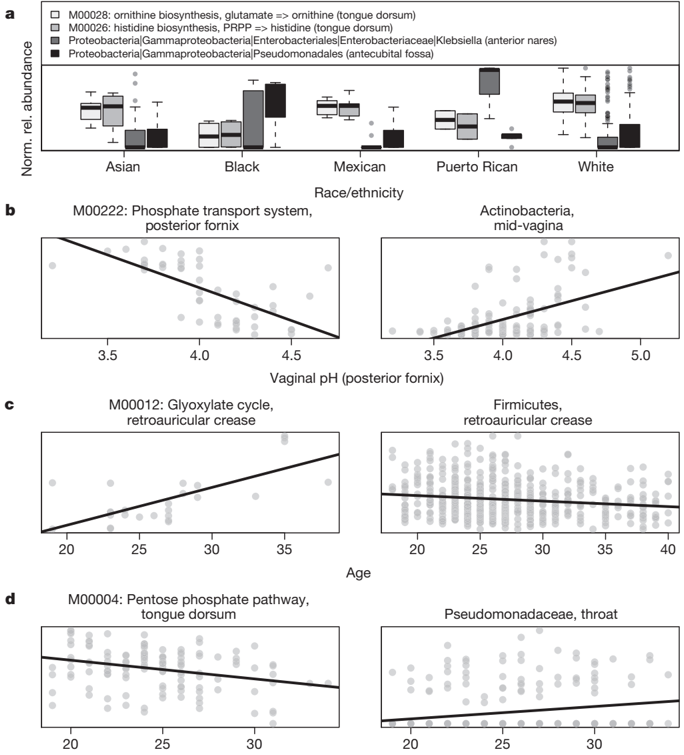
Studies of the human microbiome have revealed that even healthy individuals differ remarkably in the microbes that occupy habitats such as the gut, skin and vagina. Much of this diversity remains unexplained, although diet, environment, host genetics and early microbial exposure have all been implicated. Accordingly, to characterize the ecology of human-associated microbial communities, the Human Microbiome Project has analysed the largest cohort and set of distinct, clinically relevant body habitats so far. We found the diversity and abundance of each habitat’s signature microbes to vary widely even among healthy subjects, with strong niche specialization both within and among individuals. The project encountered an estimated 81–99% of the genera, enzyme families and community configurations occupied by the healthy Western microbiome. Metagenomic carriage of metabolic pathways was stable among individuals despite variation in community structure, and ethnic/racial background proved to be one of the strongest associations of both pathways and microbes with clinical metadata. These results thus delineate the range of structural and functional configurations normal in the microbial communities of a healthy population, enabling future characterization of the epidemiology, ecology and translational applications of the human microbiome.
Overview
The claims and statistics of this paper haven’t been checked yet.
Free: it reads the open-access text and checks the first 5 claims that cite a source we can check. Create a free account to check every claim.
Integrity signals
Registry
Cites
Statistics
Figures
Verification
Claims the paper makes
The claims and statistics of this paper haven’t been checked yet.
Free: it reads the open-access text and checks the first 5 claims that cite a source we can check. Create a free account to check every claim.
Claims other papers make about this one
Each is checked against this paper’s own text: does it say what the citing paper says it does?
The cited source doesn’t support the claim as written.
In the citing paper
“newly diagnosed cases with adenocarcinoma of the colon or rectum were recruited prior to surgery and treatment during 1985–19891, 2. Controls were patients awaiting elective surgery for non-oncologic, non-gastrointestinal conditions at these hospitals during the same period.”
From Assessment of variation in microbial community amplicon sequencing by the Microbiome Quality Control (MBQC) project consortium (2017) · cites this paper as [1]
Checked by a reasoning model — may be wrong.
Experimental — accuracy not yet measuredThe source backs part of the claim, not all of it — or backs it for a different population, condition or comparison.
In the citing paper
“Multiple factors affect the composition of the human gut microbiome, including geography, diet, infection and drug usage56,61–64.”
From Intestinal microbiota signatures of clinical response and immune-related adverse events in melanoma patients treated with anti-PD-1 (2022) · cites this paper as [64]
Experimental — accuracy not yet measuredThe source backs part of the claim, not all of it — or backs it for a different population, condition or comparison.
In the citing paper
“suggesting that no severe gut microbiome dysbiosis was present in the study group at baseline”
From Gut microbiome affects the response to anti-PD-1 immunotherapy in patients with hepatocellular carcinoma (2019) · cites this paper as [9]
Experimental — accuracy not yet measuredThe source backs part of the claim, not all of it — or backs it for a different population, condition or comparison.
In the citing paper
“Gut microbiota comprise thousands of microbial species that are involved in host metabolism by regulating energy extraction, activation of the immune system, drug metabolism, and other processes.”
From The Gut Microbiome Contributes to a Substantial Proportion of the Variation in Blood Lipids (2015) · cites this paper as [3]
Experimental — accuracy not yet measuredThe source backs part of the claim, not all of it — or backs it for a different population, condition or comparison.
In the citing paper
“The human gut microbiota contains thousands of different bacterial taxa as well as various archaea, eukaryotic microbes and viruses, more than three million genes, and harbors an enormous metabolic capacity [1, 2].”
From The athletic gut microbiota (2020) · cites this paper as [1]
Experimental — accuracy not yet measured
20 more claims about this paper
Create a free account to see every claim other papers make about this one.
Self-check
Percentages, sums and reported differences re-computed from the paper’s own numbers.
The self-check needs the paper’s full text.
Citations
Cites
Fast and accurate short read alignment with Burrows-Wheeler transform
Li, H., & Durbin, R. (2009) · Bioinformatics · doi:10.1093/bioinformatics/btp324 · Cited by 58,607
QIIME allows analysis of high-throughput community sequencing data
Caporaso, J. G., Kuczynski, J., Stombaugh, J., Bittinger, K., Bushman, F. D., Costello, E. K., Fierer, N., Peña, A. G., Goodrich, J. K., Gordon, J. I., et al. (2010) · Nature Methods · doi:10.1038/nmeth.f.303 · Cited by 34,887
Fast and accurate long-read alignment with Burrows-Wheeler transform.
Li, H., & Durbin, R. (2010) · Bioinformatics · doi:10.1093/bioinformatics/btp698 · Cited by 12,063
A human gut microbial gene catalogue established by metagenomic sequencing
MetaHIT Consortium, Qin, J., Li, R., Raes, J., Arumugam, M., Burgdorf, K. S., Manichanh, C., Nielsen, T., Pons, N., Levenez, F., et al. (2010) · Nature · doi:10.1038/nature08821 · Cited by 11,624
A core gut microbiome in obese and lean twins
Turnbaugh, P. J., Hamady, M., Yatsunenko, T., Cantarel, B. L., Duncan, A., Ley, R. E., Sogin, M. L., Jones, W. J., Roe, B. A., Affourtit, J. P., et al. (2009) · Nature · doi:10.1038/nature07540 · Cited by 7,823
Self-citationSokol, H., Pigneur, B., Watterlot, L., Lakhdari, O., Bermúdez-Humarán, L. G., Gratadoux, J.-J., Blugeon, S., Bridonneau, C., Furet, J.-P., Corthier, G., et al. (2008) · Proceedings of the National Academy of Sciences · doi:10.1073/pnas.0804812105 · Cited by 4,413
Vaginal microbiome of reproductive-age women
Ravel, J., Gajer, P., Abdo, Z., Schneider, G. M., Koenig, S. S. K., McCulle, S. L., Karlebach, S., Gorle, R., Russell, J., Tacket, C. O., et al. (2011) · Proceedings of the National Academy of Sciences · doi:10.1073/pnas.1002611107 · Cited by 4,254
Bacterial Community Variation in Human Body Habitats Across Space and Time
Costello, E. K., Lauber, C. L., Hamady, M., Fierer, N., Gordon, J. I., & Knight, R. (2009) · Science · doi:10.1126/science.1177486 · Cited by 3,231
Defining the normal bacterial flora of the oral cavity
Aas, J. A., Paster, B. J., Stokes, L. N., Olsen, I., & Dewhirst, F. E. (2005) · Journal of Clinical Microbiology · doi:10.1128/jcm.43.11.5721-5732.2005 · Cited by 3,092
Topographical and Temporal Diversity of the Human Skin Microbiome
Grice, E. A., Kong, H. H., Conlan, S., Deming, C. B., Davis, J., Young, A. C., Program, N. C. S., Bouffard, G. G., Blakesley, R. W., Murray, P. R., et al. (2009) · Science · doi:10.1126/science.1171700 · Cited by 2,953
Cited by
DADA2: High–resolution sample inference from Illumina amplicon data
Callahan, B. J., McMurdie, P. J., Rosen, M. J., Han, A. W., Johnson, A. J. A., & Holmes, S. P. (2016) · Nature Methods · doi:10.1038/nmeth.3869 · Cited by 35,698
phyloseq: An R Package for Reproducible Interactive Analysis and Graphics of Microbiome Census Data
McMurdie, P. J., & Holmes, S. (2013) · PLoS ONE · doi:10.1371/journal.pone.0061217 · Cited by 21,322
“Thresholding and noise filtering were done independently by each team, but no overall robustness study was performed [79].”
MethodUPARSE: highly accurate OTU sequences from microbial amplicon reads
Edgar, R. C. (2013) · Nature Methods · doi:10.1038/nmeth.2604 · Cited by 16,707
VSEARCH: a versatile open source tool for metagenomics
(2016) · doi:10.7717/peerj.2584 · Cited by 10,773
Predictive functional profiling of microbial communities using 16S rRNA marker gene sequences
Langille, M. G. I., Zaneveld, J., Caporaso, J. G., McDonald, D., Knights, D., Reyes, J. A., Clemente, J. C., Burkepile, D. E., Vega Thurber, R. L., Knight, R., et al. (2013) · Nature Biotechnology · doi:10.1038/nbt.2676 · Cited by 9,116
Metadata
- Authors
- The Human Microbiome Project Consortium
- Venue
- Nature
- Published
- 2012-06
- Volume
- 486
- Issue
- 7402
- Pages
- 207-214
- ISSN
- 0028-0836 (ISSN-L)
- 1476-4687
- PMC
- PMC3564958
- OpenAlex
- W2128769815
- Semantic Scholar
- 0c431405ec1eb4b84a52ed1fcc530454a4b8bf6f
- Cited by
- 11,726
- References
- 29
- Citations by year
- 2026: 586 · 2025: 748 · 2024: 890 · 2023: 950 · 2022: 1024 · 2021: 1202 · 2020: 1137 · 2019: 1032 · 2018: 863 · 2017: 853 · 2016: 732 · 2015: 651 · 2014: 532 · 2013: 413 · 2012: 104
- FWCI
- 218.52
- Type
- journal article
- Language
- en
- Open access
- hybrid
- doi.org
- Licence
- cc-by-nc-sa
- creativecommons.org/licenses/by-nc-sa/3.0/ (tdm)
- Locations
- Nature (publishedVersion, cc-by-nc-sa)
- PubMed (publishedVersion)
- Goce Delchev University Repository (Goce Delčev University of Štip) (acceptedVersion)
- Europe PMC (PubMed Central) (acceptedVersion)
- PubMed Central (acceptedVersion)
- eScholarship (California Digital Library) (submittedVersion, cc-by)
- Rutgers University Community Repository (Rutgers University) (submittedVersion)
- Open Access Server of the Woods Hole Scientific Community (Woods Hole Scientific Community) (submittedVersion)
- eScholarship (California Digital Library) (submittedVersion)
- Funders
- National Science Foundation (DEAC02-05CH11231, 1053486, 0812111)
- Howard Hughes Medical Institute (DE-AC02-05CH11231)
- U.S. Department of Energy (-AC02-05CH11231, Contract No. DE-AC02-05-CH11231, 05CH11231, No. DE-AC02-05-CH11231, DE AC02 05CH11231, DE-AC02-)
- Gordon and Betty Moore Foundation
- Rice University
- Gladstone Institutes
- Crohn's and Colitis Foundation
- Crohn's and Colitis Foundation of Canada
- Fonds Wetenschappelijk Onderzoek (DE-AC02-05CH11231)
- Vlaamse regering
- National Institutes of Health (5r01hg005172-03, n01hg62088-6-0-1, DE-AC02–05CH11231, DBI-1053486, DP2OD001500, 5r01hg004857-03, n01ai30071-19-0-3)
- Defense Threat Reduction Agency (B104153I, DE-AC02-05CH11231, B084531I)
- Office of Science (No. DE-AC02- 05-CH11231, DEAC02–05CH11231, AC02-05CH11231, DE-AC02, 05CH11231, Contract No. DE-AC02-05CH11231)
- Horace H. Rackham School of Graduate Studies, University of Michigan
- National Human Genome Research Institute (R01HG004885, U54HG003067, R01HG005975, R01-HG004857, U54HG004969, R01HG004853, U54HG003079, U01HG004866, R01HG005969, R01-HG005172, U54HG003273, R01HG004872, R21HG005811, U54HG004968, N01 HG062088, R01HG004906, R01HG004908, U54HG004973, R01HG004856, R01HG004900, R01HG005171, R01HG004877)
- National Cancer Institute (R21CA139193)
- National Institute of General Medical Sciences (T32GM087237)
- National Institute of Allergy and Infectious Diseases (UH2AI083263, UH3AI083263, U54AI084844, T32AI007528, N01 AI030071)
- National Institute of Diabetes and Digestive and Kidney Diseases (UH2DK083990, UH3DK083993)
- National Institute of Arthritis and Musculoskeletal and Skin Diseases (UH2 AR057504, UH2AR057506, UH3-AR057504)
- National Institute of Dental and Craniofacial Research (P30DE020751, R01DE021574, U01DE016937, RC1DE0202098, R37DE016937, RC1DE020298)
- U.S. National Library of Medicine
- Division of Biological Infrastructure (DBI-1053486)
- Army Research Office (DE-AC02-05CH11231, W911NF-11-1-0473, W911NF, W911NF-11)
- Los Alamos National Laboratory (DE-AC02-05CH11231)
- Topics
- Life Sciences › Biochemistry, Genetics and Molecular Biology › Molecular Biology › Gut microbiota and health
- Physical Sciences › Environmental Science › Ecology › Microbial Community Ecology and Physiology
- Health Sciences › Dentistry › Periodontics › Oral microbiology and periodontitis research
- Keywords
- human microbiome, healthy individuals, microbial diversity, gut microbiota, skin microbiome, vaginal microbiota, ecological specialization, metabolic pathways, Human Microbiome Project, metagenomics, microbial ecology
- MeSH terms
- Adolescent, Adult, Bacteria, Female, Health, Humans, Male, Phenotype, RNA, Ribosomal, 16S, Ecosystem, Biodiversity, Metabolic Networks and Pathways, Metagenome, Young Adult, Metagenomics
About these checks
Registry, retraction, Cites and statistics results are computed, not judged, with one exception: a printed reference that no index lists is read once by a model before it counts as a citation error. Claims are extracted by a model and kept only when their quote appears verbatim in the text; each cited source is then checked, with a model’s help, for whether it says what the claim relies on. Those verdicts can be wrong — read the claim’s quote and the cited source before relying on one.
Statistics and arithmetic are recomputed, not judged.
Confidence bands are shown only for fields calibrated on our annotated test set. None is calibrated yet, so no band is shown.
What counts as a claim ›How we measure confidence ›How we check this ›
Are you an author, or do you see a problem with this page? Request a review
Data sources
Bibliographic data: Semantic Scholar, OpenAlex, Crossref.
Contains information from the Semantic Scholar Academic Graph Datasets, made available under the ODC Attribution License (ODC-BY 1.0).
Semantic Scholar’s data is described in: Kinney, R., et al. (2023). The Semantic Scholar Open Data Platform. arXiv:2301.10140.
