

The DOI matches its Crossref record; 40 of the 40 references it cites were found in a registry or an index.
Integrated genomic characterization of endometrial carcinoma
Open accessAbstract
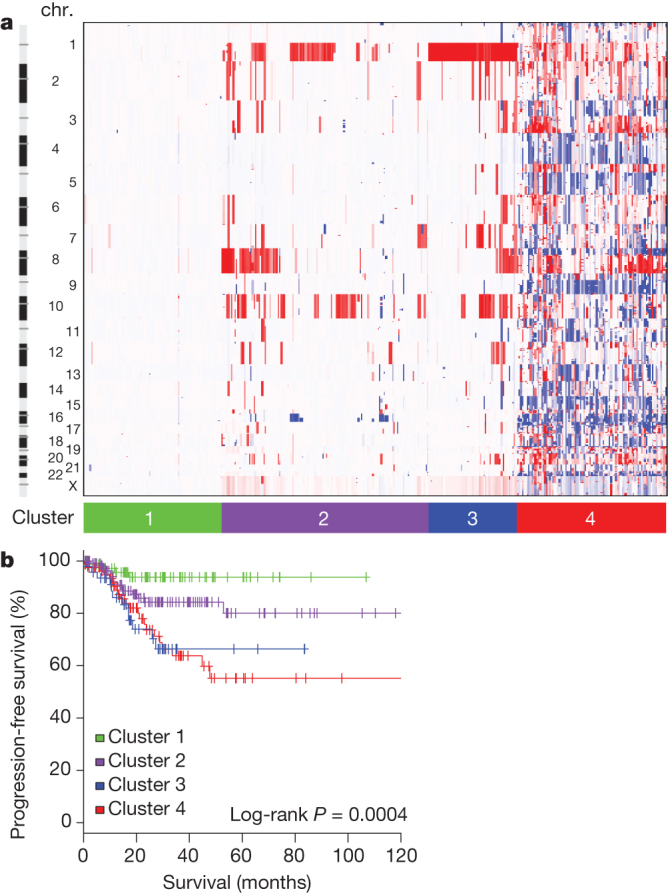
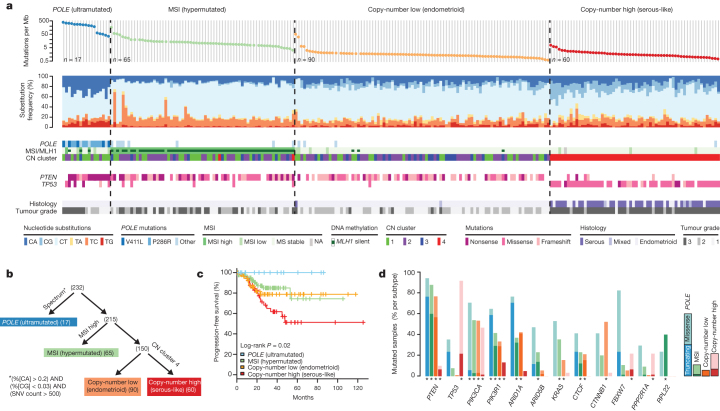
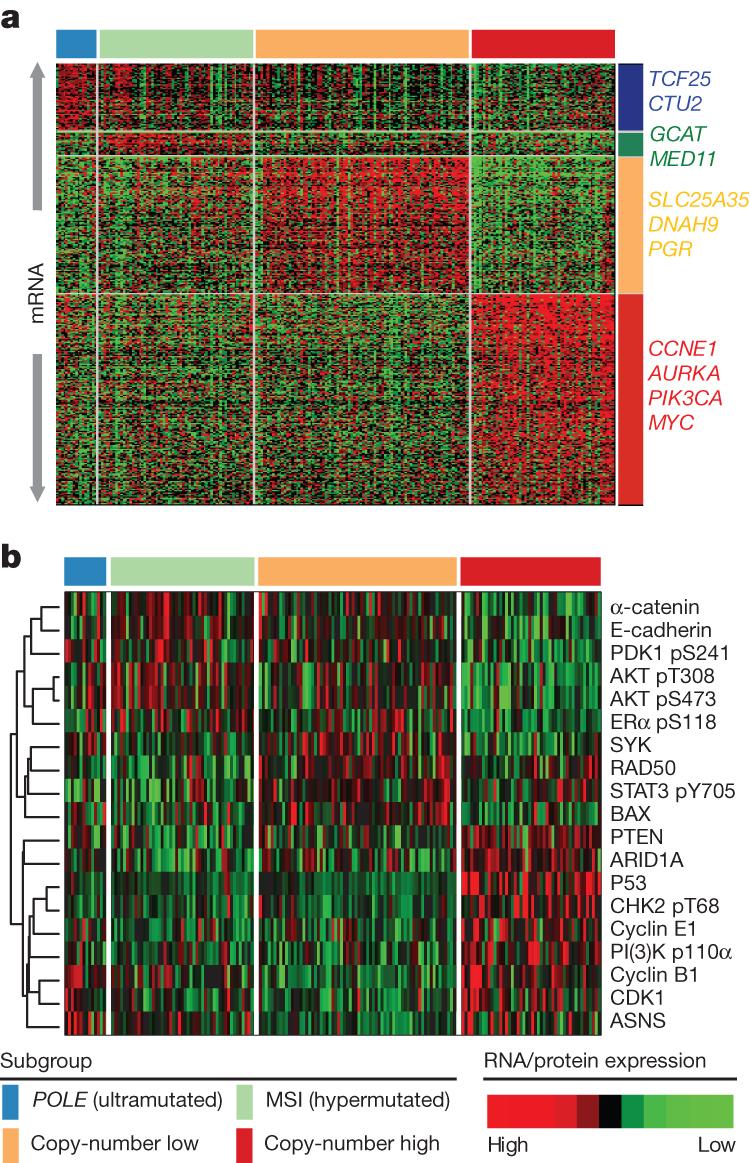
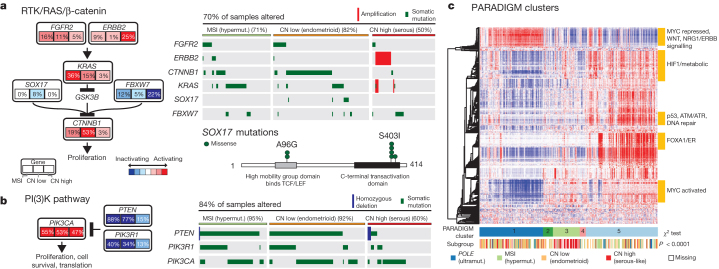
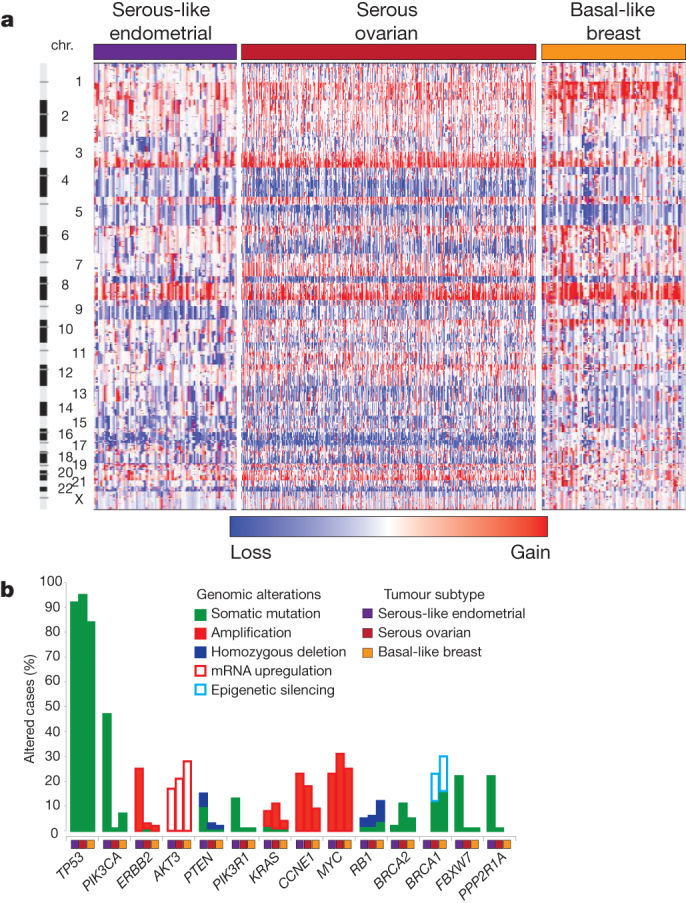
SummaryWe performed an integrated genomic, transcriptomic, and proteomic characterization of 373 endometrial carcinomas using array- and sequencing-based technologies. Uterine serous tumors and ~25% of high-grade endometrioid tumors have extensive copy number alterations, few DNA methylation changes, low ER/PR levels, and frequent TP53 mutations. Most endometrioid tumors have few copy number alterations or TP53 mutations but frequent mutations in PTEN, CTNNB1, PIK3CA, ARID1A, KRAS and novel mutations in the SWI/SNF gene ARID5B. A subset of endometrioid tumors we identified had a dramatically increased transversion mutation frequency, and newly identified hotspot mutations in POLE. Our results classified endometrial cancers into four categories: POLE ultramutated, microsatellite instability hypermutated, copy number low, and copy number high. Uterine serous carcinomas share genomic features with ovarian serous and basal-like breast carcinomas. We demonstrated that the genomic features of endometrial carcinomas permit a reclassification that may impact post-surgical adjuvant treatment for women with aggressive tumors.
Overview
The claims and statistics of this paper haven’t been checked yet.
Run the check — free, no account needed. It reads the open-access text and checks the sources it cites.
Integrity signals
Registry
Cites
Statistics
Figures
Verification
Claims the paper makes
The claims and statistics of this paper haven’t been checked yet.
Run the check — free, no account needed. It reads the open-access text and checks the sources it cites.
Claims other papers make about this one
Each is checked against this paper’s own text: does it say what the citing paper says it does?
In the citing paper
“AR is up-regulated in 9.8% of endometrial adenocarcinoma grade 3 samples [63, 90].”
From Role of aldo-keto reductase family 1 (AKR1) enzymes in human steroid metabolism (2014) · cites this paper as [90]
Self-check
Percentages, sums and reported differences re-computed from the paper’s own numbers.
The self-check needs the paper’s full text.
Citations
Cites
Dubrawsky, N. (1989) · Ca · doi:10.3322/canjclin.39.6.399 · Cited by 84,410
Comprehensive molecular portraits of human breast tumours
The Cancer Genome Atlas Network (2012) · Nature · doi:10.1038/nature11412 · Cited by 12,129
Siegel, R., Naishadham, D., & Jemal, A. (2013) · CA A Cancer Journal for Clinicians · doi:10.3322/caac.21166 · Cited by 11,825
Comprehensive molecular characterization of human colon and rectal cancer
The Cancer Genome Atlas Network (2012) · Nature · doi:10.1038/nature11252 · Cited by 8,499
Bcl-2 is an inner mitochondrial membrane protein that blocks programmed cell death
Hockenbery, D., Nuñez, G., Milliman, C., Schreiber, R. D., & Korsmeyer, S. J. (1990) · Nature · doi:10.1038/348334a0 · Cited by 3,720
Mermel, C. H., Schumacher, S. E., Hill, B., Meyerson, M. M., Beroukhim, R., & Getz, G. A. (2011) · Genome biology · doi:10.1186/gb-2011-12-4-r41 · Cited by 3,520
Self-citationCpG island methylator phenotype in colorectal cancer
Toyota, M., Ahuja, N., Ohe-Toyota, M., Herman, J. G., Baylin, S. B., & Issa, J. J. (1999) · Proceedings of the National Academy of Sciences · doi:10.1073/pnas.96.15.8681 · Cited by 2,562
Identification of a CpG Island Methylator Phenotype that Defines a Distinct Subgroup of Glioma
Noushmehr, H., Weisenberger, D. J., Diefes, K., Phillips, H. S., Pujara, K., Berman, B. P., Pan, F., Pelloski, C. E., Sulman, E. P., Bhat, K. P., et al. (2010) · Cancer Cell · doi:10.1016/j.ccr.2010.03.017 · Cited by 2,337
Self-citationMetagenes and molecular pattern discovery using matrix factorization
Brunet, J.-P., Tamayo, P., Golub, T. R., & Mesirov, J. P. (2004) · Proceedings of the National Academy of Sciences · doi:10.1073/pnas.0308531101 · Cited by 2,183
A comprehensive catalogue of somatic mutations from a human cancer genome
Pleasance, E. D., Cheetham, R. K., Stephens, P. J., McBride, D. J., Humphray, S. J., Greenman, C. D., Varela, I., Lin, M.-L., Ordóñez, G. R., Bignell, G. R., et al. (2010) · Nature · doi:10.1038/nature08658 · Cited by 1,696
Research works printed but not linked: 2
- Lax, S. F. & Kurman, R. J. A dualistic model for endometrial carcinogenesis based on immunohistochemical and molecular genetic analyses. Verh. Dtsch. Ges. Pathol. 81, 228–232 (1997)
- Levine, R. L. et al. PTEN mutations and microsatellite instability in complex atypical hyperplasia, a precursor lesion to uterine endometrioid carcinoma. Cancer Res. 58, 3254–3258 (1998)
Cited by
Sorted by citations
Items 201–300 of 477
Tumor immune microenvironment and mutational analysis of tracheal adenoid cystic carcinoma
Wang, F., Xie, X., Song, M., et al. (2020) · Annals of Translational Medicine · doi:10.21037/atm-20-3433 · Cited by 20
“Two (25%) TACCs were found as TMB-High (containing ≥200 mutations) (18), which both harbored the POLE mutation (19).”
BackgroundMolecular Profiles of Mixed Endometrial Carcinoma
Matrai, C. E., Motanagh, S. A., Mirabelli, S., Ma, L. X., He, B., Chapman‐Davis, E., Kurtis, B., Elemento, O., Mosquera, J. M., & Ellenson, L. H. (2020) · The American Journal of Surgical Pathology · doi:10.1097/pas.0000000000001519 · Cited by 20
Backman, S., Botling, J., Nord, H., Ghosal, S., Stalberg, P. L. H., Juhlin, C. C., Almlöf, J. C., Sundin, A., Zhang, L., Moens, L., et al. (2024) · The Journal of Pathology · doi:10.1002/path.6348 · Cited by 22
The extended spectrum of RAS‐MAPK pathway mutations in colorectal cancer
Costigan, D. C., & Dong, F. (2019) · Genes Chromosomes and Cancer · doi:10.1002/gcc.22813 · Cited by 21
“The adoption of next-generation sequencing into clinical practice has enhanced the understanding of cancer genomes, and a recognition of the potential of big data to enable new discoveries has encouraged interinstitutional collaboration through data sharing.(64,65) Large-scale genomic analysis has led to the recogniti…”
BackgroundIdentification of the Mutational Landscape of Gynecological Malignancies
Chava, S., & Gupta, R. (2020) · Journal of Cancer · doi:10.7150/jca.46174 · Cited by 16
“To do so, we analyzed TCGA dataset encompassing 607 patients with cervical cancer [5, 12] 1,672 cases patients with ovary/fallopian tube cancer [5, 12-14] 1,799 patients with uterine cancer [12, 15-18] and 15 patients with vulvar/vaginal cancer [19] and plotted the mutations frequencies for each of the 16 identified g…”
MethodPiffoux, M., Leary, A. F., Follana, P., et al. (2025) · Nature Communications · doi:10.1038/s41467-025-56914-7 · Cited by 18
Yang, Y., & Wang, M. (2022) · Translational Cancer Research · doi:10.21037/tcr-22-660 · Cited by 17
Aguilar, M., Chen, H., Sahoo, S. S., et al. (2023) · The American Journal of Surgical Pathology · doi:10.1097/pas.0000000000002034 · Cited by 18
Genetic and epigenetic alterations in precursor lesions of endometrial endometrioid carcinoma
Gotoh, O., Sugiyama, Y., Tonooka, A., Kosugi, M., Kitaura, S., Minegishi, R., Sano, M., Amino, S., Furuya, R., Tanaka, N., et al. (2024) · The Journal of Pathology · doi:10.1002/path.6278 · Cited by 19
Santin, A. D., Filiaci, V. L., Bellone, S., et al. (2020) · Gynecologic Oncology Reports · doi:10.1016/j.gore.2019.100532 · Cited by 18
Liang, Y., Lin, B., Ye, Z., et al. (2020) · Journal of Cancer · doi:10.7150/jca.33720 · Cited by 18
Clinicopathologic and genomic characteristics of mucinous gastric adenocarcinoma
Lee, J. E., Choi, Y. Y., An, J. Y., Kim, K., Shin, S., & Cheong, J. (2022) · Gastric Cancer · doi:10.1007/s10120-022-01295-9 · Cited by 17
Wang, Y., Chen, S., Wang, H., & Guo, F. (2023) · Biomedicine & Pharmacotherapy · doi:10.1016/j.biopha.2023.115348 · Cited by 18
Kang, E., Tessier‐Cloutier, B., Duggan, M. A., et al. (2021) · Histopathology · doi:10.1111/his.14333 · Cited by 17
Genomic alterations caused by HPV integration in a cohort of Chinese endocervical adenocarcinomas
Li, W., Lei, W., Chao, X., Song, X., Bi, Y., Wu, H., Wu, M. P., & Li, L. (2021) · Cancer Gene Therapy · doi:10.1038/s41417-020-00283-4 · Cited by 18
Wang, L., Piskorz, A., Bosse, T., et al. (2021) · International Journal of Gynecological Pathology · doi:10.1097/pgp.0000000000000763 · Cited by 17
“PTEN is the most commonly altered gene in endometrial endometrioid carcinoma (84%) (1).”
BackgroundEndometrial cancer in the morbidly obese: a review
Liu, M. C., Gardner, A. B., Wolford, J. E., et al. (2019) · Current Opinion in Obstetrics & Gynecology · doi:10.1097/gco.0000000000000606 · Cited by 17
“This is a category defined by high number of copy-number alterations, low mutation rates, TP53, FBXW7 and PPP2R1A mutations [4,5].”
BackgroundInfrared and Raman spectroscopy of blood plasma for rapid endometrial cancer detection
Schiemer, R., Grant, J., Shafiee, M. N., Phang, S., Furniss, D., Boitor, R., Seddon, A. B., Notingher, I., Atiomo, W., Jones, N. W., et al. (2025) · British Journal of Cancer · doi:10.1038/s41416-025-03050-0 · Cited by 16
“Recent advances in the genomic and proteomic characterisation of EC, particularly through The Cancer Genome Atlas (TCGA) project [10], have led to a re fi ned understanding of its molecular landscape and the identi fi cation of four EC molecular subtypes.”
Matsumoto, N. P., Manrai, P. A., Rottmann, D. A., Wu, X., Assem, H., Hui, P., & Buza, N. (2022) · International Journal of Gynecological Pathology · doi:10.1097/pgp.0000000000000930 · Cited by 16
Copy number variations in endometrial cancer: from biological significance to clinical utility
Dugo, E., Piva, F., Giulietti, M., Giannella, L., & Ciavattini, A. (2024) · International Journal of Gynecological Cancer · doi:10.1136/ijgc-2024-005295 · Cited by 16
“21 Furthermore, endometrial cancer has recently been classified into four molecular subclasses 22 on the basis of their mutation spectrum: (i) ultra-mutated POLE, due to the presence of high rates of mutations in the gene encoding DNA polymerase ε (POLEmut) (ie, the enzymatic protein involved in…”
BackgroundSon, C. H., Fleming, G. F., & Moroney, J. W. (2017) · Cancer Management and Research · doi:10.2147/cmar.s116683 · Cited by 16
“POLE is a component of the DNA polymerase epsilon, and endometrial cancer patients with this mutation (~10% of patients) have the best prognosis of the 4 subtypes, with PFS of nearly 100%, even in grade 3 tumors.(59,60) MSI hypermutated and copy-number low tumors have an intermediate prognosis, while copy-number high…”
InfluentialBuchynska, L. G., Brieiev, O. V., & Iurchenko, N. P. (2019) · Experimental Oncology · doi:10.32471/exp-oncology.2312-8852.vol-41-no-2.12973 · Cited by 16
Saeki, H., Hlaing, M. T., Horimoto, Y., et al. (2019) · Journal of obstetrics and gynaecology research · doi:10.1111/jog.14061 · Cited by 16
“Endometrial cancer has long been clinically and histologically categorized into two types based on the status of estrogen (ER) and progesterone (PgR) receptors,(3,4) although it is genetically divided into four categories at present.(5) Most EC is type I, which is ER dependent and considered to arise from endometrial…”
BackgroundWu, J., Zheng, Y., Tian, Q., Yao, M., & Yi, X. (2019) · Journal of obstetrics and gynaecology research · doi:10.1111/jog.14054 · Cited by 16
Salem, A., Pinto, K. R., Koch, M. S., Liu, J., & Silva, E. G. (2020) · Annals of Diagnostic Pathology · doi:10.1016/j.anndiagpath.2020.151505 · Cited by 16
B7-H4 Further Stratifies Patients With Endometrial Cancer Exhibiting a Nonspecific Molecular Profile
Zong, L., Yu, S., Mo, S., et al. (2023) · Archives of Pathology & Laboratory Medicine · doi:10.5858/arpa.2022-0182-oa · Cited by 15
Joehlin-Price, A. S., Komforti, M. K., Ladwig, N. R., et al. (2023) · The American Journal of Surgical Pathology · doi:10.1097/pas.0000000000002030 · Cited by 15
“% cells staining for HER2, n (% if nonzero) < 5% 0 19 (35)∥ 0 5%-10% 0 5 (9) 1 (7) > 10% to <30% 0 2 (4) 0 ≥ 30% 4 (100) 4 (7) 14 (93) Intensity of HER2 expression, n (%) Strong 4 (100) 1 (2) 11 (73) Moderate 0 11 (20) 4 (27)** Weak 0 18 (33) 0 Basolateral or lateral”
Hyperplastic processes of endometrium: what's new?
Татарчук, Т. Ф., Kaluginа, L. V., & Тутченко, Т. Н. (2015) · Reproductive Endocrinology · doi:10.18370/2309-4117.2015.25.7-13 · Cited by 15
Current and Investigational Agents Targeting the Phosphoinositide 3‐Kinase Pathway
Tang, L. A., Dixon, B. N., Maples, K. T., et al. (2018) · Pharmacotherapy The Journal of Human Pharmacology and Drug Therapy · doi:10.1002/phar.2173 · Cited by 15
Role of the pathologist in assessing response to treatment of ovarian and endometrial cancers
Williams, A. T., & Ganesan, R. (2019) · Histopathology · doi:10.1111/his.13994 · Cited by 15
“More recently, four genomic subcategories of endometrial carcinoma have been identified through The Cancer Genome Atlas.(26) Endometrioid cancer may develop from precursor lesions, classified as hyperplasia without atypia and atypical hyperplasia/endometrioid intraepithelial neoplasia (AH/EIN).”
BackgroundInfluentialNatural products targeting cancer cell dependency
Shi, C., Yang, E. J., Tao, S., Ren, G., Mou, P. K., & Shim, J. S. (2021) · The Journal of Antibiotics · doi:10.1038/s41429-021-00438-x · Cited by 15
Aznar, A. L., Bebia, V., Gómez-Hidalgo, N. R., et al. (2024) · Clinical & Translational Oncology · doi:10.1007/s12094-024-03401-y · Cited by 14
Hammer, P. M., Wang, A., Vermij, L., Zdravkovic, S., Heilbroner, L. M., Ryan, E. E., Geisick, R. L. P., Charu, V., Longacre, T. A., Suarez, C. J., et al. (2024) · The American Journal of Surgical Pathology · doi:10.1097/pas.0000000000002250 · Cited by 14
“2,50,51 Recently, ER status has also demonstrated prognostic re fi nement in high-risk NSMP ECs.”
Libert, D. M., Hammer, P. M., Hui, C., Kidd, E. A., Folkins, A. K., Longacre, T. A., Yang, E., Charu, V., & Howitt, B. E. (2024) · Histopathology · doi:10.1111/his.15302 · Cited by 16
The roles and therapeutic applications of cytokines in endometrial cancer
Azadehrah, M., Vosoogh, S., & Azadehrah, M. (2022) · Journal of Reproductive Immunology · doi:10.1016/j.jri.2022.103652 · Cited by 17
Molecular biomarkers predicting early development of endometrial carcinoma: A pilot study
Lupini, L., Scutiero, G., Iannone, P., Martinello, R., Bassi, C., Ravaioli, N., Soave, I., Bonaccorsi, G., Lanza, G., Gafà, R., et al. (2019) · European Journal of Cancer Care · doi:10.1111/ecc.13137 · Cited by 14
Prognostic molecular biomarkers in endometrial cancer: A review
Hernández, J. E., González-Montiel, A., Allos-Villalva, J. C. C., de León, D. F. C., Barquet-Muñoz, S. A., Olivares-Mundo, A., La, H., & Prada, D. (2019) · Journal of Cancer Research & Therapy · doi:10.14312/2052-4994.2019-3 · Cited by 13
“Very recently, the results derived from the Cancer Genome Atlas have defined four groups of prognosis based on molecular classifiers [17]: POLE, ultra-mutated, MSI hyper mutated, copy number (CN) low, and CN high [18].”
Devor, E. J., Cha, E., Warrier, A., et al. (2018) · OncoTargets and Therapy · doi:10.2147/ott.s180921 · Cited by 14
“13 However, their placement within the new four class system 17,18 is less certain as they display features of both Class 2 and 3 tumors.”
Kayraklioglu, N., Katsakhyan, L., Cohen, P. A., et al. (2023) · International Journal of Gynecological Pathology · doi:10.1097/pgp.0000000000000977 · Cited by 13
“A similar rift was observed with survey perceptions of histologic typing and molecular classi fi cation of endometrial cancer (44), which have been validated many times over as an independent prognostic variable.”
MethodEndometrial cancer—is our knowledge changing?
Králíčková, M., Větvička, V., & Laganà, A. S. (2020) · Translational Cancer Research · doi:10.21037/tcr-20-1720 · Cited by 13
“Using the cluster analysis of data from The Cancer Genome Atlas research network (47), a recent study hypothesized that direct molecular characterization of EC will reveal mechanisms resulting in failure of treatment.”
BackgroundMethodLi, Y., Feng, J., Zhao, C., Lin, M., Shi, S., Liu, K., & Ma, J. (2022) · Annals of Translational Medicine · doi:10.21037/atm-22-3446 · Cited by 14
“In 2013, The Cancer Genome Atlas (TCGA) performed an integrated genomic, transcriptomic, and proteomic characterization of 373 endometrial carcinomas using array-and sequencing-based technologies, before conducting a typing study on the EC genome (7).”
Li, Y., Chen, R., Yuan, M., Wang, D., Fu, C., Chen, R., Lei, C., & Zhou, Q. (2022) · International Journal of Cancer · doi:10.1002/ijc.34241 · Cited by 14
“POLE ultramutated group had the best prognosis and the copy number high group had the worst prognosis.(6) However, the methodologies used in TCGA molecular classification were costly, complex and could not be easily used in the clinical settings.”
MethodResultWang, Y., Bo, L., Fan, X., et al. (2025) · Current Oncology · doi:10.3390/curroncol32060317 · Cited by 12
“First proposed in 2013, the Cancer Genome Atlas (TCGA) differentiates EC into four prognostically significant groups and was later recommended by the 5th WHO classification [5,6].”
New histopathological and molecular findings in gynecological cancers
McCluggage, W. G. (2025) · International Journal of Gynecology & Obstetrics · doi:10.1002/ijgo.70283 · Cited by 12
Response: FIGO staging of endometrial cancer 2023
Concin, N., Matías‐Guiu, X., Fotopoulou, C., et al. (2023) · International Journal of Gynecology & Obstetrics · doi:10.1002/ijgo.15277 · Cited by 12
“5 Furthermore, these European guidelines provide treat-ment recommendations based on a molecular profile for specific situations derived from the current level of evidence, even in the absence of Level I prospective trial evidence.”
BackgroundPrognostic value of molecular classification in stage IV endometrial cancer
Uijterwaal, M. H., van Dijk, D., Lok, C. A. R., et al. (2024) · International Journal of Gynecological Cancer · doi:10.1136/ijgc-2023-005058 · Cited by 12
Primary Endometrial Gastric (Gastrointestinal)-type Mucinous Adenocarcinoma
Kaur, H. B., Lin, L. H., Kolin, D. L., et al. (2025) · The American Journal of Surgical Pathology · doi:10.1097/pas.0000000000002382 · Cited by 12
“…(TCGA) in a seminal study reported an integrated genomic, transcriptomic, and proteomic-based molecular classi fi cation of endometrial carcinoma 18 and established 4 molecularly distinct and prognostically relevant groups including POLE (polymerase epsilon) mutated/ultramutated, microsatellite…”
Chen, Q., Wang, S., & Lang, J. (2021) · Journal of Cancer · doi:10.7150/jca.51493 · Cited by 12
“low (microsatellite stable [MSS]) and copy number– high [4].”
BackgroundClinical pathological characteristics and survival of high‐grade endometrioid carcinoma
Liang, S., & Zhang, Y. (2021) · Journal of obstetrics and gynaecology research · doi:10.1111/jog.14839 · Cited by 8
LncRNA THOR promotes endometrial cancer progression through the AKT and ERK signaling pathways
Zhang, H., Li, T., Li, C., et al. (2022) · Medical Oncology · doi:10.1007/s12032-022-01802-z · Cited by 12
Mrkonjic, M., & Turashvili, G. (2021) · The American Journal of Surgical Pathology · doi:10.1097/pas.0000000000001832 · Cited by 12
The Double Engines and Single Checkpoint Theory of Endometriosis
Hsu, C.-F., Khine, A. A., Huang, H.-S., & Chu, T.-Y. (2022) · Biomedicines · doi:10.3390/biomedicines10061403 · Cited by 12
Hashem, S., Zare, S. Y., & Fadare, O. (2023) · International Journal of Gynecological Pathology · doi:10.1097/pgp.0000000000000943 · Cited by 9
PAX8 plays an essential antiapoptotic role in uterine serous papillary cancer
Fares, F., Berger, L., Girsh, E., Kakun, R. R., Ghannam-Shahbari, D., Tabach, Y., Zohar, Y., Gottlieb, E., & Perets, R. (2021) · Oncogene · doi:10.1038/s41388-021-01925-z · Cited by 11
“PAX8 transcriptionally upregulates the expression of mutant p53 and p21 in USPC In the vast majority of cases, USPC is known to harbor p53 mutations [12].”
BackgroundMethodInfluentialKitazono, I., Kobayashi, Y., Akahane, T., Yamaguchi, T., Yanazume, S., Nohara, S., Sakamoto, I., Tabata, K., Tasaki, T., Kobayashi, H., et al. (2021) · Pathology - Research and Practice · doi:10.1016/j.prp.2021.153743 · Cited by 11
Qi, X., Zhu, L., & Zhang, B. (2022) · Journal of obstetrics and gynaecology research · doi:10.1111/jog.15335 · Cited by 11
Specific Pathology Features Enrich Selection of Endometrial Carcinomas for POLE Testing
Keyhanian, K., Han, L. M., Howitt, B. E., & Longacre, T. A. (2023) · The American Journal of Surgical Pathology · doi:10.1097/pas.0000000000002165 · Cited by 12
“…have veri fi ed that POLE -mu- tated tumors are associated with the most favorable prognosis while copy-number high tumors have a worse prognosis 3,6,7,4 and there is increasing interest in the incorporation of molecular classi fi cation with clinicopathologic risk strati fi cation to guide…”
BackgroundInfluentialKnockdown of CCNO decreases the tumorigenicity of gastric cancer by inducing apoptosis
Li, L., Cao, Y., Zhou, H., Li, Y., He, B., Zhou, X., Nie, Z., Li, L., Liu, Y., & Ye, L. (2018) · OncoTargets and Therapy · doi:10.2147/ott.s176252 · Cited by 11
Trinh, V. Q., Pelletier, M. P., Echelard, P., et al. (2019) · International Journal of Gynecological Pathology · doi:10.1097/pgp.0000000000000591 · Cited by 11
“These findings highlight the need to better classify its molecular background of this specific subset of tumors, and to possibly test for molecular heterogeneity pertaining to the main genomic molecular classes (18,19).”
BackgroundWang, L., Huang, Q., Lin, Q., et al. (2021) · Journal of obstetrics and gynaecology research · doi:10.1111/jog.14777 · Cited by 11
“three types have a good prognosis, while the latter one exhibits a poor prognosis.(5) The prognosis of most”
BackgroundCombination radiation and immunotherapy in gynecologic malignancies—a comprehensive review
Ladbury, C. J., Germino, E., Novak, J., Liu, J., Horne, Z. D., Dyer, B. A., & Glaser, S. (2021) · Translational Cancer Research · doi:10.21037/tcr-20-3019 · Cited by 12
Mori, S., Gotoh, O., Kiyotani, K., & Low, S. (2021) · Journal of Human Genetics · doi:10.1038/s10038-021-00940-y · Cited by 11
High-Grade Endometrial Cancer: Molecular Subtypes, Current Challenges, and Treatment Options
Matoba, Y., Devins, K. M., Milane, L. S., Manning, W. B., Mazina, V., Yeku, O., & Rueda, B. R. (2024) · Reproductive Sciences · doi:10.1007/s43032-024-01544-5 · Cited by 10
Fard, E. V., Imboden, S., Rau, T. T., Epstein, E., Lajus, T. B. P., Walia, S., & Carlson, J. W. (2024) · International Journal of Gynecological Pathology · doi:10.1097/pgp.0000000000001012 · Cited by 11
“The POLE status of TCGA cases was determined by array-based and sequence-based technologies as de fi ned in the study by the TCGA working group (2).”
InfluentialResearch Progress of DNA Methylation Markers for Endometrial Carcinoma Diagnosis
Zheng, H., Yu, C. H., Yang, L., Zhou, F., & Liu, A. (2024) · Journal of Cancer · doi:10.7150/jca.104214 · Cited by 10
Molecular Evaluation of Low-grade Low-stage Endometrial Cancer With and Without Recurrence
Matrai, C. E., Ohara, K., Eng, K., Glynn, S. M., Chandra, P., Chatterjee‐Paer, S., Motanagh, S. A., Mirabelli, S., Kurtis, B., He, B., et al. (2021) · International Journal of Gynecological Pathology · doi:10.1097/pgp.0000000000000798 · Cited by 9
“Int J Gynecol Pathol Vol. 41, No. 3, May 2022 The TCGA has noted that 25% of high-grade endometrioid tumors and a limited percentage of lower grade (1 and 2) endometrioid tumors (o5”
BackgroundMethodResultInfluentialKobayashi, R., Kawabata‐Iwakawa, R., Sugiyama, M., Oyama, T., Ohtsuka, M., Horii, T., Morita, S., Nishiyama, M., & Hatada, I. (2022) · International Journal of Cancer · doi:10.1002/ijc.34342 · Cited by 8
Li, H., Zhou, Q., Wu, Z., et al. (2023) · Annals of Translational Medicine · doi:10.21037/atm-22-6461 · Cited by 10
“Endometrioid endometrial carcinoma usually has a significantly better outcome than does serous haplotype, which is often less well differentiated (33-36).”
BackgroundInfluentialRossi, E. D., Bizzarro, T., Monterossi, G., et al. (2016) · Human Pathology · doi:10.1016/j.humpath.2016.12.015 · Cited by 10
PD-L1 and Mismatch Repair Status in Uterine Carcinosarcomas
Jenkins, T. M., Cantrell, L. A., Stoler, M. H., & Mills, A. M. (2020) · International Journal of Gynecological Pathology · doi:10.1097/pgp.0000000000000752 · Cited by 10
Weisman, P. S., Park, K. J., & Xu, J. Y. (2022) · PubMed · doi:10.1097/pgp.0000000000000775 · Cited by 10
“described in this series (1) represent a highly aggressive CTNNB1-mutated subset of the”
Sercan, Ç., Reyhan, A. N. H., Özen, Ö., et al. (2021) · International Journal of Gynecological Pathology · doi:10.1097/pgp.0000000000000809 · Cited by 10
“This classification system divides the tumors into 4 subgroups, namely, polymerase ε exonuclease ultramutated, hypermutated microsatellite instability, copy-number low, and copy-number high (serous-like) (4).”
BackgroundInnovative strategies for annotating the “relationSNP” between variants and molecular phenotypes
Miller, J. E., Veturi, Y., & Ritchie, M. D. (2019) · BioData Mining · doi:10.1186/s13040-019-0197-9 · Cited by 9
Barber, E. L., Chen, S., Pineda, M. J., Robertson, S. E., Hill, E. K., Teoh, D., Schilder, J., O'Shea, K. L., Kocherginsky, M., Zhang, B., et al. (2022) · Cancer Research Communications · doi:10.1158/2767-9764.crc-22-0147 · Cited by 9
“Most patients with endometrial cancer have pMMR/MSS tumors (38).”
BackgroundTumor-derived ARHGAP35 mutations enhance the Gα13-Rho signaling axis in human endometrial cancer
Yagi, H., Onoyama, I., Asanoma, K., Kawakami, M., Maenohara, S., Kodama, K., Matsumura, Y., Hamada, N., Hori, E., Hachisuga, K., et al. (2022) · Cancer Gene Therapy · doi:10.1038/s41417-022-00547-1 · Cited by 7
Loukovaara, M. J., Pasanen, A. M., & Bützow, R. C. (2024) · International Journal of Gynecology & Obstetrics · doi:10.1002/ijgo.15749 · Cited by 9
Kiyozumi, Y., Matsubayashi, H., Higashigawa, S., et al. (2020) · Cancer Epidemiology Biomarkers & Prevention · doi:10.1158/1055-9965.epi-20-0694 · Cited by 9
“TMB-high cancers are biologically less aggressive (10, 56), current cases were diagnosed within the operable stage and therefore may have higher incidence of highMSI and hTMB than entire cases of colorectal and ECs.”
BackgroundA seven-m6A regulator-related CpG site-based prognostic signature for endometrial carcinoma
Zhang, X., Pang, X., Huang, Y., & Qian, S. (2021) · Medicine · doi:10.1097/md.0000000000026648 · Cited by 8
Kim, S. I., Yoon, J. H., & Hur, S. Y. (2021) · Journal of Cancer · doi:10.7150/jca.60700 · Cited by 10
“Approximately 65% of endometrial cancers contain alterations within the Wnt signaling pathway [24].”
BackgroundLiu, X., Dingqing, F., Wang, W., Liang, J., Yu, H., & Ling, B. (2023) · Journal of Immunotherapy · doi:10.1097/cji.0000000000000463 · Cited by 8
Ju, B., Wu, J., Sun, L., Yang, C., Yu, H., Hao, Q., Wang, J., & Zhang, H. (2023) · International Journal of Gynecological Pathology · doi:10.1097/pgp.0000000000000980 · Cited by 9
“The genomic features revealed by The Cancer Genome Atlas classi fi ed endometrial cancers into 4 categories: POLE ultramutated, microsatellite instability (MSI) hypermu-tated, copy-number low, and copy-number high (12).”
Landmark Series on Disparities: Uterine Cancer and Strategies for Mitigation
Chapman‐Davis, E., Webster, E., Balogun, O., et al. (2022) · Annals of Surgical Oncology · doi:10.1245/s10434-022-12765-w · Cited by 9
“In 2013, the Cancer Genome Atlas (TCGA) landmark paper challenged the traditional two-tiered type I/type II endometrial cancer classification system, proposing four molecular classes of endometrial cancer: (1) DNA polymerase epsilon catalytic subunit mutated (POLE) (2) microsatellite instability (MSI), (3) copy-number…”
BackgroundThe Tale of CHD4 in DNA Damage Response and Chemotherapeutic Response
Lin, S.-Y., Zhang, J., & Shih, D. J. H. (2019) · Cancer Research and Cellular Therapeutics · doi:10.31579/2640-1053/052 · Cited by 9
“In endometrial cancer, CHD4 is one of the most frequently mutated tumor suppressor genes and typically sustains missense mutations (instead of deletions) [39, 40].”
BackgroundRole of signaling pathways in endometrial cancer
Balhara, N., Yadav, R., & Chauhan, M. B. (2025) · Molecular Biology Reports · doi:10.1007/s11033-025-10523-1 · Cited by 9
Timmermans, P. T., León‐Castillo, A., Kramer, C. J. H., et al. (2025) · International Journal of Gynecological Pathology · doi:10.1097/pgp.0000000000001112 · Cited by 8
Serkies, K., & Baczkowska-Waliszewska, Z. (2021) · Journal of Contemporary Brachytherapy · doi:10.5114/jcb.2021.105291 · Cited by 8
“Since 2013, based on a comprehensive molecular/genetic analysis of EC (EEC as a vast majority of cases) of Cancer Genome Atlas (TCGA), four molecular sub-classes were defined, such as POLE-mutated (mutations in the exonuclease domain of DNA polymerase epsilon gene) with exceptionally good prognosis, TP53-mutated serou…”
Cytopathological features associated with POLE mutation in endometrial cancer
Yanazume, S., Iwakiri, K., Kobayashi, Y., et al. (2023) · Cytopathology · doi:10.1111/cyt.13215 · Cited by 8
“subtype: (1) the presence of tumour giant cells, (2) numerous tumourinfiltrating”
BackgroundMethodLymph node evaluation in endometrial cancer: how did it change over the last two decades?
Pinelli, C., Artuso, V., Bogani, G., et al. (2020) · Translational Cancer Research · doi:10.21037/tcr-20-2165 · Cited by 8
“Recently, with the use of microarray and sequencing technologies, the Cancer Genome Atlas (TCGA) showed four molecular subgroups in EC, which were validated and simplified as follows: POLE ultramutated, mismatch repair‐deficient, p53 mutant and those EC lacking any of these alterations (47).”
BackgroundMeljen, V. T., Mittenzwei, R., Wong, J., et al. (2021) · International Journal of Gynecological Pathology · doi:10.1097/pgp.0000000000000747 · Cited by 8
“4 (35–69) Stage, n (%) IA 8 (42) 7 (70) 2 (67) 0 IB 7 (37) 2 (20) 1 (33) 3 (50) II 1 (5) 0 0 1 (17) III 2 (11) 0 0 2 (33) IV 0 0 0 0 Not specified, n (%) 1 (5) 1 (10.”
BackgroundImpact of Molecular Classification on Treatment Paradigms in Uterine Cancers
Cosgrove, C. M., Barrington, D. A. M., & Backes, F. J. (2021) · Current Oncology Reports · doi:10.1007/s11912-021-01073-3 · Cited by 9
Innovative Follow-up Strategies for Endometrial Cancer
Collins, A., Taylor, A., Guttery, D. S., & Moss, E. L. (2021) · Clinical Oncology · doi:10.1016/j.clon.2021.06.001 · Cited by 8
New Robust Clustering Model for Identifying Cancer Genome Landscapes
Gao, H., Wang, X., & Huang, H. (2016) · Proceedings · doi:10.1109/icdm.2016.0026 · Cited by 8
“Recent studies on a variety of cancer types indicate that tumors of the same tissue possess significant differences in genetic alterations [7], [8], while similar genetic alteration exists in tumors originating from distinct tissue or organ [9].”
BackgroundEndometrial endometrioid carcinoma, grade 1, is more aggressive in the elderly than in the young
Hachisuga, K., Ohishi, Y., Tomonobe, H., et al. (2021) · Histopathology · doi:10.1111/his.14400 · Cited by 8
“The Cancer Genome Atlas Research Network reported a comprehensive genomic and transcriptomic analysis of endometrial cancers.(3) Endometrial cancers were divided into four genomic classes: (i) POLE-ultramutated tumours characterised by very high mutation rates and hotspot mutations in the exonuclease domain of POLE (w…”
BackgroundCTCF Expression Is Essential for Somatic Cell Viability and Protection against CancerPreprint
Bailey, C. G., Metierre, C., Feng, J., et al. (2018) · Preprints.org · doi:10.20944/preprints201810.0451.v1 · Cited by 8
McHenry, A. J., Devereaux, K. A., Ryan, E. E., Chow, S. K.-Y., Allard, G. M., Ho, C. C., Suarez, C. J., Folkins, A. K., Yang, E., Longacre, T. A., et al. (2024) · Histopathology · doi:10.1111/his.15232 · Cited by 9
Ni, J., Tian, W., Liang, S., et al. (2021) · International Journal of Medical Sciences · doi:10.7150/ijms.58954 · Cited by 7
“Genetic mutations in PTEN, CTNNB1, PIK3CA, ARID1A, KRAS and ARID5B were frequently observed in endometrioid EC, while TP53 mutations as well as extensive copy number alterations were commonly detected in uterine serous carcinoma, using integrated genomic, transcriptomic and proteomic analyses [4].”
BackgroundTran, L. H., Christensen, P. A., Barroeta, J. E., et al. (2022) · International Journal of Gynecological Pathology · doi:10.1097/pgp.0000000000000897 · Cited by 7
Wu, S., Cai, W., Li, Y., Tan, W., Yuan, Y., Zhou, Z., Shi, J., Liu, X., & Gao, H. (2023) · International Journal of Medical Sciences · doi:10.7150/ijms.81962 · Cited by 7
“Recent years, molecular subtypes were also found to play an important role in EC, for example, Tumor Protein 53 (TP53) mutations, accompanied by abnormal p53 expression (p53-abn) indicate the worst prognosis[22].”
Diagnostic value of endometrial cytology and related technology
Munakata, S. (2022) · Diagnostic Cytopathology · doi:10.1002/dc.24956 · Cited by 7
Cui, C., Wu, Q., Zhou, H., He, H., Wang, Y., Tang, Z., Zhang, Y., Wang, X., Xiao, J., & Zhang, H. (2022) · Annals of Translational Medicine · doi:10.21037/atm-22-5783 · Cited by 5
“The upregulated genes [2,544] and downregulated genes [3,129] in the tumor specimens were modulated significantly compared to the normal control specimens (P<0.05 and FC >2 or FC <0.5; Figure S1A).”
Influential
Metadata
- Authors
- The Cancer Genome Atlas Research Network, & Levine, D. A.
- Affiliations
- Memorial Sloan Kettering Cancer Center (US)
- Corresponding author
- Levine, Douglas A.
- ORCID
- Levine, Douglas A.
- Venue
- Nature
- Published
- 2013-05-01
- Volume
- 497
- Issue
- 7447
- Pages
- 67-73
- ISSN
- 0028-0836 (ISSN-L)
- 1476-4687
- PMC
- PMC3704730
- OpenAlex
- W2041440766
- Cited by
- 5,784
- References
- 40
- Citations by year
- 2026: 467 · 2025: 580 · 2024: 559 · 2023: 595 · 2022: 591 · 2021: 572 · 2020: 455 · 2019: 384 · 2018: 320 · 2017: 328 · 2016: 313 · 2015: 285 · 2014: 231 · 2013: 96
- FWCI
- 345.78
- Type
- journal article
- Language
- en
- Update notices
- erratum (2013-06-12)
- Open access
- hybrid
- doi.org
- Licence
- Locations
- Nature (publishedVersion, cc-by-nc-sa)
- PubMed Central (publishedVersion, cc-by-nc-sa)
- PubMed (publishedVersion)
- Europe PMC (PubMed Central) (acceptedVersion)
- RePEc: Research Papers in Economics (submittedVersion)
- Funders
- National Institutes of Health
- National Human Genome Research Institute (U54HG003067, U54HG003079, U54HG003273)
- National Cancer Institute (P50CA098258, U24CA143882, R01CA180006, U24CA143843, U24CA143840, U24CA143858, U24CA144025, U24CA143866, U24CA143883, U24CA143845, U24CA143867, U24CA143848, U24CA143799, U24CA143835, P30CA008748, P30CA016672, P30CA016056, P30CA016086)
- Topics
- Health Sciences › Medicine › Obstetrics and Gynecology › Endometrial and Cervical Cancer Treatments
- Life Sciences › Biochemistry, Genetics and Molecular Biology › Cancer Research › Cancer Genomics and Diagnostics
- Life Sciences › Biochemistry, Genetics and Molecular Biology › Molecular Biology › Chromatin Remodeling and Cancer
- Keywords
- endometrial cancer, uterine serous carcinoma, endometrioid carcinoma, copy number alterations, TP53 mutation, POLE mutation, microsatellite instability, ARID5B, SWI/SNF chromatin remodeling, CTNNB1, PIK3CA, KRAS, PTEN, DNA methylation, oestrogen receptor, progesterone receptor, adjuvant therapy, genomic profiling
- MeSH terms
- Poly-ADP-Ribose Binding Proteins, Breast Neoplasms, Chromosome Aberrations, DNA Mutational Analysis, DNA Polymerase II, DNA-Binding Proteins, Female, Humans, Ovarian Neoplasms, Transcription Factors, Signal Transduction, Genome, Human, Gene Expression Regulation, Neoplastic, Endometrial Neoplasms, Genomics, DNA Copy Number Variations, Exome
About these checks
Registry, retraction, Cites and statistics results are computed, not judged, with one exception: a printed reference that no index lists is read once by a model before it counts as a citation error. Claims are extracted by a model and kept only when their quote appears verbatim in the text; each cited source is then checked, with a model’s help, for whether it says what the claim relies on. Those verdicts can be wrong — read the claim’s quote and the cited source before relying on one.
Statistics and arithmetic are recomputed, not judged.
Confidence bands are shown only for fields calibrated on our annotated test set. None is calibrated yet, so no band is shown.
What counts as a claim ›How we measure confidence ›How we check this ›
Are you an author, or do you see a problem with this page? Request a review
