

The DOI matches its Crossref record; 40 of the 40 references it cites were found in a registry or an index.
Integrated genomic characterization of endometrial carcinoma
Open accessAbstract
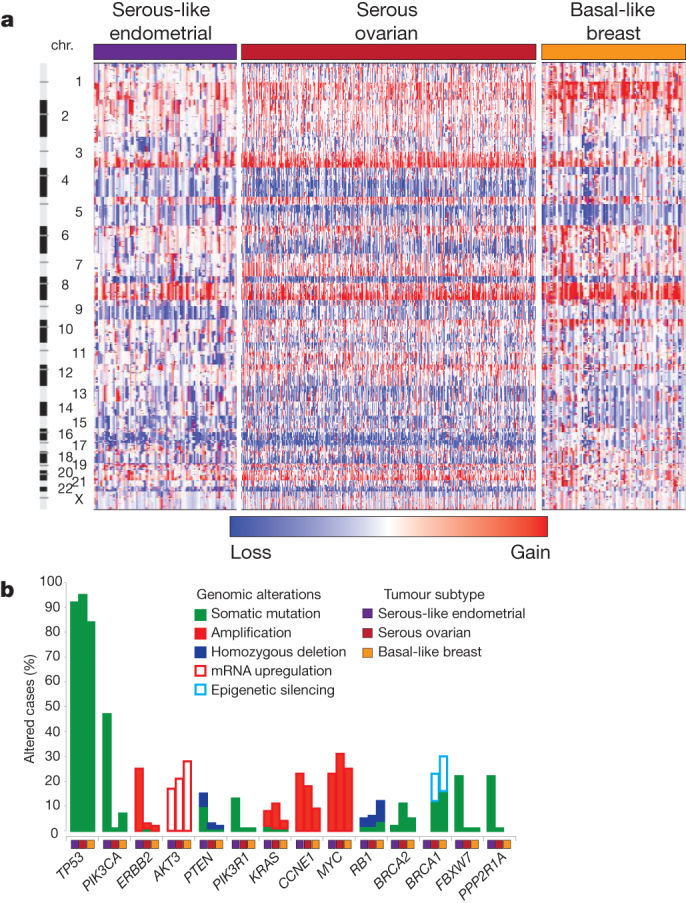
SummaryWe performed an integrated genomic, transcriptomic, and proteomic characterization of 373 endometrial carcinomas using array- and sequencing-based technologies. Uterine serous tumors and ~25% of high-grade endometrioid tumors have extensive copy number alterations, few DNA methylation changes, low ER/PR levels, and frequent TP53 mutations. Most endometrioid tumors have few copy number alterations or TP53 mutations but frequent mutations in PTEN, CTNNB1, PIK3CA, ARID1A, KRAS and novel mutations in the SWI/SNF gene ARID5B. A subset of endometrioid tumors we identified had a dramatically increased transversion mutation frequency, and newly identified hotspot mutations in POLE. Our results classified endometrial cancers into four categories: POLE ultramutated, microsatellite instability hypermutated, copy number low, and copy number high. Uterine serous carcinomas share genomic features with ovarian serous and basal-like breast carcinomas. We demonstrated that the genomic features of endometrial carcinomas permit a reclassification that may impact post-surgical adjuvant treatment for women with aggressive tumors.
Overview
The claims and statistics of this paper haven’t been checked yet.
Run the check — free, no account needed. It reads the open-access text and checks the sources it cites.
Integrity signals
Registry
Cites
Statistics
Figures
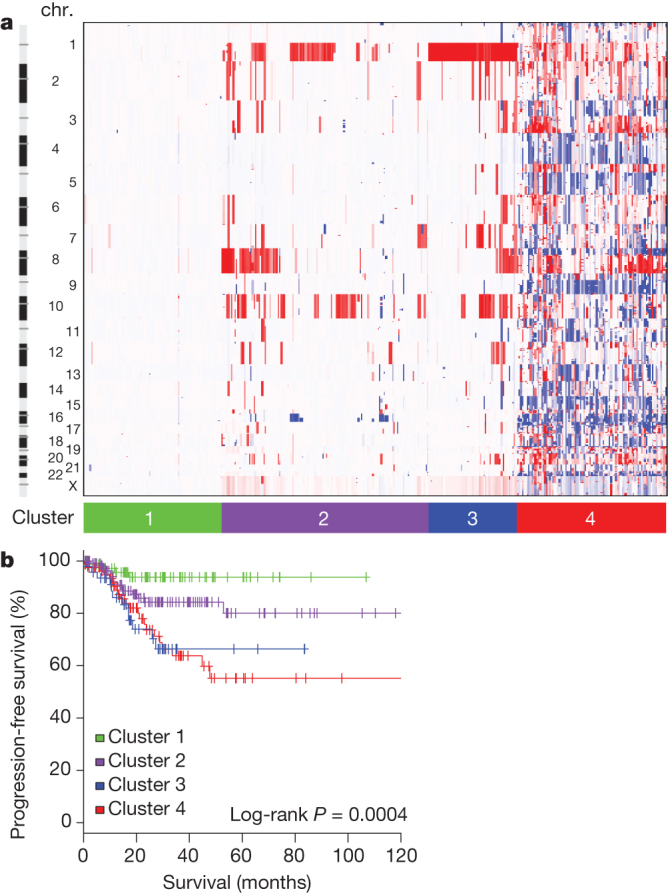
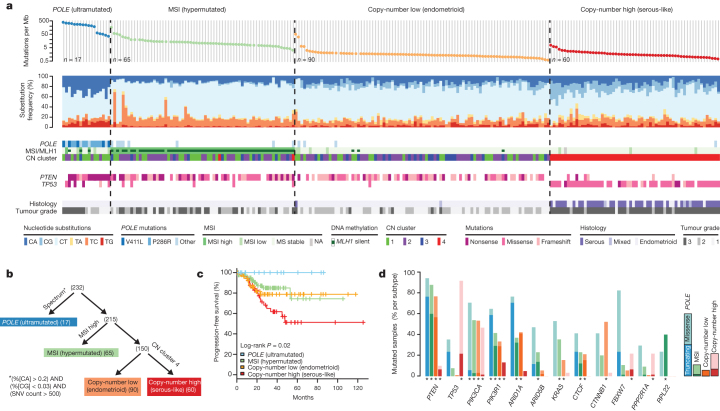
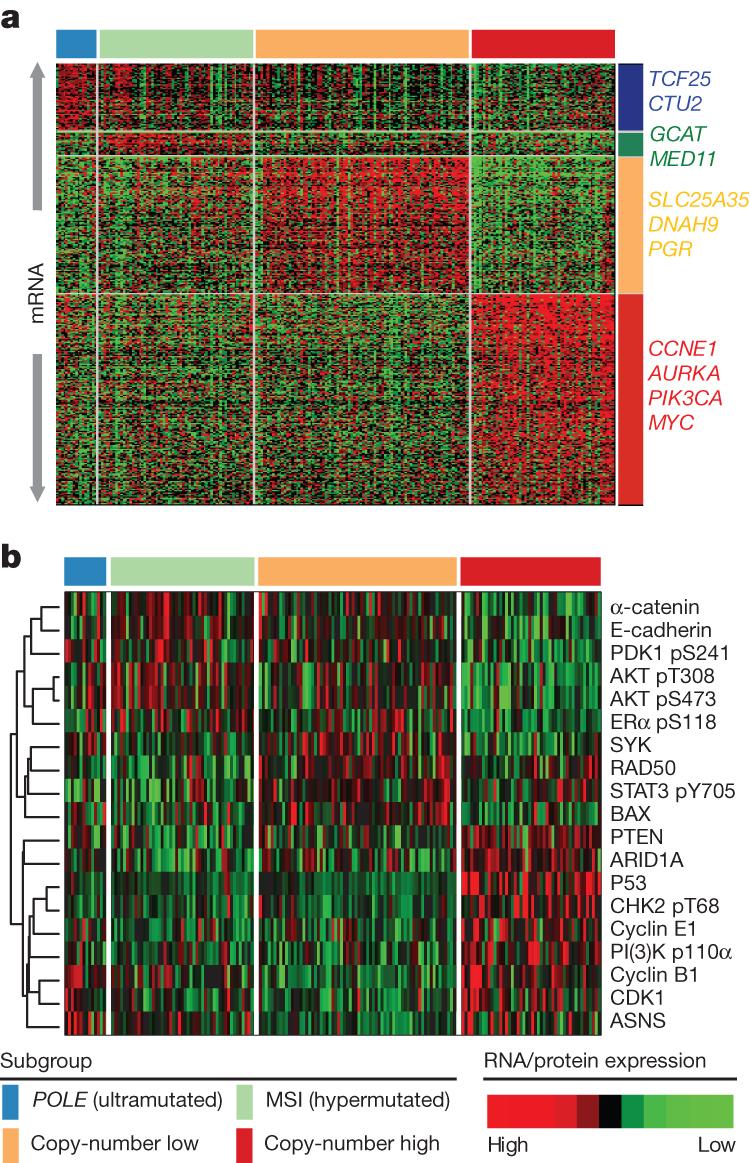
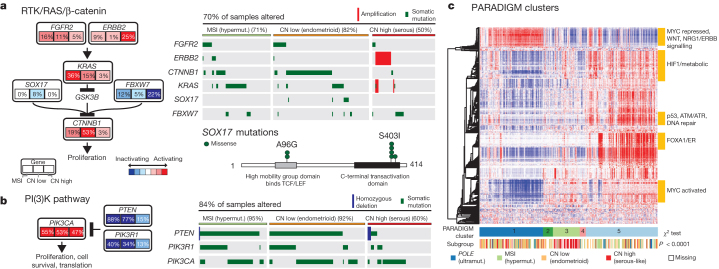
Verification
Claims the paper makes
The claims and statistics of this paper haven’t been checked yet.
Run the check — free, no account needed. It reads the open-access text and checks the sources it cites.
Claims other papers make about this one
Each is checked against this paper’s own text: does it say what the citing paper says it does?
In the citing paper
“AR is up-regulated in 9.8% of endometrial adenocarcinoma grade 3 samples [63, 90].”
From Role of aldo-keto reductase family 1 (AKR1) enzymes in human steroid metabolism (2014) · cites this paper as [90]
Self-check
Percentages, sums and reported differences re-computed from the paper’s own numbers.
The self-check needs the paper’s full text.
Citations
Cites
Dubrawsky, N. (1989) · Ca · doi:10.3322/canjclin.39.6.399 · Cited by 84,410
Comprehensive molecular portraits of human breast tumours
The Cancer Genome Atlas Network (2012) · Nature · doi:10.1038/nature11412 · Cited by 12,129
Siegel, R., Naishadham, D., & Jemal, A. (2013) · CA A Cancer Journal for Clinicians · doi:10.3322/caac.21166 · Cited by 11,825
Comprehensive molecular characterization of human colon and rectal cancer
The Cancer Genome Atlas Network (2012) · Nature · doi:10.1038/nature11252 · Cited by 8,499
Bcl-2 is an inner mitochondrial membrane protein that blocks programmed cell death
Hockenbery, D., Nuñez, G., Milliman, C., Schreiber, R. D., & Korsmeyer, S. J. (1990) · Nature · doi:10.1038/348334a0 · Cited by 3,720
Mermel, C. H., Schumacher, S. E., Hill, B., Meyerson, M. M., Beroukhim, R., & Getz, G. A. (2011) · Genome biology · doi:10.1186/gb-2011-12-4-r41 · Cited by 3,520
Self-citationCpG island methylator phenotype in colorectal cancer
Toyota, M., Ahuja, N., Ohe-Toyota, M., Herman, J. G., Baylin, S. B., & Issa, J. J. (1999) · Proceedings of the National Academy of Sciences · doi:10.1073/pnas.96.15.8681 · Cited by 2,562
Identification of a CpG Island Methylator Phenotype that Defines a Distinct Subgroup of Glioma
Noushmehr, H., Weisenberger, D. J., Diefes, K., Phillips, H. S., Pujara, K., Berman, B. P., Pan, F., Pelloski, C. E., Sulman, E. P., Bhat, K. P., et al. (2010) · Cancer Cell · doi:10.1016/j.ccr.2010.03.017 · Cited by 2,337
Self-citationMetagenes and molecular pattern discovery using matrix factorization
Brunet, J.-P., Tamayo, P., Golub, T. R., & Mesirov, J. P. (2004) · Proceedings of the National Academy of Sciences · doi:10.1073/pnas.0308531101 · Cited by 2,183
A comprehensive catalogue of somatic mutations from a human cancer genome
Pleasance, E. D., Cheetham, R. K., Stephens, P. J., McBride, D. J., Humphray, S. J., Greenman, C. D., Varela, I., Lin, M.-L., Ordóñez, G. R., Bignell, G. R., et al. (2010) · Nature · doi:10.1038/nature08658 · Cited by 1,696
Research works printed but not linked: 2
- Lax, S. F. & Kurman, R. J. A dualistic model for endometrial carcinogenesis based on immunohistochemical and molecular genetic analyses. Verh. Dtsch. Ges. Pathol. 81, 228–232 (1997)
- Levine, R. L. et al. PTEN mutations and microsatellite instability in complex atypical hyperplasia, a precursor lesion to uterine endometrioid carcinoma. Cancer Res. 58, 3254–3258 (1998)
Cited by
Sorted by citations
Items 101–200 of 477
Time Interval Between Endometrial Biopsy and Surgical Staging for Type I Endometrial Cancer
Matsuo, K., Opper, N. R., Ciccone, M. A., et al. (2015) · Obstetrics and Gynecology · doi:10.1097/aog.0000000000000636 · Cited by 62
Xu, W., Zhen, Y., Zhou, S., & Lü, N. (2014) · Drug Design Development and Therapy · doi:10.2147/dddt.s71061 · Cited by 59
Joehlin-Price, A. S., Ziffle, J. V., Hills, N. K., et al. (2020) · The American Journal of Surgical Pathology · doi:10.1097/pas.0000000000001598 · Cited by 59
“46 Follow-up time, median (range) (mo) 65 (7-183) 38 (1-169) 33 (1-211) 42.”
A weighted exact test for mutually exclusive mutations in cancer
Leiserson, M. D., Reyna, M. A., & Raphael, B. J. (2016) · Bioinformatics · doi:10.1093/bioinformatics/btw462 · Cited by 56
“For example, colorectal tumors with microsatellite stability have a median of 66 nonsynonymous mutations, but colorectal tumors with microsatellite instability have a median of 777 mutations [35].”
BackgroundAguilar, M., Chen, H., Rivera-Colon, G., et al. (2021) · The American Journal of Surgical Pathology · doi:10.1097/pas.0000000000001810 · Cited by 58
New therapies for dedifferentiated papillary thyroid cancer
Fallahi, P., Mazzi, V., Vita, R., Ferrari, S., Materazzi, G., Galleri, D., Benvenga, S., Miccoli, P., & Antonelli, A. (2015) · International Journal of Molecular Sciences · doi:10.3390/ijms16036153 · Cited by 58
Genome‐wide mutation analysis in precancerous lesions of endometrial carcinoma
Li, L., Yue, P., Song, Q., et al. (2020) · The Journal of Pathology · doi:10.1002/path.5566 · Cited by 57
“by prevalence) were PTEN, ARID1A, CTNNB1, KRAS, and PIK3CA, and the most commonly mutated genes in EC were PTEN, ARID1A, PIK3CA, CTNNB1, and CTCF, which were also reported as the major driver mutations in the TCGA endometrial cancer study [18].”
BackgroundResultTargeting obesity-related dysfunction in hormonally driven cancers
Rubinstein, M. M. Z., Brown, K. A., & Iyengar, N. M. (2021) · British Journal of Cancer · doi:10.1038/s41416-021-01393-y · Cited by 61
Hollis, R. L., Croy, I., Churchman, M., Bartos, C., Rye, T., Gourley, C., & Herrington, C. S. (2022) · British Journal of Cancer · doi:10.1038/s41416-022-01874-8 · Cited by 53
“However, it is well recognized that cancers presenting on the ovary bear stark clinical and molecular differences compared to those of the uterus that demonstrate similar histology (6-10).”
Li, S., Lavrijsen, M., Bakker, A., Magierowski, M., Magierowska, K., Liu, P., Wang, W., Peppelenbosch, M. P., & Smits, R. (2020) · Oncogene · doi:10.1038/s41388-020-1232-5 · Cited by 49
Endometrial cancer prognosis correlates with the expression of L1CAM and miR34a biomarkers
Corrado, G., Laquintana, V., Loria, R., et al. (2018) · Journal of Experimental & Clinical Cancer Research · doi:10.1186/s13046-018-0816-1 · Cited by 50
“The Cancer Genome Atlas (TCGA) Research Network proposed an innovative classification of EC that divided EC into four categories, with probable influence on treatment recommendations, based on an integrated genomic, transcriptomic and proteomic characterization [4].”
Devereaux, K. A., Weiel, J. J., Pors, J., Steiner, D. F., Ho, C. C., Charu, V., Suarez, C. J., Renz, M., Diver, E., Karam, A., et al. (2021) · Modern Pathology · doi:10.1038/s41379-021-00963-y · Cited by 50
Thompson, E. F., Huvila, J. K., Jamieson, A., Leung, S. C. Y., Lum, A. M., Offman, S. L., Lytwyn, A., Sur, M. L., Hoang, L. N., Irving, J., et al. (2022) · Modern Pathology · doi:10.1038/s41379-022-01165-w · Cited by 46
AKT inhibition is an effective treatment strategy in ARID1A-deficient gastric cancer cells
Lee, D., Yu, E. J., Ham, I., Hur, H., & Kim, Y.-S. (2017) · OncoTargets and Therapy · doi:10.2147/ott.s139664 · Cited by 53
“8–12 Genetic alterations in ARID1A in GCs are mostly insertion/deletion mutations, which lead to truncation of ARID1A protein.”
Mutational profile of endometrial hyperplasia and risk of progression to endometrioid adenocarcinoma
Russo, M., Newell, J. M., Budurlean, L., Houser, K. R., Sheldon, K. E., Kesterson, J. P., Phaëton, R., Hossler, C., Rosenberg, J., DeGraff, D. J., et al. (2020) · Cancer · doi:10.1002/cncr.32822 · Cited by 46
“Time to progression, hysterectomy, or last follow-up, median (range), mo 35 (16-259) 109 (9-140)”
BackgroundChen, J., Zhao, L., Peng, H., Dai, S., Quan, Y., Wang, M., Wang, J., Bi, Z., Zheng, Y., Zhou, S., et al. (2021) · Cancer Gene Therapy · doi:10.1038/s41417-020-0190-y · Cited by 46
Asami, Y., Kato, M. K., Hiranuma, K., Matsuda, M., Shimada, Y., Ishikawa, M., Koyama, T., Komatsu, M., Hamamoto, R., Nagashima, M., et al. (2023) · British Journal of Cancer · doi:10.1038/s41416-023-02203-3 · Cited by 52
“Somatic alterations in the exonuclease domain of POLE occur in a subgroup of endometrial cancers with ultra-mutation (frequently ≥100 mutations/Mb) [9] and excellent clinical outcome [9, 11–13]; the former was replicated in the C-CAT cohort and the latter in the NCCH cohort.”
Backgroundde Biase, D., Maloberti, T., Corradini, A. G., et al. (2023) · Frontiers in Medicine · doi:10.3389/fmed.2023.1146499 · Cited by 47
Moukarzel, L. A., Paula, A. D. C., Ferrando, L., Hoang, T. J., Sebastião, A. P. M., Pareja, F. G., Park, K. J., Jungbluth, A. A., Capellá, G., Pineda, M., et al. (2020) · Modern Pathology · doi:10.1038/s41379-020-00721-6 · Cited by 49
“Overall, the somatic mutations present in the EC were characteristic of those described in pure nonsynchronous endometrioid cancers, including ARID1A, PIK3CA and PTEN mutations in the EC [43], whereas the”
BackgroundInfluentialInhibiting Wnt/beta‐catenin in CTNNB1‐mutated endometrial cancer
Moroney, M. R., Woodruff, E. R., Qamar, L., Bradford, A. P., Wolsky, R. J., Bitler, B. G., & Corr, B. R. (2021) · Molecular Carcinogenesis · doi:10.1002/mc.23308 · Cited by 45
Plotkin, A., Kuzeljevic, B., Villa, V. D., Thompson, E. F., Gilks, C. B., Clarke, B. A., Köbel, M., & McAlpine, J. N. (2019) · International Journal of Gynecological Pathology · doi:10.1097/pgp.0000000000000654 · Cited by 43
“The Cancer Genome Atlas (TCGA) project identified 4 molecular subtypes: copy-number high (characterized by high numbers of somatic copy number alterations and also designated serous-like, as 50/53 serous carcinomas were in this group, and most mixed carcinomas and 24% of grade 3 endometrioid carcinomas), copynumber lo…”
BackgroundMonsivais, D., Vasquez, Y. M., Chen, F., Zhang, Y., Chandrashekar, D. S., Faver, J. C., Masand, R. P., Scheurer, M. E., Varambally, S., Matzuk, M. M., et al. (2021) · Oncogene · doi:10.1038/s41388-021-01681-0 · Cited by 42
“1a) was applied to an independent set of primary tumor sample mRNA profiles of the same cancer type [9, 18, 19, 45] (using datasets for which sufficient patient follow-up data were available).”
BackgroundMethodInfluentialAdjuvant treatment of endometrial cancer in molecular era: Are we ready to move on?
Paulino, E., & de Melo, A. C. (2020) · Critical Reviews in Oncology/Hematology · doi:10.1016/j.critrevonc.2020.103016 · Cited by 26
Intratumor genetic heterogeneity and clonal evolution to decode endometrial cancer progression
Mota, A., Oltra, S. S., Selenica, P., Moiola, C. P., Casas‐Arozamena, C., López-Gil, C., Díaz, E., Gatius, S., Ruiz-Miró, M., Calvo, A., et al. (2022) · Oncogene · doi:10.1038/s41388-022-02221-0 · Cited by 30
Yang, L., Yang, G., Ding, Y., Dai, Y., Xu, S., Guo, Q., Xie, A., & Hu, G. (2018) · Journal of Cancer · doi:10.7150/jca.21306 · Cited by 42
“AT-rich interactive domain containing protein 1A (ARID1A), a chromatin remodeling gene, has been recently found to be mutated in various cancers, including ovarian clear cell carcinoma [12], endometrioid carcinoma [13], gastric cancer [14], breast cancer [15], liver cancer [16], and pancreatic cancer [17, 18].”
BackgroundPIK3CA gene aberrancy and role in targeted therapy of solid malignancies
Willis, O., Choucair, K., Alloghbi, A., Stanbery, L., Mowat, R. B., Brunicardi, F. C., Dworkin, L. D., & Nemunaitis, J. J. (2020) · Cancer Gene Therapy · doi:10.1038/s41417-020-0164-0 · Cited by 43
Human DNA polymerase ε is a source of C>T mutations at CpG dinucleotides
Tomková, M., McClellan, M. J., Crevel, G., Shahid, A. M., Mozumdar, N., Tomek, J., Shepherd, E., Cotterill, S., Schuster‐Böckler, B., & Kriaučionis, S. (2024) · Nature Genetics · doi:10.1038/s41588-024-01945-x · Cited by 45
Wang, H., Zheng, H., Wang, J., Wang, C., & Wu, F. (2016) · IEEE Transactions on NanoBioscience · doi:10.1109/tnb.2016.2556640 · Cited by 39
He, J.-J., Ouyang, W., Zhao, W., Shao, L., Li, B., Liu, B., Wang, D., Han‐Zhang, H., Zhang, Z., Shao, L., et al. (2021) · Annals of Translational Medicine · doi:10.21037/atm-20-7553 · Cited by 39
Rabban, J. T., Garg, K., Ladwig, N. R., Zaloudek, C. J., & Devine, W. P. (2021) · The American Journal of Surgical Pathology · doi:10.1097/pas.0000000000001713 · Cited by 41
Wang, Y., Yu, M. Y., Yang, J., Cao, D., Zhang, Y., Zhou, H., Yuan, Z., & Shen, K. (2019) · Frontiers in Oncology · doi:10.3389/fonc.2019.00123 · Cited by 39
Prognostic impact of tumor budding in endometrial carcinoma within distinct molecular subgroups
Rau, T. T., Bettschen, E., Büchi, C. A., et al. (2020) · Modern Pathology · doi:10.1038/s41379-020-0626-9 · Cited by 40
“On the other hand, serouslike carcinoma with evidence of the TP53 mutation represents a more aggressive disease, with over 40% percent of patients dying within 5 years [7].”
BackgroundInfluentialMolecular Characterization of Neuroendocrine Carcinomas of the Endometrium
Howitt, B. E., Dong, F., Vivero, M., Shah, V., Lindeman, N. I., Schoolmeester, J. K., Baltay, M., MacConaill, L. E., Sholl, L. M., Nucci, M. R., et al. (2020) · The American Journal of Surgical Pathology · doi:10.1097/pas.0000000000001560 · Cited by 40
Zhang, Y., Yang, R., Xu, C., et al. (2022) · Pathology - Research and Practice · doi:10.1016/j.prp.2022.153990 · Cited by 39
Yahia, N. H., Gemer, O., Eitan, R., et al. (2020) · Acta Obstetricia Et Gynecologica Scandinavica · doi:10.1111/aogs.14015 · Cited by 39
Evolving toward a human-cell based and multiscale approach to drug discovery for CNS disorders
Schadt, E. E., Buchanan, S., Brennand, K. J., & Merchant, K. M. (2014) · Frontiers in Pharmacology · doi:10.3389/fphar.2014.00252 · Cited by 39
Zhang, Z., Xiao, S., Sun, G.-Y., et al. (2014) · International Journal of Gynecological Cancer · doi:10.1097/igc.0000000000000092 · Cited by 37
“Previous studies have shown that high-grade uterine endometrioid carcinoma has distinct genetic origins from low-grade and medium-grade uterine endometrioid carcinomas.(1) High-grade uterine endometrioid carcinoma has been found to have many similarities with uterine clear cell carcinoma, such as the genetic alteratio…”
BackgroundResultTargeted therapies in gynaecological cancers
Crusz, S. M., & Miller, R. E. (2019) · Histopathology · doi:10.1111/his.14009 · Cited by 37
“For example, PTEN, which regulates the expression of RAD51 and reduces the incidence of spontaneous dsDNA breaks,(33) is altered in more than 80% of endometrial cancers.(32) Furthermore, approximately 15% of copy-”
BackgroundInfluentialLadwig, N. R., Umetsu, S. E., Zaloudek, C. J., et al. (2020) · International Journal of Gynecological Pathology · doi:10.1097/pgp.0000000000000671 · Cited by 37
“The acquisition of a TP53 mutation in this case likely explains the high-grade morphology, similar to other high-grade EEC with TP53 mutations that are associated with a more aggressive clinical course (18).”
MethodResultHybrid PET/MRI in Staging Endometrial Cancer
Ironi, G., Mapelli, P., Bergamini, A., et al. (2022) · Clinical Nuclear Medicine · doi:10.1097/rlu.0000000000004064 · Cited by 36
Dong, F., Costigan, D. C., & Howitt, B. E. (2018) · Modern Pathology · doi:10.1038/s41379-018-0125-4 · Cited by 32
“Mismatch repair deficiency is a defining feature of the microsatellite instability molecular subclass of endometrial cancers as classified by the Cancer Genome Atlas project [9].”
BackgroundWen, X., Wan, J., He, Q., Wang, M., Li, S., Jiang, M. H., Qian, Z., Liu, B., Lu, W., Wang, K., et al. (2020) · Signal Transduction and Targeted Therapy · doi:10.1038/s41392-020-0170-6 · Cited by 32
“Endometrioid carcinomas populate all four molecular subgroups, whereas serous carcinomas are almost exclusively found in the copy number high (serous-like) subgroup.(2) This molecular classification provides a method for observing and describing endometrial cancers, while providing important information on diagnostic,…”
BackgroundMethodInfluentialBusca, A., Parra‐Herran, C., Nofech‐Mozes, S., et al. (2020) · Histopathology · doi:10.1111/his.14186 · Cited by 36
SEOM-GEICO clinical guidelines on endometrial cancer (2021)
Barretina-Ginesta, M.-P., Quindós, M., Alarcón, J., Esteban, C., Gaba, L., Gómez, C., Fidalgo, J. A. P., Romero, I., Santaballa, A., & Rubio-Pérez, M. J. (2022) · Clinical & Translational Oncology · doi:10.1007/s12094-022-02799-7 · Cited by 34
Mismatch Repair Deficiency in Uterine Carcinosarcoma
Jenkins, T. M., Hanley, K. Z., Schwartz, L. E., et al. (2020) · The American Journal of Surgical Pathology · doi:10.1097/pas.0000000000001434 · Cited by 35
Acosta, A. M., Sholl, L. M., Cin, P. D., et al. (2020) · Histopathology · doi:10.1111/his.14188 · Cited by 35
Mismatch repair testing in breast cancer: the path to tumor-specific immuno-oncology biomarkers
Venetis, K., Sajjadi, E., Haricharan, S., et al. (2020) · Translational Cancer Research · doi:10.21037/tcr-20-1852 · Cited by 35
“Hence, whole-exome TMBhigh tumors may not be related to MMR deficiency and/or worse prognosis (18).”
BackgroundArdighieri, L., Palicelli, A., Ferrari, F. G., et al. (2020) · Journal of Clinical Medicine · doi:10.3390/jcm9082552 · Cited by 35
DNA Polymerase ε Deficiency Leading to an Ultramutator Phenotype: A Novel Clinically Relevant Entity
Castellucci, E., He, T., Goldstein, D. Y., Halmos, B., & Chuy, J. (2017) · The Oncologist · doi:10.1634/theoncologist.2017-0034 · Cited by 34
Rottmann, D. A., Assem, H., Matsumoto, N. P., Wong, S. T.-L., Hui, P., & Buza, N. (2020) · International Journal of Gynecological Pathology · doi:10.1097/pgp.0000000000000690 · Cited by 34
Robinson, C., Harrison, B. T., Ligon, A. H., et al. (2020) · Modern Pathology · doi:10.1038/s41379-020-00695-5 · Cited by 34
Abiko, K., Hamanishi, J., Matsumura, N., & Mandai, M. (2022) · British Journal of Cancer · doi:10.1038/s41416-022-01960-x · Cited by 35
“POLEmutant cases are also called ultra-mutated cases and harbour numerous mutations [49].”
BackgroundNoninvasive detection of microsatellite instability in patients with endometrial cancer
Casas‐Arozamena, C., Moiola, C. P., Vilar, A., et al. (2023) · International Journal of Cancer · doi:10.1002/ijc.34435 · Cited by 33
Wang, Y., Mei, Y., Yang, J., et al. (2018) · Cancer Management and Research · doi:10.2147/cmar.s179566 · Cited by 32
“19,20 A few studies have confirmed the reliability of molecular biological diagnostic techniques in the evaluation of consistency between curettage endometrial specimens and definitive hysterectomy specimens.”
Niu, S., Lucas, E., Molberg, K. H., et al. (2022) · The American Journal of Surgical Pathology · doi:10.1097/pas.0000000000001934 · Cited by 32
Ye, L., Wang, X., & Li, B. (2021) · Journal of Cancer · doi:10.7150/jca.62729 · Cited by 31
“For example, the most common PTEN (phosphate and tension homology deleted on chromosome ten) and PIK3CA (p110α catalytic subunit of PI3 kinase) gene mutations are found in all the above four types of endometrial cancer [8].”
BackgroundChen, H., Lucas, E., Strickland, A. L., et al. (2020) · The American Journal of Surgical Pathology · doi:10.1097/pas.0000000000001537 · Cited by 31
“8) 33 (24-40) 30 (20-72) Yes 8 0 Complete response 26 (48.”
Wang, Y., Ren, F., Song, Z., Wang, X., & Ma, X. (2020) · Journal of Cancer · doi:10.7150/jca.46386 · Cited by 30
“Since PTEN, CTNNB1, PIK3CA, ARID1A, and KRAS play important roles in the pathogenesis of UCEC [20], we further evaluated whether the variation (SNV or CNV) of m6A regulatory genes was associated with changes in the above five genes.”
BackgroundTalhouk, A., Jamieson, A., Crosbie, E. J., et al. (2022) · International Journal of Gynecological Pathology · doi:10.1097/pgp.0000000000000898 · Cited by 31
“6) POLEmut 45 (57) 14 (35) 45 (5) 14 (3.”
BackgroundInfluentialHER-2 Amplification in Uterine Serous Carcinoma and Serous Endometrial Intraepithelial Carcinoma
Banet, N., Shahi, M., Batista, D., et al. (2021) · The American Journal of Surgical Pathology · doi:10.1097/pas.0000000000001682 · Cited by 30
“Breast score 0/1+ 29 (83) 27 (90) 0 2 (50)* 2+ 6 (17) 3 (10) 1 (100) 2 (50) 3+ 0 0 0 0 Total # of cases 35 30 1 4 GI score”
HER2 Overexpression and Amplification in Uterine Carcinosarcomas With Serous Morphology
Jenkins, T. M., Cantrell, L. A., Stoler, M. H., et al. (2022) · The American Journal of Surgical Pathology · doi:10.1097/pas.0000000000001870 · Cited by 30
Corded and Hyalinized and Spindled Endometrioid Endometrial Carcinoma
Safdar, N. S., Thompson, E. F., Gilks, C. B., et al. (2021) · The American Journal of Surgical Pathology · doi:10.1097/pas.0000000000001737 · Cited by 29
Devereaux, K. A., Steiner, D. F., Ho, C. C., Gomez, A. J., Gilks, C. B., Longacre, T. A., Zehnder, J. L., Howitt, B. E., & Suarez, C. J. (2021) · International Journal of Gynecological Pathology · doi:10.1097/pgp.0000000000000841 · Cited by 29
“In other words, the assay covers the most common mutation positions, accounting for approximately 90-95% of all clinically relevant POLE EDMs variants reported in ECs (1,2,17,35,39,40).”
BackgroundMethodInfluentialFriedman, C. F., Manning‐Geist, B. L., Zhou, Q. C., Soumerai, T. E., Holland, A., Paula, A. D. C., Green, H., Ozsoy, M. A., Iasonos, A. E., Hollmann, T. J., et al. (2024) · Nature Medicine · doi:10.1038/s41591-024-02942-7 · Cited by 30
“This patient had progression of disease at her first follow-up copy number-low and copy number-high 5 .”
Ryan, N., Nobes, M., Sedgewick, D., et al. (2020) · BJOG An International Journal of Obstetrics & Gynaecology · doi:10.1111/1471-0528.16432 · Cited by 28
BRG1, INI1, and ARID1B Deficiency in Endometrial Carcinoma
Kihara, A., Amano, Y., Matsubara, D., Fukushima, N., Fujiwara, H., & Niki, T. (2020) · The American Journal of Surgical Pathology · doi:10.1097/pas.0000000000001581 · Cited by 28
NEK10 tyrosine phosphorylates p53 and controls its transcriptional activity
Haider, N., Dutt, P., van de Kooij, B., Ho, J., Palomero, L., Pujana, M. Á., Yaffe, M. B., & Stambolic, V. (2020) · Oncogene · doi:10.1038/s41388-020-1361-x · Cited by 26
Prognostic implications of tumor-infiltrating T cells in early-stage endometrial cancer
Mendiola, M., Pellinen, T. S., Ramón-Patiño, J. L., Berjón, A., Brück, O. E., Heredia-Soto, V., Turkki, R., Escudero, J., Hemmes, A., de la Calle, L. E. G., et al. (2021) · Modern Pathology · doi:10.1038/s41379-021-00930-7 · Cited by 32
The oncogenic landscape of the idiopathic pulmonary fibrosis: a narrative review
Stella, G. M., D’Agnano, V., Piloni, D., Saracino, L., Lettieri, S., Mariani, F., Lancia, A., Bortolotto, C., Rinaldi, P., Falanga, F., et al. (2022) · Translational Lung Cancer Research · doi:10.21037/tlcr-21-880 · Cited by 25
“Interestingly, it is also associated to the enhancement of kirsten rat sarcoma (KRAS)-driven adenocarcinogenesis (82-84).”
BackgroundGilks, C. B., Selinger, C. I., Davidson, B., et al. (2022) · International Journal of Gynecological Pathology · doi:10.1097/pgp.0000000000000908 · Cited by 27
Endometrial Carcinomas With Subclonal Loss of Mismatch Repair Proteins
Mendoza, R. P., Wang, P., Schulte, J. J., Tjota, M. Y., Jani, I., Martinez, A. C., Haridas, R., Wanjari, P., Steinhardt, G., Brown, N. A., et al. (2023) · The American Journal of Surgical Pathology · doi:10.1097/pas.0000000000002031 · Cited by 30
Imboden, S., Tapia, C., Scheiwiller, N., et al. (2019) · Acta Obstetricia Et Gynecologica Scandinavica · doi:10.1111/aogs.13740 · Cited by 27
“epithelial cells DNA quality was assessed with the qBiomarker Human DNA qual‐ ity control plate (Qiagen) with wild‐type sequences of 7 genes (protooncogene B‐raf [BRAF], k‐ras [KRAS], v‐Ha‐Ras Harvey rat sarcoma viral oncogene [HRAS], neuroblastoma‐Ras [NRAS], mi‐ togen‐activated protein kinase kinase 1 [MEK1], phosph…”
BackgroundInfluentialZhu, D., Tuo, X.-M., Rong, Y., et al. (2020) · Journal of Cancer · doi:10.7150/jca.44727 · Cited by 26
“FGFR1 and FGFR3 amplifications are also found in endometrial cancer through integrating genomic characterization of somatic copy number alterations [58].”
BackgroundMatías‐Guiu, X., Selinger, C. I., Anderson, L. A., Buza, N., Ellenson, L. H., Fadare, O., Ganesan, R., Ip, P. P. C., Palacios, J., Parra‐Herran, C., et al. (2022) · International Journal of Gynecological Pathology · doi:10.1097/pgp.0000000000000901 · Cited by 24
“In the 2020 edition of the WHO Classification (5), it is suggested that patients with clonally related low-risk tumors be managed conservatively (as if they were 2 independent primaries) when the following criteria are met: (1) low-grade endometrioid morphology, (2) no more than superficial myometrial invasion, (3) ab…”
BackgroundMethodInfluentialTherapeutic targeting of mismatch repair-deficient cancers
Johannet, P. M., Rousseau, B., Aghajanian, C. A., Foote, M. B., & Diaz, L. A. (2025) · Nature Reviews Clinical Oncology · doi:10.1038/s41571-025-01054-6 · Cited by 35
“MMRd tumours were historically thought of as chromosomally stable, and MSI-H was viewed as mutually exclusive with chromosomal instability 112–114 .”
Mismatch repair deficiency and clinical implications in prostate cancer
Graham, L. S., & Schweizer, M. T. (2022) · The Prostate · doi:10.1002/pros.24343 · Cited by 30
Ryan, N. A. J., Wall, J., Crosbie, E. J., et al. (2019) · Histopathology · doi:10.1111/his.13925 · Cited by 24
“Furthermore, it highlights the disconnection between research and clinical practice; the identification of MMRd tumours has key prognostic and therapeutic implications for patients, which could be ignored if clinicians are unaware of them.(25,26) A high percentage of the pathologists who undertook the survey were invo…”
BackgroundMayo‐de‐las‐Casas, C., Velasco, A., Guzman, D. R. S., et al. (2020) · International Journal of Cancer · doi:10.1002/ijc.32872 · Cited by 24
“In addition, the Cancer Genome Atlas (TCGA) has shown that they have different mutation profiles.(26) The most frequently mutated genes in EEC were PTEN (78%), PIK3CA (53%) and KRAS (25%) compared to TP53 (91%) and PIK3CA (42%) in SC.”
BackgroundKoeneman, B. J., Schreibelt, G., Gorris, M. A. J., Hins - de Bree, S., Westdorp, H., Ottevanger, P. B., & de Vries, I. J. M. (2024) · Frontiers in Immunology · doi:10.3389/fimmu.2024.1368103 · Cited by 24
miRNA-576-5p promotes endometrial cancer cell growth and metastasis by targeting ZBTB4
Chen, C., Zhang, Q., & Kong, B. (2022) · Clinical & Translational Oncology · doi:10.1007/s12094-022-02976-8 · Cited by 23
Kommoss, F., Lee, C.-H., Tessier-Cloutier, B., Gilks, C., Stewart, C. J. R., von Deimling, A., & Köbel, M. (2023) · Journal of Pathology · doi:10.1002/path.6217 · Cited by 22
Pors, J., Ho, J., Prentice, L., et al. (2019) · The American Journal of Surgical Pathology · doi:10.1097/pas.0000000000001403 · Cited by 23
Prognostic significance of mutant-allele tumor heterogeneity in uterine corpus endometrial carcinoma
Hou, Y., Li, T., Gan, W., Lv, S., Zeng, Z., Zheng, Y., Wang, W., & Yang, M. H. (2020) · Annals of Translational Medicine · doi:10.21037/atm.2020.02.136 · Cited by 21
“The molecular type of each sample was downloaded from attachment files of the article “Integrated Genomic Characterization of Endometrial Carcinoma” (23).”
MethodChiang, S. (2020) · Genes Chromosomes and Cancer · doi:10.1002/gcc.22920 · Cited by 23
Kwiatkowski, N., Liang, T., Sha, Z., Collier, P. N., Yang, A., Sathappa, M., Paul, A., Su, L., Zheng, X., Aversa, R., et al. (2025) · Cell Chemical Biology · doi:10.1016/j.chembiol.2025.03.006 · Cited by 23
Expression of DNA repair proteins in endometrial cancer predicts disease outcome
Mhawech-Fauceglia, P. Y., Wang, D., Kim, G., Sharifian, M., Chen, X., Liu, Q., Lin, Y. G., Liu, S., & Pejovic, T. B. (2014) · Gynecologic Oncology · doi:10.1016/j.ygyno.2014.02.002 · Cited by 22
Current Issues in the Diagnosis and Treatment of Endometrial Carcinoma
Stubert, J., & Gerber, B. (2016) · Geburtshilfe und Frauenheilkunde · doi:10.1055/s-0035-1558230 · Cited by 22
KRAS, YWHAE, SP1 and MSRA as biomarkers in endometrial cancer
Yang, Y., Sang, Z., Ma, J., Zhu, Y., & Wu, S. (2021) · Translational Cancer Research · doi:10.21037/tcr-20-2969 · Cited by 19
“Transl Cancer Res 2021;10(3):1295-1312 | http://dx.”
MethodDostarlimab for recurrent mismatch repair‐deficient endometrial cancer: A cost‐effectiveness study
Dioun, S. M., Chen, L., Melamed, A., Gockley, A. A., Clair, C. M. S., Hou, J. Y., Khoury‐Collado, F., Hur, C., Elkin, E. B., Accordino, M. K., et al. (2022) · BJOG An International Journal of Obstetrics & Gynaecology · doi:10.1111/1471-0528.17338 · Cited by 20
Lucas, E., Niu, S., Aguilar, M., et al. (2023) · The American Journal of Surgical Pathology · doi:10.1097/pas.0000000000002076 · Cited by 22
Long-range gene regulation in hormone-dependent cancer
Tettey, T. T., Rinaldi, L., & Hager, G. L. (2023) · Nature reviews. Cancer · doi:10.1038/s41568-023-00603-4 · Cited by 23
Omics-based molecular classifications empowering in precision oncology
Zhou, Z., Lin, T., Chen, S., Zhang, G., Xu, Y., Zou, H., Zhou, A., Zhang, Y., Weng, S., Han, X., et al. (2024) · Cellular Oncology · doi:10.1007/s13402-023-00912-8 · Cited by 24
Yoon, J., Apellániz-Ruiz, M., Chong, A., et al. (2020) · International Journal of Gynecological Pathology · doi:10.1097/pgp.0000000000000718 · Cited by 22
Current status and perspectives of patient-derived rare cancer models
Kondo, T. (2020) · Human Cell · doi:10.1007/s13577-020-00391-1 · Cited by 21
Lin, Z., Wang, T., Li, H., et al. (2022) · Quantitative Imaging in Medicine and Surgery · doi:10.21037/qims-22-255 · Cited by 21
“In our study, approximately 33% of EC had MSI, and this prevalence was similar to that of other studies (5,32).”
Berg, H. F., Engerud, H., Myrvold, M., Lien, H. E., Hjelmeland, M. E., Halle, M. K., Woie, K., Høivik, E. A., Haldorsen, I. S., Vintermyr, O. K., et al. (2022) · British Journal of Cancer · doi:10.1038/s41416-022-02063-3 · Cited by 21
“Patients with MSI-hypermutated tumours have an intermediate prognosis [5] and may be eligible for treatment with immune checkpoint inhibitors [6], although this is seldom used in clinical routine.”
BackgroundResultInfluentialCarmichael, I., Song, A. H., Chen, R. J., Williamson, D. F. K., Chen, T. Y., & Mahmood, F. (2022) · Lecture Notes in Computer Science · doi:10.1007/978-3-031-16434-7_38 · Cited by 20
Karlow, J. A., Miao, B., Xing, X., Wang, T., & Zhang, B. (2021) · Communications Biology · doi:10.1038/s42003-021-02094-1 · Cited by 17
An emerging role for BAG3 in gynaecological malignancies
Marco, M. D., Falco, A., Iaccarino, R., Raffone, A., Mollo, A., Guida, M., Rosati, A., Chetta, M., Genovese, G., Caro, F. D., et al. (2021) · British Journal of Cancer · doi:10.1038/s41416-021-01446-2 · Cited by 19
Malignancy and lymphoid proliferation in primary immune deficiencies; hard to define, hard to treat
Kıykım, A. A., Eker, N., Surekli, O., et al. (2019) · Pediatric Blood & Cancer · doi:10.1002/pbc.28091 · Cited by 20
“Symptom of age of PID (month) (median, range) 6 (1-108)”
Background
Metadata
- Authors
- The Cancer Genome Atlas Research Network, & Levine, D. A.
- Affiliations
- Memorial Sloan Kettering Cancer Center (US)
- Corresponding author
- Levine, Douglas A.
- ORCID
- Levine, Douglas A.
- Venue
- Nature
- Published
- 2013-05-01
- Volume
- 497
- Issue
- 7447
- Pages
- 67-73
- ISSN
- 0028-0836 (ISSN-L)
- 1476-4687
- PMC
- PMC3704730
- OpenAlex
- W2041440766
- Cited by
- 5,784
- References
- 40
- Citations by year
- 2026: 467 · 2025: 580 · 2024: 559 · 2023: 595 · 2022: 591 · 2021: 572 · 2020: 455 · 2019: 384 · 2018: 320 · 2017: 328 · 2016: 313 · 2015: 285 · 2014: 231 · 2013: 96
- FWCI
- 345.78
- Type
- journal article
- Language
- en
- Update notices
- erratum (2013-06-12)
- Open access
- hybrid
- doi.org
- Licence
- Locations
- Nature (publishedVersion, cc-by-nc-sa)
- PubMed Central (publishedVersion, cc-by-nc-sa)
- PubMed (publishedVersion)
- Europe PMC (PubMed Central) (acceptedVersion)
- RePEc: Research Papers in Economics (submittedVersion)
- Funders
- National Institutes of Health
- National Human Genome Research Institute (U54HG003067, U54HG003079, U54HG003273)
- National Cancer Institute (P50CA098258, U24CA143882, R01CA180006, U24CA143843, U24CA143840, U24CA143858, U24CA144025, U24CA143866, U24CA143883, U24CA143845, U24CA143867, U24CA143848, U24CA143799, U24CA143835, P30CA008748, P30CA016672, P30CA016056, P30CA016086)
- Topics
- Health Sciences › Medicine › Obstetrics and Gynecology › Endometrial and Cervical Cancer Treatments
- Life Sciences › Biochemistry, Genetics and Molecular Biology › Cancer Research › Cancer Genomics and Diagnostics
- Life Sciences › Biochemistry, Genetics and Molecular Biology › Molecular Biology › Chromatin Remodeling and Cancer
- Keywords
- endometrial cancer, uterine serous carcinoma, endometrioid carcinoma, copy number alterations, TP53 mutation, POLE mutation, microsatellite instability, ARID5B, SWI/SNF chromatin remodeling, CTNNB1, PIK3CA, KRAS, PTEN, DNA methylation, oestrogen receptor, progesterone receptor, adjuvant therapy, genomic profiling
- MeSH terms
- Poly-ADP-Ribose Binding Proteins, Breast Neoplasms, Chromosome Aberrations, DNA Mutational Analysis, DNA Polymerase II, DNA-Binding Proteins, Female, Humans, Ovarian Neoplasms, Transcription Factors, Signal Transduction, Genome, Human, Gene Expression Regulation, Neoplastic, Endometrial Neoplasms, Genomics, DNA Copy Number Variations, Exome
About these checks
Registry, retraction, Cites and statistics results are computed, not judged, with one exception: a printed reference that no index lists is read once by a model before it counts as a citation error. Claims are extracted by a model and kept only when their quote appears verbatim in the text; each cited source is then checked, with a model’s help, for whether it says what the claim relies on. Those verdicts can be wrong — read the claim’s quote and the cited source before relying on one.
Statistics and arithmetic are recomputed, not judged.
Confidence bands are shown only for fields calibrated on our annotated test set. None is calibrated yet, so no band is shown.
What counts as a claim ›How we measure confidence ›How we check this ›
Are you an author, or do you see a problem with this page? Request a review
