

Comprehensive catecholaminergic projectome analysis reveals single-neuron integration of zebrafish ascending and descending dopaminergic systems
Open accessThe DOI matches its Crossref record; 61 of the 61 references it cites were found in a registry or an index.
Abstract
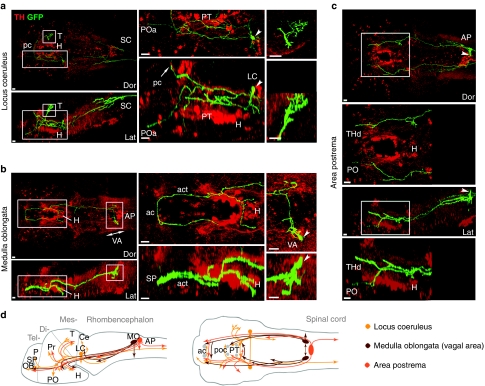
Essential components of animal behaviour are modulated by dopaminergic (DA) and noradrenergic circuitry. In this study, we reveal at cellular resolution the complete set of projections ('projectome') of every single type of DA and noradrenergio neurons in the central nervous system of zebrafish larvae. The most extensive DA projections are established by posterior tubercular otp-dependent neurons, with individual somata integrating the ascending DA system, the descending diencephalospinal, as well as the endohypothalamic circuitry. These findings suggest a major role in the modulation of physiology and behaviour for otp-dependent DA neurons, which correlate with the mammalian A11 group. We further identified an endogenous subpallial DA system that not only provides most of the local DA projections, but also connects to the ventral diencephalon. The catecholaminergic projectome map provides a framework to understand the evolution and function of these neuromodulatory systems. Dopaminergic neurons, which are affected in neuronal diseases, have important roles in modulating behaviour, cognition and physiology. In this study, the authors map every projection for each type of dopaminergic neuron in zebrafish larvae, which may help to understand neurological disease.
Overview
The claims and statistics of this paper haven’t been checked yet.
Free: it reads the open-access text and checks the first 5 claims that cite a source we can check. Create a free account to check every claim.
Integrity signals
Registry
Cites
Statistics
Figures




Verification
Claims the paper makes
The claims and statistics of this paper haven’t been checked yet.
Free: it reads the open-access text and checks the first 5 claims that cite a source we can check. Create a free account to check every claim.
Claims other papers make about this one
Each is checked against this paper’s own text: does it say what the citing paper says it does?
The source backs part of the claim, not all of it — or backs it for a different population, condition or comparison.
In the citing paper
“There are other neuromodulators thought to be present in the area immediately surrounding the nMLF, with identified terminals positive for TH and 5-HT (McLean and Fetcho, 2004), and dopaminergic and noradrenergic tracts targeting the area (Tay et al., 2011)”
From Neural control and modulation of swimming speed in the larval zebrafish (2014) · cites this paper as Tay et al., 2011
Experimental — accuracy not yet measuredThe cited source says what the claim attributes to it.
In the citing paper
“In both fish and mammals these cells reside in the hindbrain/brainstem, express dopamine beta hydroxylase and tyrosine hydroxylase (McLean and Fetcho, 2004), and project diffusely throughout the brain, including extensive forebrain innervation (McLean and Fetcho, 2004; Aston-Jones and Cohen, 2005; Tay et al., 2011).”
From Ancestral Circuits for the Coordinated Modulation of Brain State (2017) · cites this paper as Tay et al., 2011
In the citing paper
“In both fish and mammals these nuclei contain the only dopaminergic cell type that projects to the spinal cord (Tay et al., 2011; Koblinger et al., 2014), and are specified by the expression of common transcription factors (Löhr et al., 2009).”
From Ancestral Circuits for the Coordinated Modulation of Brain State (2017) · cites this paper as Tay et al., 2011
Self-check
Percentages, sums and reported differences re-computed from the paper’s own numbers.
The self-check needs the paper’s full text.
Citations
Cites
The structure of the nervous system of the nematode Caenorhabditis elegans
White, J. G., Southgate, E., Thomson, J. N., & Brenner, S. (1986) · Philosophical Transactions of the Royal Society of London. B, Biological Sciences · doi:10.1098/rstb.1986.0056 · Cited by 5,589
Isaacson, P. G., Dogan, A., Price, S. K., & Spencer, J. (1989) · The American Journal of Surgical Pathology · doi:10.1097/00000478-198912000-00004 · Cited by 1,915
The locus coeruleus and noradrenergic modulation of cognition
Sara, S. J. (2009) · Nature Reviews Neuroscience · doi:10.1038/nrn2573 · Cited by 1,848 · cited 1×
“Our findings are consistent with a fundamental modulatory role of LC NA connectivity in global behavioural patterns, ranging from basic motor behaviours and stress responses to mood and cognitio”
Kim, J.-H., Auerbach, J. M., Rodríguez-Gómez, J. A., Velasco, I., Gavin, D., Lumelsky, N., Lee, S.-H., Nguyen, J., Sánchez-Pernaute, R., Bankiewicz, K., et al. (2002) · Nature · doi:10.1038/nature00900 · Cited by 1,607
Simple and highly efficient BAC recombineering using galK selection
Warming, S. (2005) · Nucleic Acids Research · doi:10.1093/nar/gni035 · Cited by 1,212
Moore, R. Y., & Bloom, F. E. (1979) · Annual Review of Neuroscience · doi:10.1146/annurev.ne.02.030179.000553 · Cited by 1,118
Matsuda, W., Furuta, T., Nakamura, K. C., Hioki, H., Fujiyama, F., Arai, R., & Kaneko, T. (2009) · The Journal of Neuroscience · doi:10.1523/jneurosci.4029-08.2009 · Cited by 865
Evolution of the Telencephalon in Nonmammals
Northcutt, R. G. (1981) · Annual Review of Neuroscience · doi:10.1146/annurev.ne.04.030181.001505 · Cited by 502
Locomotor repertoire of the larval zebrafish: swimming, turning and prey capture
Budick, S. A., & O’Malley, D. M. (2000) · Journal of Experimental Biology · doi:10.1242/jeb.203.17.2565 · Cited by 499
Rink, E., & Wullimann, M. F. (2001) · Brain Research · doi:10.1016/s0006-8993(00)03174-7 · Cited by 472
Research works printed but not linked: 1
- Kapsimali, M., Bourrat, F. & Vernier, P. Distribution of the orphan nuclear receptor Nurr1 in medaka (Oryzias latipes): cues to the definition of homologous cell groups in the vertebrate brain. J. Comp. Neurol. 431, 276–292 (2001). · doi:10.1002/1096-9861(20010312)431:3<276::aid-cne1070>3.0.co;2-s
Cited by
Modeling anxiety using adult zebrafish: A conceptual review
Stewart, A., Gaikwad, S., Kyzar, E., Green, J., Roth, A., & Kalueff, A. V. (2012) · Neuropharmacology · doi:10.1016/j.neuropharm.2011.07.037 · Cited by 405
Glia Accumulate Evidence that Actions Are Futile and Suppress Unsuccessful Behavior
Mu, Y., Bennett, D. V., Rubinov, M., Narayan, S., Yang, C.-T., Tanimoto, M., Mensh, B. D., Looger, L. L., & Ahrens, M. B. (2019) · Cell · doi:10.1016/j.cell.2019.05.050 · Cited by 374
Deep Brain Photoreceptors Control Light-Seeking Behavior in Zebrafish Larvae
Fernandes, A. M., Fero, K., Arrenberg, A. B., Bergeron, S. A., Driever, W., & Burgess, H. A. (2012) · Current Biology · doi:10.1016/j.cub.2012.08.016 · Cited by 281
Self-citationThe Evolution of Dopamine Systems in Chordates
Yamamoto, K., & Vernier, P. (2011) · Frontiers in Neuroanatomy · doi:10.3389/fnana.2011.00021 · Cited by 243
Johnson, Z. V., & Young, L. J. (2017) · Neuroscience & Biobehavioral Reviews · doi:10.1016/j.neubiorev.2017.01.034 · Cited by 242
Metadata
- Authors
- Tay, T. L., Ronneberger, O., Ryu, S., Nitschke, R., & Driever, W.
- Affiliations
- University of Freiburg (DE)
- Corresponding author
- Driever, Wolfgang
- Venue
- Nature Communications
- Published
- 2011-01-25
- Volume
- 2
- Issue
- 1
- Pages
- 171-171
- ISSN
- 2041-1723 (ISSN-L)
- PMC
- PMC3105308
- OpenAlex
- W2132610577
- Cited by
- 307
- References
- 60
- Citations by year
- 2026: 11 · 2025: 18 · 2024: 17 · 2023: 20 · 2022: 31 · 2021: 25 · 2020: 27 · 2019: 18 · 2018: 15 · 2017: 22 · 2016: 20 · 2015: 19 · 2014: 15 · 2013: 23 · 2012: 19
- FWCI
- 9.66
- Type
- journal article
- Language
- en
- Open access
- hybrid
- doi.org
- Licence
- cc-by-nc-nd
- creativecommons.org/licenses/by-nc-nd/3.0/ (tdm)
- creativecommons.org/licenses/by-nc-nd/3.0/ (vor)
- Locations
- Nature Communications (publishedVersion, cc-by-nc-nd)
- PubMed Central (publishedVersion, cc-by-nc-nd)
- PubMed (publishedVersion)
- RePEc: Research Papers in Economics (submittedVersion)
- Funders
- Deutsche Forschungsgemeinschaft (SFB 592, SFB780, (EXC 294))
- Topics
- Life Sciences › Biochemistry, Genetics and Molecular Biology › Cell Biology › Zebrafish Biomedical Research Applications
- Life Sciences › Neuroscience › Cellular and Molecular Neuroscience › Neuroscience and Neuropharmacology Research
- Life Sciences › Neuroscience › Cellular and Molecular Neuroscience › Neurotransmitter Receptor Influence on Behavior
- Keywords
- dopaminergic neurons, noradrenergic neurons, zebrafish larvae, ventral diencephalon, neuromodulatory systems
About these checks
Registry, retraction, Cites and statistics results are computed, not judged, with one exception: a printed reference that no index lists is read once by a model before it counts as a citation error. Claims are extracted by a model and kept only when their quote appears verbatim in the text; each cited source is then checked, with a model’s help, for whether it says what the claim relies on. Those verdicts can be wrong — read the claim’s quote and the cited source before relying on one.
Statistics and arithmetic are recomputed, not judged.
Confidence bands are shown only for fields calibrated on our annotated test set. None is calibrated yet, so no band is shown.
What counts as a claim ›How we measure confidence ›How we check this ›
Are you an author, or do you see a problem with this page? Request a review
Data sources
Bibliographic data: Semantic Scholar, OpenAlex, Crossref.
Contains information from the Semantic Scholar Academic Graph Datasets, made available under the ODC Attribution License (ODC-BY 1.0).
Semantic Scholar’s data is described in: Kinney, R., et al. (2023). The Semantic Scholar Open Data Platform. arXiv:2301.10140.
