

The DOI matches its Crossref record; 52 of the 53 references it cites were found in a registry or an index.
Skin-inspired hydrogel–elastomer hybrids with robust interfaces and functional microstructures
Open accessAbstract
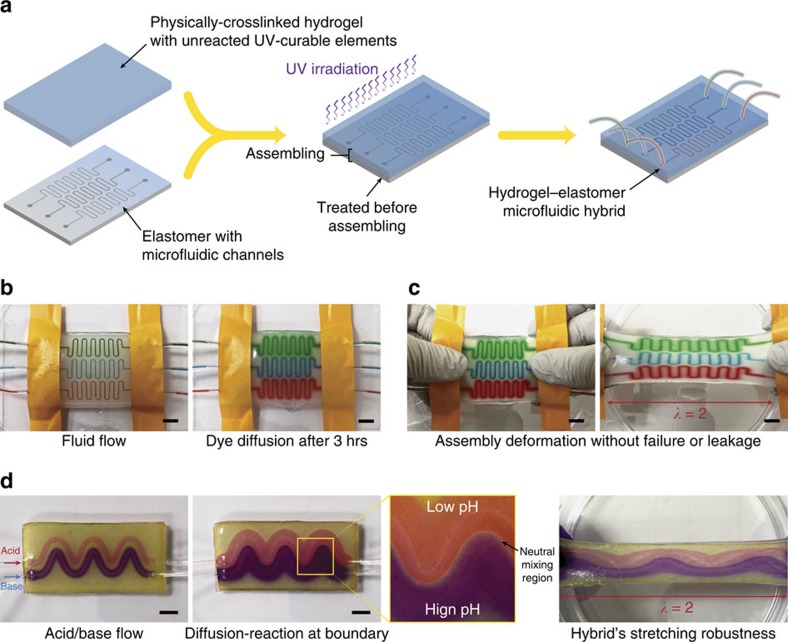
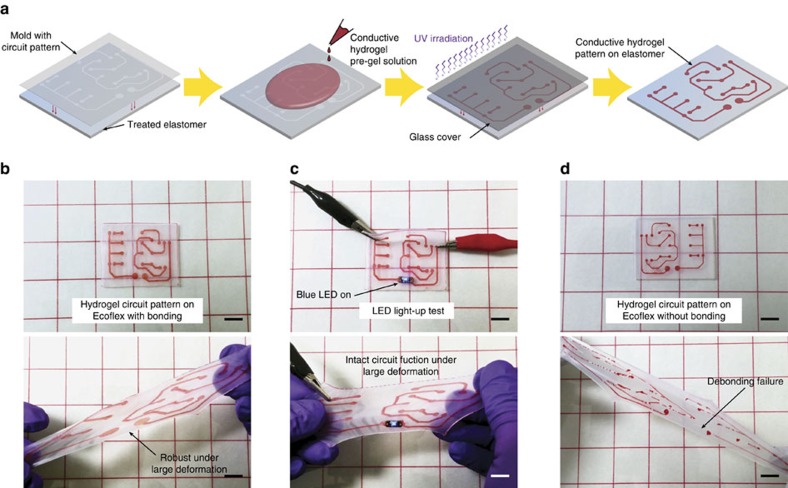
Inspired by mammalian skins, soft hybrids integrating the merits of elastomers and hydrogels have potential applications in diverse areas including stretchable and bio-integrated electronics, microfluidics, tissue engineering, soft robotics and biomedical devices. However, existing hydrogel–elastomer hybrids have limitations such as weak interfacial bonding, low robustness and difficulties in patterning microstructures. Here, we report a simple yet versatile method to assemble hydrogels and elastomers into hybrids with extremely robust interfaces (interfacial toughness over 1,000 Jm −2 ) and functional microstructures such as microfluidic channels and electrical circuits. The proposed method is generally applicable to various types of tough hydrogels and diverse commonly used elastomers including polydimethylsiloxane Sylgard 184, polyurethane, latex, VHB and Ecoflex. We further demonstrate applications enabled by the robust and microstructured hydrogel–elastomer hybrids including anti-dehydration hydrogel–elastomer hybrids, stretchable and reactive hydrogel–elastomer microfluidics, and stretchable hydrogel circuit boards patterned on elastomer.
Overview
The claims and statistics of this paper haven’t been checked yet.
Run the check — free, no account needed. It reads the open-access text and checks the sources it cites.
Integrity signals
Registry
Cites
Statistics
Figures
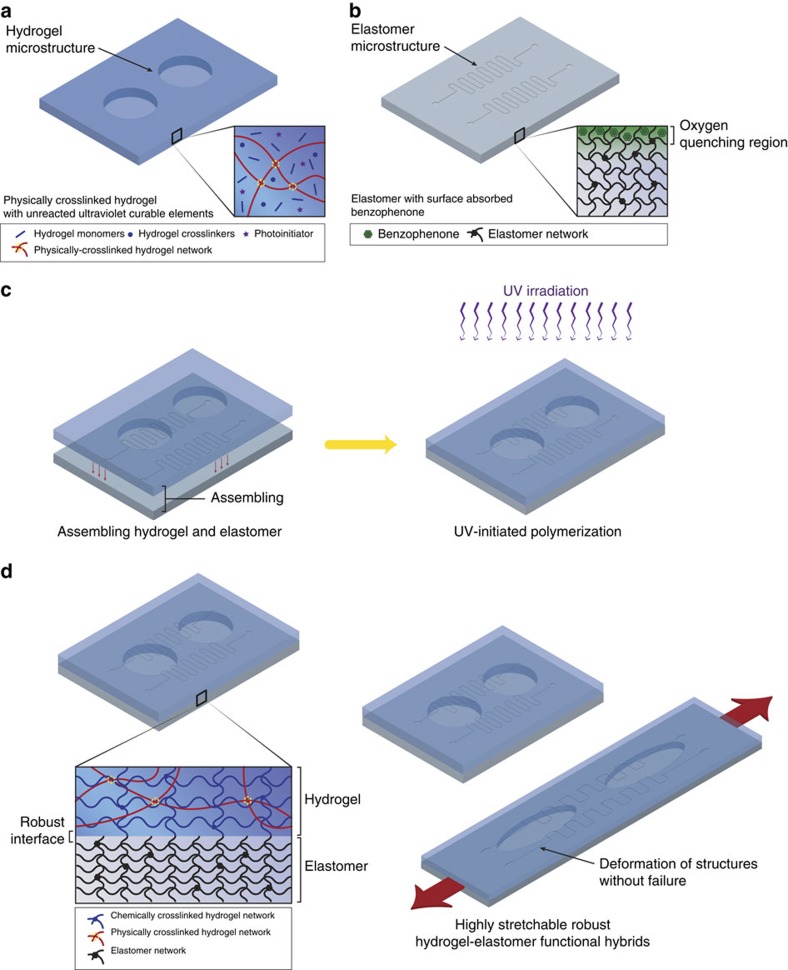
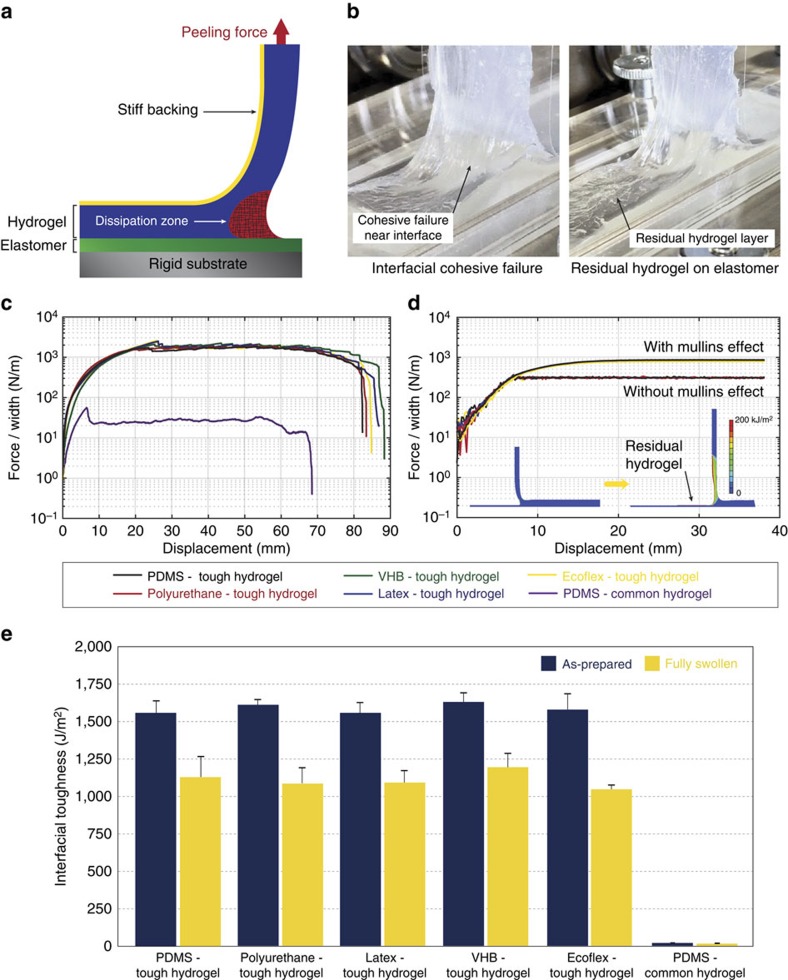
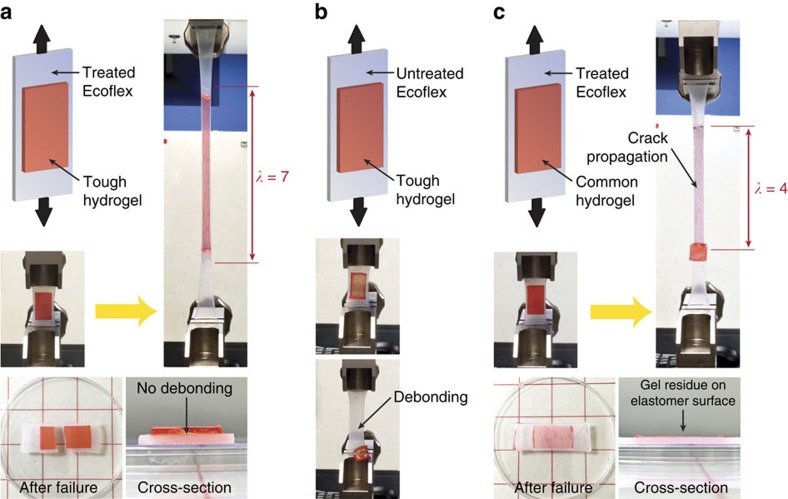
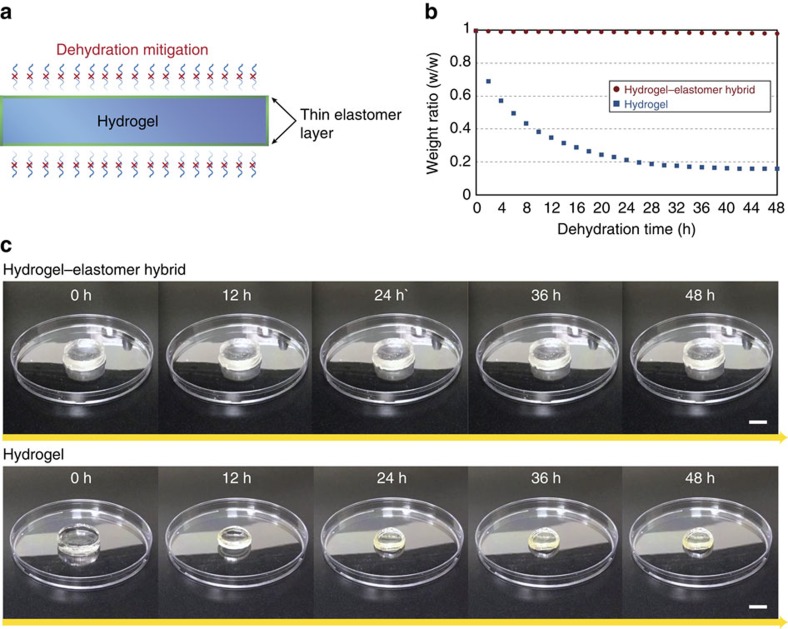
Verification
Claims the paper makes
The claims and statistics of this paper haven’t been checked yet.
Run the check — free, no account needed. It reads the open-access text and checks the sources it cites.
Claims other papers make about this one
Each is checked against this paper’s own text: does it say what the citing paper says it does?
The source backs part of the claim, not all of it — or backs it for a different population, condition or comparison.
In the citing paper
“The encapsulation of hydrogel sensors with elastomeric materials is an effective approach to prevent the evaporation of water from hydrogels”
From Functionalized Hydrogel-Based Wearable Gas and Humidity Sensors. (2023) · cites this paper as [151]
Experimental — accuracy not yet measuredThe cited source says what the claim attributes to it.
In the citing paper
“The hybrid retains stretchability, while enhancing the water-retention capacity of the hydrogel, thereby enabling it to work in dry environments”
From Functionalized Hydrogel-Based Wearable Gas and Humidity Sensors. (2023) · cites this paper as [151]
Self-check
Percentages, sums and reported differences re-computed from the paper’s own numbers.
The self-check needs the paper’s full text.
Citations
Cites
The origins and the future of microfluidics
Whitesides, G. M. (2006) · Nature · doi:10.1038/nature05058 · Cited by 9,687
Highly stretchable and tough hydrogels
Sun, J., Zhao, X., Illeperuma, W. R. K., Chaudhuri, O., Oh, K. H., Mooney, D. J., Vlassak, J. J., & Suo, Z. (2012) · Nature · doi:10.1038/nature11409 · Cited by 5,499
Self-citationHydrogels for Tissue Engineering
Lee, K. Y., & Mooney, D. J. (2001) · Chemical Reviews · doi:10.1021/cr000108x · Cited by 5,295
Materials and Mechanics for Stretchable Electronics
Rogers, J. A., Someya, T., & Huang, Y. Y. (2010) · Science · doi:10.1126/science.1182383 · Cited by 5,071
Younan Xia, A., & Whitesides, G. M. (1998) · Annual Review of Materials Science · doi:10.1146/annurev.matsci.28.1.153 · Cited by 4,610
Double‐Network Hydrogels with Extremely High Mechanical Strength
Gong, J. P., Katsuyama, Y., Kurokawa, T., & Osada, Y. (2003) · Advanced Materials · doi:10.1002/adma.200304907 · Cited by 4,552
Hydrogels in Biology and Medicine: From Molecular Principles to Bionanotechnology
Peppas, N. A., Hilt, J. Z., Khademhosseini, A., & Langer, R. (2006) · Advanced Materials · doi:10.1002/adma.200501612 · Cited by 4,109
Why are double network hydrogels so tough?
Gong, J. P. (2010) · Soft Matter · doi:10.1039/b924290b · Cited by 2,334
Shepherd, R. F., Ilievski, F., Choi, W., Morin, S. A., Stokes, A. A., Mazzeo, A. D., Chen, X., Wang, M. Y., & Whitesides, G. M. (2011) · Proceedings of the National Academy of Sciences · doi:10.1073/pnas.1116564108 · Cited by 2,142
3D bioprinting of vascularized, heterogeneous cell-laden tissue constructs
Kolesky, D. B., Truby, R. L., Gladman, A. S., Busbee, T. A., Homan, K. A., & Lewis, J. A. (2014) · Advanced Materials · doi:10.1002/adma.201305506 · Cited by 2,102
Cited by
Sorted by citations
Items 301–400 of 1,000
Zhao, S., & Ahn, J. (2022) · Materials Science and Engineering R Reports · doi:10.1016/j.mser.2022.100672 · Cited by 71
Motion‐Adaptive Tessellated Skin Patches With Switchable Adhesion for Wearable Electronics
Choi, G., Kim, J., Kim, H., Bae, H., Kim, B., Lee, H. J., Jang, H., Seong, M., Tawfik, S. M., Kim, J. J., et al. (2024) · Advanced Materials · doi:10.1002/adma.202412271 · Cited by 71
Mechanically mutable polymer enabled by light
Cai, F., Yang, B., Lv, X., Feng, W., & Yu, H. (2022) · Science Advances · doi:10.1126/sciadv.abo1626 · Cited by 71
A Review on Thermal Properties of Hydrogels for Electronic Devices Applications
Xin, F., & Lyu, Q. (2022) · Gels · doi:10.3390/gels9010007 · Cited by 70
Mao, Y., Li, P., Yin, J., Bai, Y., Zhou, H., Lin, X. Y., Yang, H., & Yang, L. (2020) · Journal of Material Science and Technology · doi:10.1016/j.jmst.2020.02.071 · Cited by 69
Tang, K., Fu, J., Wu, M., Hua, T., Liu, J., Song, L., & Hu, H. (2021) · Small Methods · doi:10.1002/smtd.202101276 · Cited by 69
Hydrogel and Machine Learning for Soft Robots’ Sensing and Signal Processing: A Review
Wang, S., & Sun, Z. (2022) · Journal of Bionic Engineering · doi:10.1007/s42235-022-00320-y · Cited by 69
Merkel cell-inspired skin-like hybrid hydrogels for wearable health monitoring
Xue, G., Shi, Y., Wang, S., Zhou, H., Chen, Z., Guo, W., Yang, Y., & Ye, M. (2022) · Chemical Engineering Journal · doi:10.1016/j.cej.2022.140976 · Cited by 69
Tian, Y., Wang, Z., Cao, S., Liu, D., Zhang, Y., Chen, C., Jiang, Z., Ma, J., & Wang, Y. (2024) · Nature Communications · doi:10.1038/s41467-024-44949-1 · Cited by 71
Zhang, H., Cheng, Y., Hou, X., Yang, B., & Guo, F. (2018) · New Journal of Chemistry · doi:10.1039/c8nj00920a · Cited by 69
Self-Adhesive Dry Ionic Conductors Based on Supramolecular Deep Eutectic Polymers
Zhang, K., Li, R., Chen, G., Wang, X., & He, M. (2022) · Chemistry of Materials · doi:10.1021/acs.chemmater.2c00074 · Cited by 68
Ultrathin Photonic Crystal Elastomer with Supersensitive Thermochromism in the Air
Wu, Y., Sun, R., Han, Y., Zhang, S., & Wu, S. (2022) · Chemical Engineering Journal · doi:10.1016/j.cej.2022.139075 · Cited by 68
3D printed drug loaded nanomaterials for wound healing applications
Yayehrad, A. T., Siraj, E. A., Matsabisa, M. G., & Birhanu, G. (2023) · Regenerative Therapy · doi:10.1016/j.reth.2023.08.007 · Cited by 68
Impermeable Robust Hydrogels via Hybrid Lamination
Parada, G. A., Yuk, H., Liu, X., Hsieh, A. J., & Zhao, X. (2017) · Advanced Healthcare Materials · doi:10.1002/adhm.201700520 · Cited by 68
Self-citationHydrogel 3D printing with the capacitor edge effect
Wang, J., Lu, T., Yang, M., Sun, D., Xia, Y., & Wang, T. (2019) · Science Advances · doi:10.1126/sciadv.aau8769 · Cited by 68
Zhang, Y., Xu, R., Zhao, W., Zhao, X., Zhang, L., Wang, R., Ma, Z., Sheng, W., Yu, B., Ma, S., et al. (2022) · Angewandte Chemie International Edition · doi:10.1002/anie.202209741 · Cited by 68
Self-citationAbdel-Mohsen, A. M., Franková, J., Abdel-Rahman, R. M., Salem, A. A., Sahffie, N. M., Kuběna, I., & Jancar, J. (2020) · International Journal of Pharmaceutics · doi:10.1016/j.ijpharm.2020.119349 · Cited by 67
Bioinspired Design of a Cartilage-like Lubricated Composite with Mechanical Robustness
Zhao, W., Zhang, Y., Zhao, X., Ji, Z., Ma, Z., Gao, X., Ma, S., Wang, X., & Zhou, F. (2022) · ACS Applied Materials & Interfaces · doi:10.1021/acsami.1c24439 · Cited by 66
Self-citationAn Antidehydration Hydrogel Based on Zwitterionic Oligomers for Bioelectronic Interfacing
He, K., Cai, P., Ji, S., Tang, Z., Zhou, F. Q., Li, W., Yu, J., Su, J., Luo, Y., Zhang, F., et al. (2023) · Advanced Materials · doi:10.1002/adma.202311255 · Cited by 66
Biomaterials for reliable wearable health monitoring: Applications in skin and eye integration
Hong, S., Yu, T., Wang, Z., & Lee, C. H. (2024) · Biomaterials · doi:10.1016/j.biomaterials.2024.122862 · Cited by 67
Lao, J., Jiao, Y., Zhang, Y., Xu, H., Wang, Y., Ma, Y., Feng, X., & Yu, J. (2025) · ACS Nano · doi:10.1021/acsnano.4c12823 · Cited by 68
Wei, S., Qu, G., Luo, G., Huang, Y., Zhang, H., Zhou, X., Wang, L., Liu, Z., & Kong, T. (2018) · ACS Applied Materials & Interfaces · doi:10.1021/acsami.8b00379 · Cited by 66
Tian, K., Bae, J., Suo, Z., & Vlassak, J. J. (2018) · ACS Applied Materials & Interfaces · doi:10.1021/acsami.8b16445 · Cited by 66
Jing, T., Xu, B., Yang, Y., Li, M., & Gao, Y. (2020) · Nano Energy · doi:10.1016/j.nanoen.2020.105373 · Cited by 65
Zhang, K., Yan, W., Simič, R., Benetti, E. M., & Spencer, N. D. (2020) · ACS Applied Materials & Interfaces · doi:10.1021/acsami.9b21399 · Cited by 64
Yu, D., Huang, J., Zhang, Z., Weng, J., Xu, X., Zhang, G., Zhang, J., Wu, X., Johnson, M., Lyu, J., et al. (2021) · Advanced Materials · doi:10.1002/adma.202106908 · Cited by 64
Mesquita, L. M. D. S., Martins, M., Maricato, É., Nunes, C., Quinteiro, P. S. G. N., Dias, A. C., Coutinho, J. A. P., Pisani, L. P., de Rosso, V. V., & Ventura, S. P. M. (2020) · ACS Sustainable Chemistry & Engineering · doi:10.1021/acssuschemeng.9b06424 · Cited by 64
He, Q., Zhong, Q., Sun, Z. Q., Zhang, H., Zhao, Z., Shi, Z., Liu, X., Zhao, Z., Lu, J., Ye, Y., et al. (2023) · Nano Energy · doi:10.1016/j.nanoen.2023.108535 · Cited by 63
Self-citationLiu, Y., Shen, S., Duan, Z., Deng, J., & Fan, D. (2025) · Advanced Functional Materials · doi:10.1002/adfm.202504356 · Cited by 63
Xu, R., Lee, J. W., Pan, T., Ma, S., Wang, J., Han, J. H., Ma, Y., Rogers, J. A., & Huang, Y. Y. (2016) · Advanced Functional Materials · doi:10.1002/adfm.201604545 · Cited by 63
Rotjanasuworapong, K., Thummarungsan, N., Lerdwijitjarud, W., & Sirivat, A. (2020) · Carbohydrate Polymers · doi:10.1016/j.carbpol.2020.116709 · Cited by 63
Printing Multi‐Material Organic Haptic Actuators
Zhai, Y., Wang, Z., Kwon, K., Cai, S., Lipomi, D. J., & Ng, T. N. (2020) · Advanced Materials · doi:10.1002/adma.202002541 · Cited by 65
“Freezing”, morphing, and folding of stretchy tough hydrogels
Li, T., Wang, J., Zhang, L., Yang, J., Yang, M., Zhu, D., Zhou, X., Handschuh‐Wang, S., Liu, Y., & Zhou, X. (2017) · Journal of Materials Chemistry B · doi:10.1039/c7tb01265a · Cited by 62
Alginate fiber toughened gels similar to skin intelligence as ionic sensors
Chen, H., Gao, Y., Ren, X., & Gao, G. (2020) · Carbohydrate Polymers · doi:10.1016/j.carbpol.2020.116018 · Cited by 62
Fu, X., Zhuang, Z., Zhao, Y., Liu, B., Liao, Y., Yu, Z., Yang, P., & Liu, K. (2022) · ACS Applied Materials & Interfaces · doi:10.1021/acsami.2c11124 · Cited by 62
Hu, Y., Qiao, Y., Lei, P., Gu, Y., Sun, L., Qiu, Y., Li, S., Xu, H. L., & Wang, R. (2023) · Chemical Engineering Journal · doi:10.1016/j.cej.2023.145502 · Cited by 62
Dual‐Channel Flexible Strain Sensors Based on Mechanofluorescent and Conductive Hydrogel Laminates
Lin, G., Si, M., Wang, L., Wei, S., Lü, W., Liu, H., Zhang, Y., Li, D., & Chen, T. (2022) · Advanced Optical Materials · doi:10.1002/adom.202102306 · Cited by 61
Mechanomodulatory biomaterials prospects in scar prevention and treatment
Fernandes, M. G., da Silva, L. P., Cerqueira, M. T., Ibañez, R. I. R., Murphy, C. M., Reis, R. L., O’Brien, F. J., & Marques, A. P. (2022) · Acta Biomaterialia · doi:10.1016/j.actbio.2022.07.042 · Cited by 61
Mechanically Programmable Composite Metamaterials with Switchable Positive/Negative Poisson's Ratio
Du, L., Shi, W., Gao, H., Jia, H., Zhang, Q., Liu, M., & Xu, Y. (2024) · Advanced Functional Materials · doi:10.1002/adfm.202314123 · Cited by 61
Mechanochemical Regulated Origami with Tough Hydrogels by Ion Transfer Printing
Zhou, X., Li, T., Wang, J., Chen, F., Zhou, D., Liu, Q., Li, B., Cheng, J., Zhou, X., & Zheng, B. (2018) · ACS Applied Materials & Interfaces · doi:10.1021/acsami.8b01610 · Cited by 62
Wang, S.-J., Chen, Z., Hu, X., Zou, J., Xie, Z., Mi, H., Liu, Z.-H., Zhang, Z., Shang, Y., & Jing, X. (2022) · Journal of Materials Chemistry C · doi:10.1039/d2tc02148j · Cited by 60
Influence of Cross-Linking Conditions on Drying Kinetics of Alginate Hydrogel
Łabowska, M. B., Skrodzka, M., Sicińska, H., Michalak, I., & Detyna, J. D. (2023) · Gels · doi:10.3390/gels9010063 · Cited by 60
Zheng, Z., Han, J., Demir, S. Ö., Wang, H., Jiang, W., Liu, H., & Sitti, M. (2023) · Advanced Science · doi:10.1002/advs.202302409 · Cited by 60
Recent innovations in artificial skin
Low, Z. W. K., Li, Z., Owh, C., Chee, P. L., Ye, E., Kai, D., Chan, S. Y., Young, D. J., & Loh, X. J. (2019) · Biomaterials Science · doi:10.1039/c9bm01445d · Cited by 60
Zhang, M., Yang, Q., Hu, T., Tang, L., Ni, Y., Chen, L., Wu, H., Huang, L., & Ding, C.-C. (2022) · ACS Applied Materials & Interfaces · doi:10.1021/acsami.1c21200 · Cited by 59
Tough Hydrogel Coating on Silicone Rubber with Improved Antifouling and Antibacterial Properties
Cheng, L., Liu, C., Wang, J., Wang, Y., Zha, W., & Li, X. (2022) · ACS Applied Polymer Materials · doi:10.1021/acsapm.2c00069 · Cited by 59
Bioinspired super-strong aqueous synthetic tissue adhesives
Li, Q., Song, W., Li, J., Ma, C., Zhao, X., Jiao, J., Mrowczynski, O., Webb, B. S., Rizk, E. B., Lu, D., et al. (2022) · Matter · doi:10.1016/j.matt.2021.12.018 · Cited by 58
Self-citationRadical polymerization as a versatile tool for surface grafting of thin hydrogel films
Seidi, F., Zhao, W., Xiao, H., Jin, Y., Saeb, M. R., & Zhao, C. (2020) · Polymer Chemistry · doi:10.1039/d0py00787k · Cited by 58
A Quenched Double‐Hydrophilic Coating for the Enhancement of Water Retention of Hydrogels
Gao, W., Chang, J., Li, X., Li, S., Zhou, Y., Hou, X., Long, L., Zhao, J., & Yuan, X. (2023) · Advanced Functional Materials · doi:10.1002/adfm.202303306 · Cited by 58
Khan, B., Abdullah, S., & Khan, S. (2023) · Micromachines · doi:10.3390/mi14051005 · Cited by 60
Conformal Fixation Strategies and Bioadhesives for Soft Bioelectronics
Park, J., Kim, H. W., Lim, S., Yi, H., Wu, Z., Kwon, I. G., Yeo, W., Song, E., & Yu, K. J. (2024) · Advanced Functional Materials · doi:10.1002/adfm.202313728 · Cited by 60
Hydrogel-based soft bioelectronic interfaces and their applications
Jiao, C., Liu, J., Yan, S., Xu, Z., Hou, Z., & Xu, W. (2025) · Journal of Materials Chemistry C · doi:10.1039/d4tc04150j · Cited by 59
Adaptable conductive hydrogel-enabled soft electronics
Liu, Y., Omar, R., Li, G., Zhou, P., Zhang, Y., Yan, W., Haick, H., Guo, C. F., Someya, T., & Wang, Y. (2025) · Progress in Materials Science · doi:10.1016/j.pmatsci.2025.101590 · Cited by 58
Li, S., Wang, Y., Xu, W., & Shi, B. Q. (2020) · ACS Sustainable Chemistry & Engineering · doi:10.1021/acssuschemeng.9b07078 · Cited by 58
Electro‐Photoluminescence Color Change for Deformable Visual Encryption
Lee, G., Kong, M., Park, D., Park, J., & Jeong, U. (2020) · Advanced Materials · doi:10.1002/adma.201907477 · Cited by 58
Hu, X., Xia, Z., & Cai, K. (2022) · Journal of Materials Chemistry B · doi:10.1039/d1tb02537f · Cited by 57
Challenges in Materials and Devices of Electronic Skin
Zhang, J., Li, J., Cheng, W. M., Zhang, J., Zhou, Z., Sun, X., Li, L., Liang, J., Shi, Y., & Pan, L. (2022) · ACS Materials Letters · doi:10.1021/acsmaterialslett.1c00799 · Cited by 57
Wang, J., Li, X., Qian, H., Wang, X., Wang, Y., Ren, K., & Ji, J. (2024) · Advanced Materials · doi:10.1002/adma.202310216 · Cited by 57
Extreme Hydrogel Bioelectronics
He, X., Liu, D., Cui, B., Huang, H. M., Dai, S., Pang, I., Qiao, Y., Xu, T., & Zhang, S. (2024) · Advanced Functional Materials · doi:10.1002/adfm.202405896 · Cited by 58
A novel leaf inspired hydrogel film based on fiber reinforcement as rapid steam sensor
Hou, K., Nie, Y., Innocent, M. T., Guo, Y., & Zhu, M. (2019) · Chemical Engineering Journal · doi:10.1016/j.cej.2019.122948 · Cited by 56
Instabilities in confined elastic layers under tension: Fringe, fingering and cavitation
Lin, S., Mao, Y., Radovitzky, R., & Zhao, X. (2017) · Journal of the Mechanics and Physics of Solids · doi:10.1016/j.jmps.2017.05.011 · Cited by 56
Self-citationCactus-inspired design principles for soft robotics based on 3D printed hydrogel-elastomer systems
Bastola, A. K., Rodriguez, N., Behl, M., Soffiatti, P., Rowe, N. P., & Lendlein, A. (2021) · Materials & Design · doi:10.1016/j.matdes.2021.109515 · Cited by 55
Stretchable Ionic Conductors for Soft Electronics
Niu, W., & Liu, X. (2022) · Macromolecular Rapid Communications · doi:10.1002/marc.202200512 · Cited by 57
Self-citationWang, Z., Wang, D., Liu, D., Han, X., Liu, X., Torun, H., Guo, Z., Duan, S., He, X., Zhang, X., et al. (2023) · Advanced Functional Materials · doi:10.1002/adfm.202301117 · Cited by 55
Self-citationBiomimetic Electronic Skin through Hierarchical Polymer Structural Design
Zhang, M., Gong, S. P., Hakobyan, K., Gao, Z., Shao, Z., Peng, S., Wu, S., Hao, X., Jiang, Z., Wong, E. H. H., et al. (2023) · Advanced Science · doi:10.1002/advs.202309006 · Cited by 55
Encapsulation of hydrogel sensors
Huang, X., & Zhang, L. (2024) · Chemical Engineering Journal · doi:10.1016/j.cej.2024.149631 · Cited by 55
A multifaceted biomimetic interface to improve the longevity of orthopedic implants
Croes, M., Akhavan, B., Sharifahmadian, O., Fan, H., Mertens, R., Tan, R. P., Chunara, A., Fadzil, A. A., Wise, S. G., Kruyt, M. C., et al. (2020) · Acta Biomaterialia · doi:10.1016/j.actbio.2020.04.020 · Cited by 55
Double Controlled Release of Therapeutic RNA Modules through Injectable DNA–RNA Hybrid Hydrogel
Han, S. W., Park, Y., Kim, H., Nam, H., Ko, O., & Lee, J. B. (2020) · ACS Applied Materials & Interfaces · doi:10.1021/acsami.0c12506 · Cited by 55
Environmentally adaptive and durable hydrogels toward multi-sensory application
Chen, Y., Zhang, C., Yin, R., Yin, A., Feng, Q., Liu, F., Shao, J., Su, T., Wang, H., Chen, G., et al. (2022) · Chemical Engineering Journal · doi:10.1016/j.cej.2022.137907 · Cited by 55
Giordano, G., Carlotti, M., & Mazzolai, B. (2021) · Advanced Materials Technologies · doi:10.1002/admt.202100437 · Cited by 56
Nonmulberry silk proteins: multipurpose ingredient in bio-functional assembly
Naskar, D., Sapru, S., Ghosh, A. K., Reis, R. L., Dey, T., & Kundu, S. C. (2021) · Biomedical Materials · doi:10.1088/1748-605x/ac20a0 · Cited by 55
Enhancing the interfacial binding strength between modular stretchable electronic components
Ji, S., & Chen, X. (2022) · National Science Review · doi:10.1093/nsr/nwac172 · Cited by 55
Zhu, W., Wang, S., Lu, Y. Q., Yang, W., Ge, S., Lou, Z., He, S., Jiang, S., & Han, J. (2024) · Industrial Crops and Products · doi:10.1016/j.indcrop.2024.119598 · Cited by 54
Conducting Hydrogel‐Based Neural Biointerfacing Technologies
Zhang, P., Yang, Y., Li, Z., Xue, Y., Wang, F., Shan, L., Wang, Y., Shi, X., Wu, K., & Liu, J. (2025) · Advanced Functional Materials · doi:10.1002/adfm.202422869 · Cited by 56
Emergent Soft Lithographic Tools for the Fabrication of Functional Polymeric Microstructures
Rose, M. A., Bowen, J. J., & Morin, S. A. (2019) · ChemPhysChem · doi:10.1002/cphc.201801140 · Cited by 54
Wan, X., Gu, Z., Zhang, F., Hao, D., Liu, X., Dai, B., Song, Y., & Wang, S. (2019) · NPG Asia Materials · doi:10.1038/s41427-019-0150-x · Cited by 57
Self-citationDautta, M., Alshetaiwi, M., Escobar, A. R., Torres, F., Bernardo, N., & Tseng, P. (2020) · Advanced Electronic Materials · doi:10.1002/aelm.201901311 · Cited by 55
Jing, X., Li, H., Mi, H., Feng, P.-Y., Tao, X., Liu, Y., Liu, C., & Shen, C. (2020) · Journal of Materials Chemistry C · doi:10.1039/c9tc06937b · Cited by 54
Fatigue-resistant adhesion I. Long-chain polymers as elastic dissipaters
Zhang, W., Gao, Y., Yang, H., Suo, Z., & Lu, T. (2020) · Extreme Mechanics Letters · doi:10.1016/j.eml.2020.100813 · Cited by 54
Huang, J., Zhang, Z., Weng, J., Yu, D., Liang, Y., Xu, X., Qiao, Z., Zhang, G., Yang, H., & Wu, X. (2020) · ACS Applied Materials & Interfaces · doi:10.1021/acsami.0c18825 · Cited by 54
Leal, C., Lopes, P. A., Serra, A. C., Coelho, J. F. J., de Almeida, A. T., & Tavakoli, M. (2019) · ACS Applied Materials & Interfaces · doi:10.1021/acsami.9b18462 · Cited by 53
Autonomous self-healing hydrogel with anti-drying properties and applications in soft robotics
Naranjo, A., Martín, C., López‐Díaz, A., Martín‐Pacheco, A., Rodríguez, A. M., Patiño, F. J., Herrero, M. A., Vázquez, A. S., & Vázquez, E. (2020) · Applied Materials Today · doi:10.1016/j.apmt.2020.100806 · Cited by 54
Flaw-sensitivity of a tough hydrogel under monotonic and cyclic loads
Zhou, Y., Hu, J. Q., Zhao, P., Zhang, W., Suo, Z., & Lu, T. (2021) · Journal of the Mechanics and Physics of Solids · doi:10.1016/j.jmps.2021.104483 · Cited by 53
Physiologically-Regulated Adhesion of Hydrogels for Wound Dressing
Xu, M., Yan, M., Yu, J., & Zhang, L. (2021) · Advanced Materials Interfaces · doi:10.1002/admi.202101131 · Cited by 53
Wei, J., Wan, F., Zhang, P., Zeng, Z., Ping, H., Xie, J., Zou, Z., Wang, W., Xie, H., Shen, Z. J., et al. (2021) · Chemical Engineering Journal · doi:10.1016/j.cej.2021.130549 · Cited by 52
Janus‐Structural AIE Nanofiber with White Light Emission and Stimuli‐Response
Zhao, S., Sun, J., Qin, Z., Li, Y., Yu, H., Wang, G., Gu, X., & Pan, K. (2022) · Small · doi:10.1002/smll.202201117 · Cited by 52
Beck, A., Obst, F., Gruner, D., Voigt, A., Mehner, P. J., Grünzner, S., Körbitz, R., Shahadha, M. H., Kutscher, A., Paschew, G., et al. (2022) · Advanced Materials Technologies · doi:10.1002/admt.202200417 · Cited by 55
He, X., Cheng, J., Li, Z., Ye, H., Wei, X., Li, H., Wang, R., Zhang, Y., Yang, H. Y., Guo, C. F., et al. (2022) · ACS Applied Materials & Interfaces · doi:10.1021/acsami.2c18954 · Cited by 53
Xiao, L., Jiang, H., Zhang, D., Ou, C., Lai, J., Wang, M., Ma, Y., & Huang, Y. (2023) · Chemical Engineering Journal · doi:10.1016/j.cej.2023.145944 · Cited by 52
A nonequilibrium thermodynamics approach to the transient properties of hydrogels
Xu, S., & Liu, Z. (2019) · Journal of the Mechanics and Physics of Solids · doi:10.1016/j.jmps.2019.03.008 · Cited by 52
Lei, W., Qi, S., Rong, Q., Huang, J., Xu, Y., Fang, R., Liu, K., Jiang, L., & Liu, M. (2019) · Advanced Materials · doi:10.1002/adma.201808217 · Cited by 52
Design and fabrication of functional hydrogels with specific surface wettability
Wang, S.-H., Yu, P., Li, X., Zhao, Z., Dong, Y., & Li, X. (2023) · Colloids and Interface Science Communications · doi:10.1016/j.colcom.2023.100697 · Cited by 53
Ren, X., Zhang, J., Yang, F., Xu, H., Guo, G., & Wang, Y. (2024) · Advanced Functional Materials · doi:10.1002/adfm.202312465 · Cited by 50
Ionic Hydrogel Sensors toward Next‐Gen Personalized Healthcare
Sun, Y., Tian, G., Deng, W., & Yang, W. (2025) · Advanced Materials · doi:10.1002/adma.202509122 · Cited by 52
Electrospun biodegradable chitosan based-poly(urethane urea) scaffolds for soft tissue engineering
Vieira, T., Silva, J. A. M. D. C., do Rego, A. M. B., Borges, J. P., & Henriques, C. (2019) · Materials Science and Engineering C · doi:10.1016/j.msec.2019.109819 · Cited by 55
Torres‐Mapa, M. L., Singh, M., Simon, O., Mapa, J. L., Machida, M., Günther, A., Roth, B., Heinemann, D., Terakawa, M., & Heisterkamp, A. (2019) · Sensors · doi:10.3390/s19194333 · Cited by 50
Coupled theory for transient responses of conductive hydrogels with multi-stimuli
Xu, S., & Liu, Z. (2020) · Journal of the Mechanics and Physics of Solids · doi:10.1016/j.jmps.2020.104055 · Cited by 50
Hydrogel−Solid Hybrid Materials for Biomedical Applications Enabled by Surface‐Embedded Radicals
Walia, R., Akhavan, B., Kosobrodova, E., Kondyurin, A. V., Oveissi, F., Naficy, S., Yeo, G. C., Hawker, M. J., Kaplan, D. L., Dehghani, F., et al. (2020) · Advanced Functional Materials · doi:10.1002/adfm.202004599 · Cited by 51
Gong, M., Wang, X., Wu, Z., Yue, L., Chen, Q., Li, H., Lin, X., Zhang, L., & Wang, D. (2024) · Small · doi:10.1002/smll.202400161 · Cited by 49
Interfacial Chemistry in Functional Hydrogel Coatings
Wan, X., Liu, M., Zhang, F., Xu, L., & Wang, S. (2025) · Angewandte Chemie International Edition · doi:10.1002/anie.202425552 · Cited by 49
Metadata
- Authors
- Yuk, H., Zhang, T., Parada, G. A., Liu, X., & Zhao, X.
- Affiliations
- Massachusetts Institute of Technology (US)
- Syracuse University (US)
- Corresponding author
- Zhao, Xuanhe
- Venue
- Nature Communications
- Published
- 2016-06-27
- Volume
- 7
- Issue
- 1
- Pages
- 12028-12028
- ISSN
- 2041-1723 (ISSN-L)
- PMC
- PMC4931236
- OpenAlex
- W2461891321
- Cited by
- 1,035
- References
- 53
- Citations by year
- 2026: 85 · 2025: 131 · 2024: 136 · 2023: 113 · 2022: 123 · 2021: 114 · 2020: 114 · 2019: 86 · 2018: 84 · 2017: 44 · 2016: 5
- FWCI
- 35.61
- Type
- journal article
- Language
- en
- Open access
- gold
- doi.org
- Locations
- Nature Communications (publishedVersion, cc-by)
- Europe PMC (PubMed Central) (publishedVersion, cc-by)
- PubMed Central (publishedVersion, cc-by)
- PubMed (publishedVersion)
- RePEc: Research Papers in Economics (submittedVersion)
- DOAJ (DOAJ: Directory of Open Access Journals) (submittedVersion, cc-by-sa)
- Funders
- National Science Foundation (1253495)
- Charles Stark Draper Laboratory
- National Institutes of Health (UH3TR000505)
- Samsung
- Office of Naval Research (N00014‐14‐1‐0528, N00014)
- Division of Civil, Mechanical and Manufacturing Innovation (CMMI-1253495)
- National Center for Advancing Translational Sciences
- Topics
- Physical Sciences › Materials Science › Biomaterials › Hydrogels: synthesis, properties, applications
- Physical Sciences › Engineering › Mechanical Engineering › Advanced Materials and Mechanics
- Physical Sciences › Engineering › Biomedical Engineering › Advanced Sensor and Energy Harvesting Materials
- Keywords
- interfacial bonding, interfacial toughness, micropatterning, microfluidic channels, stretchable electronics, stretchable circuits, polydimethylsiloxane, polyurethane, LaTeX, Ecoflex, soft robotics, bio-integrated electronics
- MeSH terms
- Chemical Engineering, Materials Testing, Surface Properties, Hydrogels, Elastomers, Mechanical Phenomena
About these checks
Registry, retraction, Cites and statistics results are computed, not judged, with one exception: a printed reference that no index lists is read once by a model before it counts as a citation error. Claims are extracted by a model and kept only when their quote appears verbatim in the text; each cited source is then checked, with a model’s help, for whether it says what the claim relies on. Those verdicts can be wrong — read the claim’s quote and the cited source before relying on one.
Statistics and arithmetic are recomputed, not judged.
Confidence bands are shown only for fields calibrated on our annotated test set. None is calibrated yet, so no band is shown.
What counts as a claim ›How we measure confidence ›How we check this ›
Are you an author, or do you see a problem with this page? Request a review
