

Decoding material-specific memory reprocessing during sleep in humans
Open accessThe DOI matches its Crossref record; 67 of the 67 references it cites were found in a registry or an index.
Abstract
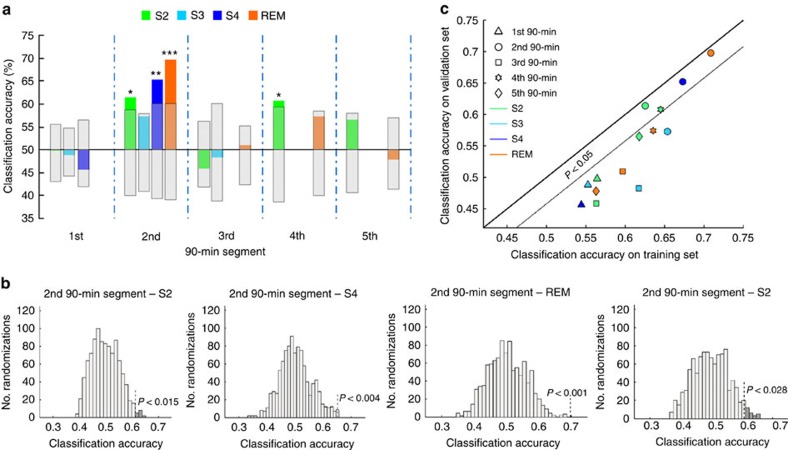
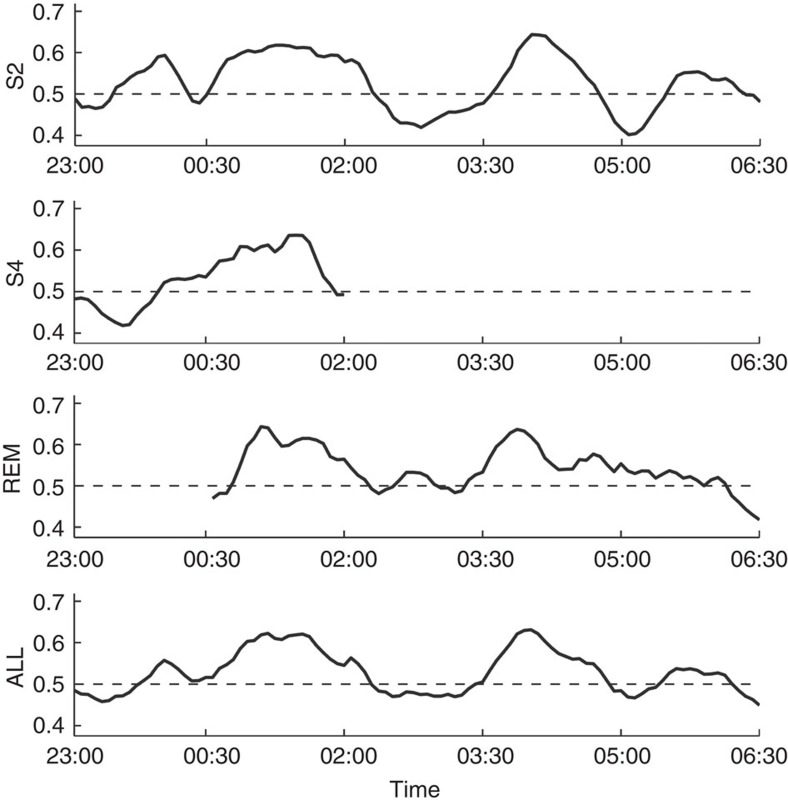
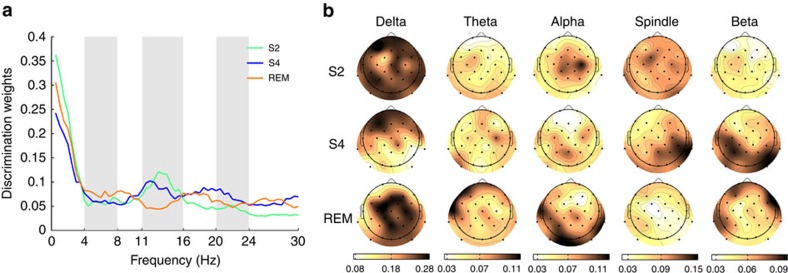
Neuronal learning activity is reactivated during sleep but the dynamics of this reactivation in humans are still poorly understood. Here we use multivariate pattern classification to decode electrical brain activity during sleep and determine what type of images participants had viewed in a preceding learning session. We find significant patterns of learning-related processing during rapid eye movement (REM) and non-REM (NREM) sleep, which are generalizable across subjects. This processing occurs in a cyclic fashion during time windows congruous to critical periods of synaptic plasticity. Its spatial distribution over the scalp and relevant frequencies differ between NREM and REM sleep. Moreover, only the strength of reprocessing in slow-wave sleep influenced later memory performance, speaking for at least two distinct underlying mechanisms between these states. We thus show that memory reprocessing occurs in both NREM and REM sleep in humans and that it pertains to different aspects of the consolidation process.
Overview
The claims and statistics of this paper haven’t been checked yet.
Free: it reads the open-access text and checks the first 5 claims that cite a source we can check. Create a free account to check every claim.
Integrity signals
Registry
Cites
Statistics
Figures
Verification
Claims the paper makes
The claims and statistics of this paper haven’t been checked yet.
Free: it reads the open-access text and checks the first 5 claims that cite a source we can check. Create a free account to check every claim.
Claims other papers make about this one
Each is checked against this paper’s own text: does it say what the citing paper says it does?
The source backs part of the claim, not all of it — or backs it for a different population, condition or comparison.
In the citing paper
“According to contemporary models and backed by a growing body of research,5,6,7,8 covert reactivation of mnemonic content underlies sleep-dependent memory consolidation by propagating information from hippocampal to neocortical regions via a synchronized interplay of hippocampal sharp-wave ripples, thalamic spindles, and neocortical slow waves.9,10”
From Random auditory stimulation during sleep disturbs traveling slow waves and declarative memory (2026) · cites this paper as [6]
Experimental — accuracy not yet measured
Self-check
Percentages, sums and reported differences re-computed from the paper’s own numbers.
The self-check needs the paper’s full text.
Citations
Cites
The assessment and analysis of handedness: The Edinburgh inventory
Oldfield, R. C. (1971) · Neuropsychologia · doi:10.1016/0028-3932(71)90067-4 · Cited by 35,900
Delorme, A., & Makeig, S. (2004) · Journal of Neuroscience Methods · doi:10.1016/j.jneumeth.2003.10.009 · Cited by 24,371
Rechtschaffen, A. (1968) · Medical Entomology and Zoology · Cited by 12,637
Thalamocortical oscillations in the sleeping and aroused brain
Steriade, M., McCormick, D. A., & Sejnowski, T. J. (1993) · Science · doi:10.1126/science.8235588 · Cited by 3,564
Reactivation of hippocampal ensemble memories during sleep
Wilson, M. A., & McNaughton, B. L. (1994) · Science · doi:10.1126/science.8036517 · Cited by 3,118
Rasch, B., & Born, J. (2013) · Physiological Reviews · doi:10.1152/physrev.00032.2012 · Cited by 2,783 · cited 1×
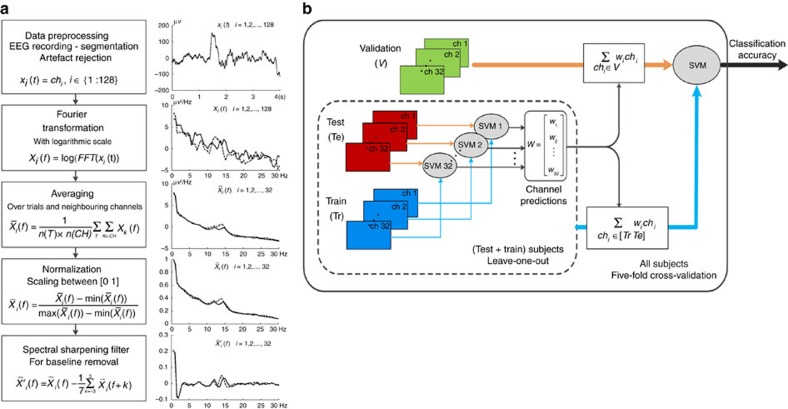
“The subsequent steps for data preparation were implemented to (1) increase signal-to-noise ratio, (2) reduce dimensionality of the data and (3) adapt the signal for between-subject classification.”
MethodBeyond mind-reading: multi-voxel pattern analysis of fMRI data
Norman, K. A., Polyn, S. M., Detre, G. J., & Haxby, J. V. (2006) · Trends in Cognitive Sciences · doi:10.1016/j.tics.2006.07.005 · Cited by 2,271
Boosting slow oscillations during sleep potentiates memory
Marshall, L., Helgadóttir, H., Mölle, M., & Born, J. (2006) · Nature · doi:10.1038/nature05278 · Cited by 1,792
Two-stage model of memory trace formation: A role for “noisy” brain states
Buzsáki, G. (1989) · Neuroscience · doi:10.1016/0306-4522(89)90423-5 · Cited by 1,709
Coordinated memory replay in the visual cortex and hippocampus during sleep
Ji, D., & Wilson, M. A. (2007) · Nature Neuroscience · doi:10.1038/nn1825 · Cited by 1,669
Cited by
Items 101–139 of 139
Revealing the cognitive contents of sleep to improve diagnosis and research
Schechtman, E. (2022) · SLEEP · doi:10.1093/sleep/zsac214 · Cited by 3
“However, other studies have focused on undisturbed sleep by focusing on spontaneous sleep-specific events, such as slow wave-spindle complexes (e.g., Figure 1b, left) [5], or even avoided relying on time-locked responses altogether [9].”
Sommer, V. R., Fandakova, Y., Grandy, T. H., Shing, Y. L., Werkle‐Bergner, M., & Sander, M. C. (2019) · bioRxiv (Cold Spring Harbor Laboratory) · doi:10.1101/528620 · Cited by 4
“To counter the effect of intrinsically high correlations between frequency patterns due to the 1/frequency power spectrum (Schönauer et al., 2017), we removed the mean background noise spectrum from the log-transformed TFRs following previously established procedures (i.e., as suggested by the…”
MethodNiediek, J., Reber, T. P., Bausch, M., Schwimmbeck, F., Gast, H., Coenen, V. A., Boström, J. P., Elger, C., & Mormann, F. (2026) · bioRxiv (Cold Spring Harbor Laboratory) · doi:10.64898/2026.01.10.698827 · Cited by 5
“These studies described the re-instantiation of task-related brain activity patterns during subsequent waking 10–12, 14, 15 and sleep 13 In this study, by making use of the rare opportunity to record continuously from single neurons in the temporal lobes of epilepsy patients undergoing presurgical…”
Schechtman, E., Stickgold, R., & Paller, K. A. (2024) · Oxford University Press eBooks · doi:10.1093/oxfordhb/9780190917982.013.45 · Cited by 4
Gilson, M., Nitsche, M. A., & Peigneux, P. (2021) · Brain Sciences · doi:10.3390/brainsci11081104 · Cited by 2
“…periods, both at wake (Humiston, Tucker, Summer, & Wamsley, 2019; Peigneux et al., 2006; Tambini & Davachi, 2019; Wamsley, 2019) and during sleep (Jegou et al., 2019; Peigneux et al., 2004; Sara, 2010; Schonauer et al., 2017; Skaggs & Mcnaughton, 1996; Valdes, McNaughton, & Fellous, 2015).”
Studying episodic memory using real-time fMRI
Wammes, J. D., Lin, Q., Norman, K. A., & Turk‐Browne, N. B. (2021) · Elsevier eBooks · doi:10.1016/b978-0-12-822421-2.00011-9 · Cited by 2
“In this work, pattern classifiers were trained on iEEG recording data from a patient to distinguish encoding states likely to yield later retrieval or forgetting.”
BackgroundInfluentialLocalizing spontaneous memory reprocessing during human sleepPreprint
Himmer, L., Bürger, Z., Fresz, L., Maschke, J., Wagner, L., Brodt, S., Braun, C., Schönauer, M., & Gais, S. (2021) · bioRxiv (Cold Spring Harbor Laboratory) · doi:10.1101/2021.11.29.470230 · Cited by 2
“While it is possible to induce reactivation using memory cues during sleep (Rasch et al., 2007; Schreiner et al., 2018), spontaneous memory processing has only been indirectly observed at a coarse spatiotemporal resolution (Schönauer et al., 2017).”
BackgroundSelf-citationMemory reactivations during sleep: a neural basis of dream experiences?Preprint
Picard‐Deland, C., Bernardi, G., Genzel, L., Dresler, M., & Schoch, S. F. (2023) · doi:10.31234/osf.io/yncxe · Cited by 2
Targeted memory reactivation elicits temporally compressed reactivation linked to spindles
Abdellahi, M. E. A., Rakowska, M., Treder, M. S., & Lewis, P. A. (2026) · Imaging Neuroscience · doi:10.1101/2024.09.12.612625 · Cited by 4
Lekha, P. P. S., & Azeez, E. P. A. (2024) · Journal of Human Behavior in the Social Environment · doi:10.1080/10911359.2024.2407914 · Cited by 1
“…functioning of individuals and influences cognitive performance (Alhola & Polo-Kantola, 2007), learning (Maquet, 2001), consolidation of memory, retaining new information (Schönauer et al., 2017; Sejnowski & Destexhe, 2000), and overall physical and mental health (Clement-Carbonell et al., 2021).”
Sleep deprivation silently undermines immunity
Zhou, Q., Feng, C., Li, S., Zhangyan, M., & Sun, Y. (2025) · International Journal of Surgery · doi:10.1097/js9.0000000000004071 · Cited by 2
Zhao, Y., & Kuhl, B. A. (2024) · Oxford University Press eBooks · doi:10.1093/oxfordhb/9780190917982.013.37 · Cited by 2
Sleep and Circadian Rhythms as Modulators of Mental Health in Ageing
Jagota, A., Priyanka, Bussa, B. R., & Gunda, V. (2024) · Healthy ageing and longevity · doi:10.1007/978-3-031-68513-2_15 · Cited by 2
Context changes retrieval of prospective outcomes during decision deliberation
Göktepe-Kavis, P., Aellen, F. M., Cortese, A., Castegnetti, G., Martino, B. D., & Tzovara, A. (2024) · Cerebral Cortex · doi:10.1093/cercor/bhae483 · Cited by 2
“…are adding to this literature by showing that in humans learning through retrieval of neural representations takes place not only in “passive” off-task rest (Schapiro et al. 2018) and sleep ( Schönauer et al. 2017; Belal et al. 2018; Zhang et al. 2018) but also while “actively” decisions are made.”
Incorporation of complex narratives into dreaming
Palmieri, J., Kumral, D., Wymer, S.-J., Kirchner, S., Schneider, M., Gais, S., & Schönauer, M. (2025) · SLEEP · doi:10.1093/sleep/zsaf280 · Cited by 1
Self-citationPhenotypic and genetic correlation between sleep, behavior, and macroscale cortical grey matter
Tahmasian, M., Samea, F., Khazaie, H., Zarei, M., Masouleh, S. K., Hoffstaedter, F., Camilleri, J., Kochunov, P., Yeo, B. T. T., Eickhoff, S. B., et al. (2022) · Sleep Medicine · doi:10.1016/j.sleep.2022.05.241 · Cited by 1
Sleep Disruption Selectively Weakens Reactivated MemoriesPreprint
Whitmore, N. W., & Paller, K. A. (2022) · bioRxiv (Cold Spring Harbor Laboratory) · doi:10.1101/2022.04.10.487316 · Cited by 2
“In human sleep, EEG activity was shown to reflect the type of information learned before sleep (Schönauer et al., 2017; Schreiner & Staudigl, 2020).”
BackgroundReap while you sleep: consolidation of memories differs by how they were sownPreprint
Antony, J. W., & Schechtman, E. (2022) · doi:10.31234/osf.io/u48fp · Cited by 1
Enhancing Precision in Human NeurosciencePreprint
Nebe, S., Reutter, M., Baker, D. H., Bölte, J., Domes, G., Gamer, M., Gärtner, A., Gießing, C., Mann, C., Hilger, K., et al. (2023) · doi:10.31234/osf.io/m8c4k · Cited by 1
Item-specific memory reactivation supports overnight memory consolidationPreprint
Liu, J., Xia, T., Chen, D., Yao, Z., Zhu, M., Antony, J. W., Lee, T. M. C., & Hu, X. (2023) · Research Square · doi:10.21203/rs.3.rs-2544886/v1 · Cited by 1
Schwimmbeck, F., Niediek, J., Borger, V., Surges, R., Trinka, E., Schreiner, T., & Mormann, F. (2026) · bioRxiv (Cold Spring Harbor Laboratory) · doi:10.64898/2026.01.15.699122 · Cited by 3
“Middle: SWR event in hippocampal iEEG, with corresponding time– frequency representation (0.1–150 Hz).”
InfluentialRandom auditory stimulation during sleep disturbs traveling slow waves and declarative memory
Roüast, N. M., Kumral, D., Gais, S., & Schönauer, M. (2026) · iScience · doi:10.1016/j.isci.2026.116601
Self-citationSleep’s role in the reprocessing and restructuring of memory
Koopman, A. C. M. (2020) · ORCA Online Research @Cardiff (Cardiff University) · Cited by 1
On the Benefits of Two Dimensional Metric Learning
Wu, D., Zhou, F., Wang, B., Wong, C. M., Shui, C., Zhou, Y., Lao, Q., & Wan, F. (2021) · IEEE Transactions on Knowledge and Data Engineering · doi:10.1109/tkde.2021.3100353
“The objective of this task is to decode the content of information in EEG signals, which has been actively studied in the fields such as brain computer interface (BCI) [43] and memory research [35].”
BackgroundHairston, I. S. (2020) · Elsevier eBooks · doi:10.1016/b978-0-12-816658-1.00036-3
Item-specific memory reactivation during sleep supports memory consolidation in humansPreprint
Liu, J., Xia, T., Chen, D., Yao, Z., Zhu, M., Antony, J. W., Lee, T. M. C., & Hu, X. (2023) · bioRxiv (Cold Spring Harbor Laboratory) · doi:10.1101/2023.01.25.525599
Modulating social learning-induced evaluation updating during human sleepPreprint
Chen, D., Xia, T., Yao, Z., Zhang, L., & Hu, X. (2023) · bioRxiv (Cold Spring Harbor Laboratory) · doi:10.1101/2023.12.11.571114
Schechtman, E., Stickgold, R., & Paller, K. A. (2024) · Elsevier eBooks · doi:10.1016/b978-0-12-820480-1.00126-1
Helfrich, R. F., Knight, R. T., & D’Esposito, M. (2024) · Oxford University Press eBooks · doi:10.1093/oxfordhb/9780190917982.013.5
Mechanisms of systems consolidation and their behavioral consequence
Tompary, A., & Murty, V. P. (2024) · Elsevier eBooks · doi:10.1016/b978-0-443-15754-7.00054-7
Torres-Platas, S. G., Yamazaki, E. M., Paller, K. A., Stickgold, R., & Schechtman, E. (2025) · Elsevier eBooks · doi:10.1016/b978-0-443-15754-7.00077-8
Functions of the Human Hippocampus
Barry, D. N., & Maguire, E. A. (2025) · Oxford University Press eBooks · doi:10.1093/med/9780190065324.003.0013
Sleep, Neurocognitive Function, Learning, and Memory
Baena, D., Alyssa, P., Hordijk, J., Ray, L. B., & Fogel, S. M. (2025) · Oxford University Press eBooks · doi:10.1093/oxfordhb/9780197602751.013.2
Chen, X., Kandel, M. E., Zhao, S., Zirkel, R. T., Huang, K., Kong, H. J., Schaffer, C. B., & Xu, C. (2026) · bioRxiv (Cold Spring Harbor Laboratory) · doi:10.64898/2026.01.19.700239 · Cited by 1
Modeling functional brain connectivity in working memory and meditation tasks
Nguyen, T.-T. H. (2020) · theses.fr (ABES) · doi:10.70675/9b3ce040z8179z4f42zbc87z50dfd0ee04a3
The borderland between wakefulness and sleep, a doorway into creativity
Lacaux, C. (2021) · theses.fr (ABES) · doi:10.70675/a9f3460dz3d02z42aczad97zf8c513812801 · Cited by 2
Sleep Spindle-Locked Targeted Memory Reactivation Enhances Declarative Memory ConsolidationPreprint
Mutreja, V., Gupta, P., Lungu, O., Lazzouni, L., Gabitov, E., Benali, H., Jourde, H. R., Beltrame, G., Coffey, E. B. J., Lina, J., et al. (2026) · bioRxiv (Cold Spring Harbor Laboratory) · doi:10.64898/2026.05.08.723823 · Cited by 1
Zhang, R. (2026) · Research Square · doi:10.21203/rs.3.rs-10024823/v1
Zhang, Y., Yao, Z., Chen, D., Xia, T., Zhang, L., Luo, A. F., & Hu, X. (2026) · bioRxiv (Cold Spring Harbor Laboratory) · doi:10.64898/2026.08.04.742295 · Cited by 1
“Prior work has shown that cardinal sleep events (e.g., slow oscillations, spindles) can carry memory-specific information (e.g., houses vs. faces) and support memory consolidation, but whether these events also reinstate the affective content of prior experiences remains unclear 16,18,53 .”
Influential
Metadata
- Authors
- Schönauer, M., Alizadeh, S., Jamalabadi, H., Abraham, A., Pawlizki, A., & Gais, S.
- Affiliations
- Bernstein Center for Computational Neuroscience Munich (DE)
- Ludwig-Maximilians-Universität München (DE)
- Corresponding author
- Schönauer, M.
- Gais, S.
- Venue
- Nature Communications
- Published
- 2017-05-17
- Volume
- 8
- Issue
- 1
- Pages
- 15404-15404
- ISSN
- 2041-1723 (ISSN-L)
- PMC
- PMC5442370
- OpenAlex
- W2615649700
- Semantic Scholar
- 9a127000f02e84346a7efd579eebd6ff5b8efbc2
- Cited by
- 139
- References
- 67
- Citations by year
- 2026: 10 · 2025: 9 · 2024: 21 · 2023: 17 · 2022: 17 · 2021: 11 · 2020: 19 · 2019: 13 · 2018: 18 · 2017: 4
- FWCI
- 8.47
- Type
- journal article
- Language
- en
- Open access
- gold
- doi.org
- Licence
- cc-by
- creativecommons.org/licenses/by/4.0 (tdm)
- creativecommons.org/licenses/by/4.0 (vor)
- Locations
- Nature Communications (publishedVersion, cc-by)
- Europe PMC (PubMed Central) (publishedVersion, cc-by)
- PubMed Central (publishedVersion, cc-by)
- PubMed (publishedVersion)
- RePEc: Research Papers in Economics (submittedVersion)
- DOAJ (DOAJ: Directory of Open Access Journals) (submittedVersion, cc-by-sa)
- Open access LMU (Ludwid Maxmilian's Universitat Munchen) (submittedVersion)
- Funders
- Deutsche Forschungsgemeinschaft (GA730/3–1)
- Topics
- Life Sciences › Neuroscience › Cognitive Neuroscience › Sleep and Wakefulness Research
- Life Sciences › Neuroscience › Cognitive Neuroscience › Memory and Neural Mechanisms
- Life Sciences › Neuroscience › Cognitive Neuroscience › Memory Processes and Influences
- Keywords
- sleep-dependent memory consolidation, REM sleep, NREM sleep, slow-wave sleep, multivariate pattern classification, neural decoding, synaptic plasticity
- MeSH terms
- Adult, Brain, Electroencephalography, Humans, Learning, Memory, Neuronal Plasticity, Neurons, Sleep, Young Adult, Healthy Volunteers
About these checks
Registry, retraction, Cites and statistics results are computed, not judged, with one exception: a printed reference that no index lists is read once by a model before it counts as a citation error. Claims are extracted by a model and kept only when their quote appears verbatim in the text; each cited source is then checked, with a model’s help, for whether it says what the claim relies on. Those verdicts can be wrong — read the claim’s quote and the cited source before relying on one.
Statistics and arithmetic are recomputed, not judged.
Confidence bands are shown only for fields calibrated on our annotated test set. None is calibrated yet, so no band is shown.
What counts as a claim ›How we measure confidence ›How we check this ›
Are you an author, or do you see a problem with this page? Request a review
Data sources
Bibliographic data: Semantic Scholar, OpenAlex, Crossref.
Contains information from the Semantic Scholar Academic Graph Datasets, made available under the ODC Attribution License (ODC-BY 1.0).
Semantic Scholar’s data is described in: Kinney, R., et al. (2023). The Semantic Scholar Open Data Platform. arXiv:2301.10140.
