

PW1/Peg3 expression regulates key properties that determine mesoangioblast stem cell competence
Open accessThe DOI matches its Crossref record; 33 of the 33 references it cites were found in a registry or an index.
Abstract
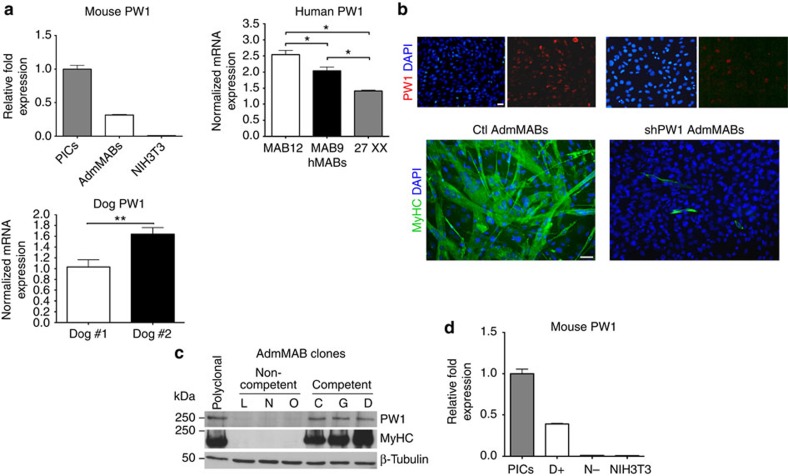
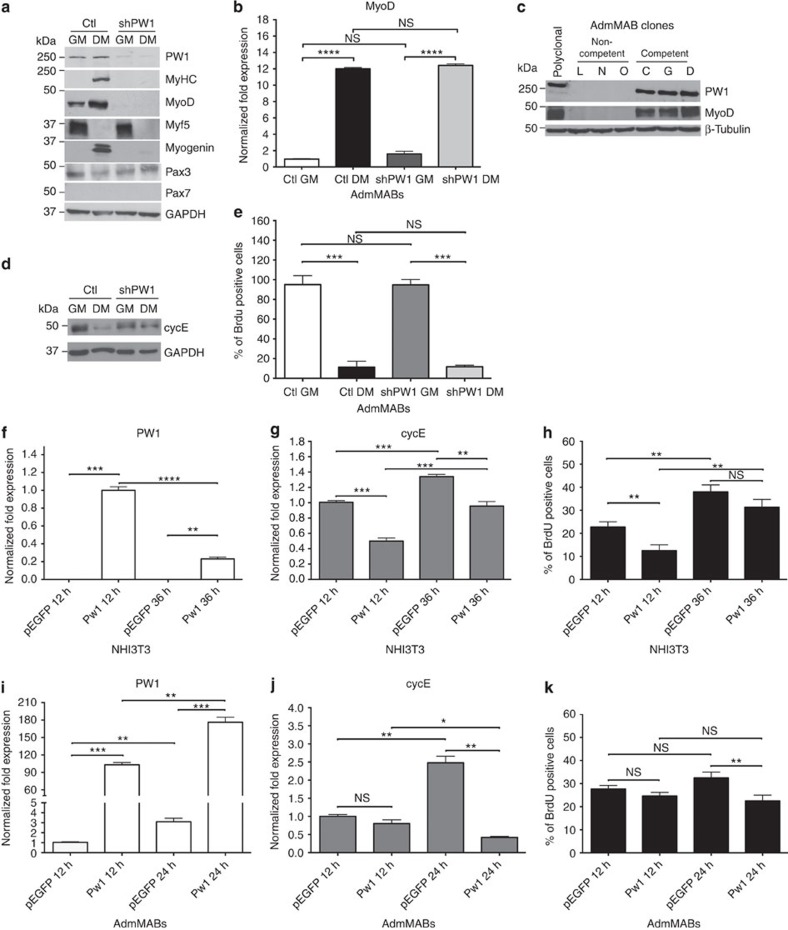
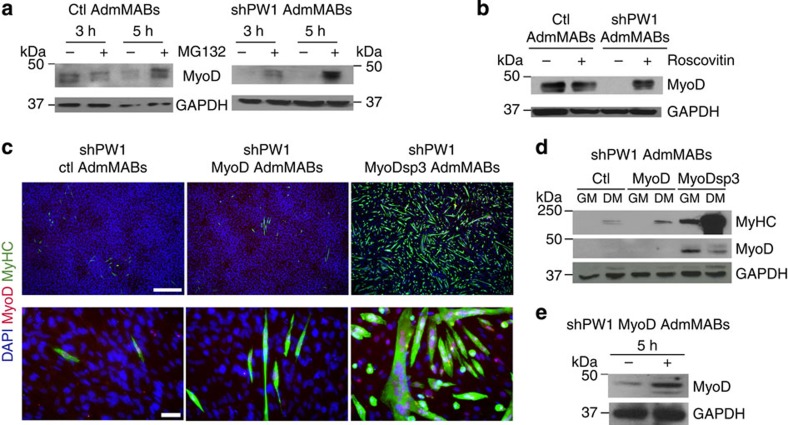
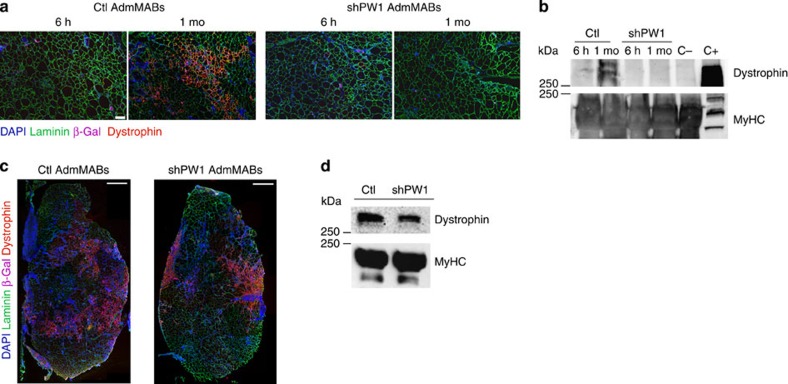
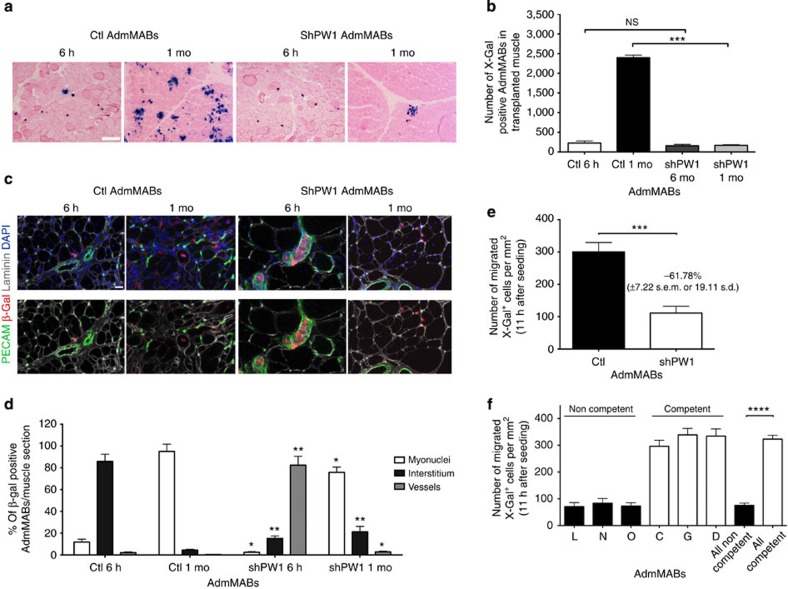
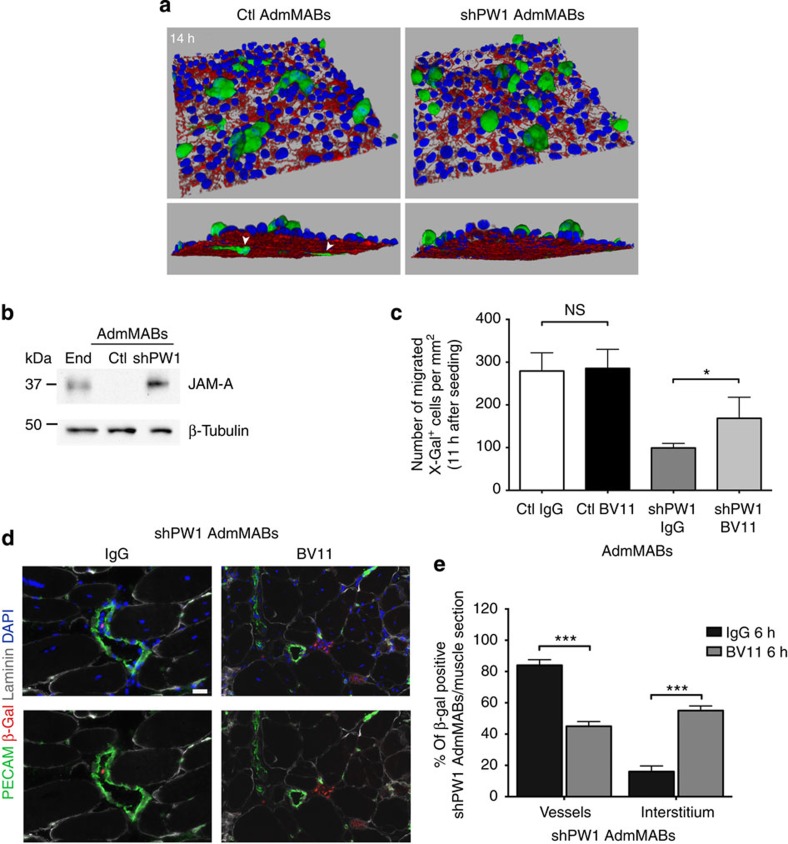
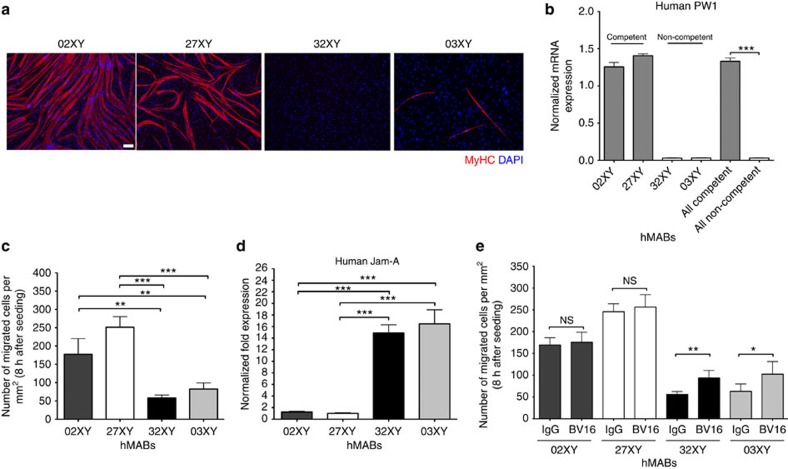
Mesoangioblasts are vessel-associated progenitor cells that show therapeutic promise for the treatment of muscular dystrophy. Mesoangioblasts have the ability to undergo skeletal muscle differentiation and cross the blood vessel wall regardless of the developmental stage at which they are isolated. Here we show that PW1/Peg3 is expressed at high levels in mesoangioblasts obtained from mouse, dog and human tissues and its level of expression correlates with their myogenic competence. Silencing PW1/Peg3 markedly inhibits myogenic potential of mesoangioblasts in vitro through MyoD degradation. Moreover, lack of PW1/Peg3 abrogates mesoangioblast ability to cross the vessel wall and to engraft into damaged myofibres through the modulation of the junctional adhesion molecule-A. We conclude that PW1/Peg3 function is essential for conferring proper mesoangioblast competence and that the determination of PW1/Peg3 levels in human mesoangioblasts may serve as a biomarker to identify the best donor populations for therapeutic application in muscular dystrophies.
Overview
The claims and statistics of this paper haven’t been checked yet.
Free: it reads the open-access text and checks the first 5 claims that cite a source we can check. Create a free account to check every claim.
Integrity signals
Registry
Cites
Statistics
Figures
Verification
Claims the paper makes
The claims and statistics of this paper haven’t been checked yet.
Free: it reads the open-access text and checks the first 5 claims that cite a source we can check. Create a free account to check every claim.
Claims other papers make about this one
Each is checked against this paper’s own text: does it say what the citing paper says it does?
In the citing paper
“These factors can derive from the circulation or neighboring cell types such as FAPs, fibroblasts and immune cells, as discussed herein, and other cell types which also play important roles, including adipocytes, endothelial cells, mesoangioblasts, PW1+ interstitial cells and myofibroblasts109–111.”
From The central role of muscle stem cells in regenerative failure with aging (2015) · cites this paper as [111]
Self-check
Percentages, sums and reported differences re-computed from the paper’s own numbers.
The self-check needs the paper’s full text.
Citations
Cites
Martìn-Padura, I., Lostaglio, S., Schneemann, M., Williams, L., Romano, M., Fruscella, P., Panzeri, C., Stoppacciaro, A., Ruco, L., Villa, A., et al. (1998) · The Journal of Cell Biology · doi:10.1083/jcb.142.1.117 · Cited by 1,388
Self-citationPericytes of human skeletal muscle are myogenic precursors distinct from satellite cells
Dellavalle, A., Sampaolesi, M., Tonlorenzi, R., Tagliafico, E., Sacchetti, B., Perani, L., Innocenzi, A., Galvez, B. G., Messina, G., Morosetti, R., et al. (2007) · Nature Cell Biology · doi:10.1038/ncb1542 · Cited by 1,001 · cited 5×
“From these arrays, PW1 was found to be expressed in MABs regardless of species and age 9,10 .”
InfluentialSelf-citationMesoangioblast stem cells ameliorate muscle function in dystrophic dogs
Sampaolesi, M., Blot, S., D’Antona, G., Granger, N., Tonlorenzi, R., Innocenzi, A., Mognol, P., Thibaud, J.-L., Galvez, B. G., Barthélémy, I., et al. (2006) · Nature · doi:10.1038/nature05282 · Cited by 769 · cited 4×
“…of muscular dystrophies in different pre-clinical animal models: the a -sarcoglican-null mouse, which models the limb-girdle muscular dystrophy, the AJ mouse model of dysferlinopathy, the mdx mouse for Duchenne muscular dystrophy (DMD) 2–5 and the golden retriever muscular dystrophy dog 6 .”
InfluentialSelf-citationRepairing skeletal muscle: regenerative potential of skeletal muscle stem cells
Tedesco, F. S., Dellavalle, A., Diaz-Manera, J., Messina, G., & Cossu, G. (2010) · Journal of Clinical Investigation · doi:10.1172/jci40373 · Cited by 677 · cited 1×
“The ability of MABs to cross the vessel wall confers an advantage as therapeutic donor stem cells as compared with satellite cells and myoblasts that need to be delivered directly into the muscle tissue to properly engraft 7,8 .”
Self-citationSampaolesi, M., Torrente, Y., Innocenzi, A., Tonlorenzi, R., D'Antona, G., Pellegrino, M. A., Barresi, R., Bresolin, N., De Angelis, M. G. C., Campbell, K. P., et al. (2003) · Science · doi:10.1126/science.1082254 · Cited by 641
Self-citationMinasi, M. G., Riminucci, M., De Angelis, L., Borello, U., Berarducci, B., Innocenzi, A., Caprioli, A., Sirabella, D., Baiocchi, M., De Maria, R., et al. (2002) · Development · doi:10.1242/dev.129.11.2773 · Cited by 514
Self-citationMitchell, K. J., Pannérec, A., Cadot, B., Parlakian, A., Besson, V., Gomes, E. R., Marazzi, G., & Sassoon, D. A. (2010) · Nature Cell Biology · doi:10.1038/ncb2025 · Cited by 441
Self-citationSkeletal muscle stem cells in developmental versus regenerative myogenesis
Tajbakhsh, S. (2009) · Journal of Internal Medicine · doi:10.1111/j.1365-2796.2009.02158.x · Cited by 332 · cited 1×
“The ability of MABs to cross the vessel wall confers an advantage as therapeutic donor stem cells as compared with satellite cells and myoblasts that need to be delivered directly into the muscle tissue to properly engraft 7,8 .”
Kitzmann, M., Carnac, G., Vandromme, M., Primig, M., Lamb, N. J. C., & Fernandez, A. (1998) · The Journal of Cell Biology · doi:10.1083/jcb.142.6.1447 · Cited by 324
Tedesco, F. S., Gerli, M. F. M., Perani, L., Benedetti, S., Ungaro, F., Cassano, M., Antonini, S., Tagliafico, E., Artusi, V., Longa, E., et al. (2012) · Science Translational Medicine · doi:10.1126/scitranslmed.3003541 · Cited by 301 · cited 1×
“In the last decade, MABs have been isolated from different species (mouse, dog and human) at different developmental stages (from mouse embryo to adult humans, including also iPS cells) 1,4,6,9,30 .”
Self-citation
Cited by
Integrin-mediated mechanotransduction
Sun, Z., Guo, S. S., & Fässler, R. (2016) · Journal of Cell Biology · doi:10.1083/jcb.201609037 · Cited by 1,079
The central role of muscle stem cells in regenerative failure with aging
Blau, H. M., Cosgrove, B. D., & Ho, A. T. V. (2015) · Nature Medicine · doi:10.1038/nm.3918 · Cited by 437
The extracellular matrix in development
Walma, D. A. C., & Yamada, K. M. (2020) · Development · doi:10.1242/dev.175596 · Cited by 397
Proteoglycan Chemical Diversity Drives Multifunctional Cell Regulation and Therapeutics
Karamanos, N. K., Piperigkou, Z., Theocharis, A. D., Watanabe, H., Franchi, M., Baud, S., Brézillon, S., Götte, M., Passi, A., Vigetti, D., et al. (2018) · Chemical Reviews · doi:10.1021/acs.chemrev.8b00354 · Cited by 367
Fibrous nonlinear elasticity enables positive mechanical feedback between cells and ECMs
Hall, M. S., Alisafaei, F., Ban, E., Feng, X., Hui, C.-Y., Shenoy, V. B., & Wu, M. (2016) · Proceedings of the National Academy of Sciences · doi:10.1073/pnas.1613058113 · Cited by 360
Metadata
- Authors
- Bonfanti, C., Rossi, G., Tedesco, F. S., Giannotta, M., Benedetti, S., Tonlorenzi, R., Antonini, S., Marazzi, G., Dejana, E., Sassoon, D., Cossu, G., & Messina, G.
- Affiliations
- University of Milan (IT)
- University College London (GB)
- IFOM (IT)
- IRCCS Ospedale San Raffaele (IT)
- Inserm (FR)
- Corresponding author
- Messina, Graziella
- ORCID
- Venue
- Nature Communications
- Published
- 2015-03-09
- Volume
- 6
- Issue
- 1
- Pages
- 6364-6364
- ISSN
- 2041-1723 (ISSN-L)
- PMC
- PMC4366533
- OpenAlex
- W2137181555
- Cited by
- 101
- References
- 33
- Citations by year
- 2026: 7 · 2025: 5 · 2024: 2 · 2023: 6 · 2022: 4 · 2021: 10 · 2020: 10 · 2019: 8 · 2018: 19 · 2017: 10 · 2016: 12 · 2015: 8
- FWCI
- 7.09
- Type
- journal article
- Language
- en
- Open access
- gold
- doi.org
- Licence
- cc-by
- creativecommons.org/licenses/by/4.0 (tdm)
- creativecommons.org/licenses/by/4.0 (vor)
- Locations
- Nature Communications (publishedVersion, cc-by)
- Europe PMC (PubMed Central) (publishedVersion, cc-by)
- PubMed Central (publishedVersion, cc-by)
- PubMed (publishedVersion)
- HAL (submittedVersion, cc-by)
- Archivio Istituzionale della Ricerca (Universita Degli Studi Di Milano) (submittedVersion, cc-by)
- RePEc: Research Papers in Economics (submittedVersion)
- UCL Discovery (University College London) (submittedVersion)
- Research Explorer (The University of Manchester) (submittedVersion)
- Funders
- European Commission (262948, 241440)
- Agence Nationale de la Recherche (ANR-10-LABX73, ANR-10, ANR-10-LABX, ANR-10-LABX-0073, 10-LABX-73)
- Ministero dell’Istruzione, dell’Università e della Ricerca (MIUR-Futuro in Ricerca 2010)
- Medical Research Council (MR/J006785/1, 602423)
- FP7 Ideas: European Research Council (268870, 280611)
- Topics
- Life Sciences › Biochemistry, Genetics and Molecular Biology › Molecular Biology › Muscle Physiology and Disorders
- Life Sciences › Biochemistry, Genetics and Molecular Biology › Cell Biology › Mesenchymal stem cell research
- Health Sciences › Medicine › Genetics (clinical) › Neurogenetic and Muscular Disorders Research
- Keywords
- mesoangioblasts, JAM-A, engraftment, muscular dystrophy, stem cell therapy, biomarkers, skeletal muscle differentiation, angiogenesis
- MeSH terms
- Animals, Blood Vessels, Cells, Cultured, Dogs, Genetic Vectors, Humans, Luciferases, Microscopy, Fluorescence, Muscular Dystrophies, Retroviridae, Stem Cells, Blotting, Western, Biomarkers, MyoD Protein, DNA Primers, Reverse Transcriptase Polymerase Chain Reaction, Gene Silencing, Muscle Development, Chromatin Immunoprecipitation, Mice, Kruppel-Like Transcription Factors
About these checks
Registry, retraction, Cites and statistics results are computed, not judged, with one exception: a printed reference that no index lists is read once by a model before it counts as a citation error. Claims are extracted by a model and kept only when their quote appears verbatim in the text; each cited source is then checked, with a model’s help, for whether it says what the claim relies on. Those verdicts can be wrong — read the claim’s quote and the cited source before relying on one.
Statistics and arithmetic are recomputed, not judged.
Confidence bands are shown only for fields calibrated on our annotated test set. None is calibrated yet, so no band is shown.
What counts as a claim ›How we measure confidence ›How we check this ›
Are you an author, or do you see a problem with this page? Request a review
How to cite
Cite CoChat for the checks on this page, and the paper for its own findings.
- This page
- CoChat. (2026). Citation check: PW1/Peg3 expression regulates key properties that determine mesoangioblast stem cell competence. https://app.cochat.ai/papers/10.1038/ncomms7364
- The paper
- Bonfanti, C., Rossi, G., Tedesco, F. S., Giannotta, M., Benedetti, S., Tonlorenzi, R., Antonini, S., Marazzi, G., Dejana, E., Sassoon, D., Cossu, G., & Messina, G. (2015). PW1/Peg3 expression regulates key properties that determine mesoangioblast stem cell competence. Nature Communications. https://doi.org/10.1038/ncomms7364
Data sources
Bibliographic data: Semantic Scholar, OpenAlex, Crossref.
Contains information from the Semantic Scholar Academic Graph Datasets, made available under the ODC Attribution License (ODC-BY 1.0).
Semantic Scholar’s data is described in: Kinney, R., et al. (2023). The Semantic Scholar Open Data Platform. arXiv:2301.10140.
