

Ontogeny of the maxilla in Neanderthals and their ancestors
Open accessThe DOI matches its Crossref record; 31 of the 31 references it cites were found in a registry or an index.
Abstract
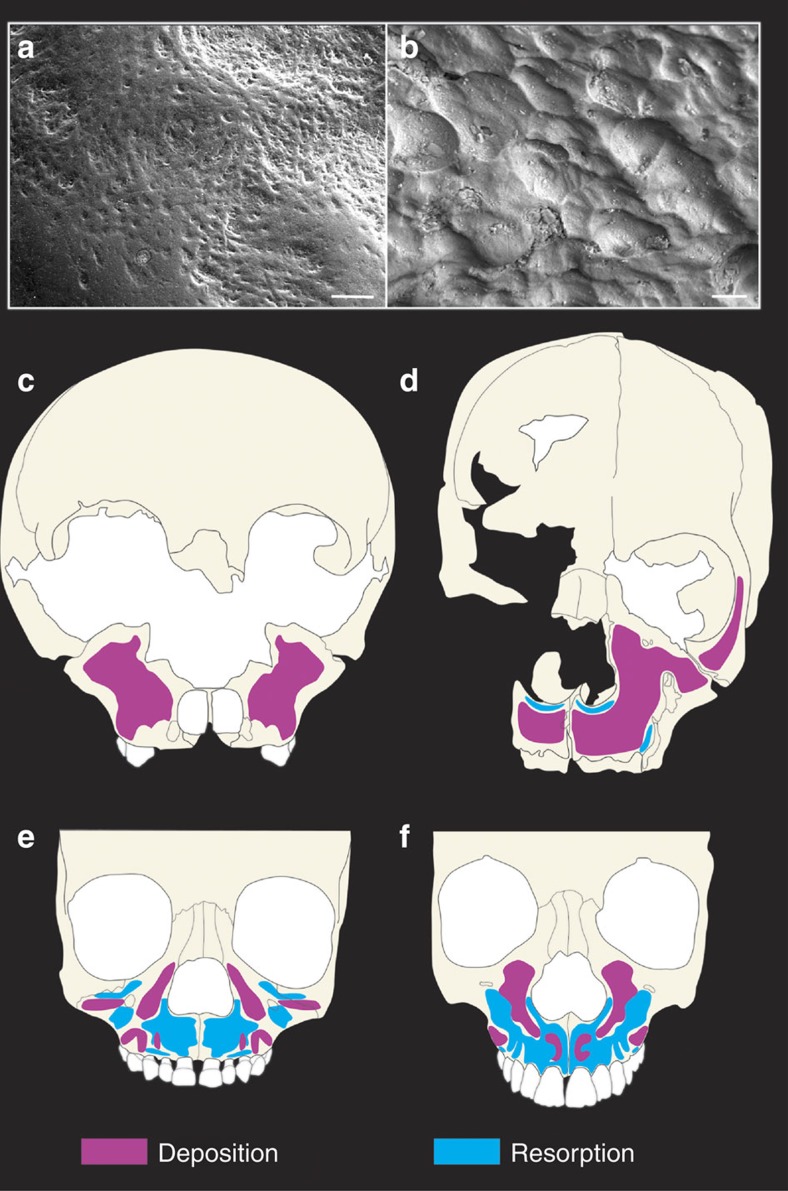
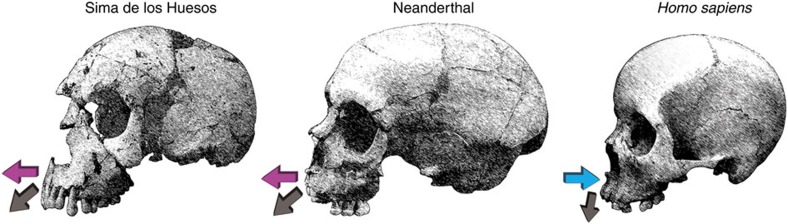
Neanderthals had large and projecting (prognathic) faces similar to those of their putative ancestors from Sima de los Huesos (SH) and different from the retracted modern human face. When such differences arose during development and the morphogenetic modifications involved are unknown. We show that maxillary growth remodelling (bone formation and resorption) of the Devil’s Tower (Gibraltar 2) and La Quina 18 Neanderthals and four SH hominins, all sub-adults, show extensive bone deposition, whereas in modern humans extensive osteoclastic bone resorption is found in the same regions. This morphogenetic difference is evident by ∼5 years of age. Modern human faces are distinct from those of the Neanderthal and SH fossils in part because their postnatal growth processes differ markedly. The growth remodelling identified in these fossil hominins is shared with Australopithecu s and early Homo but not with modern humans suggesting that the modern human face is developmentally derived.
Overview
The claims and statistics of this paper haven’t been checked yet.
Free: it reads the open-access text and checks the first 5 claims that cite a source we can check. Create a free account to check every claim.
Integrity signals
Registry
Cites
Statistics
Figures
Verification
Claims the paper makes
The claims and statistics of this paper haven’t been checked yet.
Free: it reads the open-access text and checks the first 5 claims that cite a source we can check. Create a free account to check every claim.
Claims other papers make about this one
Each is checked against this paper’s own text: does it say what the citing paper says it does?
The source backs part of the claim, not all of it — or backs it for a different population, condition or comparison.
In the citing paper
“while a second study has concluded that the facial ontogeny of immature Sima de los Huesos fossils (dated approx.400 ka) instead show homologies with later neanderthalensis specimens [110].”
From The origin and evolution of Homo sapiens (2016) · cites this paper as [110]
Experimental — accuracy not yet measuredThe cited source says what the claim attributes to it.
In the citing paper
“the maxillae of Neanderthals and the fossils from Sima de los Huesos, Atapuerca (Spain), were similar to those of more ancient Pliocene hominins showing a pattern of bone deposition 45”
From The evolutionary history of the human face (2019) · cites this paper as [45]
In the citing paper
“These genes appear to be important in determining bone density, mineralization and remodeling, hence they may underlie differences between archaic and modern human facial growth144.”
From A catalog of single nucleotide changes distinguishing modern humans from archaic hominins (2019) · cites this paper as [144]
Self-check
Percentages, sums and reported differences re-computed from the paper’s own numbers.
The self-check needs the paper’s full text.
Citations
Cites
Bermúdez de Castro, J. M., Arsuaga, J. L., Carbonell, E., Rosas, A., Martı́nez, I., & Mosquera, M. (1997) · Science · doi:10.1126/science.276.5317.1392 · Cited by 637
Self-citationAustralopithecus sediba : A New Species of Homo -Like Australopith from South Africa
Berger, L. R., de Ruiter, D. J., Churchill, S. E., Schmid, P., Carlson, K. J., Dirks, P. H. G. M., & Kibii, J. M. (2010) · Science · doi:10.1126/science.1184944 · Cited by 610
Comparison of cranial ontogenetic trajectories among great apes and humans
Mitteroecker, P., Gunz, P., Bernhard, M., Schaefer, K., & Bookstein, F. L. (2004) · Journal of Human Evolution · doi:10.1016/j.jhevol.2004.03.006 · Cited by 598
Modern human origins: progress and prospects
Stringer, C. (2002) · Philosophical Transactions of the Royal Society of London. Series B: Biological Sciences · doi:10.1098/rstb.2001.1057 · Cited by 534
Self-citationNeandertal roots: Cranial and chronological evidence from Sima de los Huesos
Arsuaga, J. L., Martínez, I., Arnold, L. J., Aranburu, A., Gracia-Téllez, A., Sharp, W. D., Quam, R. M., Falguères, C., Pantoja-Pérez, A., Bischoff, J., et al. (2014) · Science · doi:10.1126/science.1253958 · Cited by 534
Self-citationThe evolution and development of cranial form in Homo sapiens
Lieberman, D. E., McBratney, B. M., & Krovitz, G. (2002) · Proceedings of the National Academy of Sciences · doi:10.1073/pnas.022440799 · Cited by 450
The Sima de los Huesos crania (Sierra de Atapuerca, Spain). A comparative study
Arsuaga, J. L., Martı́nez, I., Gracia, A., & Lorenzo, C. (1997) · Journal of Human Evolution · doi:10.1006/jhev.1997.0133 · Cited by 411
Self-citationDental evidence for ontogenetic differences between modern humans and Neanderthals
Smith, T. M., Tafforeau, P., Reid, D. J., Pouech, J., Lazzari, V., Zermeno, J. P., Guatelli-Steinberg, D., Olejniczak, A. J., Hoffman, A., Radovčić, J., et al. (2010) · Proceedings of the National Academy of Sciences · doi:10.1073/pnas.1010906107 · Cited by 331
Self-citationThe status of Homo heidelbergensis (Schoetensack 1908)
Stringer, C. (2012) · Evolutionary Anthropology: Issues, News, and Reviews · doi:10.1002/evan.21311 · Cited by 329
Self-citationNeanderthal cranial ontogeny and its implications for late hominid diversity
Ponce de León, M. S., & Zollikofer, C. P. E. (2001) · Nature · doi:10.1038/35087573 · Cited by 320
Research works printed but not linked: 2
- Bromage T. G. & Boyde A. in Essentials of Facial Growth eds Enlow D. H., Hans M. G. 319– 344W.B. Saunders (2008).
- Meyer M.. Nuclear DNA sequences from the hominin remains of Sima de los Huesos, Atapuerca, Spain. In Proceedings of the European Society for the study of Human Evolution (ESHE) 4 (5th Annual Meeting of the ESHE, (2015).
Cited by
The origin and evolution of Homo sapiens
Stringer, C. (2016) · Philosophical Transactions of the Royal Society B: Biological Sciences · doi:10.1098/rstb.2015.0237 · Cited by 395
Self-citationSelf-domestication in Homo sapiens: Insights from comparative genomics
Theofanopoulou, C., Gastaldon, S., O’Rourke, T., Samuels, B. D., Messner, A., Martins, P. T., Delogu, F., Alamri, S., & Boeckx, C. (2017) · PLOS ONE · doi:10.1371/journal.pone.0185306 · Cited by 174
Gokhman, D., Nissim-Rafinia, M., Agranat-Tamir, L., Housman, G., García-Pérez, R., Lizano, E., Cheronet, O., Mallick, S., Nieves-Colón, M. A., Li, H., et al. (2017) · doi:10.1101/106955 · Cited by 144
Aspects of human physical and behavioural evolution during the last 1 million years
Galway‐Witham, J., Cole, J., & Stringer, C. B. (2019) · Journal of Quaternary Science · doi:10.1002/jqs.3137 · Cited by 161
“…fossil sample from the Sima de los Huesos in Atapuerca can now be firmly placed in the Neanderthal clade through cranial and dental morphology, facial growth patterns, and genomic DNA, and has been dated from associated sediments to ~430 ka (Arsuaga et al., 2014; Lacruz, 2015; Meyer et al., 2016).”
BackgroundSelf-citationThe evolutionary history of the human face
Lacruz, R. S., Stringer, C. B., Kimbel, W. H., Wood, B., Harvati, K., O’Higgins, P., Bromage, T. G., & Arsuaga, J.-L. (2019) · Nature Ecology & Evolution · doi:10.1038/s41559-019-0865-7 · Cited by 108
Self-citationA catalog of single nucleotide changes distinguishing modern humans from archaic hominins
Kuhlwilm, M., & Boeckx, C. (2019) · Scientific Reports · doi:10.1038/s41598-019-44877-x · Cited by 108
Pereira‐Pedro, A. S., Masters, M., & Bruner, E. (2017) · Journal of Anatomy · doi:10.1111/joa.12693 · Cited by 29
“It remains to be established whether modern human facial morphology is derived, or rather, is a primitive condition (Arsuaga et al. 1999; Berm udez de Castro et al. 2010; Freidline et al. 2013; Lacruz et al. 2015; Stringer, 2016).”
BackgroundMidfacial growth patterns in males from newborn to 5 years old based on computed tomography
Evteev, A., Anikin, A., & Satanin, L. A. (2018) · American Journal of Human Biology · doi:10.1002/ajhb.23132 · Cited by 28
“, 2002) and species-specific (Freidline, Gunz, Harvati, & Hublin, 2012, 2013; Lacruz et al., 2015; Minugh-Purvis, 1988; Ponce de Leon & Zollikofer, 2001; Vidarsdottir, 1999; Vi#arsd ottir & Cobb, 2004) craniofacial variation in hominins, the origins of human facial sexual dimorphism (Bulygina et al.”
BackgroundWu, X., Pei, S., Cai, Y., Tong, H., Xing, S., Jashashvili, T., Carlson, K. J., & Liu, W. (2021) · Journal of Human Evolution · doi:10.1016/j.jhevol.2021.103052 · Cited by 25
The biting performance of Homo sapiens and Homo heidelbergensis
Godinho, R. M., Fitton, L. C., Toro-Ibacache, V., Stringer, C. B., Lacruz, R. S., Bromage, T. G., & O'Higgins, P. (2018) · Journal of Human Evolution · doi:10.1016/j.jhevol.2018.02.010 · Cited by 18
“…mandible due to occlusal interlocking and this is accommodated by resorptive activity in the alveolar region with depositional activity in the basal (Enlow and Hans, 1996), a pattern of remodelling that may well covary with the presence of a chin among recent hominins (Lacruz et al., 2013, 2015).”
BackgroundSelf-citationZygomatic Root Position in Recent and Fossil Hominids
Weber, G. W., & Krenn, V. A. (2016) · The Anatomical Record · doi:10.1002/ar.23490 · Cited by 15
Šešelj, M. (2017) · American Journal of Physical Anthropology · doi:10.1002/ajpa.23228 · Cited by 14
The first otologic surgery in a skull from El Pendón site (Reinoso, Northern Spain)
Díaz‐Navarro, S., Rodríguez, C. T., Magallón, H. A., Pastor-Vázquez, J. F., Santos-Pérez, J., Lite, I. S., Gibaja, J. F., García‐González, R., & Guerra, M. Á. R. (2022) · Scientific Reports · doi:10.1038/s41598-022-06223-6 · Cited by 12
Trabecular bone in domestic dogs and wolves: Implications for understanding human self‐domestication
Chirchir, H. (2020) · The Anatomical Record · doi:10.1002/ar.24510 · Cited by 13
“…with the domestication syndrome, as evident in morphological traits in the Holocene such as a slight reduction in cranial capacity and having a globular cranium, smaller teeth, and reduction in jaw size (Cieri et al., 2014; de León et al., 2008; Lacruz et al., 2015; Zilberman & Smith, 1992).”
BackgroundVariation in facial bone growth remodeling in prehistoric populations from southern South America
Aporta, N. B., González, P., & Bernal, V. (2019) · American Journal of Physical Anthropology · doi:10.1002/ajpa.23857 · Cited by 11
A quantitative approach for analysing bone modelling patterns from craniofacial surfaces in hominins
Aporta, N. B., González, P., & Bernal, V. (2017) · Journal of Anatomy · doi:10.1111/joa.12716 · Cited by 11
“…information are the usual case due to both the limitations of some microscopic techniques for obtaining data on large areas [e.g. scanning electron microscopy (SEM), confocal; Martinez-Maza et al. 2010; Lacruz et al. 2015] and the effect of taphonomic processes (Bromage, 1984; Lacruz et al. 2015).”
BackgroundMethodInfluentialXiong, Z., Li, Y., Liu, X., Lu, H., Hysi, P. G., Pardo, L. M., Uitterlinden, A. G., Rivadeneira, F., Ikram, M. A., Ghanbari, M., et al. (2025) · Nature Communications · doi:10.1038/s41467-025-61761-7 · Cited by 16
“…brow ridge; large orbital volume 56,97 ; a nose with retracted nose root 51,56 , protruded nose bridge 51,96 , tall nostril 51 and wide nose wing 51,96 ; barely curved cheekbones 51,96 and infraorbital in fl ation 96 ; wide 8,98 and low 8,98 palate; high anterior mandible 8,52 and fl at chin 52,55 .”
Nicholas, C. L. (2016) · American Journal of Physical Anthropology · doi:10.1002/ajpa.23043 · Cited by 11
“Recent work indicates that this midfacial variation arises through differential deposition and resorption of bone across taxa, which can be seen in early childhood (Lacruz et al., 2015).”
Mugharet el'Aliya: Affinities of an enigmatic north African Aterian maxillary fragment
Röding, C., Stringer, C. B., Lacruz, R. S., & Harvati, K. (2022) · American Journal of Biological Anthropology · doi:10.1002/ajpa.24642 · Cited by 12
Self-citationEvolution is in the details: Regulatory differences in modern human and Neanderthal
Barker, H. R., Parkkila, S., & Tolvanen, M. E. E. (2025) · Computational and Structural Biotechnology Journal · doi:10.1016/j.csbj.2025.05.052 · Cited by 11
Aporta, N. B., González, P., & Bernal, V. (2018) · Annals of Anatomy - Anatomischer Anzeiger · doi:10.1016/j.aanat.2018.10.008 · Cited by 8
Boeckx, C. A. (2016) · Elsevier eBooks · doi:10.1016/b978-0-12-804042-3.00133-0 · Cited by 11
Recent regulatory changes shaped human facial and vocal anatomyPreprint
Gokhman, D., Agranat-Tamir, L., Housman, G., Nissim‐Rafinia, M., Nieves-Colón, M. A., Gu, H., Ferrando-Bernal, M., Gelabert, P., Lipende, I. F., Quillen, E. E., et al. (2017) · MPG.PuRe (Max Planck Society) · Cited by 9
NUNES, M. C., Nobre, M. D. A., & Camargo, V. B. (2024) · Journal of Clinical Medicine · doi:10.3390/jcm13113348 · Cited by 5
“The lateral wall of the nasal cavity, where the nasal concha articulates with the internal surface of the maxilla, is a thickening that protrudes medially into the nasal cavity [43] but has still relatively thin dimensions [43,44].”
Backgroundde Diego, R. G., Montero, J., López-Valverde, N., de Nieves, J. I., Prados‐Frutos, J. C., & López‐Valverde, A. (2017) · Journal of Clinical and Experimental Dentistry · doi:10.4317/jced.53947 · Cited by 5
“Among the genetic factors are the trend towards smaller and fewer teeth or the progressive degeneration of craniofacial development (4,5), an opinion that is shared by certain anthropologists after observing that third molars do not always erupt as they used to in more primitive populations (6).”
BackgroundHuman midfacial growth pattern differs from that of Neanderthals and chimpanzees
Schuh, A., Gunz, P., Villa, C., Maureille, B., Toussaint, M., Abrams, G., Hublin, J., & Freidline, S. E. (2025) · Journal of Human Evolution · doi:10.1016/j.jhevol.2025.103667 · Cited by 6
“We expect Middle Pleistocene fossils that exhibit large faces to follow a similar general cellular pattern, as already suggested by the bone modeling analysis of the Sima de Los Huesos specimens (Lacruz et al., 2015).”
InfluentialThe Non-Masticatory Use of the Anterior Teeth Among Late Pleistocene Humans
Willman, J. C. (2016) · Open Scholarship Institutional Repository (Washington University in St. Louis) · doi:10.7936/k73f4n01 · Cited by 14
“…supporting them are developmentally expensive tissues, and while maxillary growth trajectories are derived in modern humans relative to archaic Homo (Maureille and Bar 1999; Lacruz et al. 2015), it is unclear whether these aspects of growth have significantly different developmental “costs”.”
BackgroundBoggioni, M., Papini, A., Coletti, B., Profico, A., Vincenzo, F. D., & Manzi, G. (2025) · Evolutionary Anthropology Issues News and Reviews · doi:10.1002/evan.70013 · Cited by 5
“…in the maxillary and facial regions during ontogenetic growth reveal a homogeneous distribution between Atapuerca ‐ SH and Nean-derthals, mediated by consistent osteoblast and osteoclast activity, contrasting with the variability observed in H. sapiens , H. antecessor , and H. erectus [120, 161].”
Schuh, A., Heuzé, Y., Gunz, P., Berthaume, M. A., Shaw, C. N., Hublin, J., & Freidline, S. E. (2024) · Proceedings of the Royal Society B Biological Sciences · doi:10.1098/rspb.2023.2738 · Cited by 2
“The human pattern is described as unique and derived, characterized by high levels of bone resorption in the maxilla in relation to the small human face [18,19].”
Modesto‐Mata, M. (2019) · Repositorio Institucional de la Universidad de Burgos (University of Burgos) · doi:10.36443/10259/5113 · Cited by 4
The latest steps of human evolution: What the hard evidence has to say about it?
Neves, W. A., Senger, M. H., Rocha, G., Valota, L., & Hübbe, M. (2024) · Quaternary Environments and Humans · doi:10.1016/j.qeh.2024.100005 · Cited by 3
Shaping the human face: Periosteal bone modeling across ontogeny
Freidline, S. E., Hubbart, M., Shipman, C., Burgos, N., Villa, C., & Schuh, A. (2025) · The Anatomical Record · doi:10.1002/ar.25689 · Cited by 4
Dinámica del crecimiento óseo facial en poblaciones humanas del sur de Sudamérica
Aporta, N. B. (2018) · doi:10.35537/10915/68027 · Cited by 5
Asymmetric Protrusion of the Midface in Young Adults
Lee, S., Koh, K., & Song, W. (2018) · Journal of Craniofacial Surgery · doi:10.1097/scs.0000000000004988
Aporta, N. B. (2022) · Revista del Museo de Antropología · doi:10.31048/1852.4826.v15.n1.32703
Boeckx, C. A. (2020) · Elsevier eBooks · doi:10.1016/b978-0-12-820584-6.00038-6
Cowgill, L. W., & Maddux, S. D. (2026) · Cambridge University Press eBooks · doi:10.1017/9781316756492.003
Cowgill, L. W. (2026) · Cambridge University Press eBooks · doi:10.1017/9781316756492.018
Cowgill, L. W., & Maddux, S. D. (2026) · Cambridge University Press eBooks · doi:10.1017/9781316756492.017
Maddux, S. D., & Franciscus, R. G. (2026) · Cambridge University Press eBooks · doi:10.1017/9781316756492.005
Early development of Neanderthals revealed through virtual microanatomy
Miszkiewicz, J. J., Godinho, R. M., Snoddy, A. M. E., Pasda, K., Détroit, F., Mahoney, P., Rathgeber, T., Posth, C., Uthmeier, T., & Barbieri, A. (2026) · Royal Society Open Science · doi:10.1098/rsos.260485
Self-citation
Metadata
- Authors
- Lacruz, R. S., Bromage, T. G., O’Higgins, P., Arsuaga, J.-L., Stringer, C., Godinho, R. M., Warshaw, J., Martínez, I., Gracia-Tellez, A., de Castro, J. M. B., & Carbonell, E.
- Affiliations
- New York University (US)
- University of York (GB)
- Natural History Museum (GB)
- New York Consortium in Evolutionary Primatology (US)
- Institut Català de Paleoecologia Humana i Evolució Social (ES)
- Corresponding author
- Lacruz, Rodrigo S.
- ORCID
- Venue
- Nature Communications
- Published
- 2015-12-07
- Volume
- 6
- Issue
- 1
- Pages
- 8996-8996
- ISSN
- 2041-1723 (ISSN-L)
- PMC
- PMC4686851
- OpenAlex
- W2267115279
- Cited by
- 41
- References
- 30
- Citations by year
- 2026: 5 · 2025: 5 · 2024: 3 · 2022: 3 · 2021: 1 · 2020: 3 · 2019: 5 · 2018: 5 · 2017: 6 · 2016: 5
- FWCI
- 22.33
- Type
- journal article
- Language
- en
- Open access
- gold
- doi.org
- Licence
- cc-by
- creativecommons.org/licenses/by/4.0 (tdm)
- creativecommons.org/licenses/by/4.0 (vor)
- Locations
- Nature Communications (publishedVersion, cc-by)
- Europe PMC (PubMed Central) (publishedVersion, cc-by)
- PubMed Central (publishedVersion, cc-by)
- PubMed (publishedVersion)
- RePEc: Research Papers in Economics (submittedVersion)
- LA Referencia (Red Federada de Repositorios Institucionales de Publicaciones Científicas) (submittedVersion, other-oa)
- Natural History Museum, London (submittedVersion, cc-by)
- Funders
- Alexander von Humboldt-Stiftung
- Calleva Foundation
- Universidad de Burgos
- Bundesministerium für Bildung und Forschung
- Max-Planck-Gesellschaft
- National Institutes of Health
- National Institute of Dental and Craniofacial Research (R00DE022799, K99DE022799, DE022799)
- Topics
- Social Sciences › Anthropology › Pleistocene-Era Hominins and Archaeology
- Social Sciences › Arts and Humanities › Archeology (arts and humanities) › Forensic Anthropology and Bioarchaeology Studies
- Life Sciences › Agricultural and Biological Sciences › Ecology, Evolution, Behavior and Systematics › Morphological variations and asymmetry
- Keywords
- Neanderthals, maxilla, ontogeny, bone remodeling, bone deposition, bone resorption, postnatal growth, Australopithecus, early Homo, hominin evolution
- MeSH terms
- Animals, Child, Fossils, Humans, Male, Maxilla, Hominidae, Neanderthals
About these checks
Registry, retraction, Cites and statistics results are computed, not judged, with one exception: a printed reference that no index lists is read once by a model before it counts as a citation error. Claims are extracted by a model and kept only when their quote appears verbatim in the text; each cited source is then checked, with a model’s help, for whether it says what the claim relies on. Those verdicts can be wrong — read the claim’s quote and the cited source before relying on one.
Statistics and arithmetic are recomputed, not judged.
Confidence bands are shown only for fields calibrated on our annotated test set. None is calibrated yet, so no band is shown.
What counts as a claim ›How we measure confidence ›How we check this ›
Are you an author, or do you see a problem with this page? Request a review
Data sources
Bibliographic data: Semantic Scholar, OpenAlex, Crossref.
Contains information from the Semantic Scholar Academic Graph Datasets, made available under the ODC Attribution License (ODC-BY 1.0).
Semantic Scholar’s data is described in: Kinney, R., et al. (2023). The Semantic Scholar Open Data Platform. arXiv:2301.10140.
