

Ontogeny of the maxilla in Neanderthals and their ancestors
Open accessThe DOI matches its Crossref record; 31 of the 31 references it cites were found in a registry or an index.
Abstract
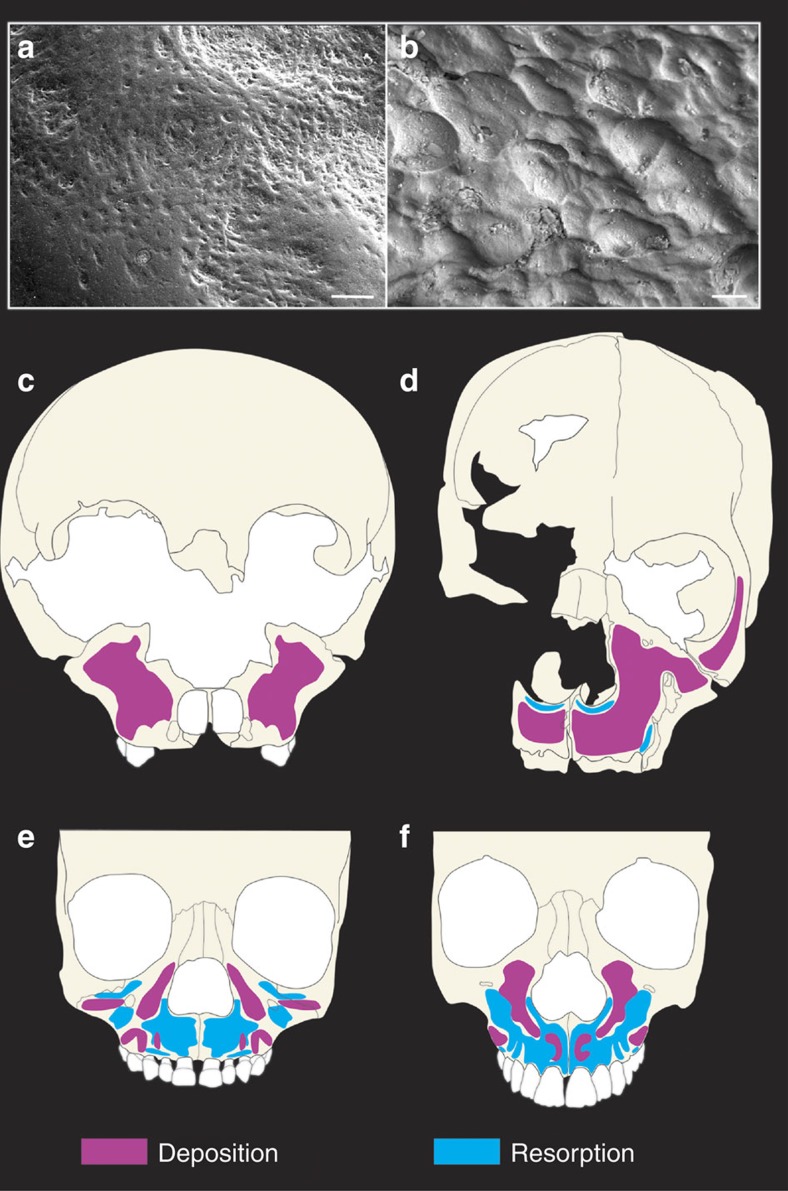
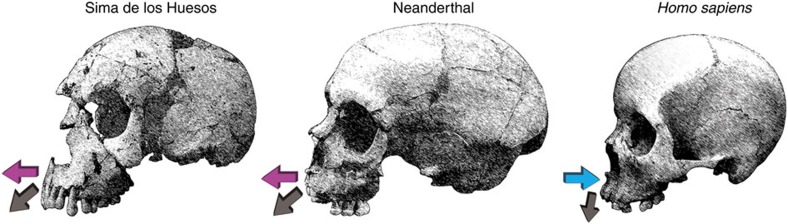
Neanderthals had large and projecting (prognathic) faces similar to those of their putative ancestors from Sima de los Huesos (SH) and different from the retracted modern human face. When such differences arose during development and the morphogenetic modifications involved are unknown. We show that maxillary growth remodelling (bone formation and resorption) of the Devil’s Tower (Gibraltar 2) and La Quina 18 Neanderthals and four SH hominins, all sub-adults, show extensive bone deposition, whereas in modern humans extensive osteoclastic bone resorption is found in the same regions. This morphogenetic difference is evident by ∼5 years of age. Modern human faces are distinct from those of the Neanderthal and SH fossils in part because their postnatal growth processes differ markedly. The growth remodelling identified in these fossil hominins is shared with Australopithecu s and early Homo but not with modern humans suggesting that the modern human face is developmentally derived.
Overview
The claims and statistics of this paper haven’t been checked yet.
Free: it reads the open-access text and checks the first 5 claims that cite a source we can check. Create a free account to check every claim.
Integrity signals
Registry
Cites
Statistics
Figures
Verification
Claims the paper makes
The claims and statistics of this paper haven’t been checked yet.
Free: it reads the open-access text and checks the first 5 claims that cite a source we can check. Create a free account to check every claim.
Claims other papers make about this one
Each is checked against this paper’s own text: does it say what the citing paper says it does?
The source backs part of the claim, not all of it — or backs it for a different population, condition or comparison.
In the citing paper
“while a second study has concluded that the facial ontogeny of immature Sima de los Huesos fossils (dated approx.400 ka) instead show homologies with later neanderthalensis specimens [110].”
From The origin and evolution of Homo sapiens (2016) · cites this paper as [110]
Experimental — accuracy not yet measuredThe cited source says what the claim attributes to it.
In the citing paper
“the maxillae of Neanderthals and the fossils from Sima de los Huesos, Atapuerca (Spain), were similar to those of more ancient Pliocene hominins showing a pattern of bone deposition 45”
From The evolutionary history of the human face (2019) · cites this paper as [45]
In the citing paper
“These genes appear to be important in determining bone density, mineralization and remodeling, hence they may underlie differences between archaic and modern human facial growth144.”
From A catalog of single nucleotide changes distinguishing modern humans from archaic hominins (2019) · cites this paper as [144]
Self-check
Percentages, sums and reported differences re-computed from the paper’s own numbers.
The self-check needs the paper’s full text.
Citations
Cites
Bermúdez de Castro, J. M., Arsuaga, J. L., Carbonell, E., Rosas, A., Martı́nez, I., & Mosquera, M. (1997) · Science · doi:10.1126/science.276.5317.1392 · Cited by 637
Self-citationAustralopithecus sediba : A New Species of Homo -Like Australopith from South Africa
Berger, L. R., de Ruiter, D. J., Churchill, S. E., Schmid, P., Carlson, K. J., Dirks, P. H. G. M., & Kibii, J. M. (2010) · Science · doi:10.1126/science.1184944 · Cited by 610
Comparison of cranial ontogenetic trajectories among great apes and humans
Mitteroecker, P., Gunz, P., Bernhard, M., Schaefer, K., & Bookstein, F. L. (2004) · Journal of Human Evolution · doi:10.1016/j.jhevol.2004.03.006 · Cited by 598
Modern human origins: progress and prospects
Stringer, C. (2002) · Philosophical Transactions of the Royal Society of London. Series B: Biological Sciences · doi:10.1098/rstb.2001.1057 · Cited by 534
Self-citationNeandertal roots: Cranial and chronological evidence from Sima de los Huesos
Arsuaga, J. L., Martínez, I., Arnold, L. J., Aranburu, A., Gracia-Téllez, A., Sharp, W. D., Quam, R. M., Falguères, C., Pantoja-Pérez, A., Bischoff, J., et al. (2014) · Science · doi:10.1126/science.1253958 · Cited by 534
Self-citationThe evolution and development of cranial form in Homo sapiens
Lieberman, D. E., McBratney, B. M., & Krovitz, G. (2002) · Proceedings of the National Academy of Sciences · doi:10.1073/pnas.022440799 · Cited by 450
The Sima de los Huesos crania (Sierra de Atapuerca, Spain). A comparative study
Arsuaga, J. L., Martı́nez, I., Gracia, A., & Lorenzo, C. (1997) · Journal of Human Evolution · doi:10.1006/jhev.1997.0133 · Cited by 411
Self-citationDental evidence for ontogenetic differences between modern humans and Neanderthals
Smith, T. M., Tafforeau, P., Reid, D. J., Pouech, J., Lazzari, V., Zermeno, J. P., Guatelli-Steinberg, D., Olejniczak, A. J., Hoffman, A., Radovčić, J., et al. (2010) · Proceedings of the National Academy of Sciences · doi:10.1073/pnas.1010906107 · Cited by 331
Self-citationThe status of Homo heidelbergensis (Schoetensack 1908)
Stringer, C. (2012) · Evolutionary Anthropology: Issues, News, and Reviews · doi:10.1002/evan.21311 · Cited by 329
Self-citationNeanderthal cranial ontogeny and its implications for late hominid diversity
Ponce de León, M. S., & Zollikofer, C. P. E. (2001) · Nature · doi:10.1038/35087573 · Cited by 320
Research works printed but not linked: 2
- Bromage T. G. & Boyde A. in Essentials of Facial Growth eds Enlow D. H., Hans M. G. 319– 344W.B. Saunders (2008).
- Meyer M.. Nuclear DNA sequences from the hominin remains of Sima de los Huesos, Atapuerca, Spain. In Proceedings of the European Society for the study of Human Evolution (ESHE) 4 (5th Annual Meeting of the ESHE, (2015).
Cited by
The origin and evolution of Homo sapiens
Stringer, C. (2016) · Philosophical Transactions of the Royal Society B: Biological Sciences · doi:10.1098/rstb.2015.0237 · Cited by 395
Self-citationSelf-domestication in Homo sapiens: Insights from comparative genomics
Theofanopoulou, C., Gastaldon, S., O’Rourke, T., Samuels, B. D., Messner, A., Martins, P. T., Delogu, F., Alamri, S., & Boeckx, C. (2017) · PLOS ONE · doi:10.1371/journal.pone.0185306 · Cited by 174
Gokhman, D., Nissim-Rafinia, M., Agranat-Tamir, L., Housman, G., García-Pérez, R., Lizano, E., Cheronet, O., Mallick, S., Nieves-Colón, M. A., Li, H., et al. (2017) · doi:10.1101/106955 · Cited by 144
Aspects of human physical and behavioural evolution during the last 1 million years
Galway‐Witham, J., Cole, J., & Stringer, C. B. (2019) · Journal of Quaternary Science · doi:10.1002/jqs.3137 · Cited by 161
“…fossil sample from the Sima de los Huesos in Atapuerca can now be firmly placed in the Neanderthal clade through cranial and dental morphology, facial growth patterns, and genomic DNA, and has been dated from associated sediments to ~430 ka (Arsuaga et al., 2014; Lacruz, 2015; Meyer et al., 2016).”
BackgroundSelf-citationThe evolutionary history of the human face
Lacruz, R. S., Stringer, C. B., Kimbel, W. H., Wood, B., Harvati, K., O’Higgins, P., Bromage, T. G., & Arsuaga, J.-L. (2019) · Nature Ecology & Evolution · doi:10.1038/s41559-019-0865-7 · Cited by 108
Self-citation
Metadata
- Authors
- Lacruz, R. S., Bromage, T. G., O’Higgins, P., Arsuaga, J.-L., Stringer, C., Godinho, R. M., Warshaw, J., Martínez, I., Gracia-Tellez, A., de Castro, J. M. B., & Carbonell, E.
- Affiliations
- New York University (US)
- University of York (GB)
- Natural History Museum (GB)
- New York Consortium in Evolutionary Primatology (US)
- Institut Català de Paleoecologia Humana i Evolució Social (ES)
- Corresponding author
- Lacruz, Rodrigo S.
- ORCID
- Venue
- Nature Communications
- Published
- 2015-12-07
- Volume
- 6
- Issue
- 1
- Pages
- 8996-8996
- ISSN
- 2041-1723 (ISSN-L)
- PMC
- PMC4686851
- OpenAlex
- W2267115279
- Cited by
- 41
- References
- 30
- Citations by year
- 2026: 5 · 2025: 5 · 2024: 3 · 2022: 3 · 2021: 1 · 2020: 3 · 2019: 5 · 2018: 5 · 2017: 6 · 2016: 5
- FWCI
- 22.33
- Type
- journal article
- Language
- en
- Open access
- gold
- doi.org
- Licence
- cc-by
- creativecommons.org/licenses/by/4.0 (tdm)
- creativecommons.org/licenses/by/4.0 (vor)
- Locations
- Nature Communications (publishedVersion, cc-by)
- Europe PMC (PubMed Central) (publishedVersion, cc-by)
- PubMed Central (publishedVersion, cc-by)
- PubMed (publishedVersion)
- RePEc: Research Papers in Economics (submittedVersion)
- LA Referencia (Red Federada de Repositorios Institucionales de Publicaciones Científicas) (submittedVersion, other-oa)
- Natural History Museum, London (submittedVersion, cc-by)
- Funders
- Alexander von Humboldt-Stiftung
- Calleva Foundation
- Universidad de Burgos
- Bundesministerium für Bildung und Forschung
- Max-Planck-Gesellschaft
- National Institutes of Health
- National Institute of Dental and Craniofacial Research (R00DE022799, K99DE022799, DE022799)
- Topics
- Social Sciences › Anthropology › Pleistocene-Era Hominins and Archaeology
- Social Sciences › Arts and Humanities › Archeology (arts and humanities) › Forensic Anthropology and Bioarchaeology Studies
- Life Sciences › Agricultural and Biological Sciences › Ecology, Evolution, Behavior and Systematics › Morphological variations and asymmetry
- Keywords
- Neanderthals, maxilla, ontogeny, bone remodeling, bone deposition, bone resorption, postnatal growth, Australopithecus, early Homo, hominin evolution
- MeSH terms
- Animals, Child, Fossils, Humans, Male, Maxilla, Hominidae, Neanderthals
About these checks
Registry, retraction, Cites and statistics results are computed, not judged, with one exception: a printed reference that no index lists is read once by a model before it counts as a citation error. Claims are extracted by a model and kept only when their quote appears verbatim in the text; each cited source is then checked, with a model’s help, for whether it says what the claim relies on. Those verdicts can be wrong — read the claim’s quote and the cited source before relying on one.
Statistics and arithmetic are recomputed, not judged.
Confidence bands are shown only for fields calibrated on our annotated test set. None is calibrated yet, so no band is shown.
What counts as a claim ›How we measure confidence ›How we check this ›
Are you an author, or do you see a problem with this page? Request a review
Data sources
Bibliographic data: Semantic Scholar, OpenAlex, Crossref.
Contains information from the Semantic Scholar Academic Graph Datasets, made available under the ODC Attribution License (ODC-BY 1.0).
Semantic Scholar’s data is described in: Kinney, R., et al. (2023). The Semantic Scholar Open Data Platform. arXiv:2301.10140.
