

Facial Morphogenesis of the Earliest Europeans
Open accessThe DOI matches its Crossref record; 43 of the 44 references it cites were found in a registry or an index.
Abstract
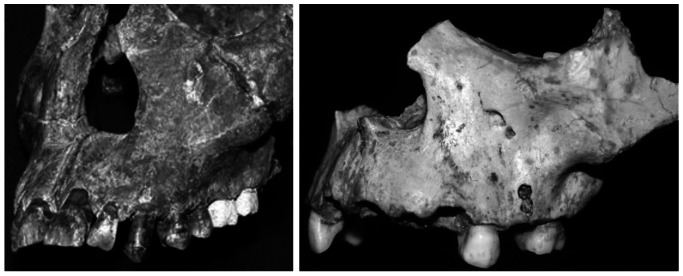
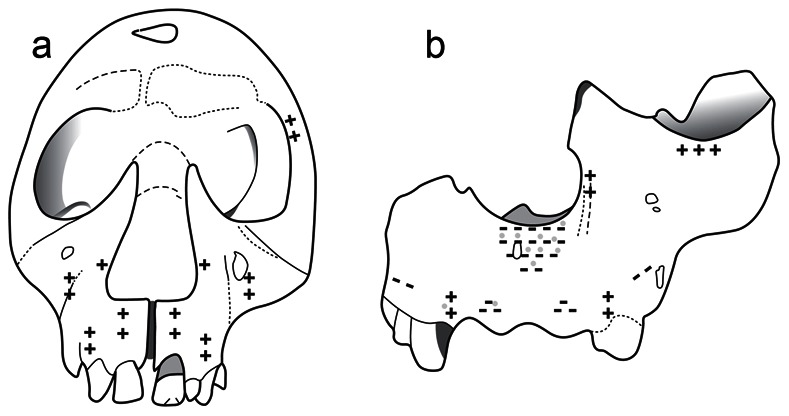
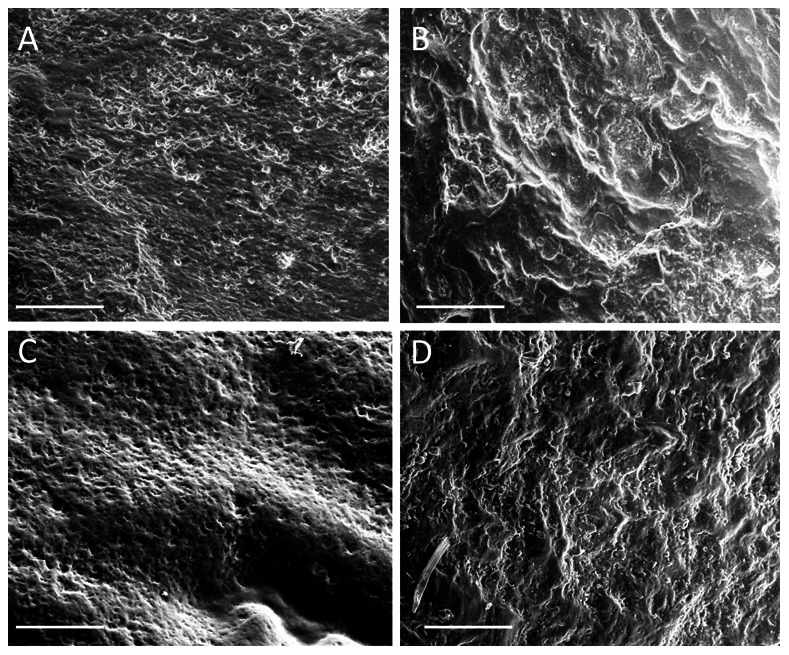
The modern human face differs from that of our early ancestors in that the facial profile is relatively retracted (orthognathic). This change in facial profile is associated with a characteristic spatial distribution of bone deposition and resorption: growth remodeling. For humans, surface resorption commonly dominates on anteriorly-facing areas of the subnasal region of the maxilla and mandible during development. We mapped the distribution of facial growth remodeling activities on the 900-800 ky maxilla ATD6-69 assigned to H. antecessor, and on the 1.5 My cranium KNM-WT 15000, part of an associated skeleton assigned to African H. erectus. We show that, as in H. sapiens, H. antecessor shows bone resorption over most of the subnasal region. This pattern contrasts with that seen in KNM-WT 15000 where evidence of bone deposition, not resorption, was identified. KNM-WT 15000 is similar to Australopithecus and the extant African apes in this localized area of bone deposition. These new data point to diversity of patterns of facial growth in fossil Homo. The similarities in facial growth in H. antecessor and H. sapiens suggest that one key developmental change responsible for the characteristic facial morphology of modern humans can be traced back at least to H. antecessor.
Overview
The claims and statistics of this paper haven’t been checked yet.
Free: it reads the open-access text and checks the first 5 claims that cite a source we can check. Create a free account to check every claim.
Integrity signals
Registry
Cites
Statistics
Figures
Verification
Claims the paper makes
The claims and statistics of this paper haven’t been checked yet.
Free: it reads the open-access text and checks the first 5 claims that cite a source we can check. Create a free account to check every claim.
Claims other papers make about this one
Each is checked against this paper’s own text: does it say what the citing paper says it does?
The source backs part of the claim, not all of it — or backs it for a different population, condition or comparison.
In the citing paper
“Some of these facial properties may have been present in the earliest fossils attributed to H. sapiens, like the Jebel Irhoud fossils4, deviating from craniofacial features which emerged in earlier forms of Homo145, and may have become established before some brain-related changes discussed here11,146.”
From A catalog of single nucleotide changes distinguishing modern humans from archaic hominins (2019) · cites this paper as [145]
Experimental — accuracy not yet measuredThe source backs part of the claim, not all of it — or backs it for a different population, condition or comparison.
In the citing paper
“has considerably more topographic relief than the “inflated” midfaces of MP fossils”
From The evolutionary history of the human face (2019) · cites this paper as [16]
Experimental — accuracy not yet measuredThe cited source says what the claim attributes to it.
In the citing paper
“The observed differences in prognathism are associated with distinct growth patterns and remodeling activity of bone cells [14][15][16]”
From The evolutionary history of the human face (2019) · cites this paper as [16]
The cited source says what the claim attributes to it.
In the citing paper
“First, microscopic study of the facial growth of the immature ATD6-69 antecessor fossil confirmed that it does show homologies with the maxillary developmental pattern of recent H. sapiens, a pattern argued to be derived, not primitive [109]”
From The origin and evolution of Homo sapiens (2016) · cites this paper as [109]
In the citing paper
“The modern appearance of ATD6-69 is also substantiated by growth simulations of this specimen based on both the Neanderthal and modern human facial growth trajectories 38 , and by the analysis of the facial growth and remodeling of ATD6-69, which identified resorptive fields on that maxilla similar to those found in sub-adult H. sapiens 16”
From The evolutionary history of the human face (2019) · cites this paper as [16]
1 more claim about this paper
Create a free account to see every claim other papers make about this one.
Self-check
Percentages, sums and reported differences re-computed from the paper’s own numbers.
The self-check needs the paper’s full text.
Citations
Cites
BIOMECHANICAL AND MOLECULAR REGULATION OF BONE REMODELING
Robling, A. G., Castillo, A. B., & Turner, C. H. (2006) · Annual Review of Biomedical Engineering · doi:10.1146/annurev.bioeng.8.061505.095721 · Cited by 1,343
The primary role of functional matrices in facial growth
Moss, M. L., & Salentijn, L. (1969) · American Journal of Orthodontics · doi:10.1016/0002-9416(69)90034-7 · Cited by 815 · cited 2×
“Yet, it is well known that the cranium is highly morphogenetically integrated [27,29]; with changes in one region having a wide impact.”
BackgroundBermúdez de Castro, J. M., Arsuaga, J. L., Carbonell, E., Rosas, A., Martı́nez, I., & Mosquera, M. (1997) · Science · doi:10.1126/science.276.5317.1392 · Cited by 637
Self-citationCarbonell, E., Bermúdez de Castro, J. M., Parés, J. M., Pérez-González, A., Cuenca-Bescós, G., Ollé, A., Mosquera, M., Huguet, R., van der Made, J., Rosas, A., et al. (2008) · Nature · doi:10.1038/nature06815 · Cited by 619 · cited 2×
“A key morphological feature bearing on the attribution of ATD6-69 to a novel taxon is its mid-facial retraction [13].”
BackgroundSelf-citationThe Nariokotome Homo erectus skeleton
(1994) · Choice Reviews Online · doi:10.5860/choice.31-4449 · Cited by 535
Modern human origins: progress and prospects
Stringer, C. (2002) · Philosophical Transactions of the Royal Society of London. Series B: Biological Sciences · doi:10.1098/rstb.2001.1057 · Cited by 534 · cited 1×
“1), and the unique features of ATD6-69 face [18] more akin to H.”
BackgroundGrowth processes in teeth distinguish modern humans from Homo erectus and earlier hominins
Dean, C., Leakey, M. G., Reid, D., Schrenk, F., Schwartz, G. T., Stringer, C., & Walker, A. (2001) · Nature · doi:10.1038/414628a · Cited by 517 · cited 2×
“erectus based on enamel microstructural details appears more akin to that of earlier hominins [39] and in particular that of KNM-WT 15000 [41].”
BackgroundThe Nariokotome Homo Erectus Skeleton
(1993) · Springer eBooks · doi:10.1007/978-3-662-10382-1 · Cited by 483
Lower Pleistocene Hominids and Artifacts from Atapuerca-TD6 (Spain)
Carbonell, E., Bermúdez de Castro, J. M., Arsuaga, J. L., Díez, J. C., Rosas, A., Cuenca-Bescós, G., Sala, R., Mosquera, M., & Rodriguez, X. P. (1995) · Science · doi:10.1126/science.7638598 · Cited by 460
Self-citationThe evolution and development of cranial form in Homo sapiens
Lieberman, D. E., McBratney, B. M., & Krovitz, G. (2002) · Proceedings of the National Academy of Sciences · doi:10.1073/pnas.022440799 · Cited by 450 · cited 4×
“, cranial base flexion) [1,31], has been linked with a more efficient (in the sense of greater bite force relative to muscle force) posterior bite [32] in Paranthropus relative to Australopithecus.”
BackgroundInfluential
Research works printed but not linked: 2
- Bromage TG, Boyde A (2008) Bone growth remodeling of the early human face. In Essentials of facial growth eds Enlow DH, Hans MG (W.B. Saunders. Philadelphia),: 319–344.
- Wood BA (1994) Taxonomy and evolutionary relationships of Homo erectus. Cour Forsch-Inst Senckenbeeg 171: 159– 165.
Cited by
The origin and evolution of Homo sapiens
Stringer, C. (2016) · Philosophical Transactions of the Royal Society B: Biological Sciences · doi:10.1098/rstb.2015.0237 · Cited by 395
The dental proteome of Homo antecessor
Welker, F., Ramos-Madrigal, J., Gutenbrunner, P., Mackie, M., Tiwary, S., Rakownikow Jersie-Christensen, R., Chiva, C., Dickinson, M. R., Kuhlwilm, M., de Manuel, M., et al. (2020) · Nature · doi:10.1038/s41586-020-2153-8 · Cited by 166
Self-citationAspects of human physical and behavioural evolution during the last 1 million years
Galway‐Witham, J., Cole, J., & Stringer, C. B. (2019) · Journal of Quaternary Science · doi:10.1002/jqs.3137 · Cited by 161
“…last view is gathering renewed support, based on suggestions that the small and retracted middle of the face of antecessor is morphologically like that of H. sapiens, and reinforced by studies showing the sapiens‐like facial growth of the immature type specimen of antecessor (Lacruz et al., 2013).”
ResultThe evolutionary history of the human face
Lacruz, R. S., Stringer, C. B., Kimbel, W. H., Wood, B., Harvati, K., O’Higgins, P., Bromage, T. G., & Arsuaga, J.-L. (2019) · Nature Ecology & Evolution · doi:10.1038/s41559-019-0865-7 · Cited by 108
Self-citationA catalog of single nucleotide changes distinguishing modern humans from archaic hominins
Kuhlwilm, M., & Boeckx, C. (2019) · Scientific Reports · doi:10.1038/s41598-019-44877-x · Cited by 108
Metadata
- Authors
- Lacruz, R. S., de Castro, J. M. B., Martinón-Torres, M., O’Higgins, P., Paine, M. L., Carbonell, E., Arsuaga, J. L., & Bromage, T. G.
- Affiliations
- University of Southern California (US)
- University of York (GB)
- Institut Català de Paleoecologia Humana i Evolució Social (ES)
- New York University (US)
- Corresponding author
- Lacruz, Rodrigo S.
- Venue
- PLoS ONE
- Publisher
- Public Library of Science (PLoS)
- Published
- 2013-06-06
- Volume
- 8
- Issue
- 6
- Pages
- e65199
- ISSN
- 1932-6203 (ISSN-L)
- PMC
- PMC3675139
- OpenAlex
- W2008047546
- Cited by
- 50
- References
- 44
- Citations by year
- 2025: 5 · 2024: 1 · 2023: 2 · 2022: 4 · 2021: 1 · 2020: 4 · 2019: 6 · 2018: 8 · 2017: 4 · 2016: 3 · 2015: 7 · 2014: 2 · 2013: 2
- FWCI
- 21.80
- Type
- journal article
- Language
- en
- Open access
- gold
- doi.org
- Locations
- PLoS ONE (publishedVersion, cc-by)
- Europe PMC (PubMed Central) (publishedVersion, cc-by)
- PubMed Central (publishedVersion, cc-by)
- PubMed (publishedVersion)
- Docta Complutense (Universidad Complutense de Madrid) (submittedVersion, cc-by)
- DOAJ (DOAJ: Directory of Open Access Journals) (submittedVersion, cc-by-sa)
- UCL Discovery (University College London) (submittedVersion)
- Figshare (submittedVersion, cc-by)
- Funders
- Alexander von Humboldt-Stiftung
- Leakey Foundation
- Government of the Republic of Kenya
- Max-Planck-Gesellschaft
- National Institutes of Health (K99-R00)
- Biotechnology and Biological Sciences Research Council
- National Institute of Dental and Craniofacial Research (DE022799)
- Topics
- Social Sciences › Anthropology › Pleistocene-Era Hominins and Archaeology
- Life Sciences › Agricultural and Biological Sciences › Ecology, Evolution, Behavior and Systematics › Morphological variations and asymmetry
- Social Sciences › Arts and Humanities › Archeology (arts and humanities) › Forensic Anthropology and Bioarchaeology Studies
- Keywords
- facial morphogenesis, bone resorption, bone deposition, maxilla, mandible, Homo antecessor, Homo erectus, early human evolution, facial profile, fossil crania, Australopithecus
- MeSH terms
- Animals, Anthropometry, Biological Evolution, Face, Fossils, Humans, Mandible, Maxilla, Morphogenesis, Hominidae
About these checks
Registry, retraction, Cites and statistics results are computed, not judged, with one exception: a printed reference that no index lists is read once by a model before it counts as a citation error. Claims are extracted by a model and kept only when their quote appears verbatim in the text; each cited source is then checked, with a model’s help, for whether it says what the claim relies on. Those verdicts can be wrong — read the claim’s quote and the cited source before relying on one.
Statistics and arithmetic are recomputed, not judged.
Confidence bands are shown only for fields calibrated on our annotated test set. None is calibrated yet, so no band is shown.
What counts as a claim ›How we measure confidence ›How we check this ›
Are you an author, or do you see a problem with this page? Request a review
How to cite
Cite CoChat for the checks on this page, and the paper for its own findings.
- This page
- CoChat. (2026). Citation check: Facial Morphogenesis of the Earliest Europeans. https://app.cochat.ai/papers/10.1371/journal.pone.0065199
- The paper
- Lacruz, R. S., de Castro, J. M. B., Martinón-Torres, M., O’Higgins, P., Paine, M. L., Carbonell, E., Arsuaga, J. L., & Bromage, T. G. (2013). Facial Morphogenesis of the Earliest Europeans. PLoS ONE. https://doi.org/10.1371/journal.pone.0065199
Data sources
Bibliographic data: Semantic Scholar, OpenAlex, Crossref.
Contains information from the Semantic Scholar Academic Graph Datasets, made available under the ODC Attribution License (ODC-BY 1.0).
Semantic Scholar’s data is described in: Kinney, R., et al. (2023). The Semantic Scholar Open Data Platform. arXiv:2301.10140.
