

The DOI matches its Crossref record; 182 of the 182 references it cites were found in a registry or an index.
Recent insights of T cell receptor-mediated signaling pathways for T cell activation and development
Abstract
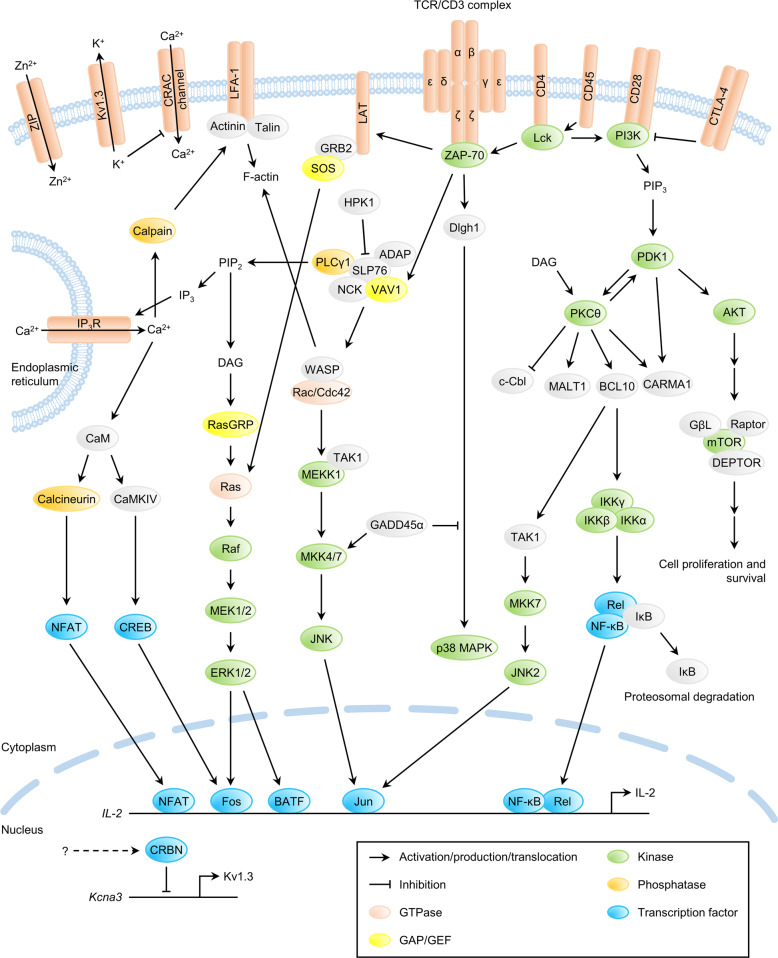
T cell activation requires extracellular stimulatory signals that are mainly mediated by T cell receptor (TCR) complexes. The TCR recognizes antigens on major histocompatibility complex molecules with the cooperation of CD4 or CD8 coreceptors. After recognition, TCR-induced signaling cascades that propagate signals via various molecules and second messengers are induced. Consequently, many features of T cell-mediated immune responses are determined by these intracellular signaling cascades. Furthermore, differences in the magnitude of TCR signaling direct T cells toward distinct effector linages. Therefore, stringent regulation of T cell activation is crucial for T cell homeostasis and proper immune responses. Dysregulation of TCR signaling can result in anergy or autoimmunity. In this review, we summarize current knowledge on the pathways that govern how the TCR complex transmits signals into cells and the roles of effector molecules that are involved in these pathways.
Overview
The claims and statistics of this paper haven’t been checked yet.
Run the check — free, no account needed. It reads the open-access text and checks the sources it cites.
Integrity signals
Registry
Cites
Statistics
Figures
Verification
Claims the paper makes
The claims and statistics of this paper haven’t been checked yet.
Run the check — free, no account needed. It reads the open-access text and checks the sources it cites.
Claims other papers make about this one
Each is checked against this paper’s own text: does it say what the citing paper says it does?
In the citing paper
“Inactive Lck will then fail to stimulate PI3K signalling [51] and decrease DOCK8-induced Rac1 activation [52].”
From The Role of RhoH in TCR Signalling and Its Involvement in Diseases (2021) · cites this paper as [51]
Self-check
Percentages, sums and reported differences re-computed from the paper’s own numbers.
The self-check needs the paper’s full text.
Citations
Cites
1 retracted
Jia, H., Xu, M. Q., Bo, Y., Li, W., & Zhou, R. (2019) · Life Sciences · doi:10.1016/j.lfs.2019.05.060 · Cited by 5
RetractedHershko, A., & Ciechanover, A. (1998) · Annual Review of Biochemistry · doi:10.1146/annurev.biochem.67.1.425 · Cited by 8,840
Mechanisms Underlying Ubiquitination
Pickart, C. M. (2001) · Annual Review of Biochemistry · doi:10.1146/annurev.biochem.70.1.503 · Cited by 3,184
RAG-1-deficient mice have no mature B and T lymphocytes
Mombaerts, P., Iacomini, J., Johnson, R. S., Herrup, K., Tonegawa, S., & Papaioannou, V. E. (1992) · Cell · doi:10.1016/0092-8674(92)90030-g · Cited by 2,972
RING Domain E3 Ubiquitin Ligases
Deshaies, R. J., & Joazeiro, C. A. P. (2009) · Annual Review of Biochemistry · doi:10.1146/annurev.biochem.78.101807.093809 · Cited by 2,679
Negative regulation of PKB/Akt-dependent cell survival by the tumor suppressor PTEN
Stambolic, V., Suzuki, A., de la Pompa, J. L., Brothers, G. M., Mirtsos, C., Sasaki, T., Ruland, J., Penninger, J. M., Siderovski, D. P., & Mak, T. W. (1998) · Cell · doi:10.1016/s0092-8674(00)81780-8 · Cited by 2,551
Zheng, W.-P., & Flavell, R. A. (1997) · Cell · doi:10.1016/s0092-8674(00)80240-8 · Cited by 2,384
Identification of Clonogenic Common Lymphoid Progenitors in Mouse Bone Marrow
Kondo, M., Weissman, I. L., & Akashi, K. (1997) · Cell · doi:10.1016/s0092-8674(00)80453-5 · Cited by 2,253
Smith-Garvin, J. E., Koretzky, G. A., & Jordan, M. S. (2009) · Annual Review of Immunology · doi:10.1146/annurev.immunol.021908.132706 · Cited by 2,144
Deng, L., Wang, C., Spencer, E., Yang, L., Braun, A., You, J., Slaughter, C., Pickart, C., & Chen, Z. J. (2000) · Cell · doi:10.1016/s0092-8674(00)00126-4 · Cited by 1,872
Research works printed but not linked: 1
- Kammerer, R., Hahn, S., Singer, B. B., Luo, J. S. & von Kleist, S. Biliary glycoprotein (CD66a), a cell adhesion molecule of the immunoglobulin superfamily, on human lymphocytes: structure, expression and involvement in T cell activation. Eur. J. Immunol. 28, 3664–3674 (1998). · DOI
Cited by
Bazioti, V., La Rose, A. M., Maassen, S., Bianchi, F., de Boer, R., Halmos, B., Dabral, D., Guilbaud, E., Flohr-Svendsen, A., Groenen, A. G., et al. (2022) · Nature Communications · doi:10.1038/s41467-022-31135-4 · Cited by 65
Insulin Signaling in Arthritis
Tripolino, C., Ciaffi, J., Pucino, V., Ruscitti, P., van Leeuwen, N., Borghi, C., Giacomelli, R., Meliconi, R., & Ursini, F. (2021) · Frontiers in Immunology · doi:10.3389/fimmu.2021.672519 · Cited by 46
The Role of RhoH in TCR Signalling and Its Involvement in Diseases
Ahmad Mokhtar, A. M., Hashim, I. F., Mohd Zaini Makhtar, M., Salikin, N. H., & Amin-Nordin, S. (2021) · Cells · doi:10.3390/cells10040950 · Cited by 25
PmVAE: learning interpretable single-cell representations with pathway modules
Gut, G., Stark, S. G., Rätsch, G., & Davidson, N. R. (2021) · doi:10.1101/2021.01.28.428664 · Cited by 24
Thioamide Analogues of MHC I Antigen Peptides
Gibadullin, R., Morris, R. K., Niu, J., Sidney, J., Sette, A., & Gellman, S. H. (2023) · Journal of the American Chemical Society · doi:10.1021/jacs.3c05300 · Cited by 17
Metadata
- Authors
- Hwang, J.-R., Byeon, Y., Kim, D., & Park, S.-G.
- ORCID
- Park, Sung-Gyoo
- Venue
- Experimental & Molecular Medicine
- Published
- 2020-05
- Volume
- 52
- Issue
- 5
- Pages
- 750-761
- ISSN
- 1226-3613
- 2092-6413
- PMC
- PMC7272404
- Cited by
- 470
- References
- 182
- Language
- en
- Licence
- creativecommons.org/licenses/by/4.0 (tdm)
- creativecommons.org/licenses/by/4.0 (vor, 20 d)
- Funders
- National Research Foundation of Korea (NRF-2016R1A5A1007318, NRF-2017R1E1A1A01074299)
About these checks
Registry, retraction, Cites and statistics results are computed, not judged, with one exception: a printed reference that no index lists is read once by a model before it counts as a citation error. Claims are extracted by a model and kept only when their quote appears verbatim in the text; each cited source is then checked, with a model’s help, for whether it says what the claim relies on. Those verdicts can be wrong — read the claim’s quote and the cited source before relying on one.
Statistics and arithmetic are recomputed, not judged.
Confidence bands are shown only for fields calibrated on our annotated test set. None is calibrated yet, so no band is shown.
What counts as a claim ›How we measure confidence ›How we check this ›
Are you an author, or do you see a problem with this page? Request a review
How to cite
Cite CoChat for the checks on this page, and the paper for its own findings.
- This page
- CoChat. (2026). Citation check: Recent insights of T cell receptor-mediated signaling pathways for T cell activation and development. https://app.cochat.ai/papers/10.1038/s12276-020-0435-8
- The paper
- Hwang, J.-R., Byeon, Y., Kim, D., & Park, S.-G. (2020). Recent insights of T cell receptor-mediated signaling pathways for T cell activation and development. Experimental & Molecular Medicine. https://doi.org/10.1038/s12276-020-0435-8
Data sources
Bibliographic data: Semantic Scholar, OpenAlex, Crossref.
Contains information from the Semantic Scholar Academic Graph Datasets, made available under the ODC Attribution License (ODC-BY 1.0).
Semantic Scholar’s data is described in: Kinney, R., et al. (2023). The Semantic Scholar Open Data Platform. arXiv:2301.10140.
