

The DOI matches its Crossref record; 171 of the 172 references it cites were found in a registry or an index.
Normalization of the tumor microenvironment by harnessing vascular and immune modulation to achieve enhanced cancer therapy
Open accessAbstract
Solid tumors are complex entities that actively shape their microenvironment to create a supportive environment for their own growth. Angiogenesis and immune suppression are two key characteristics of this tumor microenvironment. Despite attempts to deplete tumor blood vessels using antiangiogenic drugs, extensive vessel pruning has shown limited efficacy. Instead, a targeted approach involving the judicious use of drugs at specific time points can normalize the function and structure of tumor vessels, leading to improved outcomes when combined with other anticancer therapies. Additionally, normalizing the immune microenvironment by suppressing immunosuppressive cells and activating immunostimulatory cells has shown promise in suppressing tumor growth and improving overall survival. Based on these findings, many studies have been conducted to normalize each component of the tumor microenvironment, leading to the development of a variety of strategies. In this review, we provide an overview of the concepts of vascular and immune normalization and discuss some of the strategies employed to achieve these goals.
Overview
The claims and statistics of this paper haven’t been checked yet.
Run the check — free, no account needed. It reads the open-access text and checks the sources it cites.
Integrity signals
Registry
Cites
Statistics
Figures
Verification
Claims the paper makes
The claims and statistics of this paper haven’t been checked yet.
Run the check — free, no account needed. It reads the open-access text and checks the sources it cites.
Claims other papers make about this one
Each is checked against this paper’s own text: does it say what the citing paper says it does?
The source backs part of the claim, not all of it — or backs it for a different population, condition or comparison.
In the citing paper
“To address this, various immunotherapeutic strategies have emerged, including adoptive cell transfer, primarily utilizing genetically modified T cells expressing chimeric antigen receptors (CAR T-cells) to recognize and eliminate cancer cells directly (Sterner and Sterner, 2021). Adjuvant therapies, such as dendritic cell, mRNA, and peptide-based vaccinations, aim to boost the patient’s anticancer”
From Microphysiological systems as models for immunologically ‘cold’ tumors (2024) · cites this paper as Choi and Jung, 2023
Experimental — accuracy not yet measuredThe source backs part of the claim, not all of it — or backs it for a different population, condition or comparison.
In the citing paper
“The vasculature in tumors exhibits structural disorganization and functional abnormalities, particularly in ‘cold’ tumors (Choi and Jung, 2023).”
From Microphysiological systems as models for immunologically ‘cold’ tumors (2024) · cites this paper as Choi and Jung, 2023
Experimental — accuracy not yet measured
Self-check
Percentages, sums and reported differences re-computed from the paper’s own numbers.
The self-check needs the paper’s full text.
Citations
Cites
1 retracted
RETRACTED: The Oncolytic Virus in Cancer Diagnosis and Treatment
Cao, G., He, X., Sun, Q., Chen, S., Wan, K. M., Xu, X., Feng, X., Li, P., Chen, B., & Xiong, M. (2020) · Frontiers in Oncology · doi:10.3389/fonc.2020.01786 · Cited by 109
RetractedHallmarks of Cancer: The Next Generation
Hanahan, D., & Weinberg, R. A. (2011) · Cell · doi:10.1016/j.cell.2011.02.013 · Cited by 66,590
Tumor angiogenesis: therapeutic implications
Sherwood, L. M., Parris, E. E., & Folkman, J. (1971) · New England Journal of Medicine · doi:10.1056/nejm197111182852108 · Cited by 10,187
Angiogenesis in cancer and other diseases
Carmeliet, P., & Jain, R. K. (2000) · Nature · doi:10.1038/35025220 · Cited by 9,070
Understanding the tumor immune microenvironment (TIME) for effective therapy
Binnewies, M., Roberts, E. W., Kersten, K., Chan, V., Fearon, D. F., Merad, M., Coussens, L. M., Gabrilovich, D. I., Ostrand-Rosenberg, S., Hedrick, C. C., et al. (2018) · Nature Medicine · doi:10.1038/s41591-018-0014-x · Cited by 6,145
Normalization of Tumor Vasculature: An Emerging Concept in Antiangiogenic Therapy
Jain, R. K. (2005) · Science · doi:10.1126/science.1104819 · Cited by 5,527
Accessories to the Crime: Functions of Cells Recruited to the Tumor Microenvironment
Hanahan, D., & Coussens, L. M. (2012) · Cancer Cell · doi:10.1016/j.ccr.2012.02.022 · Cited by 4,632 · cited 3×
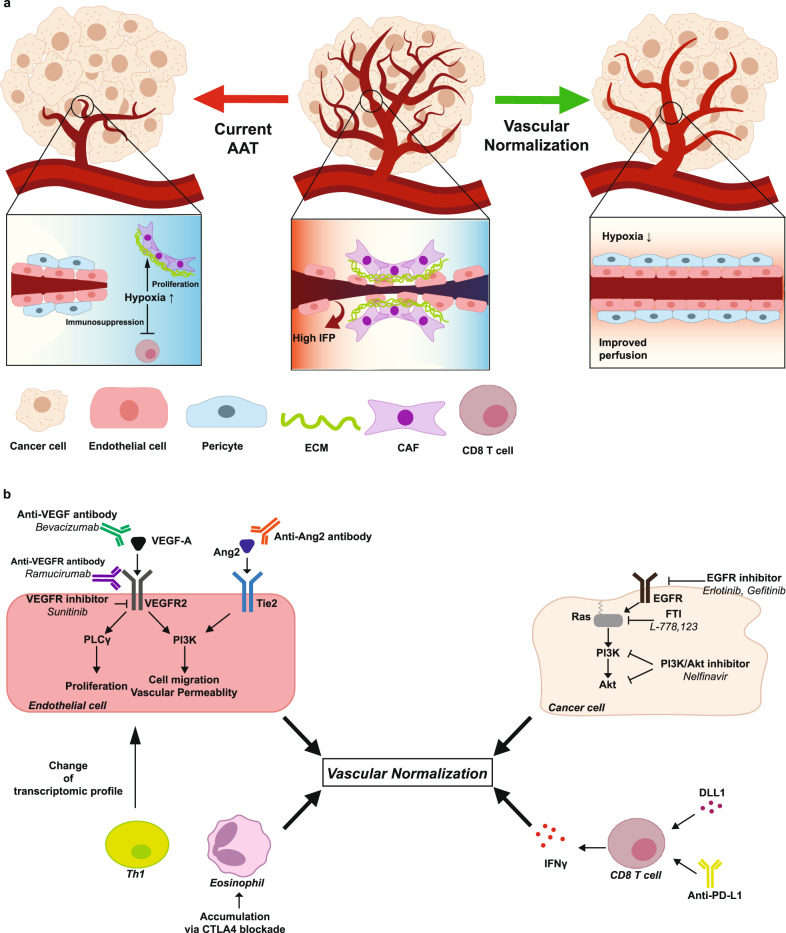
“Moreover, in certain solid tumors, cancer-associated fi broblasts (CAFs) and their production of ECM components exert compressive forces on tumor vessels, exacerbating the hypoxia 24 .”
Cancer genes and the pathways they control
Vogelstein, B., & Kinzler, K. W. (2004) · Nature Medicine · doi:10.1038/nm1087 · Cited by 4,346
Kim, K. J., Li, B., Winer, J., Armanini, M., Gillett, N., Phillips, H. S., & Ferrara, N. (1993) · Nature · doi:10.1038/362841a0 · Cited by 3,605
Döhner, H., Weisdorf, D. J., & Bloomfield, C. D. (2015) · New England Journal of Medicine · doi:10.1056/nejmra1406184 · Cited by 3,468
Cited by
Sorted by citations
Targeting cytokine and chemokine signaling pathways for cancer therapy
Yi, M., Li, T., Niu, M., Zhang, H., Wu, Y., Wu, K., & Dai, Z. (2024) · Signal Transduction and Targeted Therapy · doi:10.1038/s41392-024-01868-3 · Cited by 528
Targeting the tumour vasculature: from vessel destruction to promotion
Guelfi, S., Hodivala‐Dilke, K., & Bergers, G. (2024) · Nature reviews. Cancer · doi:10.1038/s41568-024-00736-0 · Cited by 216
Glaviano, A., Lau, H., Carter, L. M., Lee, E. H. C., Lam, H. Y., Okina, E., Tan, D. J. J., Tan, W., Ang, H. L., Carbone, D., et al. (2025) · Journal of Hematology & Oncology · doi:10.1186/s13045-024-01634-6 · Cited by 169
Kim, M., Shin, M., Zhao, Y., Ghosh, M., & Son, Y. (2024) · Small Science · doi:10.1002/smsc.202400280 · Cited by 97
The influence of endothelial metabolic reprogramming on the tumor microenvironment
Kane, K. M., Edwards, D. N., & Chen, J. (2024) · Oncogene · doi:10.1038/s41388-024-03228-5 · Cited by 72
Metadata
- Authors
- Choi, Y., & Jung, K.
- Affiliations
- Seoul National University (KR)
- Corresponding author
- Jung, Keehoon
- ORCID
- Jung, Keehoon
- Venue
- Experimental & Molecular Medicine
- Published
- 2023-11-01
- Volume
- 55
- Issue
- 11
- Pages
- 2308-2319
- ISSN
- 1226-3613 (ISSN-L)
- 2092-6413
- PMC
- PMC10689787
- OpenAlex
- W4388081006
- Cited by
- 188
- References
- 172
- Citations by year
- 2026: 109 · 2025: 47 · 2024: 32
- FWCI
- 4.97
- Type
- journal article
- Language
- en
- Open access
- gold
- doi.org
- Locations
- Experimental & Molecular Medicine (publishedVersion, cc-by)
- PubMed Central (publishedVersion, cc-by)
- PubMed (publishedVersion)
- DOAJ (DOAJ: Directory of Open Access Journals) (submittedVersion, cc-by-sa)
- Funders
- National Research Foundation
- Seoul National University
- National Research Foundation of Korea (2021M3A9I4026318, NRF-2021M3A9I4026318)
- Topics
- Life Sciences › Biochemistry, Genetics and Molecular Biology › Molecular Biology › Angiogenesis and VEGF in Cancer
- Health Sciences › Medicine › Oncology › Cancer Immunotherapy and Biomarkers
- Health Sciences › Medicine › Oncology › Cancer Cells and Metastasis
- Keywords
- tumor microenvironment, tumor vasculature normalization, angiogenesis, anti-angiogenic therapy, immunosuppression, combination cancer therapy
- MeSH terms
- Humans, Immunotherapy, Neoplasms, Neovascularization, Pathologic, Angiogenesis Inhibitors, Tumor Microenvironment
About these checks
Registry, retraction, Cites and statistics results are computed, not judged, with one exception: a printed reference that no index lists is read once by a model before it counts as a citation error. Claims are extracted by a model and kept only when their quote appears verbatim in the text; each cited source is then checked, with a model’s help, for whether it says what the claim relies on. Those verdicts can be wrong — read the claim’s quote and the cited source before relying on one.
Statistics and arithmetic are recomputed, not judged.
Confidence bands are shown only for fields calibrated on our annotated test set. None is calibrated yet, so no band is shown.
What counts as a claim ›How we measure confidence ›How we check this ›
Are you an author, or do you see a problem with this page? Request a review
