

The DOI matches its Crossref record; 73 of the 73 references it cites were found in a registry or an index.
Increased virulence of the oral microbiome in oral squamous cell carcinoma revealed by metatranscriptome analyses
Open accessAbstract
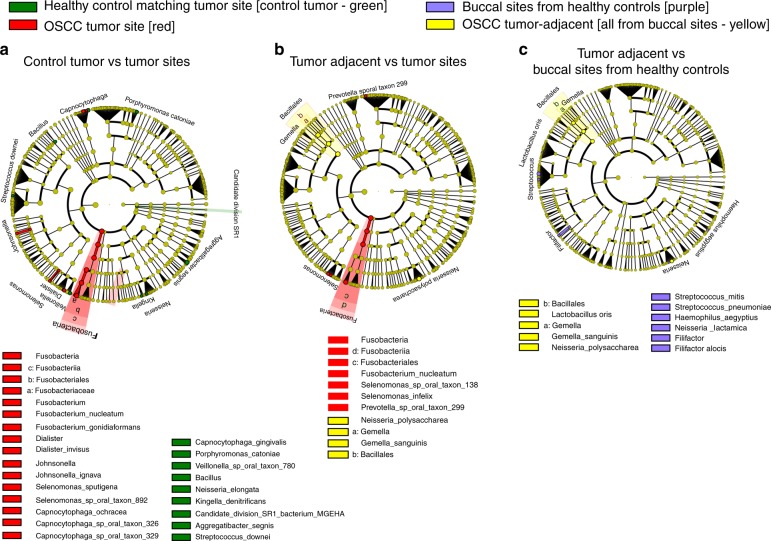
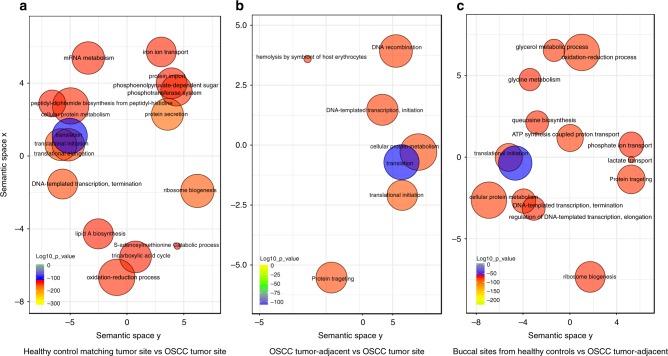
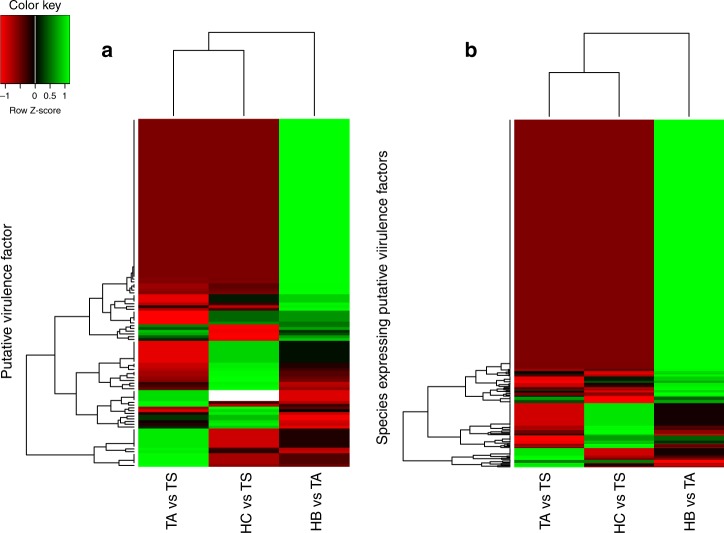
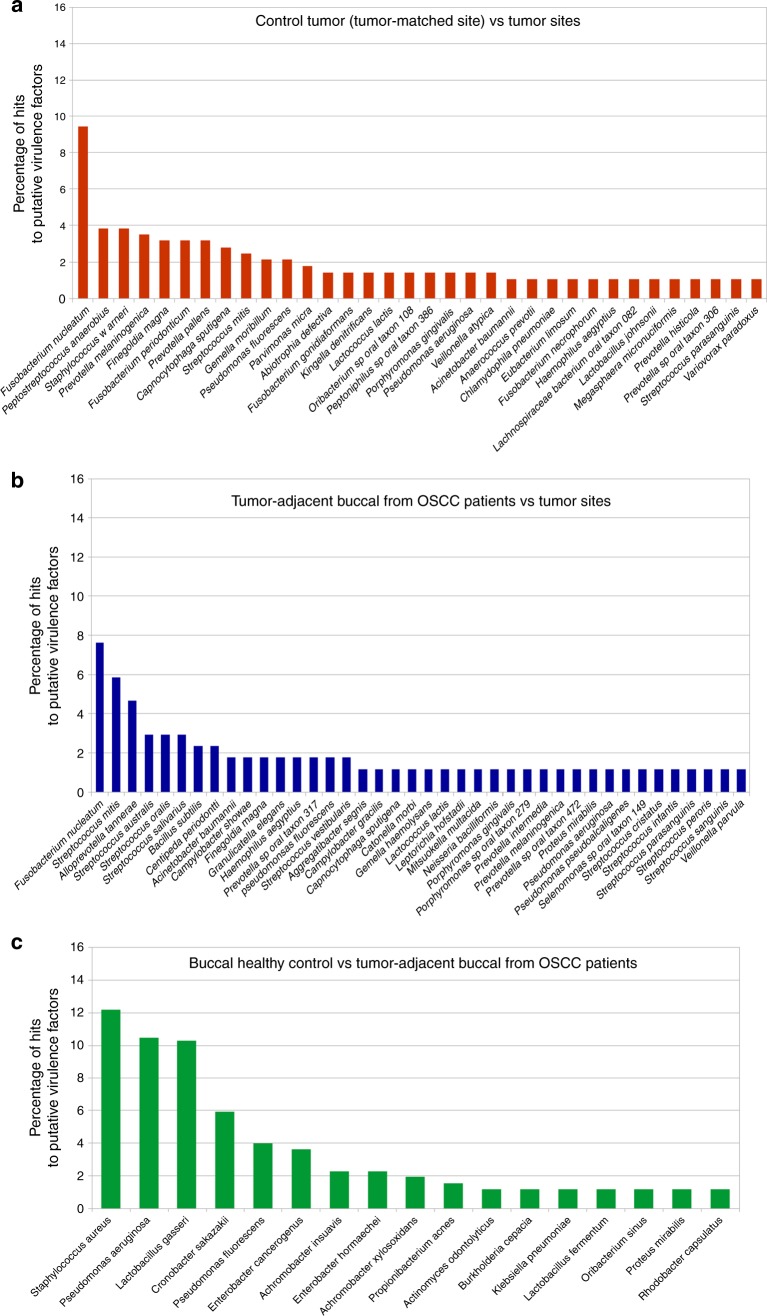
Oral squamous cell carcinoma (OSCC) is the most prevalent and most commonly studied oral cancer. However, there is a void regarding the role that the oral microbiome may play in OSCC. Although the relationship between microbial community composition and OSCC has been thoroughly investigated, microbial profiles of the human microbiome in cancer are understudied. Here we performed a small pilot study of community-wide metatranscriptome analysis to profile mRNA expression in the entire oral microbiome in OSCC to reveal molecular functions associated with this disease. Fusobacteria showed a statistically significantly higher number of transcripts at tumour sites and tumour-adjacent sites of cancer patients compared to the healthy controls analysed. Regardless of the community composition, specific metabolic signatures were consistently found in disease. Activities such as iron ion transport, tryptophanase activity, peptidase activities and superoxide dismutase were over-represented in tumour and tumour-adjacent samples when compared to the healthy controls. The expression of putative virulence factors in the oral communities associated with OSCC showed that activities related to capsule biosynthesis, flagellum synthesis and assembly, chemotaxis, iron transport, haemolysins and adhesins were upregulated at tumour sites. Moreover, activities associated with protection against reactive nitrogen intermediates, chemotaxis, flagellar and capsule biosynthesis were also upregulated in non-tumour sites of cancer patients. Although they are preliminary, our results further suggest that Fusobacteria may be the leading phylogenetic group responsible for the increase in expression of virulence factors in the oral microbiome of OSCC patients. A search of the oral microbiome has revealed a group of bacteria closely associated with the most common type of oral cancer, and whose activity may play a role in its development. Oral squamous cell carcinoma (OSCC) has been linked to tobacco and alcohol consumption, but there’s increasing interest in the role bacteria might play in its initiation and growth. To better understand the behaviour of the various microbes present in the mouths of healthy people and those with OSCC, Jorge Frias-Lopez at the University of Florida in Gainesville and his colleagues carried out a metatranscriptome analysis, which identifies the most actively expressed genes. This revealed significant differences in their microbial communities, with Fusidobacteria particularly enriched and hyperactive in patients with OSCC. The team also identified microbial activities that were consistently associated with cancer.
Overview
The claims and statistics of this paper haven’t been checked yet.
Run the check — free, no account needed. It reads the open-access text and checks the sources it cites.
Integrity signals
Registry
Cites
Statistics
Figures
Verification
Claims the paper makes
The claims and statistics of this paper haven’t been checked yet.
Run the check — free, no account needed. It reads the open-access text and checks the sources it cites.
Claims other papers make about this one
Each is checked against this paper’s own text: does it say what the citing paper says it does?
In the citing paper
“This is demonstrated by the association of various disease states with the oral microbiome, including not only caries and periodontal disease but also oral, esophageal, pancreatic, and colorectal cancers, cardiovascular disease, and inflammatory bowel disease.147, 148, 149, 150, 151, 152, 153”
From The oral microbiome: Role of key organisms and complex networks in oral health and disease (2021) · cites this paper as [147]
Self-check
Percentages, sums and reported differences re-computed from the paper’s own numbers.
The self-check needs the paper’s full text.
Citations
Cites
Controlling the False Discovery Rate: A Practical and Powerful Approach to Multiple Testing
Benjamini, Y., & Hochberg, Y. (1995) · Journal of the Royal Statistical Society Series B: Statistical Methodology · doi:10.1111/j.2517-6161.1995.tb02031.x · Cited by 109,482
The Sequence Alignment/Map format and SAMtools
Li, H., Handsaker, B., Wysoker, A., Fennell, T., Ruan, J., Homer, N., Marth, G., Abecasis, G., Durbin, R., & 1000 Genome Project Data Processing Subgroup (2009) · Bioinformatics · doi:10.1093/bioinformatics/btp352 · Cited by 62,041
Cytoscape: A software Environment for integrated models of biomolecular interaction networks
Shannon, P., Markiel, A., Ozier, O., Baliga, N. S., Wang, J. T., Ramage, D., Amin, N., Schwikowski, B., & Ideker, T. (2003) · Genome Research · doi:10.1101/gr.1239303 · Cited by 51,888
Cancer incidence and mortality worldwide: Sources, methods and major patterns in GLOBOCAN 2012
Ferlay, J., Soerjomataram, I., Dikshit, R., Eser, S., Mathers, C., Rebelo, M., Parkin, D. M., Forman, D., & Bray, F. (2015) · International Journal of Cancer · doi:10.1002/ijc.29210 · Cited by 28,766
BEDTools: a flexible suite of utilities for comparing genomic features
Quinlan, A. R., & Hall, I. M. (2010) · Bioinformatics · doi:10.1093/bioinformatics/btq033 · Cited by 27,437
Metagenomic biomarker discovery and explanation
Segata, N., Izard, J., Waldron, L., Gevers, D., Miropolsky, L., Garrett, W. S., & Huttenhower, C. (2011) · Genome Biology · doi:10.1186/gb-2011-12-6-r60 · Cited by 16,192
Siegel, R. L., Miller, K. D., & Jemal, A. (2016) · CA: A Cancer Journal for Clinicians · doi:10.3322/caac.21332 · Cited by 16,003
Gene ontology analysis for RNA-seq: accounting for selection bias
Young, M. D., Wakefield, M. J., Smyth, G. K., & Oshlack, A. (2010) · Genome Biology · doi:10.1186/gb-2010-11-2-r14 · Cited by 7,107
REVIGO summarizes and visualizes long lists of gene ontology terms
Supek, F., Bošnjak, M., Škunca, N., & Šmuc, T. (2011) · PLoS ONE · doi:10.1371/journal.pone.0021800 · Cited by 6,264
Ecologically meaningful transformations for ordination of species data
Legendre, P., & Gallagher, E. D. (2001) · Oecologia · doi:10.1007/s004420100716 · Cited by 5,556
Cited by
Sorted by citations
Oral squamous cell carcinomas: state of the field and emerging directions
Tan, Y., Wang, Z., Xu, M., Li, B., Huang, Z., Qin, S., Nice, E. C., Tang, J., & Huang, C. (2023) · International Journal of Oral Science · doi:10.1038/s41368-023-00249-w · Cited by 988
The oral microbiome: Role of key organisms and complex networks in oral health and disease
Sedghi, L., DiMassa, V., Harrington, A., Lynch, S. V., & Kapila, Y. L. (2021) · Periodontology 2000 · doi:10.1111/prd.12393 · Cited by 755
The Oral Microbiota May Have Influence on Oral Cancer
Zhang, L., Liu, Y., Zheng, H., & Zhang, C. P. (2020) · Frontiers in Cellular and Infection Microbiology · doi:10.3389/fcimb.2019.00476 · Cited by 410
“nucleatum was the most active bacterium expressing putative virulence factors in the tumor sites (Yost et al., 2018).”
BackgroundThe Oral Microbiome and Cancer
Irfan, M., Delgado, R. Z. R., & Frias-Lopez, J. (2020) · Frontiers in Immunology · doi:10.3389/fimmu.2020.591088 · Cited by 341
“Moreover, when looking at tumor signatures of the oral microbiome, metabolic activities such as iron ion transport, tryptophanase activity, peptidase activities, and superoxide dismutase were overrepresented in tumor samples when compared to the healthy controls (169).”
BackgroundSelf-citationIntratumoural microbiota: a new frontier in cancer development and therapy
Cao, Y., Xia, H., Tan, X., Shi, C., Ma, Y., Meng, D., Zhou, M., Lv, Z., Wang, S., & Jin, Y. (2024) · Signal Transduction and Targeted Therapy · doi:10.1038/s41392-023-01693-0 · Cited by 269
“228 Moreover, Sun et al. found that F. nucleatum promoted glucose transporter 1 (GLUT1) upregulation and lactic acid accumulation by triggering GalNAc-Autophagy-TBC1D5 signalling, leading to OSCC progression.”
Background
Metadata
- Authors
- Yost, S., Stashenko, P., Choi, Y., Kukuruzinska, M., Genco, C. A., Salama, A., Weinberg, E. O., Kramer, C. D., & Frias-Lopez, J.
- Affiliations
- The Forsyth Institute (US)
- Boston University (US)
- Tufts University (US)
- ORCID
- Venue
- International Journal of Oral Science
- Published
- 2018-11-12
- Volume
- 10
- Issue
- 4
- Pages
- 32-32
- ISSN
- 1674-2818 (ISSN-L)
- 2049-3169
- PMC
- PMC6232154
- OpenAlex
- W2901836693
- Cited by
- 144
- References
- 73
- Citations by year
- 2026: 12 · 2025: 24 · 2024: 13 · 2023: 25 · 2022: 28 · 2021: 18 · 2020: 20 · 2019: 4
- FWCI
- 12.07
- Type
- journal article
- Language
- en
- Open access
- gold
- doi.org
- Licence
- Locations
- International Journal of Oral Science (publishedVersion, cc-by)
- Europe PMC (PubMed Central) (publishedVersion, other-oa)
- PubMed Central (publishedVersion, cc-by)
- PubMed (publishedVersion)
- DOAJ (DOAJ: Directory of Open Access Journals) (submittedVersion)
- Funders
- Boston University (Evans Center for Interdisciplinary Biomedical Research ARC)
- Forsyth Institute Pilot Grant
- Topics
- Health Sciences › Dentistry › Periodontics › Oral microbiology and periodontitis research
- Health Sciences › Medicine › Otorhinolaryngology › Head and Neck Cancer Studies
- Life Sciences › Biochemistry, Genetics and Molecular Biology › Molecular Biology › Gut microbiota and health
- Keywords
- oral squamous cell carcinoma, oral microbiota, metatranscriptomics, Fusobacteria, virulence factors, microbial gene expression, iron transport, tryptophanase, superoxide dismutase, capsule biosynthesis, flagellar biosynthesis, chemotaxis, hemolysin, adhesins, reactive nitrogen intermediates
- MeSH terms
- Carcinoma, Squamous Cell, Humans, Mouth Neoplasms, Phylogeny, Pilot Projects, RNA, Messenger, Virulence, Virulence Factors, Metagenome, Transcriptome, Microbiota
About these checks
Registry, retraction, Cites and statistics results are computed, not judged, with one exception: a printed reference that no index lists is read once by a model before it counts as a citation error. Claims are extracted by a model and kept only when their quote appears verbatim in the text; each cited source is then checked, with a model’s help, for whether it says what the claim relies on. Those verdicts can be wrong — read the claim’s quote and the cited source before relying on one.
Statistics and arithmetic are recomputed, not judged.
Confidence bands are shown only for fields calibrated on our annotated test set. None is calibrated yet, so no band is shown.
What counts as a claim ›How we measure confidence ›How we check this ›
Are you an author, or do you see a problem with this page? Request a review
