

Recent advances in modulation of cardiovascular diseases by the gut microbiota
Open accessThe DOI matches its Crossref record; 86 of the 87 references it cites were found in a registry or an index.
Abstract
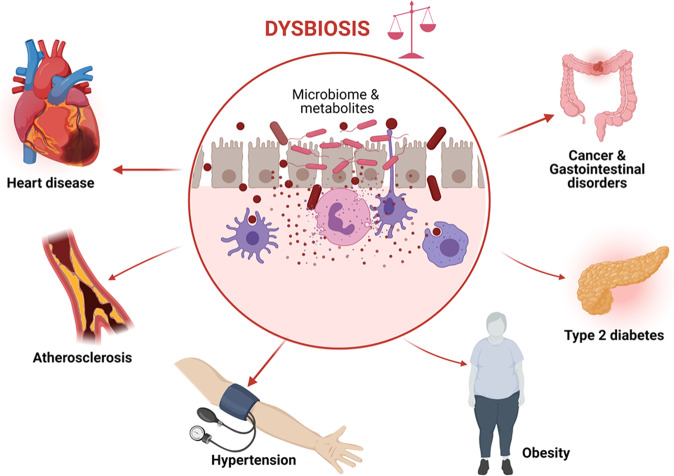
The gut microbiota has recently gained attention due to its association with cardiovascular health, cancers, gastrointestinal disorders, and non-communicable diseases. One critical question is how the composition of the microbiota contributes to cardiovascular diseases (CVDs). Insightful reviews on the gut microbiota, its metabolites and the mechanisms that underlie its contribution to CVD are limited. Hence, the aim of this review was to describe linkages between the composition of the microbiota and CVD, CVD risk factors such as hypertension, diet, ageing, and sex differences. We have also highlighted potential therapies for improving the composition of the gut microbiota, which may result in better cardiovascular health.
Overview
The claims and statistics of this paper haven’t been checked yet.
Free: it reads the open-access text and checks the first 5 claims that cite a source we can check. Create a free account to check every claim.
Integrity signals
Registry
Cites
Statistics
Figures
Verification
Claims the paper makes
The claims and statistics of this paper haven’t been checked yet.
Free: it reads the open-access text and checks the first 5 claims that cite a source we can check. Create a free account to check every claim.
Claims other papers make about this one
Each is checked against this paper’s own text: does it say what the citing paper says it does?
The cited source says what the claim attributes to it.
In the citing paper
“Cardiovascular pathology is likewise linked to microbial signatures, as atherosclerosis is accompanied by increased Streptococcus, Escherichia, and Shigella spp.111”
From Gut dysbiosis in oncology: a risk factor for immunoresistance (2026) · doi:10.1038/s41422-025-01212-6 · cites this paper as [111]
Self-check
Percentages, sums and reported differences re-computed from the paper’s own numbers.
The self-check needs the paper’s full text.
Citations
Cites
A human gut microbial gene catalogue established by metagenomic sequencing
MetaHIT Consortium, Qin, J., Li, R., Raes, J., Arumugam, M., Burgdorf, K. S., Manichanh, C., Nielsen, T., Pons, N., Levenez, F., et al. (2010) · Nature · doi:10.1038/nature08821 · Cited by 11,624 · cited 1×
“Some research estimates suggest that human gut possesses ~1000 bacterial species with 100-fold more genes than those found in the human genome [3, 4].”
BackgroundDiet rapidly and reproducibly alters the human gut microbiome
David, L. A., Maurice, C. F., Carmody, R. N., Gootenberg, D. B., Button, J. E., Wolfe, B. E., Ling, A. V., Devlin, A. S., Varma, Y., Fischbach, M. A., et al. (2014) · Nature · doi:10.1038/nature12820 · Cited by 10,100 · cited 2×
“Dietary lifestyle, microbiota, and CVD Evidence suggest that diet potentially modulates the gut microbiota by regulating the balance between pathogenic and beneficial microbes or microbial products [40].”
BackgroundHuman gut microbiome viewed across age and geography
Yatsunenko, T., Rey, F. E., Manary, M. J., Trehan, I., Dominguez-Bello, M. G., Contreras, M., Magris, M., Hidalgo, G., Baldassano, R. N., Anokhin, A. P., et al. (2012) · Nature · doi:10.1038/nature11053 · Cited by 7,815 · cited 1×
“During aging, there is additional exposure to external microbes through diet and contact with other environment factors such as farm animals and pets [58].”
BackgroundThe Microbial Metabolites, Short-Chain Fatty Acids, Regulate Colonic T reg Cell Homeostasis
Smith, P. M., Howitt, M. R., Panikov, N., Michaud, M., Gallini, C. A., Bohlooly-Y, M., Glickman, J. N., & Garrett, W. S. (2013) · Science · doi:10.1126/science.1241165 · Cited by 5,413
Ecological and Evolutionary Forces Shaping Microbial Diversity in the Human Intestine
Ley, R. E., Peterson, D. A., & Gordon, J. I. (2006) · Cell · doi:10.1016/j.cell.2006.02.017 · Cited by 3,358 · cited 1×
“Some research estimates suggest that human gut possesses ~1000 bacterial species with 100-fold more genes than those found in the human genome [3, 4].”
BackgroundThe Firmicutes/Bacteroidetes ratio of the human microbiota changes with age
Mariat, D., Firmesse, O., Levenez, F., Guimarăes, V., Sokol, H., Doré, J., Corthier, G., & Furet, J.-P. (2009) · BMC Microbiology · doi:10.1186/1471-2180-9-123 · Cited by 1,755 · cited 1×
“Specifically, the aging microbiota has been characterized by a reduction in the Firmicutus:Bacteroidetes ratio [62, 63] and by overpopulation of facultative anaerobes [64].”
BackgroundComposition, variability, and temporal stability of the intestinal microbiota of the elderly
Claesson, M. J., Cusack, S., O'Sullivan, O., Greene-Diniz, R., de Weerd, H., Flannery, E., Marchesi, J. R., Falush, D., Dinan, T., Fitzgerald, G., et al. (2011) · Proceedings of the National Academy of Sciences · doi:10.1073/pnas.1000097107 · Cited by 1,754
Gut microbiota dysbiosis contributes to the development of hypertension
Li, J., Zhao, F., Wang, Y., Chen, J., Tao, J., Tian, G., Wu, S., Liu, W., Cui, Q., Geng, B., et al. (2017) · Microbiome · doi:10.1186/s40168-016-0222-x · Cited by 1,685 · cited 1×
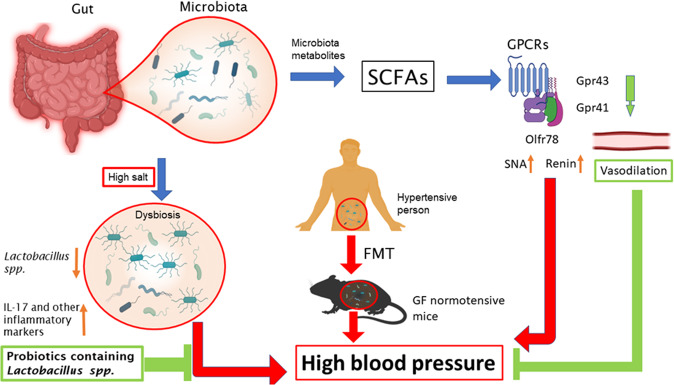
“It was clearly shown that germ-free (GF) mice, which received FMT from a hypertensive patient not only developed a similar gut microbiota as that of the donor, but also elevated systolic and diastolic blood pressures after 8 weeks when compared with GF mice that received FMT from normotensive donors [22].”
ResultGut microbiota in cardiovascular health and disease
Tang, W. H. W., Kitai, T., & Hazen, S. L. (2017) · Circulation Research · doi:10.1161/circresaha.117.309715 · Cited by 1,670 · cited 8×
“Moreover, alterations in the composition of fecal microbiota have been linked to modulation of blood pressure and poor response to antihypertensive drugs [8].”
BackgroundInfluentialDe Filippis, F., Pellegrini, N., Vannini, L., Jeffery, I. B., La Storia, A., Laghi, L., Serrazanetti, D. I., Di Cagno, R., Ferrocino, I., Lazzi, C., et al. (2016) · Gut · doi:10.1136/gutjnl-2015-309957 · Cited by 1,638
Cited by
Probiotics, prebiotics, and postbiotics in health and disease
Ji, J., Jin, W., Liu, S., Jiao, Z., & Li, X. (2023) · MedComm · doi:10.1002/mco2.420 · Cited by 384
Cardiovascular disease and cancer: shared risk factors and mechanisms
Wilcox, N. S., Amit, U., Reibel, J. B., Berlin, E., Howell, K., & Ky, B. (2024) · Nature Reviews Cardiology · doi:10.1038/s41569-024-01017-x · Cited by 310
Role of the intestinal microbiome and its therapeutic intervention in cardiovascular disorder
Luqman, A., Hassan, A., Ullah, M., Naseem, S., Ullah, M., Zhang, L., Din, A. U., Ullah, K., Ahmad, W., & Wang, G. (2024) · Frontiers in Immunology · doi:10.3389/fimmu.2024.1321395 · Cited by 157
Microbiota in Gut‐Heart Axis: Metabolites and Mechanisms in Cardiovascular Disease
Kondapalli, N. B., Katari, V., Dalal, K. K., Paruchuri, S. M., & Thodeti, C. K. (2025) · Comprehensive physiology · doi:10.1002/cph4.70024 · Cited by 107
Hamjane, N., Mechita, M. B., Nourouti, N. G., & Barakat, A. (2023) · Microvascular Research · doi:10.1016/j.mvr.2023.104601 · Cited by 101
Metadata
- Authors
- Masenga, S. K., Hamooya, B., Hangoma, J., Hayumbu, V., Ertuglu, L. A., Ishimwe, J., Rahman, S., Saleem, M., Laffer, C. L., Elijovich, F., & Kirabo, A.
- Affiliations
- Mulungushi University (ZM)
- Vanderbilt University Medical Center (US)
- Corresponding author
- Kirabo, Annet
- ORCID
- Venue
- Journal of Human Hypertension
- Published
- 2022-04-25
- Volume
- 36
- Issue
- 11
- Pages
- 952-959
- ISSN
- 0950-9240 (ISSN-L)
- 1476-5527
- PMC
- PMC9649420
- OpenAlex
- W4224935391
- Cited by
- 121
- References
- 87
- Citations by year
- 2026: 22 · 2025: 29 · 2024: 35 · 2023: 27 · 2022: 8
- FWCI
- 2.58
- Type
- journal article
- Language
- en
- Open access
- hybrid
- doi.org
- Licence
- cc-by
- creativecommons.org/licenses/by/4.0 (tdm)
- creativecommons.org/licenses/by/4.0 (vor)
- Locations
- Journal of Human Hypertension (publishedVersion, cc-by)
- PubMed Central (publishedVersion, cc-by)
- PubMed (publishedVersion)
- Funders
- U.S. Department of Health & Human Services | NIH | Fogarty International Center (TW009744, TW009337)
- U.S. Department of Health & Human Services | NIH | National Heart, Lung, and Blood Institute (R03HL155041, R01HL144941)
- Topics
- Life Sciences › Biochemistry, Genetics and Molecular Biology › Molecular Biology › Gut microbiota and health
- Health Sciences › Dentistry › Periodontics › Oral microbiology and periodontitis research
- Health Sciences › Medicine › Public Health, Environmental and Occupational Health › Nutritional Studies and Diet
- Keywords
- gut microbiota, cardiovascular disease, microbiota composition, gut microbiota metabolites, hypertension, diet, aging, sex differences, microbiota-targeted therapy, cardiovascular risk factors
- MeSH terms
- Gastrointestinal Microbiome, Cardiovascular Diseases, Cardiovascular System, Diet, Female, Humans, Hypertension, Male
About these checks
Registry, retraction, Cites and statistics results are computed, not judged, with one exception: a printed reference that no index lists is read once by a model before it counts as a citation error. Claims are extracted by a model and kept only when their quote appears verbatim in the text; each cited source is then checked, with a model’s help, for whether it says what the claim relies on. Those verdicts can be wrong — read the claim’s quote and the cited source before relying on one.
Statistics and arithmetic are recomputed, not judged.
Confidence bands are shown only for fields calibrated on our annotated test set. None is calibrated yet, so no band is shown.
What counts as a claim ›How we measure confidence ›How we check this ›
Are you an author, or do you see a problem with this page? Request a review
Data sources
Bibliographic data: Semantic Scholar, OpenAlex, Crossref.
Contains information from the Semantic Scholar Academic Graph Datasets, made available under the ODC Attribution License (ODC-BY 1.0).
Semantic Scholar’s data is described in: Kinney, R., et al. (2023). The Semantic Scholar Open Data Platform. arXiv:2301.10140.
