

Is psychosis a multisystem disorder? A meta-review of central nervous system, immune, cardiometabolic, and endocrine alterations in first-episode psychosis and perspective on potential models
Open accessThe DOI matches its Crossref record; 124 of the 124 references it cites were found in a registry or an index.
Abstract
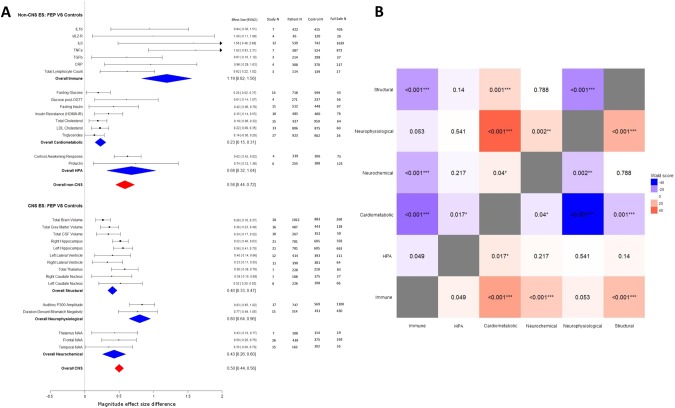
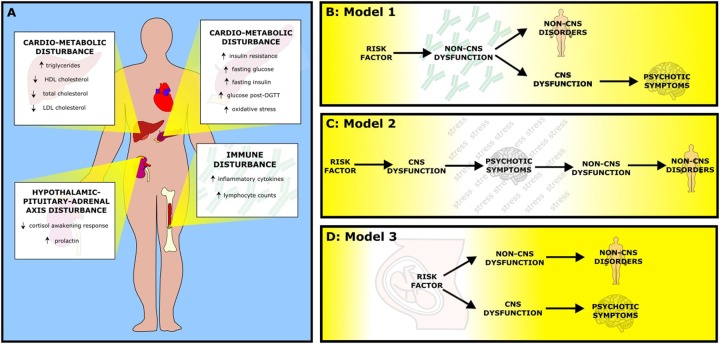
People with psychotic disorders show abnormalities in several organ systems in addition to the central nervous system (CNS); and this contributes to excess mortality. However, it is unclear how strong the evidence is for alterations in non-CNS systems at the onset of psychosis, how the alterations in non-CNS systems compare to those in the CNS, or how they relate to symptoms. Here, we consider these questions, and suggest potential models to account for findings. We conducted a systematic meta-review to summarize effect sizes for both CNS (focusing on brain structural, neurophysiological, and neurochemical parameters) and non-CNS dysfunction (focusing on immune, cardiometabolic, and hypothalamic-pituitary-adrenal (HPA) systems) in first-episode psychosis (FEP). Relevant meta-analyses were identified in a systematic search of Pubmed and the methodological quality of these was assessed using the AMSTAR checklist (A Measurement Tool to Assess Systematic Reviews). Case-control data were extracted from studies included in these meta-analyses. Random effects meta-analyses were re-run and effect size magnitudes for individual parameters were calculated, as were summary effect sizes for each CNS and non-CNS system. We also grouped studies to obtain overall effect sizes for non-CNS and CNS alterations. Robustness of data for non-CNS and CNS parameters was assessed using Rosenthal's fail-safe N. We next statistically compared summary effect size for overall CNSand overall non-CNS alterations, as well as for each organ system separately. We also examined how non-CNS alterations correlate CNS alterations, and with psychopathological symptoms. Case-control data were extracted for 165 studies comprising a total sample size of 13,440. For people with first episode psychosis compared with healthy controls, we observed alterations in immune parameters (summary effect size: g = 1.19), cardiometabolic parameters (g = 0.23); HPA parameters (g = 0.68); brain structure (g = 0.40); neurophysiology (g = 0.80); and neurochemistry (g = 0.43). Grouping non-CNS organ systems together provided an effect size for overall non-CNS alterations in patients compared with controls (g = 0.58), which was not significantly different from the overall CNS alterations effect size (g = 0.50). However, the summary effect size for immune alterations was significantly greater than that for brain structural (P < 0.001) and neurochemical alterations (P < 0.001), while the summary effect size for cardiometabolic alterations was significantly lower than neurochemical (P = 0.04), neurophysiological (P < 0.001), and brain structural alterations (P = 0.001). The summary effect size for HPA alterations was not significantly different from brain structural (P = 0.14), neurophysiological (P = 0.54), or neurochemical alterations (P = 0.22). These outcomes remained similar in antipsychotic naive sensitivity analyses. We found some, but limited and inconsistent, evidence that non-CNS alterations were associated with CNS changes and symptoms in first episode psychosis. Our findings indicate that there are robust alterations in non-CNS systems in psychosis, and that these are broadly similar in magnitude to a range of CNS alterations. We consider models that could account for these findings and discuss implications for future research and treatment.
Overview
The claims and statistics of this paper haven’t been checked yet.
Free: it reads the open-access text and checks the first 5 claims that cite a source we can check. Create a free account to check every claim.
Integrity signals
Registry
Cites
Statistics
Figures
Verification
Claims the paper makes
The claims and statistics of this paper haven’t been checked yet.
Free: it reads the open-access text and checks the first 5 claims that cite a source we can check. Create a free account to check every claim.
Claims other papers make about this one
Each is checked against this paper’s own text: does it say what the citing paper says it does?
The source backs part of the claim, not all of it — or backs it for a different population, condition or comparison.
In the citing paper
“Converging lines of genetic, post-mortem, and pre-clinical evidence suggest immune dysregulation may play a role in the pathogenesis of both schizophrenia 63–67 and depression, 68, 69 and it is hypothesised that immune alterations are seen only in a proportion of these patients (immune/inflammatory subgroups) and are linked to poor treatment response. 67, 70–72”
From Treatment resistance in psychiatry: state of the art and new directions (2022) · cites this paper as [66]
Experimental — accuracy not yet measured
Self-check
Percentages, sums and reported differences re-computed from the paper’s own numbers.
The self-check needs the paper’s full text.
Citations
Cites
Preferred Reporting Items for Systematic Reviews and Meta-Analyses: the PRISMA statement
Moher, D., Liberati, A., Tetzlaff, J., Altman, D. G., & for the PRISMA Group (2009) · BMJ · doi:10.1136/bmj.b2535 · Cited by 83,823
Statistical power analysis for the behavioral sciences
(1990) · Computers, Environment and Urban Systems · doi:10.1016/0198-9715(90)90050-4 · Cited by 65,269
Preferred reporting items for systematic reviews and meta-analyses: the PRISMA Statement.
(2009) · PubMed Central · Cited by 44,859
Toprak, O., Kurt, H., Sarı, Y., Şarkış, C., Us, H., & Kırık, A. (2017) · Kidney and Blood Pressure Research · doi:10.1159/000468530 · Cited by 29,627
Grundy, S. M., Bilheimer, D. W., Chait, A., Clark, L. T., Denke, M. A., Havel, R. J., Hazzard, W. R., Hulley, S. B., Hunninghake, D. B., Kreisberg, R. A., et al. (1993) · JAMA · doi:10.1001/jama.269.23.3015 · Cited by 27,947
Expert Panel on Detection, E. (2001) · JAMA: The Journal of the American Medical Association · doi:10.1001/jama.285.19.2486 · Cited by 26,011
Conducting Meta-Analyses in R with the metafor Package
Viechtbauer, W. (2010) · Journal of Statistical Software · doi:10.18637/jss.v036.i03 · Cited by 20,464 · cited 1×
“ducted using the metafor package [39] in the R statistical programming language.”
Preferred Reporting Items for Systematic Reviews and Meta-Analyses: The PRISMA Statement
Moher, D., Liberati, A., Tetzlaff, J., & Altman, D. G. (2009) · Journal of Clinical Epidemiology · doi:10.1016/j.jclinepi.2009.06.005 · Cited by 19,575
Grundy, S. M., Cleeman, J. I., Daniels, S. R., Donato, K. A., Eckel, R. H., Franklin, B. A., Gordon, D. J., Krauss, R. M., Savage, P. J., Smith, S. C., et al. (2005) · Circulation · doi:10.1161/circulationaha.105.169404 · Cited by 11,961
The metabolic syndrome—a new worldwide definition
Alberti, K. G. M., Zimmet, P., & Shaw, J. (2005) · The Lancet · doi:10.1016/s0140-6736(05)67402-8 · Cited by 9,352
Research works printed but not linked: 1
- Fernandes B Steiner J Bernstein H C-reactive protein is increased in schizophrenia but is not altered by antipsychotics: meta-analysis and implications Mol Psychiatry. 2016 21 554 64 26169974 · DOI · Paper page
Cited by
Items 201–230 of 230
Chen, P., Chen, P., Tsai, S., Lin, Y.-P., Su, S., Chen, C., & Kuo, C. (2025) · Psychiatry and Clinical Neurosciences · doi:10.1111/pcn.13899
“42 To elucidate the pathogenic mechanisms driving multisystem disease progression following COVID-19, mechanistic studies should be conducted to evaluate multiple dimensions, from the molecular level to the organ system level.”
Rankka, U., Lokki, M., Vahermaa, V., Laurikainen, H., Hietala, J. A., Honkanen, J. K., Meri, S., & Suvisaari, J. (2025) · Schizophrenia Research · doi:10.1016/j.schres.2025.10.001
Terrisse, R., Lemey, C., Kim-Dufor, D.-H., Miglianico, L., & Stéphan, F. (2026) · Frontiers in Psychiatry · doi:10.3389/fpsyt.2025.1702187
“Meta-analyses have shown that patients experiencing a fi rst-episode psychosis and chronic psychosis have elevated blood levels of cytokines (36), including soluble interleukin-2 receptor (sIL2R), IL6, interleukin-8 (IL8), interleukin-10 (IL10), interferon-g (IFN g ), transforming growth factor-b…”
Pedruzo, B., Aymerich, C., de Pablo, G. S., Rodríguez-Sánchez, J. M., Gil, P., Madaria, L., Acasuso, G., Arnaiz, A., González-Pinto, A., Alconada, D. A., et al. (2026) · Revista de Psiquiatría y Salud Mental · doi:10.1016/j.sjpmh.2025.12.003 · Cited by 1
Han, Y. T., Liu, M.-Y., Yang, D.-L., Xie, J.-X., Wang, X.-H., Wang, D.-B., Liang, Y.-L., Wang, C.-C., Cui, L., Chen, Y.-J., et al. (2026) · Frontiers in Psychiatry · doi:10.3389/fpsyt.2025.1730143
Milano, W., Campanile, R., Marchese, M., Milano, M. F., Ragozino, L., Saetta, B., & Capasso, A. (2026) · OBM Neurobiology · doi:10.21926/obm.neurobiol.2602330
Hıra, S., Özcan, Ö., İpçioğlu, O. M., Hatipoğlu, M., KARAGÖZ, E., Balıbey, H., & Gültepe, M. (2026) · Psychiatry Research · doi:10.1016/j.psychres.2026.117169
Stress and synaptic density in psychosis and clinical high risk: evidence from [18F]SynVesT-1 PET
Blasco, M. B., Aji, K. N., Ramos-Jiménez, C., Chartrand, D. A., Hsiao, C. H.-H., Hopewell, R., Massarweh, G., Cohen, J., Rusjan, P., & Mizrahi, R. (2026) · Translational Psychiatry · doi:10.1038/s41398-026-03993-9
Hamel, L., Pereira, S. X. E. R. L., Yang, Z., Garrido, A. N., Agarwal, S. M., Lam, T. K. T., & Hahn, M. K. (2026) · Reviews in Endocrine and Metabolic Disorders · doi:10.1007/s11154-026-10034-9 · Cited by 1
“…cause, such as inher - ited or illness-associated liabilities in liver, adipose tissue, skeletal muscle, or pancreatic β-cells, that co-segregate with schizophrenia risk [ 33 – 35 ] and are then amplified by medi - cation, stress physiology, and behavioral factors [ 5 , 6 , 9 ].”
Eramo, A., Correll, C. U., Walling, D. P., Kakar, R., Bassani, N., Callahan, L., Lee, B. P., Prensky, Z., Vaino, A. R., & Kane, J. M. (2026) · JAMA Psychiatry · doi:10.1001/jamapsychiatry.2026.0428 · Cited by 2
Do Antipsychotics Work in People with Schizophrenia? A Review of Outcomes and Effect Sizes
Correll, C. U. (2026) · Cambridge University Press eBooks · doi:10.1017/9781009587747.008
Aymerich, C., Pedruzo, B., Acasuso, G., Ibarretxe, O., Alconada, D. A., Labad, J., Algora, M. J., Cabezas, Á., de Pablo, G. S., Gonzalez-Torres, M. A., et al. (2026) · Frontiers in Psychiatry · doi:10.3389/fpsyt.2026.1838805
Guasch-Capella, N., Gassó, P., Bioque, M., Forte, M. F., Amoretti, S., Martínez‐Arán, A., Vieta, E., Mané, A., Baeza, I., Díaz‐Caneja, C. M., et al. (2026) · Schizophrenia Bulletin · doi:10.1093/schbul/sbag051
Kroken, R. A., Johnsen, E., Alisauskiene, R., Anda, L. G., Bartz-Johannessen, C. A., Berle, J. Ø., Bjarke, J., Bruserud, Ø., Fathian, F., Fleischacker, W. W., et al. (2026) · Psychiatry Research · doi:10.1016/j.psychres.2026.117266
Boughanmi, M.-E., Lespine, L., Leboyer, M., Demily, C., & Rey, R. (2026) · Brain Behavior and Immunity · doi:10.1016/j.bbi.2026.106865
Calcium at the crossroads of the immunometabolic signaling and comorbidity in schizophrenia
Borovcanin, M., Debnath, M., Janicijevic, S. M., Petrović, I., Murić, N. N., & Janjić, V. S. (2026) · Frontiers in Synaptic Neuroscience · doi:10.3389/fnsyn.2026.1882307
Howes, O. D., Arumuham, A., & Heurich, M. (2026) · Proceedings of the National Academy of Sciences · doi:10.1073/pnas.2613745123
Self-citationChu, S., Casanova, F., Bala, R., Howes, O. D., Osimo, E. F., de Marvao, A., Ardissino, M., O’Regan, D. P., McIntosh, A., Strawbridge, R. J., et al. (2026) · Biological Psychiatry Global Open Science · doi:10.1016/j.bpsgos.2026.100783
“However, metabolic and immune alterations are present at SMI onset (12–14); this suggests that dysregulation of organ systems outside the central nervous system is intrinsic to SMI (15).”
Self-citationO’Mahony, B. W., Wycherley, E., Daly, K., Cowman, M., Lonergan, E., Owens, A., O'Mahony, K., O'Donoghue, B. N., Clarke, G. A., & O’Connor, K. (2026) · Early Intervention in Psychiatry · doi:10.1111/eip.70193
Applying immunity and metabolism to psychiatry: lost, or in translation?
Giorgi, R. D., Hahn, M. K., Cheliotis-James, T., Smith, E. C. C., Penninx, B. W. J. H., Pillinger, T., & Al‐Diwani, A. (2026) · The British Journal of Psychiatry · doi:10.1192/bjp.2026.10714 · Cited by 4
“23 Mendelian randomisation studies demonstrate that genetically-predicted schizophrenia increases heart failure risk.”
Self-citationFinlay, S., Vos, G., Földesi, I., Kata, D., Adegboye, O. A., Rudd, D., McDERMOTT, B. M., Szendi, I., Azghadi, M. R., & Sarnyai, Z. (2026) · Psychiatry International · doi:10.3390/psychiatryint7040159
“Feature importance analysis highlighted uric acid, TSH, cortisol, and glucose markers as key contributors to the AL index, reflecting the involvement of multiple systems in stress-related regulation [72].”
O’Mahony, B. W., Holt, R. I. G., Osimo, E. F., Hitchins, K. V., O'Donoghue, B. N., & Perry, B. I. (2026) · BMJ Mental Health · doi:10.1136/bmjment-2026-302720
O’Mahony, B. W., Thompson, A., Morrin, A., & O'Donoghue, B. N. (2026) · Early Intervention in Psychiatry · doi:10.1111/eip.70226
“Although people with psychotic disorders appear predisposed to metabolic dysfunction prior to treatment (Perry et al. 2016; Pillinger et al. 2019), this metabolic dysfunction is accentuated by treatment with antipsychotic medication, as is the associated weight gain (Pillinger et al. 2020).”
Ang, J. E., Xu, Y., Cropley, V., Zalesky, A., & Tian, Y. (2026) · medRxiv · doi:10.64898/2026.08.01.26359479
Pedruzo, B., Aymerich, C., Rodríguez-Sánchez, J. M., Gil, P., Madaria, L., Acasuso, G., Ramírez, A., Torrecilla, M., de Pablo, G. S., Fusar‐Poli, P., et al. (2026) · The European Journal of Psychiatry · doi:10.1016/j.ejpsy.2026.100370
“Given the elevated risk of physical comorbidities in this population, 8,24 integrating professionals focused on physical health and lifestyle — such as exercise or health promotion specialists — can further support recovery and overall well-being.”
Ang, J. E., Xu, Y., Cropley, V., Zalesky, A., & Tian, Y. (2026) · Molecular Psychiatry · doi:10.1038/s41380-026-03891-y
Cortisol and cognition in psychotic disorders: A systematic review and multi-level meta-analysis
Chen, Z., Yong, J. X. M., Haussler, S. M., Murray, R. M., Pariante, C. M., Ibrahim, F., & Kravariti, E. (2026) · Psychological Medicine · doi:10.1017/s0033291726106266
“Psychosis is increasingly recognised as a multisystem disorder in which the hypothalamic – pituitary – adrenal (HPA) axis plays an important role (Pillinger, D ’ Ambrosio, McCutcheon, & Howes, 2019).”
Otto, B., Zantvoord, J. B., Siskind, D. J., & Vermeulen, J. M. (2026) · Progress in Neuro-Psychopharmacology and Biological Psychiatry · doi:10.1016/j.pnpbp.2026.111978
Changes in EASIX scores between acute psychotic episode and remission in patients with schizophrenia
Akkuş, M., Karataş, K. S., Duman, T., KAHYA, N., Dönmez, F., & Gökçen, O. (2026) · Psychiatry Research · doi:10.1016/j.psychres.2026.117544
Metadata
- Authors
- Pillinger, T., D’Ambrosio, E., McCutcheon, R., & Howes, O. D.
- Affiliations
- King's College London (GB)
- Corresponding author
- Howes, Oliver D.
- Venue
- Molecular Psychiatry
- Published
- 2018-05-09
- Volume
- 24
- Issue
- 6
- Pages
- 776-794
- ISSN
- 1359-4184 (ISSN-L)
- 1476-5578
- PMC
- PMC6124651
- OpenAlex
- W2799919475
- Cited by
- 230
- References
- 124
- Citations by year
- 2026: 38 · 2025: 32 · 2024: 35 · 2023: 33 · 2022: 29 · 2021: 22 · 2020: 24 · 2019: 9 · 2018: 7
- FWCI
- 2.36
- Type
- journal article
- Language
- en
- Update notices
- correction (2018-10-18)
- Open access
- hybrid
- doi.org
- Licence
- cc-by
- creativecommons.org/licenses/by/4.0 (tdm)
- Locations
- Molecular Psychiatry (publishedVersion, cc-by)
- Europe PMC (PubMed Central) (publishedVersion, other-oa)
- PubMed Central (publishedVersion, cc-by)
- PubMed (publishedVersion)
- Research Portal (King's College London) (submittedVersion, other-oa)
- CINECA IRIS Institutional Research Information System (University of Bari Aldo Moro) (submittedVersion)
- Funders
- Wellcome Trust (200102/Z/15/Z, 094849)
- National Institute for Health and Care Research (ACF-2014-17-008)
- Medical Research Council (MR/L022176/1, MR/N026063/1, MR/N027078/1)
- Topics
- Health Sciences › Medicine › Psychiatry and Mental health › Schizophrenia research and treatment
- Life Sciences › Neuroscience › Biological Psychiatry › Tryptophan and brain disorders
- Social Sciences › Arts and Humanities › Philosophy › Mental Health and Psychiatry
- Keywords
- first-episode psychosis, multisystem disease, immune dysfunction, cardiometabolic dysfunction, hypothalamic-pituitary-adrenal axis, brain structure, neurophysiology, neurochemistry, psychiatric symptoms, bipolar disorder, psychosis spectrum disorders, neuroinflammation, neuroendocrine dysfunction, neurodevelopmental impairment, neurodegeneration, neuroplasticity
- MeSH terms
- Animals, Brain, Cardiovascular Diseases, Central Nervous System, Endocrine System, Humans, Hypothalamo-Hypophyseal System, Pituitary-Adrenal System, Psychotic Disorders
About these checks
Registry, retraction, Cites and statistics results are computed, not judged, with one exception: a printed reference that no index lists is read once by a model before it counts as a citation error. Claims are extracted by a model and kept only when their quote appears verbatim in the text; each cited source is then checked, with a model’s help, for whether it says what the claim relies on. Those verdicts can be wrong — read the claim’s quote and the cited source before relying on one.
Statistics and arithmetic are recomputed, not judged.
Confidence bands are shown only for fields calibrated on our annotated test set. None is calibrated yet, so no band is shown.
What counts as a claim ›How we measure confidence ›How we check this ›
Are you an author, or do you see a problem with this page? Request a review
Data sources
Bibliographic data: Semantic Scholar, OpenAlex, Crossref.
Contains information from the Semantic Scholar Academic Graph Datasets, made available under the ODC Attribution License (ODC-BY 1.0).
Semantic Scholar’s data is described in: Kinney, R., et al. (2023). The Semantic Scholar Open Data Platform. arXiv:2301.10140.
