

Molecular mechanisms underlying the antidepressant actions of arketamine: beyond the NMDA receptor
Open accessThe DOI matches its Crossref record; 189 of the 191 references it cites were found in a registry or an index.
Abstract
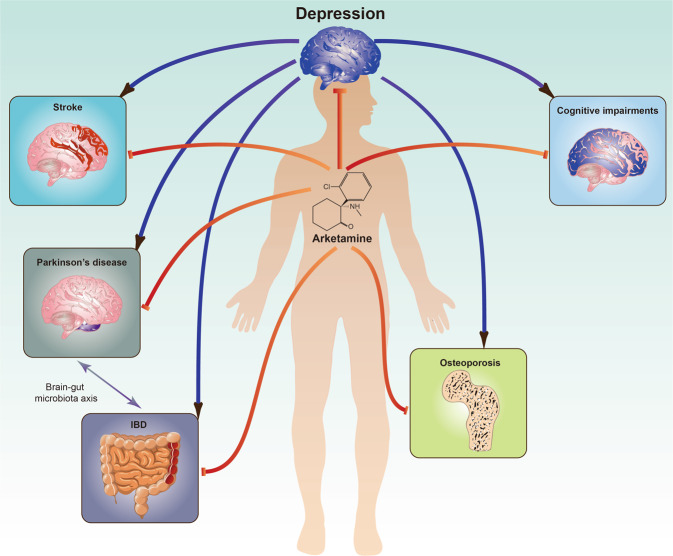
The discovery of robust antidepressant actions exerted by the N -methyl-D-aspartate receptor (NMDAR) antagonist ( R,S )-ketamine has been a crucial breakthrough in mood disorder research. ( R,S )-ketamine is a racemic mixture of equal amounts of ( R )-ketamine (arketamine) and ( S )-ketamine (esketamine). In 2019, an esketamine nasal spray from Johnson & Johnson was approved in the United States of America and Europe for treatment-resistant depression. However, an increasing number of preclinical studies show that arketamine has greater potency and longer-lasting antidepressant-like effects than esketamine in rodents, despite the lower binding affinity of arketamine for the NMDAR. In clinical trials, non-ketamine NMDAR-related compounds did not exhibit ketamine-like robust antidepressant actions in patients with depression, despite these compounds showing antidepressant-like effects in rodents. Thus, the rodent data do not necessarily translate to humans due to the complexity of human psychiatric disorders. Collectively, the available studies indicate that it is unlikely that NMDAR plays a major role in the antidepressant action of ( R,S )-ketamine and its enantiomers, although the precise molecular mechanisms underlying antidepressant actions of ( R,S )-ketamine and its enantiomers remain unclear. In this paper, we review recent findings on the molecular mechanisms underlying the antidepressant actions of ( R,S )-ketamine and its potent enantiomer arketamine. Furthermore, we discuss the possible role of the brain–gut–microbiota axis and brain–spleen axis in stress-related psychiatric disorders and in the antidepressant-like action of arketamine. Finally, we discuss the potential of arketamine as a treatment for cognitive impairment in psychiatric disorders, Parkinson’s disease, osteoporosis, inflammatory bowel diseases, and stroke.
Overview
The claims and statistics of this paper haven’t been checked yet.
Free: it reads the open-access text and checks the first 5 claims that cite a source we can check. Create a free account to check every claim.
Integrity signals
Registry
Cites
Statistics
Figures
Verification
Claims the paper makes
The claims and statistics of this paper haven’t been checked yet.
Free: it reads the open-access text and checks the first 5 claims that cite a source we can check. Create a free account to check every claim.
Claims other papers make about this one
Each is checked against this paper’s own text: does it say what the citing paper says it does?
In the citing paper
“For now, the therapeutic primacy of NMDAR inhibition and resultant AMPAR potentiation appears a temporary frontrunner in the dynamic glutamatergic antidepressant landscape [75,76].”
From Pharmacotherapies Targeting GABA-Glutamate Neurotransmission for Treatment-Resistant Depression (2023) · cites this paper as [75]
Self-check
Percentages, sums and reported differences re-computed from the paper’s own numbers.
The self-check needs the paper’s full text.
Citations
Cites
Vos, T., Lim, S. S., Abbafati, C., Abbas, K. M., Abbasi, M., Abbasifard, M., Abbasi-Kangevari, M., Abbastabar, H., Abd-Allah, F., Abdelalim, A., et al. (2020) · The Lancet · doi:10.1016/s0140-6736(20)30925-9 · Cited by 19,358
Molecular Mechanisms of Depression: Perspectives on New Treatment Strategies
Lang, U. E., & Borgwardt, S. (2013) · Cellular Physiology and Biochemistry · doi:10.1159/000350094 · Cited by 8,475
Cryan, J. F., O'Riordan, K. J., Cowan, C. S. M., Sandhu, K. V., Bastiaanssen, T. F. S., Boehme, M., Codagnone, M. G., Cussotto, S., Fulling, C., Golubeva, A. V., et al. (2019) · Physiological Reviews · doi:10.1152/physrev.00018.2018 · Cited by 5,286
Antidepressant effects of ketamine in depressed patients
Berman, R. M., Cappiello, A., Anand, A., Oren, D. A., Heninger, G. R., Charney, D. S., & Krystal, J. H. (2000) · Biological Psychiatry · doi:10.1016/s0006-3223(99)00230-9 · Cited by 3,856 · cited 1×
“[19] demonstrated that a single intravenous infusion of (R,S)-ketamine (0.”
BackgroundA randomized trial of an N-methyl-D-aspartate antagonist in treatment-resistant major depression.
Zarate, C. A., Singh, J. B., Carlson, P. J., Brutsche, N. E., Ameli, R., Luckenbaugh, D. A., Charney, D. S., & Manji, H. K. (2006) · Archives of General Psychiatry · doi:10.1001/archpsyc.63.8.856 · Cited by 3,766
The role of short-chain fatty acids in microbiota–gut–brain communication
Dalile, B., Van Oudenhove, L., Vervliet, B., & Verbeke, K. (2019) · Nature Reviews Gastroenterology & Hepatology · doi:10.1038/s41575-019-0157-3 · Cited by 3,357
Krystal, J. H. (1994) · Archives of General Psychiatry · doi:10.1001/archpsyc.1994.03950030035004 · Cited by 3,330
Nestler, E. J., Barrot, M., DiLeone, R. J., Eisch, A. J., Gold, S. J., & Monteggia, L. M. (2002) · Neuron · doi:10.1016/s0896-6273(02)00653-0 · Cited by 3,217
Recent advances in the phencyclidine model of schizophrenia
(1991) · American Journal of Psychiatry · doi:10.1176/ajp.148.10.1301 · Cited by 2,904 · cited 1×
“It is well accepted that NMDAR antagonists such as ketamine and PCP cause detrimental side effects, including psychosis and dissociation in humans in proportion to their potency at the NMDAR [97], and the difference in NMDAR potency between the two ketamine enantiomers may explain the divergence in their dissociative…”
BackgroundmTOR-Dependent Synapse Formation Underlies the Rapid Antidepressant Effects of NMDA Antagonists
Li, N., Lee, B., Liu, R.-J., Banasr, M., Dwyer, J. M., Iwata, M., Li, X.-Y., Aghajanian, G., & Duman, R. S. (2010) · Science · doi:10.1126/science.1190287 · Cited by 2,881
Research works printed but not linked: 1
- Press release: Perception Neuroscience’s PCN-101 (R-ketamine) demonstrates tolerability in phase 1 single ascending dose study. https://www.perceptionns.com/news.
Cited by
Items 201–251 of 251
Kong, L., Liu, M., Li, H., Shang, R., Lv, S., Wang, Z., & Ren, Q. (2025) · ALPHA PSYCHIATRY · doi:10.31083/ap45684 · Cited by 2
“Pharmacologically active TCM constituents exhibit clinically validated antidepressant effects with favorable safety profiles, demonstrating substantial potential for novel antidepressant development [9].”
Eleni, I., Theofanis, V., Zisis, B., & Stamoula, Ε. (2025) · Neuroscience · doi:10.1016/j.neuroscience.2025.09.010 · Cited by 2
(2024) · Frontiers research topics · doi:10.3389/978-2-8325-4734-2 · Cited by 2
Shan, J., Qu, Y., & Hashimoto, K. (2025) · Journal of Affective Disorders · doi:10.1016/j.jad.2025.04.027 · Cited by 1
Self-citationYan, J., Liu, Q.-R., Zhao, L., Yang, J., Lin, H.-Q., Wen, Z.-Y., Zhang, H., Mei, Y.-X., Zhang, W., & Wang, R.-D. (2025) · BMJ Open · doi:10.1136/bmjopen-2024-089719 · Cited by 1
“24 25 Esketamine, the S-enantiomer, exhibits higher potency, faster recovery and neuroprotective effects, 26 making it a promising option for minimising neurocognitive complications post-surgery.”
Mechanism of antidepressant action of ketamine and differences between its two enantiomers
Zhan, J., Zhang, Y., Tian, H., Zhu, X., Guo, M., Qiu, Z., & Xia, Z. (2025) · Journal of Anesthesia and Translational Medicine · doi:10.1016/j.jatmed.2025.06.001 · Cited by 1
“166 R-ketamine was also able to induce the transcription of BDNF through the inhibition of methyl-CpG-binding protein 2 (MeCP2) and the increase in the expression of NRBP1 in microglial cultures, 175 showing the importance of microglia in the antidepressant effects of R-ketamine.”
Deyama, S., Mishiro, K., Kunishima, M., & Kaneda, K. (2025) · European Journal of Pharmacology · doi:10.1016/j.ejphar.2025.178301 · Cited by 1
Marx, L., Şen, Z. D., Danyeli, L. V., Li, M., Brigadski, T., Leßmann, V., & Walter, M. (2025) · Frontiers in Psychiatry · doi:10.3389/fpsyt.2025.1662051 · Cited by 1
Zhang, M., Wang, Z., Cheng, H., Gao, D., Cui, L., Zhang, J., Zhang, R., Xu, J., & Ji, Q. (2025) · BMC Anesthesiology · doi:10.1186/s12871-025-03469-1 · Cited by 2
“As an NMDA receptor antagonist [19] esketamine may facilitate sleep initiation and maintenance by suppressing pathological NMDA receptor over-activity, enhancing neural inhibition, and rebalancing cerebral excitation-inhibition equilibrium.”
Heuvel, F. O., Zhang, J., Sun, F., Krishnamurthy, S. S., Yartas, G., Özkan, B., Pagliarini, M., Voehringer, D., O'Meara, C. C., Schäfer, M. K. E., et al. (2025) · Journal of Neuroinflammation · doi:10.1186/s12974-025-03621-1 · Cited by 1
Brown, K. A., Morris, P. J., Thomas, C. J., & Gould, T. D. (2026) · Journal of Neuroscience · doi:10.1523/jneurosci.0958-25.2026 · Cited by 1
Yin, H., Wang, S., & Huang, H. (2026) · BMJ Open · doi:10.1136/bmjopen-2025-114079 · Cited by 1
Esketamine Preserves Network Connectivity and Promotes Recovery in Consciousness Disorders
Qin, X., Chen, X., Yao, L. N., Wang, B., Niu, H., Liang, Z., Zhao, Z., Wang, J., Huang, J. N., Guo, X., et al. (2026) · CNS Neuroscience & Therapeutics · doi:10.1002/cns.70890 · Cited by 1
Liu, J., Sun, M., Wang, F., Gao, H., Lu, Y., Ma, H., Shang, R., Zhong, X., Yi, Y., Yu, X., et al. (2026) · Phytomedicine · doi:10.1016/j.phymed.2026.158397 · Cited by 1
Predictable Biomarkers for Rapid-Acting Antidepressant Response to Ketamine
Tan, Y., & Hashimoto, K. (2021) · Contemporary clinical neuroscience · doi:10.1007/978-3-030-79790-4_3 · Cited by 1
Self-citationHolden, J. M. (2022) · Learning and Motivation · doi:10.1016/j.lmot.2022.101851 · Cited by 1
Klettke, E. E., Holmes, M. D., Meyer, T. D., & Jones, G. H. (2023) · Personalized Medicine in Psychiatry · doi:10.1016/j.pmip.2023.100112 · Cited by 1
Depression: The Vagus Nerve and Gut-Brain Axis
Hashimoto, K. (2025) · Springer eBooks · doi:10.1007/978-3-031-73368-0_31 · Cited by 1
Self-citationWei, S., Wang, F., Liu, J., & Wang, Y. (2022) · Frontiers in Psychiatry · doi:10.3389/fpsyt.2022.983604 · Cited by 2
New treatment strategies for mental health
Hashimoto, K., & Schmitt, A. (2023) · European Archives of Psychiatry and Clinical Neuroscience · doi:10.1007/s00406-023-01682-y · Cited by 1
“Arketamine, the (R)-enantiomer of the anesthetic ketamine, has been developed as a new rapid-acting antidepressant that avoids the side effects of ketamine and esketamine [3].”
BackgroundSelf-citationSpecial issue on “Ketamine, MDMA, and psychedelics in the treatment of neuropsychiatric disorders”
Hashimoto, K., Wang, X., & Zhang, J. (2025) · Asian Journal of Psychiatry · doi:10.1016/j.ajp.2025.104426 · Cited by 1
Self-citation(R)-Ketamine: A New Rapid-Acting Antidepressant
Zhang, K., & Hashimoto, K. (2021) · Contemporary clinical neuroscience · doi:10.1007/978-3-030-79790-4_1 · Cited by 1
Self-citationRole of Stereochemistry in Drug Disposition and Pharmacokinetics
Curry, S. H., & Whelpton, R. (2022) · Wiley eBooks · doi:10.1002/9781119589181.ch15
Microbiota and Depression an Update
Huarcaya, L. R. D. (2023) · Biomedical Journal of Scientific & Technical Research · doi:10.26717/bjstr.2023.50.008004
Esketamina en el tratamiento de la depresión grave e ideación suicidaPreprint
toyo, J. C. B., Cortés-Jofré, M., & Ortiz-Muñoz, L. E. (2023) · OSF Preprints (OSF Preprints) · doi:10.31219/osf.io/j2d3g
Jiang, Y., Zhang, L., Wang, T., Liao, L., Zhu, S., Peng, C., Tan, Y., Hashimoto, K., Fan, X., & Yan, W. (2023) · SSRN Electronic Journal · doi:10.2139/ssrn.4564660
Self-citationBrain-Derived Neurotrophic Factor in Bipolar Disorder
Hashimoto, K. (2024) · Springer eBooks · doi:10.1007/978-3-031-32035-4_20-1
Self-citationEffects of Ketamine and Esketamine on Cognitive Functions in Treatment-Resistant Depression
Mutlu, M., Öven, Ç., Kurt, B. S., & SUNAY, E. (2025) · Psikiyatride Guncel Yaklasimlar - Current Approaches in Psychiatry · doi:10.18863/pgy.1524106
Depression: The Vagus Nerve and Gut-Brain Axis
Hashimoto, K. (2024) · Springer eBooks · doi:10.1007/978-3-031-32035-4_31-1
Self-citationArketamine: Unapproved but Promising Antidepressant with Multiple Brain Benefits
Wan, X., & Hashimoto, K. (2025) · Neuromethods · doi:10.1007/978-1-0716-4599-4_15
Self-citationBrain-Derived Neurotrophic Factor in Bipolar Disorder
Hashimoto, K. (2025) · Springer eBooks · doi:10.1007/978-3-031-73368-0_20
Self-citationPreclinical Studies on Ketamine and Its Enantiomers with Translational Significance
Elersič, K. (2025) · Neuromethods · doi:10.1007/978-1-0716-4603-8_5 · Cited by 1
Role of gut and skin microbiota and spleen in mice model of psoriasis
Shinno-Hashimoto, H. (2023) · Institutional Repositories DataBase (IRDB) · doi:10.20776/900122217
Molecular mechanisms for prophylactic effects of arketamine in inflammation model of depression
Li, M. A. (2023) · Institutional Repositories DataBase (IRDB) · doi:10.20776/900122559
Parcon, P. A., Bardhoshi, A., Olsen-Dufour, A. M., Cureton, R., Jana, S., Morse, C. L., Henter, I. D., Totis, J., Jenson, A. E., Pamie-George, M. T., et al. (2026) · Translational Psychiatry · doi:10.1038/s41398-026-04039-w
Ding, X., Hashimoto, K., & Yang, J.-J. (2026) · Progress in Neuro-Psychopharmacology and Biological Psychiatry · doi:10.1016/j.pnpbp.2026.111727
Self-citationBreit, S. (2026) · Journal of Psychiatry and Brain Science · doi:10.20900/jpbs.20260006
“There is evidence from animal studies that arketamine may have stronger and longer lasting antidepressant effects and lower side effects than esketamine [152,153].”
Influential(2024) · American Psychiatric Association Publishing eBooks · doi:10.1176/appi.books.9798894551944.bm01
Li, Y., Zhao, K., Cao, P., Wang, Q., Li, K., & Zhou, J. (2026) · Drug Design Development and Therapy · doi:10.2147/dddt.s587626
Jin, Y., Lv, Y., Wu, X., Liu, C., Guo, W., Cui, Y., Dong, Y., & 童鲁莎 (2026) · BMC Medicine · doi:10.1186/s12916-026-05014-4
Sabouri, E., Shahmoradi, T., Keshvari, N. Z., khodaee, P., Saleki, K., & Rezaei, N. (2026) · Reviews in the Neurosciences · doi:10.1515/revneuro-2026-0064
“…remain not fully understood (Sinagra et al. 2020)both preclinical and clinical studies suggest the bene-fi cial e ff ects of dietary and probiotic supplementations for depressive symptoms (Bambury et al. 2018; Long-Smith et al. 2020; Marx et al. 2021; Simpson et al. 2021; Wei et al. 2022).”
Zhao, W., Zhao, X., Zhang, Y., Ma, X., Huang, C., Zhao, G., Wang, S., Wang, H., Peng, Z., & Cai, M. (2026) · Neuroscience · doi:10.1016/j.neuroscience.2026.07.059
The Role of the NMDA Receptor in the Treatment of Psychiatric and Neurological Diseases
Heath, S. P., Ruzicka, M., McLoon, T., Gupta, D., Emeri, O., Nnabugwu, Z., Adeniji, A., Brackett, C. M., Slack, S., & Agbowuro, A. A. (2026) · Brain Sciences · doi:10.3390/brainsci16080786
“However, of the two enantiomers of ketamine, only esketamine is currently used for TRD, but there is growing evidence that the R-enantiomer (arketamine) produces greater potency and longer-lasting antidepressant effects compared to esketamine and may be more clinically beneficial [46,48].”
Li, T., Chang, Y., Tang, S., Chen, Y., Li, X., & Wang, Y. (2026) · Brain Research Bulletin · doi:10.1016/j.brainresbull.2026.112062
Liu, X., Liu, C., Li, Y., Yang, Z., Zhang, J., Yang, J., He, W., Liu, Y., & Li, J. (2026) · Frontiers in Neurology · doi:10.3389/fneur.2026.1881935
“…ketamine with a higher affinity for N-methyl-D-aspartate (NMDA) receptors and is approximately twice as potent as racemic ketamine for analgesia (9, 10) Additionally, compared with ketamine, esket-amine has fewer psychiatric adverse reactions (including hallucinations, dissociation, and mental…”
Role of gut-microbiome-brain axis via vagus nerve in the MPTP-induced neurotoxicity in the mice
Shan, J. (2022) · Institutional Repositories DataBase (IRDB) · doi:10.20776/900121485
Is (S)-norketamine an active mediator of esketamine’s antidepressant effects?
Hashimoto, K., & Yang, C. (2026) · Molecular Psychiatry · doi:10.1038/s41380-026-03867-y
Self-citationWang, H., Zhou, C., Qu, Y., & Luo, H. (2026) · Frontiers in Pharmacology · doi:10.3389/fphar.2026.1960869
“Both enantiomers appear to offer comparable direct neuroprotective effects on post-ischemic neurons, suggesting that mechanisms beyond simple NMDA receptors antagonism are at play (Wei et al., 2022).”
Song, S.-H., Ha, A., & Lee, S. (2026) · Drug Targets and Therapeutics · doi:10.58502/dtt.26.0007
Targeting NMDAR2A in microglia: esketamine suppresses M1 polarization in BV2 cells
Li, H., Zhang, X., Luo, Y., Hu, W., Liu, Y., Ren, Y., & Zou, X. (2026) · Molecular Biology Reports · doi:10.1007/s11033-026-12874-9
“While ketamine and its enantiomers have been reported to exert effects through both NMDAR-dependent and -independent mechanisms [ 17, 18 ], the present study demonstrated that esketamine inhibited M1 polarization of BV2 microglia via an NMDAR-dependent pathway, reduc - ing proinflammatory cytokine…”
Metadata
- Authors
- Wei, Y., Chang, L., & Hashimoto, K.
- Affiliations
- Chiba University (JP)
- Corresponding author
- Hashimoto, Kenji
- Venue
- Molecular Psychiatry
- Published
- 2021-05-07
- Volume
- 27
- Issue
- 1
- Pages
- 559-573
- ISSN
- 1359-4184 (ISSN-L)
- 1476-5578
- PMC
- PMC8960399
- OpenAlex
- W3158143766
- Cited by
- 248
- References
- 191
- Citations by year
- 2026: 23 · 2025: 51 · 2024: 58 · 2023: 43 · 2022: 55 · 2021: 18
- FWCI
- 5.51
- Type
- journal article
- Language
- en
- Open access
- hybrid
- doi.org
- Licence
- cc-by
- creativecommons.org/licenses/by/4.0 (tdm)
- creativecommons.org/licenses/by/4.0 (vor)
- Locations
- Molecular Psychiatry (publishedVersion, cc-by)
- PubMed Central (publishedVersion, cc-by)
- PubMed (publishedVersion)
- Funders
- Japan Agency for Medical Research and Development (JP20dm0107119)
- National Natural Science Foundation of China (31701009)
- Topics
- Health Sciences › Medicine › Pharmacology (medical) › Treatment of Major Depression
- Life Sciences › Neuroscience › Cellular and Molecular Neuroscience › Neuroscience and Neuropharmacology Research
- Life Sciences › Neuroscience › Biological Psychiatry › Tryptophan and brain disorders
- Keywords
- esketamine, antidepressant mechanism, NMDA receptor, treatment-resistant depression, brain-gut-microbiota axis, stress-related psychiatric disorders, cognitive impairment, Parkinson's disease, osteoporosis, inflammatory bowel disease, stroke
- MeSH terms
- Antidepressive Agents, Depression, Humans, Ketamine, Receptors, N-Methyl-D-Aspartate, Depressive Disorder, Treatment-Resistant
About these checks
Registry, retraction, Cites and statistics results are computed, not judged, with one exception: a printed reference that no index lists is read once by a model before it counts as a citation error. Claims are extracted by a model and kept only when their quote appears verbatim in the text; each cited source is then checked, with a model’s help, for whether it says what the claim relies on. Those verdicts can be wrong — read the claim’s quote and the cited source before relying on one.
Statistics and arithmetic are recomputed, not judged.
Confidence bands are shown only for fields calibrated on our annotated test set. None is calibrated yet, so no band is shown.
What counts as a claim ›How we measure confidence ›How we check this ›
Are you an author, or do you see a problem with this page? Request a review
Data sources
Bibliographic data: Semantic Scholar, OpenAlex, Crossref.
Contains information from the Semantic Scholar Academic Graph Datasets, made available under the ODC Attribution License (ODC-BY 1.0).
Semantic Scholar’s data is described in: Kinney, R., et al. (2023). The Semantic Scholar Open Data Platform. arXiv:2301.10140.
