

Serotonin depletion impairs both Pavlovian and instrumental reversal learning in healthy humans
Open accessPublished version of a preprint
The DOI matches its Crossref record; 147 of the 150 references it cites were found in a registry or an index.
Abstract
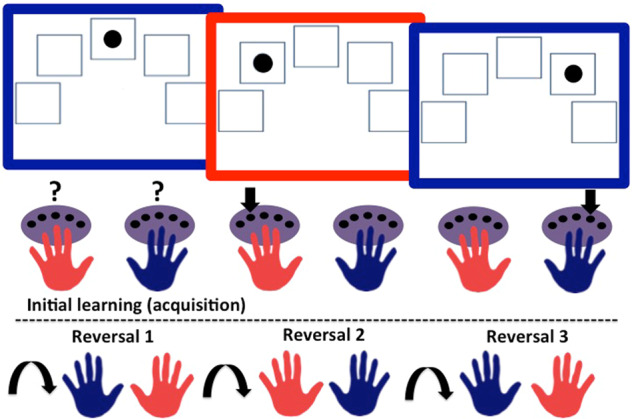
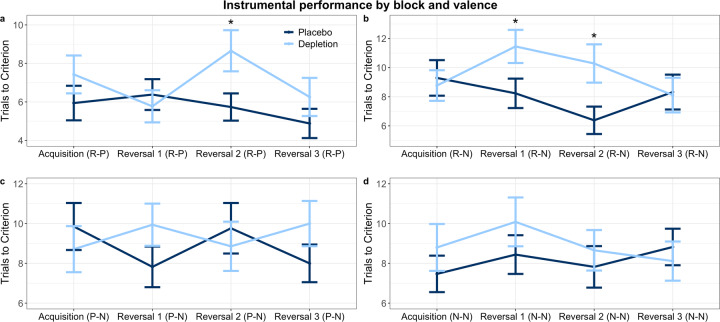
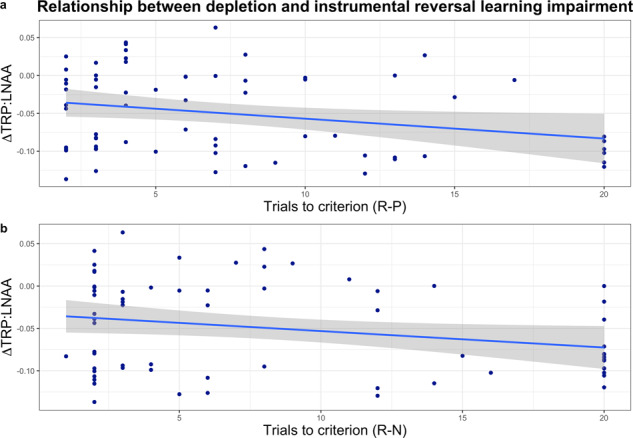
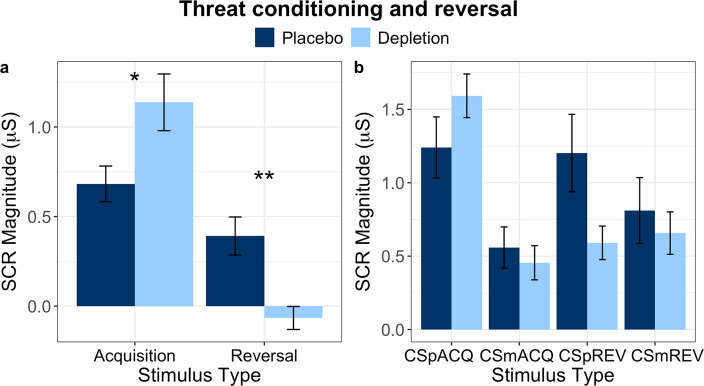
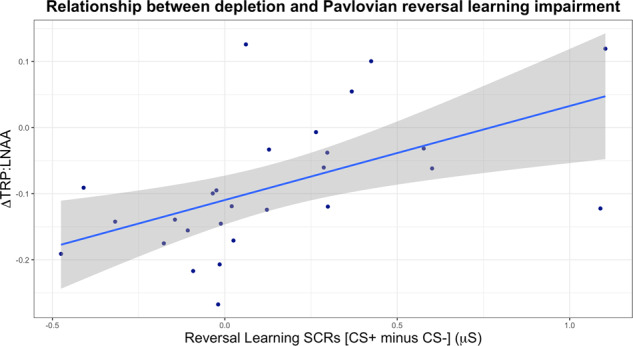
Serotonin is involved in updating responses to changing environmental circumstances. Optimising behaviour to maximise reward and minimise punishment may require shifting strategies upon encountering new situations. Likewise, autonomic responses to threats are critical for survival yet must be modified as danger shifts from one source to another. Whilst numerous psychiatric disorders are characterised by behavioural and autonomic inflexibility, few studies have examined the contribution of serotonin in humans. We modelled both processes, respectively, in two independent experiments ( N = 97). Experiment 1 assessed instrumental (stimulus-response-outcome) reversal learning whereby individuals learned through trial and error which action was most optimal for obtaining reward or avoiding punishment initially, and the contingencies subsequently reversed serially. Experiment 2 examined Pavlovian (stimulus-outcome) reversal learning assessed by the skin conductance response: one innately threatening stimulus predicted receipt of an uncomfortable electric shock and another did not; these contingencies swapped in a reversal phase. Upon depleting the serotonin precursor tryptophan—in a double-blind randomised placebo-controlled design—healthy volunteers showed impairments in updating both actions and autonomic responses to reflect changing contingencies. Reversal deficits in each domain, furthermore, were correlated with the extent of tryptophan depletion. Initial Pavlovian conditioning, moreover, which involved innately threatening stimuli, was potentiated by depletion. These results translate findings in experimental animals to humans and have implications for the neurochemical basis of cognitive inflexibility.
Overview
The claims and statistics of this paper haven’t been checked yet.
Free: it reads the open-access text and checks the first 5 claims that cite a source we can check. Create a free account to check every claim.
Integrity signals
Registry
Cites
Statistics
Figures
Verification
Claims the paper makes
The claims and statistics of this paper haven’t been checked yet.
Free: it reads the open-access text and checks the first 5 claims that cite a source we can check. Create a free account to check every claim.
Claims other papers make about this one
Each is checked against this paper’s own text: does it say what the citing paper says it does?
The source backs part of the claim, not all of it — or backs it for a different population, condition or comparison.
In the citing paper
“ATD has been shown to affect measures of both ‘cold’ (rational and non-emotional), and ‘hot’ (social and emotional) cognition [13–18].”
From Chronic escitalopram in healthy volunteers has specific effects on reinforcement sensitivity: a double-blind, placebo-controlled semi-randomised study (2023) · cites this paper as [14]
Experimental — accuracy not yet measuredThe source backs part of the claim, not all of it — or backs it for a different population, condition or comparison.
In the citing paper
“Effects of ATD have also been seen on reinforcement behaviour [13], reversal learning [9, 14], learning and memory [15], affective and social cognition [9, 16, 17] and moral judgement [18].”
From Chronic escitalopram in healthy volunteers has specific effects on reinforcement sensitivity: a double-blind, placebo-controlled semi-randomised study (2023) · cites this paper as [14]
Experimental — accuracy not yet measured
Self-check
Percentages, sums and reported differences re-computed from the paper’s own numbers.
The self-check needs the paper’s full text.
Citations
Cites
Diagnostic and Statistical Manual of Mental Disorders
American Psychiatric Association (2013) · doi:10.1176/appi.books.9780890425596 · Cited by 116,369
Controlling the False Discovery Rate: A Practical and Powerful Approach to Multiple Testing
Benjamini, Y., & Hochberg, Y. (1995) · Journal of the Royal Statistical Society Series B: Statistical Methodology · doi:10.1111/j.2517-6161.1995.tb02031.x · Cited by 109,482 · cited 1×
“Correction for multiple comparisons where relevant, was conducted using the Benjamini-Hochberg procedure [106].”
MethodDevelopment and validation of brief measures of positive and negative affect: The PANAS scales.
Watson, D., Clark, L. A., & Tellegen, A. (1988) · Journal of Personality and Social Psychology · doi:10.1037/0022-3514.54.6.1063 · Cited by 32,433
Self-citation(1998) · The Journal of Clinical Psychiatry · Cited by 19,139
(1998) · PubMed · Cited by 10,216
LeDoux, J. E. (2000) · Annual Review of Neuroscience · doi:10.1146/annurev.neuro.23.1.155 · Cited by 8,444 · cited 1×
“The central nucleus of the amygdala (CeA) is the major source of output and its downstream projections ultimately produce defence responses such as perspiration in humans and freezing in rodents (LeDoux 2000).”
BackgroundComparison of Beck Depression Inventories -IA and -II in psychiatric outpatients
Beck, A. T., Steer, R. A., Ball, R., & Ranieri, W. F. (1996) · Journal of Personality Assessment · doi:10.1207/s15327752jpa6703_13 · Cited by 5,965
The mini international neuropsychiatric interview
Lecrubier, Y., Sheehan, D., Hergueta, T., & Weiller, E. (1998) · European Psychiatry · doi:10.1016/s0924-9338(99)80239-9 · Cited by 5,872
Thresholding of statistical maps in functional neuroimaging using the false discovery rate
Genovese, C. R., Lazar, N. A., & Nichols, T. (2002) · NeuroImage · doi:10.1006/nimg.2001.1037 · Cited by 4,923
The Obsessive-Compulsive Inventory: Development and validation of a short version.
Foa, E. B., Huppert, J. D., Leiberg, S., Langner, R., Kichic, R., Hajcak, G., & Salkovskis, P. M. (2002) · Psychological Assessment · doi:10.1037/1040-3590.14.4.485 · Cited by 2,959
Cited by
Psychedelics, Sociality, and Human Evolution
Rodríguez Arce, J. M., & Winkelman, M. J. (2021) · Frontiers in Psychology · doi:10.3389/fpsyg.2021.729425 · Cited by 86
“Self-medication with psilocybin mushrooms would have ameliorated the costs associated with impairment of serotonergic neural signaling, involving depressed mood (Jenkins et al., 2016), increased stress vulnerability (Sachs et al., 2015), and cognitive inflexibility (Kanen et al., 2020).”
BackgroundUnderstanding the effects of serotonin in the brain through its role in the gastrointestinal tract
Shine, J. M., O’Callaghan, C., Walpola, I. C., Wainstein, G., Taylor, N. L., Aru, J., Huebner, B., & John, Y. J. (2022) · Brain · doi:10.1093/brain/awac256 · Cited by 73
“A 144 – 147 This perseverative responding is commonly measured in the context of reversal learning tasks, 148 whereby perseverative errors interfere with an animal ’ s ability to switch to anewresponsecontingency.”
Langley, C., Armand, S., Luo, Q., Savulich, G., Segerberg, T., Søndergaard, A., Pedersen, E. B., Svart, N., Overgaard-Hansen, O., Johansen, A., et al. (2023) · Neuropsychopharmacology · doi:10.1038/s41386-022-01523-x · Cited by 58
“Effects of ATD have also been seen on reinforcement behaviour [13], reversal learning [9, 14], learning and memory [15], affective and social cognition [9, 16, 17] and moral judgement [18].”
BackgroundSelf-citationA neurobiological perspective on social influence: Serotonin and social adaptation
Duerler, P., Vollenweider, F. X., & Preller, K. H. (2022) · Journal of Neurochemistry · doi:10.1111/jnc.15607 · Cited by 53
Денисовна, Ш. А., Zharikova, T. S., Ковалева, О. Н., Luchina, A. M., Aktemirov, A. S., Olsufieva, A. V., Sinelnikov, M. Y., Pontes‐Silva, A., & Zharikov, Y. O. (2023) · Behavioural Brain Research · doi:10.1016/j.bbr.2023.114606 · Cited by 39
Monoaminergic Modulation of Learning and Cognitive Function in the Prefrontal Cortex
Boyle, N., Betts, S., & Lü, H. (2024) · Brain Sciences · doi:10.3390/brainsci14090902 · Cited by 34
“In a similar vein, studies of serotonergic depletion result in deficits in reversal learning and impaired cognitive flexibility [113,114].”
BackgroundApergis-Schoute, A. M., van der Flier, F. E., Ip, S. H. Y., Kanen, J. W., Vaghi, M. M., Fineberg, N. A., Sahakian, B. J., Cardinal, R. N., & Robbins, T. W. (2024) · Biological Psychiatry Global Open Science · doi:10.1016/j.bpsgos.2023.06.004 · Cited by 25
“The fi ndings indicate that treat-mentwithSSRIsmayimprove fl exibility undercertainconditions in reversal learning in patients with OCD, consistent with evidence concerning serotonin and cognitive fl exibility (6,8,9).”
ResultSelf-citationA Role for Serotonin in Modulating Opposing Drive and Brake Circuits of Impulsivity
Desrochers, S. S., Spring, M. G., & Nautiyal, K. M. (2022) · Frontiers in Behavioral Neuroscience · doi:10.3389/fnbeh.2022.791749 · Cited by 29
Luo, Q., Kanen, J. W., Bari, A., Skandali, N., Langley, C., Knudsen, G. M., Alsiö, J., Phillips, B. U., Sahakian, B. J., Cardinal, R. N., et al. (2023) · Neuropsychopharmacology · doi:10.1038/s41386-023-01762-6 · Cited by 29
“The neurotransmitter serotonin (5-hydroxytryptamine; 5-HT) is widely implicated in behavioral fl exibility [11 – 19].”
BackgroundSelf-citationDirect serotonin release in humans shapes aversive learning and inhibition
Colwell, M., Tagomori, H., Shang, F., Cheng, H. I., Wigg, C., Browning, M. D., Cowen, P. J., Murphy, S. E., & Harmer, C. J. (2024) · Nature Communications · doi:10.1038/s41467-024-50394-x · Cited by 28
“…such as reversal or model-free/model-based learning involve different computational models and neural pathways 64,92,123 – 127 ; consequentially, model-free learning implemented in the present work is challenging to compare with TRP/SSRI work involving model-based and reversal learning 128 – 130 .”
MethodFeng, Y.-Y., Bromberg-Martin, E. S., & Monosov, I. E. (2024) · Cell Reports · doi:10.1016/j.celrep.2024.114341 · Cited by 21
Lan, D. C. L., & Browning, M. D. (2022) · Computational Psychiatry · doi:10.5334/cpsy.83 · Cited by 22
Mkrtchian, A., Qiu, Z., Abir, Y., Erdmann, T., Dercon, Q., Sedlinská, T., Browning, M. D., Costello, H., & Huys, Q. J. M. (2025) · JAMA Psychiatry · doi:10.1001/jamapsychiatry.2025.0839 · Cited by 19
“Several other factors may have contributed to heterogeneity, such as feedback saliency 52 or menstrual cycle 53 , which future research needs to assess.”
Threat reversal learning and avoidance habits in generalised anxiety disorder
Roberts, C., Apergis-Schoute, A. M., Brühl, A. B., Nowak, M., Baldwin, D. S., Sahakian, B. J., & Robbins, T. W. (2022) · Translational Psychiatry · doi:10.1038/s41398-022-01981-3 · Cited by 16
Self-citationBîlc, M. I., Iacob, A., Szekely‐Copîndean, R. D., Kiss, B., Ștefan, M.-G., Muresan, R. C., Pop, C. F., Pițur, S., Szentágotai-Tătar, A., Vulturar, R., et al. (2023) · Cognitive Affective & Behavioral Neuroscience · doi:10.3758/s13415-023-01116-1 · Cited by 14
“Kanen et al. (2021b) induced emotion through social scenarios that involved unjust harm and found that ATD potentiated guilt and shame when participants imagined that they were the victim of harm, and annoyance with oneself when they imagined that it was them who inflicted harm.”
BackgroundInfluentialImpaired differential learning of fear versus safety signs in obsessive‐compulsive disorder
Elsner, B., Reuter, B., Said, M., Linnman, C., Kathmann, N., & Beucke, J. (2021) · Psychophysiology · doi:10.1111/psyp.13956 · Cited by 12
Solomon, M. B., Yegla, B., Newcorn, J. H., Maletic, V., Rubin, J. S., & Robbins, T. W. (2025) · Clinical Drug Investigation · doi:10.1007/s40261-025-01473-4 · Cited by 11
“Trypto-phan depletion impaired Pavlovian and instrumental reversal learning, which is consistent with preclinical studies [355], but it did not impact probabilistic reversal learning [356], indicating task-specific effects.”
Self-citationHervig, M. E.-S., Zühlsdorff, K., Olesen, S. F., Phillips, B. U., Božič, T., Dalley, J. W., Cardinal, R. N., Alsiö, J., & Robbins, T. W. (2024) · Psychopharmacology · doi:10.1007/s00213-024-06586-w · Cited by 7
“In humans, acute tryptophan depletion (reducing 5-HT levels due to a reduction in its amino-acid precur - sor tryptophan) increases outcome-independent choice perseveration (Seymour et al. 2012 ) and impairs reversal learning (Kanen et al. 2021 ).”
BackgroundSelf-citationHarnessing temperament to elucidate the complexities of serotonin function
Kanen, J. W., Robbins, T. W., & Trofimova, I. N. (2022) · Current Opinion in Behavioral Sciences · doi:10.1016/j.cobeha.2022.101108 · Cited by 8
Self-citationDesmercieres, S., Lardeux, V., Longueville, J.-E., Hanna, M., Panlilio, L. V., Thiriet, N., & Solinas, M. (2022) · Neuropharmacology · doi:10.1016/j.neuropharm.2022.109261 · Cited by 7
Langley, C., Murray, G. K., Armand, S., Knolle, F., Cardinal, R. N., Johansen, A., Jensen, P. S., Feng, J., Stenbæk, D. S., Knudsen, G. M., et al. (2025) · Translational Psychiatry · doi:10.1038/s41398-025-03392-6 · Cited by 5
Self-citationNist, A. N., Walsh, S. J., & Shahan, T. A. (2023) · Psychopharmacology · doi:10.1007/s00213-023-06514-4 · Cited by 5
“The inability to behave flexibly may stem from low levels of the neurotransmitter serotonin (e.g., Bari et al. 2010; Kandroodi et al. 2021; Kanen et al. 2021, 2022).”
Liu, C., Li, K., Fu, M., Zhang, Y., Sindermann, C., Montag, C., Zheng, X., Zhang, H., Yao, S., Wang, Z., et al. (2023) · European Neuropsychopharmacology · doi:10.1016/j.euroneuro.2023.08.484 · Cited by 4
Solinas, M., Lardeux, V., Leblanc, P.-M., Longueville, J.-E., Thiriet, N., Vandaele, Y., Panlilio, L. V., & Jaafari, N. (2024) · Translational Psychiatry · doi:10.1038/s41398-024-02863-6 · Cited by 3
“We have recently developed a procedure to investigate punishment in rats that, similarly to what is commonly done in humans [28 – 30], individually calibrates the strength of punishment based on the animal ’ s behavior [31].”
MethodSerotonin reduces belief stickiness
Conceição, V. A., Petzschner, F. H., Cole, D. M., Wellstein, K. V., Müller, D., Raman, S., & Maia, T. V. (2026) · Nature Mental Health · doi:10.1038/s44220-026-00621-9 · Cited by 4
“…theory that serotonin, possibly acting especially on the OFC, decreases the stickiness of state beliefs explains why (1) serotonin depletions 1,26,27 , particularly in OFC 2,35,77 , hamper reversal learning, (2) increasing serotonin pharmacologically improves reversal learning 3 , with that…”
Estrada-Reyes, Y., Cervantes-Alfaro, J. M., López‐Vázquez, M. A., & Olvera‐Cortés, M. E. (2024) · Frontiers in Pharmacology · doi:10.3389/fphar.2024.1501896 · Cited by 1
Cory‐Slechta, D. A., Conrad, K., Marvin, E., Chalupa, D., Oberdörster, G., & Sobolewski, M. (2024) · Atmosphere · doi:10.3390/atmos15070853 · Cited by 1
“Given that link, identification of the contaminant components of UFPs that underlie these effects will ultimately be critical not only for elaborating the mechanisms of the effects, but for purposes of public health protection through regulation.”
BackgroundLaessing, P., Karvelis, P., Kennedy, J., Zai, C. C. H., Dayan, P., & Diaconescu, A. O. (2025) · bioRxiv (Cold Spring Harbor Laboratory) · doi:10.1101/2025.08.26.672271 · Cited by 1
Marzuki, A. A. (2021) · Apollo (University of Cambridge) · doi:10.17863/cam.70408
Desmercieres, S., Lardeux, V., Longueville, J.-E., Dugast, E., Thiriet, N., & Solinas, M. (2024) · Appetite · doi:10.1016/j.appet.2024.107340
“The progressive shock strength (PSS) procedure, similar to procedures commonly used in humans (Apergis-Schoute et al., 2017; Kanen et al., 2021; Kim & Anderson, 2020), allows individuals to titrate the level of punishment they are willing to receive in order to obtain a reward, and it provides PSS…”
Basch, R., Cohen, M., & Peled‐Avron, L. (2026) · medRxiv · doi:10.64898/2026.06.18.26355974
Stupart, O., Versprille, L. J. F. W., Zühlsdorff, K., Velázquez-Sánchez, C., Bailey, M. C. D., Chen, J. H., Lawson, R. P., & Dalley, J. W. (2026) · bioRxiv (Cold Spring Harbor Laboratory) · doi:10.64898/2026.07.03.736287
“However, artificially increasing 5-HT at the synapse using dietary tryptophan had no significant effect on PRL and DRL (Thirkettle et al. 2019; Kanen et al. 2021).”
Metadata
- Authors
- Kanen, J. W., Apergis-Schoute, A. M., Yellowlees, R., Arntz, F. E., van der Flier, F. E., Price, A., Cardinal, R. N., Christmas, D. M., Clark, L., Sahakian, B. J., Crockett, M. J., & Robbins, T. W.
- Affiliations
- University of Cambridge (GB)
- University of Leicester (GB)
- King's College London (GB)
- Leiden University (NL)
- University of British Columbia (CA)
- Yale University (US)
- Corresponding author
- Kanen, Jonathan W.
- ORCID
- Venue
- Molecular Psychiatry
- Published
- 2021-08-24
- Volume
- 26
- Issue
- 12
- Pages
- 7200-7210
- ISSN
- 1359-4184 (ISSN-L)
- 1476-5578
- PMC
- PMC8873011
- OpenAlex
- W3194895949
- Cited by
- 34
- References
- 150
- Citations by year
- 2026: 2 · 2025: 5 · 2024: 8 · 2023: 10 · 2022: 7 · 2021: 2
- FWCI
- 3.11
- Type
- journal article
- Language
- en
- Open access
- hybrid
- doi.org
- Licence
- cc-by
- creativecommons.org/licenses/by/4.0 (tdm)
- creativecommons.org/licenses/by/4.0 (vor)
- Locations
- Molecular Psychiatry (publishedVersion, cc-by)
- bioRxiv (Cold Spring Harbor Laboratory) (acceptedVersion, cc-by-nc-nd)
- PubMed Central (publishedVersion, cc-by)
- PubMed (publishedVersion)
- Queen Mary Research Online (Queen Mary University of London) (submittedVersion, cc-by)
- Apollo (University of Cambridge) (submittedVersion, cc-by)
- Apollo (cc-by)
- Funders
- Gates Cambridge Trust
- DH | National Institute for Health Research
- Wellcome Trust (104631/Z/14/Z)
- Topics
- Life Sciences › Neuroscience › Cellular and Molecular Neuroscience › Neurotransmitter Receptor Influence on Behavior
- Life Sciences › Neuroscience › Cognitive Neuroscience › Neural and Behavioral Psychology Studies
- Life Sciences › Neuroscience › Biological Psychiatry › Tryptophan and brain disorders
- Keywords
- serotonin, tryptophan depletion, reversal learning, classical conditioning, operant conditioning, cognitive flexibility, skin conductance response, reward and punishment
- MeSH terms
- Conditioning, Operant, Humans, Punishment, Reversal Learning, Reward, Serotonin
About these checks
Registry, retraction, Cites and statistics results are computed, not judged, with one exception: a printed reference that no index lists is read once by a model before it counts as a citation error. Claims are extracted by a model and kept only when their quote appears verbatim in the text; each cited source is then checked, with a model’s help, for whether it says what the claim relies on. Those verdicts can be wrong — read the claim’s quote and the cited source before relying on one.
Statistics and arithmetic are recomputed, not judged.
Confidence bands are shown only for fields calibrated on our annotated test set. None is calibrated yet, so no band is shown.
What counts as a claim ›How we measure confidence ›How we check this ›
Are you an author, or do you see a problem with this page? Request a review
Data sources
Bibliographic data: Semantic Scholar, OpenAlex, Crossref.
Contains information from the Semantic Scholar Academic Graph Datasets, made available under the ODC Attribution License (ODC-BY 1.0).
Semantic Scholar’s data is described in: Kinney, R., et al. (2023). The Semantic Scholar Open Data Platform. arXiv:2301.10140.
