

Dissociable effects of acute SSRI (escitalopram) on executive, learning and emotional functions in healthy humans
Open accessThe DOI matches its Crossref record; 58 of the 59 references it cites were found in a registry or an index; 6 of the 18 sources its claims cite were checked for support.
Abstract
Serotonin is implicated in multiple executive functions including goal-directed learning, cognitive flexibility, response inhibition and emotional regulation. These functions are impaired in several psychiatric disorders, such as depression and obsessive-compulsive disorder. We tested the cognitive effects of the selective serotonin reuptake inhibitor escitalopram, using an acute and clinically relevant dose (20 mg), in 66 healthy male and female volunteers in a double-blind, placebo-controlled study. Participants performed a cognitive test battery including a probabilistic and reversal learning task, the CANTAB intra-dimensional/extra-dimensional shift test of cognitive flexibility, a response inhibition task with interleaved stop-signal and No-Go trials and tasks measuring emotional processing. We showed that acute escitalopram administration impaired learning and cognitive flexibility, but improved the ability to inhibit responses in stop-signal trials while leaving unaffected acute emotional processing. Our findings suggest a dissociation of effects of acute escitalopram on cognitive functions, possibly mediated by differential modulation of brain serotonin levels in distinct functional neural circuits.
Overview
CoChat Summary
TL;DR
Acute escitalopram (20 mg) in healthy volunteers produced dissociable cognitive effects: it impaired probabilistic learning and cognitive flexibility but improved stop-signal response inhibition, while leaving emotional processing largely unaffected. The authors interpret this as evidence that acute SSRI effects on cognition are not uniform and may reflect differential modulation of serotonin in distinct neural circuits.
Key findings
- Acute escitalopram impaired probabilistic learning: the escitalopram group made significantly more Stage 1 errors than placebo (U = 314, z = −2.850, p = 0.004), with lower win-stay probability (p = 0.043) and higher lose-shift probability (p = 0.013); lose-shift after misleading feedback was higher in the escitalopram group (p = 0.003, F(1,62) = 9.724, partial η² = 0.136). Stage 2 reversal errors and RTs did not differ (p > 0.05).
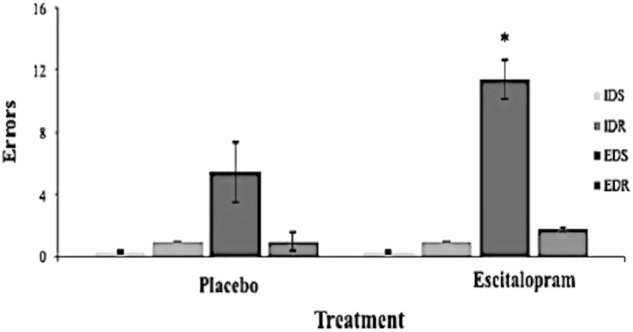
- Acute escitalopram impaired cognitive flexibility on the CANTAB ID/ED task: there was a significant stage-by-treatment effect (p = 0.026, F(3,52) = 3.339, partial η² = 0.162), and the escitalopram group made more EDS errors (mean 11.4, SD 10.49) than placebo (mean 5.43, SD 6.93), p = 0.014, F(1,56) = 6.449, partial η² = 0.103; EDS responding was also slower (p = 0.026).
- Acute escitalopram improved response inhibition: it significantly reduced stop-signal reaction time (SSRT), p = 0.013, t(62) = −2.550, without significant changes in other response-inhibition measures.
- Emotional processing was largely unaffected: acute escitalopram did not alter affective bias in the three emotional tasks, but increased the proportion of facts chosen in the EMOTICOM social information preference task (p = 0.017, t = 2.451, partial η² = 0.095).
Methods
- Double-blind, placebo-controlled, parallel-groups study in healthy volunteers; participants received acute escitalopram 20 mg (equivalent to 40 mg racemic citalopram) or placebo, with neuropsychological testing starting 3 h after pill administration. Overall, 65 healthy volunteers completed testing (placebo N = 33, escitalopram N = 32); groups were matched demographically and on baseline mood.
- Cognitive battery included a probabilistic reversal learning task, the CANTAB intra-dimensional/extra-dimensional set shift task, an integrated Stop-signal/No-Go response inhibition task, and emotional processing tasks (EMOTICOM face affective Go/No-Go, CANTAB affective Go/No-Go, EMOTICOM social information preference). Mood state and personality questionnaires included BDI and STAI.
- Analyses used SPSS v23 with chi-square tests, two-tailed t tests, and ANOVAs; Benjamini–Hochberg false discovery rate control was applied across all hypotheses at q < 0.15, giving a corrected significance level of 0.018.
Limitations
- The paper states that only one dose of escitalopram was used, although it was the clinically highest allowed dose and higher acute doses were precluded by ethical considerations; a sub-chronic study was said to be urgently indicated to determine whether acute effects persist or reverse.
- The paper states that a between-group design was used because of practice effects confounding crossover designs, though groups were well matched; many cognitive and emotional tests were administered, but false discovery rate was controlled across the battery.
- The text makes evident that sample sizes varied across task analyses due to exclusions/outliers, and the authors note that behavioural measures of emotional processing were somewhat insensitive to acute SSRI treatment; they also note that the dose produced plasma levels comparable with the lower end of the clinical range, and direct comparison with prior studies was not possible because plasma levels were not routinely reported.
Model-written summary. Check it against the paper before relying on it.
Integrity signals
Registry
Cites
Statistics
Figures
Verification
Claims the paper makes
5 Valid · 1 Not valid · 9 Not checked · 42 Own results and interpretations
At least one cited source doesn’t support this claim or points to a different paper, and none confirmed it — see the verdicts below.
In the paper
“We administered escitalopram 20 mg, equivalent to 40 mg of the racemic compound citalopram [17]”
§ Dissociable effects of acute SSRI (escitalopram) on executive, learning and emotional functions in healthy humans > Materials and methods > Study design
What the sources say
- Disputedcites [17] Hayasaka Y Purgato M Magni LR Ogawa Y Takeshima N Cipriani A Dose equivalents of antidepressants: Evidence-based recommendations from randomized controlled trials J Affect Disord 2015 180 179 84 10.1016/j.jad.2015.03.021 25911132 sourceExperimental — accuracy not yet measured
The Results (3.1 Included studies) state explicitly that 'We found no study of amineptine, amisulpride, citalopram, milnacipran, nomifensine, phenelzine, pramipexole, tianeptine, or trimipramine', so citalopram is absent from the paper's dose-equivalence estimates altogether. All equivalences the paper reports are anchored to fluoxetine 40 mg/day (Discussion; 3.2 Primary analysis; 2.7 Statistical analysis), and the paper gives no escitalopram-to-citalopram ratio; escitalopram's supporting evidence is moreover rated below high/moderate (Discussion; 3.4). The only places 'Citalopram 20-40 mg/day' and 'Escitalopram 10-20 mg/day' appear together (2.4 Comparators) are a priori dose ranges borrowed from FDA/MHRA/EMA labels and Gartlehner et al. (2011) used to select trials, not an equivalence finding. (LLM, conf=0.70)
Checked by a reasoning model — may be wrong.
plain- Asserted: passes — The authors put it forward as true.
- Checkable: passes — It can be checked against evidence.
- Load-bearing: unclear — It is unclear whether the paper’s conclusions depend on it.
- Based: passes — The paper gives a reason why it holds.
- Disputed
The cited sources support only part of this claim — read each source’s verdict below.
In the paper
“depressed humans show deficits in cognitive flexibility [9]”
§ Dissociable effects of acute SSRI (escitalopram) on executive, learning and emotional functions in healthy humans > Introduction
What the sources say
- Partly supportedcites [9] Dickstein DP Finger EC Brotman MA Rich BA Pine DS Blair JR Impaired probabilistic reversal learning in youths with mood and anxiety disorders Psychol Med 2010 40 1089 1100 10.1017/S0033291709991462 19818204 PMC3000432 sourceExperimental — accuracy not yet measured
The Introduction defines reversal learning as a measure of cognitive flexibility. The Discussion reports only a non-significant trend toward impaired probabilistic reversal learning in youths with major depressive disorder (p = 0.07), and no deficit on the non-probabilistic task. The claim presents a tentative, task-specific finding in youths as an established deficit in depressed humans generally. (LLM, conf=0.90)
plainstates an association- Asserted: passes — The authors put it forward as true.
- Checkable: passes — It can be checked against evidence.
- Load-bearing: passes — The paper’s conclusions depend on it.
- Based: passes — The paper gives a reason why it holds.
- Partly supported
The sources with a verdict support this claim; the rest weren’t checked yet, have no full text we could read, or their verdicts aren’t rated yet.
In the paper
“The inhibitory actions of acute escitalopram administration on terminal 5-HT release, through actions at auto-receptors on raphé 5-HT neurons [8], may be analogous to the presumed transient reduction in 5-HT activity caused by ATD [49].”
§ Dissociable effects of acute SSRI (escitalopram) on executive, learning and emotional functions in healthy humans > Discussion > Implications for understanding 5-HT function: comparisons with ATD
What the sources say
- Not checked — no full text of the sourcecites [8] Blier P Serrano A Scatton B Differential responsiveness of the rat dorsal and median raphe 5‐HT systems to 5‐HT1 receptor agonists and p‐chloroamphetamine Synapse 1990 5 120 33 10.1002/syn.890050206 2137943 source
- Supportedcites [49] Young SN Acute tryptophan depletion in humans: a review of theoretical, practical and ethical aspects J Psychiatry & Neurosci: JPN 2013 38 294 10.1503/jpn.120209 23428157 PMC3756112 source
Our copy of Young (2013) is a review devoted to whether ATD transiently reduces 5-HT function, and it concludes in the 'Does ATD lower serotonin function?' section that 'There is good, although not definitive, evidence that ATD can alter serotonin function in some circumstances,' with the Conclusion stating the best evidence is that ATD lowers serotonin function in mood-related contexts. The hedged wording of the citing clause ('presumed transient reduction') matches the review's own caution — the 'Validity of the ATD method' section notes that direct evidence for lowered extracellular serotonin is lacking (van Donkelaar et al.), and the Cerebrovascular changes section treats the ATD session as a ~5- to 7-hour, hence temporary, manipulation. The escitalopram/raphe auto-receptor portion carries a separate citation [8] and is not attributed to this source, so it was not judged here. (LLM, conf=0.85)
hedgedstates a possible cause- Asserted: passes — The authors put it forward as true.
- Checkable: passes — It can be checked against evidence.
- Load-bearing: unclear — It is unclear whether the paper’s conclusions depend on it.
- Based: passes — The paper gives a reason why it holds.
The cited sources support only part of this claim — read each source’s verdict below.
In the paper
“However, the common deficits produced on probabilistic learning and ED-shifting here suggest effects of the drug on neural circuits including the right ventro-lateral PFC (BA47), as both of these tasks are associated with activations of this region [44].”
§ Dissociable effects of acute SSRI (escitalopram) on executive, learning and emotional functions in healthy humans > Discussion > Effects on inhibition and attention control
What the sources say
- Partly supportedcites [44] Cools R Clark L Owen AM Robbins TW Defining the neural mechanisms of probabilistic reversal learning using event-related functional magnetic resonance imaging J Neurosci 2002 22 4563 7 10.1523/JNEUROSCI.22-11-04563.2002 12040063 PMC6758810 sourceExperimental — accuracy not yet measured
The Imaging data section reports right ventrolateral PFC activation during probabilistic reversal learning. The Discussion reports a similar ventrolateral PFC activation during attentional set shifting in Monchi et al., but notes that the shifting effect could not be separated from negative feedback; our copy does not identify the region as BA47. The drug deficits described as occurring “here” are the citing authors’ findings, not findings of this imaging study. (LLM, conf=0.83)
hedgedstates a cause- Asserted: passes — The authors put it forward as true.
- Checkable: passes — It can be checked against evidence.
- Load-bearing: passes — The paper’s conclusions depend on it.
- Based: passes — The paper gives a reason why it holds.
- Partly supported
A result the paper reports from its own data — it cites no other source for it, so there is none to check. The quote shows it is in the paper.
In the paper
“escitalopram significantly reduced SSRT (speeded response inhibition), p = 0.013, t(62) = −2.550”
§ Dissociable effects of acute SSRI (escitalopram) on executive, learning and emotional functions in healthy humans > Results > Biochemical analysis (placebo; N = 29, escitalopram; N = 30)
plainstates a causen = 32- Asserted: passes — The authors put it forward as true.
- Checkable: passes — It can be checked against evidence.
- Load-bearing: passes — The paper’s conclusions depend on it.
- Based: passes — The paper gives a reason why it holds.
28 more claims
Create a free account to see all 57 claims and to verify the 1 reference still open.
- Probably not a substantial claim. 17
- It may state two separate claims as one. 11
Claims other papers make about this one
Each is checked against this paper’s own text: does it say what the citing paper says it does?
The source backs part of the claim, not all of it — or backs it for a different population, condition or comparison.
In the citing paper
“Such an analysis of the Skandali et al. [20] similarly shows reduced reinforcement sensitivity in the escitalopram group compared to placebo controls (unpublished findings).”
From Chronic escitalopram in healthy volunteers has specific effects on reinforcement sensitivity: a double-blind, placebo-controlled semi-randomised study (2023) · cites this paper as [20]
Experimental — accuracy not yet measuredThe cited source says what the claim attributes to it.
In the citing paper
“Some studies suggest that SSRIs have acute or subacute effects on cognition, e.g., affective processing bias [25–27]”
From Effects of escitalopram on synaptic density in the healthy human brain: a randomized controlled trial (2023) · cites this paper as [26]
The cited source says what the claim attributes to it.
In the citing paper
“One study showed that response inhibition improved with SSRI administration [20], whereas another showed no effect [19].”
From Chronic escitalopram in healthy volunteers has specific effects on reinforcement sensitivity: a double-blind, placebo-controlled semi-randomised study (2023) · cites this paper as [20]
The cited source says what the claim attributes to it.
In the citing paper
“Studies examining the acute administration of SSRIs have shown impaired probabilistic learning [19, 20], and impaired cognitive flexibility [20], but increased long-term memory recall [21], emotion recognition [22], and harm aversion for moral judgements [23].”
From Chronic escitalopram in healthy volunteers has specific effects on reinforcement sensitivity: a double-blind, placebo-controlled semi-randomised study (2023) · cites this paper as [20]
The cited source says what the claim attributes to it.
In the citing paper
“Contrasting with the present findings Skandali and colleagues [20], who used similar neuropsychological tests, showed that participants administered escitalopram acutely made more errors to criterion during Stage 1 and exhibited increased lose-shifting after misleading negative feedback in the PRL task.”
From Chronic escitalopram in healthy volunteers has specific effects on reinforcement sensitivity: a double-blind, placebo-controlled semi-randomised study (2023) · cites this paper as [20]
1 more claim about this paper
Create a free account to see every claim other papers make about this one.
Statistics recomputed
Every reported test result, recomputed from its test statistic and degrees of freedom. A result shows as not adding up only once an independent check has confirmed it.
- Consistentz = -2.85reported p = .004 · recomputed p = .004
“z = −2.850, p = .004”
Self-check
Percentages, sums and reported differences re-computed from the paper’s own numbers.
Each contradiction between two passages listed here was confirmed by an independent check.
Rated minor: it would not touch a result — a value no result rests on, a p-value that stays on the same side of the significance level, or a conflict that is clerical, resolved elsewhere in the paper, or outside its own findings.
In the paper
§ Dissociable effects of acute SSRI (escitalopram) on executive, learning and emotional functions in healthy humans > Results > Biochemical analysis (placebo; N = 29, escitalopram; N = 30)
“F(1,62) = 4.834”
§ Dissociable effects of acute SSRI (escitalopram) on executive, learning and emotional functions in healthy humans > Results > Biochemical analysis (placebo; N = 29, escitalopram; N = 30)
“partial η2 = 0.72”
Citations
Cites
Controlling the False Discovery Rate: A Practical and Powerful Approach to Multiple Testing
Benjamini, Y., & Hochberg, Y. (1995) · Journal of the Royal Statistical Society Series B: Statistical Methodology · doi:10.1111/j.2517-6161.1995.tb02031.x · Cited by 109,482
(1970) · Cited by 24,983
(1998) · PubMed · Cited by 10,216
Thresholding of statistical maps in functional neuroimaging using the false discovery rate
Genovese, C. R., Lazar, N. A., & Nichols, T. (2002) · NeuroImage · doi:10.1006/nimg.2001.1037 · Cited by 4,923
State-Trait Anxiety Inventory for Adults
Spielberger, C. D. (2012) · PsycTESTS Dataset · doi:10.1037/t06496-000 · Cited by 3,479
Depression: Causes and treatment
(1973) · Behavior Therapy · doi:10.1016/s0005-7894(73)80054-1 · Cited by 3,152
Research Methods in Psychology
(2016) · doi:10.24926/8668.2201 · Cited by 1,492
Not All Executive Functions Are Related to Intelligence
Friedman, N. P., Miyake, A., Corley, R. P., Young, S. E., DeFries, J. C., & Hewitt, J. K. (2006) · Psychological Science · doi:10.1111/j.1467-9280.2006.01681.x · Cited by 1,293
Computerized assessment in neuropsychiatry using CANTAB: discussion paper.
Sahakian, B. J., & Owen, A. M. (1992) · Europe PMC (PubMed Central) · Cited by 802
Self-citationCools, R., Clark, L., Owen, A. M., & Robbins, T. W. (2002) · The Journal of Neuroscience · doi:10.1523/jneurosci.22-11-04563.2002 · Cited by 784
Self-citation
Cited by
Serotonin neurons modulate learning rate through uncertainty
Grossman, C. D., Bari, B. A., & Cohen, J. Y. (2022) · Current Biology · doi:10.1016/j.cub.2021.12.006 · Cited by 164
Kanen, J. W., Ersche, K. D., Fineberg, N. A., Robbins, T. W., & Cardinal, R. N. (2019) · Psychopharmacology · doi:10.1007/s00213-019-05325-w · Cited by 101
Self-citationRoberts, C., Sahakian, B. J., & Robbins, T. W. (2020) · Neuroscience & Biobehavioral Reviews · doi:10.1016/j.neubiorev.2020.09.001 · Cited by 67
Self-citationLangley, C., Armand, S., Luo, Q., Savulich, G., Segerberg, T., Søndergaard, A., Pedersen, E. B., Svart, N., Overgaard-Hansen, O., Johansen, A., et al. (2023) · Neuropsychopharmacology · doi:10.1038/s41386-022-01523-x · Cited by 58
Self-citationJohansen, A., Armand, S., Plavén-Sigray, P., Nasser, A., Ozenne, B., Petersen, I. N., Keller, S. H., Madsen, J., Beliveau, V., Møller, K., et al. (2023) · Molecular Psychiatry · doi:10.1038/s41380-023-02285-8 · Cited by 53
Self-citationEscitalopram increases synaptic density in the human brain over weeks: A randomized controlled trial
(2023) · doi:10.21203/rs.3.rs-2989150/v1 · Cited by 53
Self-citationTransdiagnostic computations of uncertainty: towards a new lens on intolerance of uncertainty
Sandhu, T. R., Xiao, B., & Lawson, R. P. (2023) · Neuroscience & Biobehavioral Reviews · doi:10.1016/j.neubiorev.2023.105123 · Cited by 51
Kanen, J. W., Arntz, F. E., Yellowlees, R., Cardinal, R. N., Price, A., Christmas, D. M., Apergis-Schoute, A. M., Sahakian, B. J., & Robbins, T. W. (2021) · Translational Psychiatry · doi:10.1038/s41398-020-00880-9 · Cited by 50
Self-citation(2019) · doi:10.1101/789669 · Cited by 50
Self-citationEffect of lysergic acid diethylamide (LSD) on reinforcement learning in humans
Kanen, J. W., Luo, Q., Kandroodi, M. R., Cardinal, R. N., Robbins, T. W., Nutt, D. J., Carhart-Harris, R. L., & den Ouden, H. E. M. (2022) · Psychological Medicine · doi:10.1017/s0033291722002963 · Cited by 51
Self-citationThe Role of Tryptophan and Tyrosine in Executive Function and Reward Processing
Aquili, L. (2020) · International Journal of Tryptophan Research · doi:10.1177/1178646920964825 · Cited by 48
Müller, F., Holze, F., Dolder, P., Ley, L., Vizeli, P., Soltermann, A., Liechti, M. E., & Borgwardt, S. (2021) · Neuropsychopharmacology · doi:10.1038/s41386-020-00906-2 · Cited by 38
Serotonin modulates asymmetric learning from reward and punishment in healthy human volunteers
Michely, J., Eldar, E., Erdman, A., Martin, I. M., & Dolan, R. J. (2022) · Communications Biology · doi:10.1038/s42003-022-03690-5 · Cited by 43
Behavioral measures of impulsivity and compulsivity in adolescents with nonsuicidal self-injury
Lutz, N. M., Chamberlain, S. R., Goodyer, I. M., Bhardwaj, A., Sahakian, B. J., Jones, P. B., & Wilkinson, P. O. (2021) · CNS Spectrums · doi:10.1017/s1092852921000274 · Cited by 39
Self-citationImpact of specific serotonin receptor modulation on behavioral flexibility
Alvarez, B. D., Morales, C. A., & Amodeo, D. A. (2021) · Pharmacology Biochemistry and Behavior · doi:10.1016/j.pbb.2021.173243 · Cited by 39
Neuromolecular Underpinnings of Negative Cognitive Bias in Depression
Noworyta, K., Cieslik-Starkiewicz, A., & Ryguła, R. (2021) · Cells · doi:10.3390/cells10113157 · Cited by 40
Neuroplastic effects of a selective serotonin reuptake inhibitor in relearning and retrieval
Reed, M. B., Vanicek, T., Seiger, R., Klöbl, M., Spurny‐Dworak, B., Handschuh, P. A., Ritter, V., Unterholzner, J., Godbersen, G. M., Gryglewski, G., et al. (2021) · NeuroImage · doi:10.1016/j.neuroimage.2021.118039 · Cited by 35
Serotonin depletion impairs both Pavlovian and instrumental reversal learning in healthy humans
(2020) · doi:10.1101/2020.04.26.062463 · Cited by 34
Self-citationAlsiö, J., Lehmann, O., McKenzie, C., Theobald, D. E. H., Searle, L. R., Xia, J., Dalley, J. W., & Robbins, T. W. (2020) · Cerebral Cortex · doi:10.1093/cercor/bhaa277 · Cited by 31
Self-citationSerotonin depletion impairs both Pavlovian and instrumental reversal learning in healthy humans
Kanen, J. W., Apergis-Schoute, A. M., Yellowlees, R., Arntz, F. E., van der Flier, F. E., Price, A., Cardinal, R. N., Christmas, D. M., Clark, L., Sahakian, B. J., et al. (2021) · Molecular Psychiatry · doi:10.1038/s41380-021-01240-9 · Cited by 34
Self-citationYan, H., Shan, X., Li, H., Liu, F., & Guo, W. (2022) · Journal of Affective Disorders · doi:10.1016/j.jad.2022.04.125 · Cited by 34
Anxiety disorders and executive functions: A three-level meta-analysis of reaction time and accuracy
Majeed, N. M., Chua, Y. J., Kothari, M., Kaur, M., Quek, F. Y. X., Ng, M. H. S., Ng, W. Q., & Hartanto, A. (2023) · Psychiatry Research Communications · doi:10.1016/j.psycom.2022.100100 · Cited by 31
Luo, Q., Kanen, J. W., Bari, A., Skandali, N., Langley, C., Knudsen, G. M., Alsiö, J., Phillips, B. U., Sahakian, B. J., Cardinal, R. N., et al. (2023) · Neuropsychopharmacology · doi:10.1038/s41386-023-01762-6 · Cited by 29
Self-citationApergis-Schoute, A. M., van der Flier, F. E., Ip, S. H. Y., Kanen, J. W., Vaghi, M. M., Fineberg, N. A., Sahakian, B. J., Cardinal, R. N., & Robbins, T. W. (2024) · Biological Psychiatry Global Open Science · doi:10.1016/j.bpsgos.2023.06.004 · Cited by 25
Self-citationComputational psychopharmacology: a translational and pragmatic approach
Robbins, T. W., & Cardinal, R. N. (2019) · Psychopharmacology · doi:10.1007/s00213-019-05302-3 · Cited by 25
“Skandali et al. (2018) recently followed up these findings in a similar group of volunteers to show increased shifting in response to negative feedback.”
Self-citationTeichert, J., Rowe, J. B., Ersche, K. D., Skandali, N., Sacher, J., Aigner, A. M., & Regenthal, R. (2020) · International Journal of Clinical Pharmacology and Therapeutics · doi:10.5414/cp203705 · Cited by 24
Self-citationSchachar, R. J. (2023) · Neuroscience & Biobehavioral Reviews · doi:10.1016/j.neubiorev.2023.105461 · Cited by 34
(2021) · doi:10.1016/j.bpsc.2020.12.012 · Cited by 23
Self-citationThe development of cognitive flexibility and its implications for mental health disorders
Tong, K., Fu, X., Hoo, N. P., Kean Mun, L., Vassiliu, C., Langley, C., Sahakian, B. J., & Leong, V. (2024) · Psychological Medicine · doi:10.1017/s0033291724001508 · Cited by 23
Self-citation(2020) · doi:10.1101/2020.04.26.062505 · Cited by 23
Self-citationJalal, B., McNally, R. J., Elias, J. A., Potluri, S., & Ramachandran, V. S. (2020) · Frontiers in Human Neuroscience · doi:10.3389/fnhum.2019.00414 · Cited by 23
Neural Processing of Cognitive Control in an Emotionally Neutral Context in Anxiety Patients
König, N., Steber, S., Borowski, A., Bliem, H. R., & Rossi, S. (2021) · Brain Sciences · doi:10.3390/brainsci11050543 · Cited by 26
Yan, H., Shan, X., Li, H., Liu, F., & Guo, W. (2022) · Frontiers in Cellular Neuroscience · doi:10.3389/fncel.2022.906534 · Cited by 28
Wilkinson, M. P., Grogan, J. P., Mellor, J. R., & Robinson, E. S. J. (2020) · Brain and Neuroscience Advances · doi:10.1177/2398212820907177 · Cited by 23
Alonso, L., Peeva, P., Stasko, S., Bäder, M., Alenina, N. V., Winter, Y., & Rivalan, M. (2023) · iScience · doi:10.1016/j.isci.2023.105998 · Cited by 22
Schmitt, L., Arzuaga, A. L., Dapore, A. E., Duncan, J., Patel, M., Larson, J. R., Erickson, C. A., Sweeney, J. A., & Ragozzino, M. E. (2023) · Frontiers in Behavioral Neuroscience · doi:10.3389/fnbeh.2022.1074682 · Cited by 22
Direct serotonin release in humans shapes aversive learning and inhibition
Colwell, M., Tagomori, H., Shang, F., Cheng, H. I., Wigg, C., Browning, M. D., Cowen, P. J., Murphy, S. E., & Harmer, C. J. (2024) · Nature Communications · doi:10.1038/s41467-024-50394-x · Cited by 28
Schulkens, J. E. M., Deckers, K., Jenniskens, M., Blokland, A., Verhey, F. R. J., & Sobczak, S. (2022) · Journal of Psychopharmacology · doi:10.1177/02698811221080462 · Cited by 18
Aguilar‐Martínez, I. S., Reyes‐Méndez, M. E., Herrera-Zamora, J. M., Osuna‐López, F., Virgen‐Ortiz, A., Mendoza‐Muñoz, N., Góngora-Alfaro, J. L., Moreno-Galindo, E. G., & Alamilla, J. (2020) · Psychopharmacology · doi:10.1007/s00213-020-05528-6 · Cited by 15
Cognitive flexibility in humans and other laboratory animals
Highgate, Q., & Schenk, S. (2020) · Journal of the Royal Society of New Zealand · doi:10.1080/03036758.2020.1784240 · Cited by 23
Emery, S., Häberling, I. S., Berger, G. E., Baumgartner, N., Strumberger, M. A., Albermann, M., Nalani, K., Schmeck, K., Erb, S., Bachmann, S., et al. (2020) · Nutrients · doi:10.3390/nu12123630 · Cited by 17
Joodaki, M., Radahmadi, M., & Alaei, H. (2021) · Malaysian Journal of Medical Sciences · doi:10.21315/mjms2021.28.4.6 · Cited by 16
Effect of lysergic acid diethylamide (LSD) on reinforcement learning in humans
(2020) · doi:10.1101/2020.12.04.412189 · Cited by 14
Self-citationExploring response inhibition and error monitoring in obsessive-compulsive disorder
Silveira, V. P., Frydman, I., Fontenelle, L. F., Mattos, P., de Oliveira-Souza, R., Moll, J., Hoexter, M. Q., Miguel, E. C., McLaughlin, N. C. R., Shephard, E., et al. (2020) · Journal of Psychiatric Research · doi:10.1016/j.jpsychires.2020.04.002 · Cited by 13
“, 2015), medication (Skandali et al., 2018), depression (Snyder et al.”
Technology in the Assessment, Treatment, and Management of Depression
Bader, C. S., Skurla, M. D., & Vahia, I. V. (2020) · Harvard Review of Psychiatry · doi:10.1097/hrp.0000000000000235 · Cited by 12
Feng, Y.-Y., Bromberg-Martin, E. S., & Monosov, I. E. (2024) · Cell Reports · doi:10.1016/j.celrep.2024.114341 · Cited by 21
A single oral dose of citalopram increases interoceptive insight in healthy volunteers
Livermore, J. J. A., Holmes, C. L., Moga, G., Adamatzky, K., Critchley, H., Garfinkel, S. N., & Campbell-Meiklejohn, D. K. (2022) · Psychopharmacology · doi:10.1007/s00213-022-06115-7 · Cited by 20
Lewis, C. A., Mueller, K., Zsido, R. G., Reinelt, J. D., Regenthal, R., Okon‐Singer, H., Forbes, E. E., Villringer, A., & Sacher, J. (2021) · Journal of Psychiatry and Neuroscience · doi:10.1503/jpn.200121 · Cited by 11
Self-citationSSRIs modulate asymmetric learning from reward and punishmentPreprint
Michely, J., Eldar, E., Erdman, A., Martin, I. M., & Dolan, R. J. (2020) · bioRxiv (Cold Spring Harbor Laboratory) · doi:10.1101/2020.05.21.108266 · Cited by 9
Schachar, R. J., Dupuis, A., Anagnostou, E. A., Georgiades, S., Soreni, N., Arnold, P. D., Burton, C. L., & Crosbie, J. (2021) · Journal of Child Psychology and Psychiatry · doi:10.1111/jcpp.13533 · Cited by 13
Kanen, J. W., Arntz, F. E., Yellowlees, R., Cardinal, R. N., Price, A. C., Christmas, D. M. B., Sahakian, B. J., Apergis-Schoute, A. M., & Robbins, T. W. (2020) · Journal of Psychopharmacology · doi:10.1177/0269881120907991 · Cited by 13
Self-citationBîlc, M. I., Iacob, A., Szekely‐Copîndean, R. D., Kiss, B., Ștefan, M.-G., Muresan, R. C., Pop, C. F., Pițur, S., Szentágotai-Tătar, A., Vulturar, R., et al. (2023) · Cognitive Affective & Behavioral Neuroscience · doi:10.3758/s13415-023-01116-1 · Cited by 14
Noworyta, K., & Ryguła, R. (2021) · European Neuropsychopharmacology · doi:10.1016/j.euroneuro.2020.12.004 · Cited by 9
Marghmaleki, V. S., Radahmadi, M., Alaei, H., & Khanahmad, H. (2024) · Brain Sciences · doi:10.3390/brainsci14050420 · Cited by 8
Reid, J. E., Pellegrini, L., Drummond, L. M., Varlakova, Y., Shahper, S., Baldwin, D. S., Manson, C., Chamberlain, S. R., Robbins, T. W., Wellsted, D. M., et al. (2024) · International Clinical Psychopharmacology · doi:10.1097/yic.0000000000000548 · Cited by 8
Self-citationSelective effects of serotonin on choices to gather more information
Livermore, J. J. A., Holmes, C. L., Cutler, J., Levstek, M., Moga, G., Brittain, J. R., & Campbell-Meiklejohn, D. K. (2021) · Journal of Psychopharmacology · doi:10.1177/0269881121991571 · Cited by 7
Löchner, C., Chamberlain, S. R., Kidd, M., Taljaard, L., Fineberg, N. A., Robbins, T. W., & Stein, D. J. (2020) · Psychopharmacology · doi:10.1007/s00213-020-05597-7 · Cited by 8
Self-citationKloft, L., Riesel, A., & Kathmann, N. (2019) · Experimental Brain Research · doi:10.1007/s00221-019-05688-8 · Cited by 8
Dorsal raphe neurons signal integrated value during multi-attribute decision-makingPreprint
Feng, Y.-Y., Bromberg-Martin, E. S., & Monosov, I. E. (2023) · bioRxiv (Cold Spring Harbor Laboratory) · doi:10.1101/2023.08.17.553745 · Cited by 6
A cognitive neuroscience approach to understanding aggression and its treatment
Blair, J., Habel, U., Votinov, M., Wagels, L., & Denson, T. F. (2025) · Neuroscience & Biobehavioral Reviews · doi:10.1016/j.neubiorev.2025.106386 · Cited by 11
Executive functioning in Chinese patients with obsessive compulsive disorder
Ren, H., Li, H., Huang, J., Zhang, N., Chen, R., Liu, W., Zhang, Z., & Zhang, C. (2021) · Frontiers in Psychiatry · doi:10.3389/fpsyt.2021.662449 · Cited by 5
“For example, our OCD group mainly consisted of patients who were taking SSRIs at the time of testing, which may have improved their cognitive performance (22).”
Hook, R. W., Isobe, M., Savulich, G., Grant, J. E., Ioannidis, K., Christmas, D. M. B., Sahakian, B. J., Robbins, T. W., & Chamberlain, S. R. (2023) · European Neuropsychopharmacology · doi:10.1016/j.euroneuro.2023.03.006 · Cited by 4
Self-citationSolomon, M. B., Yegla, B., Newcorn, J. H., Maletic, V., Rubin, J. S., & Robbins, T. W. (2025) · Clinical Drug Investigation · doi:10.1007/s40261-025-01473-4 · Cited by 11
Self-citationPoulin, J. M., Bigford, G. E., Lanctôt, K. L., Giacobbe, P., Schaffer, A., Sinyor, M., Rabin, J. S., Masellis, M., Singnurkar, A., Pople, C. B., et al. (2024) · Trials · doi:10.1186/s13063-024-08268-6 · Cited by 7
Common roles for serotonin in rats and humans for computations underlying flexible decision-makingPreprint
Luo, Q., Kanen, J. W., Bari, A., Skandali, N., Langley, C., Knudsen, G. M., Alsiö, J., Phillips, B. U., Sahakian, B. J., Cardinal, R. N., et al. (2023) · bioRxiv (Cold Spring Harbor Laboratory) · doi:10.1101/2023.02.15.527569 · Cited by 4
Self-citationSurówka, P., Noworyta, K., Smaga, I., Filip, M., & Ryguła, R. (2023) · Frontiers in Molecular Neuroscience · doi:10.3389/fnmol.2023.1092864 · Cited by 2
Effect of cognitive retraining treatment in mild to moderate depressive disorders
Gupta, A., & Kumari, S. (2023) · Psicologia Reflexão e Crítica · doi:10.1186/s41155-023-00269-9 · Cited by 5
Lievesley, R. (2019) · Nottingham Trent University's Institutional Repository (Nottingham Trent Repository) · Cited by 5
Langley, C., Murray, G. K., Armand, S., Knolle, F., Cardinal, R. N., Johansen, A., Jensen, P. S., Feng, J., Stenbæk, D. S., Knudsen, G. M., et al. (2025) · Translational Psychiatry · doi:10.1038/s41398-025-03392-6 · Cited by 5
Self-citationKanen, J. W., Luo, Q., Yellowlees, R., Arntz, F. E., Christmas, D. M. B., Sahakian, B. J., Apergis-Schoute, A. M., Cardinal, R. N., & Robbins, T. W. (2021) · bioRxiv (Cold Spring Harbor Laboratory) · doi:10.1101/2021.04.05.437619 · Cited by 2
Self-citationSerotonin reduces belief stickiness
Conceição, V. A., Petzschner, F. H., Cole, D. M., Wellstein, K. V., Müller, D., Raman, S., & Maia, T. V. (2026) · Nature Mental Health · doi:10.1038/s44220-026-00621-9 · Cited by 4
Exercise, the Elixir for Learning
Baloh, R. W. (2022) · Springer eBooks · doi:10.1007/978-3-031-13924-6_5 · Cited by 1
“Vicarious exposure”: “Spooky action” at a distance in obsessive-compulsive disorder
Jalal, B., McNally, R. J., Elias, J. A., & Ramachandran, V. S. (2020) · Journal of Obsessive-Compulsive and Related Disorders · doi:10.1016/j.jocrd.2020.100606 · Cited by 2
Poulin, J. M., Bigford, G. E., Lanctôt, K. L., Giacobbe, P., Schaffer, A., Sinyor, M., Rabin, J. S., Masellis, M., Singnurkar, A., Pople, C. B., et al. (2023) · Research Square · doi:10.21203/rs.3.rs-3474764/v1 · Cited by 1
A computational lens on the transdiagnostic nature of intolerance of uncertaintyPreprint
Sandhu, T., Xiao, B., & Lawson, R. P. (2022) · doi:10.31234/osf.io/eug64
Thrombocytopenia due to escitalopram use – A rare case report at the emergency department
Bedel, C., & Korkut, M. (2021) · Iraqi Journal of Hematology · doi:10.4103/ijh.ijh_47_20 · Cited by 1
Larsen, K. M., Uhre, V., Labanauskas, V., Madsen, K. H., Nejad, A. B., Baaré, W. F. C., Plessen, K. J., Siebner, H. R., & Pagsberg, A. K. (2025) · medRxiv · doi:10.1101/2025.05.09.25327300 · Cited by 1
Neuropsychological Effects of Antidepressants: Translational Studies
Kamenish, K., & Robinson, E. S. J. (2023) · Current topics in behavioral neurosciences · doi:10.1007/7854_2023_446 · Cited by 1
Greenfield, M. S., Wang, Y., Martinsson, L., Li, T., & Msghina, M. (2025) · Psychopharmacology · doi:10.1007/s00213-025-06835-6 · Cited by 2
Anxiety disorders and executive functions: A three-level meta-analysis of reaction time and accuracyPreprint
Majeed, N. M., Chua, Y. J., Kothari, M., Kaur, M., Quek, F. Y. X., Ng, M. H. S., Ng, W. Q., & Hartanto, A. (2023) · PsyArXiv (OSF Preprints) · doi:10.31234/osf.io/2w87x · Cited by 1
Basch, R., Cohen, M., & Peled‐Avron, L. (2026) · medRxiv · doi:10.64898/2026.06.18.26355974
Li, P. (2026) · Health Economics · doi:10.2139/ssrn.5265767
Beinhölzl, N., Molloy, E. N., Zsido, R. G., Richter, T., Piecha, F. A., Zheleva, G., Scharrer, U., Regenthal, R., Villringer, A., Okon‐Singer, H., et al. (2022) · Frontiers in Neuroscience · doi:10.3389/fnins.2022.809269 · Cited by 1
Self-citationLievesley, R., Hocken, K., Winder, B., Norman, C., & Kaul, A. (2026) · Sexual Abuse · doi:10.1177/10790632261460849
Rescuing behavioral flexibility in a mouse model for OCD by enhancing reward-cue saliencePreprint
van den Boom, B. J. G., Carlo, S. D., van Klaveren, J., Denys, D. A. J. P., & Willuhn, I. (2024) · bioRxiv (Cold Spring Harbor Laboratory) · doi:10.1101/2024.07.25.604103 · Cited by 1
Evaluation of risky decision-making and impulsivity in individuals with premature ejaculation
Aksu, S., Harun, B. A. L., Akarken, İ., Deliktaş, H., & Şahin, H. (2023) · Konuralp Tıp Dergisi · doi:10.18521/ktd.1359309
Baccarin, M. (2020) · Digital Library of Theses and Dissertations (Universidade de São Paulo) · doi:10.11606/t.75.2020.tde-13122019-171207
Ekici, Ö., & Söylemez, E. S. A. (2024) · CRANIO® · doi:10.1080/08869634.2024.2369729 · Cited by 1
The link between learning performance, immobility in the forced swim test, and hippocampal glia
Ozcan, T. S., Sara, Y., Arıkan, K. B., Ünal, B., & Ünal, Ç. T. (2022) · Experimental Biomedical Research · doi:10.30714/j-ebr.2022173848
Sysoeva, O., Akhmirov, R., Zaichenko, M. I., Lazarenko, I., Rebik, A., Broshevitskaya, N. D., Midzyanovskaya, I. S., & Smirnov, K. (2025) · Diagnostics · doi:10.3390/diagnostics15020151
Monoaminergic modulation of the relation between motor cortical activity and grip force
Powell, R. H., Ma, X., Bodkin, K. L., & Miller, L. E. (2026) · Journal of Neurophysiology · doi:10.1152/jn.00322.2025
Caldirola, D., Donatis, D. D., Alciati, A., Daccò, S., & Perna, G. (2023) · Expert Review of Neurotherapeutics · doi:10.1080/14737175.2023.2254938
Wu, L. C., Segal, Z. V., & Farb, N. A. S. (2025) · Journal of Affective Disorders · doi:10.1016/j.jad.2025.03.106 · Cited by 2
Metadata
- Authors
- Skandali, N., Rowe, J. B., Voon, V., Deakin, J. B., Cardinal, R. N., Cormack, F., Passamonti, L., Bevan-Jones, W. R., Regenthal, R., Chamberlain, S. R., Robbins, T. W., & Sahakian, B. J.
- Affiliations
- University of Cambridge (GB)
- Cambridge Cognition (United Kingdom) (GB)
- Leipzig University (DE)
- Corresponding author
- Skandali, Nikolina
- ORCID
- Venue
- Neuropsychopharmacology
- Published
- 2018-09-26
- Volume
- 43
- Issue
- 13
- Pages
- 2645-2651
- ISSN
- 0893-133X (ISSN-L)
- 1740-634X
- PMC
- PMC6224451
- OpenAlex
- W2892955830
- Semantic Scholar
- 1e0dedf322dfdd3ce3bf5694dad67069ef0319be
- Cited by
- 89
- References
- 59
- Citations by year
- 2026: 5 · 2025: 7 · 2024: 8 · 2023: 20 · 2022: 10 · 2021: 18 · 2020: 17 · 2019: 4
- FWCI
- 4.44
- Type
- journal article
- Language
- en
- Open access
- hybrid
- doi.org
- Licence
- cc-by
- creativecommons.org/licenses/by/4.0 (tdm)
- Locations
- Neuropsychopharmacology (publishedVersion, cc-by)
- Europe PMC (PubMed Central) (publishedVersion, other-oa)
- PubMed Central (publishedVersion, cc-by)
- PubMed (publishedVersion)
- ePrints Soton (University of Southampton) (submittedVersion)
- Apollo (University of Cambridge) (submittedVersion, cc-by)
- Apollo (cc-by)
- Funders
- James S. McDonnell Foundation
- Eli Lilly and Company
- Wellcome Trust (103838/Z/14/Z, 103838, MR/P008747/1, 110,049/Z/15/Z, 104631/Z/14/Z, /Z/15/Z, 110049, 104631)
- National Institute for Health and Care Research (MR/P008747/1, 103838)
- Shionogi
- Bundesministerium für Wirtschaft und Energie
- H. Lundbeck A/S
- Medical Research Council (MR/P01271X/1, MC_PC_17213, MR/M024873/1, MR/P008747/1, MR/M009041/1)
- NIHR Cambridge Biomedical Research Centre (MR/P008747/1)
- Topics
- Life Sciences › Neuroscience › Cellular and Molecular Neuroscience › Neurotransmitter Receptor Influence on Behavior
- Life Sciences › Neuroscience › Cognitive Neuroscience › Neural and Behavioral Psychology Studies
- Health Sciences › Medicine › Pharmacology (medical) › Treatment of Major Depression
- Keywords
- escitalopram, selective serotonin reuptake inhibitors, acute drug effects, executive function, cognitive flexibility, reversal learning, probabilistic learning, response inhibition, stop-signal task, emotional processing, serotonin, cognitive impairment
- MeSH terms
- Adult, Cognition, Dissociative Disorders, Double-Blind Method, Emotions, Female, Humans, Male, Reversal Learning, Citalopram, Selective Serotonin Reuptake Inhibitors, Young Adult, Executive Function
About these checks
Registry, retraction, Cites and statistics results are computed, not judged, with one exception: a printed reference that no index lists is read once by a model before it counts as a citation error. Claims are extracted by a model and kept only when their quote appears verbatim in the text; each cited source is then checked, with a model’s help, for whether it says what the claim relies on. Those verdicts can be wrong — read the claim’s quote and the cited source before relying on one.
The claim verdicts this report counts are experimental: their accuracy is not yet measured.
A language model drew the claims from the paper on 2026-10-10, under version 3 of the claim definition (model deepseek-v4.1-flash, prompt extract-v3).
A second model labelled each claim on 2026-10-10 (model jev-1.13-20260917, definition revision gold-guideline-v0.2).
Cited sources are checked with a language model’s help (qwen3.8-omni-flash and gpt-6-sol).
Statistics and arithmetic are recomputed, not judged.
Confidence bands are shown only for fields calibrated on our annotated test set. None is calibrated yet, so no band is shown.
What counts as a claim ›How we measure confidence ›How we check this ›
Are you an author, or do you see a problem with this page? Request a review
Data sources
Bibliographic data: Semantic Scholar, OpenAlex, Crossref.
Contains information from the Semantic Scholar Academic Graph Datasets, made available under the ODC Attribution License (ODC-BY 1.0).
Semantic Scholar’s data is described in: Kinney, R., et al. (2023). The Semantic Scholar Open Data Platform. arXiv:2301.10140.
