

The cycling brain: menstrual cycle related fluctuations in hippocampal and fronto-striatal activation and connectivity during cognitive tasks
Open accessThe DOI matches its Crossref record; 57 of the 58 references it cites were found in a registry or an index.
Abstract
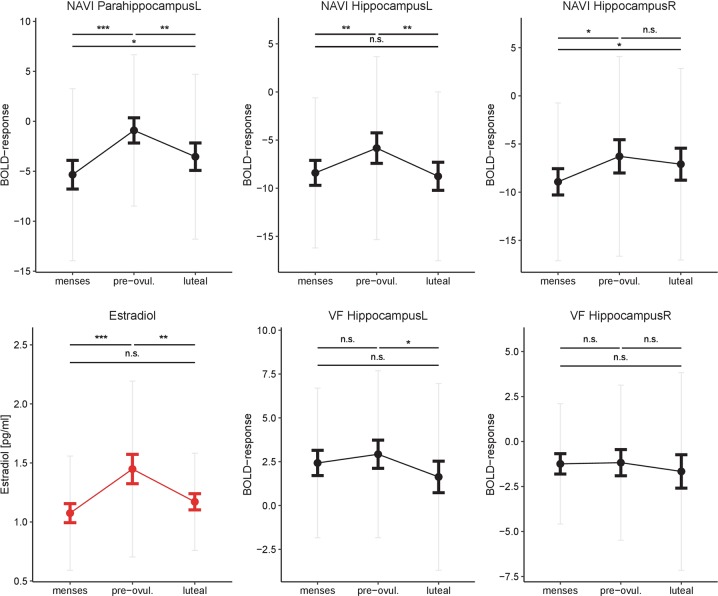
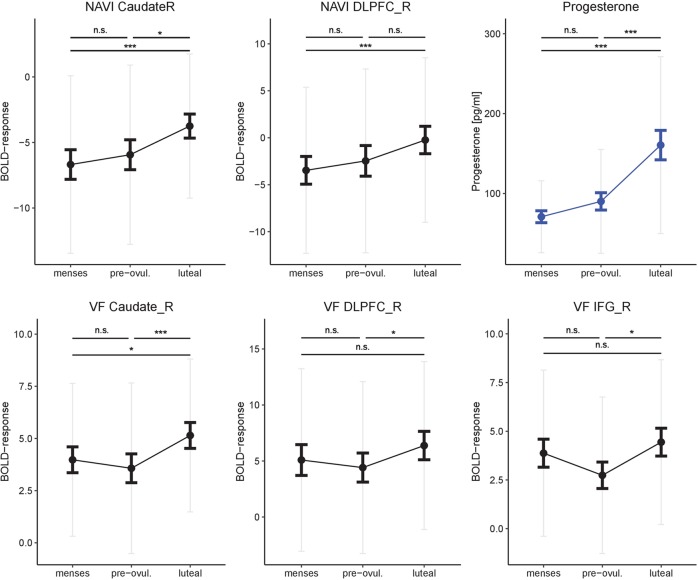
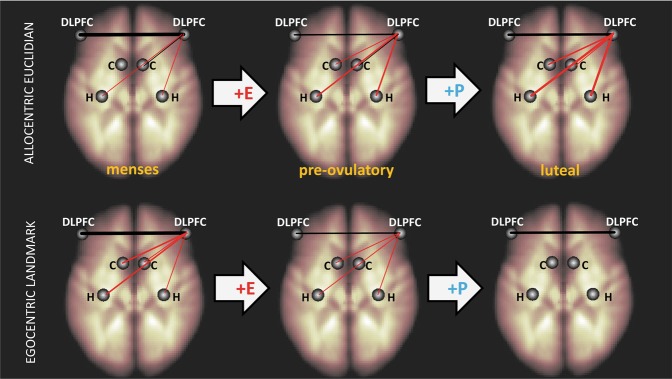
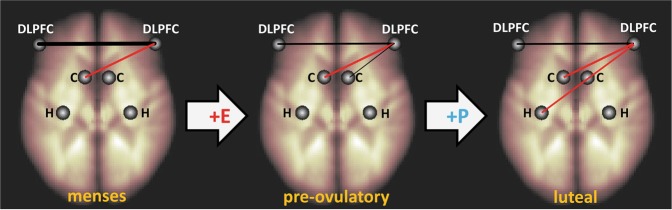
Estradiol and progesterone vary along the menstrual cycle and exert opposite effects on a variety of neurotransmitter systems. However, few studies have addressed menstrual cycle-dependent changes in the brain. In the present study we investigate menstrual cycle changes in brain activation and connectivity patterns underlying cognition. Thirty-six naturally cycling women underwent functional MRI during two cognitive tasks: spatial navigation and verbal fluency. While no significant performance differences were observed along the menstrual cycle, the changes in brain activation patterns are strikingly similar during both tasks. Irrespective of the task, estradiol boosts hippocampal activation during the pre-ovulatory cycle phase and progesterone boosts fronto-striatal activation during the luteal cycle phase. Connectivity analyses suggest that the increase in right-hemispheric frontal activation is the result of inter-hemispheric decoupling and is involved in the down-regulation of hippocampal activation.
Overview
The claims and statistics of this paper haven’t been checked yet.
Free: it reads the open-access text and checks the first 5 claims that cite a source we can check. Create a free account to check every claim.
Integrity signals
Registry
Cites
Statistics
Figures
Verification
Claims the paper makes
The claims and statistics of this paper haven’t been checked yet.
Free: it reads the open-access text and checks the first 5 claims that cite a source we can check. Create a free account to check every claim.
Claims other papers make about this one
Each is checked against this paper’s own text: does it say what the citing paper says it does?
The source backs part of the claim, not all of it — or backs it for a different population, condition or comparison.
In the citing paper
“Modern studies that incorporated functional brain imaging alongside cognitive measures also showed no cycle fluctuations [23,24,35,36].”
From Menstrual cycle effects on cognitive performance: A meta-analysis (2025) · cites this paper as [23]
Experimental — accuracy not yet measuredThe cited source says what the claim attributes to it.
In the citing paper
“both brain structure and functional activation patterns change across the cycle [17,18,23,24]”
From Menstrual cycle effects on cognitive performance: A meta-analysis (2025) · cites this paper as [23]
Self-check
Percentages, sums and reported differences re-computed from the paper’s own numbers.
The self-check needs the paper’s full text.
Citations
Cites
Maldjian, J. A., Laurienti, P. J., Kraft, R. A., & Burdette, J. H. (2003) · NeuroImage · doi:10.1016/s1053-8119(03)00169-1 · Cited by 5,085
Conn : A Functional Connectivity Toolbox for Correlated and Anticorrelated Brain Networks
Whitfield-Gabrieli, S., & Nieto-Castanon, A. (2012) · Brain Connectivity · doi:10.1089/brain.2012.0073 · Cited by 4,885
DPABI: Data Processing & Analysis for (Resting-State) Brain Imaging
Yan, C.-G., Wang, X.-D., Zuo, X.-N., & Zang, Y.-F. (2016) · Neuroinformatics · doi:10.1007/s12021-016-9299-4 · Cited by 3,853
Altered baseline brain activity in children with ADHD revealed by resting-state functional MRI
Yu-Feng, Z., Yong, H., Chao-Zhe, Z., Qing-Jiu, C., Man-Qiu, S., Meng, L., Li-Xia, T., Tian-Zi, J., & Yu-Feng, W. (2007) · Brain and Development · doi:10.1016/j.braindev.2006.07.002 · Cited by 2,660 · cited 1×
“Contrasts were then scaled [42] by dividing the contrast image by the ALFF (amplitude of low frequency oscillations) map [43] obtained from estimation residuals using the Data Processing for Analysis of Brain Imaging (DPABI) toolbox [44] and a band-pass filter of 0.”
MethodTroyer, A. K., Moscovitch, M., & Winocur, G. (1997) · Neuropsychology · doi:10.1037/0894-4105.11.1.138 · Cited by 1,241
Woolley, C., & McEwen, B. (1992) · The Journal of Neuroscience · doi:10.1523/jneurosci.12-07-02549.1992 · Cited by 990
Classical and Bayesian Inference in Neuroimaging: Applications
Friston, K. J., Glaser, D. E., Henson, R. N. A., Kiebel, S., Phillips, C., & Ashburner, J. (2002) · NeuroImage · doi:10.1006/nimg.2002.1091 · Cited by 719
Barth, C., Villringer, A., & Sacher, J. (2015) · Frontiers in Neuroscience · doi:10.3389/fnins.2015.00037 · Cited by 711
Variations in sex-related cognitive abilities across the menstrual cycle
Hampson, E. (1990) · Brain and Cognition · doi:10.1016/0278-2626(90)90058-v · Cited by 571
Menstrual cycle phase modulates reward-related neural function in women
Dreher, J.-C., Schmidt, P. J., Kohn, P., Furman, D., Rubinow, D., & Berman, K. F. (2007) · Proceedings of the National Academy of Sciences · doi:10.1073/pnas.0605569104 · Cited by 567
Research works printed but not linked: 1
- Donohue MC Gamst AC Edland SD Donohue MMC Package ‘longpower’ Biometrics 2013 53 937 47
Cited by
Items 101–118 of 118
Sellers, K. K., & Chang, E. F. (2023) · Studies in neuroscience, psychology and behavioral economics · doi:10.1007/978-3-031-20910-9_52
Maseroli, E., & Vignozzi, L. (2024) · Cambridge University Press eBooks · doi:10.1017/9781108961097.042
Han, X. (2024) · Lecture Notes in Education Psychology and Public Media · doi:10.54254/2753-7048/48/20231549 · Cited by 3
“Another more recent study found that the pattern of the menstrual cycle's effect on brain activation was very similar in both spatial navigation and verbal fluency, and excluded the effect of shifts in cognitive strategies [28].”
BackgroundFriedrich, S., Brodkin, E. S., Derntl, B., Habel, U., & Hüpen, P. (2025) · Frontiers in Psychology · doi:10.3389/fpsyg.2025.1531021
Louis, C. C., & Moser, J. S. (2025) · International Journal of Psychophysiology · doi:10.1016/j.ijpsycho.2025.113204
O'Malley, C., Vine, S. J., Arthur, T., Meléndez‐Torres, G. J., Mitchell, G. L., & Harris, D. (2025) · Physiology & Behavior · doi:10.1016/j.physbeh.2025.115014
“This is surprising, considering that studies with civilian populations have illustrated no additional barriers to exploring the effects of oestrogen concentration changes on cognitive performance compared to other hormones [12,61,62].”
Hormonal Influences on Cognitive Function in Pituitary Neuroendocrine Tumors
Ku, J., Li, H., Bao, J., Dai, X., & Wang, B. (2025) · World Neurosurgery · doi:10.1016/j.wneu.2025.124548 · Cited by 1
del Agua, E., Avila-Varela, D., Hidalgo‐Lopez, E., Dagnino, P. C., Martínez-Marín, M., Acero-Pousa, I., Perl, Y. S., Kringelbach, M. L., Deco, G., Pletzer, B., et al. (2025) · bioRxiv (Cold Spring Harbor Laboratory) · doi:10.64898/2025.12.01.691604
“…menstrual cycle phase decoding relies on distributed, hierarchically organized brain networks and richly interacting cortical and subcortical circuits, consistent with hormone-sensitive modulation of cognitive, attentional, affective, and sensorimotor processes [5, 7, 20, 23, 24, 36, 38, 39].”
Self-citationSerio, G., Pacelli, C., Piccoli, C., Capitanio, N., Cibelli, G., Valenzano, A. A., Landini, F., Carlucci, L., & Palladino, P. (2026) · PLoS ONE · doi:10.1371/journal.pone.0338877
“Typically, the most prominent negative symptoms occur during the first two weeks of ketogenic adaptation [84,85] or after a prolonged period of ketosis that occurs beyond three weeks [1,86].”
Olfactory perception and wellbeing across hormonal contraceptive users and menstrual cycle phases
Gonçalves, P. M. R., de Azevedo, B. C., Fomin, D. S., Galeazzo, R. G., Veiga, C. A., Rezende, N. Q., Siba, I. P., Pascarelli, R. G. B., Dieamant, G., Podgaec, S., et al. (2026) · Frontiers in Human Neuroscience · doi:10.3389/fnhum.2026.1646597
How do menstrual cycle and emotional expressions affect attentional and memory biases?
Ertan, Ö., Gunduz, H., Erdoğan, Ş., Doğan, D., & Baran, Z. (2026) · Current Psychology · doi:10.1007/s12144-025-08617-x
Ribeiro, T. D., Peralta, M., Iglésias, B., Clemente, F. M., Silva, A. F., & Marques, A. (2026) · Performance Enhancement & Health · doi:10.1016/j.peh.2026.100423 · Cited by 1
Structural and Functional Abnormalities in Women With Catamenial Epilepsy
Chen, Y., Ran, M., Zhang, E., Hao, N., Zhao, C., Zhang, H., Ou, Z., Le, Z., Yan, R., Tian, W., et al. (2026) · Acta Neurologica Scandinavica · doi:10.1155/ane/6589710
The influence of sex on cognition in psychosis
Brand, B. A., & McCutcheon, R. A. (2026) · Schizophrenia Research Cognition · doi:10.1016/j.scog.2026.100453
“…(Weber et al., 2014; Wood Alexander et al., 2024; Kuh et al., 2018), but there is also evidence that hormonal changes during the menstrual cycle and peri-natal period impact cognition (Pletzer et al., 2019; Scheuringer and Pletzer, 2017; Pletzer et al., 2018; Younis et al., 2025; Qiu et al., 2021).”
A standardized non-linear approach to studying menstrual cycle effects on brain and behavior
Perović, M., & Mack, M. L. (2026) · Frontiers in Cognition · doi:10.3389/fcogn.2026.1839153
Pohle, C., Büchel, D., Sandbakk, S. B., Sandbakk, Ø., Pletzer, B., & Baumeister, J. (2026) · Women s Health · doi:10.1177/17455057261456871
“Because salivary oestradiol shows ultradian fluctuations across the whole MC, 47 combining the three samples provides a more reliable estimate of mean hormone levels across the experimental session, 48 without compromising the ability to distinguish between MC phases.”
Self-citationBuades‐Rotger, M., Hendricks, R. C., Roncarati, B., Calderón-García, M., Bergmann, K., & Pérez-Cano, F. J. (2026) · Psychological Medicine · doi:10.1017/s0033291726105315
“…phase (early vs late) on most variables are also worth mentioning, as they add to the growing evidence documenting no systematic differences across the menstrual cycle in several measures of affective and cognitive function (Pletzer et al., 2019; Pletzer & Noachtar, 2023; Rafiee et al., 2023).”
Hoffmann, S., Reinhard, I., Mühle, C., Bach, P., Wenger, L., Reichert, D., Boroumand-Jazi, R., Nayman, S., Kuehner, C., Reichl, M., et al. (2026) · Addiction Biology · doi:10.1111/adb.70192
Metadata
- Authors
- Pletzer, B., Harris, T.-A., Scheuringer, A., & Hidalgo-Lopez, E.
- Affiliations
- University of Salzburg (AT)
- Corresponding author
- Pletzer, Belinda
- ORCID
- Pletzer, Belinda
- Venue
- Neuropsychopharmacology
- Published
- 2019-06-13
- Volume
- 44
- Issue
- 11
- Pages
- 1867-1875
- ISSN
- 0893-133X (ISSN-L)
- 1740-634X
- PMC
- PMC6785086
- OpenAlex
- W2950157677
- Cited by
- 118
- References
- 58
- Citations by year
- 2026: 13 · 2025: 18 · 2024: 16 · 2023: 20 · 2022: 15 · 2021: 21 · 2020: 11 · 2019: 4
- FWCI
- 7.41
- Type
- journal article
- Language
- en
- Open access
- hybrid
- doi.org
- Licence
- cc-by
- creativecommons.org/licenses/by/4.0 (tdm)
- creativecommons.org/licenses/by/4.0 (vor)
- Locations
- Neuropsychopharmacology (publishedVersion, cc-by)
- Europe PMC (PubMed Central) (publishedVersion, cc-by)
- PubMed Central (publishedVersion, cc-by)
- PubMed (publishedVersion)
- Funders
- Austrian Science Fund (P28261, W1233)
- Topics
- Life Sciences › Neuroscience › Cognitive Neuroscience › Neural and Behavioral Psychology Studies
- Life Sciences › Biochemistry, Genetics and Molecular Biology › Endocrinology › Estrogen and related hormone effects
- Life Sciences › Neuroscience › Cognitive Neuroscience › Memory and Neural Mechanisms
- Keywords
- menstrual cycle, estradiol, progesterone, hippocampal activation, functional connectivity, spatial navigation, verbal fluency, cognitive performance
- MeSH terms
- Adult, Cognition, Corpus Striatum, Female, Frontal Lobe, Hippocampus, Humans, Magnetic Resonance Imaging, Menstrual Cycle, Nerve Net, Neural Pathways, Neuropsychological Tests, Young Adult, Functional Neuroimaging
About these checks
Registry, retraction, Cites and statistics results are computed, not judged, with one exception: a printed reference that no index lists is read once by a model before it counts as a citation error. Claims are extracted by a model and kept only when their quote appears verbatim in the text; each cited source is then checked, with a model’s help, for whether it says what the claim relies on. Those verdicts can be wrong — read the claim’s quote and the cited source before relying on one.
Statistics and arithmetic are recomputed, not judged.
Confidence bands are shown only for fields calibrated on our annotated test set. None is calibrated yet, so no band is shown.
What counts as a claim ›How we measure confidence ›How we check this ›
Are you an author, or do you see a problem with this page? Request a review
Data sources
Bibliographic data: Semantic Scholar, OpenAlex, Crossref.
Contains information from the Semantic Scholar Academic Graph Datasets, made available under the ODC Attribution License (ODC-BY 1.0).
Semantic Scholar’s data is described in: Kinney, R., et al. (2023). The Semantic Scholar Open Data Platform. arXiv:2301.10140.
