

Direct comparison of the acute effects of lysergic acid diethylamide and psilocybin in a double-blind placebo-controlled study in healthy subjects
Open accessThe DOI matches its Crossref record; 48 of the 50 references it cites were found in a registry or an index.
Abstract
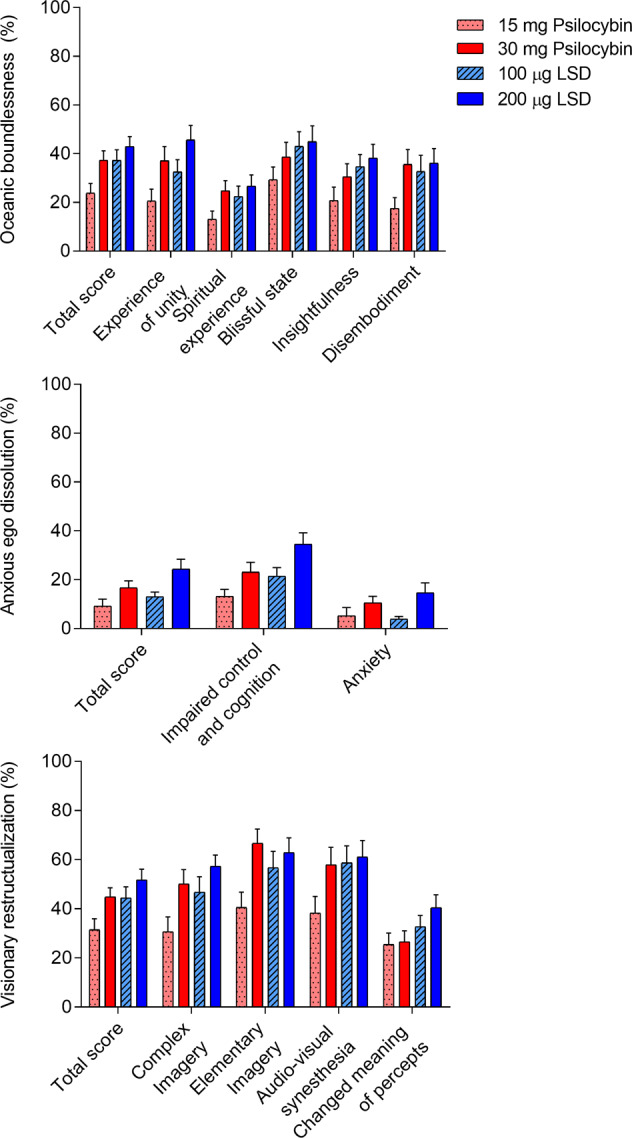
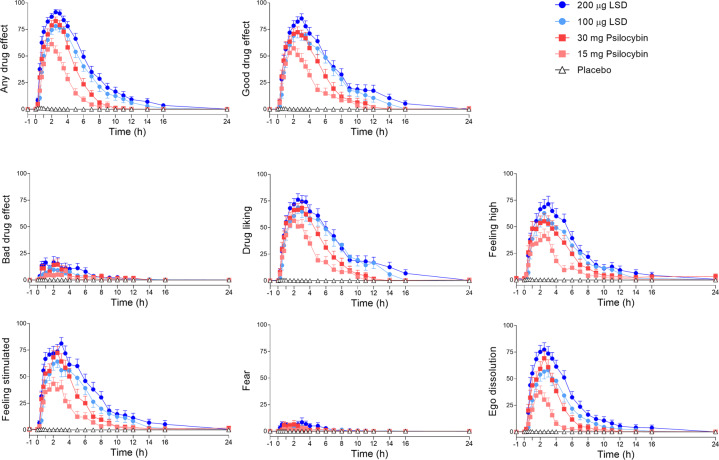
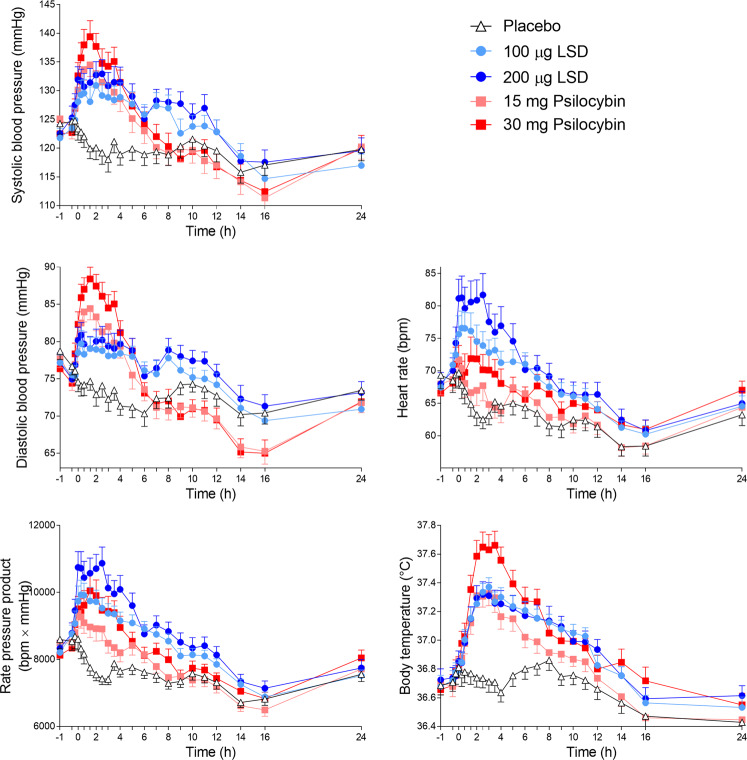
Growing interest has been seen in using lysergic acid diethylamide (LSD) and psilocybin in psychiatric research and therapy. However, no modern studies have evaluated differences in subjective and autonomic effects of LSD and psilocybin or their similarities and dose equivalence. We used a double-blind, randomized, placebo-controlled, crossover design in 28 healthy subjects (14 women, 14 men) who underwent five 25 h sessions and received placebo, LSD (100 and 200 µg), and psilocybin (15 and 30 mg). Test days were separated by at least 10 days. Outcome measures included self-rating scales for subjective effects, autonomic effects, adverse effects, effect durations, plasma levels of brain-derived neurotrophic factor (BDNF), prolactin, cortisol, and oxytocin, and pharmacokinetics. The doses of 100 and 200 µg LSD and 30 mg psilocybin produced comparable subjective effects. The 15 mg psilocybin dose produced clearly weaker subjective effects compared with both doses of LSD and 30 mg psilocybin. The 200 µg dose of LSD induced higher ratings of ego-dissolution, impairments in control and cognition, and anxiety than the 100 µg dose. The 200 µg dose of LSD increased only ratings of ineffability significantly more than 30 mg psilocybin. LSD at both doses had clearly longer effect durations than psilocybin. Psilocybin increased blood pressure more than LSD, whereas LSD increased heart rate more than psilocybin. However, both LSD and psilocybin showed comparable cardiostimulant properties, assessed by the rate-pressure product. Both LSD and psilocybin had dose-proportional pharmacokinetics and first-order elimination. Both doses of LSD and the high dose of psilocybin produced qualitatively and quantitatively very similar subjective effects, indicating that alterations of mind that are induced by LSD and psilocybin do not differ beyond the effect duration. Any differences between LSD and psilocybin are dose-dependent rather than substance-dependent. However, LSD and psilocybin differentially increased heart rate and blood pressure. These results may assist with dose finding for future psychedelic research. Trial registration: ClinicalTrials.gov identifier: NCT03604744
Overview
The claims and statistics of this paper haven’t been checked yet.
Free: it reads the open-access text and checks the first 5 claims that cite a source we can check. Create a free account to check every claim.
Integrity signals
Registry
Cites
Statistics
Figures
Verification
Claims the paper makes
The claims and statistics of this paper haven’t been checked yet.
Free: it reads the open-access text and checks the first 5 claims that cite a source we can check. Create a free account to check every claim.
Claims other papers make about this one
Each is checked against this paper’s own text: does it say what the citing paper says it does?
The cited source says what the claim attributes to it.
In the citing paper
“After psilocybin administration, participants will remain under observation for 6–8 h, based on the drug’s duration of action [92].”
The cited source says what the claim attributes to it.
In the citing paper
“Compared to other psychedelics such as psilocybin (Holze: 5.6 ± 2.2, 6.5 ± 2.4; Ley: 4.9 ± 1.7; Passie 3–6 h) or LSD (Holze: 9.3 ± 3.2, 11 ± 3.7; Ley: 8.2 ± 3.1; Passie: 9–12 h) (39, 76–78), the overall experience duration of combined DMT/HAR with this specific administration protocol (3–4 h) is shorter.”
From Potential therapeutic effects of an ayahuasca-inspired N,N-DMT and harmine formulation: a controlled trial in healthy subjects (2024) · cites this paper as [76]
In the citing paper
“In analyses comparing LSD and psilocybin, we controlled for the effect of dose by converting psilocybin doses to the LSD-equivalent dose (1 mg psilocybin = 5 µg LSD; Holze et al., 2022b).”
From Naturalistic psychedelic therapy: The role of relaxation and subjective drug effects in antidepressant response (2024) · cites this paper as Holze et al., 2022b
In the citing paper
“The frequency of side effects in the patient sample was similar to those previously reported in healthy subjects using the List of Complaints (Holze et al., 2022b).”
From Naturalistic psychedelic therapy: The role of relaxation and subjective drug effects in antidepressant response (2024) · cites this paper as Holze et al., 2022b
In the citing paper
“Overall, adverse effects were short-lived, mild, and comparable to those seen in healthy subjects (Holze et al., 2022a, 2022b).”
From Naturalistic psychedelic therapy: The role of relaxation and subjective drug effects in antidepressant response (2024) · cites this paper as Holze et al., 2022b
Self-check
Percentages, sums and reported differences re-computed from the paper’s own numbers.
The self-check needs the paper’s full text.
Citations
Cites
Griffiths, R. R., Johnson, M. W., Carducci, M. A., Umbricht, A., Richards, W. A., Richards, B. D., Cosimano, M. P., & Klinedinst, M. A. (2016) · Journal of Psychopharmacology · doi:10.1177/0269881116675513 · Cited by 2,201
Ross, S., Bossis, A., Guss, J., Agin-Liebes, G., Malone, T., Cohen, B., Mennenga, S. E., Belser, A., Kalliontzi, K., Babb, J., et al. (2016) · Journal of Psychopharmacology · doi:10.1177/0269881116675512 · Cited by 1,698
Griffiths, R. R., Richards, W. A., McCann, U., & Jesse, R. (2006) · Psychopharmacology · doi:10.1007/s00213-006-0457-5 · Cited by 1,684
Carhart-Harris, R. L., Bolstridge, M., Rucker, J., Day, C. M. J., Erritzoe, D., Kaelen, M., Bloomfield, M., Rickard, J. A., Forbes, B., Feilding, A., et al. (2016) · The Lancet Psychiatry · doi:10.1016/s2215-0366(16)30065-7 · Cited by 1,540 · cited 1×
“dosing is likely to be used in therapeutic settings [2, 41].”
BackgroundTrial of Psilocybin versus Escitalopram for Depression
Carhart-Harris, R., Giribaldi, B., Watts, R., Baker-Jones, M., Murphy-Beiner, A., Murphy, R., Martell, J., Blemings, A., Erritzoe, D., & Nutt, D. J. (2021) · New England Journal of Medicine · doi:10.1056/nejmoa2032994 · Cited by 1,391 · cited 1×
“dosing is likely to be used in therapeutic settings [2, 41].”
BackgroundEffects of Psilocybin-Assisted Therapy on Major Depressive Disorder: A Randomized Clinical Trial
Davis, A. K., Barrett, F. S., May, D. G., Cosimano, M. P., Sepeda, N. D., Johnson, M. W., Finan, P. H., & Griffiths, R. R. (2021) · JAMA Psychiatry · doi:10.1001/jamapsychiatry.2020.3285 · Cited by 1,301
Psychedelics promote structural and functional neural plasticity
Ly, C., Greb, A. C., Cameron, L. P., Wong, J. M., Barragan, E. V., Wilson, P. C., Burbach, K. F., Soltanzadeh Zarandi, S., Sood, A., Paddy, M. R., et al. (2018) · Cell Reports · doi:10.1016/j.celrep.2018.05.022 · Cited by 1,207
Psilocybin induces schizophrenia-like psychosis in humans via a serotonin-2 agonist action
Vollenweider, F. X., Vollenweider-Scherpenhuyzen, M. F. I., Bäbler, A., Vogel, H., & Hell, D. (1998) · NeuroReport · doi:10.1097/00001756-199812010-00024 · Cited by 1,018
Psilocybin occasioned mystical-type experiences: immediate and persisting dose-related effects
Griffiths, R. R., Johnson, M. W., Richards, W. A., Richards, B. D., McCann, U., & Jesse, R. (2011) · Psychopharmacology · doi:10.1007/s00213-011-2358-5 · Cited by 932
Roseman, L., Nutt, D. J., & Carhart-Harris, R. L. (2018) · Frontiers in Pharmacology · doi:10.3389/fphar.2017.00974 · Cited by 808
Cited by
Items 101–200 of 225
Colosimo, F. A., Borsellino, P., Krider, R. I., Márquez, R., & Vida, T. A. (2024) · Psychoactives · doi:10.3390/psychoactives3010007 · Cited by 11
“However, increased BDNF levels are not consistent in experiments with LSD or psilocybin [93].”
BackgroundPsilocybin induces sex- and context-specific recruitment of the stress axis
Cook, S. G., Lee, S., Ference, E., Shi, Y., Baimoukhametova, D. V., Rojas‐Carvajal, M., Hen, R., Bains, J. S., Turi, G. F., & Füzesi, T. (2025) · Current Biology · doi:10.1016/j.cub.2025.11.031 · Cited by 13
Psilocybin and chronic neuropathic pain: a systematic review
Jevotovsky, D. S., Chopra, H., Pak, D., Durbhakula, S., Shustorovich, A., Juneja, T., Broachwala, M. Y., AlFarra, T., Silver, C., Kreitzer, G., et al. (2024) · Regional Anesthesia & Pain Medicine · doi:10.1136/rapm-2024-105532 · Cited by 12
“60 Furthermore, the shift from historically favored weight-based dosing to fixed dosing, for potential efficacy and cost-effectiveness, suggests a significant change in clinical practice.”
Clinical and preclinical evidence of psilocybin as antidepressant. A narrative review
Erkizia-Santamaría, I., Horrillo, I., Meana, J. J., & Ortega, J. E. (2025) · Progress in Neuro-Psychopharmacology and Biological Psychiatry · doi:10.1016/j.pnpbp.2025.111249 · Cited by 13
“While a ceiling effect for good drug effects appears to be reached at oral dose of 20 mg, doses of 30 mg and above are associated with episodes of fear, delusions or anxiety during acute drug effects (Griffiths et al., 2011; Holze et al., 2022).”
InfluentialClassic psychedelics do not affect T cell and monocyte immune responses
Rudin, D., Areesanan, A., Liechti, M. E., & Gründemann, C. (2023) · Frontiers in Psychiatry · doi:10.3389/fpsyt.2023.1042440 · Cited by 16
Self-citationNikolič, M., Mediano, P. A. M., Froese, T., Reydellet, D., & Páleníček, T. (2024) · medRxiv · doi:10.1101/2024.09.09.24313316 · Cited by 12
Safety pharmacology of acute mescaline administration in healthy participants
Klaiber, A., Humbert‐Droz, M., Ley, L., Schmid, Y., & Liechti, M. E. (2024) · British Journal of Clinical Pharmacology · doi:10.1111/bcp.16349 · Cited by 9
Self-citationAnxiety and Affective Symptoms Related to the Use of Classic Psychedelics: A Systematic Review
Viljoen, G., & Betzler, F. (2024) · Current topics in behavioral neurosciences · doi:10.1007/7854_2024_534 · Cited by 11
Thaoboonruang, N., Lohitnavy, O., Ya, K., & Lohitnavy, M. (2025) · Scientific Reports · doi:10.1038/s41598-025-98202-w · Cited by 8
“Madsen et al. 7 Madsen et al. 9 measured plasma psilocin concentrations over 6–8 h in healthy subjects who received psilocybin doses ranging from 3 to 30 mg. Holze et al. 31 analyzed plasma psilocin profiles over five 25-h sessions in 28 healthy subjects receiving 15 or 30 mg psilocybin.”
Arikci, D., Holze, F., Mueller, L., Vizeli, P., Rudin, D., Luethi, D., Hysek, C. M., & Liechti, M. E. (2025) · Clinical Pharmacology & Therapeutics · doi:10.1002/cpt.3726 · Cited by 8
Self-citationA Virtual Clinical Trial of Psychedelics to Treat Patients With Disorders of Consciousness
Alnagger, N., Cardone, P., Martial, C., Perl, Y. S., Mindlin, I., Sitt, J. D., Roseman, L., Carhart-Harris, R. L., Nutt, D. J., Mallaroni, P., et al. (2025) · Advanced Science · doi:10.1002/advs.202511780 · Cited by 9
Halberstadt, A. L., Luethi, D., Hoener, M. C., Trachsel, D., Brandt, S. D., & Liechti, M. E. (2022) · Psychopharmacology · doi:10.1007/s00213-022-06279-2 · Cited by 8
“…produce different qualitative effects, or show pharmacokinetic differences in male and female subjects (Leary et al. 1963; Studerus et al. 2012; Dolder et al. 2016; Holze et al. 2019, 2022; McCulloch et al. 2022), so the sex differences observed in mice may not be modeling human phenomenology.”
Self-citationConstantino, J. L., van Dalfsen, J. H., Massetti, S., Kamphuis, J., & Schoevers, R. A. (2025) · Progress in Neuro-Psychopharmacology and Biological Psychiatry · doi:10.1016/j.pnpbp.2025.111251 · Cited by 10
The zebrafish for preclinical psilocybin research
Syed, O. A., Tsang, B., & Gerlai, R. T. (2023) · Neuroscience & Biobehavioral Reviews · doi:10.1016/j.neubiorev.2023.105381 · Cited by 10
Bassi, M., Bilel, S., Tirri, M., Corli, G., Rosa, F. D., Gregori, A., Alkilany, A. M., Rachid, O., Roda, E., Zauli, G., et al. (2024) · Psychopharmacology · doi:10.1007/s00213-024-06526-8 · Cited by 9
“…drugs which as previously mentioned, cause in human tachypnoea, hypertension, and tachycardia, and are in accordance with the ones evoked by severe classic psychedelics (Schlag et al. 2022), including psilocybin (Carbonaro et al. 2018; Holze et al. 2022b) and DMT (Strassman and Qualls 1994).”
BackgroundResultStocker, K., Hartmann, M., Schmid, Y., Vogt, S. B., Becker, A., Ley, L., Straumann, I., Arikci, D., Klaiber, A., Erne, L., et al. (2025) · Journal of Psychopharmacology · doi:10.1177/02698811251397328 · Cited by 11
“…from 25 to 65; 203 females) were included for the current analysis (Arikci et al., 2025; Becker et al., 2022a, 2022b, 2025; Erne et al., 2024; Holze et al., 2020, 2021, 2022; Klaiber et al., 2024; Ley et al., 2023; Liechti et al., 2017; Schmid et al., 2015; Straumann et al., 2023; Vogt et…”
Self-citationBrakha, T. A., Buchard, A., Mabilais, C., Alaux, S., Amberger, C., Furtado, L., Seragnoli, F., Briefer, J.-F., Thorens, G., Sabé, M., et al. (2026) · Psychiatry Research · doi:10.1016/j.psychres.2026.116992 · Cited by 7
“This pattern is consistent with experimental pharmacology data from controlled cross-over studies in healthy participants [7, 28, 29].”
Psychedelika in der Psychiatrie – Entwicklungen und die Stellung in Deutschland
Herwig, U., Mertens, L. J., Rosal, S. P., Koller, G., Jungaberle, A., Borgwardt, S., & Gründer, G. (2023) · Fortschritte der Neurologie · Psychiatrie · doi:10.1055/a-1981-3152 · Cited by 7
“[29] Holze F, Ley L, Müller F, Becker AM et al.”
BackgroundHuman pluripotent stem cells as a translational toolkit in psychedelic research in vitro
Salerno, J. A., & Rehen, S. K. (2024) · iScience · doi:10.1016/j.isci.2024.109631 · Cited by 7
“29 For in-depth cellular and molecular insights into the role of 5-HT2AR, in vitro investigations are required.”
BackgroundColeman, C. R., Shinozuka, K., Tromm, R., Dipasquale, O., Kaelen, M., Roseman, L., Muthukumaraswamy, S. D., Nutt, D. J., Barnett, L., & Carhart-Harris, R. L. (2025) · Human Brain Mapping · doi:10.1002/hbm.70209 · Cited by 7
Drewko, A. J., Habets, R. L. P., & Brunt, T. M. (2025) · Molecular Psychiatry · doi:10.1038/s41380-025-03169-9 · Cited by 19
“Although some studies reported no such effect [82 – 85], a meta-analysis of 9 trials conducted up to 2023 concludes a signi fi cant difference in plasma BDNF levels between placebo-and psychedelic-treated participants [86].”
López‐Arnau, R., Camarasa, J., Carbó, M., Nadal‐Gratacós, N., Puigseslloses, P., Espinosa‐Velasco, M., Urquizu, E., Escubedo, E., & Pubill, D. (2022) · Frontiers in Psychiatry · doi:10.3389/fpsyt.2022.990405 · Cited by 7
“Another study confirmed this effect for LSD and compared its effects with psilocybin, reporting that both drugs significantly increase oxytocin levels and plasma cortisol and prolactin as well (245).”
ResultEnriquez‐Geppert, S., Krc, J., O'Higgins, F., & Lietz, M. P. (2024) · Philosophical Transactions of the Royal Society B Biological Sciences · doi:10.1098/rstb.2023.0095 · Cited by 6
Exploring the Role of Psychedelics in Modulating Ego and Treating Neuropsychiatric Disorders
Wang, H., & Wang, X. (2025) · ACS Chemical Neuroscience · doi:10.1021/acschemneuro.5c00247 · Cited by 6
Kartar, A. A., Horinouchi, T., Örzsik, B., Anderson, B., Hall, L., Bailey, D., Samuel, S., Beltran, N., Bouyagoub, S., Racey, C., et al. (2025) · PLoS ONE · doi:10.1371/journal.pone.0329411 · Cited by 12
“In the present study, the magnitude of the OBN experience induced by HVB was comparable to that elicited by serotonergic psychedelic substances, including psilocybin and lysergic acid diethylamide (LSD) [41,42], reinforcing observations of other breathwork studies [1,2].”
Razidlo, J. A., Cataldo, N., & Wenthur, C. J. (2025) · ACS Pharmacology & Translational Science · doi:10.1021/acsptsci.5c00462 · Cited by 6
Bukovsky, D., Amaev, A., Song, J., Kyte, S., Carmona-Torres, E., Ueno, F., Luca, V. D., Strafella, A. P., Husain, M. I., Graff‐Guerrero, A., et al. (2025) · Progress in Neuro-Psychopharmacology and Biological Psychiatry · doi:10.1016/j.pnpbp.2025.111541 · Cited by 10
Psychotomimetic compensation versus sensitization
Brouwer, A., Carhart-Harris, R. L., & Raison, C. L. (2024) · Pharmacology Research & Perspectives · doi:10.1002/prp2.1217 · Cited by 9
“For example, psychedelics increase body temperature, 213 while cannabinoid receptor agonists, 214 D2R agonists 215 and NMDAR antagonists all reduce body temperature.”
BackgroundPsilocybin has a narrow therapeutic window as an antidepressant treatment
Seillier, L., Čechová, B., Seillier, A., & Šlamberová, R. (2025) · Progress in Neuro-Psychopharmacology and Biological Psychiatry · doi:10.1016/j.pnpbp.2025.111368 · Cited by 6
Kehler, J., & Lindskov, M. S. T. (2025) · Journal of Psychopharmacology · doi:10.1177/02698811251330741 · Cited by 9
“A similar PET study has not yet been described for LSD, however, it is possible to use recent PK-PD studies in humans with LSD where human LSD-plasma concentrations were measured and compared with the measured intensity of the psychedelic experience (Holze et al., 2021, 2022).”
Mueller, L., Klaiber, A., Ley, L., Becker, A., Thomann, J., Luethi, D., Schmid, Y., & Liechti, M. E. (2025) · Clinical Pharmacokinetics · doi:10.1007/s40262-025-01544-x · Cited by 8
Self-citationExamining the potential of psilocybin and 5-MeO-DMT as therapeutics for traumatic brain injury
Plummer, Z., Allen, J., Brand, J., Mayo, L. M., Shultz, S. R., & Christie, B. R. (2025) · Progress in Neuro-Psychopharmacology and Biological Psychiatry · doi:10.1016/j.pnpbp.2025.111448 · Cited by 6
Abrams, S. K., Rabinovitch, B. S., Zafar, R. R., Aziz, A. S., Cherup, N. P., McMillan, D. W., Nielson, J. L., & Lewis, E. C. (2023) · Neurotrauma Reports · doi:10.1089/neur.2023.0022 · Cited by 7
Pasculli, G., Busan, P., Jackson, E. S., Alm, P. A., Gregorio, D. D., Maguire, G. A., Goodwin, G. M., Gobbi, G., Erritzøe, D., & Carhart-Harris, R. L. (2024) · Frontiers in Human Neuroscience · doi:10.3389/fnhum.2024.1402549 · Cited by 7
Ekoh, F., Rerrie, S., Angud, J., & Mirabelli, E. (2025) · Psychoactives · doi:10.3390/psychoactives4040039 · Cited by 4
“While both drugs showed similar general elate presentations and on-set time in study participants, LSD was found to be a more potent drug, with longer-lasting effects and increased incidence of true hallucinations when compared to psilocybin [34–36].”
Ley, L., Liechti, M. E., Becker, A., Straumann, I., Klaiber, A., Holze, F., Vogt, S. B., Arikci, D., & Schmid, Y. (2025) · Psychopharmacology · doi:10.1007/s00213-025-06772-4 · Cited by 4
“…years, a multitude of Phase-I trials of a broad range of psychedelic substances have been conducted in our laboratory at University Hospital Basel under similar setting conditions (Holze et al. 2022; Ley et al. 2023; Becker et al. 2023; Vogt et al. 2023; Straumann et al. 2023; Klaiber et al. 2024).”
Self-citationMorse, J. D., Jeong, S. H., Murphy, R. J., Muthukumaraswamy, S. D., & Sumner, R. L. (2025) · Journal of Psychopharmacology · doi:10.1177/02698811251330747 · Cited by 7
“In terms of LSD, results are largely mixed as to the viability of this biomarker (Hutten et al., 2021; Becker et al., 2023; Holze et al., 2022; Ley et al., 2023; Straumann et al., 2023).”
Christen, S. E., Bekka, E., Schmid, Y., Benowitz, N. L., & Liakoni, E. (2025) · Swiss Medical Weekly · doi:10.57187/s.4346 · Cited by 4
LSD: Mechanisms and relevance to the treatment of depression
Bouloufa, A., Delcourte, S., Delannay, T., Rovera, R., Lau, T., Moulédous, L., Dkhissi‐Benyahya, O., Guiard, B. P., & Haddjeri, N. (2025) · Neuroscience & Biobehavioral Reviews · doi:10.1016/j.neubiorev.2025.106407 · Cited by 5
Pharmacological Properties of Psychedelics with a Special Focus on Potential Harms
Holze, F., Liechti, M. E., & Müller, F. (2024) · Current topics in behavioral neurosciences · doi:10.1007/7854_2024_510 · Cited by 6
Self-citationOblak, A., Hudnik, L. K., Levačić, A., Elersič, K., Pregelj, P., & Bon, J. (2024) · Philosophical Psychology · doi:10.1080/09515089.2024.2393690 · Cited by 5
“The issue of blinding was highlighted in a recent study reporting on the participants’ retrospective identification of the substance where psilocybin or LSD were reportedly correctly identified and distinguished from placebo in 96% of the sessions (Holze et al., 2022).”
Swanson, L. R., Jungers, S., Varghese, R., Cullen, K. R., Evans, M. D., Nielson, J. L., & Schallmo, M. (2024) · Journal of Vision · doi:10.1167/jov.24.12.5 · Cited by 6
“Thus, it is possible that dose-response differences occurred between participants, as the intensity of psilocybin’s visual effects can be dose-dependent (Carter et al., 2005; Hasler, Grimberg, Benz, Huber, & Vollenweider, 2004; Holze et al., 2022).”
BackgroundInfluentialThomas, K. L. H., Jesse, R., Mehtani, N. J., Mitchell, J., & Anderson, B. T. (2023) · Journal of Psychoactive Drugs · doi:10.1080/02791072.2023.2201244 · Cited by 4
“In a recent clinical trial, subjective effects of LSD were directly compared with those from psilocybin, with results suggesting that psilocybin 30 mg was roughly dose-equivalent to LSD base 150 mcg for self-rated subjective effects (Holze et al. 2022).”
ResultKoning, E., McMillan, R. M., Keshen, A. R., Hay, P., Fernandez, A. V., Reynolds, J., & Touyz, S. W. (2025) · Journal of Eating Disorders · doi:10.1186/s40337-025-01394-9 · Cited by 4
“For example, Holze et al. employed visual analog scales every 30–60 min during lysergic acid dieth-ylamide (LSD) and psilocybin experiences [70, 71].”
Goldy, S. P., Sepeda, N. D., Hilbert, S. N., Bari, B. A., Garcia‐Romeu, A., Gukasyan, N., Barrett, F. S., Yaden, D. B., & Nayak, S. M. (2026) · Psychiatry Research · doi:10.1016/j.psychres.2026.117010 · Cited by 5
How to set up a psychedelic study: Unique considerations for research involving human participants
Glennon, M. J., Bird, C., Yadav, P., Kleine, P., Suseelan, S., Boman-Markaki, C., Kotoula, V., Butler, M., Leech, R., Roseman, L., et al. (2026) · Neuroscience & Biobehavioral Reviews · doi:10.1016/j.neubiorev.2026.106657 · Cited by 5
Gold, N. D., Podrebarac, S. K., White, L. A., Marini, C., Simon, N. M., Mittelman, M. S., Ross, S., Bogenschutz, M. P., & Petridis, P. D. (2023) · Psychedelic Medicine · doi:10.1089/psymed.2022.0011 · Cited by 3
“155 For these reasons, individuals with preexisting cardiac risk factors have generally been excluded from clinical trial participation.”
Psychedelic visuals in context
Swanson, L. R. (2024) · Oxford University Press eBooks · doi:10.1093/oso/9780192898371.003.0006 · Cited by 6
Higgins, G. A., MacMillan, C., de Lannoy, I., Tyler, C., & Slassi, M. (2025) · Journal of Psychopharmacology · doi:10.1177/02698811251361453 · Cited by 3
“…LSD, DMT and 5-MeO-DMT with their acute perceptual effects has emerged (D’Souza et al., 2022; Dolder et al., 2015, 2017; Good et al., 2023; Holze et al., 2022, 2023; James et al., 2024; Ley et al., 2023; Vogt et al., 2023), creating opportunity to back-translate to exposures in rats…”
InfluentialDoes acute stress play a role in the lasting therapeutic effects of psychedelic drugs?
de Wit, H., Heilig, M. A., & Bershad, A. K. (2023) · Neuropsychopharmacology · doi:10.1038/s41386-023-01642-z · Cited by 4
“Serotonergic psychedelic drugs like lysergic acid diethylamide and psilocybin dose-dependently increase autonomic and endocrine stress systems, increasing heart rate, blood pressure and body temperature, and increase circulating levels of cortisol, adrenocorticotropic hormone and prolactin [2, 3].”
BackgroundDie Rolle der Psychotherapie in klinischen Studien mit Psychedelika
Evens, R., & Wolff, M. (2024) · Die Psychotherapie · doi:10.1007/s00278-024-00715-8 · Cited by 3
Neurobiologie und Wirkmodelle zu Psychedelika
Herwig, U., Avram, M., Borgwardt, S., & Aicher, H. (2024) · Nervenheilkunde · doi:10.1055/a-2261-0745 · Cited by 3
“Zudem war die funktionelle Konnektivität zwischen Amyg-dalae (funktionell: Emotionsverarbeitung) sowie poste-riorem Zingulum u. a. Selbstreferenz) und ventromedi-alem präfrontalem Kortex ( u. a. kognitive Kontrolle) re-duziert Gesich-tern im Vergleich zu Placebo reduziert war.”
BackgroundLow, Z. X. B., Yong, S. J., AlRasheed, H. A., Al‐Subaie, M. F., Kaabi, N. A., Alfaresi, M. S., Albayat, H., Alotaibi, J., bshabshe, A. A. A. A., Alwashmi, A. S. S., et al. (2025) · Progress in Neuro-Psychopharmacology and Biological Psychiatry · doi:10.1016/j.pnpbp.2025.111279 · Cited by 4
Serotonergic psychedelics for depression: A comprehensive overview
Wingert, A. M., Agnorelli, C., Peill, J., Reed, S., Nutt, D. J., & Erritzoe, D. (2025) · International Review of Neurobiology · doi:10.1016/bs.irn.2025.04.009 · Cited by 3
From the gut to the brain: Potential novel avenues for IBD treatment via serotonergic pathways
Ibgui, S., Lints, D., & Milling, S. W. F. (2025) · Pharmacological Research · doi:10.1016/j.phrs.2025.108059 · Cited by 2
Romeo, B., Kervadec, E., Fauvel, B., Strika-Bruneau, L., Mathieu, P., Amirouche, A., Bezo, A., Hacquet, R., Piolino, P., & Benyamina, A. (2026) · Progress in Neuro-Psychopharmacology and Biological Psychiatry · doi:10.1016/j.pnpbp.2026.111621 · Cited by 2
The psychedelic renaissance: psilocybin, a breakthrough for treatment resistant depression?
Norman, T. R. (2025) · Exploration of neuroscience · doi:10.37349/en.2025.1006105 · Cited by 2
Marek, G. J., Makai‐Bölöni, S., Umbricht, D., Christian, E. P., Winters, J., Dvořák, D., Raines, S. R., Hughes, Z. A., Austin, E. W., Klein, A. K., et al. (2025) · Journal of Psychopharmacology · doi:10.1177/02698811251378512 · Cited by 4
“…PK profile, the duration of GM-2505’s cardiovascular effects was shorter than that of psilocybin but longer than that of DMT (Goodwin et al., 2022; Holze et al., 2022; Vogt et al., 2023), demonstrating a more practical temporal profile compared to relatively longer-acting 5-HT 2A receptor…”
InfluentialEvidence for tolerance in psychedelic microdosing from the self-blinding microdose trialPreprint
Baumann, S., Carhart-Harris, R. L., Nutt, D. J., Erritzøe, D., & Szigeti, B. (2022) · PsyArXiv (OSF Preprints) · doi:10.31234/osf.io/s4qhf · Cited by 3
Update of the Altered States Database (ASDB): 2022-12-31Preprint
Peters, M., Prugger, J., Dimkov, P. R., & Schmidt, T. T. (2023) · PsyArXiv (OSF Preprints) · doi:10.31234/osf.io/wdfhg · Cited by 3
Psychedelics, psychiatry and pharmacokinetics - where are we now?
Caulfield, A., Hampsey, E., & Young, A. H. (2025) · Expert Opinion on Drug Metabolism & Toxicology · doi:10.1080/17425255.2025.2549987 · Cited by 2
“…parameters, including C max (maximum plasma concentration), T max (time to peak plasma concentration), and half-life, describe the temporal dynamics of psychedelic pharmacokinetics and closely mirror the acute psychedelic experience [5,6], the quality of which correlates with clinical outcomes [7].”
InfluentialVogt, S. B., & Liechti, M. E. (2025) · International review of neurobiology · doi:10.1016/bs.irn.2025.02.003 · Cited by 2
Self-citationPsychedelic studies in nonhuman primates: Past and future
Masthay, J. C., Kwan, A. C., & Chang, S. W. C. (2025) · Molecular Psychiatry · doi:10.1038/s41380-025-03240-5 · Cited by 4
Pierre, M. S., Argento, E., Cates, J., Kryskow, P., Harvey, K., Stamets, P. E., Santos-Brault, E., Paschall, S. A., Kuypers, K. P. C., Rootman, J. M., et al. (2025) · Psychopharmacology · doi:10.1007/s00213-025-06913-9 · Cited by 2
“Interestingly, direct comparison of psychedelic doses of LSD and psilocybin produced qualitatively and quantitively similar subject effects in a double-blind, randomized, placebo controlled, crossover study of 28 healthy subjects (Holze et al. 2022).”
Perkins, D., Halman, A., Urokohara, A., Palumbo, J., Low, M., Ruffell, S., Coelho, N. L. G., Collins, L., Norman, A. F., & Sarris, J. J. (2025) · Scientific Reports · doi:10.1038/s41598-025-25767-x · Cited by 1
“…mean total scores given on the Mystical Experience Questionnaire (MEQ) in the present study and in other psychedelic studies 10,18,19,21,27,46,49–59 . that the product was able to reliably induce mystical experiences comparable to, or surpassing, those reported in other psychedelic research…”
Luoma, J. B., LeJeune, J. T., Pilecki, B. C., Yi, K., & Lear, M. K. (2026) · Neuroethics · doi:10.1007/s12152-026-09631-x · Cited by 1
Courtes, A. C., Myers, B., Daly, N., Jones, G., Soares, J. C., Zarate, C. A., & Machado‐Vieira, R. (2026) · General Hospital Psychiatry · doi:10.1016/j.genhosppsych.2026.02.011 · Cited by 1
Classic psychedelics in obsessive–compulsive disorder: a circuit-based framework
Ali, S. A. M., Carhart-Harris, R. L., & Sieg, K. G. (2026) · Nature Mental Health · doi:10.1038/s44220-026-00626-4 · Cited by 2
Stocker, K., Hartmann, M., Barrett, F. S., Richards, W., Sepeda, N. D., Straumann, I., Klaiber, A., Vogt, S. B., Erne, L., Ley, L., et al. (2026) · Religion Brain & Behavior · doi:10.1080/2153599x.2026.2635353 · Cited by 2
Self-citationBhat, A., Zolali, E., Sakib, M. A., Rahimian, M., McMahon, L. R., German, N., & Obeng, S. (2026) · ACS Chemical Neuroscience · doi:10.1021/acschemneuro.6c00202 · Cited by 2
Multi-metric evaluations of acute psychedelic effects on fMRI brain entropy
McCulloch, D. E.-W., Olsen, A. S., Ozenne, B., Larsen, K. O., Stenbæk, D. S., Armand, S., Madsen, M. K., Knudsen, G. M., & Fisher, P. M. (2026) · Nature Communications · doi:10.1038/s41467-026-74215-5 · Cited by 31
“Although a between-subject association does not necessarily translate to within-subject drug effects, psilocybin acutely raises blood pressure 50 so residual blood-pressure-related variance is a plausible contributor to the SampEn changes we observed.”
Kuypers, K. P. C., Mason, N. L., Carlier, A., Totomanova, I., & Haijen, E. C. H. M. (2026) · Molecular Psychiatry · doi:10.1038/s41380-026-03801-2 · Cited by 2
Mechlińska, A., Kwaśny, A., Pastuszak, M., & Cubała, W. J. (2026) · Nutritional Psychiatry · doi:10.1016/j.nupsyc.2026.100036 · Cited by 1
LSD reconfigures cortical dynamics through faster brain rhythms and increased fractal dimension
Subramani, V., Nest, T., Pascarella, A., Brunel, J., Mantilla-Ramos, Y.-J., Harel, Y., Muthukumaraswamy, S. D., Carhart-Harris, R. L., Lioi, G., Farrugia, N., et al. (2026) · Communications Biology · doi:10.1038/s42003-026-10629-7 · Cited by 3
“Ouranalysesdid not identify a statistically signi fi cant interaction after correction; however, nominal trends in the exponent, offset, HFD, and LZC point to a relative attenuation of these neural effects during music listening.”
Progress and Puzzles in Psychedelic Therapy
de Wit, H. (2022) · Biological Psychiatry · doi:10.1016/j.biopsych.2022.09.018 · Cited by 1
Psychedelic-Assisted Therapy and Meditative Experience as Factors of Personal Change
Omelchenko, N., & Kurapov, A. (2023) · Bulletin of Taras Shevchenko National University of Kyiv Psychology · doi:10.17721/bpsy.2023.1(17).8 · Cited by 1
Bakshi, B., Yerraguntla, S., Armon, C., Barkhaus, P. E., Bertorini, T. E., Bowser, R. P., Breevoort, S. R., Bromberg, M. B., Brown, A. D., Carter, G. T., et al. (2024) · Amyotrophic Lateral Sclerosis and Frontotemporal Degeneration · doi:10.1080/21678421.2024.2441274 · Cited by 1
Journey To The Centre Of The Mind: Psychedelic Treatment of Mental Health in Aotearoa
Lutyens, D. (2023) · Open Access Victoria University of Wellington | Te Herenga Waka (Figshare) · doi:10.26686/wgtn.21904854 · Cited by 3
Enriquez‐Geppert, S., Krc, J., O'Higgins, F., & Lietz, M. P. (2023) · doi:10.31234/osf.io/jqasf · Cited by 1
Enhanced visual contrast suppression during peak psilocybin effects: A psychophysical studyPreprint
Swanson, L. R., Jungers, S., Varghese, R., Cullen, K. R., Evans, M. D., Nielson, J. L., & Schallmo, M. (2024) · doi:10.31234/osf.io/5rm62 · Cited by 1
Elsilä, L. V., Nagaeva, E. I., Luukkonen, J.-P., & Korpi, E. R. (2024) · bioRxiv (Cold Spring Harbor Laboratory) · doi:10.1101/2024.12.12.628157 · Cited by 1
Tendencias y experiencias del consumo de microdosis de hongos psilocibios en Colombia
Suárez, C., Quintero, S., & Gil, J. M. C. (2023) · Cultura y Droga · doi:10.17151/culdr.2023.28.35.7 · Cited by 1
Vanderijst, L., Hever, F., Buot, A., Dauré, C., Benoit, J., Hanak, C., Veeser, J., Morgiève, M., Campanella, S., Kornreich, C., et al. (2024) · Research Square · doi:10.21203/rs.3.rs-3829237/v1
Breeksema, J. J. (2024) · University of Groningen research database (University of Groningen / Centre for Information Technology) · doi:10.33612/diss.912040905 · Cited by 1
Zeifman, R. J. (2024) · doi:10.32920/26052859.v1 · Cited by 1
Substance Misuse: Miscellaneous Drugs
Scott-Ham, M. (2024) · Elsevier eBooks · doi:10.1016/b978-0-443-21441-7.00340-x
Carranante, G., & van Elk, M. (2024) · Oxford University Press eBooks · doi:10.1093/oxfordhb/9780192844064.013.39
Majić, T., Gouzoulis‐Mayfrank, E., & Schaub, M. (2024) · Elsevier eBooks · doi:10.1016/b978-3-437-21074-7.00015-0 · Cited by 3
Drugs of Abuse and Cardiotoxicity
Cheng, Y.-Y., Badheka, A., Mohamad, T. N., & Alfonso, L. (2025) · Elsevier eBooks · doi:10.1016/b978-0-323-95488-4.00213-8
Bahceci, D., Siefried, K. J., Steele, M., Harrod, M., Bell, G., Barratt, M. J., Nicholas, C. R. N., Rodgers, A., Hendricks, P. S., Stauffer, C. S., et al. (2025) · Drug and Alcohol Dependence · doi:10.1016/j.drugalcdep.2025.112699 · Cited by 1
Cazorla, L., Alaux, S., Amberger, C., Mabilais, C., Furtado, L., Buchard, A., Thorens, G., Penzenstadler, L. E., ZULLINO, D. F., & Brakha, T. A. (2025) · Psychoactives · doi:10.3390/psychoactives4030026 · Cited by 1
“…modulation of salivary oxytocin levels as a function of acute LSD administration, which is consistent with previously reported patterns in both human plasma [5,6,17–20] and preclinical models [21,22], suggests that oxytocin reactivity serves as an indicator of the drug’s acute biological effects.”
InfluentialEfficacy and Safety of Psychoactive Tryptamines in Addiction: A Systematic Review
van der Meer, P. B., Schukking, N., Dik, M., van Reemst, A., Fuentes, J. J., Kaptein, A. A., Schoones, J. W., Verboeket, S. O., de Waal, M. M., Goudriaan, A. E., et al. (2025) · Psychedelic Medicine · doi:10.1177/28314425251364182
Psychedelic-induced behavioral and developmental effects on zebrafish: a systematic review
de Oliveira, A. L., de Oliveira, D. P., SANTOS, R. G. D., & Hallak, J. E. C. (2025) · Progress in Neuro-Psychopharmacology and Biological Psychiatry · doi:10.1016/j.pnpbp.2025.111534
DellaCrosse, M. A., Gilead, S., Lancelotta, R., Bernal, A. M. O., Timmermann, C., & Davis, A. K. (2025) · Psychedelics · doi:10.1016/j.psyche.2025.100004
Hepburn, H., Ellenbroek, B. A., & Youn, J. (2025) · Psychedelics · doi:10.1016/j.psyche.2025.100005
Cheng, M., Brakha, T. A., Buchard, A., Anastasova, R., Girani, L., Breitenmoser, A., Alaux, S., Mabilais, C., Amberger, C., Seragnoli, F., et al. (2025) · Psychology International · doi:10.3390/psycholint8010001
“…align with the known pharmacokinetic profiles of each substance: LSD has a longer half-life, with effects lasting more than six hours, while psilocybin’s effects usually fade more quickly within a 4–6 h window (Hasler et al., 2004; Holze et al., 2020; Holze et al., 2022; Straumann et al., 2024).”
InfluentialPsychedelics as a Therapeutic Opportunity or Threat: A Narrative Review
Liszka, P., Ogorek, A., Olejnik-Chlewicka, K. M., Puchalski, K. R., Zasiadła, M., Patrzykąt, K. M., Perediatkiewicz, J., Urbański, W., Łuczak, P. M., & Brodowski, J. (2025) · Cureus · doi:10.7759/cureus.99942
“Under controlled clinical conditions with carefully selected participants, this phenomenon is not regarded as a major clinical problem [12,29].”
Chwyl, C., Spata, A., Lucas, W., & Luoma, J. B. (2026) · BMC Psychology · doi:10.1186/s40359-025-03921-4
“These findings contrast with past work observing greater mystical and self-transcendence related to classic psychedelics compared to MDMA [11, 12, 23], and align with findings from Studerus and colleagues [25], in which no differences between psilocybin and MDMA were observed on some subscales of…”
Camarena-Michel, A., & Rague, J. M. (2026) · Current Opinion in Toxicology · doi:10.1016/j.cotox.2026.100574 · Cited by 1
Metadata
- Authors
- Holze, F., Ley, L., Müller, F., Becker, A. M., Straumann, I., Vizeli, P., Kuehne, S. S., Roder, M. A., Duthaler, U., Kolaczynska, K. E., Varghese, N., Eckert, A., & Liechti, M. E.
- Affiliations
- University of Basel (CH)
- Corresponding author
- Liechti, Matthias E.
- ORCID
- Venue
- Neuropsychopharmacology
- Published
- 2022-02-25
- Volume
- 47
- Issue
- 6
- Pages
- 1180-1187
- ISSN
- 0893-133X (ISSN-L)
- 1740-634X
- PMC
- PMC9018810
- OpenAlex
- W4214649547
- Semantic Scholar
- e268f0e15376be1cfd86b6b2452bc492ece12255
- Cited by
- 226
- References
- 50
- Citations by year
- 2026: 41 · 2025: 61 · 2024: 67 · 2023: 38 · 2022: 19
- FWCI
- 42.18
- Type
- journal article
- Language
- en
- Open access
- hybrid
- doi.org
- Licence
- cc-by
- creativecommons.org/licenses/by/4.0 (tdm)
- creativecommons.org/licenses/by/4.0 (vor)
- Locations
- Neuropsychopharmacology (publishedVersion, cc-by)
- PubMed Central (publishedVersion, cc-by)
- PubMed (publishedVersion)
- edoc (University of Basel) (acceptedVersion)
- edoc (University of Basel)
- Funders
- Schweizerischer Nationalfonds zur Förderung der Wissenschaftlichen Forschung (32003B_185111)
- Topics
- Social Sciences › Psychology › Clinical Psychology › Psychedelics and Drug Studies
- Life Sciences › Pharmacology, Toxicology and Pharmaceutics › Toxicology › Forensic Toxicology and Drug Analysis
- Life Sciences › Pharmacology, Toxicology and Pharmaceutics › Pharmacology › Alkaloids: synthesis and pharmacology
- Keywords
- lysergic acid diethylamide, psilocybin, autonomic effects, dose equivalence, ego dissolution, ineffability, anxiety, heart rate, blood pressure, rate-pressure product, pharmacokinetics, brain-derived neurotrophic factor, prolactin, cortisol, oxytocin
- MeSH terms
- Double-Blind Method, Female, Hallucinogens, Humans, Lysergic Acid Diethylamide, Male, Psilocybin, Healthy Volunteers
About these checks
Registry, retraction, Cites and statistics results are computed, not judged, with one exception: a printed reference that no index lists is read once by a model before it counts as a citation error. Claims are extracted by a model and kept only when their quote appears verbatim in the text; each cited source is then checked, with a model’s help, for whether it says what the claim relies on. Those verdicts can be wrong — read the claim’s quote and the cited source before relying on one.
Statistics and arithmetic are recomputed, not judged.
Confidence bands are shown only for fields calibrated on our annotated test set. None is calibrated yet, so no band is shown.
What counts as a claim ›How we measure confidence ›How we check this ›
Are you an author, or do you see a problem with this page? Request a review
Data sources
Bibliographic data: Semantic Scholar, OpenAlex, Crossref.
Contains information from the Semantic Scholar Academic Graph Datasets, made available under the ODC Attribution License (ODC-BY 1.0).
Semantic Scholar’s data is described in: Kinney, R., et al. (2023). The Semantic Scholar Open Data Platform. arXiv:2301.10140.
