

Direct comparison of the acute effects of lysergic acid diethylamide and psilocybin in a double-blind placebo-controlled study in healthy subjects
Open accessThe DOI matches its Crossref record; 48 of the 50 references it cites were found in a registry or an index.
Abstract
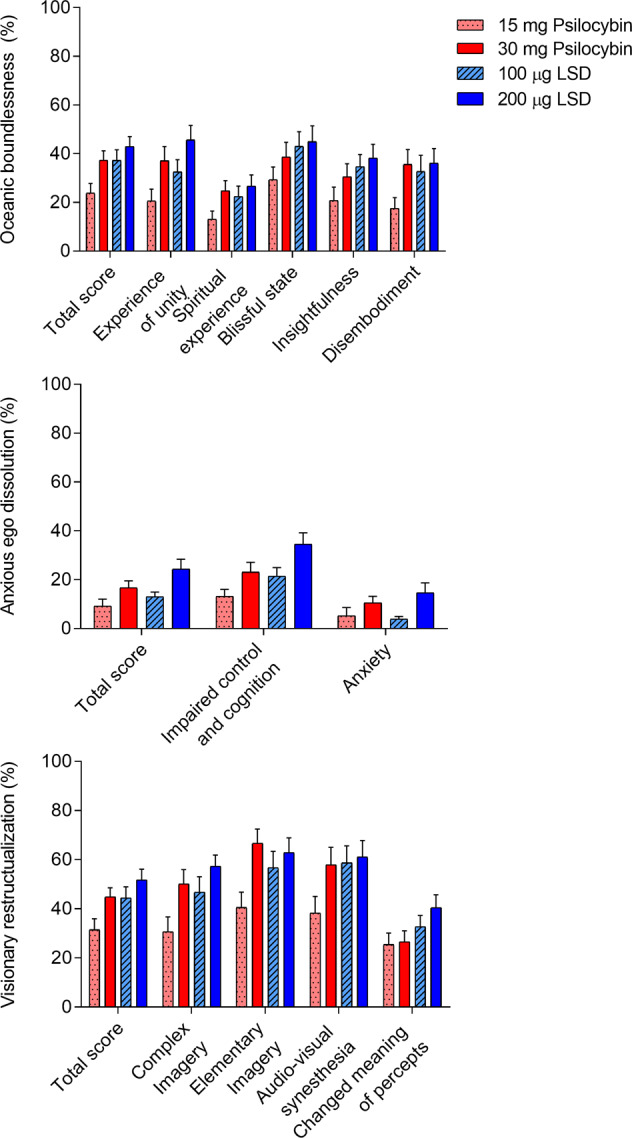
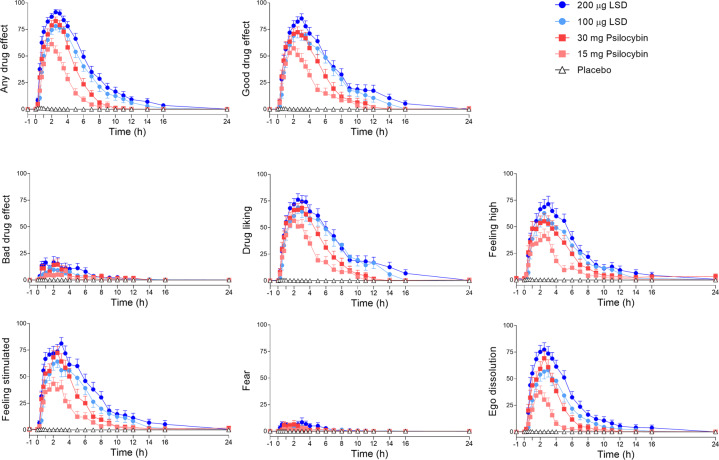
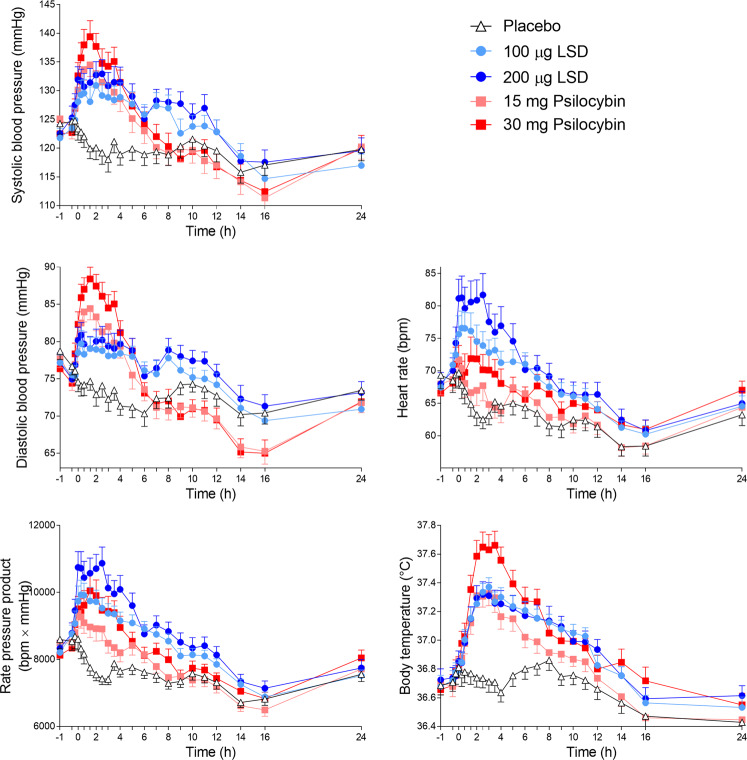
Growing interest has been seen in using lysergic acid diethylamide (LSD) and psilocybin in psychiatric research and therapy. However, no modern studies have evaluated differences in subjective and autonomic effects of LSD and psilocybin or their similarities and dose equivalence. We used a double-blind, randomized, placebo-controlled, crossover design in 28 healthy subjects (14 women, 14 men) who underwent five 25 h sessions and received placebo, LSD (100 and 200 µg), and psilocybin (15 and 30 mg). Test days were separated by at least 10 days. Outcome measures included self-rating scales for subjective effects, autonomic effects, adverse effects, effect durations, plasma levels of brain-derived neurotrophic factor (BDNF), prolactin, cortisol, and oxytocin, and pharmacokinetics. The doses of 100 and 200 µg LSD and 30 mg psilocybin produced comparable subjective effects. The 15 mg psilocybin dose produced clearly weaker subjective effects compared with both doses of LSD and 30 mg psilocybin. The 200 µg dose of LSD induced higher ratings of ego-dissolution, impairments in control and cognition, and anxiety than the 100 µg dose. The 200 µg dose of LSD increased only ratings of ineffability significantly more than 30 mg psilocybin. LSD at both doses had clearly longer effect durations than psilocybin. Psilocybin increased blood pressure more than LSD, whereas LSD increased heart rate more than psilocybin. However, both LSD and psilocybin showed comparable cardiostimulant properties, assessed by the rate-pressure product. Both LSD and psilocybin had dose-proportional pharmacokinetics and first-order elimination. Both doses of LSD and the high dose of psilocybin produced qualitatively and quantitatively very similar subjective effects, indicating that alterations of mind that are induced by LSD and psilocybin do not differ beyond the effect duration. Any differences between LSD and psilocybin are dose-dependent rather than substance-dependent. However, LSD and psilocybin differentially increased heart rate and blood pressure. These results may assist with dose finding for future psychedelic research. Trial registration: ClinicalTrials.gov identifier: NCT03604744
Overview
The claims and statistics of this paper haven’t been checked yet.
Free: it reads the open-access text and checks the first 5 claims that cite a source we can check. Create a free account to check every claim.
Integrity signals
Registry
Cites
Statistics
Figures
Verification
Claims the paper makes
The claims and statistics of this paper haven’t been checked yet.
Free: it reads the open-access text and checks the first 5 claims that cite a source we can check. Create a free account to check every claim.
Claims other papers make about this one
Each is checked against this paper’s own text: does it say what the citing paper says it does?
The cited source says what the claim attributes to it.
In the citing paper
“After psilocybin administration, participants will remain under observation for 6–8 h, based on the drug’s duration of action [92].”
The cited source says what the claim attributes to it.
In the citing paper
“Compared to other psychedelics such as psilocybin (Holze: 5.6 ± 2.2, 6.5 ± 2.4; Ley: 4.9 ± 1.7; Passie 3–6 h) or LSD (Holze: 9.3 ± 3.2, 11 ± 3.7; Ley: 8.2 ± 3.1; Passie: 9–12 h) (39, 76–78), the overall experience duration of combined DMT/HAR with this specific administration protocol (3–4 h) is shorter.”
From Potential therapeutic effects of an ayahuasca-inspired N,N-DMT and harmine formulation: a controlled trial in healthy subjects (2024) · cites this paper as [76]
In the citing paper
“In analyses comparing LSD and psilocybin, we controlled for the effect of dose by converting psilocybin doses to the LSD-equivalent dose (1 mg psilocybin = 5 µg LSD; Holze et al., 2022b).”
From Naturalistic psychedelic therapy: The role of relaxation and subjective drug effects in antidepressant response (2024) · cites this paper as Holze et al., 2022b
In the citing paper
“The frequency of side effects in the patient sample was similar to those previously reported in healthy subjects using the List of Complaints (Holze et al., 2022b).”
From Naturalistic psychedelic therapy: The role of relaxation and subjective drug effects in antidepressant response (2024) · cites this paper as Holze et al., 2022b
In the citing paper
“Overall, adverse effects were short-lived, mild, and comparable to those seen in healthy subjects (Holze et al., 2022a, 2022b).”
From Naturalistic psychedelic therapy: The role of relaxation and subjective drug effects in antidepressant response (2024) · cites this paper as Holze et al., 2022b
Self-check
Percentages, sums and reported differences re-computed from the paper’s own numbers.
The self-check needs the paper’s full text.
Citations
Cites
Griffiths, R. R., Johnson, M. W., Carducci, M. A., Umbricht, A., Richards, W. A., Richards, B. D., Cosimano, M. P., & Klinedinst, M. A. (2016) · Journal of Psychopharmacology · doi:10.1177/0269881116675513 · Cited by 2,201
Ross, S., Bossis, A., Guss, J., Agin-Liebes, G., Malone, T., Cohen, B., Mennenga, S. E., Belser, A., Kalliontzi, K., Babb, J., et al. (2016) · Journal of Psychopharmacology · doi:10.1177/0269881116675512 · Cited by 1,698
Griffiths, R. R., Richards, W. A., McCann, U., & Jesse, R. (2006) · Psychopharmacology · doi:10.1007/s00213-006-0457-5 · Cited by 1,684
Carhart-Harris, R. L., Bolstridge, M., Rucker, J., Day, C. M. J., Erritzoe, D., Kaelen, M., Bloomfield, M., Rickard, J. A., Forbes, B., Feilding, A., et al. (2016) · The Lancet Psychiatry · doi:10.1016/s2215-0366(16)30065-7 · Cited by 1,540 · cited 1×
“dosing is likely to be used in therapeutic settings [2, 41].”
BackgroundTrial of Psilocybin versus Escitalopram for Depression
Carhart-Harris, R., Giribaldi, B., Watts, R., Baker-Jones, M., Murphy-Beiner, A., Murphy, R., Martell, J., Blemings, A., Erritzoe, D., & Nutt, D. J. (2021) · New England Journal of Medicine · doi:10.1056/nejmoa2032994 · Cited by 1,391 · cited 1×
“dosing is likely to be used in therapeutic settings [2, 41].”
BackgroundEffects of Psilocybin-Assisted Therapy on Major Depressive Disorder: A Randomized Clinical Trial
Davis, A. K., Barrett, F. S., May, D. G., Cosimano, M. P., Sepeda, N. D., Johnson, M. W., Finan, P. H., & Griffiths, R. R. (2021) · JAMA Psychiatry · doi:10.1001/jamapsychiatry.2020.3285 · Cited by 1,301
Psychedelics promote structural and functional neural plasticity
Ly, C., Greb, A. C., Cameron, L. P., Wong, J. M., Barragan, E. V., Wilson, P. C., Burbach, K. F., Soltanzadeh Zarandi, S., Sood, A., Paddy, M. R., et al. (2018) · Cell Reports · doi:10.1016/j.celrep.2018.05.022 · Cited by 1,207
Psilocybin induces schizophrenia-like psychosis in humans via a serotonin-2 agonist action
Vollenweider, F. X., Vollenweider-Scherpenhuyzen, M. F. I., Bäbler, A., Vogel, H., & Hell, D. (1998) · NeuroReport · doi:10.1097/00001756-199812010-00024 · Cited by 1,018
Psilocybin occasioned mystical-type experiences: immediate and persisting dose-related effects
Griffiths, R. R., Johnson, M. W., Richards, W. A., Richards, B. D., McCann, U., & Jesse, R. (2011) · Psychopharmacology · doi:10.1007/s00213-011-2358-5 · Cited by 932
Roseman, L., Nutt, D. J., & Carhart-Harris, R. L. (2018) · Frontiers in Pharmacology · doi:10.3389/fphar.2017.00974 · Cited by 808
Psychometric evaluation of the altered states of consciousness rating scale (OAV)
Studerus, E., Gamma, A., & Vollenweider, F. X. (2010) · PLoS ONE · doi:10.1371/journal.pone.0012412 · Cited by 683 · cited 1×
“The 5 Dimensions of Altered States of Consciousness (5D-ASC) scale [30, 31] was used as the primary outcome measure and was administered 24 h after drug administration to retrospectively rate peak drug effects.”
MethodValidation of the revised Mystical Experience Questionnaire in experimental sessions with psilocybin
Barrett, F. S., Johnson, M. W., & Griffiths, R. R. (2015) · Journal of Psychopharmacology · doi:10.1177/0269881115609019 · Cited by 637 · cited 3×
“The only subscale on which 200 µg LSD was significantly different from 30mg psilocybin was “ineffability” on the MEQ30 and MEQ43.”
MethodThe Standardized Psychometric Assessment of Altered States of Consciousness (ASCs) in Humans
Dittrich, A. (1998) · Pharmacopsychiatry · doi:10.1055/s-2007-979351 · Cited by 577 · cited 1×
“The 5 Dimensions of Altered States of Consciousness (5D-ASC) scale [30, 31] was used as the primary outcome measure and was administered 24 h after drug administration to retrospectively rate peak drug effects.”
MethodStuderus, E., Kometer, M., Hasler, F., & Vollenweider, F. X. (2011) · Journal of Psychopharmacology · doi:10.1177/0269881110382466 · Cited by 532
Madsen, M. K., Fisher, P. M., Burmester, D., Dyssegaard, A., Stenbæk, D. S., Kristiansen, S., Johansen, S. S., Lehel, S., Linnet, K., Svarer, C., et al. (2019) · Neuropsychopharmacology · doi:10.1038/s41386-019-0324-9 · Cited by 517 · cited 1×
“Previous research has shown that plasma concentrations of LSD and psilocybin are strongly linked to subjective effects [7, 19, 20].”
BackgroundPsilocybin-Occasioned mystical experiences in the treatment of tobacco addiction.
Garcia-Romeu, A., Griffiths, R., & Johnson, M. (2015) · Current Drug Abuse Reviews · doi:10.2174/1874473708666150107121331 · Cited by 476
Gasser, P., Kirchner, K., & Passie, T. (2015) · Journal of Psychopharmacology · doi:10.1177/0269881114555249 · Cited by 456
Hasler, F., Grimberg, U., Benz, M. A., Huber, T., & Vollenweider, F. X. (2004) · Psychopharmacology · doi:10.1007/s00213-003-1640-6 · Cited by 451
Acute Effects of Lysergic Acid Diethylamide in Healthy Subjects
Schmid, Y., Enzler, F., Gasser, P., Grouzmann, E., Preller, K. H., Vollenweider, F. X., Brenneisen, R., Müller, F., Borgwardt, S., & Liechti, M. E. (2015) · Biological Psychiatry · doi:10.1016/j.biopsych.2014.11.015 · Cited by 411 · cited 5×
“Furthermore, the present study was the first to document increases in circulating oxytocin after psilocybin administration as previously shown for LSD [21, 22] and MDMA [28, 50].”
BackgroundMethodResultSelf-citationPreller, K. H., Herdener, M., Pokorny, T., Planzer, A., Kraehenmann, R., Stämpfli, P., Liechti, M. E., Seifritz, E., & Vollenweider, F. X. (2017) · Current Biology · doi:10.1016/j.cub.2016.12.030 · Cited by 402
Self-citationReceptor interaction profiles of novel psychoactive tryptamines compared with classic hallucinogens
Rickli, A., Moning, O. D., Hoener, M. C., & Liechti, M. E. (2016) · European Neuropsychopharmacology · doi:10.1016/j.euroneuro.2016.05.001 · Cited by 379 · cited 3×
“This similarity may be explained by a common action of psilocybin and MDMA on the serotonin transporter [10].”
BackgroundResultSelf-citationHaile, C. N., Murrough, J. W., Iosifescu, D. V., Chang, L. C., Al Jurdi, R. K., Foulkes, A., Iqbal, S., Mahoney, J. J., De La Garza, R., Charney, D. S., et al. (2014) · The International Journal of Neuropsychopharmacology · doi:10.1017/s1461145713001119 · Cited by 253 · cited 1×
“In addition, we assessed plasma levels of brain-derived neurotrophic factor (BDNF), which is considered a possible marker of neurogenesis [24] and has been shown to increase following psychedelic administration [7, 25–27].”
MethodDistinct acute effects of LSD, MDMA, and d-amphetamine in healthy subjects
Holze, F., Vizeli, P., Müller, F., Ley, L., Duerig, R., Varghese, N., Eckert, A., Borgwardt, S., & Liechti, M. E. (2020) · Neuropsychopharmacology · doi:10.1038/s41386-019-0569-3 · Cited by 247 · cited 8×
“Furthermore, the present study was the first to document increases in circulating oxytocin after psilocybin administration as previously shown for LSD [21, 22] and MDMA [28, 50].”
BackgroundMethodResultSelf-citationHolze, F., Vizeli, P., Ley, L., Müller, F., Dolder, P., Stocker, M., Duthaler, U., Varghese, N., Eckert, A., Borgwardt, S., et al. (2021) · Neuropsychopharmacology · doi:10.1038/s41386-020-00883-6 · Cited by 245 · cited 10×
“Previous research has shown that plasma concentrations of LSD and psilocybin are strongly linked to subjective effects [7, 19, 20].”
BackgroundMethodResultSelf-citationModern clinical research on LSD
Liechti, M. E. (2017) · Neuropsychopharmacology · doi:10.1038/npp.2017.86 · Cited by 236
Self-citationHasler, F., Bourquin, D., Brenneisen, R., Bär, T., & Vollenweider, F. X. (1997) · Pharmaceutica Acta Helvetiae · doi:10.1016/s0031-6865(97)00014-9 · Cited by 232
Alterations of consciousness and mystical-type experiences after acute LSD in humans
Liechti, M. E., Dolder, P. C., & Schmid, Y. (2017) · Psychopharmacology · doi:10.1007/s00213-016-4453-0 · Cited by 198
Self-citationPharmacokinetics of Escalating Doses of Oral Psilocybin in Healthy Adults
Brown, R. T., Nicholas, C. R., Cozzi, N. V., Gassman, M. C., Cooper, K. M., Muller, D., Thomas, C. D., Hetzel, S. J., Henriquez, K. M., Ribaudo, A. S., et al. (2017) · Clinical Pharmacokinetics · doi:10.1007/s40262-017-0540-6 · Cited by 188 · cited 1×
“These values are consistent with previous studies [7, 13, 19, 37], although a slightly shorter half-life of 2 h has also been described for psilocybin [38, 44].”
ResultBecker, A. M., Holze, F., Grandinetti, T., Klaiber, A., Toedtli, V. E., Kolaczynska, K. E., Duthaler, U., Varghese, N., Eckert, A., Grünblatt, E., et al. (2022) · Clinical Pharmacology & Therapeutics · doi:10.1002/cpt.2487 · Cited by 184
Self-citationAlmeida, R. N. D., Galvão, A. C. D. M., da Silva, F. S., Silva, E. A. D. S., Palhano-Fontes, F., Maia-de-Oliveira, J. P., de Araújo, L.-S. B., Lobão-Soares, B., & Galvão-Coelho, N. L. (2019) · Frontiers in Psychology · doi:10.3389/fpsyg.2019.01234 · Cited by 177
Gouzoulis‐Mayfrank, E., Thelen, B., Habermeyer, E., Kunert, H. J., Kovar, K. ‐., Lindenblatt, H., Hermle, L., Spitzer, M., & Sass, H. (1999) · Psychopharmacology · doi:10.1007/s002130050860 · Cited by 160
Exploratory Controlled Study of the Migraine-Suppressing Effects of Psilocybin
Schindler, E. A. D., Sewell, R. A., Gottschalk, C. H., Luddy, C., Flynn, L. T., Lindsey, H. M., Pittman, B. P., Cozzi, N. V., & D’Souza, D. C. (2020) · Neurotherapeutics · doi:10.1007/s13311-020-00962-y · Cited by 157
Marona‐Lewicka, D., Thisted, R. A., & Nichols, D. E. (2005) · Psychopharmacology · doi:10.1007/s00213-005-2183-9 · Cited by 147 · cited 1×
“Studies in rats indicated a later, more negative, temporal phase with involvement of D2 and D4 receptors for LSD, but not for psilocybin [47, 48].”
BackgroundPharmacokinetics and Pharmacodynamics of Lysergic Acid Diethylamide in Healthy Subjects
Dolder, P. C., Schmid, Y., Steuer, A. E., Kraemer, T., Rentsch, K. M., Hammann, F., & Liechti, M. E. (2017) · Clinical Pharmacokinetics · doi:10.1007/s40262-017-0513-9 · Cited by 133 · cited 1×
“Body weight had no influence on LSD or psilocin plasma concentrations, as described previously [7, 38, 45].”
Self-citationCarbonaro, T. M., Johnson, M. W., Hurwitz, E., & Griffiths, R. R. (2018) · Psychopharmacology · doi:10.1007/s00213-017-4769-4 · Cited by 133 · cited 3×
“Subjective effects of LSD in the present study were similar to previous studies that investigated either LSD or psilocybin [7, 11, 28].”
BackgroundResultLow doses of LSD acutely increase BDNF blood plasma levels in healthy volunteers
Hutten, N. R. P. W., Mason, N. L., Dolder, P. C., Theunissen, E. L., Holze, F., Liechti, M. E., Varghese, N., Eckert, A., Feilding, A., Ramaekers, J. G., et al. (2021) · ACS Pharmacology & Translational Science · doi:10.1021/acsptsci.0c00099 · Cited by 131
Self-citationOver 30 million psychedelic users in the United States
Krebs, T. S., & Johansen, P.-Ø. (2013) · F1000Research · doi:10.12688/f1000research.2-98.v1 · Cited by 124 · cited 1×
“INTRODUCTION Lysergic acid diethylamide (LSD) and psilocybin are both classic serotonergic psychedelics that are used recreationally [1] and have recently become promising candidates for the treatment of various psychiatric disorders (e.”
BackgroundSeifritz, E., Baumann, P., Müller, M. J., Annen, O., Amey, M., Hemmeter, U., Hatzinger, M., Chardon, F., & Holsboer-Trachsler, E. (1996) · Neuropsychopharmacology · doi:10.1016/0893-133x(95)00117-v · Cited by 105 · cited 1×
“In addition, LSD and psilocybin both increased PRL and cortisol levels, which are markers of serotonergic activity [49].”
BackgroundGarcia-Romeu, A., Barrett, F. S., Carbonaro, T. M., Johnson, M. W., & Griffiths, R. R. (2021) · Journal of Psychopharmacology · doi:10.1177/0269881121991822 · Cited by 96 · cited 1×
“The body weight adjustment of the psilocybin dose did not alter subjective effects and had no advantages [42], and fixed dosing is more practical in large trials in patients.”
BackgroundKuypers, K. P. C., de la Torre, R., Farre, M., Yubero-Lahoz, S., Dziobek, I., Van den Bos, W., & Ramaekers, J. G. (2014) · PLoS ONE · doi:10.1371/journal.pone.0100719 · Cited by 88
High dose psilocybin is associated with positive subjective effects in healthy volunteers
Nicholas, C. R., Henriquez, K. M., Gassman, M. C., Cooper, K. M., Muller, D., Hetzel, S., Brown, R. T., Cozzi, N. V., Thomas, C., & Hutson, P. R. (2018) · Journal of Psychopharmacology · doi:10.1177/0269881118780713 · Cited by 83 · cited 3×
“The only subscale on which 200 µg LSD was significantly different from 30mg psilocybin was “ineffability” on the MEQ30 and MEQ43.”
BackgroundPharmacokinetics and subjective effects of a novel oral LSD formulation in healthy subjects
Holze, F., Duthaler, U., Vizeli, P., Müller, F., Borgwardt, S., & Liechti, M. E. (2019) · British Journal of Clinical Pharmacology · doi:10.1111/bcp.13918 · Cited by 73 · cited 8×
“Previous research has shown that plasma concentrations of LSD and psilocybin are strongly linked to subjective effects [7, 19, 20].”
BackgroundMethodResultSelf-citationRole of the 5-HT2A Receptor in Acute Effects of LSD on Empathy and Circulating Oxytocin
Holze, F., Avedisian, I., Varghese, N., Eckert, A., & Liechti, M. E. (2021) · Frontiers in Pharmacology · doi:10.3389/fphar.2021.711255 · Cited by 67 · cited 2×
“Endocrine effects and BDNF Plasma concentrations of cortisol, PRL, oxytocin, and BDNF were determined as previously described [7, 21, 22, 28].”
MethodSelf-citationSafety pharmacology of acute LSD administration in healthy subjects
Holze, F., Caluori, T. V., Vizeli, P., & Liechti, M. E. (2022) · Psychopharmacology · doi:10.1007/s00213-021-05978-6 · Cited by 61
Self-citationKolaczynska, K. E., Liechti, M. E., & Duthaler, U. (2021) · Journal of Chromatography B · doi:10.1016/j.jchromb.2020.122486 · Cited by 56
Self-citationMarona‐Lewicka, D., Chemel, B. R., & Nichols, D. E. (2008) · Psychopharmacology · doi:10.1007/s00213-008-1238-0 · Cited by 51
Effects of a -blocker on the cardiovascular response to MDMA (Ecstasy)
Hysek, C. M., Vollenweider, F. X., & Liechti, M. E. (2010) · Emergency Medicine Journal · doi:10.1136/emj.2009.079905 · Cited by 51
Self-citationLiechti, M. E., & Holze, F. (2021) · Current topics in behavioral neurosciences · doi:10.1007/7854_2021_270 · Cited by 44 · cited 1×
“Altogether, these results suggest that 20mg psilocybin is equivalent to 100 μg LSD, and 30 mg psilocybin is equivalent to 150 μg LSD, a consistency that was also noted elsewhere [46].”
BackgroundSelf-citation
Cited by
von Rotz, R., Schindowski, E. M., Jungwirth, J., Schuldt, A., Rieser, N. M., Zahoranszky, K., Seifritz, E., Nowak, A., Nowak, P., Jäncke, L., et al. (2023) · eClinicalMedicine · doi:10.1016/j.eclinm.2022.101809 · Cited by 354
Holze, F., Gasser, P., Müller, F., Dolder, P. C., & Liechti, M. E. (2023) · Biological Psychiatry · doi:10.1016/j.biopsych.2022.08.025 · Cited by 318
“The 200mg dose of LSD that was used in this study can be considered equivalent to 40 mg of psilocybin (6) and higher than the psilocybin doses of 15 to 30 mg that have been used in clinical trials to date.”
BackgroundMethodResultInfluentialSelf-citationTowards an understanding of psychedelic-induced neuroplasticity
Calder, A. E., & Hasler, G. (2023) · Neuropsychopharmacology · doi:10.1038/s41386-022-01389-z · Cited by 313
“However, a similar study using doses of between 25 μg and 200 μg LSD only found significant effects on BDNF at 200 μg [49], and another failed to find significant changes even at this dose [50].”
BackgroundMethodResultPharmacological, neural, and psychological mechanisms underlying psychedelics: A critical review
van Elk, M., & Yaden, D. B. (2022) · Neuroscience & Biobehavioral Reviews · doi:10.1016/j.neubiorev.2022.104793 · Cited by 221
“Despite their different pharmacological profile and affinity for different receptor sub-types, recent evidence indicates that the subjective effects of 30mg psilocybin and 100 or 200 mg of LSD were statistically indistinguishable (Holze et al., 2022), thereby calling into question the potential for establishing a prec…”
BackgroundPsilocybin for treatment resistant depression in patients taking a concomitant SSRI medication
Goodwin, G. M., Croal, M., Feifel, D., Kelly, J. R., Marwood, L., Mistry, S., O’Keane, V., Peck, S. K., Simmons, H., Sisa, C., et al. (2023) · Neuropsychopharmacology · doi:10.1038/s41386-023-01648-7 · Cited by 187
Metadata
- Authors
- Holze, F., Ley, L., Müller, F., Becker, A. M., Straumann, I., Vizeli, P., Kuehne, S. S., Roder, M. A., Duthaler, U., Kolaczynska, K. E., Varghese, N., Eckert, A., & Liechti, M. E.
- Affiliations
- University of Basel (CH)
- Corresponding author
- Liechti, Matthias E.
- ORCID
- Venue
- Neuropsychopharmacology
- Published
- 2022-02-25
- Volume
- 47
- Issue
- 6
- Pages
- 1180-1187
- ISSN
- 0893-133X (ISSN-L)
- 1740-634X
- PMC
- PMC9018810
- OpenAlex
- W4214649547
- Semantic Scholar
- e268f0e15376be1cfd86b6b2452bc492ece12255
- Cited by
- 226
- References
- 50
- Citations by year
- 2026: 41 · 2025: 61 · 2024: 67 · 2023: 38 · 2022: 19
- FWCI
- 42.18
- Type
- journal article
- Language
- en
- Open access
- hybrid
- doi.org
- Licence
- cc-by
- creativecommons.org/licenses/by/4.0 (tdm)
- creativecommons.org/licenses/by/4.0 (vor)
- Locations
- Neuropsychopharmacology (publishedVersion, cc-by)
- PubMed Central (publishedVersion, cc-by)
- PubMed (publishedVersion)
- edoc (University of Basel) (acceptedVersion)
- edoc (University of Basel)
- Funders
- Schweizerischer Nationalfonds zur Förderung der Wissenschaftlichen Forschung (32003B_185111)
- Topics
- Social Sciences › Psychology › Clinical Psychology › Psychedelics and Drug Studies
- Life Sciences › Pharmacology, Toxicology and Pharmaceutics › Toxicology › Forensic Toxicology and Drug Analysis
- Life Sciences › Pharmacology, Toxicology and Pharmaceutics › Pharmacology › Alkaloids: synthesis and pharmacology
- Keywords
- lysergic acid diethylamide, psilocybin, autonomic effects, dose equivalence, ego dissolution, ineffability, anxiety, heart rate, blood pressure, rate-pressure product, pharmacokinetics, brain-derived neurotrophic factor, prolactin, cortisol, oxytocin
- MeSH terms
- Double-Blind Method, Female, Hallucinogens, Humans, Lysergic Acid Diethylamide, Male, Psilocybin, Healthy Volunteers
About these checks
Registry, retraction, Cites and statistics results are computed, not judged, with one exception: a printed reference that no index lists is read once by a model before it counts as a citation error. Claims are extracted by a model and kept only when their quote appears verbatim in the text; each cited source is then checked, with a model’s help, for whether it says what the claim relies on. Those verdicts can be wrong — read the claim’s quote and the cited source before relying on one.
Statistics and arithmetic are recomputed, not judged.
Confidence bands are shown only for fields calibrated on our annotated test set. None is calibrated yet, so no band is shown.
What counts as a claim ›How we measure confidence ›How we check this ›
Are you an author, or do you see a problem with this page? Request a review
Data sources
Bibliographic data: Semantic Scholar, OpenAlex, Crossref.
Contains information from the Semantic Scholar Academic Graph Datasets, made available under the ODC Attribution License (ODC-BY 1.0).
Semantic Scholar’s data is described in: Kinney, R., et al. (2023). The Semantic Scholar Open Data Platform. arXiv:2301.10140.
