

Direct comparison of the acute effects of lysergic acid diethylamide and psilocybin in a double-blind placebo-controlled study in healthy subjects
Open accessThe DOI matches its Crossref record; 48 of the 50 references it cites were found in a registry or an index.
Abstract
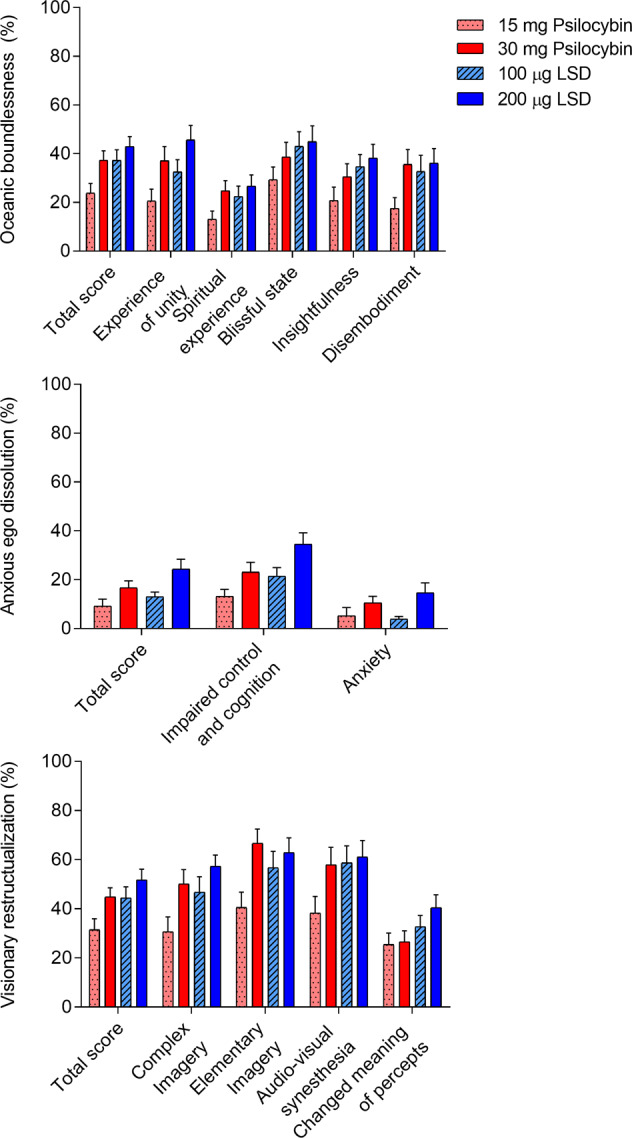
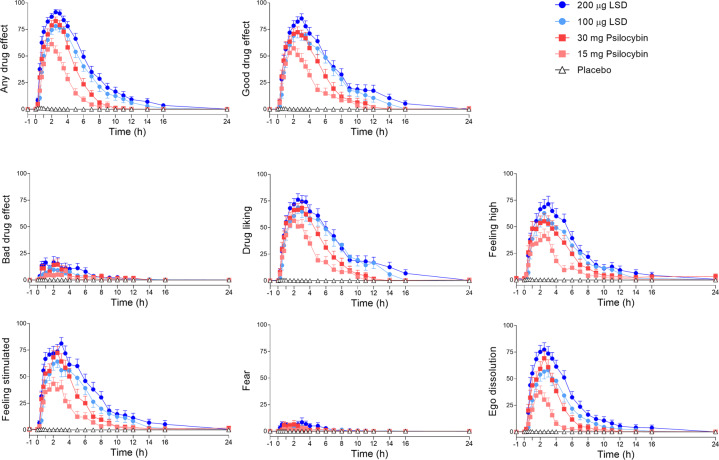
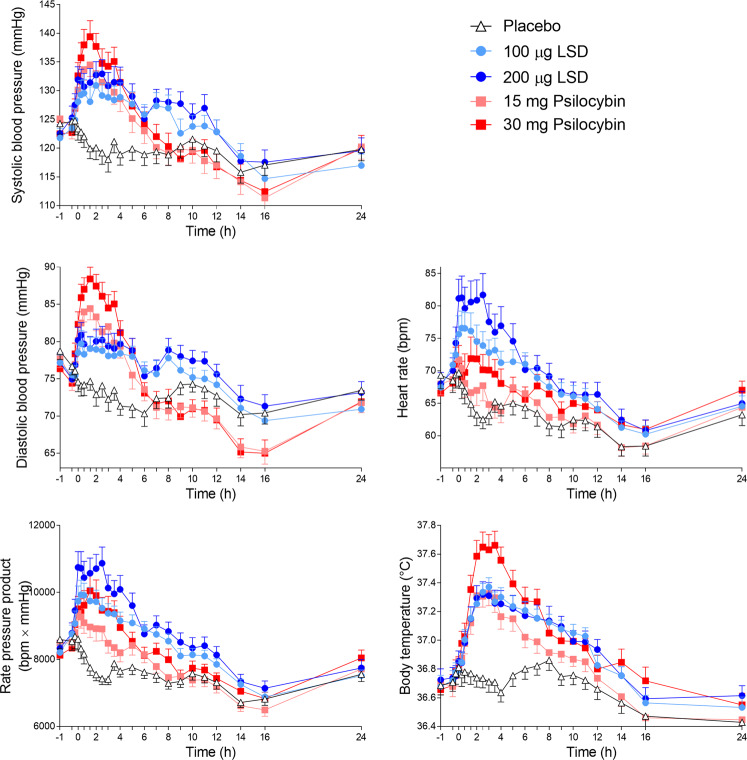
Growing interest has been seen in using lysergic acid diethylamide (LSD) and psilocybin in psychiatric research and therapy. However, no modern studies have evaluated differences in subjective and autonomic effects of LSD and psilocybin or their similarities and dose equivalence. We used a double-blind, randomized, placebo-controlled, crossover design in 28 healthy subjects (14 women, 14 men) who underwent five 25 h sessions and received placebo, LSD (100 and 200 µg), and psilocybin (15 and 30 mg). Test days were separated by at least 10 days. Outcome measures included self-rating scales for subjective effects, autonomic effects, adverse effects, effect durations, plasma levels of brain-derived neurotrophic factor (BDNF), prolactin, cortisol, and oxytocin, and pharmacokinetics. The doses of 100 and 200 µg LSD and 30 mg psilocybin produced comparable subjective effects. The 15 mg psilocybin dose produced clearly weaker subjective effects compared with both doses of LSD and 30 mg psilocybin. The 200 µg dose of LSD induced higher ratings of ego-dissolution, impairments in control and cognition, and anxiety than the 100 µg dose. The 200 µg dose of LSD increased only ratings of ineffability significantly more than 30 mg psilocybin. LSD at both doses had clearly longer effect durations than psilocybin. Psilocybin increased blood pressure more than LSD, whereas LSD increased heart rate more than psilocybin. However, both LSD and psilocybin showed comparable cardiostimulant properties, assessed by the rate-pressure product. Both LSD and psilocybin had dose-proportional pharmacokinetics and first-order elimination. Both doses of LSD and the high dose of psilocybin produced qualitatively and quantitatively very similar subjective effects, indicating that alterations of mind that are induced by LSD and psilocybin do not differ beyond the effect duration. Any differences between LSD and psilocybin are dose-dependent rather than substance-dependent. However, LSD and psilocybin differentially increased heart rate and blood pressure. These results may assist with dose finding for future psychedelic research. Trial registration: ClinicalTrials.gov identifier: NCT03604744
Overview
The claims and statistics of this paper haven’t been checked yet.
Free: it reads the open-access text and checks the first 5 claims that cite a source we can check. Create a free account to check every claim.
Integrity signals
Registry
Cites
Statistics
Figures
Verification
Claims the paper makes
The claims and statistics of this paper haven’t been checked yet.
Free: it reads the open-access text and checks the first 5 claims that cite a source we can check. Create a free account to check every claim.
Claims other papers make about this one
Each is checked against this paper’s own text: does it say what the citing paper says it does?
The cited source says what the claim attributes to it.
In the citing paper
“After psilocybin administration, participants will remain under observation for 6–8 h, based on the drug’s duration of action [92].”
The cited source says what the claim attributes to it.
In the citing paper
“Compared to other psychedelics such as psilocybin (Holze: 5.6 ± 2.2, 6.5 ± 2.4; Ley: 4.9 ± 1.7; Passie 3–6 h) or LSD (Holze: 9.3 ± 3.2, 11 ± 3.7; Ley: 8.2 ± 3.1; Passie: 9–12 h) (39, 76–78), the overall experience duration of combined DMT/HAR with this specific administration protocol (3–4 h) is shorter.”
From Potential therapeutic effects of an ayahuasca-inspired N,N-DMT and harmine formulation: a controlled trial in healthy subjects (2024) · cites this paper as [76]
In the citing paper
“In analyses comparing LSD and psilocybin, we controlled for the effect of dose by converting psilocybin doses to the LSD-equivalent dose (1 mg psilocybin = 5 µg LSD; Holze et al., 2022b).”
From Naturalistic psychedelic therapy: The role of relaxation and subjective drug effects in antidepressant response (2024) · cites this paper as Holze et al., 2022b
In the citing paper
“The frequency of side effects in the patient sample was similar to those previously reported in healthy subjects using the List of Complaints (Holze et al., 2022b).”
From Naturalistic psychedelic therapy: The role of relaxation and subjective drug effects in antidepressant response (2024) · cites this paper as Holze et al., 2022b
In the citing paper
“Overall, adverse effects were short-lived, mild, and comparable to those seen in healthy subjects (Holze et al., 2022a, 2022b).”
From Naturalistic psychedelic therapy: The role of relaxation and subjective drug effects in antidepressant response (2024) · cites this paper as Holze et al., 2022b
Self-check
Percentages, sums and reported differences re-computed from the paper’s own numbers.
The self-check needs the paper’s full text.
Citations
Cites
Griffiths, R. R., Johnson, M. W., Carducci, M. A., Umbricht, A., Richards, W. A., Richards, B. D., Cosimano, M. P., & Klinedinst, M. A. (2016) · Journal of Psychopharmacology · doi:10.1177/0269881116675513 · Cited by 2,201
Ross, S., Bossis, A., Guss, J., Agin-Liebes, G., Malone, T., Cohen, B., Mennenga, S. E., Belser, A., Kalliontzi, K., Babb, J., et al. (2016) · Journal of Psychopharmacology · doi:10.1177/0269881116675512 · Cited by 1,698
Griffiths, R. R., Richards, W. A., McCann, U., & Jesse, R. (2006) · Psychopharmacology · doi:10.1007/s00213-006-0457-5 · Cited by 1,684
Carhart-Harris, R. L., Bolstridge, M., Rucker, J., Day, C. M. J., Erritzoe, D., Kaelen, M., Bloomfield, M., Rickard, J. A., Forbes, B., Feilding, A., et al. (2016) · The Lancet Psychiatry · doi:10.1016/s2215-0366(16)30065-7 · Cited by 1,540 · cited 1×
“dosing is likely to be used in therapeutic settings [2, 41].”
BackgroundTrial of Psilocybin versus Escitalopram for Depression
Carhart-Harris, R., Giribaldi, B., Watts, R., Baker-Jones, M., Murphy-Beiner, A., Murphy, R., Martell, J., Blemings, A., Erritzoe, D., & Nutt, D. J. (2021) · New England Journal of Medicine · doi:10.1056/nejmoa2032994 · Cited by 1,391 · cited 1×
“dosing is likely to be used in therapeutic settings [2, 41].”
BackgroundEffects of Psilocybin-Assisted Therapy on Major Depressive Disorder: A Randomized Clinical Trial
Davis, A. K., Barrett, F. S., May, D. G., Cosimano, M. P., Sepeda, N. D., Johnson, M. W., Finan, P. H., & Griffiths, R. R. (2021) · JAMA Psychiatry · doi:10.1001/jamapsychiatry.2020.3285 · Cited by 1,301
Psychedelics promote structural and functional neural plasticity
Ly, C., Greb, A. C., Cameron, L. P., Wong, J. M., Barragan, E. V., Wilson, P. C., Burbach, K. F., Soltanzadeh Zarandi, S., Sood, A., Paddy, M. R., et al. (2018) · Cell Reports · doi:10.1016/j.celrep.2018.05.022 · Cited by 1,207
Psilocybin induces schizophrenia-like psychosis in humans via a serotonin-2 agonist action
Vollenweider, F. X., Vollenweider-Scherpenhuyzen, M. F. I., Bäbler, A., Vogel, H., & Hell, D. (1998) · NeuroReport · doi:10.1097/00001756-199812010-00024 · Cited by 1,018
Psilocybin occasioned mystical-type experiences: immediate and persisting dose-related effects
Griffiths, R. R., Johnson, M. W., Richards, W. A., Richards, B. D., McCann, U., & Jesse, R. (2011) · Psychopharmacology · doi:10.1007/s00213-011-2358-5 · Cited by 932
Roseman, L., Nutt, D. J., & Carhart-Harris, R. L. (2018) · Frontiers in Pharmacology · doi:10.3389/fphar.2017.00974 · Cited by 808
Cited by
Items 201–225 of 225
Psilocin glucuronide in whole blood: a stable and useful biomarker of psilocybin intake
Bergh, M. S., Bogen, I. L., Vevelstad, M. S., & Øiestad, Å. M. L. (2026) · Journal of Analytical Toxicology · doi:10.1093/jat/bkag015
Predictors of the Effectiveness of Psychedelics in Treating Depression—A Scoping Review
Chmiel, J., & Rybakowski, F. (2026) · International Journal of Molecular Sciences · doi:10.3390/ijms27052202 · Cited by 2
“For instance, psilocybin transiently elevates plasma cortisol and other neuroendocrine markers [23,24], which might engage executive control circuits and emotional processing in beneficial ways.”
Schlomberg, J. T., Meling, D., Grylka, R., Vasella, E. A., Augustinovic, D., & Scheidegger, M. (2026) · Scientific Reports · doi:10.1038/s41598-026-39261-5 · Cited by 1
Ferris, C. F. (2026) · Frontiers in Psychiatry · doi:10.3389/fpsyt.2026.1772265 · Cited by 2
Low, Z. X. B. (2026) · Progress in Neuro-Psychopharmacology and Biological Psychiatry · doi:10.1016/j.pnpbp.2026.111717 · Cited by 2
Psychothérapie assistée par psychédéliques : enjeux et contenu des séances de préparation
Briefer, J.-F., Seragnoli, F., Thorens, G., Penzenstadler, L. E., Furtado, L., Buchard, A., Bachmann, S., Iuga, R., Cazorla, L., Sabé, M., et al. (2026) · Annales Médico-psychologiques revue psychiatrique · doi:10.1016/j.amp.2026.03.020
Zhang, T., Lin, C., & Wang, X. (2026) · ACS Pharmacology & Translational Science · doi:10.1021/acsptsci.6c00146
Hampsey, E., Martin, K., Kalfas, M., Benson, L. E., Wihlborg, S., Jelen, L. A., Young, A. H., & Rucker, J. (2026) · Journal of Psychopharmacology · doi:10.1177/02698811261453938
“…et al., 1999; Dolder et al., 2015; Egger et al., 2025; Erne et al., 2025; Family et al., 2020, 2022; Good et al., 2023; Hasler et al., 1997; Holze et al., 2019, 2021, 2022a, 2022b, 2023; Klaiber et al., 2024; Lanaro et al., 2021; Ley et al., 2023; Lindenblatt et al., 1998; Mallaroni et…”
Calder, A. E., Diehl, V. J., Lietz, M. P., Yousefi, P., Friedli, N., Coviello, F., Rouaud, A., Beichmann, K., Eckert, A., & Hasler, G. (2026) · Neuropsychopharmacology · doi:10.1038/s41386-026-02454-7
“Because previous studies have typically used only one blood fraction [28, 29], we chose to measure BDNF in both plasma and serum in order to compare their sensitivity to LSD. Plasma samples were collected with EDTA tubes and serum samples were collected using rapid serum tubes.”
Self-citationBrar, P. S., Price, R. B., Ross, S., Tofighi, B., & Sarpal, D. K. (2026) · Journal of Psychopharmacology · doi:10.1177/02698811261456191
“Broadly, psychedelic compounds have a wide range of molecular effects, from interactions with major neurotransmitter systems to the release of neuropeptides such as BDNF and oxytocin (Holze et al., 2022; Kirkpatrick et al., 2014; Moliner et al., 2023).”
Du, Y. J., Zhao, X., Yao, Y., Li, Y., Wang, G., & Zhang, L. (2026) · Journal of Psychopharmacology · doi:10.1177/02698811261453819
Enriquez‐Geppert, S., Bevers, L., Rosander, A., Fodran, P., & Polito, V. (2026) · Biomolecules · doi:10.3390/biom16070983
“Similarly, a double-blind study comparing 15 mg and 30 mg doses found dose-dependent increases in subjective effects, blood pressure, heart rate, and body temperature, which remained within tolerable safety limits [114].”
Averill, L. A., & Neitzke‐Spruill, L. (2026) · FOCUS The Journal of Lifelong Learning in Psychiatry · doi:10.1176/appi.focus.20260006
O’Callaghan, C. C., Kallianis, V., & Ross, M. (2026) · Journal of Music Therapy · doi:10.1093/jmt/thag015
Schmitz, C. N., Bernardic, M., Vlădoiu, A.-D., Harris, R., Carmana, D., Kärtner, L., Oberthür, G., Gründer, G., & Adolphi, H. (2026) · Progress in Neuro-Psychopharmacology and Biological Psychiatry · doi:10.1016/j.pnpbp.2026.111873 · Cited by 2
Molecules, meaning, and physiology: disentangling the active ingredients of psychedelic therapeutics
Kuypers, K. P. C. (2026) · Frontiers in Neuroscience · doi:10.3389/fnins.2026.1892474
“Psychedelics reliably modulate autonomic balance, with studies reporting dose-dependent increases in heart rate, blood pressure, and sympathetic arousal (Holze et al., 2022).”
Multidimensional characterization of the physiological and behavioral effects of TCB-2 in micePreprint
Yamamoto, M., Inoue, H., Hayashi, K., Aota, I., Matsumoto, J., Yamada, K., & Toda, K. (2026) · bioRxiv (Cold Spring Harbor Laboratory) · doi:10.64898/2026.08.01.742216
Jaeckel, L., Logvinski, D., Kanana, M., Müller, F., Rohner, N., Becker, A. M., Liechti, M. E., & Sterzer, P. (2026) · Neuroscience of Consciousness · doi:10.1093/nc/niag050
“We used Visual Analog Scales (VAS; 100 mm) to assess subjective drug effects throughout the study sessions ( Farré et al. 2007, Schmid et al. 2015, Holze et al. 2022).”
Self-citationPsilocybin collapses visual change detection and drives cortical dynamics toward a state of surprisePreprint
Filippo, R. D., Gillis, R., Wyrick, D. G., Carlson, M., Durand, S., Peene, C. R., Bawany, A., Amaya, A. M., Belski, H., Grasso, C., et al. (2026) · bioRxiv (Cold Spring Harbor Laboratory) · doi:10.64898/2026.08.21.745777 · Cited by 2
Psilocybin-induced changes in electroencephalography link acute and long-term effects
Nikolič, M., Froese, T., Mediano, P. A. M., Koudelka, V., Horáček, J., Tylš, F., & Páleníček, T. (2026) · Journal of Psychopharmacology · doi:10.1177/02698811261473445
Seillier, A., Dannan, G. I. E., & Seillier, L. (2026) · Progress in Neuro-Psychopharmacology and Biological Psychiatry · doi:10.1016/j.pnpbp.2026.111924
Moving beyond 5-HT2A: language models map neurotransmitter receptors to experiential semantics
Suresh, P., Kins, J., Levkovskyy, L., Thieme, A., Wren, P. B., Ray, T., Barrett, F. S., Carhart-Harris, R. L., & Bzdok, D. (2026) · Psychopharmacology · doi:10.1007/s00213-026-07170-0
Wójcik, K. K., Kieres, M., Habirek, K. S., Porażko, M. M., Żurakowska-Zadrożna, A. K., Krupska, A., Czarnecka, J. A., Marcinkowska, Z. M., Gugulska, J. Z., Kropiwnicka, A., et al. (2026) · International Journal of Innovative Technologies in Social Science · doi:10.31435/ijitss.3(51).2026.6082
Investigating molecular and hemodynamic effects of LSD in the human brain
McCulloch, D. E.-W., Larsen, K., Johansen, A., Jensen, K. H. R., Nykjær, C. H., Holze, F., Falck, N. D., Neufeld, V. A., Steenstrup, E., Skov-Andersen, P., et al. (2026) · Nature Neuroscience · doi:10.1038/s41593-026-02462-2 · Cited by 2
Self-citationChiorean, A., Kim, H. K., Lustig, A., & Husain, M. I. (2026) · Journal of Psychopharmacology · doi:10.1177/02698811261488460
Metadata
- Authors
- Holze, F., Ley, L., Müller, F., Becker, A. M., Straumann, I., Vizeli, P., Kuehne, S. S., Roder, M. A., Duthaler, U., Kolaczynska, K. E., Varghese, N., Eckert, A., & Liechti, M. E.
- Affiliations
- University of Basel (CH)
- Corresponding author
- Liechti, Matthias E.
- ORCID
- Venue
- Neuropsychopharmacology
- Published
- 2022-02-25
- Volume
- 47
- Issue
- 6
- Pages
- 1180-1187
- ISSN
- 0893-133X (ISSN-L)
- 1740-634X
- PMC
- PMC9018810
- OpenAlex
- W4214649547
- Semantic Scholar
- e268f0e15376be1cfd86b6b2452bc492ece12255
- Cited by
- 226
- References
- 50
- Citations by year
- 2026: 41 · 2025: 61 · 2024: 67 · 2023: 38 · 2022: 19
- FWCI
- 42.18
- Type
- journal article
- Language
- en
- Open access
- hybrid
- doi.org
- Licence
- cc-by
- creativecommons.org/licenses/by/4.0 (tdm)
- creativecommons.org/licenses/by/4.0 (vor)
- Locations
- Neuropsychopharmacology (publishedVersion, cc-by)
- PubMed Central (publishedVersion, cc-by)
- PubMed (publishedVersion)
- edoc (University of Basel) (acceptedVersion)
- edoc (University of Basel)
- Funders
- Schweizerischer Nationalfonds zur Förderung der Wissenschaftlichen Forschung (32003B_185111)
- Topics
- Social Sciences › Psychology › Clinical Psychology › Psychedelics and Drug Studies
- Life Sciences › Pharmacology, Toxicology and Pharmaceutics › Toxicology › Forensic Toxicology and Drug Analysis
- Life Sciences › Pharmacology, Toxicology and Pharmaceutics › Pharmacology › Alkaloids: synthesis and pharmacology
- Keywords
- lysergic acid diethylamide, psilocybin, autonomic effects, dose equivalence, ego dissolution, ineffability, anxiety, heart rate, blood pressure, rate-pressure product, pharmacokinetics, brain-derived neurotrophic factor, prolactin, cortisol, oxytocin
- MeSH terms
- Double-Blind Method, Female, Hallucinogens, Humans, Lysergic Acid Diethylamide, Male, Psilocybin, Healthy Volunteers
About these checks
Registry, retraction, Cites and statistics results are computed, not judged, with one exception: a printed reference that no index lists is read once by a model before it counts as a citation error. Claims are extracted by a model and kept only when their quote appears verbatim in the text; each cited source is then checked, with a model’s help, for whether it says what the claim relies on. Those verdicts can be wrong — read the claim’s quote and the cited source before relying on one.
Statistics and arithmetic are recomputed, not judged.
Confidence bands are shown only for fields calibrated on our annotated test set. None is calibrated yet, so no band is shown.
What counts as a claim ›How we measure confidence ›How we check this ›
Are you an author, or do you see a problem with this page? Request a review
Data sources
Bibliographic data: Semantic Scholar, OpenAlex, Crossref.
Contains information from the Semantic Scholar Academic Graph Datasets, made available under the ODC Attribution License (ODC-BY 1.0).
Semantic Scholar’s data is described in: Kinney, R., et al. (2023). The Semantic Scholar Open Data Platform. arXiv:2301.10140.
