

The DOI matches its Crossref record; 324 of the 324 references it cites were found in a registry or an index.
Ferroptosis: mechanisms and links with diseases
Open accessAbstract
Ferroptosis is an iron-dependent cell death, which is different from apoptosis, necrosis, autophagy, and other forms of cell death. The process of ferroptotic cell death is defined by the accumulation of lethal lipid species derived from the peroxidation of lipids, which can be prevented by iron chelators (e.g., deferiprone, deferoxamine) and small lipophilic antioxidants (e.g., ferrostatin, liproxstatin). This review summarizes current knowledge about the regulatory mechanism of ferroptosis and its association with several pathways, including iron, lipid, and cysteine metabolism. We have further discussed the contribution of ferroptosis to the pathogenesis of several diseases such as cancer, ischemia/reperfusion, and various neurodegenerative diseases (e.g., Alzheimer's disease and Parkinson's disease), and evaluated the therapeutic applications of ferroptosis inhibitors in clinics.
Overview
The claims and statistics of this paper haven’t been checked yet.
Run the check — free, no account needed. It reads the open-access text and checks the sources it cites.
Integrity signals
Registry
Cites
Statistics
Figures
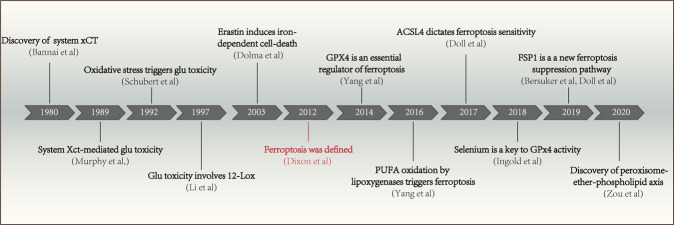
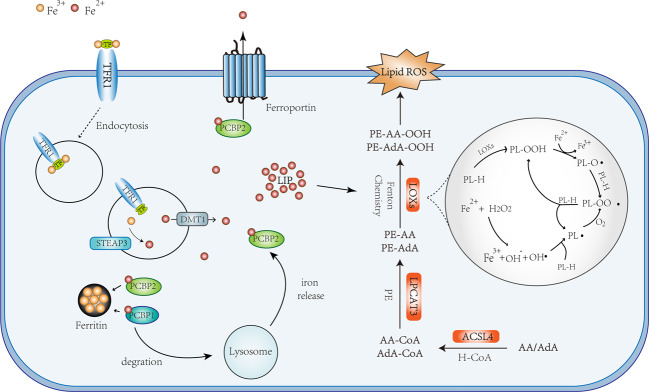
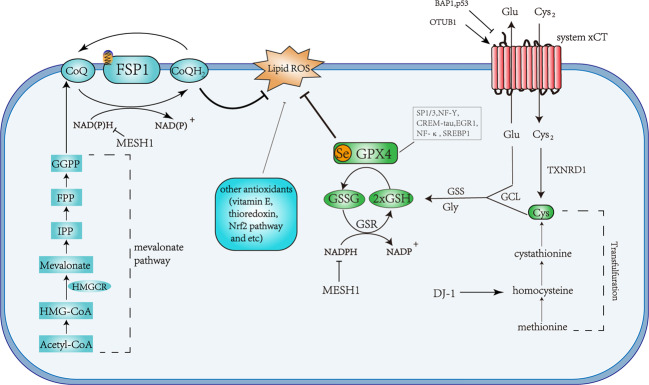
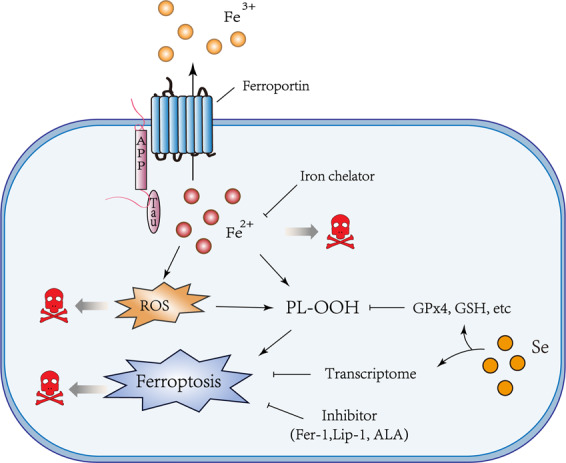
Verification
Claims the paper makes
The claims and statistics of this paper haven’t been checked yet.
Run the check — free, no account needed. It reads the open-access text and checks the sources it cites.
Claims other papers make about this one
Each is checked against this paper’s own text: does it say what the citing paper says it does?
In the citing paper
“Abnormalities in iron homeostasis in brain tissue can increase ROS production, causing noxious oxidative damage to sensitive cellular structures, and trigger a new cell death process called ferroptosis [98,99].”
From Role of Oxidative Damage in Alzheimer’s Disease and Neurodegeneration: From Pathogenic Mechanisms to Biomarker Discovery (2021) · cites this paper as [99]
Self-check
Percentages, sums and reported differences re-computed from the paper’s own numbers.
The self-check needs the paper’s full text.
Citations
Cites
3 retracted
Chen, L., Li, X., LIU, L., Yu, B., Xue, Y., & Liu, Y. (2015) · Oncology Reports · doi:10.3892/or.2015.3712 · Cited by 286
RetractedCoenzyme Q10 for Parkinson's disease
Liu, J., Wang, L., Zhan, S.-Y., & Xia, Y. (2011) · Cochrane Database of Systematic Reviews · doi:10.1002/14651858.cd008150.pub2 · Cited by 36
RetractedCoenzyme Q10 for Parkinson's disease
Liu, J., Wang, L., Zhan, S.-Y., & Xia, Y. (2012) · Cochrane Database of Systematic Reviews · doi:10.1002/14651858.cd008150.pub3 · Cited by 32
RetractedFerroptosis: An Iron-Dependent Form of Nonapoptotic Cell Death
Dixon, S. J., Lemberg, K. M., Lamprecht, M. R., Skouta, R., Zaitsev, E. M., Gleason, C. E., Patel, D. N., Bauer, A. J., Cantley, A. M., Yang, W. S., et al. (2012) · Cell · doi:10.1016/j.cell.2012.03.042 · Cited by 18,691
Regulation of Ferroptotic Cancer Cell Death by GPX4
Yang, W. S., SriRamaratnam, R., Welsch, M. E., Shimada, K., Skouta, R., Viswanathan, V. S., Cheah, J. H., Clemons, P. A., Shamji, A. F., Clish, C. B., et al. (2014) · Cell · doi:10.1016/j.cell.2013.12.010 · Cited by 7,713
Ferroptosis: A Regulated Cell Death Nexus Linking Metabolism, Redox Biology, and Disease
Stockwell, B. R., Friedmann Angeli, J. P., Bayir, H., Bush, A. I., Conrad, M., Dixon, S. J., Fulda, S., Gascón, S., Hatzios, S. K., Kagan, V. E., et al. (2017) · Cell · doi:10.1016/j.cell.2017.09.021 · Cited by 7,695
Ayala, A., Muñoz, M., & Argüelles, S. (2014) · Oxidative Medicine and Cellular Longevity · doi:10.1155/2014/360438 · Cited by 6,837
ACSL4 dictates ferroptosis sensitivity by shaping cellular lipid composition
Doll, S., Proneth, B., Tyurina, Y. Y., Panzilius, E., Kobayashi, S., Ingold, I., Irmler, M., Beckers, J., Aichler, M., Walch, A., et al. (2017) · Nature Chemical Biology · doi:10.1038/nchembio.2239 · Cited by 4,293
Inactivation of the ferroptosis regulator Gpx4 triggers acute renal failure in mice
Friedmann Angeli, J. P., Schneider, M., Proneth, B., Tyurina, Y. Y., Tyurin, V. A., Hammond, V. J., Herbach, N., Aichler, M., Walch, A., Eggenhofer, E., et al. (2014) · Nature Cell Biology · doi:10.1038/ncb3064 · Cited by 3,732
The CoQ oxidoreductase FSP1 acts parallel to GPX4 to inhibit ferroptosis
Bersuker, K., Hendricks, J. M., Li, Z., Magtanong, L., Ford, B., Tang, P. H., Roberts, M. A., Tong, B., Maimone, T. J., Zoncu, R., et al. (2019) · Nature · doi:10.1038/s41586-019-1705-2 · Cited by 3,703
Research works printed but not linked: 1
- Zhang, Y. H. et al. α-Lipoic acid improves abnormal behavior by mitigation of oxidative stress, inflammation, ferroptosis, and tauopathy in P301S Tau transgenic mice. Redox Biol. 14, 535–548 (2018). · DOI
Cited by
Sorted by citations
Targeting p53 pathways: mechanisms, structures, and advances in therapy
Wang, H., Guo, M., Wei, H., & Chen, Y. (2023) · Signal Transduction and Targeted Therapy · doi:10.1038/s41392-023-01347-1 · Cited by 1,016
Buccellato, F. R., D’Anca, M., Fenoglio, C., Scarpini, E., & Galimberti, D. (2021) · Antioxidants · doi:10.3390/antiox10091353 · Cited by 179
Tong, B., Ba, Y., Li, Z., Yang, C., Su, K., Qi, H., Zhang, D., Liu, X., Wu, Y., Chen, Y., et al. (2024) · Neurobiology of Disease · doi:10.1016/j.nbd.2024.106505 · Cited by 117
Selective ferroptosis vulnerability due to familial Alzheimer’s disease presenilin mutations
Greenough, M. A., Lane, D. J. R., Balez, R., Anastacio, H. T. D., Zeng, Z., Ganio, K., McDevitt, C. A., Acevedo, K., Belaidi, A. A., Koistinaho, J., et al. (2022) · Cell Death & Differentiation · doi:10.1038/s41418-022-01003-1 · Cited by 102
Self-citationTripathy, R. K., Frohock, Z., Wang, H., Cary, G. A., Keegan, S., Carter, G. W., & Li, Y. (2025) · npj Systems Biology and Applications · doi:10.1038/s41540-025-00519-9 · Cited by 36
Metadata
- Authors
- Yan, H.-F., Zou, T., Tuo, Q.-Z., Xu, S., Li, H., Belaidi, A. A., & Lei, P.
- Affiliations
- Sichuan University (CN)
- The University of Melbourne (AU)
- Corresponding author
- Belaidi, Abdel Ali
- Lei, Peng
- Venue
- Signal Transduction and Targeted Therapy
- Published
- 2021-02-03
- Volume
- 6
- Issue
- 1
- Pages
- 49-49
- ISSN
- 2059-3635 (ISSN-L)
- PMC
- PMC7858612
- OpenAlex
- W3127839532
- Cited by
- 1,471
- References
- 324
- Citations by year
- 2026: 233 · 2025: 395 · 2024: 361 · 2023: 264 · 2022: 165 · 2021: 53
- FWCI
- 34.03
- Type
- journal article
- Language
- en
- Open access
- gold
- doi.org
- Locations
- Signal Transduction and Targeted Therapy (publishedVersion, cc-by)
- PubMed Central (publishedVersion, cc-by)
- PubMed (publishedVersion)
- DOAJ (DOAJ: Directory of Open Access Journals) (submittedVersion, cc-by-sa)
- Minerva Access (University of Melbourne) (submittedVersion, cc-by)
- Funders
- Ministry of Science and Technology of the People’s Republic of China (2018YFC1312300)
- National Natural Science Foundation of China (81722016, 82071191)
- Topics
- Life Sciences › Biochemistry, Genetics and Molecular Biology › Cancer Research › Ferroptosis and cancer prognosis
- Health Sciences › Medicine › Hematology › Iron Metabolism and Disorders
- Life Sciences › Biochemistry, Genetics and Molecular Biology › Molecular Biology › Cell death mechanisms and regulation
- Keywords
- ferroptosis, iron-dependent cell death, lipid peroxidation, iron chelators, iron metabolism, cysteine metabolism, lipid metabolism, cancer, ischemia-reperfusion injury, neurodegenerative diseases, Alzheimer's disease, Parkinson's disease, ferroptosis inhibitors
- MeSH terms
- Ferroptosis, Alzheimer Disease, Autophagy, Cysteine, Humans, Iron, Neoplasms, Parkinson Disease, Lipid Peroxidation, Apoptosis, Reactive Oxygen Species, Lipid Metabolism
About these checks
Registry, retraction, Cites and statistics results are computed, not judged, with one exception: a printed reference that no index lists is read once by a model before it counts as a citation error. Claims are extracted by a model and kept only when their quote appears verbatim in the text; each cited source is then checked, with a model’s help, for whether it says what the claim relies on. Those verdicts can be wrong — read the claim’s quote and the cited source before relying on one.
Statistics and arithmetic are recomputed, not judged.
Confidence bands are shown only for fields calibrated on our annotated test set. None is calibrated yet, so no band is shown.
What counts as a claim ›How we measure confidence ›How we check this ›
Are you an author, or do you see a problem with this page? Request a review
