

The DOI matches its Crossref record; 588 of the 588 references it cites were found in a registry or an index.
Extracellular matrix and its therapeutic potential for cancer treatment
Open accessAbstract
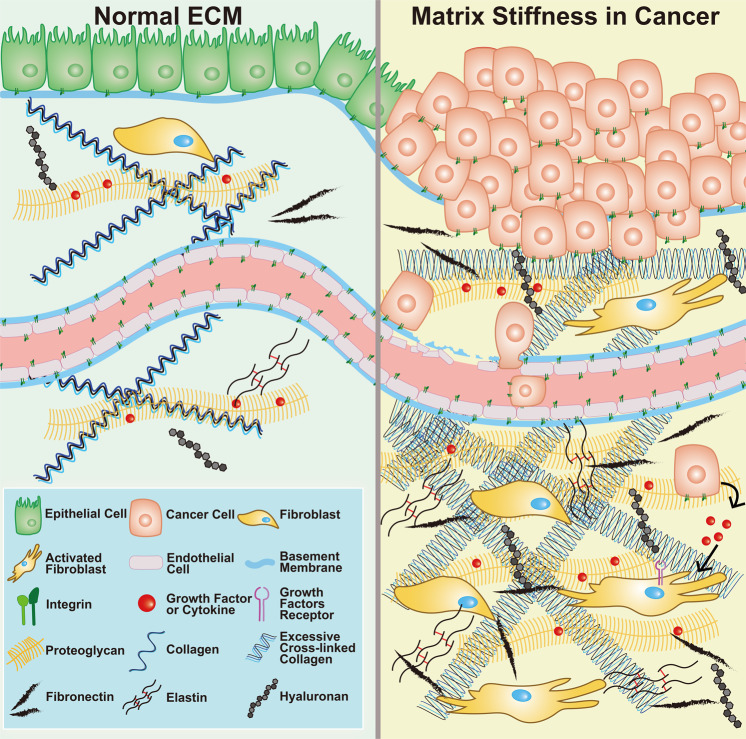
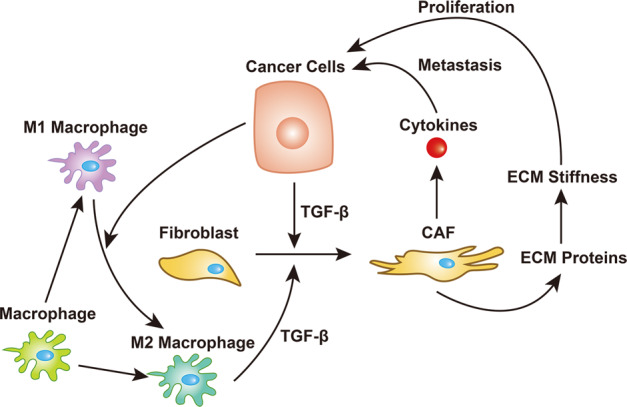
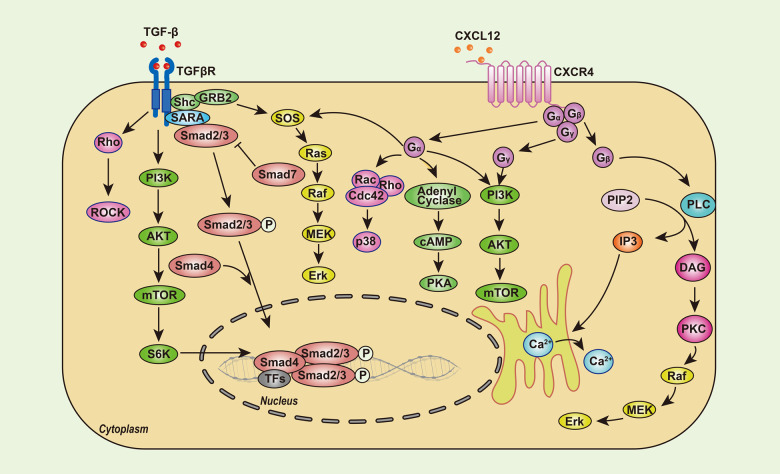
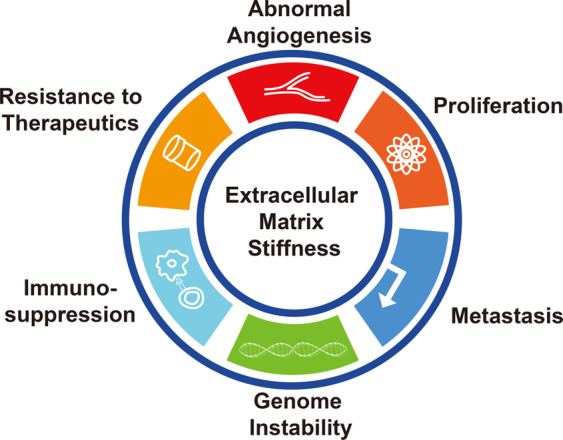
The extracellular matrix (ECM) is one of the major components of tumors that plays multiple crucial roles, including mechanical support, modulation of the microenvironment, and a source of signaling molecules. The quantity and cross-linking status of ECM components are major factors determining tissue stiffness. During tumorigenesis, the interplay between cancer cells and the tumor microenvironment (TME) often results in the stiffness of the ECM, leading to aberrant mechanotransduction and further malignant transformation. Therefore, a comprehensive understanding of ECM dysregulation in the TME would contribute to the discovery of promising therapeutic targets for cancer treatment. Herein, we summarized the knowledge concerning the following: (1) major ECM constituents and their functions in both normal and malignant conditions; (2) the interplay between cancer cells and the ECM in the TME; (3) key receptors for mechanotransduction and their alteration during carcinogenesis; and (4) the current therapeutic strategies targeting aberrant ECM for cancer treatment.
Overview
The claims and statistics of this paper haven’t been checked yet.
Run the check — free, no account needed. It reads the open-access text and checks the sources it cites.
Integrity signals
Registry
Cites
Statistics
Figures
Verification
Claims the paper makes
The claims and statistics of this paper haven’t been checked yet.
Run the check — free, no account needed. It reads the open-access text and checks the sources it cites.
Claims other papers make about this one
Each is checked against this paper’s own text: does it say what the citing paper says it does?
The cited source says what the claim attributes to it.
In the citing paper
“several other ECM components, such as fibronectin, hyaluronan, TGF-β, integrins involved in mechanotransduction, and other sensors of matrix stiffness, are being studied as potential therapeutic targets in various cancers, including CRC [218].”
From Mechanisms and Strategies to Overcome Drug Resistance in Colorectal Cancer (2025) · cites this paper as [218]
The cited source says what the claim attributes to it.
In the citing paper
“Several therapeutic approaches have been developed that aim to alleviate excessive collagen deposition in the TME of solid tumors by altering the synthesis, degradation, or crosslinking of collagen [218].”
From Mechanisms and Strategies to Overcome Drug Resistance in Colorectal Cancer (2025) · cites this paper as [218]
The cited source says what the claim attributes to it.
In the citing paper
“The ECM's functional characteristics and structural components, such as collagen and proteoglycans, play a critical role in maintaining tissue homeostasis and promoting angiogenesis.”
From Bioactive scaffolds for tissue engineering: A review of decellularized extracellular matrix applications and innovations (2025) · cites this paper as [5]
In the citing paper
“A key limitation of nanoparticle therapy is heterogeneous tumor deposition driven by weak recognition/internalization and limited traversal through dense ECM [78].”
From Overcoming tumor microenvironment barriers: transformable and bioinspired nanomedicine strategies for deep tumor penetration (2026) · cites this paper as [78]
Self-check
Percentages, sums and reported differences re-computed from the paper’s own numbers.
The self-check needs the paper’s full text.
Citations
Cites
2 retracted
Yoon, C., Park, D. J., Schmidt, B. H., Thomas, N. J., Lee, H., Kim, T. S., Janjigian, Y. Y., Cohen, D. J., & Yoon, S. S. (2014) · Clinical Cancer Research · doi:10.1158/1078-0432.ccr-14-0011 · Cited by 188
RetractedDDR1 Receptor Tyrosine Kinase Promotes Prosurvival Pathway through Notch1 Activation
Kim, H.-G., Hwang, S.-Y., Aaronson, S. A., Mandinova, A., & Lee, S. W. (2011) · Journal of Biological Chemistry · doi:10.1074/jbc.m111.236612 · Cited by 94
RetractedSung, H., Ferlay, J., Siegel, R. L., Laversanne, M., Soerjomataram, I., Jemal, A., & Bray, F. (2021) · CA: A Cancer Journal for Clinicians · doi:10.3322/caac.21660 · Cited by 108,699
Hallmarks of Cancer: The Next Generation
Hanahan, D., & Weinberg, R. A. (2011) · Cell · doi:10.1016/j.cell.2011.02.013 · Cited by 66,590
Stem cells, cancer, and cancer stem cells
Reya, T., Morrison, S. J., Clarke, M. F., & Weissman, I. L. (2001) · Nature · doi:10.1038/35102167 · Cited by 9,738
Molecular Mechanisms of Stress-Responsive Changes in Collagen and Elastin Networks in Skin
Aziz, J., Shezali, H., Radzi, Z., Yahya, N. A., Abu Kassim, N. H., Czernuszka, J., & Rahman, M. T. (2016) · Skin Pharmacology and Physiology · doi:10.1159/000447017 · Cited by 7,323
Mutational heterogeneity in cancer and the search for new cancer-associated genes
Lawrence, M. S., Stojanov, P., Polak, P., Kryukov, G. V., Cibulskis, K., Sivachenko, A., Carter, S. L., Stewart, C., Mermel, C. H., Roberts, S. A., et al. (2013) · Nature · doi:10.1038/nature12213 · Cited by 5,461
Targeting Hypoxia-Inducible Factors for the Treatment of Anemia in Chronic Kidney Disease Patients
Locatelli, F., Fishbane, S. N., Block, G. A., & Macdougall, I. C. (2017) · American Journal of Nephrology · doi:10.1159/000455166 · Cited by 4,836
Visse, R., & Nagase, H. (2003) · Circulation Research · doi:10.1161/01.res.0000070112.80711.3d · Cited by 4,575
Kalluri, R., & Zeisberg, M. (2006) · Nature Reviews Cancer · doi:10.1038/nrc1877 · Cited by 4,538
Cited by
Sorted by citations
Immune Checkpoint Inhibitors in Cancer Therapy
Shiravand, Y., Khodadadi, F., Kashani, S. M. A., Hosseini-Fard, S. R., Hosseini, S., Sadeghirad, H., Ladwa, R., O’Byrne, K., & Kulasinghe, A. (2022) · Current Oncology · doi:10.3390/curroncol29050247 · Cited by 1,353
Modulating extracellular matrix stiffness: A strategic approach to boost cancer immunotherapy
Mai, Z., Lin, Y., Lin, P., Zhao, X., & Cui, L. (2024) · Cell Death & Disease · doi:10.1038/s41419-024-06697-4 · Cited by 398
Tumor microenvironment signaling and therapeutics in cancer progression
Goenka, A., Khan, F., Verma, B., Sinha, P., Dmello, C. C., Jogalekar, M. P., Gangadaran, P., & Ahn, B. (2023) · Cancer Communications · doi:10.1002/cac2.12416 · Cited by 323
Extracellular matrix stiffness: Mechanisms in tumor progression and therapeutic potential in cancer
Zhang, M., & Zhang, B. (2025) · Experimental Hematology & Oncology · doi:10.1186/s40164-025-00647-2 · Cited by 269
“Similarly, EDB can also be used as a target for antibody-mediated radioisotope delivery, and fusion protein I labeling of L19 and small immune protein can not only slow tumor growth but also prolong the survival of F9 teratoma and head and neck cancer xenograft mice [8].”
InfluentialLiu, J., Song, Q., Yin, W., Li, C., An, N., Le, Y., Wang, Q., Feng, Y., Hu, Y., & Wang, Y. (2025) · Exploration · doi:10.1002/exp.20230078 · Cited by 140
Mechanisms and Strategies to Overcome Drug Resistance in Colorectal Cancer
Haynes, J., & Manogaran, P. (2025) · International Journal of Molecular Sciences · doi:10.3390/ijms26051988 · Cited by 82
“In addition, several other ECM components, such as fibronectin, hyaluronan, TGF-β , integrins involved in mechanotransduction, and other sensors of matrix stiffness, are being studied as potential therapeutic targets in various cancers, including CRC [218].”
Cancer-on-chip models for metastasis: importance of the tumor microenvironment
Jouybar, M., de Winde, C. M., Wolf, K., Friedl, P., Mebius, R. E., & den Toonder, J. M. J. (2024) · Trends in Biotechnology · doi:10.1016/j.tibtech.2023.10.001 · Cited by 66
Sheng, J., Yuan, W., Zhang, M., Chen, Z., Qi, Y., Zhao, Y., & Zhang, S. (2026) · Journal of Nanobiotechnology · doi:10.1186/s12951-026-04028-7 · Cited by 35
Lei, Y., Liao, F., Tian, Y., Wang, Y., Xia, F., & Wang, J. (2023) · Frontiers in Neuroscience · doi:10.3389/fnins.2023.1321176 · Cited by 35
Targeting tumor extracellular matrix with nanoparticles to circumvent therapeutic resistance
Ding, X., Liang, Y., Zhou, S., Wu, Y., Sałata, P., Mikolajczk-Martinez, A., Khosrawipour, V., & Zhang, Z. (2025) · Journal of Controlled Release · doi:10.1016/j.jconrel.2025.113786 · Cited by 20
Metadata
- Authors
- Huang, J., Zhang, L., Wan, D., Zhou, L., Zheng, S., Lin, S., & Qiao, Y.
- Affiliations
- Chinese Academy of Medical Sciences & Peking Union Medical College (CN)
- First Affiliated Hospital Zhejiang University (CN)
- Zhejiang Shuren University (CN)
- Corresponding author
- Lin, Shengzhang
- Qiao, Yiting
- Venue
- Signal Transduction and Targeted Therapy
- Published
- 2021-04-23
- Volume
- 6
- Issue
- 1
- Pages
- 153-153
- ISSN
- 2059-3635 (ISSN-L)
- PMC
- PMC8062524
- OpenAlex
- W3152880902
- Cited by
- 962
- References
- 588
- Citations by year
- 2026: 206 · 2025: 308 · 2024: 212 · 2023: 136 · 2022: 84 · 2021: 15
- FWCI
- 14.17
- Type
- journal article
- Language
- en
- Open access
- gold
- doi.org
- Locations
- Signal Transduction and Targeted Therapy (publishedVersion, cc-by)
- PubMed Central (publishedVersion, cc-by)
- PubMed (publishedVersion)
- DOAJ (DOAJ: Directory of Open Access Journals) (submittedVersion, cc-by-sa)
- Funders
- National Natural Science Foundation of China (2016C04003, 81903143, no.81721091, 81721091, 2017ZX10203205, 91542205)
- Chinese Academy of Medical Sciences ((2019‐I2M‐5‐030))
- Topics
- Life Sciences › Biochemistry, Genetics and Molecular Biology › Cell Biology › Cellular Mechanics and Interactions
- Life Sciences › Biochemistry, Genetics and Molecular Biology › Molecular Biology › TGF-β signaling in diseases
- Health Sciences › Medicine › Oncology › Cancer Cells and Metastasis
- Keywords
- extracellular matrix, tumor microenvironment, tissue stiffness, mechanotransduction, cancer cells, carcinogenesis
- MeSH terms
- Extracellular Matrix, Humans, Neoplasms, Tumor Microenvironment, Carcinogenesis
About these checks
Registry, retraction, Cites and statistics results are computed, not judged, with one exception: a printed reference that no index lists is read once by a model before it counts as a citation error. Claims are extracted by a model and kept only when their quote appears verbatim in the text; each cited source is then checked, with a model’s help, for whether it says what the claim relies on. Those verdicts can be wrong — read the claim’s quote and the cited source before relying on one.
Statistics and arithmetic are recomputed, not judged.
Confidence bands are shown only for fields calibrated on our annotated test set. None is calibrated yet, so no band is shown.
What counts as a claim ›How we measure confidence ›How we check this ›
Are you an author, or do you see a problem with this page? Request a review
