

Signaling pathways involved in colorectal cancer: pathogenesis and targeted therapy
Open accessThe DOI matches its Crossref record; 537 of the 537 references it cites were found in a registry or an index.
Abstract
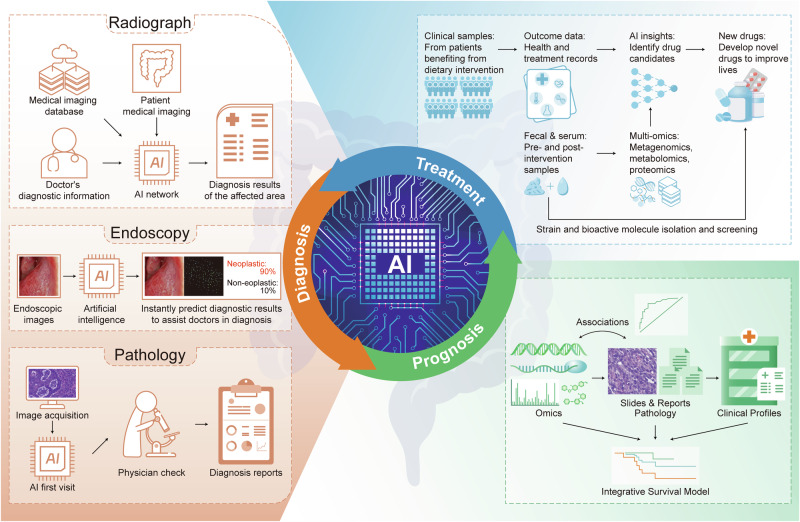
Colorectal cancer (CRC) remains one of the leading causes of cancer-related mortality worldwide. Its complexity is influenced by various signal transduction networks that govern cellular proliferation, survival, differentiation, and apoptosis. The pathogenesis of CRC is a testament to the dysregulation of these signaling cascades, which culminates in the malignant transformation of colonic epithelium. This review aims to dissect the foundational signaling mechanisms implicated in CRC, to elucidate the generalized principles underpinning neoplastic evolution and progression. We discuss the molecular hallmarks of CRC, including the genomic, epigenomic and microbial features of CRC to highlight the role of signal transduction in the orchestration of the tumorigenic process. Concurrently, we review the advent of targeted and immune therapies in CRC, assessing their impact on the current clinical landscape. The development of these therapies has been informed by a deepening understanding of oncogenic signaling, leading to the identification of key nodes within these networks that can be exploited pharmacologically. Furthermore, we explore the potential of integrating AI to enhance the precision of therapeutic targeting and patient stratification, emphasizing their role in personalized medicine. In summary, our review captures the dynamic interplay between aberrant signaling in CRC pathogenesis and the concerted efforts to counteract these changes through targeted therapeutic strategies, ultimately aiming to pave the way for improved prognosis and personalized treatment modalities in colorectal cancer.
Overview
The claims and statistics of this paper haven’t been checked yet.
Free: it reads the open-access text and checks the first 5 claims that cite a source we can check. Create a free account to check every claim.
Integrity signals
Registry
Cites
Statistics
Figures
Verification
Claims the paper makes
The claims and statistics of this paper haven’t been checked yet.
Free: it reads the open-access text and checks the first 5 claims that cite a source we can check. Create a free account to check every claim.
Claims other papers make about this one
Each is checked against this paper’s own text: does it say what the citing paper says it does?
The source backs part of the claim, not all of it — or backs it for a different population, condition or comparison.
In the citing paper
“Additionally, HER2 is commonly amplified or overexpressed in 7% to 47.4% of CRC patients, activating downstream signaling in a similar manner [81–83].”
From Differential Response and Resistance to KRAS-Targeted Therapy (2025) · cites this paper as [81]
Experimental — accuracy not yet measured
Self-check
Percentages, sums and reported differences re-computed from the paper’s own numbers.
The self-check needs the paper’s full text.
Citations
Cites
Hallmarks of Cancer: The Next Generation
Hanahan, D., & Weinberg, R. A. (2011) · Cell · doi:10.1016/j.cell.2011.02.013 · Cited by 66,590
Bray, F., Laversanne, M., Sung, H., Ferlay, J., Siegel, R. L., Soerjomataram, I., & Jemal, A. (2024) · CA: a cancer journal for clinicians · doi:10.3322/caac.21834 · Cited by 27,064
Coussens, L. M., & Werb, Z. (2002) · Nature · doi:10.1038/nature01322 · Cited by 15,111
Lynch, T. J., Bell, D. W., Sordella, R., Gurubhagavatula, S., Okimoto, R. A., Brannigan, B. W., Harris, P. L., Haserlat, S. M., Supko, J. G., Haluska, F. G., et al. (2004) · New England Journal of Medicine · doi:10.1056/nejmoa040938 · Cited by 11,486
Mantovani, A., Allavena, P., Sica, A., & Balkwill, F. (2008) · Nature · doi:10.1038/nature07205 · Cited by 11,399
Chromatin modifications and their function
Kouzarides, T. (2007) · Cell · doi:10.1016/j.cell.2007.02.005 · Cited by 10,883
Immunity, Inflammation, and Cancer
Grivennikov, S. I., Greten, F. R., & Karin, M. (2010) · Cell · doi:10.1016/j.cell.2010.01.025 · Cited by 10,755
Mutations of the BRAF gene in human cancer
Davies, H., Bignell, G. R., Cox, C., Stephens, P., Edkins, S., Clegg, S., Teague, J., Woffendin, H., Garnett, M. J., Bottomley, W., et al. (2002) · Nature · doi:10.1038/nature00766 · Cited by 10,674
The role of pattern-recognition receptors in innate immunity: update on Toll-like receptors
Kawai, T., & Akira, S. (2010) · Nature Immunology · doi:10.1038/ni.1863 · Cited by 9,304
Shrestha, S., & Offer, S. M. (2016) · Medical Epigenetics · doi:10.1159/000444713 · Cited by 8,914
Research works printed but not linked: 4
- Charifa, A., Jamil, R. T. & Zhang, X. Gardner syndrome. (2018). 29493967
- Garralda, E. et al. (Wolters Kluwer Health, 2021).
- Troyanska, O. & Reich, R. Pacific Symposium on Biocomputing 2022. World Sci, 175–186 (2022).
- Mnih, V., Heess, N. & Graves, A. Recurrent models of visual attention. Adv. Neural Inf. Process Syst. 2204–2212 (2014).
Cited by
Unveiling the link between chronic inflammation and cancer
Tripathi, S., Sharma, Y., & Kumar, D. (2025) · Metabolism Open · doi:10.1016/j.metop.2025.100347 · Cited by 109
“Recent research, however, has shown that inflammation continues to be a critical factor in the initiation and spread of some childhood cancers, especially those with developmental origins [335].”
Galasso, L., Termite, F., Mignini, I., Esposto, G., Borriello, R., Vitale, F., Nicoletti, A., Paratore, M., Ainora, M. E., Gasbarrini, A., et al. (2025) · Cancers · doi:10.3390/cancers17030368 · Cited by 90
“These alterations lead to microsatellite instability (MSI), including MSI-L or elevated microsatellite alterations at selected tetranu-cleotide repeats (EMAST), and facilitate the relocation of the mismatch repair protein MSH3 [14–33].”
Uti, D. E., Atangwho, I. J., Alum, E. U., Ntaobeten, E., Obeten, U. N., Bawa, I., Agada, S. A., Ukam, C. I.-O., & Egbung, G. E. (2025) · Discover Nano · doi:10.1186/s11671-025-04248-0 · Cited by 82
Bautista, J., Maceiras, M. L., Hidalgo‐Tinoco, C., Guerra-Guerrero, A., Betancourt-Velarde, A., & López‐Cortés, A. (2026) · npj Biofilms and Microbiomes · doi:10.1038/s41522-025-00883-8 · Cited by 77
“These transmitters activate β -adrenergic and muscarinic receptors on epithelial and stromal cells, leading to downstream activation of oncogenic pathways, including MAPK, PI3K-AKT,andSTAT3signaling,therebypromotingproliferation, migration, and resistance to apoptosis 111,148 .”
InfluentialPang, B., & Wu, H. (2025) · Cell Death Discovery · doi:10.1038/s41420-025-02623-5 · Cited by 79
“As our understanding of the metabolic-immunological axis in CRC advances, so too will our ability to develop personalized treatment strategies that harness the immune system to combat this disease [79, 80].”
Metadata
- Authors
- Li, Q., Geng, S., Luo, H., Wang, W., Mo, Y.-Q., Luo, Q., Wang, L., Song, G.-B., Sheng, J.-P., & Xu, B.
- Affiliations
- Chongqing University (CN)
- Chongqing Medical University (CN)
- Army Medical University (CN)
- Chongqing Municipal Health Commission (CN)
- Corresponding author
- Xu, Bo
- Venue
- Signal Transduction and Targeted Therapy
- Published
- 2024-10-07
- Volume
- 9
- Issue
- 1
- Pages
- 266-266
- ISSN
- 2059-3635 (ISSN-L)
- PMC
- PMC11456611
- OpenAlex
- W4403163174
- Cited by
- 546
- References
- 537
- Citations by year
- 2026: 275 · 2025: 263 · 2024: 7
- FWCI
- 29.22
- Type
- journal article
- Language
- en
- Open access
- gold
- doi.org
- Licence
- cc-by
- creativecommons.org/licenses/by/4.0 (tdm)
- creativecommons.org/licenses/by/4.0 (vor)
- Locations
- Signal Transduction and Targeted Therapy (publishedVersion, cc-by)
- PubMed Central (publishedVersion, cc-by)
- PubMed (publishedVersion)
- DOAJ (DOAJ: Directory of Open Access Journals) (submittedVersion, cc-by-sa)
- Funders
- National Natural Science Foundation of China (61906022, 82203066)
- Topics
- Health Sciences › Medicine › Oncology › Colorectal Cancer Treatments and Studies
- Health Sciences › Medicine › Pathology and Forensic Medicine › Genetic factors in colorectal cancer
- Life Sciences › Biochemistry, Genetics and Molecular Biology › Molecular Biology › Wnt/β-catenin signaling in development and cancer
- Keywords
- colorectal cancer, signal transduction, oncogenic signaling, colorectal cancer pathogenesis, colorectal cancer progression, targeted therapy, immunotherapy, epigenomics, microbiome, patient stratification
- MeSH terms
- Humans, Colorectal Neoplasms, Signal Transduction, Precision Medicine, Molecular Targeted Therapy
About these checks
Registry, retraction, Cites and statistics results are computed, not judged, with one exception: a printed reference that no index lists is read once by a model before it counts as a citation error. Claims are extracted by a model and kept only when their quote appears verbatim in the text; each cited source is then checked, with a model’s help, for whether it says what the claim relies on. Those verdicts can be wrong — read the claim’s quote and the cited source before relying on one.
Statistics and arithmetic are recomputed, not judged.
Confidence bands are shown only for fields calibrated on our annotated test set. None is calibrated yet, so no band is shown.
What counts as a claim ›How we measure confidence ›How we check this ›
Are you an author, or do you see a problem with this page? Request a review
Data sources
Bibliographic data: Semantic Scholar, OpenAlex, Crossref.
Contains information from the Semantic Scholar Academic Graph Datasets, made available under the ODC Attribution License (ODC-BY 1.0).
Semantic Scholar’s data is described in: Kinney, R., et al. (2023). The Semantic Scholar Open Data Platform. arXiv:2301.10140.
