

Effects of acute systemic inflammation on the interplay between sad mood and affective cognition.
Open accessThe DOI matches its Crossref record; 49 of the 49 references it cites were found in a registry or an index.
Abstract
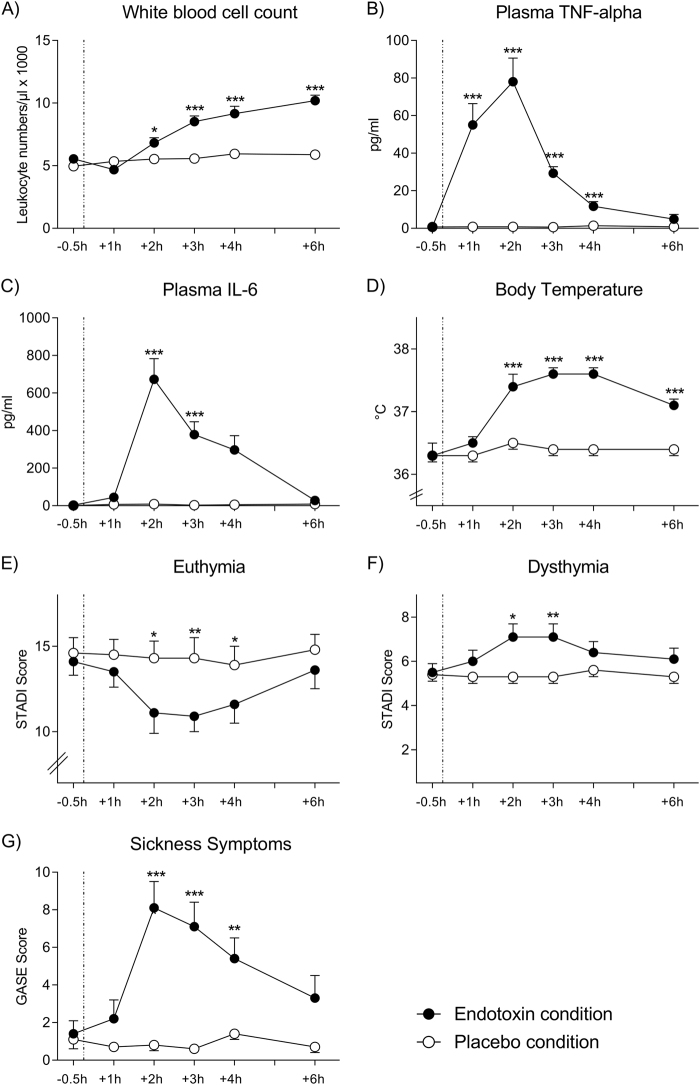
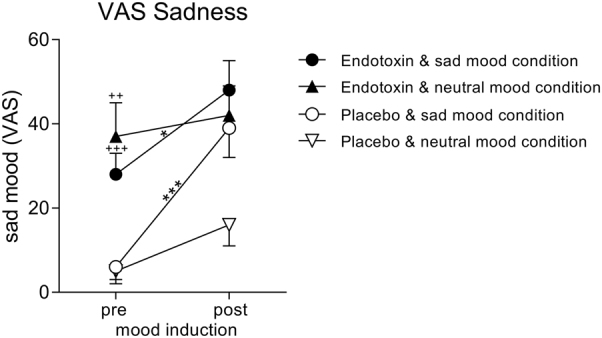
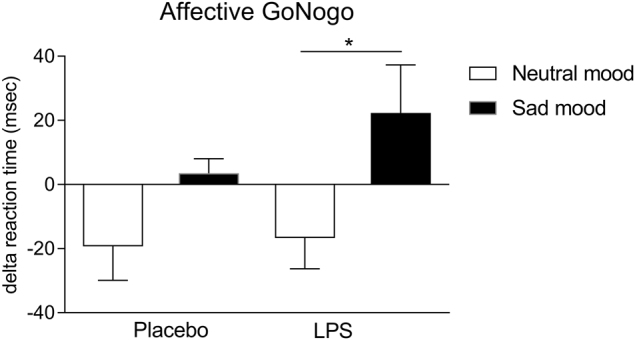
Experimental endotoxemia is a translational model to study inflammatory mechanisms involved in the pathophysiology of mood disorders including depression. Disturbed affective cognition constitutes a core aspect in depression, but has never been studied in the context of inflammation. We combined experimental endotoxemia with an established experimental mood induction procedure to assess the interaction between acute inflammation and sad mood and their effects on affective cognition. In this randomized cross-over study, N = 15 healthy males received endotoxin (0.8 ng/kg lipopolysaccharide iv) on one study day and placebo an otherwise identical study day. The affective Go/Nogo task was conducted after experimental induction of neutral and sad mood. Inflammatory markers were assessed hourly. Endotoxin application induced a transient systemic inflammation, characterized by increased leukocyte counts, TNF-alpha and interleukin-6 plasma concentrations (all p < 0.01, interaction effects). Mood induction led to greater sadness ratings, with highest ratings when sad mood was induced during inflammation ( p < 0.05, interaction effect). Based on a 2 (endotoxin vs. placebo) × 2 (sad vs. neutral mood) × 2 (sad vs. happy Go/Nogo target words) factorial design, we observed a significant target × endotoxin condition interaction ( p < 0.01) reflecting slower responses to sad targets during endotoxemia. Additionally, we found a valence × mood interaction ( p < 0.05), reflecting slower reaction times to sad targets in sad mood. In summary, acute inflammation and sad mood are risk factors for disturbed affective cognition. The results may reflect a mood-congruency effect, with prolonged and sustained processing of mood-congruent information during acute inflammation, which may contribute to depression risk.
Overview
The claims and statistics of this paper haven’t been checked yet.
Free: it reads the open-access text and checks the first 5 claims that cite a source we can check. Create a free account to check every claim.
Integrity signals
Registry
Cites
Statistics
Figures
Verification
Claims the paper makes
The claims and statistics of this paper haven’t been checked yet.
Free: it reads the open-access text and checks the first 5 claims that cite a source we can check. Create a free account to check every claim.
Claims other papers make about this one
Each is checked against this paper’s own text: does it say what the citing paper says it does?
In the citing paper
“other studies could not confirm this hypothesis (Benson et al., 2017; Niemegeers et al., 2019).”
From The interplay between stress, inflammation, and emotional attention: relevance for depression (2019) · cites this paper as Benson et al., 2017
In the citing paper
“slower processing of negative information was observed in response to LPS treatment and at a trend level in combined LPS and negative mood induction condition in healthy males (Benson et al., 2017).”
From The interplay between stress, inflammation, and emotional attention: relevance for depression (2019) · cites this paper as Benson et al., 2017
Self-check
Percentages, sums and reported differences re-computed from the paper’s own numbers.
The self-check needs the paper’s full text.
Citations
Cites
Cognitive Therapy for Depression: (675542012-001)
(2012) · PsycEXTRA Dataset · doi:10.1037/e675542012-001 · Cited by 9,663
Molecular Mechanisms of Depression: Perspectives on New Treatment Strategies
Lang, U. E., & Borgwardt, S. (2013) · Cellular Physiology and Biochemistry · doi:10.1159/000350094 · Cited by 8,475
A Meta-Analysis of Cytokines in Major Depression
Dowlati, Y., Herrmann, N., Swardfager, W., Liu, H., Sham, L., Reim, E. K., & Lanctôt, K. L. (2010) · Biological Psychiatry · doi:10.1016/j.biopsych.2009.09.033 · Cited by 4,729
The role of inflammation in depression: from evolutionary imperative to modern treatment target
Miller, A. H., & Raison, C. L. (2016) · Nature Reviews Immunology · doi:10.1038/nri.2015.5 · Cited by 3,942
Inflammation and Its Discontents: The Role of Cytokines in the Pathophysiology of Major Depression
Miller, A. H., Maletic, V., & Raison, C. L. (2009) · Biological Psychiatry · doi:10.1016/j.biopsych.2008.11.029 · Cited by 3,848
Cytokines sing the blues: inflammation and the pathogenesis of depression
Raison, C. L., Capuron, L., & Miller, A. H. (2006) · Trends in Immunology · doi:10.1016/j.it.2005.11.006 · Cited by 3,009
Cognition and Depression: Current Status and Future Directions
Gotlib, I. H., & Joormann, J. (2010) · Annual Review of Clinical Psychology · doi:10.1146/annurev.clinpsy.121208.131305 · Cited by 2,420
A laboratory task for induction of mood states
Velten, E. (1968) · Behaviour Research and Therapy · doi:10.1016/0005-7967(68)90028-4 · Cited by 1,201
Hyde, J. S., Mezulis, A. H., & Abramson, L. Y. (2008) · Psychological Review · doi:10.1037/0033-295x.115.2.291 · Cited by 1,146
Tyring, S., Gottlieb, A., Papp, K., Gordon, K., Leonardi, C., Wang, A., Lalla, D., Woolley, M., Jahreis, A., Zitnik, R., et al. (2006) · The Lancet · doi:10.1016/s0140-6736(05)67763-x · Cited by 1,069
Research works printed but not linked: 1
- Beck A. T., Rush A. J., Shaw B. F., Emery G. Cognitive Therapy of Depression. Guilford Press, New York, 1979.
Cited by
Labanski, A., Langhorst, J., Engler, H., & Elsenbruch, S. (2020) · Psychoneuroendocrinology · doi:10.1016/j.psyneuen.2019.104501 · Cited by 200
Self-citationThe interplay between stress, inflammation, and emotional attention: relevance for depression
Maydych, V. (2019) · Frontiers in Neuroscience · doi:10.3389/fnins.2019.00384 · Cited by 193
Lasselin, J., Schedlowski, M., Karshikoff, B., Engler, H., Lekander, M., & Konsman, J. P. (2020) · Neuroscience & Biobehavioral Reviews · doi:10.1016/j.neubiorev.2020.05.001 · Cited by 165
“The LPS-induced rise in body temperature in humans typically starts 1 h and peaks 3−4 h after the injection (Benson et al., 2017; Calvano and Coyle, 2012; Coyle et al., 2006; Grigoleit et al., 2011; Kox et al., 2014).”
Self-citationZeng, Y., Lin, R., Liu, L., Liu, Y., & Li, Y. (2019) · Psychiatry Research · doi:10.1016/j.psychres.2019.04.019 · Cited by 148
Lasselin, J., Lekander, M., Benson, S., Schedlowski, M., & Engler, H. (2021) · Molecular Psychiatry · doi:10.1038/s41380-020-00869-2 · Cited by 114
“Experimental endotoxemia also affects incentive motivation [38, 39], and alters the cognitive processing of negative information [40].”
BackgroundSelf-citationThompson, K. I., Chau, M., Lorenzetti, M. S., Hill-Bowen, L. D., Fins, A. I., & Tartar, J. L. (2022) · Frontiers in Behavioral Neuroscience · doi:10.3389/fnbeh.2022.945661 · Cited by 140
“Combined, elevated levels in inflammationmarkers would plausibly account for mood changes observed following acute sleep deprivation (Benson et al., 2017), as neuroimaging supports the finding that peripheral inflammation contributes to behavioral changes (Felger, 2018).”
BackgroundLasselin, J., Lekander, M., Axelsson, J., & Karshikoff, B. (2018) · Frontiers in Neuroendocrinology · doi:10.1016/j.yfrne.2018.06.005 · Cited by 106
Back to the future of psychoneuroimmunology: Studying inflammation-induced sickness behavior
Lasselin, J. (2021) · Brain Behavior & Immunity - Health · doi:10.1016/j.bbih.2021.100379 · Cited by 79
Common Fundamentals of Psoriasis and Depression
Hölsken, S., Krefting, F., Schedlowski, M., & Sondermann, W. (2021) · Acta Dermato Venereologica · doi:10.2340/actadv.v101.565 · Cited by 76
Self-citationLasselin, J., Karshikoff, B., Axelsson, J., Åkerstedt, T., Benson, S., Engler, H., Schedlowski, M., Jones, M., Lekander, M., & Andréasson, A. (2019) · Brain Behavior and Immunity · doi:10.1016/j.bbi.2019.10.020 · Cited by 66
Self-citationCordeiro, R. C., Filho, A. J. M. C., Gomes, N. S., Tomaz, V. D. S., Medeiros, C. D., Queiroz, A. I. D. G., Maes, M. H. J., Macêdo, D. S., & Carvalho, A. F. (2019) · Frontiers in Psychiatry · doi:10.3389/fpsyt.2019.00125 · Cited by 60
“In humans and rodents, a unique systemic administration of LPS causes a spectrum of behavioral alterations that resembles depression, including depressed mood, fatigue, and psychomotor slowing in humans (23, 24), as well as anhedonia, decreased activity, cognitive dysfunction, and altered sleep in rodents (25, 26).”
BackgroundHuang, W.-Y., Liu, K.-H., Lin, S., Chen, T.-Y., Tseng, C.-Y., Chen, H.-Y., Wu, H.-M., & Hsu, K. (2019) · Brain Behavior and Immunity · doi:10.1016/j.bbi.2019.12.006 · Cited by 57
Peters, A. T., Ren, X., Bessette, K. L., Goldstein, B. I., West, A. E., Langenecker, S. A., & Pandey, G. N. (2019) · Journal of Psychiatric Research · doi:10.1016/j.jpsychires.2019.03.030 · Cited by 48
Resende, R., Fernandes, T., Pereira, A. C., Pascale, J. D., Marques, A. P., Oliveira, P., Morais, S., Santos, V. L. C. D. G., Madeira, N. G. G. F., Pereira, C., et al. (2020) · Biochimica et Biophysica Acta (BBA) - Molecular Basis of Disease · doi:10.1016/j.bbadis.2020.165752 · Cited by 42
Integrative medicine considerations for convalescence from mild-to-moderate COVID-19 disease
Alschuler, L. N., Chiasson, A. M., Horwitz, R., STERNBERG, E. M., Crocker, R. L., Weil, A., & Maizes, V. (2020) · EXPLORE · doi:10.1016/j.explore.2020.12.005 · Cited by 40
“Additionally, inflammatory cytokines, such as IL-6 and TNF-alpha, which are characteristically elevated in SARS-CoV-2 infection, are implicated in mood disorders especially depression.(19) Convalescence from MtoM COVID-19 infection is not the primary concern of conventional medicine, whose resources are appropriately…”
BackgroundFarfara, D., Feierman, E. R., Richards, A. T., Revenko, A. S., MacLeod, R. A., Norris, E. H., & Strickland, S. (2019) · Glia · doi:10.1002/glia.23611 · Cited by 41
“Systemic inflammation can induce neuroinflammation and behavioral deficits such as depressive-like behavior and cognitive impairment (Benson et al., 2017; Biesmans et al., 2013, 2015).”
Lasselin, J., Petrović, P., Olsson, M. J., Göranson, S. P., Lekander, M., Jensen, K. B., & Axelsson, J. (2018) · Brain Behavior and Immunity · doi:10.1016/j.bbi.2018.09.008 · Cited by 40
Benson, S., Labrenz, F., Kotulla, S., Brotte, L., Rödder, P., Tebbe, B., Theysohn, N., Engler, H., & Elsenbruch, S. (2023) · Brain Behavior and Immunity · doi:10.1016/j.bbi.2023.06.005 · Cited by 36
“Since inflammation reportedly enhances negative mood and susceptibility to negative emotional stimuli (i.e., negativity bias) (Benson et al., 2017; Eisenberger et al., 2009), one may have expected greater sadness responses in the LPS condition, presumably contributing to amplified interoceptive…”
BackgroundMethodResultInfluentialSelf-citationEmotional expressions of the sick face
Sarolidou, G., Axelsson, J., Sundelin, T., Lasselin, J., Regenbogen, C., Sorjonen, K., Lundström, J. N., Lekander, M., & Olsson, M. J. (2019) · Brain Behavior and Immunity · doi:10.1016/j.bbi.2019.04.003 · Cited by 35
Targeting inflammatory pathways for treatment of the major depressive disorder
Patil, C. R., Gawli, C., & Bhatt, S. (2023) · Drug Discovery Today · doi:10.1016/j.drudis.2023.103697 · Cited by 35
Hou, S., Tian, Z., Zhao, D., Liang, Y. J., Dai, S., Ji, Q., Fan, Z., Liu, Z., Liu, M., & Yang, Y. (2023) · Molecular Nutrition & Food Research · doi:10.1002/mnfr.202200800 · Cited by 30
Inflammatory neuropsychiatric disorders and COVID-19 neuroinflammation
Tang, S. W., Helmeste, D. M., & Leonard, B. E. (2021) · Acta Neuropsychiatrica · doi:10.1017/neu.2021.13 · Cited by 35
“Acute systematic inflammation induced by endotoxin also may precipitate sad mood (Benson et al., 2017) and exacerbation of schizophrenic symptoms has been reported with oseltamivir administration (Lan et al., 2015).”
BackgroundGiménez, M. C., Luxwolda, M., van Stipriaan, E., Bollen, P. P., Hoekman, R. L., Koopmans, M. A., Arany, P. R., Krames, M. R., Berends, A. C., Hut, R. A., et al. (2022) · Biology · doi:10.3390/biology12010060 · Cited by 33
Neuroimmune modulation of pain across the developmental spectrum
Karshikoff, B., Tadros, M. A., Mackey, S., & Zouikr, I. (2019) · Current Opinion in Behavioral Sciences · doi:10.1016/j.cobeha.2019.01.010 · Cited by 21
Toll-like receptor 4 methylation grade is linked to depressive symptom severity
Rasmusson, A. J., Gallwitz, M., Soltanabadi, B., Ciuculete, D. M., Mengel‐From, J., Christensen, K., Nygaard, M., Soerensen, M., Boström, A. E. D., Fredriksson, R., et al. (2021) · Translational Psychiatry · doi:10.1038/s41398-021-01481-w · Cited by 20
Resolution of depression: Antidepressant actions of resolvins
Deyama, S., Kaneda, K., & Minami, M. (2022) · Neuroscience Research · doi:10.1016/j.neures.2022.10.006 · Cited by 19
The roles of neuroinflammation and glutamatergic excitotoxicity in treatment-resistant depression
Candee, R., Wilkenson, R., Schreiber, M., & DeCenzo, M. (2023) · JAAPA · doi:10.1097/01.jaa.0000921252.57819.4b · Cited by 20
Does Human Experimental Endotoxemia Impact Negative Cognitions Related to the Self?
Kotulla, S., Elsenbruch, S., Roderigo, T., Brinkhoff, A., Wegner, A., Engler, H., Schedlowski, M., & Benson, S. (2018) · Frontiers in Behavioral Neuroscience · doi:10.3389/fnbeh.2018.00183 · Cited by 18
Self-citationLee, H., Lee, Y., Chung, C., Park, S., Shin, H. J., Joe, E.-H., Lee, S. J., Kim, D. W., Jo, S., & Choi, S. (2024) · Glia · doi:10.1002/glia.24629 · Cited by 15
“…cytokines and causes a series of depression-like behaviors including low locomotion, decreased sociability, anhedonia, and cognitive impairment (Benson et al., 2017; Beurel et al., 2020; Custódio et al., 2013; Frenois et al., 2007; Klawonn et al., 2021; Tomaz et al., 2014; Yirmiya, 1996; Zhang…”
The roles of inflammation, affect, and interoception in predicting social perception
Feldman, M. J., Jolink, T. A., Alvarez, G., Fendinger, N. J., Gaudier‐Diaz, M. M., Lindquist, K. A., & Muscatell, K. A. (2023) · Brain Behavior and Immunity · doi:10.1016/j.bbi.2023.05.011 · Cited by 16
No Reason to Feel Sick? Nocebo Responses in the Placebo Arms of Experimental Endotoxemia Studies
Benson, S., & Elsenbruch, S. (2019) · Frontiers in Psychiatry · doi:10.3389/fpsyt.2019.00511 · Cited by 15
Self-citationNiemegeers, P., de Boer, P., Schuermans, J., Dumont, G. J. H., Coppens, V., Spittaels, K., Claes, S., Sabbe, B. G. C., & Morrens, M. (2019) · Journal of Affective Disorders · doi:10.1016/j.jad.2018.11.020 · Cited by 12
Handke, A. E., Axelsson, J., Benson, S., Boy, K., Weskamp, V., Hasenberg, T., Remy, M., Hebebrand, J., Föcker, M., Brinkhoff, A., et al. (2020) · Brain Behavior & Immunity - Health · doi:10.1016/j.bbih.2020.100130 · Cited by 12
Self-citationBenmhammed, H., Lamtai, M., Mesfioui, A., Nassiri, A., Mouden, S., Bikri, S., & Hessni, A. E. (2024) · Neuroscience and Behavioral Physiology · doi:10.1007/s11055-024-01584-z · Cited by 10
Regulation of emotions during experimental endotoxemia: A pilot study
Hansson, L. S., Axelsson, J., Petrović, P., Göranson, S. P., Olsson, M. J., Lekander, M., & Lasselin, J. (2021) · Brain Behavior and Immunity · doi:10.1016/j.bbi.2021.01.013 · Cited by 10
Alzarea, S. I., Alhassan, H. H., Alzarea, A. I., Al‐Oanzi, Z. H., & Afzal, M. (2022) · Brain Sciences · doi:10.3390/brainsci12050655 · Cited by 8
“Experimental procedures conducted to study the influence of LPS administration in rodents confirmed the development of depression, anhedonia, low interest in social activities, fatigue, psychomotor slowing, and cognitive alterations [39].”
MethodAlhazzaa, O. A., Abahussin, H. M., Majrashi, M. A., Alotaibi, M. S., Alkhrayef, M. N., Alhamdan, Z. A., & Alawad, A. O. (2026) · Frontiers in Aging · doi:10.3389/fragi.2026.1743142 · Cited by 7
How Can Experimental Endotoxemia Contribute to Our Understanding of Pain? A Narrative Review
Benson, S., & Karshikoff, B. (2023) · NeuroImmunoModulation · doi:10.1159/000534467 · Cited by 8
“Experimental endotoxemia reportedly induces mood changes, with transient states of negative, depression-like mood [100, 101] and anxiety [102, 103], as well as an altered cognitive processing of emotional information [100] (for review, see [2]).”
BackgroundSelf-citationSchmidt, J., Reinold, J., Klinger, R., & Benson, S. (2021) · Der Schmerz · doi:10.1007/s00482-021-00602-0 · Cited by 7
Self-citationKelliher, J. C., Marić, I., Engeland, C. G., Shearer, G. C., & Skibicka, K. P. (2024) · American Journal of Physiology-Regulatory, Integrative and Comparative Physiology · doi:10.1152/ajpregu.00242.2024 · Cited by 6
Inflammatory models of depression in rodents and humans
Markov, D., Zozulya, S. A., & Dolotov, O. V. (2026) · Frontiers in Psychiatry · doi:10.3389/fpsyt.2026.1687579 · Cited by 5
Makhanova, A., Tolliver, M., Buckner, Z., Shields, G. S., Hunter, C. L., Mengelkoch, S., Houpt, J. W., Belote, A. E., Hoose, D. V., & Schulz, T. K. (2023) · Brain Behavior and Immunity · doi:10.1016/j.bbi.2024.08.039 · Cited by 5
Muthusamy, N., Williams, T. I., O’Toole, R., Brudvig, J. J., Adler, K. B., Weimer, J. M., Muddiman, D. C., & Ghashghaei, H. T. (2022) · GeroScience · doi:10.1007/s11357-022-00517-3 · Cited by 5
“: (0123456789) increased inflammation in the brain is associated with neurocognitive and neuropsychiatric behavioral deficits [58, 59, 61, 62].”
BackgroundPeripheral inflammation is associated with impaired sadness recognition in euthymic bipolar patients
Chang, C.-Y., Chang, H. H., Wu, C. Y., Tsai, Y. T., Lu, T., Chang, W. H., Hsu, C., Chen, P. S., & Tseng, H. (2024) · Journal of Psychiatric Research · doi:10.1016/j.jpsychires.2024.03.049 · Cited by 4
Exercise-induced inflammation alters the perception and visual exploration of emotional interactions
Keck, J., Honekamp, C., Gebhardt, K., Nolte, S., Linka, M., de Haas, B., Munzert, J., Krüger, K., & Krüger, B. (2024) · Brain Behavior & Immunity - Health · doi:10.1016/j.bbih.2024.100806 · Cited by 4
“…increase of pro-inflammatory cytokines, such as TNF-α and IL-6, in healthy subjects without inducing an actual infection (Balter et al., 2018; Benson et al., 2017; Bollen et al., 2017; Eisenberger et al., 2009; Grigoleit et al., 2011; Kotulla et al., 2018; Kullmann et al., 2014; Moieni et…”
BackgroundBetween care and contagion: Insights from the endotoxin model into the social facets of sickness
Flasbeck, V., Engler, H., Marková, V., Schedlowski, M., & Brüne, M. (2025) · Neuroscience & Biobehavioral Reviews · doi:10.1016/j.neubiorev.2025.106486 · Cited by 1
Self-citationSARS-CoV-2 Spike Protein S1 Subunit Induces Neuroinflammation Via Microglial Kv1.3 Channel
Lee, H.-Y., Lee, Y., Jo, S., & Choi, S. (2026) · Biological Psychiatry Global Open Science · doi:10.1016/j.bpsgos.2026.100716 · Cited by 2
Howell, J. (2018) · Carleton University's Institutional Repository (MacOdrum Library, Carleton University) · doi:10.22215/etd/2018-13331 · Cited by 1
“In addition, the induction of inflammatory states through the administration of an endotoxin may alter the recognition of mood related stimuli, which may contribute to the risk of depression (Benson et al., 2017).”
BackgroundKlawonn, A. M., & Fritz, M. (2020) · Neuromethods · doi:10.1007/978-1-0716-1146-3_7
Can Chronic Pain be considered a Disease of Civilization?
Clayton, P. (2022) · Chronic Pain & Management · doi:10.29011/2576-957x.100046
Brotte, L. (2024) · DuEPublico (University of Duisburg-Essen) · doi:10.17185/duepublico/82334
Kircher, J. A. (2024) · eScholarship (California Digital Library) · Cited by 1
Scare or care? How immunological processes shape perception of sickness-relevant stimuli in humans
Hansson, L. S. (2024) · Open Archive (Karolinska Institutet)
Zandasrar, F., & Alimohammadi, S. (2026) · International Journal of Peptide Research and Therapeutics · doi:10.1007/s10989-026-10824-4
“…systemic inflammation induced by the administration of LPS with the manifestation of neuro - psychological disturbances, which encompass depressive mood, anhedonia, anxiety and psychomotor retardation in human subjects (DellaGioia and Hannestad 2010; Grigoleit et al. 2011 ; Benson et al. 2017).”
Wolff, L. M. (2026) · Lincoln (University of Nebraska)
Milasauskiene, E., Burkauskas, J., Jesmanas, S., Gleiznienė, R., Borutaitė, V., Raškauskienė, N., Škėmienė, K., Adomaitienė, V., Gradauskienė, B., Brown, G. C., et al. (2026) · Brain Sciences · doi:10.3390/brainsci16080852
Association of air pollution with mental and behavioral disorders in young and middle-aged adults
Zhao, Z., Chu, Y., Chen, X., & Liu, T. (2026) · Scientific Reports · doi:10.1038/s41598-026-69746-2
“Systemic inflammation can induce cytokine responses affecting the brain, correlating with depressive symptoms 59 .”
Metadata
- Authors
- Benson, S., Brinkhoff, A., Lueg, L., Roderigo, T., Kribben, A., Wilde, B., Witzke, O., Engler, H., Schedlowski, M., & Elsenbruch, S.
- Affiliations
- Essen University Hospital (DE)
- Corresponding author
- Benson, Sven
- ORCID
- Venue
- Translational Psychiatry
- Published
- 2017-12-11
- Volume
- 7
- Issue
- 12
- Pages
- 1281-1281
- ISSN
- 2158-3188 (ISSN-L)
- PMC
- PMC5802562
- OpenAlex
- W2771072859
- Cited by
- 53
- References
- 49
- Citations by year
- 2026: 6 · 2025: 1 · 2024: 5 · 2023: 7 · 2022: 6 · 2021: 6 · 2020: 6 · 2019: 11 · 2018: 5
- FWCI
- 2.00
- Type
- journal article
- Language
- en
- Open access
- gold
- doi.org
- Licence
- cc-by
- creativecommons.org/licenses/by/4.0 (tdm)
- creativecommons.org/licenses/by/4.0 (vor)
- Locations
- Translational Psychiatry (publishedVersion, cc-by)
- PubMed Central (publishedVersion, cc-by)
- PubMed (publishedVersion)
- DOAJ (DOAJ: Directory of Open Access Journals) (submittedVersion)
- Funders
- Deutsche Forschungsgemeinschaft (EL 236/11-1, BE-5173/2-1)
- Topics
- Life Sciences › Neuroscience › Biological Psychiatry › Tryptophan and brain disorders
- Life Sciences › Neuroscience › Behavioral Neuroscience › Stress Responses and Cortisol
- Life Sciences › Neuroscience › Cognitive Neuroscience › Neural and Behavioral Psychology Studies
- Keywords
- acute systemic inflammation, endotoxemia, lipopolysaccharide, sad mood, affective cognition, mood induction, go/no-go task, TNF-α, interleukin-6, depression risk, valence, emotional processing
- MeSH terms
- Adult, Affect, Cognition, Depression, Double-Blind Method, Humans, Inflammation, Lipopolysaccharides, Male, Cross-Over Studies, Endotoxemia, Young Adult
About these checks
Registry, retraction, Cites and statistics results are computed, not judged, with one exception: a printed reference that no index lists is read once by a model before it counts as a citation error. Claims are extracted by a model and kept only when their quote appears verbatim in the text; each cited source is then checked, with a model’s help, for whether it says what the claim relies on. Those verdicts can be wrong — read the claim’s quote and the cited source before relying on one.
Statistics and arithmetic are recomputed, not judged.
Confidence bands are shown only for fields calibrated on our annotated test set. None is calibrated yet, so no band is shown.
What counts as a claim ›How we measure confidence ›How we check this ›
Are you an author, or do you see a problem with this page? Request a review
Data sources
Bibliographic data: Semantic Scholar, OpenAlex, Crossref.
Contains information from the Semantic Scholar Academic Graph Datasets, made available under the ODC Attribution License (ODC-BY 1.0).
Semantic Scholar’s data is described in: Kinney, R., et al. (2023). The Semantic Scholar Open Data Platform. arXiv:2301.10140.
