

Prefrontal networks dynamically related to recovery from major depressive disorder: a longitudinal pharmacological fMRI study
Open accessThe DOI matches its Crossref record; 88 of the 89 references it cites were found in a registry or an index.
Abstract
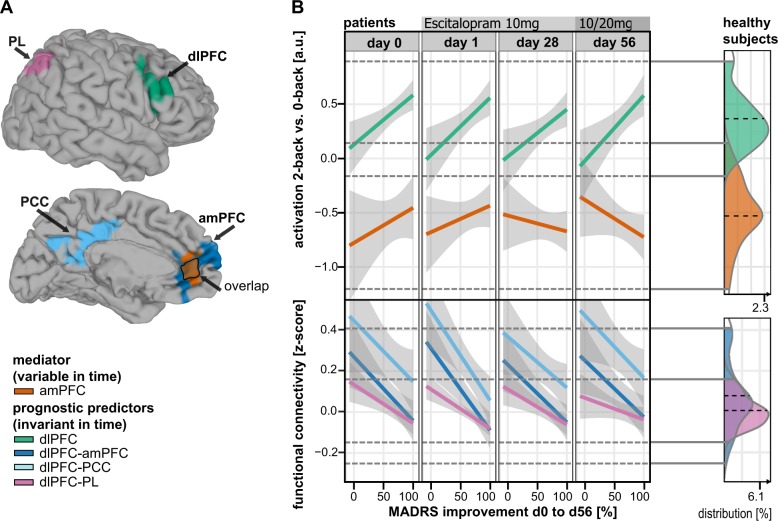
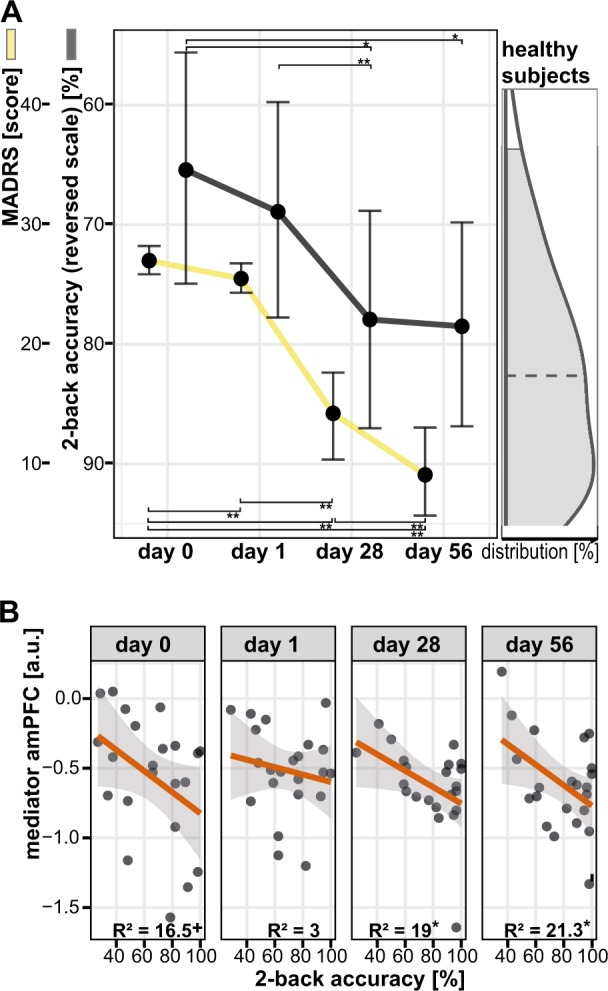
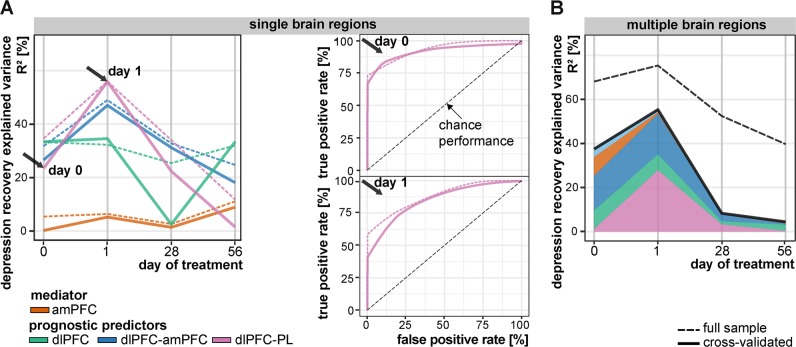
Due to lacking predictors of depression recovery, successful treatment of major depressive disorder (MDD) is frequently only achieved after therapeutic optimization leading to a prolonged suffering of patients. This study aimed to determine neural prognostic predictors identifying non-remitters prior or early after treatment initiation. Moreover, it intended to detect time-sensitive neural mediators indicating depression recovery. This longitudinal, interventional, single-arm, open-label, phase IV, pharmacological functional magnetic resonance imaging (fMRI) study comprised four scans at important stages prior (day 0) and after escitalopram treatment initiation (day 1, 28, and 56). Totally, 22 treatment-free MDD patients (age mean ± SD: 31.5 ± 7.7; females: 50%) suffering from a concurrent major depressive episode without any comorbid DSM-IV axis I diagnosis completed the study protocol. Primary outcome were neural prognostic predictors of depression recovery. Enhanced de-activation of anterior medial prefrontal cortex (amPFC, single neural mediator) indicated depression recovery correlating with MADRS score and working memory improvements. Strong dorsolateral PFC (dlPFC) activation and weak dlPFC-amPFC, dlPFC-posterior cingulate cortex (PCC), dlPFC-parietal lobe (PL) coupling (three prognostic predictors) hinted at depression recovery at day 0 and 1. Preresponse prediction of continuous (dlPFC-PL: R 2day1 = 55.9%, 95% CI: 22.6–79%, P < 0.005) and dichotomous (specificity/sensitivity: SP/SN day1 = 0.91/0.82) recovery definitions remained significant after leave-one-out cross-validation. Identified prefrontal neural predictors might propel the future development of fMRI markers for clinical decision making, which could lead to increased response rates and adherence during acute phase treatment periods. Moreover, this study underscores the importance of the amPFC in depression recovery.
Overview
The claims and statistics of this paper haven’t been checked yet.
Free: it reads the open-access text and checks the first 5 claims that cite a source we can check. Create a free account to check every claim.
Integrity signals
Registry
Cites
Statistics
Figures
Verification
Claims the paper makes
The claims and statistics of this paper haven’t been checked yet.
Free: it reads the open-access text and checks the first 5 claims that cite a source we can check. Create a free account to check every claim.
Claims other papers make about this one
Each is checked against this paper’s own text: does it say what the citing paper says it does?
The source backs part of the claim, not all of it — or backs it for a different population, condition or comparison.
In the citing paper
“Among medication-free patients with MDD, greater deactivation of an anteromedial PFC (amPFC) region encompassing the pgACC and mPFC (BA10) during a WM task predicted greater symptom reduction with escitalopram (and greater WM improvements) [247].”
From Prefrontal cortex and depression (2022) · cites this paper as [247]
Experimental — accuracy not yet measuredThe cited source says what the claim attributes to it.
In the citing paper
“stronger pretreatment dlPFC activationcoupled with weaker dlPFC-amPFC functional connectivitypredicted depression recovery.”
From Prefrontal cortex and depression (2022) · cites this paper as [247]
Self-check
Percentages, sums and reported differences re-computed from the paper’s own numbers.
The self-check needs the paper’s full text.
Citations
Cites
A new depression scale designed to be sensitive to change
Montgomery, S. A., & Åsberg, M. (1979) · British Journal of Psychiatry · doi:10.1192/bjp.134.4.382 · Cited by 13,962
Desikan, R. S., Ségonne, F., Fischl, B., Quinn, B. T., Dickerson, B. C., Blacker, D., Buckner, R. L., Dale, A. M., Maguire, R. P., Hyman, B. T., et al. (2006) · NeuroImage · doi:10.1016/j.neuroimage.2006.01.021 · Cited by 13,324
Cohen, J. (1992) · Psychological Bulletin · doi:10.1037//0033-2909.112.1.155 · Cited by 8,771
Vos, T., Flaxman, A. D., Naghavi, M., Lozano, R., Michaud, C., Ezzati, M., Shibuya, K., Salomon, J. A., Abdalla, S., Aboyans, V., et al. (2012) · The Lancet · doi:10.1016/s0140-6736(12)61729-2 · Cited by 8,291
Rush, A. J., Trivedi, M. H., Wisniewski, S. R., Nierenberg, A. A., Stewart, J. W., Warden, D., Niederehe, G., Thase, M. E., Lavori, P. W., Lebowitz, B. D., et al. (2006) · American Journal of Psychiatry · doi:10.1176/ajp.2006.163.11.1905 · Cited by 5,643
Responses to depression and their effects on the duration of depressive episodes
Nolen-Hoeksema, S. (1991) · Journal of Abnormal Psychology · doi:10.1037/0021-843x.100.4.569 · Cited by 4,529
Circular analysis in systems neuroscience: the dangers of double dipping
Kriegeskorte, N., Simmons, W. K., Bellgowan, P. S. F., & Baker, C. I. (2009) · Nature Neuroscience · doi:10.1038/nn.2303 · Cited by 2,696
Subgenual prefrontal cortex abnormalities in mood disorders
Drevets, W. C., Price, J. L., Simpson, J. R., Todd, R. D., Reich, T., Vannier, M., & Raichle, M. E. (1997) · Nature · doi:10.1038/386824a0 · Cited by 2,693
Mediators and Moderators of Treatment Effects in Randomized Clinical Trials
Kraemer, H. C., Wilson, G. T., Fairburn, C. G., & Agras, W. S. (2002) · Archives of General Psychiatry · doi:10.1001/archpsyc.59.10.877 · Cited by 2,562
Pezawas, L., Meyer-Lindenberg, A., Drabant, E. M., Verchinski, B. A., Munoz, K. E., Kolachana, B. S., Egan, M. F., Mattay, V. S., Hariri, A. R., & Weinberger, D. R. (2005) · Nature Neuroscience · doi:10.1038/nn1463 · Cited by 1,980
Self-citation
Research works printed but not linked: 2
- McGrath CL Toward a neuroimaging treatment selection biomarker for major depressive disorder JAMA Psychiatry 2013 70 821 829 10.1001/jamapsychiatry.2013.143 23760393 PMC4413467 · DOI · Paper page
- Roiser JP Elliott R Sahakian BJ Cognitive mechanisms of treatment in depression Neuropsychopharmacology 2012 37 117 136 10.1038/npp.2011.183 21976044 PMC3238070 · DOI · Paper page
Cited by
Prefrontal cortex and depression
Pizzagalli, D. A., & Roberts, A. C. (2022) · Neuropsychopharmacology · doi:10.1038/s41386-021-01101-7 · Cited by 667
Major Depressive Disorder: Advances in Neuroscience Research and Translational Applications
Li, Z., Ruan, M., Chen, J., & Fang, Y. (2021) · Neuroscience Bulletin · doi:10.1007/s12264-021-00638-3 · Cited by 326
Cohen, S. E., Zantvoord, J. B., Wezenberg, B. N., Bockting, C., & van Wingen, G. A. (2021) · Translational Psychiatry · doi:10.1038/s41398-021-01286-x · Cited by 93
Yoshino, Y., Roy, B., & Dwivedi, Y. (2021) · Neuropsychopharmacology · doi:10.1038/s41386-020-00861-y · Cited by 70
Lai, C. (2020) · Progress in Neuro-Psychopharmacology and Biological Psychiatry · doi:10.1016/j.pnpbp.2020.110234 · Cited by 75
Bertocci, M. A., Afriyie-Agyemang, Y., Rozovsky, R., Iyengar, S., Stiffler, R. S., Aslam, H. A., Bebko, G. M., & Phillips, M. L. (2022) · Molecular Psychiatry · doi:10.1038/s41380-022-01899-8 · Cited by 71
Long, F., Chen, Y. A., Zhang, Q., Li, Q., Wang, Y., Wang, Y., Li, H., Zhao, Y., McNamara, R. K., DelBello, M. P., et al. (2024) · Molecular Psychiatry · doi:10.1038/s41380-024-02710-6 · Cited by 61
MRI predictors of pharmacotherapy response in major depressive disorder
Gerlach, A. R., Karim, H. T., Peciña, M., Ajilore, O., Taylor, W. D., Butters, M. A., & Andreescu, C. (2022) · NeuroImage: Clinical · doi:10.1016/j.nicl.2022.103157 · Cited by 57
“nectivity between dlPFC and the anterior mPFC, PCC, and parietal lobe, as well as deactivation of the anterior mPFC, correlated with symptom improvement (Meyer et al., 2019).”
BackgroundConnectome-based models can predict early symptom improvement in major depressive disorder
Ju, Y., Horien, C. L., Chen, W., Guo, W., Lu, X., Sun, J., Dong, Q., Liu, B., Liu, J., Yan, D., et al. (2020) · Journal of Affective Disorders · doi:10.1016/j.jad.2020.04.028 · Cited by 53
Grennan, G., Withers, M. C., Ramanathan, D., & Mishra, J. (2023) · PLOS Climate · doi:10.1371/journal.pclm.0000125 · Cited by 45
Kotoula, V., Evans, J. W., Punturieri, C., & Zarate, C. A. (2023) · Frontiers in Neuroimaging · doi:10.3389/fnimg.2023.1110258 · Cited by 43
Takamiya, A., Kishimoto, T., Hirano, J., Nishikata, S., Sawada, K., Kurokawa, S., Yamagata, B., Kikuchi, T., & Mimura, M. (2020) · Psychological Medicine · doi:10.1017/s0033291720001518 · Cited by 38
Blank, T. S., Meyer, B. M., Wieser, M., Rabl, U., Schögl, P., & Pezawas, L. (2022) · Depression and Anxiety · doi:10.1002/da.23254 · Cited by 32
Self-citationWu, H., Liu, R., Zhou, J., Feng, L., Wang, Y., Chen, X., Zhang, Z., Cui, J., Zhou, Y., & Wang, G. (2022) · Translational Psychiatry · doi:10.1038/s41398-022-02152-0 · Cited by 32
Fournier, J. C. J., Bertocci, M. A., Ladouceur, C. D., Bonar, L. K., Monk, K., Abdul‐waalee, H., Versace, A., Santos, J. P. L., Iyengar, S., Birmaher, B. B., et al. (2021) · Neuropsychopharmacology · doi:10.1038/s41386-021-01001-w · Cited by 29
Reyes-Lizaola, S., Luna-Zarate, U., Tendilla‐Beltrán, H., Morales‐Medina, J. C., & Flores, G. (2023) · Progress in Neuro-Psychopharmacology and Biological Psychiatry · doi:10.1016/j.pnpbp.2023.110876 · Cited by 28
Sacu, S., Wackerhagen, C., Erk, S., Romanczuk‐Seiferth, N., Schwarz, K., Schweiger, J. I., Tost, H., Meyer‐Lindenberg, A., Heinz, A., Razi, A., et al. (2022) · Psychological Medicine · doi:10.1017/s0033291722000824 · Cited by 26
Karvelis, P., Charlton, C. E., Allohverdi, S. G., Bedford, P., Hauke, D. J., & Diaconescu, A. O. (2022) · Network Neuroscience · doi:10.1162/netn_a_00233 · Cited by 26
Grimm, S., Keicher, C., Paret, C., Niedtfeld, I., Beckmann, C. F., Mennes, M., Just, S., Sharma, V., Fuertig, R., Herich, L., et al. (2022) · European Neuropsychopharmacology · doi:10.1016/j.euroneuro.2022.10.009 · Cited by 23
Liu, C., Belleau, E. L., Dong, D., Sun, X., Xiong, G., Pizzagalli, D. A., Auerbach, R. P., Wang, X., & Yao, S. (2023) · Journal of Affective Disorders · doi:10.1016/j.jad.2023.05.074 · Cited by 24
SSRI Treatment Response Prediction in Depression Based on Brain Activation by Emotional Stimuli
Preuss, A., Bolliger, B., Schicho, W., Hättenschwiler, J., Seifritz, E., Brühl, A. B., & Herwig, U. (2020) · Frontiers in Psychiatry · doi:10.3389/fpsyt.2020.538393 · Cited by 22
Neural mechanisms of emotional health in traumatic brain injury patients undergoing rTMS treatment
Sultana, T., Hasan, M. A., Kang, X., Liou-Johnson, V., Adamson, M. M., & Razi, A. (2023) · Molecular Psychiatry · doi:10.1038/s41380-023-02159-z · Cited by 22
“The dysfunction of prefrontal cortical regions account for the psychiatric disorders related to mood dysregulation [68, 69].”
BackgroundSuppressed activity of the rostral anterior cingulate cortex as a biomarker for depression remission
Davey, C. G., Cearns, M., Jamieson, A. J., & Harrison, B. J. (2021) · Psychological Medicine · doi:10.1017/s0033291721004323 · Cited by 22
Figeys, M., Villarey, S., Leung, A. W. S., Raso, J., Buchan, S., Kammerer, H., Rawani, D., Kohls-Wiebe, M., & Kim, E. S. (2022) · Frontiers in Rehabilitation Sciences · doi:10.3389/fresc.2022.997531 · Cited by 20
Fan, X.-F., Peng, J., Zhang, L., Hu, Y., Li, Y., Shi, Y., & Zhang, T.-M. (2024) · Annals of General Psychiatry · doi:10.1186/s12991-024-00503-3 · Cited by 19
Farb, N. A. S., Desormeau, P., Anderson, A. K., & Segal, Z. V. (2022) · NeuroImage: Clinical · doi:10.1016/j.nicl.2022.102969 · Cited by 16
“Functional connectivity studies corroborate this account, linking MDD to elevated connectivity within prefrontal networks (22), and remission to reduced connectivity within these networks (23).”
Hou, Z., Jiang, W., Li, F., Liu, X., Hou, Z., Yin, Y., Zhang, H., Zhang, H., Xie, C., Zhang, Z., et al. (2023) · Journal of Affective Disorders · doi:10.1016/j.jad.2023.02.104 · Cited by 16
Zhou, C., Kong, D., Xue, R., Chen, M., Li, G., Xu, Y. J., Liu, S., Tian, H., & Zhuo, C. (2020) · Frontiers in Neuroscience · doi:10.3389/fnins.2020.00517 · Cited by 17
Functional neuroimaging biomarkers of resilience in major depressive disorder
Fischer, A. S., Hagan, K. E., & Gotlib, I. H. (2021) · Current Opinion in Psychiatry · doi:10.1097/yco.0000000000000662 · Cited by 15
Goldberg, J. F., & Nasrallah, H. A. (2022) · Psychological Medicine · doi:10.1017/s0033291722001179 · Cited by 10
“Similar changes in prefrontal network connectivity have been observed after successful treatment of MDD with selective serotonin reuptake inhibitors (Meyer et al., 2019).”
BackgroundTRPC4/5 inhibitors: Phase I results and proof of concept studies
Grimm, S., Just, S., Fuertig, R., Dwyer, J. B., Sharma, V., & Wunder, A. (2024) · European Archives of Psychiatry and Clinical Neuroscience · doi:10.1007/s00406-024-01890-0 · Cited by 10
Indoleamine 2, 3-dioxygenase is responsible for low stress tolerance after intracerebral hemorrhage
Ohnishi, M., Akagi, M., Kotsuki, M., Yonemura, S., Aokawa, H., Yamashita-Ibara, M., Yokofujita, O., Maehara, S., Hata, T., & Inoue, A. (2023) · PLoS ONE · doi:10.1371/journal.pone.0273037 · Cited by 9
Neurobiological predictors for clinical trajectories in fully remitted depressed patients
Blank, T. S., Meyer, B. M., Rabl, U., Schögl, P., Wieser, M., & Pezawas, L. (2020) · Depression and Anxiety · doi:10.1002/da.23108 · Cited by 8
Self-citationTang, H., Wang, X., Lü, Q., Zhao, S., Zou, H., Hua, L., Chen, Z., Shi, J., & Yao, Z. (2025) · BMC Psychiatry · doi:10.1186/s12888-025-07180-w · Cited by 7
Zhang, H., Li, C., Shi, K., Xia, Y., Song, Y., Feng, J., Wang, Z., Wang, K., & Yang, Y. (2025) · Translational Psychiatry · doi:10.1038/s41398-025-03576-0 · Cited by 7
Wu, Y.-C., Yu, H., Yen, C., Yeh, Y., Jian, C.-R., Lin, C.-W., & Lin, I. (2024) · Journal of Affective Disorders · doi:10.1016/j.jad.2024.01.020 · Cited by 7
Social interactions between attachment partners increase inter-brain plasticity
Schwartz, L., Lévy, J., Salomonski, C., Peleg, I., Hayut, O., Zagoory‐Sharon, O., & Feldman, R. (2025) · Brain Research · doi:10.1016/j.brainres.2025.149856 · Cited by 6
Zhang, C., Zhang, L., Liang, J., Han, Y., Yan, H., Ou, Y., Liang, W., Huang, W., Li, X., Tang, C., et al. (2025) · Asian Journal of Psychiatry · doi:10.1016/j.ajp.2025.104764 · Cited by 6
Collo, G., Cavalleri, L., & Pich, E. M. (2019) · Chronic Stress · doi:10.1177/2470547019842545 · Cited by 6
Omlor, N., Richter, M., Goltermann, J., Steinmann, L. A., Kraus, A., Borgers, T., Klug, M., Enneking, V., Redlich, R., Dohm, K., et al. (2023) · Journal of Affective Disorders · doi:10.1016/j.jad.2023.02.102 · Cited by 5
Li, K., Lu, X., Xiao, C., Zheng, K., Sun, J., Dong, Q., Wang, M., Zhang, L., Liu, B., Liu, J., et al. (2023) · Brain Sciences · doi:10.3390/brainsci13050705 · Cited by 4
Escitalopram and functional connectivity in major depressive disorder: A systematic review
Turiaco, F., Arnone, F., Drago, A., Muscatello, M. R. A., Bruno, A., & Iannuzzo, F. (2025) · Journal of Psychopharmacology · doi:10.1177/02698811251370998 · Cited by 3
Reward-related activation of fronto-striatal regions scaled negatively with C-reactive protein
Aruldass, A. R., Kitzbichler, M. G., Lim, T. V., Cavanagh, J., Cowen, P. J., Pariante, C. M., Bullmore, E. T., & Harrison, N. A. (2025) · Psychological Medicine · doi:10.1017/s0033291725102031 · Cited by 3
Jing, R., Huo, Y., Si, J., Li, H., Yu, M., Lin, X., Liu, G., & Li, P. (2022) · Brain Imaging and Behavior · doi:10.1007/s11682-022-00739-1 · Cited by 3
Schneider, B. C., Diedrich, S., Hauschildt, M., Biedermann, S. V., Arlt, S., Moritz, S., & Jelinek, L. (2021) · Zeitschrift für Neuropsychologie · doi:10.1024/1016-264x/a000330 · Cited by 3
Functional Magnetic Resonance Imaging: An Overview of Technical Advances and Clinical Applications
Zhang, L., Wang, X., & Liu, H. (2024) · Advances in medical diagnosis, treatment, and care (AMDTC) book series · doi:10.4018/979-8-3693-3218-4.ch006 · Cited by 2
Natural Language Processing Applied to Psychiatric Clinical Notes: Scoping Review
Rao, S., Chen, X. R., Deng, G., Xie, J., Jiang, T., Li, T., Zhang, Y., & Jiang, H. (2026) · JMIR Medical Informatics · doi:10.2196/91249 · Cited by 2
Yang, C., Wang, P., Biswal, B. B., & Wang, Y. (2025) · BMC Psychiatry · doi:10.1186/s12888-025-07351-9 · Cited by 1
Die Alpha-Asymmetrie als Responseprädiktor in der antidepressiven Therapie
Weise, J. (2021) · Refubium (Universitätsbibliothek der Freien Universität Berlin) · doi:10.17169/refubium-30341
Tura, A. (2024) · eDiss (Georg-August-Universität Göttingen) · doi:10.53846/goediss-10519
Connection Selection and Asymmetric Attention Mechanism for Brain Network Classification
Cui, X. (2025) · International Conference on Internet of Things, Automation and Artificial Intelligence (IoTAAI) · doi:10.1109/iotaai66837.2025.11213282
Zhang, S., Zhang, Z., Li, X., Zhou, J., Li, R., Liu, R., Wang, Y., Chen, X., Feng, Y., Cui, J., et al. (2026) · Depression and Anxiety · doi:10.1155/da/4701907
FARMACOGENÉTICA NA PERSONALIZAÇÃO DO TRATAMENTO DA DEPRESSÃO: REVISÃO SISTEMÁTICA
Albuquerque, A. A. E., da Paixão, G. V. C., Gomes, S. A., da Paixão, I. V., Pereira, J. E. G., Segato, A. C. F., da Paixão, Y. V., Carvalho, J. B. G., de Oliveira, L. S., Filho, R. R. D., et al. (2026) · Revista de Geopolítica · doi:10.56238/revgeov17n10-110
Metadata
- Authors
- Meyer, B. M., Rabl, U., Huemer, J., Bartova, L., Kalcher, K., Provenzano, J., Brandner, C., Sezen, P., Kasper, S., Schatzberg, A. F., Moser, E., Chen, G., & Pezawas, L.
- Affiliations
- Medical University of Vienna (AT)
- Stanford Medicine (US)
- National Institute of Mental Health (US)
- Corresponding author
- Pezawas, Lukas
- ORCID
- Venue
- Translational Psychiatry
- Published
- 2019-02-04
- Volume
- 9
- Issue
- 1
- Pages
- 64-64
- ISSN
- 2158-3188 (ISSN-L)
- PMC
- PMC6362173
- OpenAlex
- W2911421502
- Cited by
- 52
- References
- 89
- Citations by year
- 2026: 4 · 2025: 6 · 2024: 6 · 2023: 9 · 2022: 12 · 2021: 6 · 2020: 8 · 2019: 1
- FWCI
- 4.18
- Type
- journal article
- Language
- en
- Open access
- gold
- doi.org
- Licence
- cc-by
- creativecommons.org/licenses/by/4.0 (tdm)
- creativecommons.org/licenses/by/4.0 (vor)
- Locations
- Translational Psychiatry (publishedVersion, cc-by)
- Europe PMC (PubMed Central) (publishedVersion, other-oa)
- PubMed Central (publishedVersion, cc-by)
- PubMed (publishedVersion)
- Lirias (KU Leuven) (submittedVersion, other-oa)
- DOAJ (DOAJ: Directory of Open Access Journals) (submittedVersion)
- Topics
- Health Sciences › Medicine › Pharmacology (medical) › Treatment of Major Depression
- Life Sciences › Neuroscience › Cognitive Neuroscience › Neural and Behavioral Psychology Studies
- Life Sciences › Neuroscience › Cognitive Neuroscience › Functional Brain Connectivity Studies
- Keywords
- major depressive disorder, recovery from depression, escitalopram, anterior medial prefrontal cortex, dorsolateral prefrontal cortex, posterior cingulate cortex, parietal lobe, working memory, Montgomery-Asberg Depression Rating Scale, treatment response prediction, fMRI biomarkers
- MeSH terms
- Adult, Major Depressive Disorder, Female, Gyrus Cinguli, Humans, Longitudinal Studies, Magnetic Resonance Imaging, Male, Memory, Short-Term, Nerve Net, Parietal Lobe, Prognosis, Sensitivity and Specificity, Citalopram, Outcome Assessment, Health Care, Selective Serotonin Reuptake Inhibitors, Prefrontal Cortex, Young Adult, Connectome
About these checks
Registry, retraction, Cites and statistics results are computed, not judged, with one exception: a printed reference that no index lists is read once by a model before it counts as a citation error. Claims are extracted by a model and kept only when their quote appears verbatim in the text; each cited source is then checked, with a model’s help, for whether it says what the claim relies on. Those verdicts can be wrong — read the claim’s quote and the cited source before relying on one.
Statistics and arithmetic are recomputed, not judged.
Confidence bands are shown only for fields calibrated on our annotated test set. None is calibrated yet, so no band is shown.
What counts as a claim ›How we measure confidence ›How we check this ›
Are you an author, or do you see a problem with this page? Request a review
Data sources
Bibliographic data: Semantic Scholar, OpenAlex, Crossref.
Contains information from the Semantic Scholar Academic Graph Datasets, made available under the ODC Attribution License (ODC-BY 1.0).
Semantic Scholar’s data is described in: Kinney, R., et al. (2023). The Semantic Scholar Open Data Platform. arXiv:2301.10140.
