

Prefrontal networks dynamically related to recovery from major depressive disorder: a longitudinal pharmacological fMRI study
Open accessThe DOI matches its Crossref record; 88 of the 89 references it cites were found in a registry or an index.
Abstract
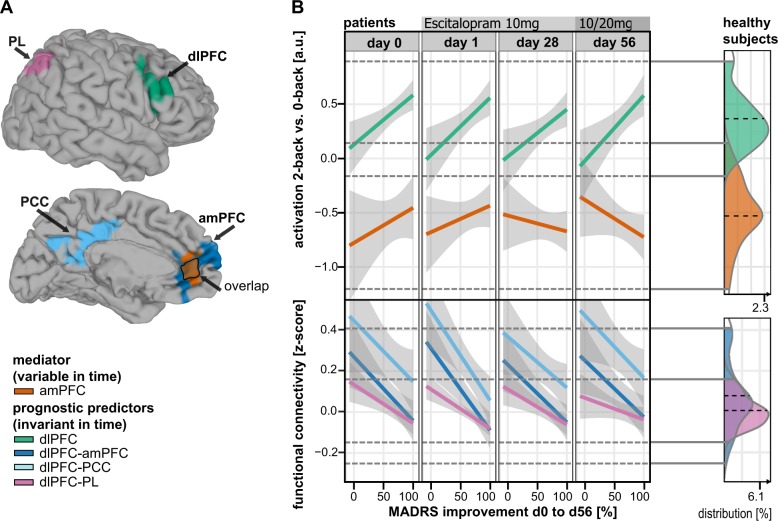
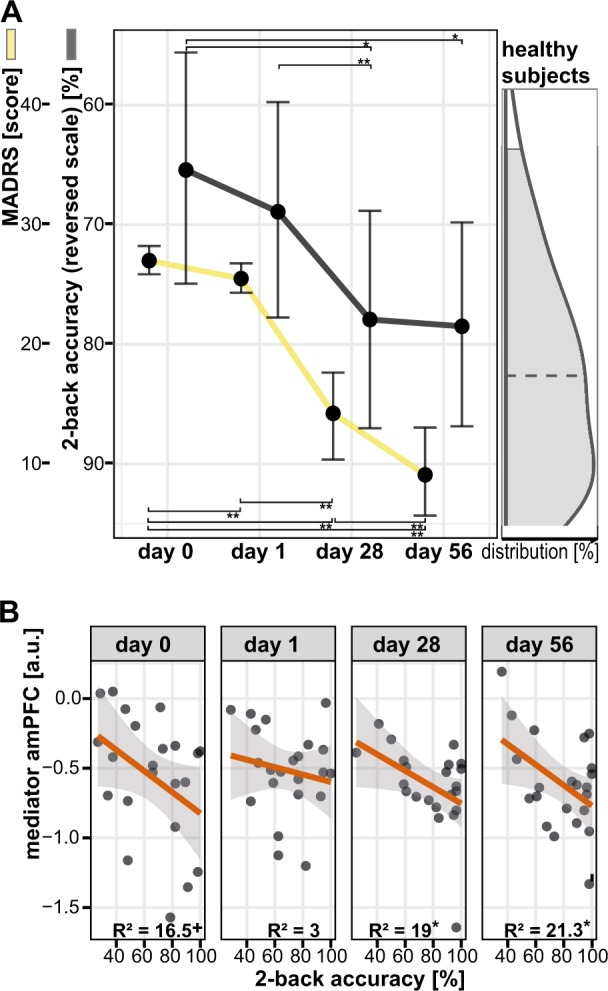
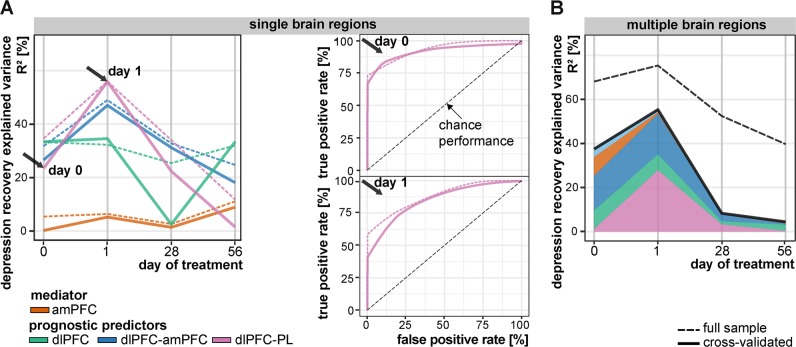
Due to lacking predictors of depression recovery, successful treatment of major depressive disorder (MDD) is frequently only achieved after therapeutic optimization leading to a prolonged suffering of patients. This study aimed to determine neural prognostic predictors identifying non-remitters prior or early after treatment initiation. Moreover, it intended to detect time-sensitive neural mediators indicating depression recovery. This longitudinal, interventional, single-arm, open-label, phase IV, pharmacological functional magnetic resonance imaging (fMRI) study comprised four scans at important stages prior (day 0) and after escitalopram treatment initiation (day 1, 28, and 56). Totally, 22 treatment-free MDD patients (age mean ± SD: 31.5 ± 7.7; females: 50%) suffering from a concurrent major depressive episode without any comorbid DSM-IV axis I diagnosis completed the study protocol. Primary outcome were neural prognostic predictors of depression recovery. Enhanced de-activation of anterior medial prefrontal cortex (amPFC, single neural mediator) indicated depression recovery correlating with MADRS score and working memory improvements. Strong dorsolateral PFC (dlPFC) activation and weak dlPFC-amPFC, dlPFC-posterior cingulate cortex (PCC), dlPFC-parietal lobe (PL) coupling (three prognostic predictors) hinted at depression recovery at day 0 and 1. Preresponse prediction of continuous (dlPFC-PL: R 2day1 = 55.9%, 95% CI: 22.6–79%, P < 0.005) and dichotomous (specificity/sensitivity: SP/SN day1 = 0.91/0.82) recovery definitions remained significant after leave-one-out cross-validation. Identified prefrontal neural predictors might propel the future development of fMRI markers for clinical decision making, which could lead to increased response rates and adherence during acute phase treatment periods. Moreover, this study underscores the importance of the amPFC in depression recovery.
Overview
The claims and statistics of this paper haven’t been checked yet.
Free: it reads the open-access text and checks the first 5 claims that cite a source we can check. Create a free account to check every claim.
Integrity signals
Registry
Cites
Statistics
Figures
Verification
Claims the paper makes
The claims and statistics of this paper haven’t been checked yet.
Free: it reads the open-access text and checks the first 5 claims that cite a source we can check. Create a free account to check every claim.
Claims other papers make about this one
Each is checked against this paper’s own text: does it say what the citing paper says it does?
The source backs part of the claim, not all of it — or backs it for a different population, condition or comparison.
In the citing paper
“Among medication-free patients with MDD, greater deactivation of an anteromedial PFC (amPFC) region encompassing the pgACC and mPFC (BA10) during a WM task predicted greater symptom reduction with escitalopram (and greater WM improvements) [247].”
From Prefrontal cortex and depression (2022) · cites this paper as [247]
Experimental — accuracy not yet measuredThe cited source says what the claim attributes to it.
In the citing paper
“stronger pretreatment dlPFC activationcoupled with weaker dlPFC-amPFC functional connectivitypredicted depression recovery.”
From Prefrontal cortex and depression (2022) · cites this paper as [247]
Self-check
Percentages, sums and reported differences re-computed from the paper’s own numbers.
The self-check needs the paper’s full text.
Citations
Cites
A new depression scale designed to be sensitive to change
Montgomery, S. A., & Åsberg, M. (1979) · British Journal of Psychiatry · doi:10.1192/bjp.134.4.382 · Cited by 13,962
Desikan, R. S., Ségonne, F., Fischl, B., Quinn, B. T., Dickerson, B. C., Blacker, D., Buckner, R. L., Dale, A. M., Maguire, R. P., Hyman, B. T., et al. (2006) · NeuroImage · doi:10.1016/j.neuroimage.2006.01.021 · Cited by 13,324
Cohen, J. (1992) · Psychological Bulletin · doi:10.1037//0033-2909.112.1.155 · Cited by 8,771
Vos, T., Flaxman, A. D., Naghavi, M., Lozano, R., Michaud, C., Ezzati, M., Shibuya, K., Salomon, J. A., Abdalla, S., Aboyans, V., et al. (2012) · The Lancet · doi:10.1016/s0140-6736(12)61729-2 · Cited by 8,291
Rush, A. J., Trivedi, M. H., Wisniewski, S. R., Nierenberg, A. A., Stewart, J. W., Warden, D., Niederehe, G., Thase, M. E., Lavori, P. W., Lebowitz, B. D., et al. (2006) · American Journal of Psychiatry · doi:10.1176/ajp.2006.163.11.1905 · Cited by 5,643
Responses to depression and their effects on the duration of depressive episodes
Nolen-Hoeksema, S. (1991) · Journal of Abnormal Psychology · doi:10.1037/0021-843x.100.4.569 · Cited by 4,529
Circular analysis in systems neuroscience: the dangers of double dipping
Kriegeskorte, N., Simmons, W. K., Bellgowan, P. S. F., & Baker, C. I. (2009) · Nature Neuroscience · doi:10.1038/nn.2303 · Cited by 2,696
Subgenual prefrontal cortex abnormalities in mood disorders
Drevets, W. C., Price, J. L., Simpson, J. R., Todd, R. D., Reich, T., Vannier, M., & Raichle, M. E. (1997) · Nature · doi:10.1038/386824a0 · Cited by 2,693
Mediators and Moderators of Treatment Effects in Randomized Clinical Trials
Kraemer, H. C., Wilson, G. T., Fairburn, C. G., & Agras, W. S. (2002) · Archives of General Psychiatry · doi:10.1001/archpsyc.59.10.877 · Cited by 2,562
Pezawas, L., Meyer-Lindenberg, A., Drabant, E. M., Verchinski, B. A., Munoz, K. E., Kolachana, B. S., Egan, M. F., Mattay, V. S., Hariri, A. R., & Weinberger, D. R. (2005) · Nature Neuroscience · doi:10.1038/nn1463 · Cited by 1,980
Self-citationThe robust beauty of improper linear models in decision making.
Dawes, R. M. (1979) · American Psychologist · doi:10.1037/0003-066x.34.7.571 · Cited by 1,966
Neural mechanisms of the cognitive model of depression.
Disner, S. G., Beevers, C. G., Haigh, E. A. P., & Beck, A. T. (2011) · Nature Reviews Neuroscience · doi:10.1038/nrn3027 · Cited by 1,718
The neural bases of emotion regulation
Etkin, A., Büchel, C., & Gross, J. J. (2015) · Nature Reviews Neuroscience · doi:10.1038/nrn4044 · Cited by 1,244
Severity classification on the Hamilton depression rating scale
Zimmerman, M., Martinez, J. H., Young, D., Chelminski, I., & Dalrymple, K. (2013) · Journal of Affective Disorders · doi:10.1016/j.jad.2013.04.028 · Cited by 1,199
Mayberg, H. S., Brannan, S. K., Tekell, J. L., Silva, J. A., Mahurin, R. K., McGinnis, S., & Jerabek, P. A. (2000) · Biological Psychiatry · doi:10.1016/s0006-3223(00)01036-2 · Cited by 1,115
Goldapple, K., Segal, Z., Garson, C., Lau, M., Bieling, P., Kennedy, S., & Mayberg, H. (2004) · Archives of General Psychiatry · doi:10.1001/archpsyc.61.1.34 · Cited by 1,068
Explicit and implicit emotion regulation: a dual-process framework.
Gyurak, A., Gross, J. J., & Etkin, A. (2011) · Cognition and Emotion · doi:10.1080/02699931.2010.544160 · Cited by 1,015
Kapur, S., Phillips, A. G., & Insel, T. R. (2012) · Molecular Psychiatry · doi:10.1038/mp.2012.105 · Cited by 980
Frontocingulate Dysfunction in Depression: Toward Biomarkers of Treatment Response
Pizzagalli, D. A. (2011) · Neuropsychopharmacology · doi:10.1038/npp.2010.166 · Cited by 945
Hamilton, J. P., Furman, D. J., Chang, C., Thomason, M. E., Dennis, E., & Gotlib, I. H. (2011) · Biological Psychiatry · doi:10.1016/j.biopsych.2011.02.003 · Cited by 823
How Many Subjects Constitute a Study?
Friston, K. J., Holmes, A. P., & Worsley, K. J. (1999) · NeuroImage · doi:10.1006/nimg.1999.0439 · Cited by 814
Callicott, J. H. (1999) · Cerebral Cortex · doi:10.1093/cercor/9.1.20 · Cited by 771
Cleare, A., Pariante, C., Young, A., Anderson, I., Christmas, D., Cowen, P., Dickens, C., Ferrier, I., Geddes, J., Gilbody, S., et al. (2015) · Journal of Psychopharmacology · doi:10.1177/0269881115581093 · Cited by 759
Mapping the functional connectivity of anterior cingulate cortex
Margulies, D. S., Kelly, A. M. C., Uddin, L. Q., Biswal, B. B., Castellanos, F. X., & Milham, M. P. (2007) · NeuroImage · doi:10.1016/j.neuroimage.2007.05.019 · Cited by 756
Bland, J. M., & Altman, D. G. (1990) · Computers in Biology and Medicine · doi:10.1016/0010-4825(90)90013-f · Cited by 691
Cognitive therapy versus medication for depression: treatment outcomes and neural mechanisms
DeRubeis, R. J., Siegle, G. J., & Hollon, S. D. (2008) · Nature Reviews Neuroscience · doi:10.1038/nrn2345 · Cited by 690
Subcallosal Cingulate Deep Brain Stimulation for Treatment-Resistant Unipolar and Bipolar Depression
Holtzheimer, P. E. (2012) · Archives of General Psychiatry · doi:10.1001/archgenpsychiatry.2011.1456 · Cited by 608
Toward a Neuroimaging Treatment Selection Biomarker for Major Depressive Disorder
McGrath, C. L., Kelley, M. E., Holtzheimer, P. E., Dunlop, B. W., Craighead, W. E., Franco, A. R., Craddock, R. C., & Mayberg, H. S. (2013) · JAMA Psychiatry · doi:10.1001/jamapsychiatry.2013.143 · Cited by 561
How can we learn about developmental processes from cross-sectional studies, or can we?
Kraemer, H. C., Yesavage, J. A., Taylor, J. L., & Kupfer, D. (2000) · American Journal of Psychiatry · doi:10.1176/appi.ajp.157.2.163 · Cited by 548
Prediction as a Humanitarian and Pragmatic Contribution from Human Cognitive Neuroscience
Gabrieli, J. D. E., Ghosh, S. S., & Whitfield-Gabrieli, S. (2015) · Neuron · doi:10.1016/j.neuron.2014.10.047 · Cited by 535
Cognitive Mechanisms of Treatment in Depression
Roiser, J. P., Elliott, R., & Sahakian, B. J. (2012) · Neuropsychopharmacology · doi:10.1038/npp.2011.183 · Cited by 535
Stratified medicine: strategic and economic implications of combining drugs and clinical biomarkers
Trusheim, M. R., Berndt, E. R., & Douglas, F. L. (2007) · Nature Reviews Drug Discovery · doi:10.1038/nrd2251 · Cited by 509
The neural substrates of affective processing in depressed patients treated with venlafaxine
Davidson, R. J., Irwin, W., Anderle, M. J., & Kalin, N. H. (2003) · American Journal of Psychiatry · doi:10.1176/appi.ajp.160.1.64 · Cited by 487
Functional Biomarkers of Depression: Diagnosis, Treatment, and Pathophysiology
Schmidt, H. D., Shelton, R. C., & Duman, R. S. (2011) · Neuropsychopharmacology · doi:10.1038/npp.2011.151 · Cited by 474
Review and meta-analysis of antidepressant pharmacogenetic findings in major depressive disorder
Kato, M., & Serretti, A. (2010) · Molecular Psychiatry · doi:10.1038/mp.2008.116 · Cited by 450
Linear mixed-effects modeling approach to FMRI group analysis
Chen, G., Saad, Z. S., Britton, J. C., Pine, D. S., & Cox, R. W. (2013) · NeuroImage · doi:10.1016/j.neuroimage.2013.01.047 · Cited by 447
Self-citationCattaneo, A., Gennarelli, M., Uher, R., Breen, G., Farmer, A., Aitchison, K. J., Craig, I. W., Anacker, C., Zunsztain, P. A., McGuffin, P., et al. (2013) · Neuropsychopharmacology · doi:10.1038/npp.2012.191 · Cited by 436
Moving From Static to Dynamic Models of the Onset of Mental Disorder: A Review
Nelson, B., McGorry, P. D., Wichers, M., Wigman, J. T. W., & Hartmann, J. A. (2017) · JAMA Psychiatry · doi:10.1001/jamapsychiatry.2017.0001 · Cited by 376
Statistical analysis of longitudinal neuroimage data with Linear Mixed Effects models
Bernal-Rusiel, J. L., Greve, D. N., Reuter, M., Fischl, B., & Sabuncu, M. R. (2013) · NeuroImage · doi:10.1016/j.neuroimage.2012.10.065 · Cited by 360
Dunlop, B. W., Rajendra, J. K., Craighead, W. E., Kelley, M. E., McGrath, C. L., Choi, K. S., Kinkead, B., Nemeroff, C. B., & Mayberg, H. S. (2017) · American Journal of Psychiatry · doi:10.1176/appi.ajp.2016.16050518 · Cited by 342
Response and remission criteria in major depression – A validation of current practice
Riedel, M., Möller, H.-J., Obermeier, M., Schennach-Wolff, R., Bauer, M., Adli, M., Kronmüller, K., Nickel, T., Brieger, P., Laux, G., et al. (2010) · Journal of Psychiatric Research · doi:10.1016/j.jpsychires.2010.03.006 · Cited by 288
Test-retest reliability of evoked BOLD signals from a cognitive-emotive fMRI test battery.
Plichta, M. M., Schwarz, A. J., Grimm, O., Morgen, K., Mier, D., Haddad, L., Gerdes, A. B. M., Sauer, C., Tost, H., Esslinger, C., et al. (2012) · NeuroImage · doi:10.1016/j.neuroimage.2012.01.129 · Cited by 287
Chekroud, A. M., Gueorguieva, R., Krumholz, H. M., Trivedi, M. H., Krystal, J. H., & McCarthy, G. (2017) · JAMA Psychiatry · doi:10.1001/jamapsychiatry.2017.0025 · Cited by 276
Anticevic, A., Repovs, G., Shulman, G. L., & Barch, D. M. (2010) · NeuroImage · doi:10.1016/j.neuroimage.2009.11.008 · Cited by 274
Behavioral effects of longitudinal training in cognitive reappraisal.
Denny, B. T., & Ochsner, K. N. (2014) · Emotion · doi:10.1037/a0035276 · Cited by 269
Phillips, M. L., Chase, H. W., Sheline, Y. I., Etkin, A., Almeida, J. R. C., Deckersbach, T., & Trivedi, M. H. (2015) · American Journal of Psychiatry · doi:10.1176/appi.ajp.2014.14010076 · Cited by 267
Normative database of the serotonergic system in healthy subjects using multi-tracer PET
Savli, M., Bauer, A., Mitterhauser, M., Ding, Y.-S., Hahn, A., Kroll, T., Neumeister, A., Haeusler, D., Ungersboeck, J., Henry, S., et al. (2012) · NeuroImage · doi:10.1016/j.neuroimage.2012.07.001 · Cited by 251
Self-citationCao, H., Plichta, M. M., Schäfer, A., Haddad, L., Grimm, O., Schneider, M., Esslinger, C., Kirsch, P., Meyer-Lindenberg, A., & Tost, H. (2014) · NeuroImage · doi:10.1016/j.neuroimage.2013.09.013 · Cited by 227
Salvadore, G., Cornwell, B. R., Sambataro, F., Latov, D., Colon-Rosario, V., Carver, F., Holroyd, T., DiazGranados, N., Machado-Vieira, R., Grillon, C., et al. (2010) · Neuropsychopharmacology · doi:10.1038/npp.2010.24 · Cited by 218
Langenecker, S. A., Kennedy, S. E., Guidotti, L. M., Briceno, E. M., Own, L. S., Hooven, T., Young, E. A., Akil, H., Noll, D. C., & Zubieta, J.-K. (2007) · Biological Psychiatry · doi:10.1016/j.biopsych.2007.02.019 · Cited by 211
Brain connectomics predict response to treatment in social anxiety disorder
Whitfield-Gabrieli, S., Ghosh, S. S., Nieto-Castanon, A., Saygin, Z., Doehrmann, O., Chai, X. J., Reynolds, G. O., Hofmann, S. G., Pollack, M. H., & Gabrieli, J. D. E. (2016) · Molecular Psychiatry · doi:10.1038/mp.2015.109 · Cited by 210
Hieronymus, F., Emilsson, J. F., Nilsson, S., & Eriksson, E. (2016) · Molecular Psychiatry · doi:10.1038/mp.2015.53 · Cited by 201
The neuroscience of emotion regulation development: Implications for education
Martin, R. E., & Ochsner, K. N. (2016) · Current Opinion in Behavioral Sciences · doi:10.1016/j.cobeha.2016.06.006 · Cited by 197
Pizzagalli, D. A., Webb, C. A., Dillon, D. G., Tenke, C. E., Kayser, J., Goer, F., Fava, M., McGrath, P., Weissman, M., Parsey, R., et al. (2018) · JAMA Psychiatry · doi:10.1001/jamapsychiatry.2018.0252 · Cited by 189
Combining clinical variables to optimize prediction of antidepressant treatment outcomes
Iniesta, R., Malki, K., Maier, W., Rietschel, M., Mors, O., Hauser, J., Henigsberg, N., Dernovsek, M. Z., Souery, D., Stahl, D., et al. (2016) · Journal of Psychiatric Research · doi:10.1016/j.jpsychires.2016.03.016 · Cited by 179
Roy, M., Harvey, P.-O., Berlim, M. T., Mamdani, F., Beaulieu, M.-M., Turecki, G., & Lepage, M. (2010) · Journal of Psychiatry and Neuroscience · doi:10.1139/jpn.090010 · Cited by 175
Depression Subtypes in Predicting Antidepressant Response: A Report From the iSPOT-D Trial
Arnow, B. A., Blasey, C., Williams, L. M., Palmer, D. M., Rekshan, W., Schatzberg, A. F., Etkin, A., Kulkarni, J., Luther, J. F., & Rush, A. J. (2015) · American Journal of Psychiatry · doi:10.1176/appi.ajp.2015.14020181 · Cited by 175
Self-citationPharmacological treatment of unipolar depressive disorders: summary of WFSBP guidelines
Bauer, M., Severus, E., Möller, H.-J., Young, A. H., & WFSBP Task Force on Unipolar Depressive Disorders (2017) · International Journal of Psychiatry in Clinical Practice · doi:10.1080/13651501.2017.1306082 · Cited by 175
Predictive analytics in mental health: applications, guidelines, challenges and perspectives
Hahn, T., Nierenberg, A. A., & Whitfield, S. (2016) · Molecular Psychiatry · doi:10.1038/mp.2016.201 · Cited by 150
Konarski, J. Z., Kennedy, S. H., Segal, Z. V., Lau, M. A., Bieling, P. J., McIntyre, R. S., & Mayberg, H. S. (2009) · Journal of Psychiatry and Neuroscience · doi:10.1139/jpn.0923 · Cited by 149
Gyurak, A., Patenaude, B., Korgaonkar, M. S., Grieve, S. M., Williams, L. M., & Etkin, A. (2016) · Biological Psychiatry · doi:10.1016/j.biopsych.2015.02.037 · Cited by 149
Etkin, A., Patenaude, B., Song, Y. J. C., Usherwood, T., Rekshan, W. R., Schatzberg, A. F., Rush, A. J., & Williams, L. M. (2014) · Neuropsychopharmacology · doi:10.1038/npp.2014.333 · Cited by 144
Self-citationPretreatment Brain States Identify Likely Nonresponse to Standard Treatments for Depression
McGrath, C. L., Kelley, M. E., Dunlop, B. W., Holtzheimer III, P. E., Craighead, W. E., & Mayberg, H. S. (2014) · Biological Psychiatry · doi:10.1016/j.biopsych.2013.12.005 · Cited by 139
Reduced default mode network suppression during a working memory task in remitted major depression
Bartova, L., Meyer, B. M., Diers, K., Rabl, U., Scharinger, C., Popovic, A., Pail, G., Kalcher, K., Boubela, R. N., Huemer, J., et al. (2015) · Journal of Psychiatric Research · doi:10.1016/j.jpsychires.2015.02.025 · Cited by 135
Self-citationTranslating biomarkers to clinical practice
Perlis, R. H. (2011) · Molecular Psychiatry · doi:10.1038/mp.2011.63 · Cited by 133
Treatment response and cognitive impairment in major depression: Association with C-reactive protein
Chang, H. H., Lee, I. H., Gean, P. W., Lee, S.-Y., Chi, M. H., Yang, Y. K., Lu, R.-B., & Chen, P. S. (2012) · Brain, Behavior, and Immunity · doi:10.1016/j.bbi.2011.07.239 · Cited by 120
Predictors, moderators, and mediators (correlates) of treatment outcome in major depressive disorder
Papakostas, G. I., & Fava, M. (2008) · Dialogues in Clinical Neuroscience · doi:10.31887/dcns.2008.10.4/gipapakostas · Cited by 113
Diagnostic and therapeutic utility of neuroimaging in depression: an overview
Arnone, D., Wise, T., Cleare, A., Young, A., & Herane, A. (2014) · Neuropsychiatric Disease and Treatment · doi:10.2147/ndt.s50156 · Cited by 106
Bosch, O. G., Rihm, J. S., Scheidegger, M., Landolt, H.-P., Stämpfli, P., Brakowski, J., Esposito, F., Rasch, B., & Seifritz, E. (2013) · Proceedings of the National Academy of Sciences · doi:10.1073/pnas.1317010110 · Cited by 90
Neuropsychological characteristics as predictors of SSRI treatment response in depressed subjects
Gorlyn, M., Keilp, J. G., Grunebaum, M. F., Taylor, B. P., Oquendo, M. A., Bruder, G. E., Stewart, J. W., Zalsman, G., & Mann, J. J. (2008) · Journal of Neural Transmission · doi:10.1007/s00702-008-0084-x · Cited by 84
Assessing human 5-HT function in vivo with pharmacoMRI
Anderson, I. M., McKie, S., Elliott, R., Williams, S., & Deakin, J. F. W. (2008) · Neuropharmacology · doi:10.1016/j.neuropharm.2008.06.029 · Cited by 82
Gaynes, B. N., Dusetzina, S. B., Ellis, A. R., Hansen, R. A., Farley, J. F., Miller, W. C., & Stürmer, T. (2012) · Journal of Clinical Psychopharmacology · doi:10.1097/jcp.0b013e31823f705d · Cited by 78
Default mode network deactivation during emotion processing predicts early antidepressant response
Spies, M., Kraus, C., Geissberger, N., Auer, B., Klöbl, M., Tik, M., Stürkat, I.-L., Hahn, A., Woletz, M., Pfabigan, D. M., et al. (2017) · Translational Psychiatry · doi:10.1038/tp.2016.265 · Cited by 68
Self-citationMumford, J. A., & Poldrack, R. A. (2007) · Social Cognitive and Affective Neuroscience · doi:10.1093/scan/nsm019 · Cited by 65
Leuchter, A. F., Morgan, M. L., Cook, I. A., Dunkin, J. J., Abrams, M., & Witte, E. A. (2004) · Psychopharmacology · doi:10.1007/s00213-004-1919-2 · Cited by 53
Power considerations when a continuous outcome variable is dichotomized
Deyi, B. A., Kosinski, A. S., & Snapinn, S. M. (1998) · Journal of Biopharmaceutical Statistics · doi:10.1080/10543409808835243 · Cited by 49
Young, K. D., Bellgowan, P. S. F., Bodurka, J., & Drevets, W. C. (2014) · Psychological Medicine · doi:10.1017/s0033291714000464 · Cited by 49
Platelet Serotonin Transporter Function Predicts Default-Mode Network Activity
Scharinger, C., Rabl, U., Kasess, C. H., Meyer, B. M., Hofmaier, T., Diers, K., Bartova, L., Pail, G., Huf, W., Uzelac, Ž., et al. (2014) · PLoS ONE · doi:10.1371/journal.pone.0092543 · Cited by 32
Self-citationKraus, C., Klöbl, M., Tik, M., Auer, B., Vanicek, T., Geissberger, N., Pfabigan, D. M., Hahn, A., Woletz, M., Paul, K., et al. (2018) · Molecular Psychiatry · doi:10.1038/s41380-017-0009-x · Cited by 31
Self-citationKendler, K. S., Ohlsson, H., Keefe, R. S. E., Sundquist, K., & Sundquist, J. (2017) · Molecular Psychiatry · doi:10.1038/mp.2017.78 · Cited by 30
Modeling Predictors, Moderators and Mediators of Treatment Outcome and Resistance in Depression
Trivedi, M. H. (2013) · Biological Psychiatry · doi:10.1016/j.biopsych.2013.05.009 · Cited by 22
Michl, J., Scharinger, C., Zauner, M., Kasper, S. F., Freissmuth, M., Sitte, H. H., Ecker, G. F., & Pezawas, L. (2014) · European Neuropsychopharmacology · doi:10.1016/j.euroneuro.2014.06.013 · Cited by 21
Self-citationThase, M. E., Weisler, R. H., Manning, J. S., & Trivedi, M. H. (2017) · The Journal of Clinical Psychiatry · doi:10.4088/jcp.ot17015ah1 · Cited by 21
Klomp, A., van Wingen, G. A., de Ruiter, M. B., Caan, M. W. A., Denys, D. A. J. P., & Reneman, L. (2013) · NeuroImage · doi:10.1016/j.neuroimage.2013.03.002 · Cited by 20
Moderators of Antidepressant Response in Major Depression
Shelton, R. C., & Trivedi, M. H. (2011) · The Journal of Clinical Psychiatry · doi:10.4088/jcp.10027tx3cc · Cited by 11
Personalizing the Care of Geriatric Depression
Alexopoulos, G. S. (2008) · American Journal of Psychiatry · doi:10.1176/appi.ajp.2008.08040461 · Cited by 11
Variability of Antidepressant Drug Response
Rabl, U., Meyer, B. M., & Pezawas, L. (2016) · Oxford University Press eBooks · doi:10.1093/med/9780199920211.003.0006 · Cited by 2
Self-citationKraus, C., Klöbl, M., Tik, M., Auer, B., Vanicek, T., Geissberger, N., Pfabigan, D. M., Hahn, A., Woletz, M., Paul, K., et al. (2018) · Molecular Psychiatry · doi:10.1038/s41380-018-0032-6 · Cited by 2
Self-citation
Research works printed but not linked: 2
- McGrath CL Toward a neuroimaging treatment selection biomarker for major depressive disorder JAMA Psychiatry 2013 70 821 829 10.1001/jamapsychiatry.2013.143 23760393 PMC4413467 · DOI · Paper page
- Roiser JP Elliott R Sahakian BJ Cognitive mechanisms of treatment in depression Neuropsychopharmacology 2012 37 117 136 10.1038/npp.2011.183 21976044 PMC3238070 · DOI · Paper page
Cited by
Prefrontal cortex and depression
Pizzagalli, D. A., & Roberts, A. C. (2022) · Neuropsychopharmacology · doi:10.1038/s41386-021-01101-7 · Cited by 667
Major Depressive Disorder: Advances in Neuroscience Research and Translational Applications
Li, Z., Ruan, M., Chen, J., & Fang, Y. (2021) · Neuroscience Bulletin · doi:10.1007/s12264-021-00638-3 · Cited by 326
Cohen, S. E., Zantvoord, J. B., Wezenberg, B. N., Bockting, C., & van Wingen, G. A. (2021) · Translational Psychiatry · doi:10.1038/s41398-021-01286-x · Cited by 93
Yoshino, Y., Roy, B., & Dwivedi, Y. (2021) · Neuropsychopharmacology · doi:10.1038/s41386-020-00861-y · Cited by 70
Lai, C. (2020) · Progress in Neuro-Psychopharmacology and Biological Psychiatry · doi:10.1016/j.pnpbp.2020.110234 · Cited by 75
Metadata
- Authors
- Meyer, B. M., Rabl, U., Huemer, J., Bartova, L., Kalcher, K., Provenzano, J., Brandner, C., Sezen, P., Kasper, S., Schatzberg, A. F., Moser, E., Chen, G., & Pezawas, L.
- Affiliations
- Medical University of Vienna (AT)
- Stanford Medicine (US)
- National Institute of Mental Health (US)
- Corresponding author
- Pezawas, Lukas
- ORCID
- Venue
- Translational Psychiatry
- Published
- 2019-02-04
- Volume
- 9
- Issue
- 1
- Pages
- 64-64
- ISSN
- 2158-3188 (ISSN-L)
- PMC
- PMC6362173
- OpenAlex
- W2911421502
- Cited by
- 52
- References
- 89
- Citations by year
- 2026: 4 · 2025: 6 · 2024: 6 · 2023: 9 · 2022: 12 · 2021: 6 · 2020: 8 · 2019: 1
- FWCI
- 4.18
- Type
- journal article
- Language
- en
- Open access
- gold
- doi.org
- Licence
- cc-by
- creativecommons.org/licenses/by/4.0 (tdm)
- creativecommons.org/licenses/by/4.0 (vor)
- Locations
- Translational Psychiatry (publishedVersion, cc-by)
- Europe PMC (PubMed Central) (publishedVersion, other-oa)
- PubMed Central (publishedVersion, cc-by)
- PubMed (publishedVersion)
- Lirias (KU Leuven) (submittedVersion, other-oa)
- DOAJ (DOAJ: Directory of Open Access Journals) (submittedVersion)
- Topics
- Health Sciences › Medicine › Pharmacology (medical) › Treatment of Major Depression
- Life Sciences › Neuroscience › Cognitive Neuroscience › Neural and Behavioral Psychology Studies
- Life Sciences › Neuroscience › Cognitive Neuroscience › Functional Brain Connectivity Studies
- Keywords
- major depressive disorder, recovery from depression, escitalopram, anterior medial prefrontal cortex, dorsolateral prefrontal cortex, posterior cingulate cortex, parietal lobe, working memory, Montgomery-Asberg Depression Rating Scale, treatment response prediction, fMRI biomarkers
- MeSH terms
- Adult, Major Depressive Disorder, Female, Gyrus Cinguli, Humans, Longitudinal Studies, Magnetic Resonance Imaging, Male, Memory, Short-Term, Nerve Net, Parietal Lobe, Prognosis, Sensitivity and Specificity, Citalopram, Outcome Assessment, Health Care, Selective Serotonin Reuptake Inhibitors, Prefrontal Cortex, Young Adult, Connectome
About these checks
Registry, retraction, Cites and statistics results are computed, not judged, with one exception: a printed reference that no index lists is read once by a model before it counts as a citation error. Claims are extracted by a model and kept only when their quote appears verbatim in the text; each cited source is then checked, with a model’s help, for whether it says what the claim relies on. Those verdicts can be wrong — read the claim’s quote and the cited source before relying on one.
Statistics and arithmetic are recomputed, not judged.
Confidence bands are shown only for fields calibrated on our annotated test set. None is calibrated yet, so no band is shown.
What counts as a claim ›How we measure confidence ›How we check this ›
Are you an author, or do you see a problem with this page? Request a review
Data sources
Bibliographic data: Semantic Scholar, OpenAlex, Crossref.
Contains information from the Semantic Scholar Academic Graph Datasets, made available under the ODC Attribution License (ODC-BY 1.0).
Semantic Scholar’s data is described in: Kinney, R., et al. (2023). The Semantic Scholar Open Data Platform. arXiv:2301.10140.
