

The DOI matches its Crossref record; 81 of the 81 references it cites were found in a registry or an index; 5 of the 63 sources its claims cite were checked for support.
Inflammation-related biomarkers in major psychiatric disorders: a cross-disorder assessment of reproducibility and specificity in 43 meta-analyses
Open accessAbstract
Inflammation is a natural defence response of the immune system against environmental insult, stress and injury, but hyper- and hypo-inflammatory responses can trigger diseases. Accumulating evidence suggests that inflammation is involved in multiple psychiatric disorders. Using inflammation-related factors as biomarkers of psychiatric disorders requires the proof of reproducibility and specificity of the changes in different disorders, which remains to be established. We performed a cross-disorder study by systematically evaluating the meta-analysis results of inflammation-related factors in eight major psychiatric disorders, including schizophrenia (SCZ), bipolar disorder (BD), autism spectrum disorder (ASD), major depression disorder (MDD), post-trauma stress disorder (PTSD), sleeping disorder (SD), obsessive–compulsive disorder (OCD) and suicide. A total of 43 meta-analyses involving 704 publications on 44 inflammation-related factors were included in the study. We calculated the effect size and statistical power for every inflammation-related factor in each disorder. Our analyses showed that well-powered case–control studies provided more consistent results than underpowered studies when one factor was meta-analysed by different researchers. After removing underpowered studies, 30 of the 44 inflammation-related factors showed significant alterations in at least one disorder based on well-powered meta-analyses. Eleven of them changed in patients of more than two disorders when compared with the controls. A few inflammation-related factors showed unique changes in specific disorders (e.g., IL-4 increased in BD, decreased in suicide, but had no change in MDD, ASD, PTSD and SCZ). MDD had the largest number of changes while SD has the least. Clustering analysis showed that closely related disorders share similar patterns of inflammatory changes, as genome-wide genetic studies have found. According to the effect size obtained from the meta-analyses, 13 inflammation-related factors would need <50 cases and 50 controls to achieve 80% power to show significant differences ( p < 0.0016) between patients and controls. Changes in different states of MDD, SCZ or BD were also observed in various comparisons. Studies comparing first-episode SCZ to controls may have more reproducible findings than those comparing pre- and post-treatment results. Longitudinal, system-wide studies of inflammation regulation that can differentiate trait- and state-specific changes will be needed to establish valuable biomarkers.
Overview
AI snapshot
Written from the paper’s full text.
TL;DR
This cross-disorder systematic review of 43 meta-analyses found that well-powered studies yield more consistent inflammation-related biomarker findings across major psychiatric disorders. After filtering underpowered meta-analyses, 30 of 44 inflammation-related factors showed significant alterations in at least one disorder, with 11 changing in more than two disorders.
Key findings
- The review included 43 meta-analyses involving 704 publications on 44 inflammation-related factors across eight disorders; 26% of meta-analyses were underpowered (<80%). After removing underpowered data, 30 of 44 factors showed significant alterations in at least one disorder, and 11 changed in more than two disorders.
- Consistency improved after power filtering: inconsistent case–control results fell from 42% (16/38) to 16% (5/31), and inconsistent state-related results fell from 67% (24/36) to 48% (15/31). Well-powered case–control findings had 84% consistency; SCZ and BD case–control comparisons showed 100% consistency.
- Specificity examples: IL-4 increased in BD, decreased in suicide, and showed no change in MDD, ASD, PTSD, or SCZ; IL-2 was uniquely low in suicide; sIL-6R was uniquely high in BD; sIL-2R was uniquely not changed in PTSD. IL-6 and CRP were the most commonly increased factors, each changed in four disorders; NGF was the most commonly decreased factor in MDD and SCZ.
- Based on effect sizes, 13 inflammation-related factors would need <50 cases and 50 controls to achieve 80% power at p < 0.0016. MDD had the largest number of changes and SD the least. Clustering showed BD and SCZ closer to each other, while suicide clustered with PTSD and SD.
Methods
- Systematic review of meta-analysis publications in PubMed, Springer, and Web of Science before March 2018, following PRISMA; inclusion required English-language meta-analyses of circulating cytokine/chemokine/inflammation-related factor levels in plasma, serum, or CNS. The final set comprised 43 meta-analyses on 44 factors in eight disorders: SCZ (n = 11), MDD (n = 16), BD (n = 6), OCD (n = 1), suicide (n = 2), ASD (n = 1), PTSD (n = 1), SD (n = 1), and cross-disorder studies (n = 4); anxiety did not meet inclusion criteria.
- Data were partitioned into trait marker analyses (undifferentiated case–control comparisons; 24 studies), state marker analyses (6 studies), or both (13 studies). Effect sizes were extracted as standardized mean differences, statistical power was calculated with G*Power, and data with power <0.8 were filtered out. Stability across repeated meta-analyses was used as a proxy for reproducibility, and unsupervised clustering assessed cross-disorder similarity.
Limitations
- The paper states that it is built on meta-analysis results, so it cannot recover signals missed by original studies due to technical limitations, and meta-analyses can be misled by systematic bias in individual data. Independence of samples was problematic because meta-analyses often reuse the same underlying studies, so stability was used as a proxy for reproducibility rather than true independent replication.
- The paper states that many effect sizes may be inflated because some factors have limited studies, and independent testing is needed. State-related data carry more uncertainty than trait-related data, with frequent inconsistencies in pre- and post-treatment comparisons; first-episode SCZ findings were considered more reliable. Few prior studies reported statistical power, quality control, covariate control, or multiple-testing correction.
- Evident from the text: most data came from peripheral blood, with only one brain study and limited CSF data; the review covered only eight psychiatric disorders and excluded anxiety; most included studies focused on candidate factors rather than system-wide measures; and longitudinal data were rare, limiting differentiation of trait and state markers.
Model-written summary. Check it against the paper before relying on it.
Integrity signals
Registry
Cites
Statistics
Figures
Verification
Claims the paper makes
50 Own result · 26 Not checked yet · 21 No basis given · 13 Own interpretation · 5 Own method · 1 Partly supported · accuracy not yet measured
The paper states this without a source or data behind it here, so there is nothing to check it against. The quote shows it is in the paper.
In the paper
“A total of 43 meta-analyses involving 704 publications on 44 inflammation-related factors were included in the study.”
§ Inflammation-related biomarkers in major psychiatric disorders: a cross-disorder assessment of reproducibility and specificity in 43 meta-analyses > Abstract
plain- Asserted: passes — The authors put it forward as true.
- Checkable: passes — It can be checked against evidence.
- Load-bearing: passes — The paper’s conclusions depend on it.
- Based: passes — The paper gives a reason why it holds.
A result the paper reports from its own data — it cites no other source for it, so there is none to check. The quote shows it is in the paper.
In the paper
“Eleven of them changed in patients of more than two disorders when compared with the controls.”
§ Inflammation-related biomarkers in major psychiatric disorders: a cross-disorder assessment of reproducibility and specificity in 43 meta-analyses > Abstract
plaincorrelational- Asserted: passes — The authors put it forward as true.
- Checkable: passes — It can be checked against evidence.
- Load-bearing: passes — The paper’s conclusions depend on it.
- Based: passes — The paper gives a reason why it holds.
A result the paper reports from its own data — it cites no other source for it, so there is none to check. The quote shows it is in the paper.
In the paper
“Clustering analysis showed that closely related disorders share similar patterns of inflammatory changes, as genome-wide genetic studies have found.”
§ Inflammation-related biomarkers in major psychiatric disorders: a cross-disorder assessment of reproducibility and specificity in 43 meta-analyses > Abstract
plaincorrelational- Asserted: passes — The authors put it forward as true.
- Checkable: passes — It can be checked against evidence.
- Load-bearing: passes — The paper’s conclusions depend on it.
- Based: passes — The paper gives a reason why it holds.
A result the paper reports from its own data — it cites no other source for it, so there is none to check. The quote shows it is in the paper.
In the paper
“Our analyses showed that well-powered case–control studies provided more consistent results than underpowered studies when one factor was meta-analysed by different researchers.”
§ Inflammation-related biomarkers in major psychiatric disorders: a cross-disorder assessment of reproducibility and specificity in 43 meta-analyses > Abstract
plaincorrelational- Asserted: passes — The authors put it forward as true.
- Checkable: passes — It can be checked against evidence.
- Load-bearing: passes — The paper’s conclusions depend on it.
- Based: passes — The paper gives a reason why it holds.
A result the paper reports from its own data — it cites no other source for it, so there is none to check. The quote shows it is in the paper.
In the paper
“After removing underpowered studies, 30 of the 44 inflammation-related factors showed significant alterations in at least one disorder based on well-powered meta-analyses.”
§ Inflammation-related biomarkers in major psychiatric disorders: a cross-disorder assessment of reproducibility and specificity in 43 meta-analyses > Abstract
plaincorrelational- Asserted: passes — The authors put it forward as true.
- Checkable: passes — It can be checked against evidence.
- Load-bearing: passes — The paper’s conclusions depend on it.
- Based: passes — The paper gives a reason why it holds.
- The authors state this as an assumption: All data including those tested only once will have better reproducibility.
The paper states this without a source or data behind it here, so there is nothing to check it against. The quote shows it is in the paper.
In the paper
“According to the effect size obtained from the meta-analyses, 13 inflammation-related factors would need <50 cases and 50 controls to achieve 80% power to show significant differences (p < 0.0016) between patients and controls.”
§ Inflammation-related biomarkers in major psychiatric disorders: a cross-disorder assessment of reproducibility and specificity in 43 meta-analyses > Abstract
hedgedn = 50- Asserted: passes — The authors put it forward as true.
- Checkable: passes — It can be checked against evidence.
- Load-bearing: unclear — It is unclear whether the paper’s conclusions depend on it.
- Based: passes — The paper gives a reason why it holds.
A result the paper reports from its own data — it cites no other source for it, so there is none to check. The quote shows it is in the paper.
In the paper
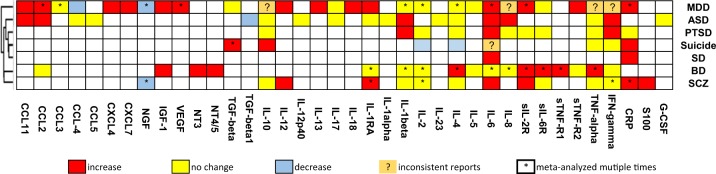
“Unsupervised clustering analysis on the presence of the changes of the 30 IRFs in the seven disorders showed an interesting pattern—BD and SCZ were closer to each other than the others, while suicide clustered with PTSD and SD (Fig. 1).”
§ Inflammation-related biomarkers in major psychiatric disorders: a cross-disorder assessment of reproducibility and specificity in 43 meta-analyses > Trait-related biomarkers > Disease specificity based on cross-disorder comparison
plaincorrelational- Asserted: passes — The authors put it forward as true.
- Checkable: passes — It can be checked against evidence.
- Load-bearing: passes — The paper’s conclusions depend on it.
- Based: passes — The paper gives a reason why it holds.
A result the paper reports from its own data — it cites no other source for it, so there is none to check. The quote shows it is in the paper.
In the paper
“IL-4 is significantly low in suicide, but high in BD;”
§ Inflammation-related biomarkers in major psychiatric disorders: a cross-disorder assessment of reproducibility and specificity in 43 meta-analyses > Trait-related biomarkers > Disease specificity based on cross-disorder comparison
plaincorrelational- Asserted: passes — The authors put it forward as true.
- Checkable: passes — It can be checked against evidence.
- Load-bearing: passes — The paper’s conclusions depend on it.
- Based: passes — The paper gives a reason why it holds.
A result the paper reports from its own data — it cites no other source for it, so there is none to check. The quote shows it is in the paper.
In the paper
“Unsupervised clustering analysis on the presence of the changes of the 30 IRFs in the seven disorders showed an interesting pattern—BD and SCZ were closer to each other than the others, while suicide clustered with PTSD and SD (Fig. 1).”
§ Inflammation-related biomarkers in major psychiatric disorders: a cross-disorder assessment of reproducibility and specificity in 43 meta-analyses > Trait-related biomarkers > Disease specificity based on cross-disorder comparison
plaincorrelational- Asserted: passes — The authors put it forward as true.
- Checkable: passes — It can be checked against evidence.
- Load-bearing: passes — The paper’s conclusions depend on it.
- Based: passes — The paper gives a reason why it holds.
A result the paper reports from its own data — it cites no other source for it, so there is none to check. The quote shows it is in the paper.
In the paper
“Totally, 26% of the meta-analyses did not have enough power (<80%).”
§ Inflammation-related biomarkers in major psychiatric disorders: a cross-disorder assessment of reproducibility and specificity in 43 meta-analyses > Systematic review of meta-analyses on inflammation-related factors in psychiatric disorders > Evaluation of the stability of findings by consistency in IRFs meta-analysed multiple times
plain- Asserted: passes — The authors put it forward as true.
- Checkable: passes — It can be checked against evidence.
- Load-bearing: passes — The paper’s conclusions depend on it.
- Based: passes — The paper gives a reason why it holds.
- Probably not a substantial claim. 28
- It may state two separate claims as one. 24
The cited sources support only part of this claim — read each source’s verdict below.
In the paper
“On one hand, drugs that target IRFs have been proposed for treating psychiatric disorders, including major depression (MDD)10–12, schizophrenia (SCZ)13 and bipolar disorder (BD)14, particularly in a subset of patients with chronic inflammation10”
§ Inflammation-related biomarkers in major psychiatric disorders: a cross-disorder assessment of reproducibility and specificity in 43 meta-analyses > Introduction
What the sources say
- Partly supportedcites [10] Kappelmann N., Lewis G., Dantzer R., Jones P. B., Khandaker G. M. Antidepressant activity of anti-cytokine treatment: a systematic review and meta-analysis of clinical trials of chronic inflammatory conditions. Mol. Psychiatry 23, 335–343 (2018). sourceExperimental — accuracy not yet measured
The Discussion (page not available in our copy) proposes anti-cytokine treatment for some patients with depression, particularly those with increased inflammation. It does not identify these drugs as targeting IRFs. The schizophrenia and bipolar disorder portions of the citing sentence carry other citations, so they are not assessed against this source. (LLM, conf=0.88)
- Partly supportedcites [11] Kohler, O., Krogh, J., Mors, O. & Benros, M. E. Inflammation in depression and the potential for anti-inflammatory treatment. Curr. Neuropharmacol. 14, 732–742 (2016). sourceExperimental — accuracy not yet measured
The Conclusions and perspectives section proposes anti-inflammatory treatment for subgroups of patients with depression, particularly those with elevated CRP or IL-6. The Discussion similarly suggests using inflammatory markers to guide treatment. These passages support the depression and inflammation-subgroup portion, but they do not propose drugs targeting IRFs; the schizophrenia and bipolar-disorder portions carry other citations in the citing sentence. (LLM, conf=0.88)
- Partly supportedcites [12] Kopschina Feltes, P. et al. Anti-inflammatory treatment for major depressive disorder: implications for patients with an elevated immune profile and non-responders to standard antidepressant therapy. J. Psychopharmacol. 31, 1149–1165 (2017). sourceExperimental — accuracy not yet measured
The Concluding remarks (page not provided) propose anti-inflammatory treatment for a subgroup of patients with MDD and an elevated immune profile. The paper discusses NSAIDs and antidepressants, but the passages do not propose drugs targeting IRFs; it also does not substantiate the sentence’s references to schizophrenia or bipolar disorder. (LLM, conf=0.86)
- Partly supportedcites [13] Miller, B. J., Buckley, P., Seabolt, W., Mellor, A. & Kirkpatrick, B. Meta-analysis of cytokine alterations in schizophrenia: clinical status and antipsychotic effects. Biol. Psychiatry 70, 663–671 (2011). sourceExperimental — accuracy not yet measured
The Conclusions report that adjunctive anti-inflammatory drugs improved symptoms in acutely relapsed patients with schizophrenia and suggest that cytokine levels might help identify a responsive subset. They do not propose drugs targeting interferon regulatory factors (IRFs); the treatment discussion concerns nonsteroidal anti-inflammatory agents, cytokines, and cytokine receptors. The other disorders in the citing sentence are attached to other citations. (LLM, conf=0.86)
- Supportedcites [14] Rosenblat J. D., McIntyre R. S. Bipolar disorder and immune dysfunction: epidemiological findings, proposed pathophysiology and clinical implications. Brain Sci. 7, (2017). source
The Clinical Implications section proposes targeting the immune system with anti-inflammatory agents to treat BD and discusses a TNF-α inhibitor as an example. The Conclusions specify that these agents may benefit a subset of BD patients with elevated inflammatory markers. Citation 14 is attached to BD, so this verdict does not assess the sentence’s MDD or SCZ claims. (LLM, conf=0.87)
plainconditional- Asserted: passes — The authors put it forward as true.
- Checkable: passes — It can be checked against evidence.
- Load-bearing: fails — The paper’s conclusions may not depend on it.
- Based: passes — The paper gives a reason why it holds.
Probably not a substantial claim. The paper’s conclusions may not depend on it.
- Partly supported
A result the paper reports from its own data — it cites no other source for it, so there is none to check. The quote shows it is in the paper.
In the paper
“A few inflammation-related factors showed unique changes in specific disorders (e.g., IL-4 increased in BD, decreased in suicide, but had no change in MDD, ASD, PTSD and SCZ).”
§ Inflammation-related biomarkers in major psychiatric disorders: a cross-disorder assessment of reproducibility and specificity in 43 meta-analyses > Abstract
plaincorrelational- Asserted: passes — The authors put it forward as true.
- Checkable: passes — It can be checked against evidence.
- Load-bearing: passes — The paper’s conclusions depend on it.
- Based: passes — The paper gives a reason why it holds.
It may state two separate claims as one.
The paper states this without a source or data behind it here, so there is nothing to check it against. The quote shows it is in the paper.
In the paper
“MDD had the largest number of changes while SD has the least.”
§ Inflammation-related biomarkers in major psychiatric disorders: a cross-disorder assessment of reproducibility and specificity in 43 meta-analyses > Abstract
plaincorrelational- Asserted: passes — The authors put it forward as true.
- Checkable: passes — It can be checked against evidence.
- Load-bearing: unclear — It is unclear whether the paper’s conclusions depend on it.
- Based: passes — The paper gives a reason why it holds.
It may state two separate claims as one.
A result the paper reports from its own data — it cites no other source for it, so there is none to check. The quote shows it is in the paper.
In the paper
“IL-6 was consistent with the changes detected in blood while IL-1beta was inconsistent.”
§ Inflammation-related biomarkers in major psychiatric disorders: a cross-disorder assessment of reproducibility and specificity in 43 meta-analyses > Trait-related biomarkers > Reproducible findings in meta-analyses from well-powered studies
plaincorrelational- Asserted: passes — The authors put it forward as true.
- Checkable: passes — It can be checked against evidence.
- Load-bearing: passes — The paper’s conclusions depend on it.
- Based: passes — The paper gives a reason why it holds.
It may state two separate claims as one.
A result the paper reports from its own data — it cites no other source for it, so there is none to check. The quote shows it is in the paper.
In the paper
“The single meta-analysis of OCD was filtered out because of the insufficient statistical power.”
§ Inflammation-related biomarkers in major psychiatric disorders: a cross-disorder assessment of reproducibility and specificity in 43 meta-analyses > Trait-related biomarkers > Reproducible findings in meta-analyses from well-powered studies
plaindirect- Asserted: passes — The authors put it forward as true.
- Checkable: passes — It can be checked against evidence.
- Load-bearing: fails — The paper’s conclusions may not depend on it.
- Based: passes — The paper gives a reason why it holds.
Probably not a substantial claim. The paper’s conclusions may not depend on it.
A result the paper reports from its own data — it cites no other source for it, so there is none to check. The quote shows it is in the paper.
In the paper
“20% of the studies required specific age ranges”
§ Inflammation-related biomarkers in major psychiatric disorders: a cross-disorder assessment of reproducibility and specificity in 43 meta-analyses > Systematic review of meta-analyses on inflammation-related factors in psychiatric disorders > Evaluation of the stability of findings by consistency in IRFs meta-analysed multiple times
plain- Asserted: passes — The authors put it forward as true.
- Checkable: passes — It can be checked against evidence.
- Load-bearing: fails — The paper’s conclusions may not depend on it.
- Based: passes — The paper gives a reason why it holds.
Probably not a substantial claim. The paper’s conclusions may not depend on it.
A result the paper reports from its own data — it cites no other source for it, so there is none to check. The quote shows it is in the paper.
In the paper
“Totally, 48% (15/31 total, 4/10 of BD, 5/6 of MDD and 6/15 of SCZ) of the state-related tests remained inconsistent.”
§ Inflammation-related biomarkers in major psychiatric disorders: a cross-disorder assessment of reproducibility and specificity in 43 meta-analyses > Systematic review of meta-analyses on inflammation-related factors in psychiatric disorders > Evaluation of the stability of findings by consistency in IRFs meta-analysed multiple times
plain- Asserted: passes — The authors put it forward as true.
- Checkable: passes — It can be checked against evidence.
- Load-bearing: passes — The paper’s conclusions depend on it.
- Based: passes — The paper gives a reason why it holds.
It may state two separate claims as one.
None of the sources cited for this claim have been checked yet.
In the paper
“Most data were generated from peripheral blood without differentiating whole blood, serum and plasma; one study involved three IRFs in the brain29, and four meta-analyses were analysed in both blood and the cerebrospinal fluid (CSF)13,29–31.”
§ Inflammation-related biomarkers in major psychiatric disorders: a cross-disorder assessment of reproducibility and specificity in 43 meta-analyses > Systematic review of meta-analyses on inflammation-related factors in psychiatric disorders
What the sources say
- Not checked yetcites [29] Black, C. & Miller, B. J. Meta-analysis of cytokines and chemokines in suicidality: distinguishing suicidal versus nonsuicidal patients. Biol. Psychiatry 78, 28–37 (2015). source
- Not checked yetcites [13] Miller, B. J., Buckley, P., Seabolt, W., Mellor, A. & Kirkpatrick, B. Meta-analysis of cytokine alterations in schizophrenia: clinical status and antipsychotic effects. Biol. Psychiatry 70, 663–671 (2011). source
- Not checked yetcites [30] Ducasse, D., Olie, E., Guillaume, S., Artero, S. & Courtet, P. A meta-analysis of cytokines in suicidal behavior. Brain Behav. Immun. 46, 203–211 (2015). source
- Not checked yetcites [31] Rao, S. et al. Peripheral blood nerve growth factor levels in major psychiatric disorders. J. Psychiatr. Res. 86, 39–45 (2017). source
plain- Asserted: passes — The authors put it forward as true.
- Checkable: passes — It can be checked against evidence.
- Load-bearing: unclear — It is unclear whether the paper’s conclusions depend on it.
- Based: passes — The paper gives a reason why it holds.
It may state two separate claims as one.
None of the sources cited for this claim have been checked yet.
In the paper
“IL-8 was reported to have no significant changes in MDD by a study of 560 subjects37, but it was found to be increased in MDD in a later study of 3788 subjects38.”
§ Inflammation-related biomarkers in major psychiatric disorders: a cross-disorder assessment of reproducibility and specificity in 43 meta-analyses > Systematic review of meta-analyses on inflammation-related factors in psychiatric disorders > Evaluation of the stability of findings by consistency in IRFs meta-analysed multiple times
What the sources say
- Not checked yetcites [37] Eyre, H. A. et al. A meta-analysis of chemokines in major depression. Prog. Neuropsychopharmacol. Biol. Psychiatry 68, 1–8 (2016). source
- Not checked yetcites [38] Leighton, S. P. et al. Chemokines in depression in health and in inflammatory illness: a systematic review and meta-analysis. Mol. Psychiatry 23, 48–58 (2018). source
plaincorrelationaln = 3,788- Asserted: passes — The authors put it forward as true.
- Checkable: passes — It can be checked against evidence.
- Load-bearing: passes — The paper’s conclusions depend on it.
- Based: passes — The paper gives a reason why it holds.
It may state two separate claims as one.
A result the paper reports from its own data — it cites no other source for it, so there is none to check. The quote shows it is in the paper.
In the paper
“All these IRFs changed in some disorders but had no change or even opposite changes in other disorders.”
§ Inflammation-related biomarkers in major psychiatric disorders: a cross-disorder assessment of reproducibility and specificity in 43 meta-analyses > Trait-related biomarkers > Disease specificity based on cross-disorder comparison
plain- Asserted: passes — The authors put it forward as true.
- Checkable: passes — It can be checked against evidence.
- Load-bearing: passes — The paper’s conclusions depend on it.
- Based: passes — The paper gives a reason why it holds.
It may state two separate claims as one.
A result the paper reports from its own data — it cites no other source for it, so there is none to check. The quote shows it is in the paper.
In the paper
“MDD, ASD, PTSD, suicide, SD, BD and SCZ have 16, 7, 3, 5, 2, 8 and 7 IRF changes, respectively”
§ Inflammation-related biomarkers in major psychiatric disorders: a cross-disorder assessment of reproducibility and specificity in 43 meta-analyses > Trait-related biomarkers > Disease specificity based on cross-disorder comparison
plain- Asserted: passes — The authors put it forward as true.
- Checkable: passes — It can be checked against evidence.
- Load-bearing: passes — The paper’s conclusions depend on it.
- Based: passes — The paper gives a reason why it holds.
It may state two separate claims as one.
None of the sources cited for this claim have been checked yet.
In the paper
“For example, the difference of IFN-gamma was not significant between MDD and controls in a study of 238 subjects35, but a later meta-analysis that includes a total of 1470 subjects found IFN-gamma to be significantly decreased in MDD patients36.”
§ Inflammation-related biomarkers in major psychiatric disorders: a cross-disorder assessment of reproducibility and specificity in 43 meta-analyses > Systematic review of meta-analyses on inflammation-related factors in psychiatric disorders > Evaluation of the stability of findings by consistency in IRFs meta-analysed multiple times
What the sources say
- Not checked yetcites [35] Dowlati, Y. et al. A meta-analysis of cytokines in major depression. Biol. Psychiatry 67, 446–457 (2010). source
- Not checked yetcites [36] Kohler, C. A. et al. Peripheral cytokine and chemokine alterations in depression: a meta-analysis of 82 studies. Acta Psychiatr. Scand. 135, 373–387 (2017). source
plainn = 1,470- Asserted: passes — The authors put it forward as true.
- Checkable: passes — It can be checked against evidence.
- Load-bearing: passes — The paper’s conclusions depend on it.
- Based: passes — The paper gives a reason why it holds.
It may state two separate claims as one.
A result the paper reports from its own data — it cites no other source for it, so there is none to check. The quote shows it is in the paper.
In the paper
“In those 43 meta-analyses, there were 24 trait marker studies, 6 state marker studies and 13 studies containing both trait and state analyses (Table 1).”
§ Inflammation-related biomarkers in major psychiatric disorders: a cross-disorder assessment of reproducibility and specificity in 43 meta-analyses > Systematic review of meta-analyses on inflammation-related factors in psychiatric disorders
plain- Asserted: passes — The authors put it forward as true.
- Checkable: passes — It can be checked against evidence.
- Load-bearing: unclear — It is unclear whether the paper’s conclusions depend on it.
- Based: passes — The paper gives a reason why it holds.
It may state two separate claims as one.
The paper states this without a source or data behind it here, so there is nothing to check it against. The quote shows it is in the paper.
In the paper
“Most of those studies focused on candidate genes, which do not provide system-wide information.”
§ Inflammation-related biomarkers in major psychiatric disorders: a cross-disorder assessment of reproducibility and specificity in 43 meta-analyses > Better study design to translate inflammation-related factors to biomarkers
plain- Asserted: passes — The authors put it forward as true.
- Checkable: passes — It can be checked against evidence.
- Load-bearing: fails — The paper’s conclusions may not depend on it.
- Based: fails — The paper may give no reason why it holds.
Probably not a substantial claim. The paper’s conclusions may not depend on it. The paper may give no reason why it holds.
In the paper
“We performed power analysis39 on the 427 meta-analyses of 44 IRFs done in the eight disorders, 318 of them (74%) have sufficient power ( ≥ 0.8), while the rest were under-powered.”
§ Inflammation-related biomarkers in major psychiatric disorders: a cross-disorder assessment of reproducibility and specificity in 43 meta-analyses > Better study design to translate inflammation-related factors to biomarkers > Mandatory power analysis
What the sources say
- Not checked yetcites [39] Faul, F., Erdfelder, E., Buchner, A. & Lang, A. G. Statistical power analyses using G*Power 3.1: tests for correlation and regression analyses. Behav. Res Methods 41, 1149–1160 (2009). source
plain- Asserted: passes — The authors put it forward as true.
- Checkable: passes — It can be checked against evidence.
- Load-bearing: passes — The paper’s conclusions depend on it.
- Based: passes — The paper gives a reason why it holds.
It may state two separate claims as one.
In the paper
“many were also replicated by Upthegrove et al.46 except for IL-4 and IFN-gamma.”
§ Inflammation-related biomarkers in major psychiatric disorders: a cross-disorder assessment of reproducibility and specificity in 43 meta-analyses > State-related biomarkers
What the sources say
- Not checked yetcites [46] Upthegrove, R., Manzanares-Teson, N. & Barnes, N. M. Cytokine function in medication-naive first episode psychosis: a systematic review and meta-analysis. Schizophr. Res. 155, 101–108 (2014). source
plaincorrelational- Asserted: passes — The authors put it forward as true.
- Checkable: passes — It can be checked against evidence.
- Load-bearing: unclear — It is unclear whether the paper’s conclusions depend on it.
- Based: passes — The paper gives a reason why it holds.
It may state two separate claims as one.
The paper states this without a source or data behind it here, so there is nothing to check it against. The quote shows it is in the paper.
In the paper
“Only a limited number of them have been investigated in psychiatric disorders due to the constraints of methodology and resources.”
§ Inflammation-related biomarkers in major psychiatric disorders: a cross-disorder assessment of reproducibility and specificity in 43 meta-analyses > Better study design to translate inflammation-related factors to biomarkers > Unbiased system-wide study
plaindirect- Asserted: passes — The authors put it forward as true.
- Checkable: passes — It can be checked against evidence.
- Load-bearing: passes — The paper’s conclusions depend on it.
- Based: passes — The paper gives a reason why it holds.
Probably not a substantial claim.
The paper states this without a source or data behind it here, so there is nothing to check it against. The quote shows it is in the paper.
In the paper
“Candidate gene studies contributed to answering specific questions in biology, but they frequently missed the big picture, without assessing the impact of the genes that changed the most.”
§ Inflammation-related biomarkers in major psychiatric disorders: a cross-disorder assessment of reproducibility and specificity in 43 meta-analyses > Better study design to translate inflammation-related factors to biomarkers > Unbiased system-wide study
plain- Asserted: passes — The authors put it forward as true.
- Checkable: passes — It can be checked against evidence.
- Load-bearing: passes — The paper’s conclusions depend on it.
- Based: passes — The paper gives a reason why it holds.
Probably not a substantial claim. It may state two separate claims as one.
The paper states this without a source or data behind it here, so there is nothing to check it against. The quote shows it is in the paper.
In the paper
“Statistical procedures were commonly liberal, leaving more space for false findings.”
§ Inflammation-related biomarkers in major psychiatric disorders: a cross-disorder assessment of reproducibility and specificity in 43 meta-analyses > Better study design to translate inflammation-related factors to biomarkers
plaindirect- Asserted: passes — The authors put it forward as true.
- Checkable: fails — It may be too vague to check against evidence.
- Load-bearing: fails — The paper’s conclusions may not depend on it.
- Based: fails — The paper may give no reason why it holds.
Probably not a substantial claim. It may be too vague to check against evidence. The paper’s conclusions may not depend on it. The paper may give no reason why it holds.
The paper states this without a source or data behind it here, so there is nothing to check it against. The quote shows it is in the paper.
In the paper
“Most IRF studies neither evaluate technical variances for their assays, nor did they report data-missing rates.”
§ Inflammation-related biomarkers in major psychiatric disorders: a cross-disorder assessment of reproducibility and specificity in 43 meta-analyses > Better study design to translate inflammation-related factors to biomarkers > Practicing strict experimental, analytical procedures and statistical criteria
plain- Asserted: passes — The authors put it forward as true.
- Checkable: passes — It can be checked against evidence.
- Load-bearing: passes — The paper’s conclusions depend on it.
- Based: passes — The paper gives a reason why it holds.
It may state two separate claims as one.
In the paper
“a recent meta-analysis of anti-cytokine treatment showed significant antidepressant effects10.”
§ Inflammation-related biomarkers in major psychiatric disorders: a cross-disorder assessment of reproducibility and specificity in 43 meta-analyses > Introduction
What the sources say
- Not checked yetcites [10] Kappelmann N., Lewis G., Dantzer R., Jones P. B., Khandaker G. M. Antidepressant activity of anti-cytokine treatment: a systematic review and meta-analysis of clinical trials of chronic inflammatory conditions. Mol. Psychiatry 23, 335–343 (2018). source
plaindirect- Asserted: passes — The authors put it forward as true.
- Checkable: passes — It can be checked against evidence.
- Load-bearing: fails — The paper’s conclusions may not depend on it.
- Based: passes — The paper gives a reason why it holds.
Probably not a substantial claim. The paper’s conclusions may not depend on it.
None of the sources cited for this claim have been checked yet.
In the paper
“Changes of some inflammation-related factors (IRFs) have been intensively studied and reviewed in relation to psychiatric disorders1–9.”
§ Inflammation-related biomarkers in major psychiatric disorders: a cross-disorder assessment of reproducibility and specificity in 43 meta-analyses > Introduction
What the sources say
- Not checked yetcites [1] Gill, J. M., Saligan, L., Woods, S. & Page, G. PTSD is associated with an excess of inflammatory immune activities. Perspect. Psychiatr. Care 45, 262–277 (2009). source
- Not checked yetcites [2] Michopoulos, V., Powers, A., Gillespie, C. F., Ressler, K. J. & Jovanovic, T. Inflammation in fear- and anxiety-based disorders: PTSD, GAD, and beyond. Neuropsychopharmacology 42, 254–270 (2017). source
- Not checked yetcites [3] Wang, Z. & Young, M. R. PTSD, a disorder with an immunological component. Front. Immunol. 7, 219 (2016).
- Not checked yetcites [4] Tonhajzerova, I. et al. Inflammatory activity in autism spectrum disorder. Adv. Exp. Med. Biol. 861, 93–98 (2015). source
- Not checked yetcites [5] Kern, J. K., Geier, D. A., Sykes, L. K. & Geier, M. R. Relevance of neuroinflammation and encephalitis in autism. Front. Cell. Neurosci. 9, 519 (2015).
- Not checked yetcites [6] Muller, N. Inflammation in schizophrenia: pathogenetic aspects and therapeutic considerations. Schizophr. Bull. 44, 973–982 (2018). source
- Not checked yetcites [7] Muneer, A. Bipolar disorder: role of inflammation and the development of disease biomarkers. Psychiatry Investig. 13, 18–33 (2016). source
- Not checked yetcites [8] Bauer M. E., Teixeira A. L. Inflammation in psychiatric disorders: what comes first? Ann. N. Y. Acad. Sci. 1437, 57–67 (2019). source
- Not checked yetcites [9] Friedrich, M. J. Research on psychiatric disorders targets inflammation. J. Am. Med. Assoc. 312, 474–476 (2014). source
boostedcorrelational- Asserted: passes — The authors put it forward as true.
- Checkable: passes — It can be checked against evidence.
- Load-bearing: fails — The paper’s conclusions may not depend on it.
- Based: passes — The paper gives a reason why it holds.
Probably not a substantial claim. The paper’s conclusions may not depend on it.
None of the sources cited for this claim have been checked yet.
In the paper
“On the other hand, some current psychotropic drugs, including antipsychotics and antidepressants, have anti-inflammatory effects, though with inconsistent findings15–19.”
§ Inflammation-related biomarkers in major psychiatric disorders: a cross-disorder assessment of reproducibility and specificity in 43 meta-analyses > Introduction
What the sources say
- Not checked yetcites [15] Maes, M. et al. Effects of atypical antipsychotics on the inflammatory response system in schizophrenic patients resistant to treatment with typical neuroleptics. Eur. Neuropsychopharmacol. 10, 119–124 (2000). source
- Not checked yetcites [16] Stefanovic, V. et al. The effect of antipsychotic drugs on nonspecific inflammation markers in the first episode of schizophrenia. Vojnosanit. Pregl. 72, 1085–1092 (2015). source
- Not checked yetcites [17] Zajkowska, Z. & Mondelli, V. First-episode psychosis: an inflammatory state? Neuroimmunomodulation 21, 102–108 (2014). source
- Not checked yetcites [18] Hannestad, J., DellaGioia, N. & Bloch, M. The effect of antidepressant medication treatment on serum levels of inflammatory cytokines: a meta-analysis. Neuropsychopharmacology 36, 2452–2459 (2011). source
- Not checked yetcites [19] Lopresti, A. L. Cognitive behaviour therapy and inflammation: a systematic review of its relationship and the potential implications for the treatment of depression. Aust. N.Z. J. Psychiatry 51, 565–582 (2017). source
plaindirect- Asserted: passes — The authors put it forward as true.
- Checkable: passes — It can be checked against evidence.
- Load-bearing: fails — The paper’s conclusions may not depend on it.
- Based: passes — The paper gives a reason why it holds.
Probably not a substantial claim. The paper’s conclusions may not depend on it. It may state two separate claims as one.
The paper states this without a source or data behind it here, so there is nothing to check it against. The quote shows it is in the paper.
In the paper
“Without comparing the studies from different disorders, the specificity of IRFs cannot be determined.”
§ Inflammation-related biomarkers in major psychiatric disorders: a cross-disorder assessment of reproducibility and specificity in 43 meta-analyses > Introduction
plain- Asserted: passes — The authors put it forward as true.
- Checkable: passes — It can be checked against evidence.
- Load-bearing: passes — The paper’s conclusions depend on it.
- Based: fails — The paper may give no reason why it holds.
Probably not a substantial claim. The paper may give no reason why it holds.
In the paper
“The literature selection followed the standard by Preferred Reporting Items for Systematic Reviews and Meta-Analyses (PRISMA)28 (Supplementary Figure, SF1).”
§ Inflammation-related biomarkers in major psychiatric disorders: a cross-disorder assessment of reproducibility and specificity in 43 meta-analyses > Systematic review of meta-analyses on inflammation-related factors in psychiatric disorders
What the sources say
- Not checked yetcites [28] Moher, D., Liberati, A., Tetzlaff, J., Altman, D. G. & Group, P. Preferred reporting items for systematic reviews and meta-analyses: the PRISMA statement. PLoS Med. 6, e1000097 (2009). source
plain- Asserted: passes — The authors put it forward as true.
- Checkable: passes — It can be checked against evidence.
- Load-bearing: fails — The paper’s conclusions may not depend on it.
- Based: passes — The paper gives a reason why it holds.
Probably not a substantial claim. The paper’s conclusions may not depend on it.
A conclusion the paper draws from its own results — it cites no other source for it, so there is none to check. The quote shows it is in the paper.
In the paper
“Trait-related findings are generally more reliable than state-related tests, which have consistencies ranging between 16% and 60%.”
§ Inflammation-related biomarkers in major psychiatric disorders: a cross-disorder assessment of reproducibility and specificity in 43 meta-analyses > Systematic review of meta-analyses on inflammation-related factors in psychiatric disorders > Evaluation of the stability of findings by consistency in IRFs meta-analysed multiple times
plaincorrelational- Asserted: passes — The authors put it forward as true.
- Checkable: passes — It can be checked against evidence.
- Load-bearing: passes — The paper’s conclusions depend on it.
- Based: passes — The paper gives a reason why it holds.
It may state two separate claims as one.
The paper states this without a source or data behind it here, so there is nothing to check it against. The quote shows it is in the paper.
In the paper
“Acute and chronic inflammation can have very different impacts and consequences in aetiology and pathology.”
§ Inflammation-related biomarkers in major psychiatric disorders: a cross-disorder assessment of reproducibility and specificity in 43 meta-analyses > Better study design to translate inflammation-related factors to biomarkers > Longitudinal study for acute and chronic changes, trait and state biomarkers
plain- Asserted: passes — The authors put it forward as true.
- Checkable: fails — It may be too vague to check against evidence.
- Load-bearing: passes — The paper’s conclusions depend on it.
- Based: fails — The paper may give no reason why it holds.
Probably not a substantial claim. It may be too vague to check against evidence. The paper may give no reason why it holds.
A conclusion the paper draws from its own results — it cites no other source for it, so there is none to check. The quote shows it is in the paper.
In the paper
“Certainly, since many of the IRFs have limited studies, their effect sizes in this table may be inflated.”
§ Inflammation-related biomarkers in major psychiatric disorders: a cross-disorder assessment of reproducibility and specificity in 43 meta-analyses > Better study design to translate inflammation-related factors to biomarkers > Mandatory power analysis
hedgedconditional- Asserted: passes — The authors put it forward as true.
- Checkable: passes — It can be checked against evidence.
- Load-bearing: fails — The paper’s conclusions may not depend on it.
- Based: passes — The paper gives a reason why it holds.
Probably not a substantial claim. The paper’s conclusions may not depend on it.
None of the sources cited for this claim have been checked yet.
In the paper
“Genomic and epigenetic methods have been applied to adipose tissue49 and blood leucocytes50, leading to the discovery of large inflammatory response networks.”
§ Inflammation-related biomarkers in major psychiatric disorders: a cross-disorder assessment of reproducibility and specificity in 43 meta-analyses > Better study design to translate inflammation-related factors to biomarkers > Unbiased system-wide study
What the sources say
- Not checked yetcites [49] Toubal, A., Treuter, E., Clement, K. & Venteclef, N. Genomic and epigenomic regulation of adipose tissue inflammation in obesity. Trends Endocrinol. Metab. 24, 625–634 (2013). source
- Not checked yetcites [50] Calvano, S. E. et al. A network-based analysis of systemic inflammation in humans. Nature 437, 1032–1037 (2005). source
plaindirect- Asserted: passes — The authors put it forward as true.
- Checkable: passes — It can be checked against evidence.
- Load-bearing: fails — The paper’s conclusions may not depend on it.
- Based: passes — The paper gives a reason why it holds.
Probably not a substantial claim. The paper’s conclusions may not depend on it.
In the paper
“Regulation of inflammatory responses occurs at various levels including genetic, transcriptional, translational, protein modification and protein interaction, and involves many signalling pathways47.”
§ Inflammation-related biomarkers in major psychiatric disorders: a cross-disorder assessment of reproducibility and specificity in 43 meta-analyses > Better study design to translate inflammation-related factors to biomarkers > Unbiased system-wide study
What the sources say
- Not checked yetcites [47] Hanada, T. & Yoshimura, A. Regulation of cytokine signaling and inflammation. Cytokine Growth Factor Rev. 13, 413–421 (2002). source
plain- Asserted: passes — The authors put it forward as true.
- Checkable: passes — It can be checked against evidence.
- Load-bearing: fails — The paper’s conclusions may not depend on it.
- Based: passes — The paper gives a reason why it holds.
Probably not a substantial claim. The paper’s conclusions may not depend on it. It may state two separate claims as one.
What the paper did — it cites no source for this, so there is none to check. The quote shows it is in the paper.
In the paper
“Meta-analyses can be misled by systematic bias in individual data.”
§ Inflammation-related biomarkers in major psychiatric disorders: a cross-disorder assessment of reproducibility and specificity in 43 meta-analyses > State-related biomarkers
plaindirect- Asserted: passes — The authors put it forward as true.
- Checkable: passes — It can be checked against evidence.
- Load-bearing: passes — The paper’s conclusions depend on it.
- Based: passes — The paper gives a reason why it holds.
Probably not a substantial claim.
None of the sources cited for this claim have been checked yet.
In the paper
“Many physical and psychological stressors, environmental insults including acute smoking56, acute ethanol intoxication57, long-term smoking58,59, binge drinking60, psychological stress61–63, diet64, air pollution65 and infection all can induce inflammation.”
§ Inflammation-related biomarkers in major psychiatric disorders: a cross-disorder assessment of reproducibility and specificity in 43 meta-analyses > Better study design to translate inflammation-related factors to biomarkers > Longitudinal study for acute and chronic changes, trait and state biomarkers
What the sources say
- Not checked yetcites [56] van der Vaart, H., Postma, D. S., Timens, W. & ten Hacken, N. H. Acute effects of cigarette smoke on inflammation and oxidative stress: a review. Thorax 59, 713–721 (2004). source
- Not checked yetcites [57] Neupane, S. P., Skulberg, A., Skulberg, K. R., Aass, H. C. & Bramness, J. G. Cytokine changes following acute ethanol intoxication in healthy men: a crossover study. Mediators Inflamm. 2016, 3758590 (2016). source
- Not checked yetcites [58] Rom, O., Avezov, K., Aizenbud, D. & Reznick, A. Z. Cigarette smoking and inflammation revisited. Respir. Physiol. Neurobiol. 187, 5–10 (2013). source
plaindirect- Asserted: passes — The authors put it forward as true.
- Checkable: passes — It can be checked against evidence.
- Load-bearing: passes — The paper’s conclusions depend on it.
- Based: passes — The paper gives a reason why it holds.
Probably not a substantial claim. It may state two separate claims as one.
None of the sources cited for this claim have been checked yet.
In the paper
“It has been used in studies of alcoholism52, depression53 and autism54, with up to 41 IRFs examined simultaneously52,53.”
§ Inflammation-related biomarkers in major psychiatric disorders: a cross-disorder assessment of reproducibility and specificity in 43 meta-analyses > Better study design to translate inflammation-related factors to biomarkers > Unbiased system-wide study
What the sources say
- Not checked yetcites [52] Manzardo, A. M., Poje, A. B., Penick, E. C. & Butler, M. G. Multiplex immunoassay of plasma cytokine levels in men with alcoholism and the relationship to psychiatric assessments. Int. J. Mol. Sci. 17, 472 (2016). source
- Not checked yetcites [53] Kiraly, D. D. et al. Altered peripheral immune profiles in treatment-resistant depression: response to ketamine and prediction of treatment outcome. Transl. Psychiatry 7, e1065 (2017). source
- Not checked yetcites [54] Masi, A. et al. Cytokine levels and associations with symptom severity in male and female children with autism spectrum disorder. Mol. Autism 8, 63 (2017). source
plain- Asserted: passes — The authors put it forward as true.
- Checkable: passes — It can be checked against evidence.
- Load-bearing: fails — The paper’s conclusions may not depend on it.
- Based: passes — The paper gives a reason why it holds.
Probably not a substantial claim. The paper’s conclusions may not depend on it. It may state two separate claims as one.
In the paper
“Multiplex protein assay is a technology getting more attention recently51.”
§ Inflammation-related biomarkers in major psychiatric disorders: a cross-disorder assessment of reproducibility and specificity in 43 meta-analyses > Better study design to translate inflammation-related factors to biomarkers > Unbiased system-wide study
What the sources say
- Not checked yetcites [51] Belzeaux, R. et al. How to: measuring blood cytokines in biological psychiatry using commercially available multiplex immunoassays. Psychoneuroendocrinology 75, 72–82 (2017). source
plain- Asserted: passes — The authors put it forward as true.
- Checkable: passes — It can be checked against evidence.
- Load-bearing: fails — The paper’s conclusions may not depend on it.
- Based: passes — The paper gives a reason why it holds.
Probably not a substantial claim. The paper’s conclusions may not depend on it.
What the paper did — it cites no source for this, so there is none to check. The quote shows it is in the paper.
In the paper
“Since longitudinal studies are still rare, we can neither differentiate acute and chronic changes nor can we discern trait and state markers.”
§ Inflammation-related biomarkers in major psychiatric disorders: a cross-disorder assessment of reproducibility and specificity in 43 meta-analyses > Better study design to translate inflammation-related factors to biomarkers
plaindirect- Asserted: passes — The authors put it forward as true.
- Checkable: passes — It can be checked against evidence.
- Load-bearing: passes — The paper’s conclusions depend on it.
- Based: passes — The paper gives a reason why it holds.
Probably not a substantial claim. It may state two separate claims as one.
What the paper did — it cites no source for this, so there is none to check. The quote shows it is in the paper.
In the paper
“At the same time, meta-analyses cannot recover signals that may be missed by original studies due to technical limitations.”
§ Inflammation-related biomarkers in major psychiatric disorders: a cross-disorder assessment of reproducibility and specificity in 43 meta-analyses > State-related biomarkers
hedged- Asserted: passes — The authors put it forward as true.
- Checkable: passes — It can be checked against evidence.
- Load-bearing: fails — The paper’s conclusions may not depend on it.
- Based: fails — The paper may give no reason why it holds.
Probably not a substantial claim. The paper’s conclusions may not depend on it. The paper may give no reason why it holds.
In the paper
“One GWAS of inflammation quantitative trait locus (QTL) identified some potential genetic regulators of inflammation48.”
§ Inflammation-related biomarkers in major psychiatric disorders: a cross-disorder assessment of reproducibility and specificity in 43 meta-analyses > Better study design to translate inflammation-related factors to biomarkers > Unbiased system-wide study
What the sources say
- Not checked yetcites [48] Naitza, S. et al. A genome-wide association scan on the levels of markers of inflammation in Sardinians reveals associations that underpin its complex regulation. PLoS Genet. 8, e1002480 (2012). source
plaincorrelational- Asserted: passes — The authors put it forward as true.
- Checkable: passes — It can be checked against evidence.
- Load-bearing: fails — The paper’s conclusions may not depend on it.
- Based: passes — The paper gives a reason why it holds.
Probably not a substantial claim. The paper’s conclusions may not depend on it.
What the paper did — it cites no source for this, so there is none to check. The quote shows it is in the paper.
In the paper
“It should be noted that our study was built upon meta-analysis results, which represented the consensus of multiple individual studies, less influenced than original individual studies by biological or technical noises or variations from individual studies.”
§ Inflammation-related biomarkers in major psychiatric disorders: a cross-disorder assessment of reproducibility and specificity in 43 meta-analyses > State-related biomarkers
plaincorrelational- Asserted: passes — The authors put it forward as true.
- Checkable: fails — It may be too vague to check against evidence.
- Load-bearing: passes — The paper’s conclusions depend on it.
- Based: passes — The paper gives a reason why it holds.
Probably not a substantial claim. It may be too vague to check against evidence. It may state two separate claims as one.
A conclusion the paper draws from its own results — it cites no other source for it, so there is none to check. The quote shows it is in the paper.
In the paper
“The other genes discovered from system-wide hunting may be better biomarker candidates.”
§ Inflammation-related biomarkers in major psychiatric disorders: a cross-disorder assessment of reproducibility and specificity in 43 meta-analyses > Better study design to translate inflammation-related factors to biomarkers > Unbiased system-wide study
hedgedconditional- Asserted: passes — The authors put it forward as true.
- Checkable: fails — It may be too vague to check against evidence.
- Load-bearing: fails — The paper’s conclusions may not depend on it.
- Based: passes — The paper gives a reason why it holds.
Probably not a substantial claim. It may be too vague to check against evidence. The paper’s conclusions may not depend on it.
- Rests on an assumption: Candidate genes are generally not the top signals in genome-wide or system-wide studies.
A conclusion the paper draws from its own results — it cites no other source for it, so there is none to check. The quote shows it is in the paper.
In the paper
“Among these state-related studies, findings from first-episode SCZ studies are likely more reliable.”
§ Inflammation-related biomarkers in major psychiatric disorders: a cross-disorder assessment of reproducibility and specificity in 43 meta-analyses > State-related biomarkers
hedgedcorrelational- Asserted: passes — The authors put it forward as true.
- Checkable: passes — It can be checked against evidence.
- Load-bearing: fails — The paper’s conclusions may not depend on it.
- Based: fails — The paper may give no reason why it holds.
Probably not a substantial claim. The paper’s conclusions may not depend on it. The paper may give no reason why it holds.
The paper states this without a source or data behind it here, so there is nothing to check it against. The quote shows it is in the paper.
In the paper
“These experimental factors can impact data quality.”
§ Inflammation-related biomarkers in major psychiatric disorders: a cross-disorder assessment of reproducibility and specificity in 43 meta-analyses > Better study design to translate inflammation-related factors to biomarkers > Practicing strict experimental, analytical procedures and statistical criteria
plainconditional- Asserted: passes — The authors put it forward as true.
- Checkable: passes — It can be checked against evidence.
- Load-bearing: passes — The paper’s conclusions depend on it.
- Based: passes — The paper gives a reason why it holds.
Probably not a substantial claim.
In the paper
“Postmortem brain data are valuable, and the PsychENCODE project72 brought more insights into the inflammation status of brains affected by SCZ, BD and ASD.”
§ Inflammation-related biomarkers in major psychiatric disorders: a cross-disorder assessment of reproducibility and specificity in 43 meta-analyses > Better study design to translate inflammation-related factors to biomarkers > Peripheral vs. central nervous system
What the sources say
- Not checked yetcites [72] Psych, E. C. et al. The PsychENCODE project. Nat. Neurosci. 18, 1707–1712 (2015). source
plaincorrelational- Asserted: passes — The authors put it forward as true.
- Checkable: passes — It can be checked against evidence.
- Load-bearing: unclear — It is unclear whether the paper’s conclusions depend on it.
- Based: passes — The paper gives a reason why it holds.
It may state two separate claims as one.
None of the sources cited for this claim have been checked yet.
In the paper
“This may be particularly true in relation to the blood–brain barrier, which separates the central nervous system from peripheral circulation and responds to inflammation under its own regulation70,71.”
§ Inflammation-related biomarkers in major psychiatric disorders: a cross-disorder assessment of reproducibility and specificity in 43 meta-analyses > Better study design to translate inflammation-related factors to biomarkers > Peripheral vs. central nervous system
What the sources say
- Not checked yetcites [70] Sonar, S. A. & Lal, G. Blood-brain barrier and its function during inflammation and autoimmunity. J. Leukoc. Biol. 103, 839–853 (2018). source
- Not checked yetcites [71] Webb, A. A. & Muir, G. D. The blood-brain barrier and its role in inflammation. J. Vet. Intern. Med 14, 399–411 (2000). source
plaindirect- Asserted: passes — The authors put it forward as true.
- Checkable: passes — It can be checked against evidence.
- Load-bearing: passes — The paper’s conclusions depend on it.
- Based: passes — The paper gives a reason why it holds.
It may state two separate claims as one.
None of the sources cited for this claim have been checked yet.
In the paper
“Changes of IRFs are not limited to neuropsychiatric disorders; they are also reported in patients with cardiovascular and metabolic diseases66, as well as cancer67,68.”
§ Inflammation-related biomarkers in major psychiatric disorders: a cross-disorder assessment of reproducibility and specificity in 43 meta-analyses > Better study design to translate inflammation-related factors to biomarkers > Longitudinal study for acute and chronic changes, trait and state biomarkers
What the sources say
- Not checked yetcites [66] Lopez-Candales A., Hernandez Burgos P. M., Hernandez-Suarez D. F., Harris D. Linking chronic inflammation with cardiovascular disease: from normal aging to the metabolic syndrome. J. Nat. Sci. 3, (2017).
- Not checked yetcites [67] Grivennikov, S. I., Greten, F. R. & Karin, M. Immunity, inflammation, and cancer. Cell 140, 883–899 (2010). source
- Not checked yetcites [68] Korniluk, A., Koper, O., Kemona, H. & Dymicka-Piekarska, V. From inflammation to cancer. Ir. J. Med. Sci. 186, 57–62 (2017). source
plaincorrelational- Asserted: passes — The authors put it forward as true.
- Checkable: passes — It can be checked against evidence.
- Load-bearing: passes — The paper’s conclusions depend on it.
- Based: passes — The paper gives a reason why it holds.
It may state two separate claims as one.
A conclusion the paper draws from its own results — it cites no other source for it, so there is none to check. The quote shows it is in the paper.
In the paper
“Therefore, much remains to be learned about the specificity of each individual IRF as related to various psychiatric and non-psychiatric diseases.”
§ Inflammation-related biomarkers in major psychiatric disorders: a cross-disorder assessment of reproducibility and specificity in 43 meta-analyses > Better study design to translate inflammation-related factors to biomarkers > Longitudinal study for acute and chronic changes, trait and state biomarkers
plain- Asserted: passes — The authors put it forward as true.
- Checkable: fails — It may be too vague to check against evidence.
- Load-bearing: passes — The paper’s conclusions depend on it.
- Based: passes — The paper gives a reason why it holds.
Probably not a substantial claim. It may be too vague to check against evidence.
The authors state this as an assumption.
Stable findings are more likely to be reproducible than unstable ones.
“Even though stability is not a true measure of reproducibility, we assume that stable findings are more likely to be reproducible than unstable ones.”
The authors state this as an assumption.
All data including those tested only once will have better reproducibility.
“We applied this filter to all data, assuming that all data including those tested only once will have better reproducibility.”
The paper relies on this without support.
Candidate genes are generally not the top signals in genome-wide or system-wide studies.
“Candidate genes are generally not the top signals in genome-wide or system-wide studies.”
The paper relies on this without support.
Sample size is one of the major drivers of statistical power and is a limiting factor for many studies.
“Sample size, one of the major drivers of statistical power, is a limiting factor for many studies.”
The paper relies on this without support.
Genetic studies of candidate genes have produced a large number of false positives in small-sample studies due to loose statistical criteria.
“Genetic studies of candidate genes have produced a large number of false positives in small-sample studies due to loose statistical criteria.”
The paper relies on this without support.
Inflammation levels likely also fluctuate temporally due to environmental and circadian rhythm changes regardless of health status.
“The inflammation levels likely also fluctuate temporally due to environmental and circadian rhythm changes regardless of health status.”
The paper relies on this without support.
The clinical symptoms can change through the disease course while the diagnosis remains unchanged.
“The clinical symptoms can change through the disease course while the diagnosis remains unchanged.”
The paper relies on this without support.
Hundreds of genes or proteins are involved in immunity and inflammation regulation.
“Hundreds of genes or proteins are involved in immunity and inflammation regulation and should be studied in relation to psychiatric disorders.”
Claims other papers make about this one
Each is checked against this paper’s own text: does it say what the citing paper says it does?
The cited source says what the claim attributes to it.
In the citing paper
“inflammation, which has been linked with a broad range of psychiatric disorders 112 .”
From A meta-review of "lifestyle psychiatry": the role of exercise, smoking, diet and sleep in the prevention and treatment of mental disorders (2020) · cites this paper as [112]
The cited source says what the claim attributes to it.
In the citing paper
“One potentially shared biological mechanism by which multiple adverse health behaviors could increase risk of mental illness is through inflammation”
From A meta-review of "lifestyle psychiatry": the role of exercise, smoking, diet and sleep in the prevention and treatment of mental disorders (2020) · cites this paper as [112]
In the citing paper
“various mental health conditions, including mood disorders, have been linked to heightened inflammation,16”
From Food and mood: How do diet and nutrition affect mental wellbeing? (2020) · cites this paper as [16]
In the citing paper
“this mechanism also presents a pathway through which poor diet could increase the risk of depression.”
From Food and mood: How do diet and nutrition affect mental wellbeing? (2020) · cites this paper as [16]
Self-check
Percentages, sums and reported differences re-computed from the paper’s own numbers.
Each contradiction between two passages listed here was confirmed by an independent check.
Rated major: it would touch a result — a value a result rests on, reported and recomputed p-values on opposite sides of the significance level, two passages that conflict with no sign which is right, or a cited work retracted before this paper was published.
In the paper
§ Inflammation-related biomarkers in major psychiatric disorders: a cross-disorder assessment of reproducibility and specificity in 43 meta-analyses > Trait-related biomarkers > Reproducible findings in meta-analyses from well-powered studies
“| IGF-1 | Increase | Blood | – | −0.48 | 327 | 114 | 288 | 26825882 |”
§ Inflammation-related biomarkers in major psychiatric disorders: a cross-disorder assessment of reproducibility and specificity in 43 meta-analyses > Trait-related biomarkers > Disease specificity based on cross-disorder comparison
“blue cells are the decreased changes in disorders (ES < 0, P < 0.05 and power > 0.8)”
Rated major: it would touch a result — a value a result rests on, reported and recomputed p-values on opposite sides of the significance level, two passages that conflict with no sign which is right, or a cited work retracted before this paper was published.
In the paper
“If two studies were completely independent, as each result has three possible states: increase, decrease and no change, the chance of two results having the same type of state is 11% (1/3 × 1/3).”
§ Inflammation-related biomarkers in major psychiatric disorders: a cross-disorder assessment of reproducibility and specificity in 43 meta-analyses > Systematic review of meta-analyses on inflammation-related factors in psychiatric disorders > Evaluation of the stability of findings by consistency in IRFs meta-analysed multiple times
Reported 11 · recomputed 33.333333
Citations
Cites
Preferred Reporting Items for Systematic Reviews and Meta-Analyses: the PRISMA statement
Moher, D., Liberati, A., Tetzlaff, J., Altman, D. G., & for the PRISMA Group (2009) · BMJ · doi:10.1136/bmj.b2535 · Cited by 83,823
Preferred Reporting Items for Systematic Reviews and Meta-Analyses: The PRISMA Statement
Moher, D., Liberati, A., Tetzlaff, J., Altman, D. G., & The PRISMA Group (2009) · PLoS Medicine · doi:10.1371/journal.pmed.1000097 · Cited by 64,042
Preferred reporting items for systematic reviews and meta-analyses: the PRISMA Statement.
(2009) · PubMed Central · Cited by 44,859
Statistical power analyses using G∗Power 3.1: tests for correlation and regression analyses
Faul, F., Erdfelder, E., Buchner, A., & Lang, A.-G. (2009) · Behavior Research Methods · doi:10.3758/brm.41.4.1149 · Cited by 37,615
Wang, G., Ma, R., Qiao, G., Wada, K., Aizawa, Y., & Satoh, T. (2015) · Integrative Medicine International · doi:10.1159/000368408 · Cited by 18,762
Immunity, Inflammation, and Cancer
Grivennikov, S. I., Greten, F. R., & Karin, M. (2010) · Cell · doi:10.1016/j.cell.2010.01.025 · Cited by 10,755
Molecular Mechanisms of Depression: Perspectives on New Treatment Strategies
Lang, U. E., & Borgwardt, S. (2013) · Cellular Physiology and Biochemistry · doi:10.1159/000350094 · Cited by 8,526
A Meta-Analysis of Cytokines in Major Depression
Dowlati, Y., Herrmann, N., Swardfager, W., Liu, H., Sham, L., Reim, E. K., & Lanctôt, K. L. (2010) · Biological Psychiatry · doi:10.1016/j.biopsych.2009.09.033 · Cited by 4,729
Overweight, Obesity, and Depression: A Systematic Review and Meta-analysis of Longitudinal Studies
Luppino, F. S., de Wit, L. M., Bouvy, P. F., Stijnen, T., Cuijpers, P., Penninx, B. W. J. H., & Zitman, F. G. (2010) · Archives of General Psychiatry · doi:10.1001/archgenpsychiatry.2010.2 · Cited by 4,322
Associations of depression with C-reactive protein, IL-1, and IL-6: a meta-analysis.
Howren, M. B., Lamkin, D. M., & Suls, J. (2009) · Psychosomatic Medicine · doi:10.1097/psy.0b013e3181907c1b · Cited by 2,766
Cited by
Sorted by citations
Items 401–432 of 432
Iorio, C., Norton, S. A., Boudreaux, M. J., Chang, K. K., Michalski, L. J., Cruitt, P. J., Winstone, J. M. A., Oltmanns, T. F., & Bogdan, R. (2025) · Research in Human Development · doi:10.1080/15427609.2025.2602867
Endocannabinoids in Saliva: Origins, Significance, and Research Directions
Hargreaves, J. A., Lipp, O. V., & Ney, L. J. (2026) · Cannabis and Cannabinoid Research · doi:10.1177/25785125261423034
Goel, R., Meena, R. K., Tyagi, A. K., Rajender, G., & Thaper, K. (2026) · International Journal of Pharmaceutical Quality Assurance · doi:10.25258/ijpqa.17.2.12
Chakraborty, I., Shaw, R., & Pal, K. (2026) · Neuroinformatics · doi:10.1007/s12021-025-09765-y
The causal relationships between childhood-onset asthma and major mental disorders: an MR study
He, Z., Chen, B., Xue, M., & Deng, Q. (2026) · European Archives of Psychiatry and Clinical Neuroscience · doi:10.1007/s00406-026-02200-6
Metabolic markers in bipolar disorder with childhood trauma exposure: a systematic review
Guillen-Burgos, H. F., Montero, N., Orozco, I., Gamba, G., Vanegas, V., Uribe, A., Morelli, A. M., Moreno‐Lopez, S. M., Galvez-Florez, J. F., & McIntyre, R. S. (2026) · CNS Spectrums · doi:10.1017/s1092852926100881
Febo, M., Sorcini, D., Mirarchi, A., Cogliati, P., Stella, A., Sportoletti, P., Ermakova, O. V., Mandarano, M., Marchetti, M. C., Riccardi, C., et al. (2026) · HemaSphere · doi:10.1002/hem3.70341
Coral, R.-P., Khandaker, G. M., Sanderson, E. C. M., Lau, J. Y. F., & Carvalho, L. A. (2026) · medRxiv · doi:10.64898/2026.04.08.26350416
Castán-Sogas, M., & Escolano, A. F. (2026) · Brain Behavior and Immunity · doi:10.1016/j.bbi.2026.106773
Usemann, P. L., David, F. S., Sagcob, L., Hammes, V., Stein, F., Thomas‐Odenthal, F., Teutenberg, L., Flinkenflügel, K., Hubbert, J. M., Jurischka, C., et al. (2026) · Brain Behavior and Immunity · doi:10.1016/j.bbi.2026.106807
Cognitive Dysfunction and Suicide
Sunzeri, F. (2026) · Springer eBooks · doi:10.1007/978-3-032-14465-2_19
Guest, P. C., Cunningham, J. L., Raabe, F., Schiltz, K., Asl, L. S., Nickl-Jockschat, T., & Steiner, J. H. (2026) · Brain Behavior & Immunity - Health · doi:10.1016/j.bbih.2026.101285
Alves, J. C., Santos, A., Sirvent, N. P., Jorge, P., & Mendonça, T. (2026) · Lasers in Medical Science · doi:10.1007/s10103-026-04918-0
Effectiveness of aerobic exercise in psychiatric disorders: Naturopathy has its say
Khan, M. M., Pandey, G., & Jafar, T. (2026) · World Journal of Psychiatry · doi:10.5498/wjp.118479
Li, B., Li, M., Li, M., Wang, X., Wang, X., Li, J., Chen, Z., Sun, L., Zhang, X., & Zhang, X. (2026) · Scientific Reports · doi:10.1038/s41598-026-59370-5
Margelyte, R., Dardani, C., Hanson, A., Shen, X., Havdahl, A., Rai, D., McIntosh, A. M., Wray, N. R., Smith, G. D., Hemani, G., et al. (2026) · medRxiv · doi:10.64898/2026.07.10.26357744
Tsapakis, E.-M., Keskilidou, E., Karapatis, A., Kyziridis, T. C., Prokopiou, P., Karalazou, P., Thisiadou, A., Makedou, K., & Fountoulakis, K. Ν. (2026) · Brain Behavior & Immunity - Health · doi:10.1016/j.bbih.2026.101312
Dai, H., Chen, J., & Yin, Z. (2026) · World Journal of Psychiatry · doi:10.5498/wjp.117289
Proximity-extension dementia-panel in 41 brain disorders: a meta-analysisPreprint
Blujdea, E. R., Hok‐A‐Hin, Y. S., Schumacher, A.-M., Maple‐Grødem, J., Cano, A., Ali, M., Price, R., Göteson, A., Abdelhak, A., Sogorb‐Esteve, A., et al. (2026) · Research Square · doi:10.21203/rs.3.rs-9903081/v1
Mitochondrial control of blood-brain barrier homeostasis in neuroinflammatory psychiatric disorders
Pérez-López, L. M., Camacho-Morales, A., Álvarez, I. H., & Pérez‐Maya, A. A. (2026) · Frontiers in Molecular Neuroscience · doi:10.3389/fnmol.2026.1924581
Temporal coupling of cortisol and immune cell responses in acute psychosocial stress
Grönvall, H., Tabrizi, F. F., Edwards, S., Rosén, J., Hirsch, J., & Åhs, F. (2026) · Brain Behavior & Immunity - Health · doi:10.1016/j.bbih.2026.101318
Yıldız, A., Karabıyık, B., & Deniz, L. (2026) · BMC Psychiatry · doi:10.1186/s12888-026-08587-9
Meena, R., Meena, R., Meena, J. S., Nigam, R., Agarwal, J., & Baghel, R. (2026) · Cureus · doi:10.7759/cureus.115769
Hillmann, A. R., Lam, P. H., Forest, A. L., Depro, J. M., Zou, H., Marsland, A. L., & Reed, R. G. (2026) · Neuroscience & Biobehavioral Reviews · doi:10.1016/j.neubiorev.2026.106962
Huang, W.-C., & Doong, J.-Y. (2026) · Nutrients · doi:10.3390/nu18183037
Bhak, J., Kwon, Y., Jeon, J., Jeon, S., Ryu, H., An, K., Kim, Y. J., Blažytė, A., Kim, B.-C., Jung, H.-T., et al. (2026) · Research Square · doi:10.21203/rs.3.rs-10605383/v1
Filho, I. J. Z., Filho, D. R., Duarte, M. G., de Avance, A. D., Pettersen, H. G. V., Magalhães, S. R. L., de Andrade, P. P. F. P., Junior, A. G. R., & de Oliveira, L. M. (2026) · International Journal of Nutrology · doi:10.54448/ijn26405
Ruthra, K., Muhunthan, S., Rubinshteyn, V., Richmond, L. H., & Lakhi, N. A. (2026) · Journal of Trauma and Injury · doi:10.20408/jti.2025.0062
Immunometabolic alterations in post-traumatic stress disorder
Brasanac, J., El‐Ahmad, L., Mollerup, E., Gamradt, S., Gruenberg, L., Shyshko, D., Stiglbauer, V., Zimbalski, K., Schoofs, N., Priebe, K., et al. (2026) · Brain Behavior and Immunity · doi:10.1016/j.bbi.2026.107031
Bruun, C. F., Long, C., Krogh, H. B., Zarp, J., Coello, K., Frikke‐Schmidt, R., Ostrowski, S. R., Nielsen, F., Giraldi, A. G. E., Vinberg, M., et al. (2026) · Progress in Neuro-Psychopharmacology and Biological Psychiatry · doi:10.1016/j.pnpbp.2026.111964
López-Ojeda, W., & Hurley, R. A. (2026) · Journal of Neuropsychiatry · doi:10.1176/appi.neuropsych.20260183
Metadata
- Authors
- Yuan, N., Chen, Y., Xia, Y., Dai, J., & Liu, C.
- Affiliations
- Central South University (CN)
- Corresponding author
- Liu, Chunyu
- Venue
- Translational Psychiatry
- Published
- 2019-09-18
- Volume
- 9
- Issue
- 1
- Pages
- 233-233
- ISSN
- 2158-3188 (ISSN-L)
- PMC
- PMC6751188
- OpenAlex
- W2974338024
- Cited by
- 428
- References
- 81
- Citations by year
- 2026: 44 · 2025: 77 · 2024: 80 · 2023: 59 · 2022: 76 · 2021: 59 · 2020: 31 · 2019: 2
- FWCI
- 13.79
- Type
- journal article
- Language
- en
- Open access
- gold
- doi.org
- Locations
- Translational Psychiatry (publishedVersion, cc-by)
- PubMed Central (publishedVersion, cc-by)
- PubMed (publishedVersion)
- DOAJ (DOAJ: Directory of Open Access Journals) (submittedVersion)
- Funders
- National Natural Science Foundation of China (31871276)
- Central South University
- Hunan University
- Natural Science Foundation of Hunan Province
- National Institutes of Health
- National Institute on Aging (R21AG045789)
- National Institute of Mental Health (U01MH116489, R01MH110920, U01MH103340)
- Topics
- Life Sciences › Neuroscience › Biological Psychiatry › Tryptophan and brain disorders
- Life Sciences › Neuroscience › Behavioral Neuroscience › Stress Responses and Cortisol
- Life Sciences › Neuroscience › Neurology › Neuroinflammation and Neurodegeneration Mechanisms
- Keywords
- inflammation, inflammatory markers, mental illness, cross-disorder analysis, reproducibility, statistical power, underpowered studies, schizophrenia, bipolar disorder, autism spectrum disorder, major depressive disorder, post-traumatic stress disorder, sleep disorders, obsessive-compulsive disorder, suicide, IL-4, first-episode schizophrenia, meta-analysis
- MeSH terms
- Mental Disorders, Humans, Inflammation, Sensitivity and Specificity, Meta-Analysis as Topic, Reproducibility of Results, Biomarkers
About these checks
Registry, retraction, Cites and statistics results are computed, not judged, with one exception: a printed reference that no index lists is read once by a model before it counts as a citation error. Claims are extracted by a model and kept only when their quote appears verbatim in the text; each cited source is then checked, with a model’s help, for whether it says what the claim relies on. Those verdicts can be wrong — read the claim’s quote and the cited source before relying on one.
A language model drew the claims from the paper on 2026-10-09, under version 3 of the claim definition (model deepseek-v4.1-flash, prompt extract-v3).
A second model labelled each claim on 2026-10-09 (model jev-1.13-20260917, definition revision gold-guideline-v0.2).
Cited sources are checked with a language model’s help (gpt-6-sol).
Statistics and arithmetic are recomputed, not judged.
Confidence bands are shown only for fields calibrated on our annotated test set. None is calibrated yet, so no band is shown.
What counts as a claim ›How we measure confidence ›How we check this ›
Are you an author, or do you see a problem with this page? Request a review
