

The DOI matches its Crossref record; 52 of the 52 references it cites were found in a registry or an index.
Attention-deficit hyperactivity disorder shares copy number variant risk with schizophrenia and autism spectrum disorder
Open accessAbstract
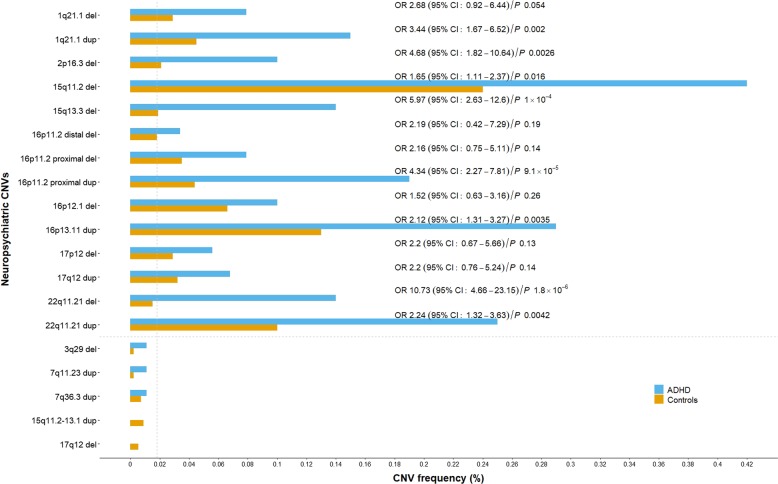
Attention-deficit/hyperactivity disorder (ADHD) is a highly heritable common childhood-onset neurodevelopmental disorder. Some rare copy number variations (CNVs) affect multiple neurodevelopmental disorders such as intellectual disability, autism spectrum disorders (ASD), schizophrenia and ADHD. The aim of this study is to determine to what extent ADHD shares high risk CNV alleles with schizophrenia and ASD. We compiled 19 neuropsychiatric CNVs and test 14, with sufficient power, for association with ADHD in Icelandic and Norwegian samples. Eight associate with ADHD; deletions at 2p16.3 (NRXN1), 15q11.2, 15q13.3 (BP4 & BP4.5–BP5) and 22q11.21, and duplications at 1q21.1 distal, 16p11.2 proximal, 16p13.11 and 22q11.21. Six of the CNVs have not been associated with ADHD before. As a group, the 19 CNVs associate with ADHD (OR = 2.43, P = 1.6 × 10⁻²¹), even when comorbid ASD and schizophrenia are excluded from the sample. These results highlight the pleiotropic effect of the neuropsychiatric CNVs and add evidence for ADHD, ASD and schizophrenia being related neurodevelopmental disorders rather than distinct entities.
Overview
The claims and statistics of this paper haven’t been checked yet.
Run the check — free, no account needed. It reads the open-access text and checks the sources it cites.
Integrity signals
Registry
Cites
Statistics
Figures
Verification
Claims the paper makes
The claims and statistics of this paper haven’t been checked yet.
Run the check — free, no account needed. It reads the open-access text and checks the sources it cites.
Claims other papers make about this one
Each is checked against this paper’s own text: does it say what the citing paper says it does?
In the citing paper
“Attention-deficit/hyperactivity disorder (ADHD) is also observed in 16p11.2 CNV carriers [12, 15–17, 19, 23, 48], at rates as high as 29% (63/217) and 42% (48/114) in deletion and duplication carriers, respectively [34].”
From 16p11.2 Copy Number Variations and Neurodevelopmental Disorders (2020) · cites this paper as [48]
Self-check
Percentages, sums and reported differences re-computed from the paper’s own numbers.
The self-check needs the paper’s full text.
Citations
Cites
LD Score regression distinguishes confounding from polygenicity in genome-wide association studies
Schizophrenia Working Group of the Psychiatric Genomics Consortium, Bulik-Sullivan, B. K., Loh, P.-R., Finucane, H. K., Ripke, S., Yang, J., Patterson, N., Daly, M. J., Price, A. L., & Neale, B. M. (2015) · Nature Genetics · doi:10.1038/ng.3211 · Cited by 5,559
Identification of common genetic risk variants for autism spectrum disorder
Autism Spectrum Disorder Working Group of the Psychiatric Genomics Consortium, Grove, J., BUPGEN, Major Depressive Disorder Working Group of the Psychiatric Genomics Consortium, 23andMe Research Team, Ripke, S., Als, T. D., Mattheisen, M., Walters, R. K., Won, H., et al. (2019) · Nature Genetics · doi:10.1038/s41588-019-0344-8 · Cited by 2,421
Self-citationMolecular genetics of attention-deficit/hyperactivity disorder
Faraone, S. V., Perlis, R. H., Doyle, A. E., Smoller, J. W., Goralnick, J. J., Holmgren, M. A., & Sklar, P. (2005) · Biological Psychiatry · doi:10.1016/j.biopsych.2004.11.024 · Cited by 2,357
ADHD Working Group of the Psychiatric Genomics Consortium (PGC), Demontis, D., Early Lifecourse & Genetic Epidemiology (EAGLE) Consortium, 23andMe Research Team, Walters, R. K., Martin, J., Mattheisen, M., Als, T. D., Agerbo, E., Baldursson, G., et al. (2019) · Nature Genetics · doi:10.1038/s41588-018-0269-7 · Cited by 2,203
Self-citationWang, K., Li, M., Hadley, D., Liu, R., Glessner, J., Grant, S. F. A., Hakonarson, H., & Bucan, M. (2007) · Genome Research · doi:10.1101/gr.6861907 · Cited by 1,792
Genetics of attention deficit hyperactivity disorder
Faraone, S. V., & Larsson, H. (2019) · Molecular Psychiatry · doi:10.1038/s41380-018-0070-0 · Cited by 1,338
Contribution of copy number variants to schizophrenia from a genome-wide study of 41,321 subjects
Marshall, C. R., Howrigan, D. P., Merico, D., Thiruvahindrapuram, B., Wu, W., Greer, D. S., Antaki, D., Shetty, A., Holmans, P. A., Pinto, D., et al. (2017) · Nature Genetics · doi:10.1038/ng.3725 · Cited by 1,058
Self-citationCohort profile: The Norwegian Mother and Child Cohort Study (MoBa)
Magnus, P. M., Irgens, L. M., Haug, K., Nystad, W., Skjærven, R., & Stoltenberg, C. (2006) · International Journal of Epidemiology · doi:10.1093/ije/dyl170 · Cited by 1,027
Convergence of genes and cellular pathways dysregulated in autism spectrum disorders
Pinto, D., Delaby, E., Merico, D., Barbosa, M., Merikangas, A., Klei, L., Thiruvahindrapuram, B., Xu, X., Ziman, R., Wang, Z., et al. (2014) · The American Journal of Human Genetics · doi:10.1016/j.ajhg.2014.03.018 · Cited by 969
Cohort Profile Update: The Norwegian Mother and Child Cohort Study (MoBa).
Magnus, P., Birke, C., Vejrup, K., Haugan, A., Alsaker, E., Daltveit, A., Handal, M., Haugen, M., Høiseth, G., Knudsen, G., et al. (2016) · International Journal of Epidemiology · doi:10.1093/ije/dyw029 · Cited by 936
Self-citation
Cited by
Sorted by citations
Items 101–128 of 128
Autism, schizofrenie, ADHD. Perspective convergente
Miclea, B. (2021) · Revista Română de Terapia Tulburărilor de Limbaj şi Comunicare · doi:10.26744/rrttlc.2021.7.1.08
ADHD Genetics in Mouse and Man
Mortimer, N. (2021) · Online Publication Service of Würzburg University (Würzburg University) · doi:10.25972/opus-23626
Wu, D., Zhu, J., You, L., Wang, J., Zhang, S., Liu, Z., Xu, Q., Yuan, X., Yang, L., Wang, W., et al. (2021) · SSRN Electronic Journal · doi:10.2139/ssrn.3997504
Dai, Y., Fernandes, B. S., & Zhao, Z. (2024) · Biological Psychiatry · doi:10.1016/j.biopsych.2024.02.1007
Heaton, P. F. (2024) · Springer eBooks · doi:10.1007/978-3-031-70403-1_3
Ethical aspects of counseling people with mental disorders who are planning their pregnancy
Лобанова, И. В., Sataev, A., & Manaeva, T. (2024) · Медицинская этика · doi:10.24075/medet.2024.025
Peng, W., Ran, Q., Wu, F., & Hu, Z. (2025) · Technology and Health Care · doi:10.1177/09287329251316227
Excitation-inhibition imbalance in Neurexin-1α mutant mice is rescued by administering arbaclofenPreprint
Østergaard, F. G., & Kas, M. J. (2025) · Research Square · doi:10.21203/rs.3.rs-7426046/v1
Deconstruction in Psychiatry: Are We Missing the Forest for the Trees?
Nair, G. A., Jakowczuk, T. E., Florentin, O. D., Sheikh, F., Shad, M. U., Glannon, W., Schaefer, M., Barlati, S., Kling, M. A., Curtis, S. D., et al. (2025) · Annals of Clinical Psychiatry · doi:10.1177/10401237251344101
Yang, Y.-S., Hsu, C.-W., Wang, L.-J., Hung, K.-C., Chen, Y., Liang, C.-S., & Chen, M.-H. (2025) · Child and Adolescent Psychiatry and Mental Health · doi:10.1186/s13034-025-01002-3
“2, NRXN1) [45], these observations support a genetic-stratification hypothesis: ADHD–psychotic and ADHD–bipolar lineages may reflect partially distinct allele constellations.”
Cai, M., Lin, N., Su, L., Fu, M., Huang, H., & Xu, L. (2025) · PLoS ONE · doi:10.1371/journal.pone.0337437
“11 microduplication in one fetus—a finding not previously linked to fetal ascites but strongly associated with neurodevelopmental disorders (autism, cognitive impairment) [21–23].”
Dypås, L. B., Duale, N., Olsen, A.-K., Bustamante, M., Maître, L., Escaramis, G., Júlvez, J., Aguilar-Lacasaña, S., Andrušaitytė, S., Casas, M., et al. (2023) · Figshare · doi:10.6084/m9.figshare.24196664
Glessner, J. T., Khan, M. E., Chang, X., Liu, Y., Otieno, F. G., Lemma, M., Slaby, I., Hain, H. S., Mentch, F., Li, J., et al. (2023) · Figshare · doi:10.6084/m9.figshare.22723001
Dypås, L. B., Duale, N., Olsen, A.-K., Bustamante, M., Maître, L., Escaramis, G., Julvez, J., Aguilar-Lacasaña, S., Andrušaitytė, S., Casas, M., et al. (2023) · Figshare · doi:10.6084/m9.figshare.24196661
Dypås, L. B., Duale, N., Olsen, A.-K., Bustamante, M., Maître, L., Escaramis, G., Júlvez, J., Aguilar-Lacasaña, S., Andrušaitytė, S., Casas, M., et al. (2023) · Figshare · doi:10.6084/m9.figshare.24196667
Mahjani, B., Rubeis, S. D., Mahjani, C. G., Mulhern, M., Xu, X., Klei, L., Satterstrom, F. K., Fu, J. M., Talkowski, M. E., Reichenberg, A., et al. (2021) · Figshare · doi:10.6084/m9.figshare.16755875
Wu, D., Zhu, J., You, L., Wang, J., Zhang, S., Liu, Z., Xu, Q., Yuan, X., Yang, L., Wang, W., et al. (2024) · Figshare · doi:10.6084/m9.figshare.26566031
CNValidatron: accurate and efficient validation of PennCNV calls using computer vision
Montalbano, S., Walters, G. B., Jónsson, G. F., Gådin, J. R., Werge, T., Gudbjartsson, D. F., Stefánsson, H., & Ingason, A. (2026) · BMC Bioinformatics · doi:10.1186/s12859-026-06375-6
“CNV calling was performed internally at deCODE for the Icelandic samples [23], while we use our previously described protocol [30] for the UKB and 1kG.”
Self-citationTakesada, M., Miyashita, S., & Kikuchi, M. (2026) · Cureus · doi:10.7759/cureus.103818
“The biological overlap between these two disorders is supported by both neuroimaging studies [11,12] and genetic research [13].”
Drozd, M. M. (2020) · theses.fr (ABES) · doi:10.70675/bd6e393fzd4c4z4de0z8980z0e6ffa109757
Roles of NRXN1 in neuropsychiatric disorders: from genetic lesion to molecular mechanism
Liu, J., Zhang, Y., Jin, R., Zhu, Y., & Chen, J. (2026) · Frontiers in Neuroscience · doi:10.3389/fnins.2026.1808921 · Cited by 1
“3 locus ( NRXN1 ) (Gudmundsson et al., 2019).”
Neurodevelopmental Impact of Copy Number Variants in Patients With Treatment-Resistant Schizophrenia
Bian, W., Xavier, R. M., Dietterich, T. E., Zhou, X., Harner, M. K., Bruno, L., Lichtenstein, M. L., Farrell, M. S., Szatkiewicz, J. P., Shaughnessy, R. A., et al. (2026) · Biological Research For Nursing · doi:10.1177/10998004261471531
Integrating Sex and Gender into Transcriptomics of the Brain
McCarthy, M. M., & Raznahan, A. (2026) · Springer eBooks · doi:10.1007/978-3-032-40218-9_3
Concomitant pathologies and their impact on schizophrenia: a narrative overview of current evidence
Jellinger, K. A. (2026) · Journal of Neural Transmission · doi:10.1007/s00702-026-03293-y
Attention deficit hyperactivity disorder: transition to psychotic disorders
Thapar, A., Dennison, C. A., Kandeğer, A., & Owen, M. J. (2026) · Molecular Psychiatry · doi:10.1038/s41380-026-03926-4
Systematic Functional Interrogation of Neurodevelopmental Disorder Risk VariantsPreprint
Gomez, A., McAfee, J. C., Min, H., Avila, T. U., Jones, S., Bell, J., Gao, Y., Hu, E., Li, H., Lee, S., et al. (2026) · bioRxiv (Cold Spring Harbor Laboratory) · doi:10.64898/2026.10.21.760732 · Cited by 1
Glaser, M., Dieterich, L., Ceslik, L., Schickardt, Z., Gätzner, S., Schmitt, L., Oberwinkler, H., Reining, J., Friedrich, M., Hemmen, K., et al. (2026) · Fluids and Barriers of the CNS · doi:10.1186/s12987-026-00892-5
“Beyond this overall polygenic background, rare genomic alterations including copy number variations (CNVs) have also been associated with ADHD and partly overlap with loci implicated in other neurodevelopmental and psychiatric disorders [9].”
Metadata
- Authors
- Gudmundsson, O. O., Walters, G. B., Ingason, A., Johansson, S., Zayats, T., Athanasiu, L., Sonderby, I. E., Gustafsson, O., Nawaz, M. S., Jonsson, G. F., Jonsson, L., Knappskog, P.-M., Ingvarsdottir, E., Davidsdottir, K., Djurovic, S., Knudsen, G. P. S., Askeland, R. B., Haraldsdottir, G. S., Baldursson, G., Magnusson, P., Sigurdsson, E., Gudbjartsson, D. F., Stefansson, H., Andreassen, O. A., Haavik, J., Reichborn-Kjennerud, T., & Stefansson, K.
- Affiliations
- deCODE Genetics (Iceland) (IS)
- Haukeland University Hospital (NO)
- University of Bergen (NO)
- Oslo University Hospital (NO)
- Norwegian Institute of Public Health (NO)
- ORCID
- Venue
- Translational Psychiatry
- Published
- 2019-10-17
- Volume
- 9
- Issue
- 1
- Pages
- 258-258
- ISSN
- 2158-3188 (ISSN-L)
- PMC
- PMC6797719
- OpenAlex
- W2980448813
- Cited by
- 128
- References
- 51
- Citations by year
- 2026: 11 · 2025: 18 · 2024: 17 · 2023: 22 · 2022: 20 · 2021: 25 · 2020: 15
- FWCI
- 9.01
- Type
- journal article
- Language
- en
- Open access
- gold
- doi.org
- Locations
- Translational Psychiatry (publishedVersion, cc-by)
- PubMed Central (publishedVersion, cc-by)
- PubMed (publishedVersion)
- NORA - Norwegian Open Research Archives (submittedVersion, cc-by)
- DOAJ (DOAJ: Directory of Open Access Journals) (submittedVersion)
- NORA - Norwegian Open Research Archives (submittedVersion, other-oa)
- Opin vísindi (Opin vísindi) (submittedVersion, cc-by)
- Hirsla (Landspítali University Hospital) (submittedVersion, other-oa)
- Funders
- European Federation of Pharmaceutical Industries and Associations (FP7/20072013)
- European Commission (EU-FP7, 602450, 2007–2013, 226971, FP7 2007-2013, 115300, 286213, FP7/2007, 248778, 115008)
- Norges Forskningsråd (226971, 229129, 223273, #213694, 248778, SKGJ-MED-008)
- Innovative Medicines Initiative (FP7/2007‐2013, 115008, 115300)
- Topics
- Life Sciences › Biochemistry, Genetics and Molecular Biology › Genetics › Genomic variations and chromosomal abnormalities
- Health Sciences › Medicine › Psychiatry and Mental health › Attention Deficit Hyperactivity Disorder
- Life Sciences › Biochemistry, Genetics and Molecular Biology › Genetics › Genetics and Neurodevelopmental Disorders
- Keywords
- attention deficit hyperactivity disorder, copy number variation, schizophrenia, autism spectrum disorder, pleiotropy, neurodevelopmental disorders, 15q11.2, 15q13.3, 16p11.2, genetic risk, comorbidities
- MeSH terms
- Autism Spectrum Disorder, Adolescent, Adult, Attention Deficit Disorder with Hyperactivity, Female, Humans, Iceland, Male, Norway, Schizophrenia, Case-Control Studies, Genetic Predisposition to Disease, Polymorphism, Single Nucleotide, Genome-Wide Association Study, DNA Copy Number Variations
About these checks
Registry, retraction, Cites and statistics results are computed, not judged, with one exception: a printed reference that no index lists is read once by a model before it counts as a citation error. Claims are extracted by a model and kept only when their quote appears verbatim in the text; each cited source is then checked, with a model’s help, for whether it says what the claim relies on. Those verdicts can be wrong — read the claim’s quote and the cited source before relying on one.
Statistics and arithmetic are recomputed, not judged.
Confidence bands are shown only for fields calibrated on our annotated test set. None is calibrated yet, so no band is shown.
What counts as a claim ›How we measure confidence ›How we check this ›
Are you an author, or do you see a problem with this page? Request a review
