

The DOI matches its Crossref record; 52 of the 52 references it cites were found in a registry or an index.
Attention-deficit hyperactivity disorder shares copy number variant risk with schizophrenia and autism spectrum disorder
Open accessAbstract
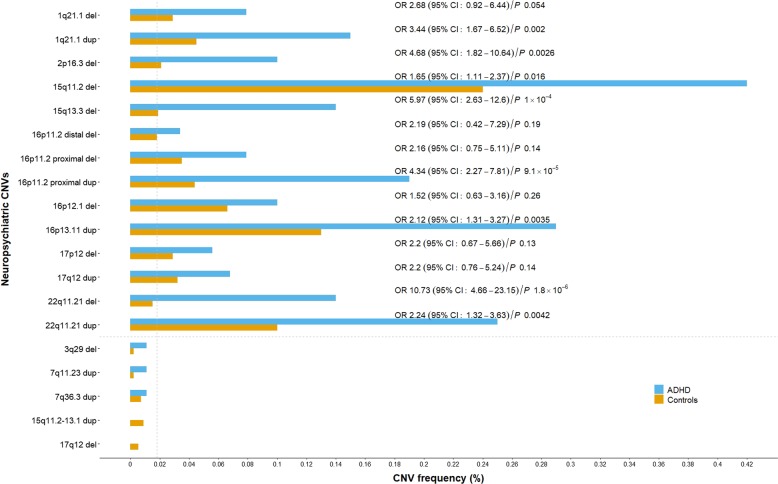
Attention-deficit/hyperactivity disorder (ADHD) is a highly heritable common childhood-onset neurodevelopmental disorder. Some rare copy number variations (CNVs) affect multiple neurodevelopmental disorders such as intellectual disability, autism spectrum disorders (ASD), schizophrenia and ADHD. The aim of this study is to determine to what extent ADHD shares high risk CNV alleles with schizophrenia and ASD. We compiled 19 neuropsychiatric CNVs and test 14, with sufficient power, for association with ADHD in Icelandic and Norwegian samples. Eight associate with ADHD; deletions at 2p16.3 (NRXN1), 15q11.2, 15q13.3 (BP4 & BP4.5–BP5) and 22q11.21, and duplications at 1q21.1 distal, 16p11.2 proximal, 16p13.11 and 22q11.21. Six of the CNVs have not been associated with ADHD before. As a group, the 19 CNVs associate with ADHD (OR = 2.43, P = 1.6 × 10⁻²¹), even when comorbid ASD and schizophrenia are excluded from the sample. These results highlight the pleiotropic effect of the neuropsychiatric CNVs and add evidence for ADHD, ASD and schizophrenia being related neurodevelopmental disorders rather than distinct entities.
Overview
The claims and statistics of this paper haven’t been checked yet.
Run the check — free, no account needed. It reads the open-access text and checks the sources it cites.
Integrity signals
Registry
Cites
Statistics
Figures
Verification
Claims the paper makes
The claims and statistics of this paper haven’t been checked yet.
Run the check — free, no account needed. It reads the open-access text and checks the sources it cites.
Claims other papers make about this one
Each is checked against this paper’s own text: does it say what the citing paper says it does?
In the citing paper
“Attention-deficit/hyperactivity disorder (ADHD) is also observed in 16p11.2 CNV carriers [12, 15–17, 19, 23, 48], at rates as high as 29% (63/217) and 42% (48/114) in deletion and duplication carriers, respectively [34].”
From 16p11.2 Copy Number Variations and Neurodevelopmental Disorders (2020) · cites this paper as [48]
Self-check
Percentages, sums and reported differences re-computed from the paper’s own numbers.
The self-check needs the paper’s full text.
Citations
Cites
LD Score regression distinguishes confounding from polygenicity in genome-wide association studies
Schizophrenia Working Group of the Psychiatric Genomics Consortium, Bulik-Sullivan, B. K., Loh, P.-R., Finucane, H. K., Ripke, S., Yang, J., Patterson, N., Daly, M. J., Price, A. L., & Neale, B. M. (2015) · Nature Genetics · doi:10.1038/ng.3211 · Cited by 5,559
Identification of common genetic risk variants for autism spectrum disorder
Autism Spectrum Disorder Working Group of the Psychiatric Genomics Consortium, Grove, J., BUPGEN, Major Depressive Disorder Working Group of the Psychiatric Genomics Consortium, 23andMe Research Team, Ripke, S., Als, T. D., Mattheisen, M., Walters, R. K., Won, H., et al. (2019) · Nature Genetics · doi:10.1038/s41588-019-0344-8 · Cited by 2,421
Self-citationMolecular genetics of attention-deficit/hyperactivity disorder
Faraone, S. V., Perlis, R. H., Doyle, A. E., Smoller, J. W., Goralnick, J. J., Holmgren, M. A., & Sklar, P. (2005) · Biological Psychiatry · doi:10.1016/j.biopsych.2004.11.024 · Cited by 2,357
ADHD Working Group of the Psychiatric Genomics Consortium (PGC), Demontis, D., Early Lifecourse & Genetic Epidemiology (EAGLE) Consortium, 23andMe Research Team, Walters, R. K., Martin, J., Mattheisen, M., Als, T. D., Agerbo, E., Baldursson, G., et al. (2019) · Nature Genetics · doi:10.1038/s41588-018-0269-7 · Cited by 2,203
Self-citationWang, K., Li, M., Hadley, D., Liu, R., Glessner, J., Grant, S. F. A., Hakonarson, H., & Bucan, M. (2007) · Genome Research · doi:10.1101/gr.6861907 · Cited by 1,792
Genetics of attention deficit hyperactivity disorder
Faraone, S. V., & Larsson, H. (2019) · Molecular Psychiatry · doi:10.1038/s41380-018-0070-0 · Cited by 1,338
Contribution of copy number variants to schizophrenia from a genome-wide study of 41,321 subjects
Marshall, C. R., Howrigan, D. P., Merico, D., Thiruvahindrapuram, B., Wu, W., Greer, D. S., Antaki, D., Shetty, A., Holmans, P. A., Pinto, D., et al. (2017) · Nature Genetics · doi:10.1038/ng.3725 · Cited by 1,058
Self-citationCohort profile: The Norwegian Mother and Child Cohort Study (MoBa)
Magnus, P. M., Irgens, L. M., Haug, K., Nystad, W., Skjærven, R., & Stoltenberg, C. (2006) · International Journal of Epidemiology · doi:10.1093/ije/dyl170 · Cited by 1,027
Convergence of genes and cellular pathways dysregulated in autism spectrum disorders
Pinto, D., Delaby, E., Merico, D., Barbosa, M., Merikangas, A., Klei, L., Thiruvahindrapuram, B., Xu, X., Ziman, R., Wang, Z., et al. (2014) · The American Journal of Human Genetics · doi:10.1016/j.ajhg.2014.03.018 · Cited by 969
Cohort Profile Update: The Norwegian Mother and Child Cohort Study (MoBa).
Magnus, P., Birke, C., Vejrup, K., Haugan, A., Alsaker, E., Daltveit, A., Handal, M., Haugen, M., Høiseth, G., Knudsen, G., et al. (2016) · International Journal of Epidemiology · doi:10.1093/ije/dyw029 · Cited by 936
Self-citationCNVs: Harbingers of a Rare Variant Revolution in Psychiatric Genetics
Malhotra, D., & Sebat, J. (2012) · Cell · doi:10.1016/j.cell.2012.02.039 · Cited by 854
Schneider, M., Debbané, M., Bassett, A. S., Chow, E. W. C., Fung, W. L. A., van den Bree, M. B. M., Owen, M., Murphy, K. C., Niarchou, M., Kates, W. R., et al. (2014) · American Journal of Psychiatry · doi:10.1176/appi.ajp.2013.13070864 · Cited by 779
CNVs conferring risk of autism or schizophrenia affect cognition in controls
Stefansson, H., Meyer-Lindenberg, A., Steinberg, S., Magnusdottir, B., Morgen, K., Arnarsdottir, S., Bjornsdottir, G., Walters, G. B., Jonsdottir, G. A., Doyle, O. M., et al. (2014) · Nature · doi:10.1038/nature12818 · Cited by 699
Self-citationLive fast, die young? A review on the developmental trajectories of ADHD across the lifespan
Franke, B., Michelini, G., Asherson, P., Banaschewski, T., Bilbow, A., Buitelaar, J. K., Cormand, B., Faraone, S. V., Ginsberg, Y., Haavik, J., et al. (2018) · European Neuropsychopharmacology · doi:10.1016/j.euroneuro.2018.08.001 · Cited by 643
Self-citationShinawi, M., Liu, P., Kang, S.-H. L., Shen, J., Belmont, J. W., Scott, D. A., Probst, F. J., Craigen, W. J., Graham, B. H., Pursley, A., et al. (2010) · Journal of Medical Genetics · doi:10.1136/jmg.2009.073015 · Cited by 580
Williams, N. M., Zaharieva, I., Martin, A., Langley, K., Mantripragada, K., Fossdal, R., Stefansson, H., Stefansson, K., Magnusson, P., Gudmundsson, O. O., et al. (2010) · The Lancet · doi:10.1016/s0140-6736(10)61109-9 · Cited by 572
Shared heritability of attention-deficit/hyperactivity disorder and autism spectrum disorder
Rommelse, N. N. J., Franke, B., Geurts, H. M., Hartman, C. A., & Buitelaar, J. K. (2010) · European Child & Adolescent Psychiatry · doi:10.1007/s00787-010-0092-x · Cited by 564
Disruption of the neurexin 1 gene is associated with schizophrenia
Rujescu, D., Ingason, A., Cichon, S., Pietiläinen, O. P. H., Barnes, M. R., Toulopoulou, T., Picchioni, M., Vassos, E., Ettinger, U., Bramon, E., et al. (2009) · Human Molecular Genetics · doi:10.1093/hmg/ddn351 · Cited by 471
Self-citationRare Copy Number Variation Discovery and Cross-Disorder Comparisons Identify Risk Genes for ADHD
Lionel, A. C., Crosbie, J., Barbosa, N., Goodale, T., Thiruvahindrapuram, B., Rickaby, J., Gazzellone, M. J., Carson, A. R., Howe, J., Wang, Z., et al. (2011) · Science Translational Medicine · doi:10.1126/scitranslmed.3002464 · Cited by 374
Halmøy, A., Fasmer, O. B., Gillberg, C., & Haavik, J. (2009) · Journal of Attention Disorders · doi:10.1177/1087054708329777 · Cited by 317
Self-citationWilliams, N. M., Franke, B., Mick, E., Anney, R. J. L., Freitag, C. M., Gill, M., Thapar, A., O'Donovan, M. C., Owen, M. J., Holmans, P., et al. (2012) · American Journal of Psychiatry · doi:10.1176/appi.ajp.2011.11060822 · Cited by 290
Ben-Shachar, S., Lanpher, B., German, J. R., Qasaymeh, M., Potocki, L., Nagamani, S. C. S., Franco, L. M., Malphrus, A., Bottenfield, G. W., Spence, J. E., et al. (2009) · Journal of Medical Genetics · doi:10.1136/jmg.2008.064378 · Cited by 261
The 15q11.2 BP1–BP2 Microdeletion Syndrome: A Review
Cox, D., & Butler, M. (2015) · International Journal of Molecular Sciences · doi:10.3390/ijms16024068 · Cited by 243
Doherty, J. L., & Owen, M. J. (2014) · Genome Medicine · doi:10.1186/gm546 · Cited by 228
iPSYCH-Broad Consortium, Satterstrom, F. K., Walters, R. K., Singh, T., Wigdor, E. M., Lescai, F., Demontis, D., Kosmicki, J. A., Grove, J., Stevens, C., et al. (2019) · Nature Neuroscience · doi:10.1038/s41593-019-0527-8 · Cited by 209
Larsson, H., Rydén, E., Boman, M., Långström, N., Lichtenstein, P., & Landén, M. (2013) · The British Journal of Psychiatry · doi:10.1192/bjp.bp.112.120808 · Cited by 199
Clinical phenotype of the recurrent 1q21.1 copy-number variant
Bernier, R., Steinman, K. J., Reilly, B., Wallace, A. S., Sherr, E. H., Pojman, N. J., Mefford, H. C., Gerdts, J., Earl, R. K., Hanson, E. M., et al. (2015) · Genetics in Medicine · doi:10.1038/gim.2015.78 · Cited by 195
Evidence that duplications of 22q11.2 protect against schizophrenia
Wellcome Trust Case Control Consortium, Rees, E., Kirov, G., Sanders, A., Walters, J. T. R., Chambert, K. D., Shi, J., Szatkiewicz, J., O'Dushlaine, C., Richards, A. L., et al. (2014) · Molecular Psychiatry · doi:10.1038/mp.2013.156 · Cited by 183
Lowther, C., Costain, G., Stavropoulos, D. J., Melvin, R., Silversides, C. K., Andrade, D. M., So, J., Faghfoury, H., Lionel, A. C., Marshall, C. R., et al. (2014) · Genetics in Medicine · doi:10.1038/gim.2014.83 · Cited by 177
Yang, L., Neale, B. M., Liu, L., Lee, S. H., Wray, N. R., Ji, N., Li, H., Qian, Q., Wang, D., Li, J., et al. (2013) · American Journal of Medical Genetics Part B: Neuropsychiatric Genetics · doi:10.1002/ajmg.b.32169 · Cited by 171
Kendall, K. M., Bracher‐Smith, M., Fitzpatrick, H., Lynham, A. J., Rees, E., Escott‐Price, V., Owen, M. J., O’Donovan, M. C., Walters, J., & Kirov, G. (2019) · The British Journal of Psychiatry · doi:10.1192/bjp.2018.301 · Cited by 167
Male-biased autosomal effect of 16p13.11 copy number variation in neurodevelopmental disorders
Tropeano, M., Ahn, J. W., Dobson, R. J. B., Breen, G., Rucker, J., Dixit, A., Pal, D. K., McGuffin, P., Farmer, A., White, P. S., et al. (2013) · PLoS ONE · doi:10.1371/journal.pone.0061365 · Cited by 154
Towards an understanding of unique and shared pathways in the psychopathophysiology of ADHD
Banaschewski, T., Hollis, C., Oosterlaan, J., Roeyers, H., Rubia, K., Willcutt, E., & Taylor, E. (2005) · Developmental Science · doi:10.1111/j.1467-7687.2005.00400.x · Cited by 152
16p13.11 duplication is a risk factor for a wide spectrum of neuropsychiatric disorders
Ramalingam, A., Zhou, X.-G., Fiedler, S. D., Brawner, S. J., Joyce, J. M., Liu, H.-Y., & Yu, S. (2011) · Journal of Human Genetics · doi:10.1038/jhg.2011.42 · Cited by 151
Protection of privacy by third-party encryption in genetic research in Iceland
Gulcher, J. R., Kristjánsson, K., Guðbjartsson, H., & Stefánsson, K. (2000) · European Journal of Human Genetics · doi:10.1038/sj.ejhg.5200530 · Cited by 138
Martin, J., Cooper, M., Hamshere, M. L., Pocklington, A. J., Scherer, S. W., Kent, L., Gill, M., Owen, M. J., Williams, N. M., O’Donovan, M. C., et al. (2014) · Journal of the American Academy of Child & Adolescent Psychiatry · doi:10.1016/j.jaac.2014.03.004 · Cited by 117
Hamshere, M. L., Stergiakouli, E., Langley, K., Martin, J., Holmans, P., Kent, L., Owen, M. J., Gill, M., Thapar, A., O’Donovan, M. C., et al. (2013) · The British Journal of Psychiatry · doi:10.1192/bjp.bp.112.117432 · Cited by 112
Risk of Psychiatric Disorders Among Individuals With the 22q11.2 Deletion or Duplication
Hoeffding, L. K., Trabjerg, B. B., Olsen, L., Mazin, W., Sparsø, T., Vangkilde, A., Mortensen, P. B., Pedersen, C. B., & Werge, T. M. (2017) · JAMA Psychiatry · doi:10.1001/jamapsychiatry.2016.3939 · Cited by 104
Genetics of attention-deficit/hyperactivity disorder: an update
Akutagava‐Martins, G. C., Rohde, L. A., & Hutz, M. H. (2015) · Expert Review of Neurotherapeutics · doi:10.1586/14737175.2016.1130626 · Cited by 97
Wenger, T. L., Miller, J. S., DePolo, L. M., de Marchena, A. B., Clements, C. C., Emanuel, B. S., Zackai, E. H., McDonald‐McGinn, D. M., & Schultz, R. T. (2016) · Molecular Autism · doi:10.1186/s13229-016-0090-z · Cited by 94
The complex behavioral phenotype of 15q13.3 microdeletion syndrome
Ziats, M. N., Goin‐Kochel, R. P., Berry, L. N., Ali, M. A., Ge, J., Guffey, D., Rosenfeld, J. A., Bader, P. I., Gambello, M. J., Wolf, V. L., et al. (2016) · Genetics in Medicine · doi:10.1038/gim.2016.9 · Cited by 91
15q11.2 CNV affects cognitive, structural and functional correlates of dyslexia and dyscalculia
Ulfarsson, M. O., Walters, G. B., Gustafsson, O., Steinberg, S., Silva, A., Doyle, O. M., Brammer, M., Gudbjartsson, D. F., Arnarsdottir, S., Jonsdottir, G. A., et al. (2017) · Translational Psychiatry · doi:10.1038/tp.2017.77 · Cited by 78
Self-citationRees, E., O’Donovan, M. C., & Owen, M. J. (2014) · Current Opinion in Behavioral Sciences · doi:10.1016/j.cobeha.2014.07.001 · Cited by 77
Developmental and Behavioral Disorders Through the Life Span
Stein, D. S., Blum, N. J., & Barbaresi, W. J. (2011) · PEDIATRICS · doi:10.1542/peds.2011-0266 · Cited by 63
Developmental trajectories for young children with 16p11.2 copy number variation
Bernier, R., Hudac, C. M., Chen, Q., Zeng, C., Wallace, A. S., Gerdts, J., Earl, R. K., Peterson, J. L., Wolken, A., Peters, A., et al. (2017) · American Journal of Medical Genetics Part B Neuropsychiatric Genetics · doi:10.1002/ajmg.b.32525 · Cited by 50
Oerbeck, B., Øvergaard, K. R., Aspenes, S. T., Pripp, A. H., Mørdre, M., Aase, H., Reichborn‐Kjennerud, T., & Zeiner, P. (2017) · BMC Psychiatry · doi:10.1186/s12888-017-1204-7 · Cited by 45
Self-citationGenomic Disorders in Psychiatry-What Does the Clinician Need to Know?
Lowther, C., Costain, G., Baribeau, D. A., & Bassett, A. S. (2017) · Current Psychiatry Reports · doi:10.1007/s11920-017-0831-5 · Cited by 41
Curran, S. R., Ahn, J. W., Grayton, H. M., Collier, D. A., & Ogilvie, C. M. (2013) · Journal of Molecular Psychiatry · doi:10.1186/2049-9256-1-4 · Cited by 40
Shared and Nonshared Symptoms in Youth-Onset Psychosis and ADHD
Karatekin, C., White, T. J. H., & Bingham, C. R. (2009) · Journal of Attention Disorders · doi:10.1177/1087054709347434 · Cited by 39
Demontis, D., Lescai, F., Børglum, A. D., Glerup, S., Østergaard, S. D., Mors, O. N., Li, Q., Liang, J., Jiang, H., Li, Y., et al. (2016) · Journal of the American Academy of Child & Adolescent Psychiatry · doi:10.1016/j.jaac.2016.03.009 · Cited by 32
ASD and ADHD have a similar burden of rare protein-truncating variantsPreprint
Satterstrom, F., Walters, R. K., Singh, T., Wigdor, E., Lescai, F., Demontis, D., Kosmicki, J. A., Grove, J., Stevens, C. R., Bybjerg-Grauholm, J., et al. (2018) · bioRxiv · doi:10.1101/277707 · Cited by 30
Failure to detect the 22q11.2 duplication syndrome rearrangement among patients with schizophrenia
Brunet‐Vega, A., Armengol, L., Pelaez, T., Guillamat, R., Vallès, V., Gabau, E., Estivill, X., & Guitart, M. (2008) · Behavioral and Brain Functions · doi:10.1186/1744-9081-4-10 · Cited by 22
Cited by
Sorted by citations
Attention-deficit/hyperactivity disorder
Faraone, S. V., Bellgrove, M. A., Brikell, I., Cortese, S., Hartman, C. A., Hollis, C., Newcorn, J. H., Philipsen, A., Polanczyk, G. V., Rubia, K., et al. (2024) · Nature Reviews Disease Primers · doi:10.1038/s41572-024-00495-0 · Cited by 355
“CNV associations were identified in at least four independent samples and prioritized by bioinformatics 86 and/or replicated across the two largest CNV studies to date 87,88 .”
Andreassen, O. A., Hindley, G., Frei, O., & Smeland, O. B. (2023) · World Psychiatry · doi:10.1002/wps.21034 · Cited by 284
Self-citationGenomics, convergent neuroscience and progress in understanding autism spectrum disorder
Willsey, H. R., Willsey, A. J., Wang, B., & State, M. W. (2022) · Nature reviews. Neuroscience · doi:10.1038/s41583-022-00576-7 · Cited by 239
Genetic Testing in Neurodevelopmental Disorders
Savatt, J. M., & Myers, S. M. (2021) · Frontiers in Pediatrics · doi:10.3389/fped.2021.526779 · Cited by 237
Genetic contributions to autism spectrum disorder
Havdahl, A., Niarchou, M., Starnawska, A., Uddin, M., van der Merwe, C., & Warrier, V. (2021) · Psychological Medicine · doi:10.1017/s0033291721000192 · Cited by 211
“Rare CNVs and SNVs associated with autism have pleiotropic effects, thus increasing the risk for other complex disorders such as schizophrenia, ADHD, ID, and epilepsy (Gudmundsson et al., 2019; Satterstrom et al., 2019, 2020).”
Background
Metadata
- Authors
- Gudmundsson, O. O., Walters, G. B., Ingason, A., Johansson, S., Zayats, T., Athanasiu, L., Sonderby, I. E., Gustafsson, O., Nawaz, M. S., Jonsson, G. F., Jonsson, L., Knappskog, P.-M., Ingvarsdottir, E., Davidsdottir, K., Djurovic, S., Knudsen, G. P. S., Askeland, R. B., Haraldsdottir, G. S., Baldursson, G., Magnusson, P., Sigurdsson, E., Gudbjartsson, D. F., Stefansson, H., Andreassen, O. A., Haavik, J., Reichborn-Kjennerud, T., & Stefansson, K.
- Affiliations
- deCODE Genetics (Iceland) (IS)
- Haukeland University Hospital (NO)
- University of Bergen (NO)
- Oslo University Hospital (NO)
- Norwegian Institute of Public Health (NO)
- ORCID
- Venue
- Translational Psychiatry
- Published
- 2019-10-17
- Volume
- 9
- Issue
- 1
- Pages
- 258-258
- ISSN
- 2158-3188 (ISSN-L)
- PMC
- PMC6797719
- OpenAlex
- W2980448813
- Cited by
- 128
- References
- 51
- Citations by year
- 2026: 11 · 2025: 18 · 2024: 17 · 2023: 22 · 2022: 20 · 2021: 25 · 2020: 15
- FWCI
- 9.01
- Type
- journal article
- Language
- en
- Open access
- gold
- doi.org
- Locations
- Translational Psychiatry (publishedVersion, cc-by)
- PubMed Central (publishedVersion, cc-by)
- PubMed (publishedVersion)
- NORA - Norwegian Open Research Archives (submittedVersion, cc-by)
- DOAJ (DOAJ: Directory of Open Access Journals) (submittedVersion)
- NORA - Norwegian Open Research Archives (submittedVersion, other-oa)
- Opin vísindi (Opin vísindi) (submittedVersion, cc-by)
- Hirsla (Landspítali University Hospital) (submittedVersion, other-oa)
- Funders
- European Federation of Pharmaceutical Industries and Associations (FP7/20072013)
- European Commission (EU-FP7, 602450, 2007–2013, 226971, FP7 2007-2013, 115300, 286213, FP7/2007, 248778, 115008)
- Norges Forskningsråd (226971, 229129, 223273, #213694, 248778, SKGJ-MED-008)
- Innovative Medicines Initiative (FP7/2007‐2013, 115008, 115300)
- Topics
- Life Sciences › Biochemistry, Genetics and Molecular Biology › Genetics › Genomic variations and chromosomal abnormalities
- Health Sciences › Medicine › Psychiatry and Mental health › Attention Deficit Hyperactivity Disorder
- Life Sciences › Biochemistry, Genetics and Molecular Biology › Genetics › Genetics and Neurodevelopmental Disorders
- Keywords
- attention deficit hyperactivity disorder, copy number variation, schizophrenia, autism spectrum disorder, pleiotropy, neurodevelopmental disorders, 15q11.2, 15q13.3, 16p11.2, genetic risk, comorbidities
- MeSH terms
- Autism Spectrum Disorder, Adolescent, Adult, Attention Deficit Disorder with Hyperactivity, Female, Humans, Iceland, Male, Norway, Schizophrenia, Case-Control Studies, Genetic Predisposition to Disease, Polymorphism, Single Nucleotide, Genome-Wide Association Study, DNA Copy Number Variations
About these checks
Registry, retraction, Cites and statistics results are computed, not judged, with one exception: a printed reference that no index lists is read once by a model before it counts as a citation error. Claims are extracted by a model and kept only when their quote appears verbatim in the text; each cited source is then checked, with a model’s help, for whether it says what the claim relies on. Those verdicts can be wrong — read the claim’s quote and the cited source before relying on one.
Statistics and arithmetic are recomputed, not judged.
Confidence bands are shown only for fields calibrated on our annotated test set. None is calibrated yet, so no band is shown.
What counts as a claim ›How we measure confidence ›How we check this ›
Are you an author, or do you see a problem with this page? Request a review
