

The relevance of transdiagnostic shared networks to the severity of symptoms and cognitive deficits in schizophrenia: a multimodal brain imaging fusion study
Open accessThe DOI matches its Crossref record; 48 of the 48 references it cites were found in a registry or an index.
Abstract
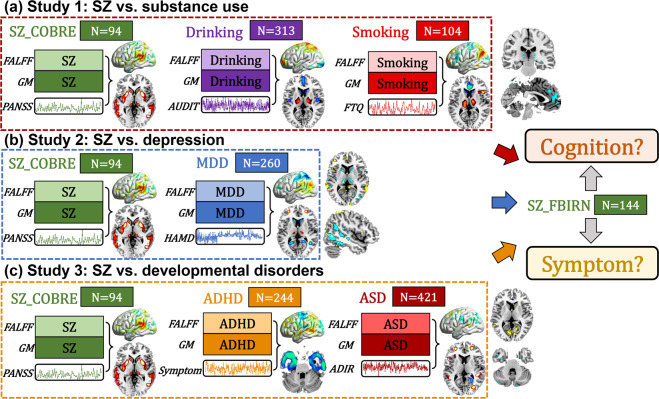
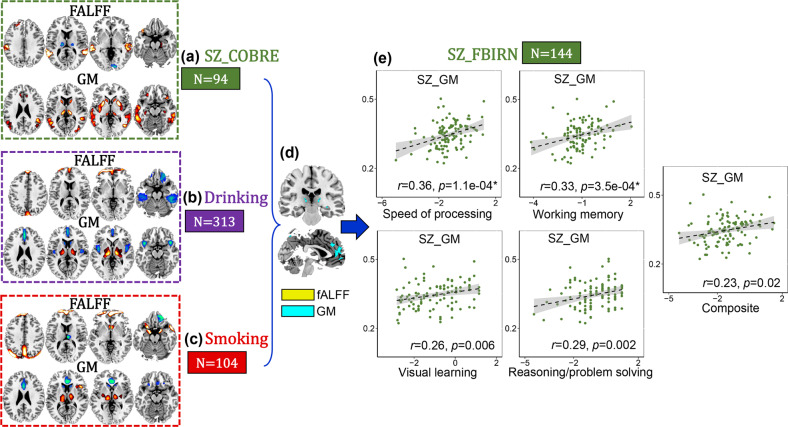
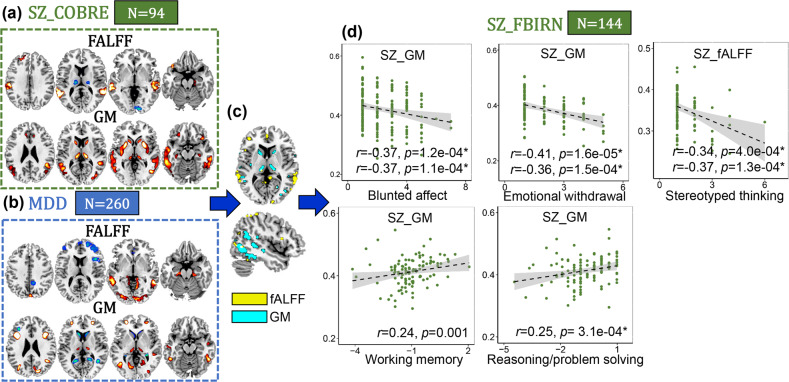
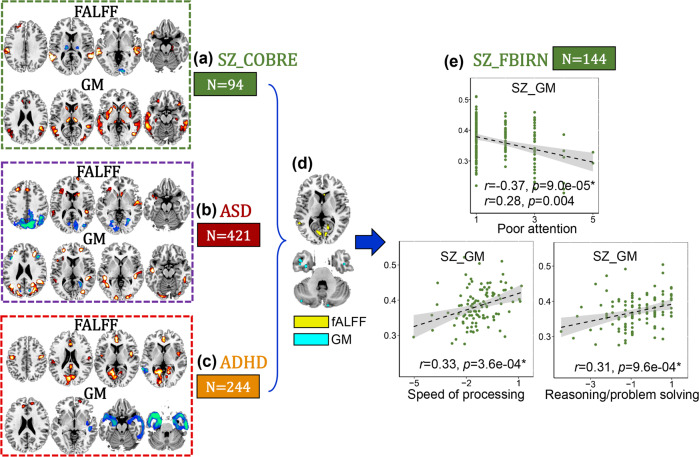
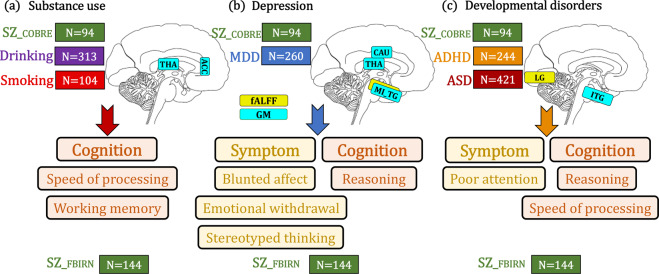
Schizophrenia (SZ) is frequently concurrent with substance use, depressive symptoms, social communication and attention deficits. However, the relationship between common brain networks (e.g., SZ vs. substance use, SZ vs. depression, SZ vs. developmental disorders) with SZ on specific symptoms and cognition is unclear. Symptom scores were used as a reference to guide fMRI-sMRI fusion for SZ ( n = 94), substance use with drinking ( n = 313), smoking ( n = 104), major depressive disorder (MDD, n = 260), developmental disorders with autism spectrum disorder (ASD, n = 421) and attention-deficit/hyperactivity disorder (ADHD, n = 244) respectively. Common brain regions were determined by overlapping the symptom-related components between SZ and these other groups. Correlation between the identified common brain regions and cognition/symptoms in an independent SZ dataset ( n = 144) was also performed. Results show that (1): substance use was related with cognitive deficits in schizophrenia through gray matter volume (GMV) in anterior cingulate cortex and thalamus; (2) depression was linked to PANSS negative dimensions and reasoning in SZ through a network involving caudate-thalamus-middle/inferior temporal gyrus in GMV; (3) developmental disorders pattern was correlated with poor attention, speed of processing and reasoning in SZ through inferior temporal gyrus in GMV. This study reveals symptom driven transdiagnostic shared networks between SZ and other mental disorders via multi-group data mining, indicating that some potential common underlying brain networks associated with schizophrenia differently with respect to symptoms and cognition. These results have heuristic value and advocate specific approaches to refine available treatment strategies for comorbid conditions in schizophrenia.
Overview
The claims and statistics of this paper haven’t been checked yet.
Free: it reads the open-access text and checks the first 5 claims that cite a source we can check. Create a free account to check every claim.
Integrity signals
Registry
Cites
Statistics
Figures
Verification
Claims the paper makes
The claims and statistics of this paper haven’t been checked yet.
Free: it reads the open-access text and checks the first 5 claims that cite a source we can check. Create a free account to check every claim.
Claims other papers make about this one
Each is checked against this paper’s own text: does it say what the citing paper says it does?
The check wasn’t confident either way, so it gives no verdict — never disputed.
In the citing paper
“SAN plays a critical role in attentional capture of biological and cognitively relevant events [56], and the atypical activation patterns (primarily hypoactivation) of these regions have been extensively reported in ADHD [57, 58].”
From Confound Controlled Multimodal Neuroimaging Data Fusion and Its Application to Developmental Disorders (2025) · cites this paper as [58]
Experimental — accuracy not yet measured
Self-check
Percentages, sums and reported differences re-computed from the paper’s own numbers.
The self-check needs the paper’s full text.
Citations
Cites
Ashburner, J., & Friston, K. J. (2005) · NeuroImage · doi:10.1016/j.neuroimage.2005.02.018 · Cited by 7,507
(2013) · The Lancet · doi:10.1016/s0140-6736(12)62129-1 · Cited by 3,010
Di Martino, A., Yan, C.-G., Li, Q., Denio, E., Castellanos, F. X., Alaerts, K., Anderson, J. S., Assaf, M., Bookheimer, S. Y., Dapretto, M., et al. (2014) · Molecular Psychiatry · doi:10.1038/mp.2013.78 · Cited by 2,780
Zou, Q.-H., Zhu, C.-Z., Yang, Y., Zuo, X.-N., Long, X.-Y., Cao, Q.-J., Wang, Y.-F., & Zang, Y.-F. (2008) · Journal of Neuroscience Methods · doi:10.1016/j.jneumeth.2008.04.012 · Cited by 2,161
Insel, T. R. (2010) · Nature · doi:10.1038/nature09552 · Cited by 1,783 · cited 3×
“According to our current results, we highlight that (1): substance use may relate with cognitive deficits (speed of processing and working memory) in schizophrenia through GMV in ACC-thalamus reward circuit; (2) depression was linked to PANSS negative dimensions Qi et al.”
BackgroundAmaral, D. G., Schumann, C. M., & Nordahl, C. W. (2008) · Trends in Neurosciences · doi:10.1016/j.tins.2007.12.005 · Cited by 1,492
Identification of a Common Neurobiological Substrate for Mental Illness
Goodkind, M., Eickhoff, S. B., Oathes, D. J., Jiang, Y., Chang, A., Jones-Hagata, L. B., Ortega, B. N., Zaiko, Y. V., Roach, E. L., Korgaonkar, M. S., et al. (2015) · JAMA Psychiatry · doi:10.1001/jamapsychiatry.2014.2206 · Cited by 1,404
Psychiatric Comorbidities and Schizophrenia
Buckley, P. F., Miller, B. J., Lehrer, D. S., & Castle, D. J. (2009) · Schizophrenia Bulletin · doi:10.1093/schbul/sbn135 · Cited by 1,121
Shared molecular neuropathology across major psychiatric disorders parallels polygenic overlap
Gandal, M. J., Haney, J. R., Parikshak, N. N., Leppa, V., Ramaswami, G., Hartl, C., Schork, A. J., Appadurai, V., Buil, A., Werge, T. M., et al. (2018) · Science · doi:10.1126/science.aad6469 · Cited by 1,095
Psychiatric genome-wide association study analyses implicate neuronal, immune and histone pathways
The Network and Pathway Analysis Subgroup of the Psychiatric Genomics Consortium (2015) · Nature Neuroscience · doi:10.1038/nn.3922 · Cited by 755
Cited by
Brain imaging-based machine learning in autism spectrum disorder: methods and applications
Xu, M., Calhoun, V. D., Jiang, R., Yan, W., & Sui, J. (2021) · Journal of Neuroscience Methods · doi:10.1016/j.jneumeth.2021.109271 · Cited by 81
“Furthermore, combining multimodal brain imaging data could give comprehensive views of brain organizations, and facilitate to reveal complex, cross-modal alterations associated with the intrinsic pathology of disorders (Jiang et al., 2020a, 2020c; Qi et al., 2020a).”
BackgroundMethodSelf-citationCommon and unique multimodal covarying patterns in autism spectrum disorder subtypes
Qi, S., Morris, R., Turner, J. A., Fu, Z., Jiang, R., Deramus, T. P., Zhi, D., Calhoun, V. D., & Sui, J. (2020) · Molecular Autism · doi:10.1186/s13229-020-00397-4 · Cited by 58
Self-citationCui, Z., Pines, A. R., Larsen, B., Sydnor, V. J., Li, H., Adebimpe, A., Alexander‐Bloch, A. F., Bassett, D. S., Bertolero, M. A., Calkins, M. E., et al. (2022) · Biological Psychiatry · doi:10.1016/j.biopsych.2022.05.014 · Cited by 68
“disrupted patterns of functional connectivity across mental disorders (Baker et al., 2019; Barron et al., 2020; Ma et al., 2020; Qi et al., 2020; Xia et al., 2018).”
BackgroundReward Processing in Novelty Seekers: A Transdiagnostic Psychiatric Imaging Biomarker
Qi, S., Schumann, G., Bustillo, J., Turner, J. A., Jiang, R., Zhi, D., Fu, Z., Mayer, A. R., Vergara, V. M., Silva, R. F., et al. (2021) · Biological Psychiatry · doi:10.1016/j.biopsych.2021.01.011 · Cited by 55
“html) were obtained from the ADHD-200 project (18).”
BackgroundMethodSelf-citationData-driven multimodal fusion: approaches and applications in psychiatric research
Sui, J., Zhi, D., & Calhoun, V. D. (2023) · Psychoradiology · doi:10.1093/psyrad/kkad026 · Cited by 64
“For m ultiple psyc hiatric disorders, the study combined fMRI and sMRI to explor e symptom-driv en tr ansdia gnostic shar ed networks between SZ and substance use with drinking, smoking, depression, ASD, and ADHD via m ulti-gr oup data mining (Qi, Bustillo, et al. , 2020 ).”
MethodSelf-citationQi, S., Sui, J., Pearlson, G. D., Bustillo, J., Perrone‐Bizzozero, N. I., Kochunov, P., Turner, J. A., Fu, Z., Shao, W., Jiang, R., et al. (2022) · Nature Communications · doi:10.1038/s41467-022-32513-8 · Cited by 60
Self-citationThe neurophysiological consequences of racism-related stressors in Black Americans
Webb, E. K., Carter, S. E., Ressler, K. J., Fani, N., & Harnett, N. G. (2024) · Neuroscience & Biobehavioral Reviews · doi:10.1016/j.neubiorev.2024.105638 · Cited by 40
Mapping working memory-specific dysfunction using a transdiagnostic approach
Yaple, Z. A., Tolomeo, S., & Yu, R. (2021) · NeuroImage: Clinical · doi:10.1016/j.nicl.2021.102747 · Cited by 26
“Interestingly, a rapid growing increase of original transdiagnostic studies (Huang et al., 2020; Li et al., 2019; Qi et al., 2020; Ma et al., 2020; Lerman-Sinkoff et al., 2019; Baker et al., 2019), meta-analyses (Sha et al.”
Qi, S., Calhoun, V. D., Zhang, D., Miller, J., Deng, Z., Narr, K. L., Sheline, Y. I., McClintock, S. M., Jiang, R., Yang, X., et al. (2022) · BMC Medicine · doi:10.1186/s12916-022-02678-6 · Cited by 24
Self-citationLiang, C., Pearlson, G., Bustillo, J., Kochunov, P., Turner, J. A., Wen, X., Jiang, R., Fu, Z., Zhang, X., Li, K., et al. (2023) · Schizophrenia Bulletin · doi:10.1093/schbul/sbac158 · Cited by 19
Self-citationZhuo, C., Fang, T., Chen, C., Chen, M., Sun, Y., Ma, X., Li, R., Tian, H., & Ping, J. (2020) · Brain and Behavior · doi:10.1002/brb3.1991 · Cited by 34
“It is believed that the whole brain FCD is impaired in first-episode schizophrenia patients with comorbid depression (Qi et al., 2020).”
BackgroundSelf-citationLi, Y., Zhang, T., Feng, J., Qian, S., Wu, S., Zhou, R., Wang, J., Sa, G., Wang, X., Li, L., et al. (2022) · European Journal of Nuclear Medicine and Molecular Imaging · doi:10.1007/s00259-022-05740-w · Cited by 18
Zhao, C., Jiang, R., Bustillo, J., Kochunov, P., Turner, J. A., Liang, C., Fu, Z., Zhang, D., Qi, S., & Calhoun, V. D. (2024) · Human Brain Mapping · doi:10.1002/hbm.26694 · Cited by 19
“Cognitive impairments in SZ involve deficits in attention, memory, learning, and executive function (Joyce & Roiser, 2007; Qi et al., 2020; S. Qi et al., 2021; Rodrigues-Amorim et al., 2017; Wang et al., 2020).”
BackgroundSelf-citationAkhonda, M. A. B. S., Levin‐Schwartz, Y., Calhoun, V. D., & Adalı, T. (2022) · Sensors · doi:10.3390/s22031224 · Cited by 15
“A few recently published methods use fusion-based methods on neuroimaging datasets and show improved performance compared with individual analysis methods [33,43,44].”
MethodSelf-citationJi, Y., Pearlson, G. D., Bustillo, J., Kochunov, P., Turner, J. A., Jiang, R., Shao, W., Zhang, X., Fu, Z., Li, K., et al. (2023) · Schizophrenia Research · doi:10.1016/j.schres.2023.12.013 · Cited by 8
Self-citationZhang, Y., Gao, S., Liang, C., Bustillo, J., Kochunov, P., Turner, J. A., Calhoun, V. D., Wu, L., Fu, Z., Jiang, R., et al. (2024) · NeuroImage Clinical · doi:10.1016/j.nicl.2024.103726 · Cited by 10
“Schizophrenia (SZ) is a severe, chronic and debilitating mental illness, characterized by positive and negative symptoms, and cognitive deficits (Qi et al., 2020), with a clinical burden compounded by high rate (Correll et al., 2022; Siskind et al., 2022) (up to 30”
Self-citationZhou, Y., Yang, W. F. Z., Wu, Q., Ma, Y., Zhou, J., Ren, H., Hao, Y., Li, M., Wang, Y., Peng, P., et al. (2024) · Asian Journal of Psychiatry · doi:10.1016/j.ajp.2024.103936 · Cited by 6
Qiu, L., Liang, C., Kochunov, P., Hutchison, K. E., Sui, J., Jiang, R., Zhi, D., Vergara, V. M., Yang, X., Zhang, D., et al. (2024) · Translational Psychiatry · doi:10.1038/s41398-024-03035-2 · Cited by 8
“ASD ( n = 421) and ADHD ( n = 346) were obtained from the Autism Brain Imaging Data Exchange II (ABIDE II [27, 28]) and the ADHD-200 project [19] (http://fcon_1000.projects.nitrc.org/indi/ adhd200/), respectively.”
BackgroundMethodSelf-citationFunctional Connectivity Biomarkers in Schizophrenia
Howell, A. M., & Anticevic, A. (2024) · Advances in neurobiology · doi:10.1007/978-3-031-69491-2_10 · Cited by 5
Liang, C., Silva, R. F., Adali, T., Jiang, R., Zhang, D., Qi, S., & Calhoun, V. D. (2025) · IEEE Transactions on Image Processing · doi:10.1109/tip.2025.3597045 · Cited by 3
“SAN plays a critical role in attentional capture of biological and cognitively relevant events [56], and the atypical activation patterns (primarily hypoactivation) of these regions have been extensively reported in ADHD [57], [58].”
Self-citationMultivariate Approaches for Multimodal Fusion of Structural and Functional Brain Imaging Data
Sui, J., & Calhoun, V. D. (2025) · Neuromethods · doi:10.1007/978-1-0716-4438-6_29 · Cited by 3
Self-citationQi, S., Plis, S., Miller, R. L., Silva, R. F., Vergara, V. M., Jiang, R., Zhi, D., Sui, J., & Calhoun, V. D. (2021) · IEEE International Symposium on Biomedical Imaging (ISBI) · doi:10.1109/isbi48211.2021.9433935 · Cited by 2
“ACC, insular and prefrontal cortex detected in sMRI covaried with forceps major and forceps minor identified in dMRI that are being involved in multiple high-order cognitive functions including attention [14, 22], working memory [23] and learning [24-26].”
Self-citationWei, Y., Huang, Y., Cui, H., Xu, L., Wei, Y., Tang, X., Tang, Y., Hu, H., Zhang, T., Liu, Y., et al. (2026) · Schizophrenia Research · doi:10.1016/j.schres.2026.04.011 · Cited by 1
Consistent Brain Age Difference in Childhood Autism Spectrum Disorder and its Subtypes
Sun, F., Liang, C., Shao, W., Fu, Z., Zhang, D., Jiang, R., Qi, S., & Calhoun, V. D. (2025) · Communications in computer and information science · doi:10.1007/978-981-96-4001-0_20
Self-citationThe Co-varying Multimodal Pattern in Treatment-Resistant and Non-treatment-Resistant Schizophrenia
Cao, S., Gao, S., Liang, C., Calhoun, V. D., Wen, X., Fu, Z., Wu, L., Jiang, R., Zhang, D., Qi, S., et al. (2025) · Communications in computer and information science · doi:10.1007/978-981-96-4001-0_8 · Cited by 1
Self-citationIndividual Differential Functional Brain Networks Based on Sparsity and Dissimilarity
Zhao, C., Jiang, R., Wei, G., Adalı, T., Zhang, D., Calhoun, V. D., & Qi, S. (2025) · Annual International Conference of the IEEE Engineering in Medicine and Biology Society (EMBC) · doi:10.1109/embc58623.2025.11254225
“Resting-state functional connectivity (RSFC) characterizes the network organization of the human brain by quantifying temporal dependencies between signals from voxels, regions, or networks [12-15].”
Self-citationQi, S., Calhoun, V. D., Zhang, D., Miller, J., Deng, Z., Narr, K. L., Sheline, Y. I., McClintock, S. M., Jiang, R., Yang, X., et al. (2023) · Figshare · doi:10.6084/m9.figshare.22598698
Self-citationQi, S., Morris, R., Turner, J. A., Fu, Z., Jiang, R., DeRamus, T. P., Zhi, D., Calhoun, V. D., & Sui, J. (2020) · Figshare · doi:10.6084/m9.figshare.13257777
Self-citationDisrupted Structural Covariance in Schizophrenia, Bipolar Disorder, and Major Depressive Disorder
Yin, Y., Wei, W., Deng, L., Li, X., Ma, X., Zhao, L., Deng, W., Guo, W., Sham, P. C., Wang, Q., et al. (2026) · Schizophrenia Bulletin · doi:10.1093/schbul/sbaf250
Self-citationHarikumar, A., Baker, B. T., Amen, D., Keator, D. B., & Calhoun, V. D. (2026) · medRxiv · doi:10.64898/2026.04.15.26350953
Self-citationBrain aging patterns among nine neurological disorders: A case-control study
Liang, C., Pearlson, G. D., Bustillo, J., Kochunov, P., Chen, J., Zhang, X., Jiang, R., Hutchison, K. E., Sui, J., Fu, Z., et al. (2026) · PLoS Medicine · doi:10.1371/journal.pmed.1004860
“…n = 258) from Beijing Anding Hospital, West China Hospital of Sichuan, First Affiliated Hospital of Zhejiang and Henan Mental Hospital of Xinxiang [22]; AUD ( n = 155) and TUD ( n = 144) from Albuquerque [23]; AD ( n = 361) and matched HC ( n = 361), MCI ( n = 657) and matched HC ( n = 657) from…”
Self-citationLiang, C., Adalı, T., Sui, J., Qi, S., & Calhoun, V. D. (2026) · ACM SIGKDD Conference on Knowledge Discovery and Data Mining (KDD) · doi:10.1145/3770855.3818859
Self-citation
Metadata
- Authors
- Qi, S., Bustillo, J., Turner, J. A., Jiang, R., Zhi, D., Fu, Z., Deramus, T. P., Vergara, V., Ma, X., Yang, X., Stevens, M., Zhuo, C., Xu, Y., Calhoun, V. D., & Sui, J.
- Affiliations
- Georgia Institute of Technology (US)
- University of New Mexico (US)
- Chinese Academy of Sciences (CN)
- Sichuan University (CN)
- Nankai University (CN)
- Shanxi Medical University (CN)
- Corresponding author
- Calhoun, Vince D.
- ORCID
- Venue
- Translational Psychiatry
- Published
- 2020-05-18
- Volume
- 10
- Issue
- 1
- Pages
- 149-149
- ISSN
- 2158-3188 (ISSN-L)
- PMC
- PMC7235018
- OpenAlex
- W3024177735
- Semantic Scholar
- f09fa6bde067f2551d93d03b1055d5b000bcedc3
- Cited by
- 32
- References
- 48
- Citations by year
- 2026: 4 · 2025: 6 · 2024: 6 · 2023: 3 · 2022: 6 · 2021: 4 · 2020: 3
- FWCI
- 2.92
- Type
- journal article
- Language
- en
- Open access
- gold
- doi.org
- Licence
- cc-by
- creativecommons.org/licenses/by/4.0 (tdm)
- creativecommons.org/licenses/by/4.0 (vor)
- Locations
- Translational Psychiatry (publishedVersion, cc-by)
- PubMed Central (publishedVersion, cc-by)
- PubMed (publishedVersion)
- Funders
- National Science Foundation (1R01EB005846, R01-EB020407, 1539067, P30GM122734, P20-GM103472, R01MH118695)
- Chinese Academy of Sciences (P20GM103472, R01EB020407, 61773380)
- Beijing Municipal Science and Technology Commission (Z181100001518005, No. Z181100001518005)
- National Institute of Mental Health (R01MH117107, R01MH094524, R01MH118695)
- National Institute of General Medical Sciences (P20GM103472, P30GM122734)
- National Institute of Biomedical Imaging and Bioengineering (R01EB020407, R01EB005846)
- Topics
- Health Sciences › Medicine › Psychiatry and Mental health › Schizophrenia research and treatment
- Life Sciences › Neuroscience › Cognitive Neuroscience › Functional Brain Connectivity Studies
- Social Sciences › Arts and Humanities › Philosophy › Mental Health and Psychiatry
- Keywords
- schizophrenia, substance use, major depressive disorder, developmental disorders, autism spectrum disorder, attention deficit hyperactivity disorder, cognitive impairment, symptom severity, gray matter volume, anterior cingulate cortex, thalamus, caudate nucleus, inferior temporal gyrus, comorbidities
- MeSH terms
- Autism Spectrum Disorder, Brain, Cognition, Major Depressive Disorder, Humans, Magnetic Resonance Imaging, Schizophrenia, Neuroimaging
About these checks
Registry, retraction, Cites and statistics results are computed, not judged, with one exception: a printed reference that no index lists is read once by a model before it counts as a citation error. Claims are extracted by a model and kept only when their quote appears verbatim in the text; each cited source is then checked, with a model’s help, for whether it says what the claim relies on. Those verdicts can be wrong — read the claim’s quote and the cited source before relying on one.
Statistics and arithmetic are recomputed, not judged.
Confidence bands are shown only for fields calibrated on our annotated test set. None is calibrated yet, so no band is shown.
What counts as a claim ›How we measure confidence ›How we check this ›
Are you an author, or do you see a problem with this page? Request a review
Data sources
Bibliographic data: Semantic Scholar, OpenAlex, Crossref.
Contains information from the Semantic Scholar Academic Graph Datasets, made available under the ODC Attribution License (ODC-BY 1.0).
Semantic Scholar’s data is described in: Kinney, R., et al. (2023). The Semantic Scholar Open Data Platform. arXiv:2301.10140.
