

The DOI matches its Crossref record; 121 of the 121 references it cites were found in a registry or an index.
Depression—an underrecognized target for prevention of dementia in Alzheimer’s disease
Open accessAbstract
It is broadly acknowledged that the onset of dementia in Alzheimer’s disease (AD) may be modifiable by the management of risk factors. While several recent guidelines and multidomain intervention trials on prevention of cognitive decline address lifestyle factors and risk diseases, such as hypertension and diabetes, a special reference to the established risk factor of depression or depressive symptoms is systematically lacking. In this article we review epidemiological studies and biological mechanisms linking depression with AD and cognitive decline. We also emphasize the effects of antidepressive treatment on AD pathology including the molecular effects of antidepressants on neurogenesis, amyloid burden, tau pathology, and inflammation. We advocate moving depression and depressive symptoms into the focus of prevention of cognitive decline and dementia. We constitute that early treatment of depressive symptoms may impact on the disease course of AD and affect the risk of developing dementia and we propose the need for clinical trials.
Overview
The claims and statistics of this paper haven’t been checked yet.
Run the check — free, no account needed. It reads the open-access text and checks the sources it cites.
Integrity signals
Registry
Cites
Statistics
Figures
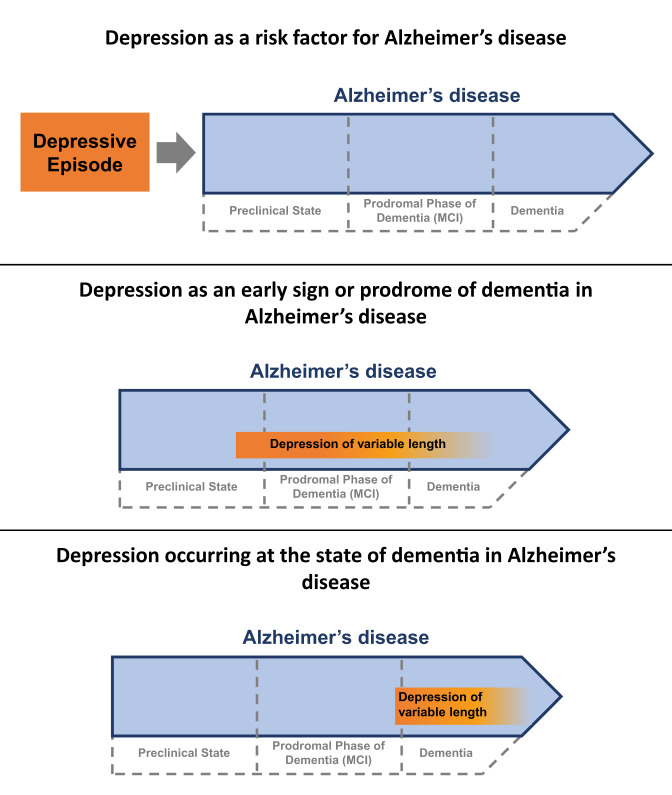
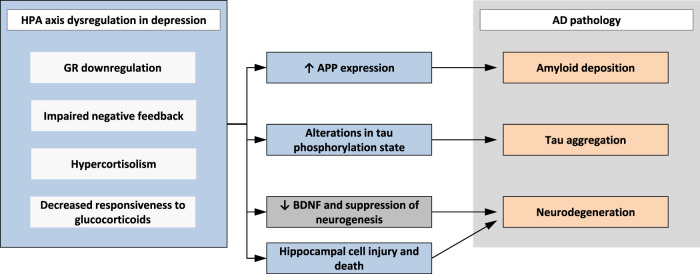
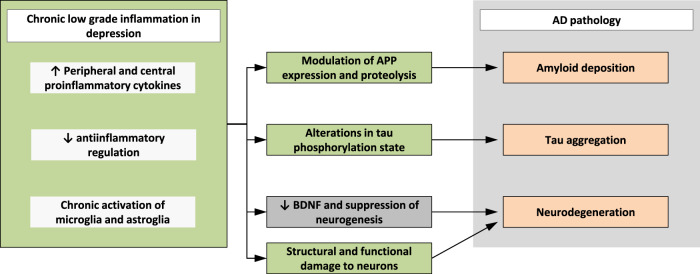
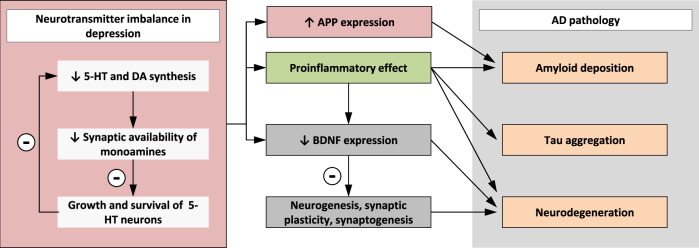
Verification
Claims the paper makes
The claims and statistics of this paper haven’t been checked yet.
Run the check — free, no account needed. It reads the open-access text and checks the sources it cites.
Claims other papers make about this one
Each is checked against this paper’s own text: does it say what the citing paper says it does?
The source backs part of the claim, not all of it — or backs it for a different population, condition or comparison.
In the citing paper
“NPS may accelerate the course of neurodegenerative diseases and are potential modifying risk factors for cognitive decline [21–25].”
From Psychotherapeutic interventions in individuals at risk for Alzheimer’s dementia: a systematic review (2022) · cites this paper as [21]
Experimental — accuracy not yet measured
Self-check
Percentages, sums and reported differences re-computed from the paper’s own numbers.
The self-check needs the paper’s full text.
Citations
Cites
Molecular Mechanisms of Depression: Perspectives on New Treatment Strategies
Lang, U. E., & Borgwardt, S. (2013) · Cellular Physiology and Biochemistry · doi:10.1159/000350094 · Cited by 8,526
From inflammation to sickness and depression: when the immune system subjugates the brain
Dantzer, R., O'Connor, J. C., Freund, G. G., Johnson, R. W., & Kelley, K. W. (2008) · Nature Reviews Neuroscience · doi:10.1038/nrn2297 · Cited by 7,395
Neuroinflammation in Alzheimer's disease
Heneka, M. T., Carson, M. J., Khoury, J. E., Landreth, G. E., Brosseron, F., Feinstein, D. L., Jacobs, A. H., Wyss-Coray, T., Vitorica, J., Ransohoff, R. M., et al. (2015) · The Lancet Neurology · doi:10.1016/s1474-4422(15)70016-5 · Cited by 6,226
Dementia prevention, intervention, and care
Livingston, G., Sommerlad, A., Orgeta, V., Costafreda, S. G., Huntley, J., Ames, D., Ballard, C., Banerjee, S., Burns, A., Cohen-Mansfield, J., et al. (2017) · The Lancet · doi:10.1016/s0140-6736(17)31363-6 · Cited by 6,072
The global prevalence of dementia: a systematic review and metaanalysis.
Prince, M., Bryce, R., Albanese, E., Wimo, A., Ribeiro, W., & Ferri, C. P. (2013) · Alzheimer's & Dementia · doi:10.1016/j.jalz.2012.11.007 · Cited by 4,941
Hypothetical model of dynamic biomarkers of the Alzheimer's pathological cascade
Jack, C. R., Knopman, D. S., Jagust, W. J., Shaw, L. M., Aisen, P. S., Weiner, M. W., Petersen, R. C., & Trojanowski, J. Q. (2010) · The Lancet Neurology · doi:10.1016/s1474-4422(09)70299-6 · Cited by 4,806
A Meta-Analysis of Cytokines in Major Depression
Dowlati, Y., Herrmann, N., Swardfager, W., Liu, H., Sham, L., Reim, E. K., & Lanctôt, K. L. (2010) · Biological Psychiatry · doi:10.1016/j.biopsych.2009.09.033 · Cited by 4,729
Requirement of hippocampal neurogenesis for the behavioral effects of antidepressants
Santarelli, L., Saxe, M., Gross, C., Surget, A., Battaglia, F., Dulawa, S., Weisstaub, N., Lee, J., Duman, R., Arancio, O., et al. (2003) · Science · doi:10.1126/science.1083328 · Cited by 4,321
The role of inflammation in depression: from evolutionary imperative to modern treatment target
Miller, A. H., & Raison, C. L. (2016) · Nature Reviews Immunology · doi:10.1038/nri.2015.5 · Cited by 3,942
A Neurotrophic Model for Stress-Related Mood Disorders
Duman, R. S., & Monteggia, L. M. (2006) · Biological Psychiatry · doi:10.1016/j.biopsych.2006.02.013 · Cited by 3,375
Cited by
Sorted by citations
Items 301–312 of 312
Ren, Z., Zhang, R., Guo, S., Zhao, Y., Liu, J., & Zheng, X. (2026) · The Journal of Prevention of Alzheimer s Disease · doi:10.1016/j.tjpad.2026.100577
Alshahrani, M., Siervo, M., Burley, C. V., Burton, E., Pereira, G. F., Guan, Z., MYERS, B. J., Tully, P. J., Stephan, B. C. M., & Dunne, J. (2026) · Archives of Gerontology and Geriatrics · doi:10.1016/j.archger.2026.106309 · Cited by 1
Wei, J., Kim, Y., Zhang, Y., Tang, V., Lohman, M. C., Merchant, A. T., & Crump, C. (2026) · Journal of Psychiatric Research · doi:10.1016/j.jpsychires.2026.06.045
LG, P., Hemanth Vikram, P. R., Krishna, K. L., & Beeraka, N. M. (2026) · Journal of Applied Pharmaceutical Science · doi:10.1177/22313354261436142
Validation and Reliability of the “SLU-AMSAD” Depression Scale in Individuals With Dementia
Öntan, M. S., Petek, K., Söylemez, B. A., Grossberg, G. T., & Işık, A. T. (2026) · Journal of the American Medical Directors Association · doi:10.1016/j.jamda.2026.106371
Retinal sublayer changes in cases with Alzheimer’s disease and depression
Talebnejad, M. R., Zia, Z., Ostovan, V. R., Nazarpour-Servak, M., & Nowroozzadeh, M. H. (2026) · Graefe s Archive for Clinical and Experimental Ophthalmology · doi:10.1007/s00417-026-07378-y
Chang, J., Gao, P., Gao, Y., Wu, Z.-Y., Wang, Z.-B., Chen, O., Kulick, E. R., Zhao, G., & Tang, Y. (2026) · Journal of Advanced Research · doi:10.1016/j.jare.2026.07.036 · Cited by 1
Liu, M., Gresham, L. K., Puccetti, N. A., Betthauser, T. J., Johnson, S. C., & Schaefer, S. M. (2026) · Affective Science · doi:10.1007/s42761-026-00394-5
Brooks, H., Mirjalili, M., Ma, C., Blumberger, D. M., Bowie, C. R., Fischer, C. E., Flint, A. J., Herrmann, N., Kumar, S., Lanctôt, K. L., et al. (2026) · Neuropsychopharmacology · doi:10.1038/s41386-026-02524-w
Guo, C., Fang, Y., Qiu, Q., Fan, L., Brodaty, H., Sachdev, P. S., Wen, W. X., & Li, X. (2026) · International Psychogeriatrics · doi:10.1016/j.inpsyc.2026.100265
Melin, E. O., Landin‐Olsson, M., & Hillman, M. (2026) · Journal of Clinical & Translational Endocrinology · doi:10.1016/j.jcte.2026.100457
Salem, M. A., Hamza, E. A., Bedewy, D., Amer, R. A. R., Hamid, A. A. R. M., Mahgoub, E., & Moustafa, A. A. (2026) · Frontiers in Aging Neuroscience · doi:10.3389/fnagi.2026.1848025
Metadata
- Authors
- Dafsari, F. S., & Jessen, F.
- Affiliations
- University of Cologne (DE)
- Corresponding author
- Dafsari, Forugh S.
- Venue
- Translational Psychiatry
- Published
- 2020-05-20
- Volume
- 10
- Issue
- 1
- Pages
- 160-160
- ISSN
- 2158-3188 (ISSN-L)
- PMC
- PMC7239844
- OpenAlex
- W3028374504
- Cited by
- 312
- References
- 121
- Citations by year
- 2026: 38 · 2025: 65 · 2024: 68 · 2023: 56 · 2022: 44 · 2021: 33 · 2020: 6
- FWCI
- 5.75
- Type
- journal article
- Language
- en
- Open access
- gold
- doi.org
- Locations
- Translational Psychiatry (publishedVersion, cc-by)
- PubMed Central (publishedVersion, cc-by)
- PubMed (publishedVersion)
- Kölner Universitäts PublikationsServer (Universität zu Köln) (publishedVersion)
- DZNE Pub (publishedVersion, other-oa)
- MPG.PuRe (Max Planck Society) (submittedVersion)
- Topics
- Health Sciences › Medicine › Psychiatry and Mental health › Dementia and Cognitive Impairment Research
- Life Sciences › Neuroscience › Cellular and Molecular Neuroscience › Alzheimer's disease research and treatments
- Health Sciences › Medicine › Pharmacology (medical) › Treatment of Major Depression
- Keywords
- depression, Alzheimer's disease, dementia prevention, cognitive decline, depressive symptoms, antidepressants, neurogenesis, amyloid burden, tau pathology, neuroinflammation, risk factors, early treatment
- MeSH terms
- Alzheimer Disease, Depression, Humans, Life Style, Risk Factors, Cognitive Dysfunction
About these checks
Registry, retraction, Cites and statistics results are computed, not judged, with one exception: a printed reference that no index lists is read once by a model before it counts as a citation error. Claims are extracted by a model and kept only when their quote appears verbatim in the text; each cited source is then checked, with a model’s help, for whether it says what the claim relies on. Those verdicts can be wrong — read the claim’s quote and the cited source before relying on one.
Statistics and arithmetic are recomputed, not judged.
Confidence bands are shown only for fields calibrated on our annotated test set. None is calibrated yet, so no band is shown.
What counts as a claim ›How we measure confidence ›How we check this ›
Are you an author, or do you see a problem with this page? Request a review
