

Depression treatment response to ketamine: sex-specific role of interleukin-8, but not other inflammatory markers
Open accessThe DOI matches its Crossref record; 51 of the 51 references it cites were found in a registry or an index.
Abstract
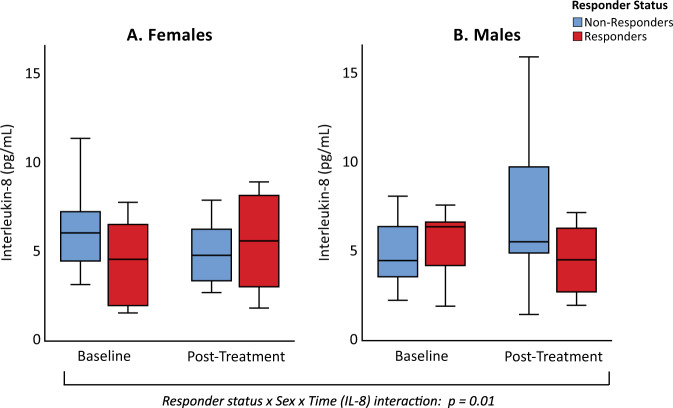
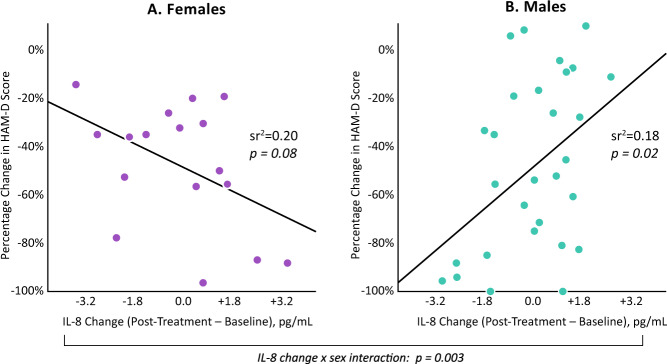
Inflammation plays a role in depression pathophysiology and treatment response, with effects varying by sex and therapeutic modality. Lower levels of interleukin(IL)-8 predict depression response to antidepressant medication and to electroconvulsive therapy (ECT), although ECT effects are specific to females. Whether IL-8 predicts depression response to ketamine and in a sex-specific manner is not known. Here, depressed patients (n = 46; female, n = 17) received open label infusion of ketamine (0.5 mg/kg over 40 min; NCT02165449). Plasma levels of IL-8 were evaluated at baseline and post-treatment. Baseline levels of IL-8 had a trending association with response to ketamine, depending upon sex (responder status × sex interaction: p = 0.096), in which lower baseline levels of IL-8 in females (p = 0.095) but not males (p = 0.96) trended with treatment response. Change in levels of IL-8 from baseline to post-treatment differed significantly by responder status (defined as ≥50% reduction in Hamilton Depression Rating Scale [HAM-D] Score), depending upon sex (responder status × sex × time interaction: F(1,42)=6.68, p = 0.01). In addition, change in IL-8 interacted with sex to predict change in HAM-D score (β = -0.63, p = 0.003); increasing IL-8 was associated with decreasing HAM-D score in females (p = 0.08) whereas the inverse was found in males (p = 0.02). Other inflammatory markers (IL-6, IL-10, tumor necrosis factor-α, C-reactive protein) were explored with no significant relationships identified. Given these preliminary findings, further evaluation of sex differences in the relationship between IL-8 and treatment response is warranted to elucidate mechanisms of response and aid in the development of personalized approaches to depression treatment.
Overview
The claims and statistics of this paper haven’t been checked yet.
Free: it reads the open-access text and checks the first 5 claims that cite a source we can check. Create a free account to check every claim.
Integrity signals
Registry
Cites
Statistics
Figures
Verification
Claims the paper makes
The claims and statistics of this paper haven’t been checked yet.
Free: it reads the open-access text and checks the first 5 claims that cite a source we can check. Create a free account to check every claim.
Claims other papers make about this one
Each is checked against this paper’s own text: does it say what the citing paper says it does?
The source backs part of the claim, not all of it — or backs it for a different population, condition or comparison.
In the citing paper
“Female rats with lower IL-8 levels are more susceptible to medication and electroconvulsive therapy (ECT) [92,93].”
From Selected biomarkers of depression: what are the effects of cytokines and inflammation (2022) · cites this paper as [92]
Experimental — accuracy not yet measured
Self-check
Percentages, sums and reported differences re-computed from the paper’s own numbers.
The self-check needs the paper’s full text.
Citations
Cites
Hamilton, M. (1960) · Journal of Neurology, Neurosurgery & Psychiatry · doi:10.1136/jnnp.23.1.56 · Cited by 32,817
Molecular Mechanisms of Depression: Perspectives on New Treatment Strategies
Lang, U. E., & Borgwardt, S. (2013) · Cellular Physiology and Biochemistry · doi:10.1159/000350094 · Cited by 8,475
Rush, A. J., Trivedi, M. H., Wisniewski, S. R., Nierenberg, A. A., Stewart, J. W., Warden, D., Niederehe, G., Thase, M. E., Lavori, P. W., Lebowitz, B. D., et al. (2006) · American Journal of Psychiatry · doi:10.1176/ajp.2006.163.11.1905 · Cited by 5,643
A Meta-Analysis of Cytokines in Major Depression
Dowlati, Y., Herrmann, N., Swardfager, W., Liu, H., Sham, L., Reim, E. K., & Lanctôt, K. L. (2010) · Biological Psychiatry · doi:10.1016/j.biopsych.2009.09.033 · Cited by 4,729
The role of inflammation in depression: from evolutionary imperative to modern treatment target
Miller, A. H., & Raison, C. L. (2016) · Nature Reviews Immunology · doi:10.1038/nri.2015.5 · Cited by 3,942
International Standard Classification of Education, ISCED 1997
UNESCO United Nations Educational, S. A. C. O. (2003) · Advances in Cross-National Comparison · doi:10.1007/978-1-4419-9186-7_10 · Cited by 2,351
Cross-national epidemiology of DSM-IV major depressive episode
Bromet, E., Andrade, L. H., Hwang, I., Sampson, N. A., Alonso, J., de Girolamo, G., de Graaf, R., Demyttenaere, K., Hu, C., Iwata, N., et al. (2011) · BMC Medicine · doi:10.1186/1741-7015-9-90 · Cited by 2,221
PRACTICE GUIDELINE FOR THE Treatment of Patients With Major Depressive Disorder
Gelenberg, A. J., Freeman, P. B., Markowitz, J. C., Rosenbaum, J. F., Thase, M. E., Trivedi, M. H., & Rhoads, R. S. (2010) · Cited by 1,521
Depression Is the Leading Cause of Disability Around the World
Friedrich, M. J. (2017) · JAMA · doi:10.1001/jama.2017.3826 · Cited by 1,459 · cited 6×
“6) Responder Status × Sex × Time F(1,42)= 6.”
BackgroundInfluentialCytokine-Associated Emotional and Cognitive Disturbances in Humans
Reichenberg, A., Yirmiya, R., Schuld, A., Kraus, T., Haack, M., Morag, A., & Pollmächer, T. (2001) · Archives of General Psychiatry · doi:10.1001/archpsyc.58.5.445 · Cited by 1,365
Cited by
Selected biomarkers of depression: what are the effects of cytokines and inflammation
Harsanyi, S., Kupcova, I., Danisovic, L., & Klein, M. (2022) · International Journal of Molecular Sciences · doi:10.3390/ijms24010578 · Cited by 299
“Female rats with lower IL-8 levels are more susceptible to medication and electroconvulsive therapy (ECT) [92,93].”
BackgroundNew and emerging approaches to treat psychiatric disorders
Scangos, K. W., State, M. W., Miller, A. H., Baker, J. T., & Williams, L. M. (2023) · Nature Medicine · doi:10.1038/s41591-022-02197-0 · Cited by 180
Inflammatory signaling mechanisms in bipolar disorder
Jones, G. H., Vecera, C. M., Pinjari, O. F., & Machado‐Vieira, R. (2021) · Journal of Biomedical Science · doi:10.1186/s12929-021-00742-6 · Cited by 161
Jiao, W., Lin, J., Deng, Y., Ji, Y., Liang, C., Wei, S., Xi, J., & Yan, F. (2025) · Journal of Neuroinflammation · doi:10.1186/s12974-024-03312-3 · Cited by 144
Microbiota-immune-brain interactions: A lifespan perspective
Ratsika, A., Cruz Pereira, J. S., Lynch, C. M. K., Clarke, G., & Cryan, J. F. (2023) · Current Opinion in Neurobiology · doi:10.1016/j.conb.2022.102652 · Cited by 74
Medeiros, G. C., Gould, T. D., Prueitt, W. L., Nanavati, J., Grunebaum, M. F., Farber, N. B., Singh, B., Selvaraj, S., Machado-Vieira, R., Achtyes, E. D., et al. (2022) · Molecular Psychiatry · doi:10.1038/s41380-022-01652-1 · Cited by 75
Johnston, J. N., Kadriu, B., Allen, J., Gilbert, J. R., Henter, I. D., & Zarate, C. A. (2023) · Neuropharmacology · doi:10.1016/j.neuropharm.2023.109422 · Cited by 76
Sobolewska-Nowak, J., Wachowska, K., Nowak, A., Orzechowska, A., Szulc, A., Płaza, O., & Gałecki, P. (2023) · Biomedicines · doi:10.3390/biomedicines11071903 · Cited by 84
“Their findings suggest that IL-8 may be a biological agent that reduces the risk of inflammation-related depression [133].”
BackgroundInflammation, stress and depression: An exploration of ketamine’s therapeutic profile
Johnston, J. N., Greenwald, M. S., Henter, I. D., Kraus, C., Mkrtchian, A., Clark, N. G., Park, L. T., Gold, P. W., Zarate, C. A., & Kadriu, B. (2023) · Drug Discovery Today · doi:10.1016/j.drudis.2023.103518 · Cited by 80
“Interestingly, a recent open-label ketamine trial found that IL-8 did not predict antidepressant response to ketamine, but that there was a trend towards prediction in females, suggesting a potential sex-specific effect [126].”
Lullau, A. P. M., Haga, E. M. W., Ronold, E. H., & Dwyer, G. E. (2023) · Frontiers in Neuroscience · doi:10.3389/fnins.2023.1223145 · Cited by 68
“Interestingly, changes in IL-8 levels have been significantly linked with response through its association with sex, where improvement in females was associated with reductions, while improvement in males was associated with elevations of IL-8 (Kruse et al., 2021).”
BackgroundInfluentialSilva, R. C., Pisanu, C., Maffioletti, E., Menesello, V., Bortolomasi, M., Gennarelli, M., Baune, B. T., Squassina, A., & Minelli, A. (2023) · European Neuropsychopharmacology · doi:10.1016/j.euroneuro.2023.07.012 · Cited by 61
Medeiros, G. C., Matheson, M., Demo, I., Reid, M. J., Matheson, S., Twose, C., Smith, G. S., Gould, T. D., Zarate, C. A., Barrett, F. S., et al. (2023) · The Lancet Psychiatry · doi:10.1016/s2215-0366(23)00183-9 · Cited by 49
Li, Q., Wang, S., & Mei, X. (2022) · Psychiatry Research · doi:10.1016/j.psychres.2022.114396 · Cited by 38
Bleibel, L., Sokołowska, P., Henrykowska, G. A., Owczarek, J., & Wiktorowska‐Owczarek, A. (2025) · Pharmaceuticals · doi:10.3390/ph18060867 · Cited by 40
Sex dependence of opioid-mediated responses to subanesthetic ketamine in rats
Ianni, T. D., Ewbank, S. N., Levinstein, M. R., Azadian, M. M., Budinich, R. C., Michaelides, M., & Airan, R. D. (2024) · Nature Communications · doi:10.1038/s41467-024-45157-7 · Cited by 39
“Sex-dependent ketamine and norketamine pharmacokinetics have been observed 67 , and diverging correlations between treatment outcomes and depression-related in fl ammatory cytokines have been reported in male and female subjects 69 .”
BackgroundIL-8 (CXCL8) Correlations with Psychoneuroimmunological Processes and Neuropsychiatric Conditions
Shkundin, A., & Halaris, A. E. (2024) · Journal of Personalized Medicine · doi:10.3390/jpm14050488 · Cited by 37
“Similarly, lower baseline plasma levels of IL-8 and subsequent increases in IL-8 were specifically correlated with improved depression in females treated with ketamine [247].”
BackgroundKruse, J. L., Olmstead, R., Hellemann, G. S., Breen, E. C., Tye, S. J., Brooks, J. O., Wade, B., Congdon, E. L., Espinoza, R. T., Narr, K. L., et al. (2021) · Journal of Psychiatric Research · doi:10.1016/j.jpsychires.2021.06.009 · Cited by 30
Self-citationSukhram, S. D., Yilmaz, G., & Gu, J. (2022) · Oxidative Medicine and Cellular Longevity · doi:10.1155/2022/1061274 · Cited by 33
“[32], USA Open-label, clinical trial (ClinicalTrials.”
InfluentialKruse, J. L., Boyle, C. C., Olmstead, R., Breen, E. C., Tye, S. J., Eisenberger, N. I., & Irwin, M. R. (2022) · Scientific Reports · doi:10.1038/s41598-022-16364-3 · Cited by 22
Self-citationXia, J., Chen, M., Shao, H., Chen, H., Zhu, S., Zhao, M., Luo, W., Yang, J., & Wu, S. (2023) · Frontiers in Bioscience-Landmark · doi:10.31083/j.fbl2812356 · Cited by 19
“Some investigations suggest that elevated levels of IL-1 β , IL-6, and IL-8 post-ketamine infusion [228,229] correlate with improved treatment outcomes, though other studies present conflicting findings.”
ResultRossi, G. N., Hallak, J. E. C., Baker, G. B., Dursun, S. M., & SANTOS, R. G. D. (2022) · European Archives of Psychiatry and Clinical Neuroscience · doi:10.1007/s00406-022-01460-2 · Cited by 16
Irwin, M. R., Olmstead, R., Kruse, J., Breen, E. C., & Haque, R. (2022) · Brain, Behavior, and Immunity · doi:10.1016/j.bbi.2022.07.003 · Cited by 14
“…higher levels of IL-8 correlate with lower severity of depressive symptoms (Kruse et al., 2021a), decreased risk of suicide (Janelidze et al., 2015; Keaton et al., 2019; Zou et al., 2018); and improved treatment response in females, but not males (Kruse et al., 2020; Kruse et al., 2021b).”
BackgroundResultInfluentialSelf-citationLisowska, K. A. (2025) · International Journal of Molecular Sciences · doi:10.3390/ijms262010092 · Cited by 15
“Recent findings [72,74] suggest that the effects of IL-8 on treatment response may vary by sex.”
InfluentialImpact of chronic stress on intestinal mucosal immunity in colorectal cancer progression
Yang, S., Li, Y., Zhang, Y., & Wang, Y. (2024) · Cytokine & Growth Factor Reviews · doi:10.1016/j.cytogfr.2024.10.007 · Cited by 15
Long, Z., Li, J., & Marino, M. (2024) · Journal of Affective Disorders · doi:10.1016/j.jad.2024.09.150 · Cited by 9
Shan, L.-L., Wang, Y., Qiao, T., Bian, Y., Huo, Y., Guo, C., Liu, Q., Yang, Z., Li, Z., Liu, M., et al. (2022) · Frontiers in Neurology · doi:10.3389/fneur.2022.938655 · Cited by 8
“These similar sex-specific effects were also found in electroconvulsive or ketamine therapy studies in depressed patients (64, 65).”
BackgroundJóźwiak-Bębenista, M., Wiktorowska‐Owczarek, A., Siatkowska, M., Komorowski, P., Włodarczyk, A., Kowalczyk, E., & Sokołowska, P. (2025) · Cells · doi:10.3390/cells14110831 · Cited by 8
“Studies in male patients have shown that a decrease in IL-8 levels after ketamine administration correlates with improved outcomes in TRD [51].”
Wang, W., Liang, W., Sun, C., & Liu, S. (2024) · International Journal of Molecular Sciences · doi:10.3390/ijms252413412 · Cited by 7
“A sex-specific role for IL-8 has been found in predicting treatment response in MDD; lower baseline IL-8 levels and an increase during treatment correlate with better outcomes, especially in females [6,41].”
Petersen, K. J., Yu, X., Masters, M. C., Lobo, J. D., Lu, T., Letendre, S. L., Ellis, R. J., McCutchan, J. A., & Sundermann, E. E. (2023) · Brain Behavior & Immunity - Health · doi:10.1016/j.bbih.2023.100644 · Cited by 9
Melink, Z., Lustberg, M. B., Schnell, P., Mezzanotte-Sharpe, J., & Orchard, T. (2024) · Breast Cancer Research and Treatment · doi:10.1007/s10549-024-07457-w · Cited by 7
Tan, J.-Q., Gu, L.-M., Zhou, Y., Wang, C., Lan, X., Zheng, W., & Ning, Y. (2025) · Frontiers in Psychiatry · doi:10.3389/fpsyt.2025.1498952 · Cited by 7
Possidente, C., Biancalani, A., Baune, B. T., Serretti, A., & Fabbri, C. (2026) · Brain Behavior and Immunity · doi:10.1016/j.bbi.2026.106874 · Cited by 4
Elmaadawi, A. Z., Naha, I., Prabhudesai, S., & Eltohami, M. (2025) · Psychiatry Research · doi:10.1016/j.psychres.2025.116821 · Cited by 5
Ketamine, a trauma analgesic with sex-specific immunomodulatory function
Choi, K., Spencer, H. F., Berman, R. Y., & Boese, M. (2022) · Neural Regeneration Research · doi:10.4103/1673-5374.358617 · Cited by 4
“…changes in levels of the pro-inflammatory cytokine IL-8 after ketamine treatment interacted with sex to influence the Hamilton Depression Rating Scale score; specifically, decreasing IL-8 levels were correlated with depressive symptom improvement in men, but not in women (Kruse et al., 2021).”
BackgroundSex differences in ketamine treatment for depressive disorders: A systematic review
Feng, Z., Wu, H., Xu, F., Zheng, Y., & Xu, H. (2025) · Progress in Neuro-Psychopharmacology and Biological Psychiatry · doi:10.1016/j.pnpbp.2025.111521 · Cited by 3
Valizadeh, A., Roache, J. D., Zhang, X., Hu, Y., Gueorguieva, R. V., Averill, L. A., Ranganathan, M., Wang, Z., Williamson, D. E., Shiroma, P. R., et al. (2025) · iScience · doi:10.1016/j.isci.2025.114445 · Cited by 3
Lan, X., Wu, Z., Wang, C., Liu, G., Zhang, M., Li, W., Luo, Z., Shen, J., Chen, Z., Ning, Y., et al. (2026) · Journal of Affective Disorders · doi:10.1016/j.jad.2026.121488 · Cited by 4
Okusu, A. R., da Silva, E. R. B., Gama, H. C., Leite, J. F., Pedrosa, M. D. S. B., Sáber, M. R., de Sousa, M. M., Quiroga, P. C. C., & Mariano, U. S. (2024) · EPITAYA eBooks · doi:10.47879/ed.ep.2024479p623 · Cited by 5
Towards causal inference-based antidepressant selection with brain and blood biomarkers
Barac, M., Grant, C. W., Toll, R. T., Carmody, T. J., Minhajuddin, A., Fatt, C. C., Foster, J. A., Croarkin, P. E., Bobo, W. V., Jha, M. K., et al. (2025) · Neuropsychopharmacology · doi:10.1038/s41386-025-02183-3 · Cited by 3
Kim, J., Kang, H., Kim, J., Jhon, M., Kim, M., Lee, J., Kim, S., & Shin, I. (2025) · Clinical Psychopharmacology and Neuroscience · doi:10.9758/cpn.25.1331 · Cited by 3
“First, prior biomarker studies have primarily examined short-term outcomes (8 − 12 weeks) [8,10].”
InfluentialPsychoneuroimmunology as a Case Study for Multidisciplinary Clinical Science
Bower, J. E., & Segerstrom, S. C. (2026) · Clinical Psychological Science · doi:10.1177/21677026261424168 · Cited by 1
“…treatment; circulating concentrations of inflammatory markers predict response to antidepressants (Roman & Irwin, 2020) and other pharmacotherapies (Kruse et al., 2021) among depressed patients, and there is preliminary evidence that immune-based markers can also predict responses to certain…”
Peripheral biomarkers in Repeated Ketamine Infusions Trial
Geel, A. V. (2021) · Carleton University's Institutional Repository (MacOdrum Library, Carleton University) · doi:10.22215/etd/2021-14775
Potencial terapêutico da cetamina em transtornos depressivos
Mendes, L. F. D. S., Bezerra, C. D. S., Piauilino, B. C. N., de Sousa, L. L., Leal, A. K. M. P., Moura, P. R. D. S. E. S., da Silva, L. S. A., Noronha, M. Y. D. C., & Menezes, A. G. V. A. (2023) · Research Society and Development · doi:10.33448/rsd-v12i2.40153
Fathi, P., Karkanitsa, M. L., Rupert, A. W., Lin, A., Darrah, J. R., Thomas, F. D., Lai, J., Babu, K. M., Neavyn, M., Kozar, R. A., et al. (2024) · medRxiv · doi:10.1101/2024.04.22.24306188
Menescal-de-Oliveira, L., Brentegani, M. R., Teixeira, F. P., Giusti, H., & Saia, R. S. (2024) · Pflügers Archiv - European Journal of Physiology · doi:10.1007/s00424-024-03011-1
“In humans, a decrease in IL-8 levels was correlated with depression improvement in men and treatment responsiveness [48].”
Olaoluwa, I. F. (2025) · Carleton University's Institutional Repository (MacOdrum Library, Carleton University) · doi:10.22215/etd/2025-16871
Chen, J., Sun, X., Yue, S., Feng, Z., Yang, R., Yu, Y., He, H., Zhao, S., Li, Y., Chen, S., et al. (2026) · BMC Psychiatry · doi:10.1186/s12888-026-08045-6
“Heterogeneous results have also been reported in studies related to MDD [72, 73], which may be related to differences in sample size, demographic characteristics, and medication status [74, 75].”
Breit, S. (2026) · Journal of Psychiatry and Brain Science · doi:10.20900/jpbs.20260006
“Increased IL-8 levels correlate with a decrease in depressive symptoms in females and the opposite in males [145].”
Zhu, Q., Zhou, X., Gao, H., Wu, H., & Zheng, Y. (2026) · Journal of Neuroimmunology · doi:10.1016/j.jneuroim.2026.579038
Metelska, A., Ziemichód, W., & Karakuła‐Juchnowicz, H. (2026) · Journal of Personalized Medicine · doi:10.3390/jpm16100488
Metadata
- Authors
- Kruse, J. L., Vasavada, M. M., Olmstead, R., Hellemann, G., Wade, B., Breen, E. C., Brooks, J. O., Congdon, E., Espinoza, R., Narr, K. L., & Irwin, M. R.
- Affiliations
- University of California, Los Angeles (US)
- Corresponding author
- Kruse, Jennifer L.
- ORCID
- Venue
- Translational Psychiatry
- Published
- 2021-03-15
- Volume
- 11
- Issue
- 1
- Pages
- 167-167
- ISSN
- 2158-3188 (ISSN-L)
- PMC
- PMC7960960
- OpenAlex
- W3137344175
- Cited by
- 48
- References
- 51
- Citations by year
- 2026: 7 · 2025: 9 · 2024: 9 · 2023: 10 · 2022: 10 · 2021: 3
- FWCI
- 4.67
- Type
- journal article
- Language
- en
- Open access
- gold
- doi.org
- Licence
- cc-by
- creativecommons.org/licenses/by/4.0 (tdm)
- creativecommons.org/licenses/by/4.0 (vor)
- Locations
- Translational Psychiatry (publishedVersion, cc-by)
- PubMed Central (publishedVersion, cc-by)
- PubMed (publishedVersion)
- eScholarship (California Digital Library) (submittedVersion, cc-by)
- DOAJ (DOAJ: Directory of Open Access Journals) (submittedVersion, cc-by-sa)
- eScholarship (California Digital Library) (submittedVersion)
- Funders
- U.S. Department of Health & Human Services | NIH | National Institute of Mental Health (R01MH092301, K24MH102743, U01MH110008)
- Topics
- Health Sciences › Medicine › Pharmacology (medical) › Treatment of Major Depression
- Life Sciences › Neuroscience › Biological Psychiatry › Tryptophan and brain disorders
- Health Sciences › Medicine › Psychiatry and Mental health › Electroconvulsive Therapy Studies
- Keywords
- depression, ketamine, interleukin-8, sex differences, treatment response, inflammation, inflammatory markers, antidepressant response, electroconvulsive therapy, personalized treatment
- MeSH terms
- Depression, Electroconvulsive Therapy, Female, Humans, Ketamine, Male, Psychiatric Status Rating Scales, Sex Factors, Interleukin-8, Treatment Outcome
About these checks
Registry, retraction, Cites and statistics results are computed, not judged, with one exception: a printed reference that no index lists is read once by a model before it counts as a citation error. Claims are extracted by a model and kept only when their quote appears verbatim in the text; each cited source is then checked, with a model’s help, for whether it says what the claim relies on. Those verdicts can be wrong — read the claim’s quote and the cited source before relying on one.
Statistics and arithmetic are recomputed, not judged.
Confidence bands are shown only for fields calibrated on our annotated test set. None is calibrated yet, so no band is shown.
What counts as a claim ›How we measure confidence ›How we check this ›
Are you an author, or do you see a problem with this page? Request a review
Data sources
Bibliographic data: Semantic Scholar, OpenAlex, Crossref.
Contains information from the Semantic Scholar Academic Graph Datasets, made available under the ODC Attribution License (ODC-BY 1.0).
Semantic Scholar’s data is described in: Kinney, R., et al. (2023). The Semantic Scholar Open Data Platform. arXiv:2301.10140.
