

Translating the immediate effects of S-Ketamine using hippocampal subfield analysis in healthy subjects-results of a randomized controlled trial
Open accessThe DOI matches its Crossref record; 60 of the 60 references it cites were found in a registry or an index.
Abstract
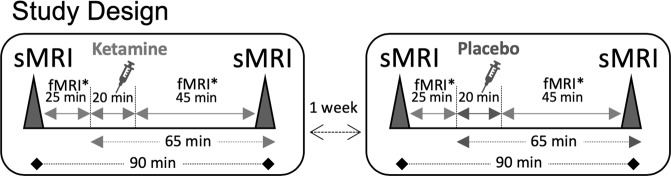
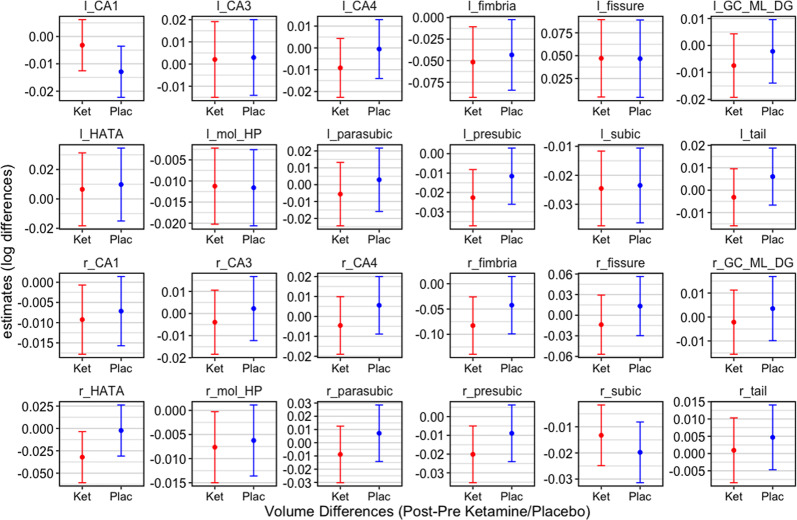
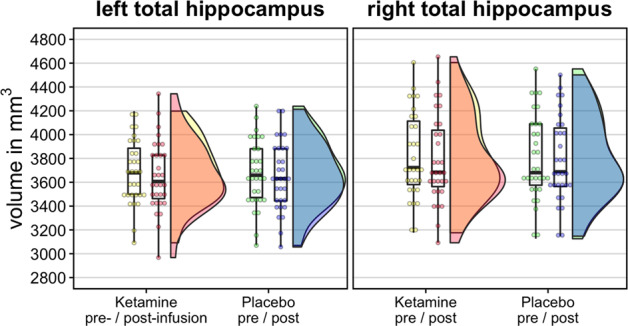
Antidepressant doses of ketamine rapidly facilitate synaptic plasticity and modify neuronal function within prefrontal and hippocampal circuits. However, most studies have demonstrated these effects in animal models and translational studies in humans are scarce. A recent animal study showed that ketamine restored dendritic spines in the hippocampal CA1 region within 1 h of administration. To translate these results to humans, this randomized, double-blind, placebo-controlled, crossover magnetic resonance imaging (MRI) study assessed ketamine’s rapid neuroplastic effects on hippocampal subfield measurements in healthy volunteers. S-Ketamine vs. placebo data were analyzed, and data were also grouped by brain-derived neurotrophic factor (BDNF) genotype. Linear mixed models showed that overall hippocampal subfield volumes were significantly larger (p = 0.009) post ketamine than post placebo (LS means difference=0.008, standard error=0.003). Post-hoc tests did not attribute effects to specific subfields (all p > 0.05). Trend-wise volumetric increases were observed within the left hippocampal CA1 region (p = 0.076), and trend-wise volumetric reductions were obtained in the right hippocampal—amygdaloid transition region (HATA) (p = 0.067). Neither genotype nor a genotype–drug interaction significantly affected the results (all p > 0.7). The study provides evidence that ketamine has short-term effects on hippocampal subfield volumes in humans. The results translate previous findings from animal models of depression showing that ketamine has pro-neuroplastic effects on hippocampal structures and underscore the importance of the hippocampus as a key region in ketamine’s mechanism of action.
Overview
The claims and statistics of this paper haven’t been checked yet.
Free: it reads the open-access text and checks the first 5 claims that cite a source we can check. Create a free account to check every claim.
Integrity signals
Registry
Cites
Statistics
Figures
Verification
Claims the paper makes
The claims and statistics of this paper haven’t been checked yet.
Free: it reads the open-access text and checks the first 5 claims that cite a source we can check. Create a free account to check every claim.
Claims other papers make about this one
Each is checked against this paper’s own text: does it say what the citing paper says it does?
The cited source says what the claim attributes to it.
In the citing paper
“(S)-ketamine (bolus of 0.11 mg/kg with 0.12 mg/kg maintenance i.v. infusion over 20 min) produced significant increases in overall hippocampal subfield volumes in healthy volunteers 65 minutes following treatment initiation independent of whether the volunteer carried the Met allele (Höflich et al., 2021).”
From Mechanisms of ketamine and its metabolites as antidepressants (2022) · cites this paper as Höflich et al., 2021
Self-check
Percentages, sums and reported differences re-computed from the paper’s own numbers.
The self-check needs the paper’s full text.
Citations
Cites
Molecular Mechanisms of Depression: Perspectives on New Treatment Strategies
Lang, U. E., & Borgwardt, S. (2013) · Cellular Physiology and Biochemistry · doi:10.1159/000350094 · Cited by 8,475
Domingos da Silveira da Luz, A. C., Pereira Dias, G., do Nascimento Bevilaqua, M. C., Cocks, G., Gardino, P. F., Thuret, S., & Nardi, A. E. (2013) · Neuropsychobiology · doi:10.1159/000353269 · Cited by 3,995
Egan, M. F., Kojima, M., Callicott, J. H., Goldberg, T. E., Kolachana, B. S., Bertolino, A., Zaitsev, E., Gold, B., Goldman, D., Dean, M., et al. (2003) · Cell · doi:10.1016/s0092-8674(03)00035-7 · Cited by 3,888
Chronic antidepressant treatment increases neurogenesis in adult rat hippocampus
Malberg, J. E., Eisch, A. J., Nestler, E. J., & Duman, R. S. (2000) · The Journal of Neuroscience · doi:10.1523/jneurosci.20-24-09104.2000 · Cited by 3,111
mTOR-Dependent Synapse Formation Underlies the Rapid Antidepressant Effects of NMDA Antagonists
Li, N., Lee, B., Liu, R.-J., Banasr, M., Dwyer, J. M., Iwata, M., Li, X.-Y., Aghajanian, G., & Duman, R. S. (2010) · Science · doi:10.1126/science.1190287 · Cited by 2,881
NMDA receptor blockade at rest triggers rapid behavioural antidepressant responses
Autry, A. E., Adachi, M., Nosyreva, E., Na, E. S., Los, M. F., Cheng, P.-F., Kavalali, E. T., & Monteggia, L. M. (2011) · Nature · doi:10.1038/nature10130 · Cited by 1,926
Synaptic plasticity and depression: new insights from stress and rapid-acting antidepressants
Duman, R. S., Aghajanian, G. K., Sanacora, G., & Krystal, J. H. (2016) · Nature Medicine · doi:10.1038/nm.4050 · Cited by 1,750
Plasticity in gray and white: neuroimaging changes in brain structure during learning
Zatorre, R. J., Fields, R. D., & Johansen-Berg, H. (2012) · Nature Neuroscience · doi:10.1038/nn.3045 · Cited by 1,685
Iglesias, J. E., Augustinack, J. C., Nguyen, K., Player, C. M., Player, A., Wright, M., Roy, N., Frosch, M. P., McKee, A. C., Wald, L. L., et al. (2015) · NeuroImage · doi:10.1016/j.neuroimage.2015.04.042 · Cited by 1,277
Ketamine and Ketamine Metabolite Pharmacology: Insights into Therapeutic Mechanisms
Zanos, P., Moaddel, R., Morris, P. J., Riggs, L. M., Highland, J. N., Georgiou, P., Pereira, E. F. R., Albuquerque, E. X., Thomas, C. J., Zarate, C. A., et al. (2018) · Pharmacological Reviews · doi:10.1124/pr.117.015198 · Cited by 1,260
Self-citation
Cited by
Mechanisms of ketamine and its metabolites as antidepressants
Hess, E. M., Riggs, L. M., Michaelides, M., & Gould, T. D. (2022) · Biochemical Pharmacology · doi:10.1016/j.bcp.2021.114892 · Cited by 175
Tang, Y., Liu, Y., Zhou, H., Lu, H., Zhang, Y., Hua, J., & Liao, X. (2023) · Experimental Neurology · doi:10.1016/j.expneurol.2023.114436 · Cited by 61
Xiong, X., Shao, Y., Chen, D., Chen, B., Lan, X., & Shi, J. (2024) · Anesthesia & Analgesia · doi:10.1213/ane.0000000000006925 · Cited by 51
“18 Despite its stronger potency and a lower incidence rate of adverse reactions, there is limited evidence supporting the effectiveness of esketamine in reducing the risk of POD.”
Suzuki, K., Kim, J.-W., Nosyreva, E., Kavalali, E. T., & Monteggia, L. M. (2021) · Cell Reports · doi:10.1016/j.celrep.2021.109918 · Cited by 49
Paolini, M., Harrington, Y. A., Colombo, F., Bettonagli, V., Poletti, S., Carminati, M., Colombo, C., Benedetti, F., & Zanardi, R. (2023) · Journal of Psychopharmacology · doi:10.1177/02698811231190859 · Cited by 38
“…if on the one hand Ketamine was found to be more effective in patients with relatively smaller left hippocampus (Abdallah et al., 2015), at the same time ketamine treatment was associated with increases in hippocampal volumes (Höflich et al., 2021) and mean diffusivity (Kopelman et al., 2023).”
BackgroundWei, W., Zhang, A., Liu, L., Zheng, X., Tang, C., Zhou, M., Gu, Y., & Yao, Y. (2022) · BMJ Open · doi:10.1136/bmjopen-2022-061535 · Cited by 30
Calder, A. E., Hase, A., & Hasler, G. (2024) · Molecular Psychiatry · doi:10.1038/s41380-024-02830-z · Cited by 25
Neurobiological and genetic correlates of the dissociative subtype of posttraumatic stress disorder.
Wolf, E. J., Hawn, S. E., Sullivan, D. R., Miller, M. W., Sanborn, V., Brown, E., Neale, Z., Fein-Schaffer, D., Zhao, X., Logue, M. W., et al. (2023) · Journal of Psychopathology and Clinical Science · doi:10.1037/abn0000795 · Cited by 23
Esketamine in depression: putative biomarkers from clinical research
Johnston, J. N., Zarate, C. A., & Kvarta, M. D. (2024) · European Archives of Psychiatry and Clinical Neuroscience · doi:10.1007/s00406-024-01865-1 · Cited by 24
“Additional neuroimaging research in healthy volunteers found that esketamine may increase hippocampal subfield volumes [88], increase resting cerebral blood flow [91], lead to changes in slow and fast (gamma) wave frequencies [87], and alter pgACC to medial ACC connectivity [86]. pgACC cortical…”
Self-citationAntos, Z., Żukow, X., Bursztynowicz, L., & Jakubów, P. (2024) · International Journal of Molecular Sciences · doi:10.3390/ijms252413658 · Cited by 21
“Furthermore, in human studies, 65 min after S-ketamine administration, all hippocampal subfields in healthy subjects showed increased volumes compared to placebo, with the most significant effect observed in the right hippocampal CA1 region [163].”
The Downstaging Concept in Treatment-Resistant Depression: Spotlight on Ketamine
Wilkowska, A., & Cubała, W. J. (2022) · International Journal of Molecular Sciences · doi:10.3390/ijms232314605 · Cited by 22
Gao, Y., Li, L., Zhao, F., Cheng, Y., Jin, M., & Xue, F. (2025) · Drug Design Development and Therapy · doi:10.2147/dddt.s504179 · Cited by 20
Vanicek, T., Unterholzner, J., Lanzenberger, R. R., Naderi‐Heiden, A., Kasper, S. F., & Praschak-Rieder, N. (2022) · The World Journal of Biological Psychiatry · doi:10.1080/15622975.2022.2031287 · Cited by 19
“…have been shown to increase hippocampal volumes in healthy males, and to attenuate depressionlike behaviour by mediating rapid and sustained cortical disinhibition in the medial prefrontal cortex in mice, underlining ketamine’s neuroplastic properties (Grieco et al. 2021; Hoflich et al. 2021).”
BackgroundSelf-citationZhang, Y., Wei, C., Wang, P., Zheng, L.-C., Cheng, Y., Ren, Z., Jin, Y., Yao, Y., & Liu, H. (2024) · Scientific Reports · doi:10.1038/s41598-024-76226-y · Cited by 20
Evans, J. W., Graves, M. C., Nugent, A. C., & Zarate, C. A. (2024) · Scientific Reports · doi:10.1038/s41598-024-54370-9 · Cited by 15
Self-citationHou, L., Miao, J., Meng, H., Liu, X., Wang, D., Tan, Y., & Li, C. (2022) · Frontiers in Psychiatry · doi:10.3389/fpsyt.2022.855810 · Cited by 14
“Notably, existing literature suggests that the hippocampus is also a key region in which ketamine exerts its antidepressant effects and S-ketamine has pro-neuroplastic effects on hippocampal structures (38, 39).”
BackgroundThe Clinician Scientist Training Program in Iran: Catalyzing Clinical Science Advancements
Moghaddan, H. S., & Akhondzadeh, S. (2023) · Avicenna Journal of Medical Biotechnology · doi:10.18502/ajmb.v15i3.12921 · Cited by 13
Kojic, M., Saelens, J., Kadriu, B., Zarate, C. A., & Kraus, C. (2022) · Current topics in behavioral neurosciences · doi:10.1007/7854_2022_313 · Cited by 13
Self-citationGarcia-Carachure, I., Lira, O., Themann, A., Rodriguez, M., Flores‐Ramirez, F. J., Lobo, M. K., & Iñiguez, S. D. (2023) · Biological Psychiatry Global Open Science · doi:10.1016/j.bpsgos.2023.07.009 · Cited by 12
Hippocampal subfield volumes predict treatment response to oral ketamine in people with suicidality
Dutton, M., Boyes, A., Can, A., Mohamed, A. Z., Hajishafiee, M., Shan, Z., Lagopoulos, J., & Hermens, D. F. (2023) · Journal of Psychiatric Research · doi:10.1016/j.jpsychires.2023.11.040 · Cited by 10
Perspectives in treatment-resistant depression: esketamine and electroconvulsive therapy
Baldinger, P., Spies, M., Bozic, I., Kasper, S. F., Rujescu, D., & Frey, R. (2024) · Wiener klinische Wochenschrift · doi:10.1007/s00508-024-02358-w · Cited by 9
Self-citationZhu, Y., Feng, W., Kong, Q., Sheng, F., Li, Z., Xu, W., Li, Q., Han, Y., Wu, X., Jia, C., et al. (2023) · Frontiers in Aging Neuroscience · doi:10.3389/fnagi.2023.1298661 · Cited by 9
Matar, D., Serhan, A., Bilani, S. E., Faraj, R. A., Hadi, B. A., & Fakhoury, M. (2024) · Advances in experimental medicine and biology · doi:10.1007/978-981-97-4402-2_2 · Cited by 7
Li, X., Mao, H., Luo, J., Jiang, W., Li, P., Zhou, L., Tian, L., Liu, Z., & Qiu, Y. (2025) · Actas Españolas de Psiquiatría · doi:10.62641/aep.v53i6.2044 · Cited by 4
“Clinically, two randomised controlled trials have demonstrated that esketamine administration is associated with significant improvements in multiple cognitive domains, including executive function, attention and delayed recall [9,12].”
Flynn, L., Rondeau, M., Kršák, M., & Shannon, S. (2025) · Psychedelic Medicine · doi:10.1089/psymed.2024.0050 · Cited by 4
Vigne, M. M., Kweon, J., Fukuda, A. M., Brown, J. C., & Carpenter, L. L. (2025) · Journal of Ect · doi:10.1097/yct.0000000000001123 · Cited by 3
Lin, C., Wang, J., Zhang, L., Yuan, L., Liu, G., Zhu, M., & Zhang, L. (2025) · Frontiers in Medicine · doi:10.3389/fmed.2025.1579908 · Cited by 3
Ma, X., YU, W., Jia, L., 盛明薇, 翁亦齐, Sun, Y., & Yang, L. (2025) · Frontiers in Medicine · doi:10.3389/fmed.2025.1653132 · Cited by 3
Lorente, A. R., Campos-Navarro, M. P., Montoya, Á. G., Pérez, C. M., Navarro, M. L. M., Morales, T. O., Ramirez, N. L., & García-Carmona, J. A. (2025) · CNS Spectrums · doi:10.1017/s1092852925100631 · Cited by 2
“36 Altogether, these findings suggest that TRD pathophysiology could be different from other types of depression and that it could be associated with brain atrophy as a marker of non-response to SSRI treatment.”
Morphological correlates of anxiety-related experiences during a ketamine infusion
Graf, S., Dörl, G., Milz, C., Kathofer, M., Stöhrmann, P., Gomola, D., Briem, E., Schlosser, G., Mayerweg, A., Semmelweis-Tomits, J., et al. (2024) · The World Journal of Biological Psychiatry · doi:10.1080/15622975.2024.2402261 · Cited by 2
“An MRI study confirmed an immediate hippocampal volume increase in healthy human subjects following a single ketamine infusion, putting emphasis on the hippocampus as a key area of ketamine’s action (Höflich et al. 2021).”
InfluentialSelf-citationZhang, C., Yan, Y., Ma, J., Wang, K., Liu, D., Zhang, Y., Li, X., & Ren, L. (2025) · PubMed Central · doi:10.12182/20250360202 · Cited by 2
Esketamine in Treatment-Resistant Depression and Suicidal Ideation: A Systematic Review
Dudziak, N., Drozd, Z., Niemiec, B., Piosik, S., Olesiński, B., Piasecki, Ł., Guzowicz, Z., Kamińska, M., & Gągałka, P. (2025) · Journal of Education Health and Sport · doi:10.12775/jehs.2025.81.66740 · Cited by 1
Liu, Y., Hung, C., Potenza, M. N., Chou, K., Lee, P., Huang, C., Li, C. R., Lee, T. S., & Lin, C. (2026) · Addiction · doi:10.1111/add.70331 · Cited by 1
“By contrast, therapeutic ketamine can enhance hippocampal plasticity through BDNF (brain-derived neurotrophic factor)/AKT (the protein kinase B)/mTOR (mammalian target of rapamycin) signaling [19] and has been associated with acute increases in hippocampal subregion volume [20].”
Zeng, J., Tang, Y., Zhao, A., Yang, J., Zhang, X., Qi, H., Peng, Q., Su, Y., Liu, R., Peng, X., et al. (2026) · Phytomedicine · doi:10.1016/j.phymed.2026.158411 · Cited by 1
Patients and Healthy Volunteers Are Not the Same: The Distinct Responses to Ketamine
Himmelseher, S., & Kochs, E. F. (2025) · Neuromethods · doi:10.1007/978-1-0716-4603-8_15 · Cited by 1
Scacco, T. (2024) · AMS Degree Thesis (University of Bologna)
Shu, Y., Guo, Y., Xu, S., He, H., Zeng, B., Yang, Z., Gao, W., & Li, J. (2026) · PLoS ONE · doi:10.1371/journal.pone.0343918
“BDNF signaling appears critical, as disruption of BDNF–TrkB signaling in the medial PFC abolishes ketamine’s antidepressant effects [24].”
Le, A., Berre, Attali, D., Uszynski, I., Piche, P., Debacker, C., Lui, M., Charron, S., Paolillo, C., Moyal, M., et al. (2026) · European Psychiatry · doi:10.1192/j.eurpsy.2026.11630
Metadata
- Authors
- Höflich, A., Kraus, C., Pfeiffer, R. M., Seiger, R., Rujescu, D., Zarate, C. A., Kasper, S., Winkler, D., & Lanzenberger, R.
- Affiliations
- Medical University of Vienna (AT)
- National Institutes of Health (US)
- Martin Luther University Halle-Wittenberg (DE)
- Corresponding author
- Lanzenberger, Rupert
- ORCID
- Venue
- Translational Psychiatry
- Published
- 2021-04-01
- Volume
- 11
- Issue
- 1
- Pages
- 200-200
- ISSN
- 2158-3188 (ISSN-L)
- PMC
- PMC8016970
- OpenAlex
- W3146692759
- Cited by
- 34
- References
- 60
- Citations by year
- 2026: 3 · 2025: 7 · 2024: 10 · 2023: 7 · 2022: 5 · 2021: 2
- FWCI
- 3.50
- Type
- journal article
- Language
- en
- Open access
- gold
- doi.org
- Licence
- cc-by
- creativecommons.org/licenses/by/4.0 (tdm)
- creativecommons.org/licenses/by/4.0 (vor)
- Locations
- Translational Psychiatry (publishedVersion, cc-by)
- PubMed Central (publishedVersion, cc-by)
- PubMed (publishedVersion)
- DOAJ (DOAJ: Directory of Open Access Journals) (submittedVersion, cc-by-sa)
- Funders
- Intramural Research Program at the National Institute of Mental Health, National Institutes of Health
- Oesterreichische Nationalbank (P 14193)
- Topics
- Health Sciences › Medicine › Pharmacology (medical) › Treatment of Major Depression
- Life Sciences › Neuroscience › Cellular and Molecular Neuroscience › Neuroscience and Neuropharmacology Research
- Health Sciences › Medicine › Psychiatry and Mental health › Electroconvulsive Therapy Studies
- Keywords
- esketamine, hippocampal subfields, hippocampal volume, CA1 region, rapid-acting antidepressants, synaptic plasticity, neuroplasticity, dendritic spines, healthy volunteers
- MeSH terms
- Antidepressive Agents, Double-Blind Method, Hippocampus, Humans, Ketamine, Magnetic Resonance Imaging, Cross-Over Studies, Healthy Volunteers
About these checks
Registry, retraction, Cites and statistics results are computed, not judged, with one exception: a printed reference that no index lists is read once by a model before it counts as a citation error. Claims are extracted by a model and kept only when their quote appears verbatim in the text; each cited source is then checked, with a model’s help, for whether it says what the claim relies on. Those verdicts can be wrong — read the claim’s quote and the cited source before relying on one.
Statistics and arithmetic are recomputed, not judged.
Confidence bands are shown only for fields calibrated on our annotated test set. None is calibrated yet, so no band is shown.
What counts as a claim ›How we measure confidence ›How we check this ›
Are you an author, or do you see a problem with this page? Request a review
Data sources
Bibliographic data: Semantic Scholar, OpenAlex, Crossref.
Contains information from the Semantic Scholar Academic Graph Datasets, made available under the ODC Attribution License (ODC-BY 1.0).
Semantic Scholar’s data is described in: Kinney, R., et al. (2023). The Semantic Scholar Open Data Platform. arXiv:2301.10140.
