

Translating the immediate effects of S-Ketamine using hippocampal subfield analysis in healthy subjects-results of a randomized controlled trial
Open accessThe DOI matches its Crossref record; 60 of the 60 references it cites were found in a registry or an index.
Abstract
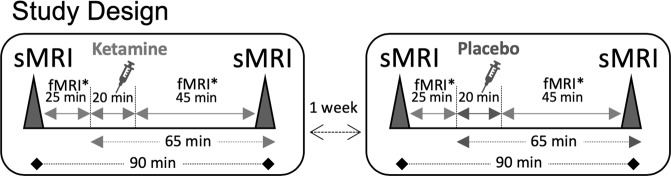
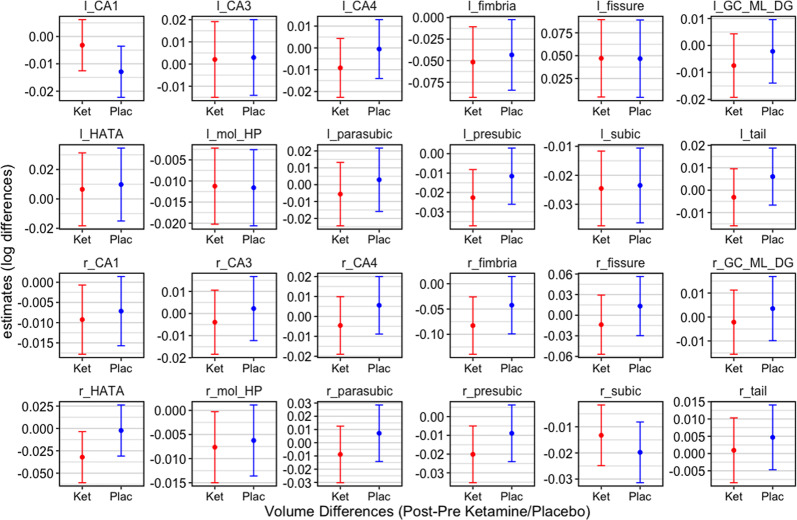
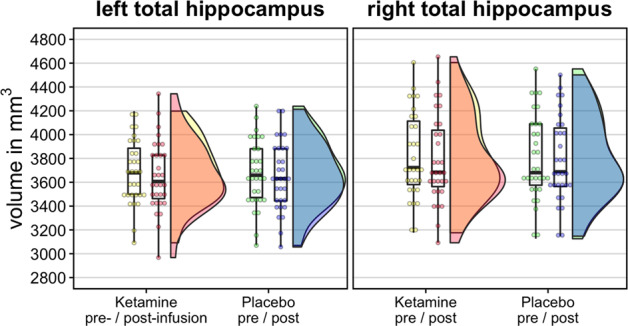
Antidepressant doses of ketamine rapidly facilitate synaptic plasticity and modify neuronal function within prefrontal and hippocampal circuits. However, most studies have demonstrated these effects in animal models and translational studies in humans are scarce. A recent animal study showed that ketamine restored dendritic spines in the hippocampal CA1 region within 1 h of administration. To translate these results to humans, this randomized, double-blind, placebo-controlled, crossover magnetic resonance imaging (MRI) study assessed ketamine’s rapid neuroplastic effects on hippocampal subfield measurements in healthy volunteers. S-Ketamine vs. placebo data were analyzed, and data were also grouped by brain-derived neurotrophic factor (BDNF) genotype. Linear mixed models showed that overall hippocampal subfield volumes were significantly larger (p = 0.009) post ketamine than post placebo (LS means difference=0.008, standard error=0.003). Post-hoc tests did not attribute effects to specific subfields (all p > 0.05). Trend-wise volumetric increases were observed within the left hippocampal CA1 region (p = 0.076), and trend-wise volumetric reductions were obtained in the right hippocampal—amygdaloid transition region (HATA) (p = 0.067). Neither genotype nor a genotype–drug interaction significantly affected the results (all p > 0.7). The study provides evidence that ketamine has short-term effects on hippocampal subfield volumes in humans. The results translate previous findings from animal models of depression showing that ketamine has pro-neuroplastic effects on hippocampal structures and underscore the importance of the hippocampus as a key region in ketamine’s mechanism of action.
Overview
The claims and statistics of this paper haven’t been checked yet.
Free: it reads the open-access text and checks the first 5 claims that cite a source we can check. Create a free account to check every claim.
Integrity signals
Registry
Cites
Statistics
Figures
Verification
Claims the paper makes
The claims and statistics of this paper haven’t been checked yet.
Free: it reads the open-access text and checks the first 5 claims that cite a source we can check. Create a free account to check every claim.
Claims other papers make about this one
Each is checked against this paper’s own text: does it say what the citing paper says it does?
The cited source says what the claim attributes to it.
In the citing paper
“(S)-ketamine (bolus of 0.11 mg/kg with 0.12 mg/kg maintenance i.v. infusion over 20 min) produced significant increases in overall hippocampal subfield volumes in healthy volunteers 65 minutes following treatment initiation independent of whether the volunteer carried the Met allele (Höflich et al., 2021).”
From Mechanisms of ketamine and its metabolites as antidepressants (2022) · cites this paper as Höflich et al., 2021
Self-check
Percentages, sums and reported differences re-computed from the paper’s own numbers.
The self-check needs the paper’s full text.
Citations
Cites
Molecular Mechanisms of Depression: Perspectives on New Treatment Strategies
Lang, U. E., & Borgwardt, S. (2013) · Cellular Physiology and Biochemistry · doi:10.1159/000350094 · Cited by 8,475
Domingos da Silveira da Luz, A. C., Pereira Dias, G., do Nascimento Bevilaqua, M. C., Cocks, G., Gardino, P. F., Thuret, S., & Nardi, A. E. (2013) · Neuropsychobiology · doi:10.1159/000353269 · Cited by 3,995
Egan, M. F., Kojima, M., Callicott, J. H., Goldberg, T. E., Kolachana, B. S., Bertolino, A., Zaitsev, E., Gold, B., Goldman, D., Dean, M., et al. (2003) · Cell · doi:10.1016/s0092-8674(03)00035-7 · Cited by 3,888
Chronic antidepressant treatment increases neurogenesis in adult rat hippocampus
Malberg, J. E., Eisch, A. J., Nestler, E. J., & Duman, R. S. (2000) · The Journal of Neuroscience · doi:10.1523/jneurosci.20-24-09104.2000 · Cited by 3,111
mTOR-Dependent Synapse Formation Underlies the Rapid Antidepressant Effects of NMDA Antagonists
Li, N., Lee, B., Liu, R.-J., Banasr, M., Dwyer, J. M., Iwata, M., Li, X.-Y., Aghajanian, G., & Duman, R. S. (2010) · Science · doi:10.1126/science.1190287 · Cited by 2,881
NMDA receptor blockade at rest triggers rapid behavioural antidepressant responses
Autry, A. E., Adachi, M., Nosyreva, E., Na, E. S., Los, M. F., Cheng, P.-F., Kavalali, E. T., & Monteggia, L. M. (2011) · Nature · doi:10.1038/nature10130 · Cited by 1,926
Synaptic plasticity and depression: new insights from stress and rapid-acting antidepressants
Duman, R. S., Aghajanian, G. K., Sanacora, G., & Krystal, J. H. (2016) · Nature Medicine · doi:10.1038/nm.4050 · Cited by 1,750
Plasticity in gray and white: neuroimaging changes in brain structure during learning
Zatorre, R. J., Fields, R. D., & Johansen-Berg, H. (2012) · Nature Neuroscience · doi:10.1038/nn.3045 · Cited by 1,685
Iglesias, J. E., Augustinack, J. C., Nguyen, K., Player, C. M., Player, A., Wright, M., Roy, N., Frosch, M. P., McKee, A. C., Wald, L. L., et al. (2015) · NeuroImage · doi:10.1016/j.neuroimage.2015.04.042 · Cited by 1,277
Ketamine and Ketamine Metabolite Pharmacology: Insights into Therapeutic Mechanisms
Zanos, P., Moaddel, R., Morris, P. J., Riggs, L. M., Highland, J. N., Georgiou, P., Pereira, E. F. R., Albuquerque, E. X., Thomas, C. J., Zarate, C. A., et al. (2018) · Pharmacological Reviews · doi:10.1124/pr.117.015198 · Cited by 1,260
Self-citationUntreated Depression and Hippocampal Volume Loss
Sheline, Y. I., Gado, M. H., & Kraemer, H. C. (2003) · American Journal of Psychiatry · doi:10.1176/appi.ajp.160.8.1516 · Cited by 1,180
for the ENIGMA-Major Depressive Disorder Working Group, Schmaal, L., Veltman, D. J., van Erp, T. G. M., Sämann, P. G., Frodl, T., Jahanshad, N., Loehrer, E., Tiemeier, H., Hofman, A., et al. (2016) · Molecular Psychiatry · doi:10.1038/mp.2015.69 · Cited by 1,172
Koolschijn, P. C. M. P., van Haren, N. E. M., Lensvelt‐Mulders, G. J. L. M., Hulshoff Pol, H. E., & Kahn, R. S. (2009) · Human Brain Mapping · doi:10.1002/hbm.20801 · Cited by 902
Sustained rescue of prefrontal circuit dysfunction by antidepressant-induced spine formation
Moda-Sava, R. N., Murdock, M. H., Parekh, P. K., Fetcho, R. N., Huang, B. S., Huynh, T. N., Witztum, J., Shaver, D. C., Rosenthal, D. L., Alway, E. J., et al. (2019) · Science · doi:10.1126/science.aat8078 · Cited by 643
Lower synaptic density is associated with depression severity and network alterations
Holmes, S. E., Scheinost, D., Finnema, S. J., Naganawa, M., Davis, M. T., DellaGioia, N., Nabulsi, N., Matuskey, D., Angarita, G. A., Pietrzak, R. H., et al. (2019) · Nature Communications · doi:10.1038/s41467-019-09562-7 · Cited by 484
Dendritic Spines in Depression: What We Learned from Animal Models
Qiao, H., Li, M.-X., Xu, C., Chen, H.-B., An, S.-C., & Ma, X.-M. (2016) · Neural Plasticity · doi:10.1155/2016/8056370 · Cited by 446
Liu, R.-J., Lee, F. S., Li, X.-Y., Bambico, F., Duman, R. S., & Aghajanian, G. K. (2012) · Biological Psychiatry · doi:10.1016/j.biopsych.2011.09.030 · Cited by 403
Frodl, T., Schüle, C., Schmitt, G., Born, C., Baghai, T., Zill, P., Bottlender, R., Rupprecht, R., Bondy, B., Reiser, M., et al. (2007) · Archives of General Psychiatry · doi:10.1001/archpsyc.64.4.410 · Cited by 394
BDNF release is required for the behavioral actions of ketamine
Lepack, A. E., Fuchikami, M., Dwyer, J. M., Banasr, M., & Duman, R. S. (2015) · International Journal of Neuropsychopharmacology · doi:10.1093/ijnp/pyu033 · Cited by 368
Deakin, J. F. W., Lees, J., McKie, S., Hallak, J. E. C., Williams, S. R., & Dursun, S. M. (2008) · Archives of General Psychiatry · doi:10.1001/archgenpsychiatry.2007.37 · Cited by 311
Reduced hippocampal volume correlates with executive dysfunctioning in major depression
Frodl, T., Schaub, A., Banac, S., Charypar, M., Jäger, M., Kümmler, P., Bottlender, R., Zetzsche, T., Born, C., Leinsinger, G., et al. (2006) · Journal of Psychiatry and Neuroscience · doi:10.1139/jpn.0636 · Cited by 278
Kassem, M. S., Lagopoulos, J., Stait-Gardner, T., Price, W. S., Chohan, T. W., Arnold, J. C., Hatton, S. N., & Bennett, M. R. (2013) · Molecular Neurobiology · doi:10.1007/s12035-012-8365-7 · Cited by 220
Laje, G., Lally, N., Mathews, D., Brutsche, N., Chemerinski, A., Akula, N., Kelmendi, B., Simen, A., McMahon, F. J., Sanacora, G., et al. (2012) · Biological Psychiatry · doi:10.1016/j.biopsych.2012.05.031 · Cited by 213
Self-citationMalykhin, N. V., Carter, R., Seres, P., & Coupland, N. J. (2010) · Journal of Psychiatry and Neuroscience · doi:10.1503/jpn.100002 · Cited by 212
Schmaal, L., Veltman, D. J., van Erp, T. G. M., Sämann, P. G., Frodl, T., Jahanshad, N., Loehrer, E. A., Tiemeier, H. W., Albert Hofman, D., Niessen, W. J., et al. (2015) · QUT ePrints (Queensland University of Technology) · Cited by 207
Widman, A. J., & McMahon, L. L. (2018) · Proceedings of the National Academy of Sciences · doi:10.1073/pnas.1718883115 · Cited by 204
Yang, C., Yang, J., Luo, A., & Hashimoto, K. (2019) · Translational Psychiatry · doi:10.1038/s41398-019-0624-1 · Cited by 190
Fukumoto, K., Fogaça, M. V., Liu, R.-J., Duman, C., Kato, T., Li, X.-Y., & Duman, R. S. (2019) · Proceedings of the National Academy of Sciences · doi:10.1073/pnas.1814709116 · Cited by 188
Targeting Homeostatic Synaptic Plasticity for Treatment of Mood Disorders
Kavalali, E. T., & Monteggia, L. M. (2020) · Neuron · doi:10.1016/j.neuron.2020.05.015 · Cited by 179
Hippocampal subfield volumes in mood disorders
Cao, B., Passos, I. C., Mwangi, B., Amaral-Silva, H., Tannous, J., Wu, M.-J., Zunta-Soares, G. B., & Soares, J. C. (2017) · Molecular Psychiatry · doi:10.1038/mp.2016.262 · Cited by 165
Glutamatergic Neurotransmission: Pathway to Developing Novel Rapid-Acting Antidepressant Treatments
Kadriu, B., Musazzi, L., Henter, I. D., Graves, M., Popoli, M., & Zarate, C. A. (2019) · International Journal of Neuropsychopharmacology · doi:10.1093/ijnp/pyy094 · Cited by 165
Self-citationSarkar, A., & Kabbaj, M. (2016) · Biological Psychiatry · doi:10.1016/j.biopsych.2015.12.025 · Cited by 134
Keifer Jr, O. P., Hurt, R. C., Gutman, D. A., Keilholz, S. D., Gourley, S. L., & Ressler, K. J. (2015) · Nature Communications · doi:10.1038/ncomms8582 · Cited by 132
Höflich, A., Hahn, A., Küblböck, M., Kranz, G. S., Vanicek, T., Windischberger, C., Saria, A., Kasper, S., Winkler, D., & Lanzenberger, R. (2015) · International Journal of Neuropsychopharmacology · doi:10.1093/ijnp/pyv040 · Cited by 125
Self-citationCao, X., Liu, Z., Xu, C., Li, J., Gao, Q., Sun, N., Xu, Y., Ren, Y., Yang, C., & Zhang, K. (2012) · Journal of Affective Disorders · doi:10.1016/j.jad.2012.03.002 · Cited by 118
Brown, E. M., Pierce, M. E., Clark, D. C., Fischl, B. R., Iglesias, J. E., Milberg, W. P., McGlinchey, R. E., & Salat, D. H. (2020) · NeuroImage · doi:10.1016/j.neuroimage.2020.116563 · Cited by 115
Hajek, T., Kopecek, M., & Höschl, C. (2012) · The World Journal of Biological Psychiatry · doi:10.3109/15622975.2011.580005 · Cited by 99
du Jardin, K. G., Liebenberg, N., Müller, H. K., Elfving, B., Sánchez, C., & Wegener, G. (2016) · Psychopharmacology · doi:10.1007/s00213-016-4327-5 · Cited by 93
Nishitani, N., Nagayasu, K., Asaoka, N., Yamashiro, M., Shirakawa, H., Nakagawa, T., & Kaneko, S. (2014) · The International Journal of Neuropsychopharmacology · doi:10.1017/s1461145714000649 · Cited by 87
Farmer, C. A., Gilbert, J. R., Moaddel, R., George, J., Adeojo, L., Lovett, J., Nugent, A. C., Kadriu, B., Yuan, P., Gould, T. D., et al. (2020) · Neuropsychopharmacology · doi:10.1038/s41386-020-0663-6 · Cited by 85
Self-citationKasper, S., Cubała, W. J., Fagiolini, A., Ramos-Quiroga, J. A., Souery, D., & Young, A. H. (2021) · The World Journal of Biological Psychiatry · doi:10.1080/15622975.2020.1836399 · Cited by 85 · cited 1×
“ZarateJr.(2), Siegfried Kasper(1), Dietmar Winkler 1 and Rupert Lanzenberger 1”
BackgroundSelf-citationSystematic comparison of different techniques to measure hippocampal subfield volumes in ADNI2
Mueller, S. G., Yushkevich, P. A., Das, S. R., Wang, L., Leemput, K. V., Iglesias, J. E., Alpert, K., Mezher, A. F., Ng, P., Paz, K., et al. (2017) · NeuroImage Clinical · doi:10.1016/j.nicl.2017.12.036 · Cited by 81
Hippocampal volume and the rapid antidepressant effect of ketamine
Abdallah, C. G., Salas, R., Jackowski, A., Baldwin, P., Sato, J. R., & Mathew, S. J. (2015) · Journal of Psychopharmacology · doi:10.1177/0269881114544776 · Cited by 78
Jett, J. D., Boley, A. M., Girotti, M., Shah, A., Lodge, D. J., & Morilak, D. A. (2015) · Psychopharmacology · doi:10.1007/s00213-015-3957-3 · Cited by 75
Treccani, G., Ardalan, M., Chen, F., Musazzi, L., Popoli, M., Wegener, G., Nyengaard, J. R., & Müller, H. K. (2019) · Molecular Neurobiology · doi:10.1007/s12035-019-1613-3 · Cited by 73 · cited 2×
“The design of the present study corresponded to a recent study by Treccani et al.(15) that reported rapid increases in dendritic spine density in hippocampal CA1 pyramidal neurons using S-ketamine in an animal model of depression.”
ResultSeo, M. K., Lee, C. H., Cho, H. Y., Lee, J. G., Lee, B. J., Kim, J. E., Seol, W., Kim, Y. H., & Park, S. W. (2013) · Neuropharmacology · doi:10.1016/j.neuropharm.2013.11.019 · Cited by 68
Harrisberger, F., Spalek, K., Smieskova, R., Schmidt, A., Coynel, D., Milnik, A., Fastenrath, M., Freytag, V., Gschwind, L., Walter, A., et al. (2014) · Neuroscience & Biobehavioral Reviews · doi:10.1016/j.neubiorev.2014.03.011 · Cited by 66
Highland, J. N., Morris, P. J., Zanos, P., Lovett, J., Ghosh, S., Wang, A. Q., Zarate, C. A., Thomas, C. J., Moaddel, R., & Gould, T. D. (2019) · Journal of Psychopharmacology · doi:10.1177/0269881118812095 · Cited by 62
Self-citationGiza, J. I., Kim, J., Meyer, H. C., Anastasia, A., Dincheva, I., Zheng, C. I., Lopez, K., Bains, H., Yang, J., Bracken, C., et al. (2018) · Neuron · doi:10.1016/j.neuron.2018.05.024 · Cited by 60
Hippocampal subregions and networks linked with antidepressant response to electroconvulsive therapy
Leaver, A. M., Vasavada, M., Kubicki, A., Wade, B., Loureiro, J., Hellemann, G., Joshi, S. H., Woods, R. P., Espinoza, R., & Narr, K. L. (2021) · Molecular Psychiatry · doi:10.1038/s41380-020-0666-z · Cited by 57
Ketamine-dependent neuronal activation in healthy volunteers
Höflich, A. S., Hahn, A., Küblböck, M., Kranz, G. S., Vanicek, T., Ganger, S., Spies, M., Windischberger, C., Kasper, S. F., Winkler, D., et al. (2016) · Brain Structure and Function · doi:10.1007/s00429-016-1291-0 · Cited by 50
Self-citationSigurdardottir, H. L., Kranz, G. S., Rami-Mark, C., James, G. M., Vanicek, T., Gryglewski, G., Berroterán-Infante, N., Kautzky, A., Hienert, M., Traub-Weidinger, T., et al. (2021) · Molecular Psychiatry · doi:10.1038/s41380-019-0461-x · Cited by 40
Self-citationDynamic study of the hippocampal volume by structural MRI in a rat model of depression
Luo, Y., Cao, Z., Wang, D., Wu, L., Li, Y., Sun, W., & Zhu, Y. (2014) · Neurological Sciences · doi:10.1007/s10072-014-1837-y · Cited by 38
Kraus, C., Seiger, R., Pfabigan, D. M., Sladky, R., Tik, M., Paul, K., Woletz, M., Gryglewski, G., Vanicek, T., Komorowski, A., et al. (2019) · The International Journal of Neuropsychopharmacology · doi:10.1093/ijnp/pyz030 · Cited by 32
Self-citationLi, Y., Zhu, X., Ju, S., Yan, J., Dongqing, W., Zhu, Y. P., & Zang, F. (2017) · Journal of Magnetic Resonance Imaging · doi:10.1002/jmri.25667 · Cited by 31
Imaging the neuroplastic effects of ketamine with VBM and the necessity of placebo control
Höflich, A. S., Ganger, S., Tik, M., Hahn, A., Kranz, G. S., Vanicek, T., Spies, M., Kraus, C., Windischberger, C., Kasper, S. F., et al. (2016) · NeuroImage · doi:10.1016/j.neuroimage.2016.12.032 · Cited by 29
Self-citationSpies, M., Klöbl, M., Höflich, A. S., Hummer, A., Vanicek, T., Michenthaler, P., Kranz, G. S., Hahn, A., Winkler, D., Windischberger, C., et al. (2019) · Scientific Reports · doi:10.1038/s41598-019-46702-x · Cited by 23
Self-citationGiza, J. I., Kim, J., Meyer, H. C., Anastasía, A., Dincheva, I., Zheng, C. I., Lopez, K. C., Bains, H., Yang, J., Bracken, C., et al. (2018) · Neuron · doi:10.1016/j.neuron.2018.08.041 · Cited by 17
Ketamine: Leading us into the future for development of antidepressants
Carreno, F. R., Lodge, D. J., & Frazer, A. (2020) · Behavioural Brain Research · doi:10.1016/j.bbr.2020.112532 · Cited by 16
Nedelec, M. L., Glue, P., Winter, H. R., Goulton, C. S., & Medlicott, N. J. (2018) · Journal of Psychopharmacology · doi:10.1177/0269881118780013 · Cited by 15
Cited by
Mechanisms of ketamine and its metabolites as antidepressants
Hess, E. M., Riggs, L. M., Michaelides, M., & Gould, T. D. (2022) · Biochemical Pharmacology · doi:10.1016/j.bcp.2021.114892 · Cited by 175
Tang, Y., Liu, Y., Zhou, H., Lu, H., Zhang, Y., Hua, J., & Liao, X. (2023) · Experimental Neurology · doi:10.1016/j.expneurol.2023.114436 · Cited by 61
Xiong, X., Shao, Y., Chen, D., Chen, B., Lan, X., & Shi, J. (2024) · Anesthesia & Analgesia · doi:10.1213/ane.0000000000006925 · Cited by 51
“18 Despite its stronger potency and a lower incidence rate of adverse reactions, there is limited evidence supporting the effectiveness of esketamine in reducing the risk of POD.”
Suzuki, K., Kim, J.-W., Nosyreva, E., Kavalali, E. T., & Monteggia, L. M. (2021) · Cell Reports · doi:10.1016/j.celrep.2021.109918 · Cited by 49
Paolini, M., Harrington, Y. A., Colombo, F., Bettonagli, V., Poletti, S., Carminati, M., Colombo, C., Benedetti, F., & Zanardi, R. (2023) · Journal of Psychopharmacology · doi:10.1177/02698811231190859 · Cited by 38
“…if on the one hand Ketamine was found to be more effective in patients with relatively smaller left hippocampus (Abdallah et al., 2015), at the same time ketamine treatment was associated with increases in hippocampal volumes (Höflich et al., 2021) and mean diffusivity (Kopelman et al., 2023).”
Background
Metadata
- Authors
- Höflich, A., Kraus, C., Pfeiffer, R. M., Seiger, R., Rujescu, D., Zarate, C. A., Kasper, S., Winkler, D., & Lanzenberger, R.
- Affiliations
- Medical University of Vienna (AT)
- National Institutes of Health (US)
- Martin Luther University Halle-Wittenberg (DE)
- Corresponding author
- Lanzenberger, Rupert
- ORCID
- Venue
- Translational Psychiatry
- Published
- 2021-04-01
- Volume
- 11
- Issue
- 1
- Pages
- 200-200
- ISSN
- 2158-3188 (ISSN-L)
- PMC
- PMC8016970
- OpenAlex
- W3146692759
- Cited by
- 34
- References
- 60
- Citations by year
- 2026: 3 · 2025: 7 · 2024: 10 · 2023: 7 · 2022: 5 · 2021: 2
- FWCI
- 3.50
- Type
- journal article
- Language
- en
- Open access
- gold
- doi.org
- Licence
- cc-by
- creativecommons.org/licenses/by/4.0 (tdm)
- creativecommons.org/licenses/by/4.0 (vor)
- Locations
- Translational Psychiatry (publishedVersion, cc-by)
- PubMed Central (publishedVersion, cc-by)
- PubMed (publishedVersion)
- DOAJ (DOAJ: Directory of Open Access Journals) (submittedVersion, cc-by-sa)
- Funders
- Intramural Research Program at the National Institute of Mental Health, National Institutes of Health
- Oesterreichische Nationalbank (P 14193)
- Topics
- Health Sciences › Medicine › Pharmacology (medical) › Treatment of Major Depression
- Life Sciences › Neuroscience › Cellular and Molecular Neuroscience › Neuroscience and Neuropharmacology Research
- Health Sciences › Medicine › Psychiatry and Mental health › Electroconvulsive Therapy Studies
- Keywords
- esketamine, hippocampal subfields, hippocampal volume, CA1 region, rapid-acting antidepressants, synaptic plasticity, neuroplasticity, dendritic spines, healthy volunteers
- MeSH terms
- Antidepressive Agents, Double-Blind Method, Hippocampus, Humans, Ketamine, Magnetic Resonance Imaging, Cross-Over Studies, Healthy Volunteers
About these checks
Registry, retraction, Cites and statistics results are computed, not judged, with one exception: a printed reference that no index lists is read once by a model before it counts as a citation error. Claims are extracted by a model and kept only when their quote appears verbatim in the text; each cited source is then checked, with a model’s help, for whether it says what the claim relies on. Those verdicts can be wrong — read the claim’s quote and the cited source before relying on one.
Statistics and arithmetic are recomputed, not judged.
Confidence bands are shown only for fields calibrated on our annotated test set. None is calibrated yet, so no band is shown.
What counts as a claim ›How we measure confidence ›How we check this ›
Are you an author, or do you see a problem with this page? Request a review
Data sources
Bibliographic data: Semantic Scholar, OpenAlex, Crossref.
Contains information from the Semantic Scholar Academic Graph Datasets, made available under the ODC Attribution License (ODC-BY 1.0).
Semantic Scholar’s data is described in: Kinney, R., et al. (2023). The Semantic Scholar Open Data Platform. arXiv:2301.10140.
