

Acute cognitive effects of single-dose intravenous ketamine in major depressive and posttraumatic stress disorder
Open accessThe DOI matches its Crossref record; 80 of the 81 references it cites were found in a registry or an index.
Abstract
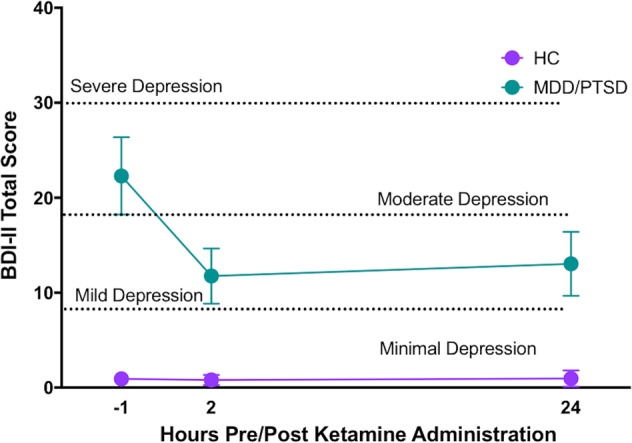
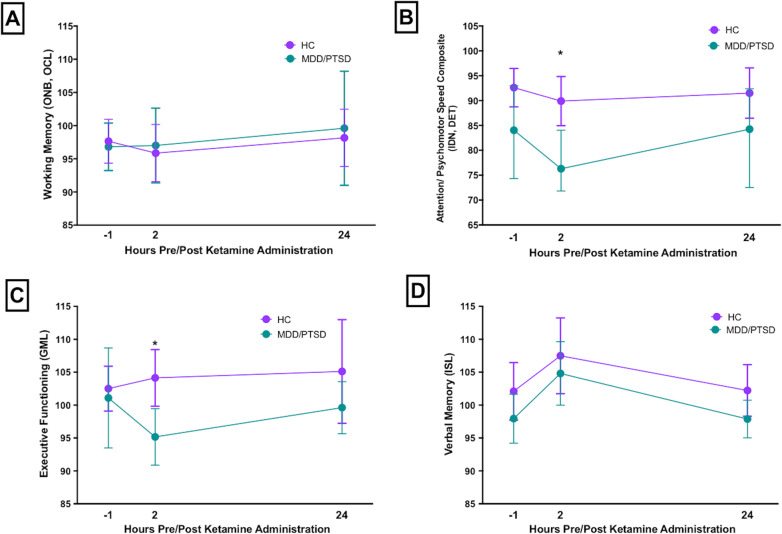
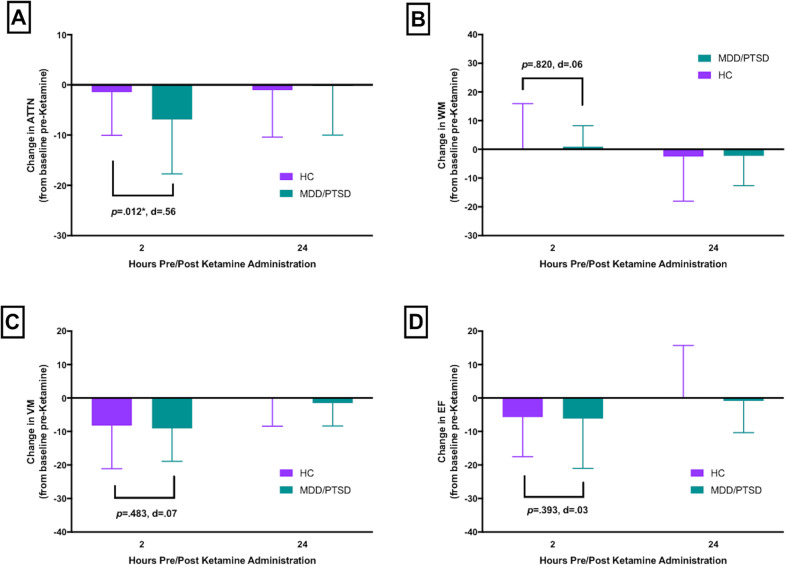
Intravenous (IV) subanesthetic doses of ketamine have been shown to reduce psychiatric distress in both major depressive (MDD) and posttraumatic stress disorder (PTSD). However, the effect of ketamine on cognitive function in these disorders is not well understood. To address this gap, we examined the effect of a single dose of IV ketamine on cognition in individuals with MDD and/or PTSD relative to healthy controls (HC). Psychiatric ( n = 29; 15 PTSD, 14 MDD) and sex- age- and IQ matched HC ( n = 29) groups were recruited from the community. A single subanesthetic dose of IV ketamine was administered. Mood and cognitive measures were collected prior to, 2 h and 1 day post-ketamine administration. MDD/PTSD individuals evidenced a large-magnitude improvement in severity of depressive symptoms at both 2-hours and 1 day post-ketamine administration ( p ’s < .001, Cohen d ’s = 0.80–1.02). Controlling for baseline performance and years of education, IV ketamine induced declines in attention (ATTN), executive function (EF), and verbal memory (VM) 2 h post-administration, all of which had resolved by 1 day post-ketamine across groups. The magnitude of cognitive decline was significantly larger in MDD/PTSD relative to HC on attention only ( p = .012, d = 0.56). Ketamine did not affect working memory (WM) performance. Cognitive function (baseline, change from baseline to post-ketamine) was not associated with antidepressant response to ketamine. Results suggest that while ketamine may have an acute deleterious effect on some cognitive domains in both MDD/PTSD and HC individuals, most notably attention, this reduction is transient and there is no evidence of ketamine-related cognitive dysfunction at 1 day post-administration.
Overview
The claims and statistics of this paper haven’t been checked yet.
Free: it reads the open-access text and checks the first 5 claims that cite a source we can check. Create a free account to check every claim.
Integrity signals
Registry
Cites
Statistics
Figures
Verification
Claims the paper makes
The claims and statistics of this paper haven’t been checked yet.
Free: it reads the open-access text and checks the first 5 claims that cite a source we can check. Create a free account to check every claim.
Claims other papers make about this one
Each is checked against this paper’s own text: does it say what the citing paper says it does?
The cited source says what the claim attributes to it.
In the citing paper
“but these effects appeared to be transient [105]”
From Ketamine in neuropsychiatric disorders: an update (2024) · cites this paper as [105]
The cited source says what the claim attributes to it.
In the citing paper
“Another study (n = 15) found that ketamine was associated with short-term attention deficits in participants with PTSD”
From Ketamine in neuropsychiatric disorders: an update (2024) · cites this paper as [105]
Self-check
Percentages, sums and reported differences re-computed from the paper’s own numbers.
The self-check needs the paper’s full text.
Citations
Cites
Hamilton, M. (1960) · Journal of Neurology, Neurosurgery & Psychiatry · doi:10.1136/jnnp.23.1.56 · Cited by 32,817
A new depression scale designed to be sensitive to change
Montgomery, S. A., & Åsberg, M. (1979) · British Journal of Psychiatry · doi:10.1192/bjp.134.4.382 · Cited by 13,962
Beck, A. T., Steer, R. A., & Brown, G. (2011) · PsycTESTS Dataset · doi:10.1037/t00742-000 · Cited by 7,535
Krystal, J. H. (1994) · Archives of General Psychiatry · doi:10.1001/archpsyc.1994.03950030035004 · Cited by 3,330
Cognitive impairment in depression: a systematic review and meta-analysis
Rock, P. L., Roiser, J. P., Riedel, W. J., & Blackwell, A. D. (2014) · Psychological Medicine · doi:10.1017/s0033291713002535 · Cited by 2,161
Glickman, M. E., Rao, S. R., & Schultz, M. R. (2014) · Journal of Clinical Epidemiology · doi:10.1016/j.jclinepi.2014.03.012 · Cited by 1,542
Ketamine and Ketamine Metabolite Pharmacology: Insights into Therapeutic Mechanisms
Zanos, P., Moaddel, R., Morris, P. J., Riggs, L. M., Highland, J. N., Georgiou, P., Pereira, E. F. R., Albuquerque, E. X., Thomas, C. J., Zarate, C. A., et al. (2018) · Pharmacological Reviews · doi:10.1124/pr.117.015198 · Cited by 1,260
Kraus, M. F., Susmaras, T., Caughlin, B. P., Walker, C. J., Sweeney, J. A., & Little, D. M. (2007) · Brain · doi:10.1093/brain/awm216 · Cited by 994
Chronic stress, cognitive functioning and mental health
Marin, M.-F., Lord, C., Andrews, J., Juster, R.-P., Sindi, S., Arsenault-Lapierre, G., Fiocco, A. J., & Lupien, S. J. (2011) · Neurobiology of Learning and Memory · doi:10.1016/j.nlm.2011.02.016 · Cited by 654
Maruff, P., Thomas, E., Cysique, L., Brew, B., Collie, A., Snyder, P., & Pietrzak, R. H. (2009) · Archives of Clinical Neuropsychology · doi:10.1093/arclin/acp010 · Cited by 635
Self-citation
Research works printed but not linked: 3
- Cusin C. The Massachusetts General Hospital Guide to Depression (Springer, 2019).
- Thase M., Connolly K. R. Ketamine and esketamine for treating unipolar depression in adults: administration, efficacy, and adverse effects. (Wolters Kluwer, 2019).
- First, M. B. Structured Clinical Interview for DSM-IV-TR Axis I Disorders: Patient Edition (Biometrics Research Department, Columbia University, 2005).
Cited by
Nicosia, N., Giovenzana, M., Misztak, P., Mingardi, J., & Musazzi, L. (2024) · International Journal of Molecular Sciences · doi:10.3390/ijms25126521 · Cited by 135
Ketamine in neuropsychiatric disorders: an update
Johnston, J. N., Kadriu, B., Kraus, C., Henter, I. D., & Zarate, C. A. (2024) · Neuropsychopharmacology · doi:10.1038/s41386-023-01632-1 · Cited by 108
Rawat, R., Tunc‐Ozcan, E., McGuire, T. L., Peng, C., & Kessler, J. A. (2022) · Nature Communications · doi:10.1038/s41467-022-30386-5 · Cited by 81
Colwell, M., Tagomori, H., Chapman, S., Gillespie, A. L., Cowen, P. J., Harmer, C. J., & Murphy, S. E. (2022) · Translational Psychiatry · doi:10.1038/s41398-022-02249-6 · Cited by 74
The potential of ketamine for posttraumatic stress disorder: a review of clinical evidence
Ragnhildstveit, A., Roscoe, J., Bass, L. C., Averill, C. L., Abdallah, C. G., & Averill, L. A. (2023) · Therapeutic Advances in Psychopharmacology · doi:10.1177/20451253231154125 · Cited by 57
The Possible Application of Ketamine in the Treatment of Depression in Alzheimer’s Disease
Mohammad Shehata, I., Masood, W., Nemr, N., Anderson, A., Bhusal, K., Edinoff, A. N., Cornett, E. M., Kaye, A. M., & Kaye, A. D. (2022) · Neurology International · doi:10.3390/neurolint14020025 · Cited by 41
“, accessed the acute cognitive effects of ketamine with a single intravenous infusion and found no association with cognitive impairment or working memory performance [48].”
BackgroundBrzozowska, A., & Grabowski, J. (2025) · International Journal of Molecular Sciences · doi:10.3390/ijms26115216 · Cited by 41
Sicignano, D. J., Kurschner, R., Weisman, N., Sedensky, A., Hernández, A. V., & White, C. M. (2023) · Annals of Pharmacotherapy · doi:10.1177/10600280231199666 · Cited by 31
Bernardo, A. M., Lee, P., Marcotte, M. D., Mian, M. Y., Rezvanian, S., Sharmin, D., Kovačević, A., Savić, M. M., Cook, J. M., Sibille, E. L., et al. (2022) · Neuropsychopharmacology · doi:10.1038/s41386-022-01360-y · Cited by 30
Jumaili, W. A., Trivedi, C., Chao, T., Kubosumi, A., & Jain, S. (2022) · Behavioural Brain Research · doi:10.1016/j.bbr.2022.113804 · Cited by 29
de Albuquerque, T. R., Macedo, L. F. R., Delmondes, G. D. A., Neto, M. L. R., Almeida, T. M., Uchida, R. R., Cordeiro, Q., Lisboa, K. W. D. S. C., & de Menezes, I. R. A. (2022) · Journal of Cerebral Blood Flow & Metabolism · doi:10.1177/0271678x221116477 · Cited by 29
Philipp-Muller, A. E., Stephenson, C., Moghimi, E., Shirazi, A. H., Milev, R. V., Vázquez, G. H., Reshetukha, T., & Alavi, N. (2023) · The Journal of Clinical Psychiatry · doi:10.4088/jcp.22br14564 · Cited by 25
Thomson, D. M., Mitchell, E. J., Openshaw, R. L., Pratt, J. A., & Morris, B. (2021) · Journal of Psychopharmacology · doi:10.1177/02698811211032439 · Cited by 25
Kritzer, M. D., Pae, C., & Masand, P. S. (2022) · Expert Opinion on Drug Safety · doi:10.1080/14740338.2022.2069749 · Cited by 23
Ketamine and esketamine for crisis management in patients with depression: Why, whom, and how?
Lengvenytė, A., Strumila, R., Olié, É., & Courtet, P. (2022) · European Neuropsychopharmacology · doi:10.1016/j.euroneuro.2022.02.004 · Cited by 21
Acevedo, J., Mugarura, N. E., Welter, A. L., Johnson, E. M., & Siegel, J. A. (2022) · Neuroscience · doi:10.1016/j.neuroscience.2022.12.002 · Cited by 16
Ketamine for the Treatment of Psychiatric Disorders: A Systematic Review and Meta-Analysis
Kwan, A. T. H., Lakhani, M., Singh, G., Le, G. H., Wong, S., Teopiz, K. M., Dev, D. A., Manku, A. S., Sidhu, G., & McIntyre, R. S. (2024) · CNS Spectrums · doi:10.1017/s1092852924000580 · Cited by 15
The Therapeutic Effects of Ketamine in Mental Health Disorders: A Narrative Review
Ramos, C. S., Thornburg, M., Long, K., Sharma, K., Roth, J., Lacatusu, D., Whitaker, R., Pacciulli, D., Loo, S. M., Manzoor, M., et al. (2022) · Cureus · doi:10.7759/cureus.23647 · Cited by 14
Cognitive changes in patients with unipolar TRD treated with IV ketamine: A systematic review
Grasso, V., Gutiérrez, G., Alzbeidi, N., Hernandorena, C. V., & Vázquez, G. H. (2024) · Progress in Neuro-Psychopharmacology and Biological Psychiatry · doi:10.1016/j.pnpbp.2024.111095 · Cited by 14
Wang, Y., Xu, J., Zhou, X., Che, L., Qiu, M., Liu, Y., Gao, M., & Yang, Z. (2025) · Advanced Science · doi:10.1002/advs.202516024 · Cited by 13
Deng, Q., Parker, E., Wu, C., Zhu, L., Liu, T. C., Duan, R., & Yang, L. (2024) · Aging and Disease · doi:10.14336/ad.2024.0239 · Cited by 12
Psychedelika und Dissoziativa in der Psychiatrie: Herausforderungen in der Behandlung
Jungwirth, J., Bavato, F., & Quednow, B. B. (2024) · Der Nervenarzt · doi:10.1007/s00115-024-01727-0 · Cited by 10
Similar destabilization of neural dynamics under different general anesthetics
Eisen, A. J., Bardon, A. G., Ballesteros, J. J., Bastos, A. M., Donoghue, J., Mahnke, M. K., Brincat, S. L., Roy, J. E., Ishizawa, Y., Brown, E. N., et al. (2026) · Cell Reports · doi:10.1016/j.celrep.2026.117048 · Cited by 8
Dunbar, J., Walling, D. P., Hassman, H. A., Jain, R. K., Czysz, A., Nandy, I. M., Ona, V. O., Moseley, M. K., Levin, S. N., & Maruff, P. T. (2024) · Journal of Psychopharmacology · doi:10.1177/02698811241282777 · Cited by 8
Self-citationA Paradox in Digital Memory Assessment: Increased Sensitivity With Reduced Difficulty
White, J. P., Schembri, A. J., Edgar, C. J., Lim, Y. Y., Masters, C. L., & Maruff, P. T. (2021) · Frontiers in Digital Health · doi:10.3389/fdgth.2021.780303 · Cited by 8
Self-citationPalamar, J. J., Rutherford, C., & Keyes, K. M. (2025) · The Lancet Regional Health - Americas · doi:10.1016/j.lana.2025.101230 · Cited by 7
“7,10,11 Individuals experiencing dissociation are also at increased risk for trauma.”
Huang, R., Gong, S., Xiong, B., Yang, X., Chen, C., Song, W., Wu, R., Yang, L., Yin, J., & Chen, M. (2024) · Heliyon · doi:10.1016/j.heliyon.2024.e34596 · Cited by 4
The role of ketamine as an antidepressant agent
Senapathi, T. G. A., Widnyana, M. G., Aryani, L. N. A., & Ryalino, C. (2023) · Bali Journal of Anesthesiology · doi:10.4103/bjoa.bjoa_81_23 · Cited by 3
Therapeutic Potential of Intravenous Ketamine in Early-Onset Dementia: A Case Report
Tadros, M., Lavastida, D. R., & Hanna, A. F. (2024) · Cureus · doi:10.7759/cureus.65261 · Cited by 2
From Bench to Bedside: Understanding General Anesthetics' Impact on PTSD
Li, K., Meimei, G., Wei, W., Li, X., & Peng, M. (2026) · Current Neuropharmacology · doi:10.2174/011570159x402072251103071408 · Cited by 1
Dutra, R. N., Nascimento, M. V. F., Gontijo, J. P. S., LISBOA, K. S., Viana, G. F., Coelho, N. C., Dutra, S. M., & Alves, B. D. M. L. (2025) · STUDIES IN HEALTH SCIENCES · doi:10.54022/shsv6n1-037 · Cited by 1
General anaesthetics and therapeutic gases
Tandon, A., & Hall, A. (2022) · Side effects of drugs annual · doi:10.1016/bs.seda.2022.07.004 · Cited by 1
Ketamine in Diabetes Care: Metabolic Insights and Clinical Applications
Sukhram, S. D., Sanchez, M., Anidugbe, A., Kupa, B., Edwards, V. P., Zia, M., & Yilmaz, G. (2026) · Pharmaceutics · doi:10.3390/pharmaceutics18010081
Kelly, C., Cooley, B. J., Zeng, L., Hurzeler, T. P., Manning, V., McNally, G. P., Watt, J., Haber, P., & Morley, K. C. (2026) · Neuroscience & Biobehavioral Reviews · doi:10.1016/j.neubiorev.2026.106911
Anesthetic Amnesia: The Forgotten Importance of Forgetting?
Pryor, K. O., Jiang, Y., & SLEIGH, J. W. (2025) · Anesthesiology · doi:10.1097/aln.0000000000005544
The Relationship Between Ketamine and Memory Impairment: A Systematic Review
Al-badran, G. (2024) · Cumhuriyet Tıp Dergisi/Cumhuriyet Üniversitesi Tıp Fakültesi dergisi · doi:10.7197/cmj.1452303
Philipp-Muller, A. E. (2022) · QSpace (Queen's University Library)
Gualda, L. M. G., Dies, M. A., Cobos, N. I. M., Águila, J. D. Á., Cremades, R. R., & Espuña, J. B. (2024) · Psiquiatría Biológica · doi:10.1016/j.psiq.2024.100556
Metadata
- Authors
- Davis, M. T., DellaGiogia, N., Maruff, P., Pietrzak, R. H., & Esterlis, I.
- Affiliations
- United States Department of Veterans Affairs (US)
- Yale University (US)
- Corresponding author
- Esterlis, Irina
- Venue
- Translational Psychiatry
- Published
- 2021-04-08
- Volume
- 11
- Issue
- 1
- Pages
- 205-205
- ISSN
- 2158-3188 (ISSN-L)
- PMC
- PMC8032778
- OpenAlex
- W3145554712
- Cited by
- 37
- References
- 81
- Citations by year
- 2026: 4 · 2025: 5 · 2024: 10 · 2023: 5 · 2022: 11 · 2021: 2
- FWCI
- 4.09
- Type
- journal article
- Language
- en
- Open access
- gold
- doi.org
- Licence
- cc-by
- creativecommons.org/licenses/by/4.0 (tdm)
- creativecommons.org/licenses/by/4.0 (vor)
- Locations
- Translational Psychiatry (publishedVersion, cc-by)
- PubMed Central (publishedVersion, cc-by)
- PubMed (publishedVersion)
- DOAJ (DOAJ: Directory of Open Access Journals) (submittedVersion, cc-by-sa)
- Minerva Access (University of Melbourne) (submittedVersion, cc-by)
- Funders
- U.S. Department of Health & Human Services | NIH | National Institute of Mental Health (1K08MH117351-01, K01MH092681, R01MH104459)
- Topics
- Health Sciences › Medicine › Pharmacology (medical) › Treatment of Major Depression
- Health Sciences › Medicine › Psychiatry and Mental health › Electroconvulsive Therapy Studies
- Life Sciences › Neuroscience › Developmental Neuroscience › Anesthesia and Neurotoxicity Research
- Keywords
- ketamine, major depressive disorder, post-traumatic stress disorder, cognitive function, attention, executive function, verbal memory, working memory, subanesthetic doses, antidepressant response
- MeSH terms
- Antidepressive Agents, Cognition, Major Depressive Disorder, Humans, Ketamine, Stress Disorders, Post-Traumatic
About these checks
Registry, retraction, Cites and statistics results are computed, not judged, with one exception: a printed reference that no index lists is read once by a model before it counts as a citation error. Claims are extracted by a model and kept only when their quote appears verbatim in the text; each cited source is then checked, with a model’s help, for whether it says what the claim relies on. Those verdicts can be wrong — read the claim’s quote and the cited source before relying on one.
Statistics and arithmetic are recomputed, not judged.
Confidence bands are shown only for fields calibrated on our annotated test set. None is calibrated yet, so no band is shown.
What counts as a claim ›How we measure confidence ›How we check this ›
Are you an author, or do you see a problem with this page? Request a review
Data sources
Bibliographic data: Semantic Scholar, OpenAlex, Crossref.
Contains information from the Semantic Scholar Academic Graph Datasets, made available under the ODC Attribution License (ODC-BY 1.0).
Semantic Scholar’s data is described in: Kinney, R., et al. (2023). The Semantic Scholar Open Data Platform. arXiv:2301.10140.
