

Acute cognitive effects of single-dose intravenous ketamine in major depressive and posttraumatic stress disorder
Open accessThe DOI matches its Crossref record; 80 of the 81 references it cites were found in a registry or an index.
Abstract
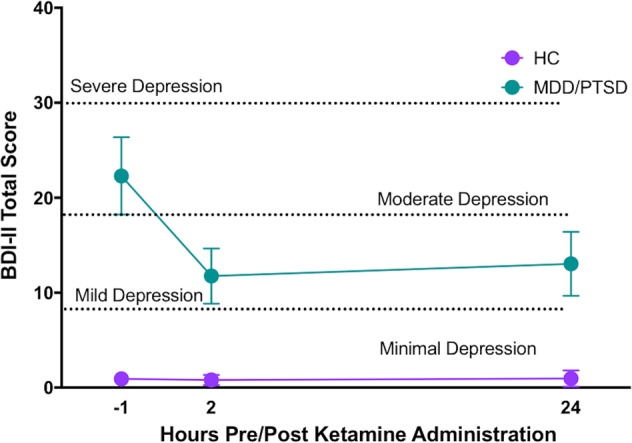
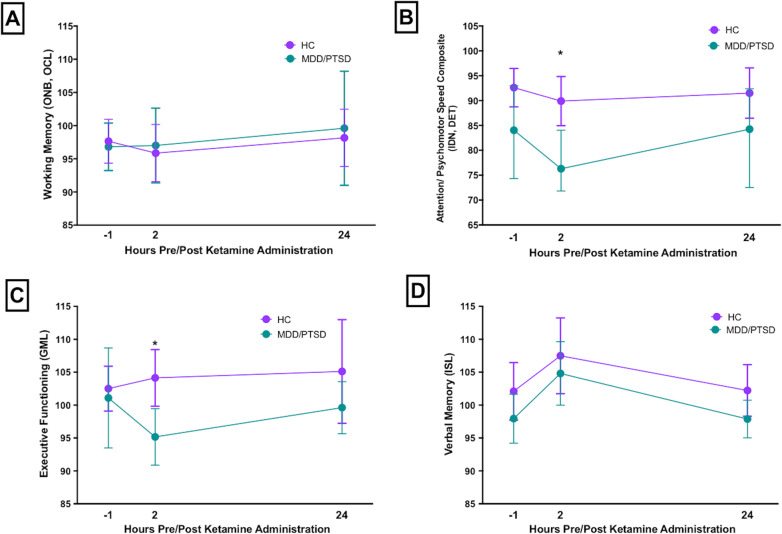
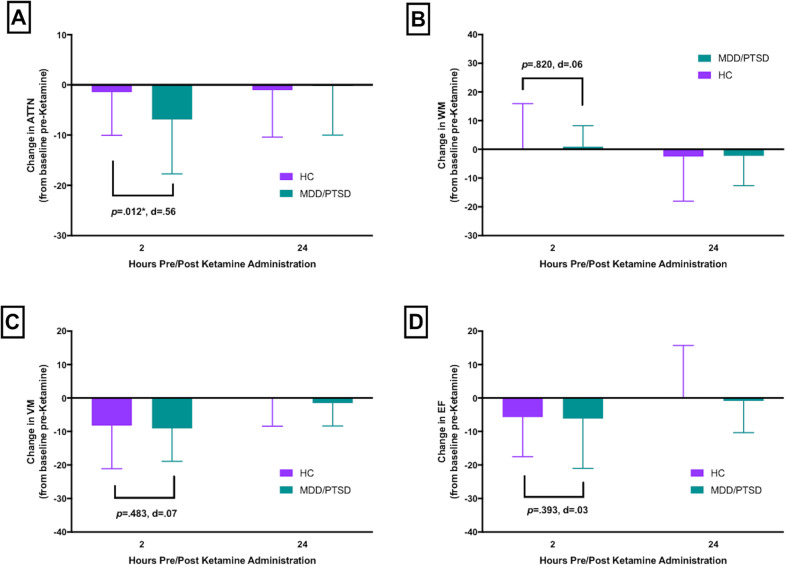
Intravenous (IV) subanesthetic doses of ketamine have been shown to reduce psychiatric distress in both major depressive (MDD) and posttraumatic stress disorder (PTSD). However, the effect of ketamine on cognitive function in these disorders is not well understood. To address this gap, we examined the effect of a single dose of IV ketamine on cognition in individuals with MDD and/or PTSD relative to healthy controls (HC). Psychiatric ( n = 29; 15 PTSD, 14 MDD) and sex- age- and IQ matched HC ( n = 29) groups were recruited from the community. A single subanesthetic dose of IV ketamine was administered. Mood and cognitive measures were collected prior to, 2 h and 1 day post-ketamine administration. MDD/PTSD individuals evidenced a large-magnitude improvement in severity of depressive symptoms at both 2-hours and 1 day post-ketamine administration ( p ’s < .001, Cohen d ’s = 0.80–1.02). Controlling for baseline performance and years of education, IV ketamine induced declines in attention (ATTN), executive function (EF), and verbal memory (VM) 2 h post-administration, all of which had resolved by 1 day post-ketamine across groups. The magnitude of cognitive decline was significantly larger in MDD/PTSD relative to HC on attention only ( p = .012, d = 0.56). Ketamine did not affect working memory (WM) performance. Cognitive function (baseline, change from baseline to post-ketamine) was not associated with antidepressant response to ketamine. Results suggest that while ketamine may have an acute deleterious effect on some cognitive domains in both MDD/PTSD and HC individuals, most notably attention, this reduction is transient and there is no evidence of ketamine-related cognitive dysfunction at 1 day post-administration.
Overview
The claims and statistics of this paper haven’t been checked yet.
Free: it reads the open-access text and checks the first 5 claims that cite a source we can check. Create a free account to check every claim.
Integrity signals
Registry
Cites
Statistics
Figures
Verification
Claims the paper makes
The claims and statistics of this paper haven’t been checked yet.
Free: it reads the open-access text and checks the first 5 claims that cite a source we can check. Create a free account to check every claim.
Claims other papers make about this one
Each is checked against this paper’s own text: does it say what the citing paper says it does?
The cited source says what the claim attributes to it.
In the citing paper
“but these effects appeared to be transient [105]”
From Ketamine in neuropsychiatric disorders: an update (2024) · cites this paper as [105]
The cited source says what the claim attributes to it.
In the citing paper
“Another study (n = 15) found that ketamine was associated with short-term attention deficits in participants with PTSD”
From Ketamine in neuropsychiatric disorders: an update (2024) · cites this paper as [105]
Self-check
Percentages, sums and reported differences re-computed from the paper’s own numbers.
The self-check needs the paper’s full text.
Citations
Cites
Hamilton, M. (1960) · Journal of Neurology, Neurosurgery & Psychiatry · doi:10.1136/jnnp.23.1.56 · Cited by 32,817
A new depression scale designed to be sensitive to change
Montgomery, S. A., & Åsberg, M. (1979) · British Journal of Psychiatry · doi:10.1192/bjp.134.4.382 · Cited by 13,962
Beck, A. T., Steer, R. A., & Brown, G. (2011) · PsycTESTS Dataset · doi:10.1037/t00742-000 · Cited by 7,535
Krystal, J. H. (1994) · Archives of General Psychiatry · doi:10.1001/archpsyc.1994.03950030035004 · Cited by 3,330
Cognitive impairment in depression: a systematic review and meta-analysis
Rock, P. L., Roiser, J. P., Riedel, W. J., & Blackwell, A. D. (2014) · Psychological Medicine · doi:10.1017/s0033291713002535 · Cited by 2,161
Glickman, M. E., Rao, S. R., & Schultz, M. R. (2014) · Journal of Clinical Epidemiology · doi:10.1016/j.jclinepi.2014.03.012 · Cited by 1,542
Ketamine and Ketamine Metabolite Pharmacology: Insights into Therapeutic Mechanisms
Zanos, P., Moaddel, R., Morris, P. J., Riggs, L. M., Highland, J. N., Georgiou, P., Pereira, E. F. R., Albuquerque, E. X., Thomas, C. J., Zarate, C. A., et al. (2018) · Pharmacological Reviews · doi:10.1124/pr.117.015198 · Cited by 1,260
Kraus, M. F., Susmaras, T., Caughlin, B. P., Walker, C. J., Sweeney, J. A., & Little, D. M. (2007) · Brain · doi:10.1093/brain/awm216 · Cited by 994
Chronic stress, cognitive functioning and mental health
Marin, M.-F., Lord, C., Andrews, J., Juster, R.-P., Sindi, S., Arsenault-Lapierre, G., Fiocco, A. J., & Lupien, S. J. (2011) · Neurobiology of Learning and Memory · doi:10.1016/j.nlm.2011.02.016 · Cited by 654
Maruff, P., Thomas, E., Cysique, L., Brew, B., Collie, A., Snyder, P., & Pietrzak, R. H. (2009) · Archives of Clinical Neuropsychology · doi:10.1093/arclin/acp010 · Cited by 635
Self-citationPrice, R. B., Nock, M. K., Charney, D. S., & Mathew, S. J. (2009) · Biological Psychiatry · doi:10.1016/j.biopsych.2009.04.029 · Cited by 600
Umbricht, D., Schmid, L., Koller, R., Vollenweider, F. X., Hell, D., & Javitt, D. C. (2000) · Archives of General Psychiatry · doi:10.1001/archpsyc.57.12.1139 · Cited by 583
A Consensus Statement on the Use of Ketamine in the Treatment of Mood Disorders
Sanacora, G., Frye, M. A., McDonald, W., Mathew, S. J., Turner, M. S., Schatzberg, A. F., Summergrad, P., Nemeroff, C. B., & for the American Psychiatric Association (APA) Council of Research Task Force on Novel Biomarkers and Treatments (2017) · JAMA Psychiatry · doi:10.1001/jamapsychiatry.2017.0080 · Cited by 576
Side-effects associated with ketamine use in depression: a systematic review
Short, B., Fong, J., Galvez, V., Shelker, W., & Loo, C. K. (2018) · The Lancet Psychiatry · doi:10.1016/s2215-0366(17)30272-9 · Cited by 558
Structured Clinical Interview for the DSM ( SCID )
First, M. B. (2015) · The Encyclopedia of Clinical Psychology · doi:10.1002/9781118625392.wbecp351 · Cited by 532
Conradi, H. J., Ormel, J., & de Jonge, P. (2011) · Psychological Medicine · doi:10.1017/s0033291710001911 · Cited by 515
Neurocognitive deficits and disability in major depressive disorder
Jaeger, J., Berns, S., Uzelac, S., & Davis-Conway, S. (2006) · Psychiatry Research · doi:10.1016/j.psychres.2005.11.011 · Cited by 484
Sandi, C. (2013) · WIREs Cognitive Science · doi:10.1002/wcs.1222 · Cited by 474
Ketamine: A Paradigm Shift for Depression Research and Treatment
Krystal, J. H., Abdallah, C. G., Sanacora, G., Charney, D. S., & Duman, R. S. (2019) · Neuron · doi:10.1016/j.neuron.2019.02.005 · Cited by 455
Falleti, M. G., Maruff, P., Collie, A., & Darby, D. G. (2006) · Journal of Clinical and Experimental Neuropsychology · doi:10.1080/13803390500205718 · Cited by 422
Self-citationCognitive impairment in depression: recent advances and novel treatments
Perini, G., Cotta Ramusino, M., Sinforiani, E., Bernini, S., Petrachi, R., & Costa, A. (2019) · Neuropsychiatric Disease and Treatment · doi:10.2147/ndt.s199746 · Cited by 384
Button, K. S., Kounali, D., Thomas, L., Wiles, N. J., Peters, T. J., Welton, N. J., Ades, A. E., & Lewis, G. (2015) · Psychological Medicine · doi:10.1017/s0033291715001270 · Cited by 332
Cognitive function in major depression
Austin, M.-P., Ross, M., Murray, C., O'Caŕroll, R. E., Ebmeier, K. P., & Goodwin, G. M. (1992) · Journal of Affective Disorders · doi:10.1016/0165-0327(92)90089-o · Cited by 320
Krystal, J. H., Perry, E. B., Gueorguieva, R., Belger, A., Madonick, S. H., Abi-Dargham, A., Cooper, T. B., MacDougall, L., Abi-Saab, W., & D’Souza, D. C. (2005) · Archives of General Psychiatry · doi:10.1001/archpsyc.62.9.985 · Cited by 317
Cognitive dysfunction in depression: Neurocircuitry and new therapeutic strategies
Murrough, J. W., Iacoviello, B., Neumeister, A., Charney, D. S., & Iosifescu, D. V. (2011) · Neurobiology of Learning and Memory · doi:10.1016/j.nlm.2011.06.006 · Cited by 307
Ketamine Treatment and Global Brain Connectivity in Major Depression
Abdallah, C. G., Averill, L. A., Collins, K. A., Geha, P., Schwartz, J., Averill, C., DeWilde, K. E., Wong, E., Anticevic, A., Tang, C. Y., et al. (2017) · Neuropsychopharmacology · doi:10.1038/npp.2016.186 · Cited by 300 · cited 4×
“Of note, the decision to combine MDD and PTSD groups was made for two reasons: (1) based on review of available prior literature we expected to observe a similar pattern of results in MDD and PTSD; (2) in consideration of statistical power given modest sample sizes.”
BackgroundMethodResultInfluentialAntidepressant Efficacy and Tolerability of Ketamine and Esketamine: A Critical Review
Molero, P., Ramos-Quiroga, J. A., Martin-Santos, R., Calvo-Sánchez, E., Gutiérrez-Rojas, L., & Meana, J. J. (2018) · CNS Drugs · doi:10.1007/s40263-018-0519-3 · Cited by 280
Acute Effects of Ketamine on Memory Systems and Psychotic Symptoms in Healthy Volunteers
Morgan, C. J. A., Mofeez, A., Brandner, B., Bromley, L., & Curran, H. V. (2004) · Neuropsychopharmacology · doi:10.1038/sj.npp.1300342 · Cited by 277
Wechsler Test of Adult Reading
Hill, A. K., Venegas, J., & Clark, E. (2017) · Encyclopedia of Clinical Neuropsychology · doi:10.1007/978-3-319-56782-2_1500-2 · Cited by 246
Interactive effects of subanesthetic ketamine and haloperidol in healthy humans
Krystal, J. H., D'Souza, D. C., Karper, L. P., Bennett, A., Abi-Dargham, A., Abi-Saab, D., Cassello, K., Bowers Jr., M. B., Vegso, S., Heninger, G. R., et al. (1999) · Psychopharmacology · doi:10.1007/s002130051049 · Cited by 243
Anticevic, A., Gancsos, M., Murray, J. D., Repovs, G., Driesen, N. R., Ennis, D. J., Niciu, M. J., Morgan, P. T., Surti, T. S., Bloch, M. H., et al. (2012) · Proceedings of the National Academy of Sciences · doi:10.1073/pnas.1208494109 · Cited by 243
for the AIBL Research Group, Maruff, P., Lim, Y. Y., Darby, D., Ellis, K. A., Pietrzak, R. H., Snyder, P. J., Bush, A. I., Szoeke, C., Schembri, A., et al. (2013) · BMC Psychology · doi:10.1186/2050-7283-1-30 · Cited by 239
Self-citationThe role of ketamine in treatment-resistant depression: A systematic review
Serafini, G., Howland, R., Rovedi, F., Girardi, P., & Amore, M. (2014) · Current Neuropharmacology · doi:10.2174/1570159x12666140619204251 · Cited by 234 · cited 4×
“Of note, the decision to combine MDD and PTSD groups was made for two reasons: (1) based on review of available prior literature we expected to observe a similar pattern of results in MDD and PTSD; (2) in consideration of statistical power given modest sample sizes.”
BackgroundMethodResultInfluentialFrom prediction error to psychosis: Ketamine as a pharmacological model of delusions
Corlett, P. R., Honey, G. D., & Fletcher, P. C. (2007) · Journal of Psychopharmacology · doi:10.1177/0269881107077716 · Cited by 227
Driesen, N. R., McCarthy, G., Bhagwagar, Z., Bloch, M., Calhoun, V, D'Souza, D. C., Gueorguieva, R., He, G., Ramachandran, R., Suckow, R. F., et al. (2013) · Molecular Psychiatry · doi:10.1038/mp.2012.194 · Cited by 224
Pharmacological treatment of PTSD – Established and new approaches
Steckler, T., & Risbrough, V. (2012) · Neuropharmacology · doi:10.1016/j.neuropharm.2011.06.012 · Cited by 182
Corlett, P. R., Honey, G. D., Aitken, M. R. F., Dickinson, A., Shanks, D. R., Absalom, A. R., Lee, M., Pomarol-Clotet, E., Murray, G. K., McKenna, P. J., et al. (2006) · Archives of General Psychiatry · doi:10.1001/archpsyc.63.6.611 · Cited by 182
Cadinu, D., Grayson, B., Podda, G., Harte, M. K., Doostdar, N., & Neill, J. C. (2018) · Neuropharmacology · doi:10.1016/j.neuropharm.2017.11.045 · Cited by 168
DEN HARTOG, H. M., DERIX, M. M. A., VAN BEMMEL, A. L., KREMER, B., & JOLLES, J. (2003) · Psychological Medicine · doi:10.1017/s003329170300833x · Cited by 160
Esterlis, I., DellaGioia, N., Pietrzak, R. H., Matuskey, D., Nabulsi, N., Abdallah, C. G., Yang, J., Pittenger, C., Sanacora, G., Krystal, J. H., et al. (2018) · Molecular Psychiatry · doi:10.1038/mp.2017.58 · Cited by 148
Self-citationIADL Functions, Cognitive Deficits, and Severity of Depression: A Preliminary Study
Kiosses, D. N., & Alexopoulos, G. S. (2005) · American Journal of Geriatric Psychiatry · doi:10.1176/appi.ajgp.13.3.244 · Cited by 145
Trail Making Test Errors and Executive Function in Schizophrenia and Depression
Mahurin, R. K., Velligan, D. I., Hazleton, B., Mark Davis, J., Eckert, S., & Miller, A. L. (2006) · The Clinical Neuropsychologist · doi:10.1080/13854040590947498 · Cited by 144
Murrough, J. W., Burdick, K. E., Levitch, C. F., Perez, A. M., Brallier, J. W., Chang, L. C., Foulkes, A., Charney, D. S., Mathew, S. J., & Iosifescu, D. V. (2015) · Neuropsychopharmacology · doi:10.1038/npp.2014.298 · Cited by 142
Shiroma, P. R., Albott, C. S., Johns, B., Thuras, P., Wels, J., & Lim, K. O. (2014) · The International Journal of Neuropsychopharmacology · doi:10.1017/s1461145714001011 · Cited by 126
HAWKINS, K. A., MOHAMED, S., & WOODS, S. W. (1999) · Psychological Medicine · doi:10.1017/s0033291798006990 · Cited by 120
Morgan, C. J. A., Mofeez, A., Brandner, B., Bromley, L. M., & Curran, H. V. (2003) · Psychopharmacology · doi:10.1007/s00213-003-1656-y · Cited by 119
Ketamine-Induced Hallucinations
Powers III, A. R., Gancsos, M. G., Finn, E. S., Morgan, P. T., & Corlett, P. R. (2015) · Psychopathology · doi:10.1159/000438675 · Cited by 117
Yan, J., & Jiang, H. (2014) · Journal of Neurosurgical Anesthesiology · doi:10.1097/ana.0000000000000027 · Cited by 114
Morgan, C. J. A., Dodds, C. M., Furby, H., Pepper, F., Fam, J., Freeman, T. P., Hughes, E., Doeller, C., King, J., Howes, O., et al. (2014) · Frontiers in Psychiatry · doi:10.3389/fpsyt.2014.00149 · Cited by 110
Murrough, J. W., Wan, L.-B., Iacoviello, B., Collins, K. A., Solon, C., Glicksberg, B., Perez, A. M., Mathew, S. J., Charney, D. S., Iosifescu, D. V., et al. (2014) · Psychopharmacology · doi:10.1007/s00213-013-3255-x · Cited by 108
DeLorenzo, C., DellaGioia, N., Bloch, M., Sanacora, G., Nabulsi, N., Abdallah, C., Yang, J., Wen, R., Mann, J. J., Krystal, J. H., et al. (2015) · Biological Psychiatry · doi:10.1016/j.biopsych.2014.06.024 · Cited by 105
Self-citationMinimum clinically important differences identified for commonly used depression rating scales
Masson, S. C., & Tejani, A. M. (2013) · Journal of Clinical Epidemiology · doi:10.1016/j.jclinepi.2013.01.010 · Cited by 94
Wilkinson, S. T., Katz, R. B., Toprak, M., Webler, R., Ostroff, R. B., & Sanacora, G. (2018) · The Journal of Clinical Psychiatry · doi:10.4088/jcp.17m11731 · Cited by 91
Chen, M.-H., Li, C.-T., Lin, W.-C., Hong, C.-J., Tu, P.-C., Bai, Y.-M., Cheng, C.-M., & Su, T.-P. (2018) · Journal of Affective Disorders · doi:10.1016/j.jad.2018.07.033 · Cited by 86
Chen, M.-H., Lin, W.-C., Tu, P.-C., Li, C.-T., Bai, Y.-M., Tsai, S.-J., & Su, T.-P. (2019) · Journal of Affective Disorders · doi:10.1016/j.jad.2019.08.022 · Cited by 78
A New Perspective on the Anti-Suicide Effects With Ketamine Treatment: A Procognitive Effect
Lee, Y., Syeda, K., Maruschak, N. A., Cha, D. S., Mansur, R. B., Wium-Andersen, I. K., Woldeyohannes, H. O., Rosenblat, J. D., & McIntyre, R. S. (2016) · Journal of Clinical Psychopharmacology · doi:10.1097/jcp.0000000000000441 · Cited by 74
Morrison, R. L., Fedgchin, M., Singh, J., Van Gerven, J., Zuiker, R., Lim, K. S., van der Ark, P., Wajs, E., Xi, L., Zannikos, P., et al. (2018) · Psychopharmacology · doi:10.1007/s00213-018-4828-5 · Cited by 72
Cognition as a target in major depression: new developments.
Solé, B., Jiménez, E., Martinez-Aran, A., & Vieta, E. (2015) · European Neuropsychopharmacology · doi:10.1016/j.euroneuro.2014.12.004 · Cited by 68
Basso, L., Bönke, L., Aust, S., Gärtner, M., Heuser-Collier, I., Otte, C., Wingenfeld, K., Bajbouj, M., & Grimm, S. (2020) · Journal of Psychiatric Research · doi:10.1016/j.jpsychires.2020.01.002 · Cited by 67
The anesthetics nitrous oxide and ketamine are more neurotoxic to old than to young rat brain
Jevtović‐Todorović, V., & Carter, L. B. (2004) · Neurobiology of Aging · doi:10.1016/j.neurobiolaging.2004.07.009 · Cited by 65
Effects of chronic ketamine use on frontal and medial temporal cognition
Chan, K. W. S., Lee, T. M. C., Siu, A. M. H., Wong, D. P. L., Kam, C.-M., Tsang, S. K. M., & Chan, C. C. H. (2013) · Addictive Behaviors · doi:10.1016/j.addbeh.2013.01.014 · Cited by 65
Mareš, P., & Mikulecká, A. (2008) · Epilepsy & Behavior · doi:10.1016/j.yebeh.2008.08.013 · Cited by 65
Neurocognitive performance and repeated-dose intravenous ketamine in major depressive disorder
Zheng, W., Zhou, Y.-L., Liu, W.-J., Wang, C.-Y., Zhan, Y.-N., Li, H.-Q., Chen, L.-J., Li, M.-D., & Ning, Y.-P. (2019) · Journal of Affective Disorders · doi:10.1016/j.jad.2018.12.005 · Cited by 64
Jensen, J. S., Bielefeldt, A. Ø., & Hróbjartsson, A. (2017) · Journal of Clinical Epidemiology · doi:10.1016/j.jclinepi.2017.03.001 · Cited by 57
Effects of ketamine on psychomotor, sensory and cognitive functions relevant for driving ability
Giorgetti, R., Marcotulli, D., Tagliabracci, A., & Schifano, F. (2015) · Forensic Science International · doi:10.1016/j.forsciint.2015.04.024 · Cited by 56
Antagonists of the NMDA receptor-channel complex and motor coordination
Carter, A. J. (1995) · Life Sciences · doi:10.1016/0024-3205(95)02027-g · Cited by 43
Controversies of the Effect of Ketamine on Cognition
Zhang, M. W. B., & Ho, R. C. M. (2016) · Frontiers in Psychiatry · doi:10.3389/fpsyt.2016.00047 · Cited by 41
Granholm, E., Link, P., Fish, S., Kraemer, H., & Jeste, D. (2010) · Neuropsychology · doi:10.1037/a0019560 · Cited by 40
Considerations on the Off-label Use of Ketamine as a Treatment for Mood Disorders
Wilkinson, S. T., & Sanacora, G. (2017) · JAMA · doi:10.1001/jama.2017.10697 · Cited by 38
Majewski-Tiedeken, C. R., Rabin, C. R., & Siegel, S. J. (2007) · Drug and Alcohol Dependence · doi:10.1016/j.drugalcdep.2007.08.009 · Cited by 37
Cognition in depression: Can we THINC-it better?
Baune, B. T., Malhi, G. S., Morris, G., Outhred, T., Hamilton, A., Das, P., Bassett, D. L., Berk, M., Boyce, P. M., Lyndon, B., et al. (2017) · Journal of Affective Disorders · doi:10.1016/j.jad.2017.08.080 · Cited by 33
The role of TNF-α in regulating ketamine-induced hippocampal neurotoxicity
Zheng, X., Zhou, J., & Xia, Y. (2015) · Archives of Medical Science · doi:10.5114/aoms.2015.56355 · Cited by 32
Sands, S. A., Harel, B., Savone, M., Kelly, K. M., Vijayanathan, V., Welch, J. J. G., Vrooman, L. M., Silverman, L. B., & Cole, P. D. (2016) · Supportive Care in Cancer · doi:10.1007/s00520-016-3422-9 · Cited by 31
Brain penetration of ketamine: Intranasal delivery VS parenteral routes of administraion
Naidoo, V., Mdanda, S., Ntshangase, S., Naicker, T., Kruger, H. G., Govender, T., Naidoo, P., & Baijnath, S. (2019) · Journal of Psychiatric Research · doi:10.1016/j.jpsychires.2019.02.003 · Cited by 25
Recovery of cognitive functioning following abstinence from ketamine
Tang, W. K., Lau, C. G., Ungvari, G. S., Lin, S.-K., & Lane, H.-Y. (2019) · Addictive Behaviors · doi:10.1016/j.addbeh.2019.106081 · Cited by 23
Episodic-like memory impairment induced by sub-anaesthetic doses of ketamine
de Souza, I. B. M. B., Meurer, Y. D. S. R., Tavares, P. M., Pugliane, K. C., Lima, R. H., Silva, R. H., & Barbosa, F. F. (2019) · Behavioural Brain Research · doi:10.1016/j.bbr.2018.10.031 · Cited by 19
Roseberry, J. E., & Hill, S. K. (2014) · Schizophrenia Research · doi:10.1016/j.schres.2014.08.004 · Cited by 15
Hayley, A. C., Green, M. M., Downey, L. A., Stough, C. K. K., Keane, M. J., Shiferaw, B. A., Kostakis, P., & Shehabi, Y. (2018) · Progress in Neuro-Psychopharmacology and Biological Psychiatry · doi:10.1016/j.pnpbp.2018.05.015 · Cited by 15
Escarment, J., Wey, P., Martinez, J. Y., & Lohéas, D. (2016) · Journal of Burn Care & Research · doi:10.1097/bcr.0000000000000346 · Cited by 3
Wilkinson, S. T., Webler, R. D., Katz, R. R., Toprak, M., Ostroff, R. B., & Sanacora, G. (2018) · Biological Psychiatry · doi:10.1016/j.biopsych.2018.02.997 · Cited by 3
Research works printed but not linked: 3
- Cusin C. The Massachusetts General Hospital Guide to Depression (Springer, 2019).
- Thase M., Connolly K. R. Ketamine and esketamine for treating unipolar depression in adults: administration, efficacy, and adverse effects. (Wolters Kluwer, 2019).
- First, M. B. Structured Clinical Interview for DSM-IV-TR Axis I Disorders: Patient Edition (Biometrics Research Department, Columbia University, 2005).
Cited by
Nicosia, N., Giovenzana, M., Misztak, P., Mingardi, J., & Musazzi, L. (2024) · International Journal of Molecular Sciences · doi:10.3390/ijms25126521 · Cited by 135
Ketamine in neuropsychiatric disorders: an update
Johnston, J. N., Kadriu, B., Kraus, C., Henter, I. D., & Zarate, C. A. (2024) · Neuropsychopharmacology · doi:10.1038/s41386-023-01632-1 · Cited by 108
Rawat, R., Tunc‐Ozcan, E., McGuire, T. L., Peng, C., & Kessler, J. A. (2022) · Nature Communications · doi:10.1038/s41467-022-30386-5 · Cited by 81
Colwell, M., Tagomori, H., Chapman, S., Gillespie, A. L., Cowen, P. J., Harmer, C. J., & Murphy, S. E. (2022) · Translational Psychiatry · doi:10.1038/s41398-022-02249-6 · Cited by 74
The potential of ketamine for posttraumatic stress disorder: a review of clinical evidence
Ragnhildstveit, A., Roscoe, J., Bass, L. C., Averill, C. L., Abdallah, C. G., & Averill, L. A. (2023) · Therapeutic Advances in Psychopharmacology · doi:10.1177/20451253231154125 · Cited by 57
Metadata
- Authors
- Davis, M. T., DellaGiogia, N., Maruff, P., Pietrzak, R. H., & Esterlis, I.
- Affiliations
- United States Department of Veterans Affairs (US)
- Yale University (US)
- Corresponding author
- Esterlis, Irina
- Venue
- Translational Psychiatry
- Published
- 2021-04-08
- Volume
- 11
- Issue
- 1
- Pages
- 205-205
- ISSN
- 2158-3188 (ISSN-L)
- PMC
- PMC8032778
- OpenAlex
- W3145554712
- Cited by
- 37
- References
- 81
- Citations by year
- 2026: 4 · 2025: 5 · 2024: 10 · 2023: 5 · 2022: 11 · 2021: 2
- FWCI
- 4.09
- Type
- journal article
- Language
- en
- Open access
- gold
- doi.org
- Licence
- cc-by
- creativecommons.org/licenses/by/4.0 (tdm)
- creativecommons.org/licenses/by/4.0 (vor)
- Locations
- Translational Psychiatry (publishedVersion, cc-by)
- PubMed Central (publishedVersion, cc-by)
- PubMed (publishedVersion)
- DOAJ (DOAJ: Directory of Open Access Journals) (submittedVersion, cc-by-sa)
- Minerva Access (University of Melbourne) (submittedVersion, cc-by)
- Funders
- U.S. Department of Health & Human Services | NIH | National Institute of Mental Health (1K08MH117351-01, K01MH092681, R01MH104459)
- Topics
- Health Sciences › Medicine › Pharmacology (medical) › Treatment of Major Depression
- Health Sciences › Medicine › Psychiatry and Mental health › Electroconvulsive Therapy Studies
- Life Sciences › Neuroscience › Developmental Neuroscience › Anesthesia and Neurotoxicity Research
- Keywords
- ketamine, major depressive disorder, post-traumatic stress disorder, cognitive function, attention, executive function, verbal memory, working memory, subanesthetic doses, antidepressant response
- MeSH terms
- Antidepressive Agents, Cognition, Major Depressive Disorder, Humans, Ketamine, Stress Disorders, Post-Traumatic
About these checks
Registry, retraction, Cites and statistics results are computed, not judged, with one exception: a printed reference that no index lists is read once by a model before it counts as a citation error. Claims are extracted by a model and kept only when their quote appears verbatim in the text; each cited source is then checked, with a model’s help, for whether it says what the claim relies on. Those verdicts can be wrong — read the claim’s quote and the cited source before relying on one.
Statistics and arithmetic are recomputed, not judged.
Confidence bands are shown only for fields calibrated on our annotated test set. None is calibrated yet, so no band is shown.
What counts as a claim ›How we measure confidence ›How we check this ›
Are you an author, or do you see a problem with this page? Request a review
Data sources
Bibliographic data: Semantic Scholar, OpenAlex, Crossref.
Contains information from the Semantic Scholar Academic Graph Datasets, made available under the ODC Attribution License (ODC-BY 1.0).
Semantic Scholar’s data is described in: Kinney, R., et al. (2023). The Semantic Scholar Open Data Platform. arXiv:2301.10140.
