

The DOI matches its Crossref record; 233 of the 233 references it cites were found in a registry or an index.
The central role of the Thalamus in psychosis, lessons from neurodegenerative diseases and psychedelics
Open accessAbstract
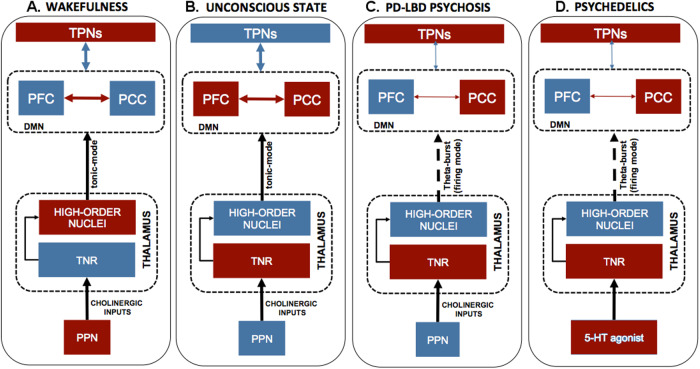
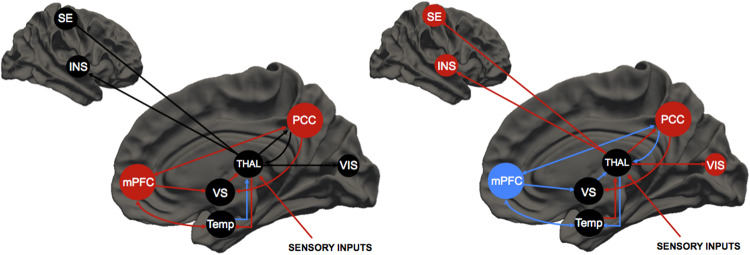
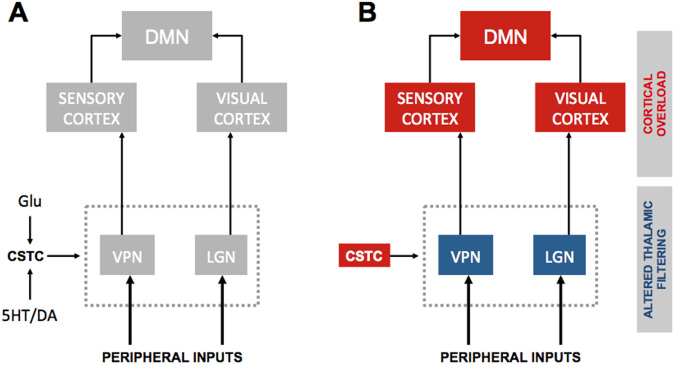
The PD-DLB psychosis complex found in Parkinson’s disease (PD) and Dementia with Lewy Bodies (DLB) includes hallucinations, Somatic Symptom/Functional Disorders, and delusions. These disorders exhibit similar presentation patterns and progression. Mechanisms at the root of these symptoms also share similarities with processes promoting altered states of consciousness found in Rapid Eye Movement sleep, psychiatric disorders, or the intake of psychedelic compounds. We propose that these mechanisms find a crucial driver and trigger in the dysregulated activity of high-order thalamic nuclei set in motion by ThalamoCortical Dysrhythmia (TCD). TCD generates the loss of finely tuned cortico-cortical modulations promoted by the thalamus and unleashes the aberrant activity of the Default Mode Network (DMN). TCD moves in parallel with altered thalamic filtering of external and internal information. The process produces an input overload to the cortex, thereby exacerbating DMN decoupling from task-positive networks. These phenomena alter the brain metastability, creating dreamlike, dissociative, or altered states of consciousness. In support of this hypothesis, mind-altering psychedelic drugs also modulate thalamic-cortical pathways. Understanding the pathophysiological background of these conditions provides a conceptual bridge between neurology and psychiatry, thereby helping to generate a promising and converging area of investigation and therapeutic efforts.
Overview
The claims and statistics of this paper haven’t been checked yet.
Run the check — free, no account needed. It reads the open-access text and checks the sources it cites.
Integrity signals
Registry
Cites
Statistics
Figures
Verification
Claims the paper makes
The claims and statistics of this paper haven’t been checked yet.
Run the check — free, no account needed. It reads the open-access text and checks the sources it cites.
Claims other papers make about this one
Each is checked against this paper’s own text: does it say what the citing paper says it does?
The cited source says what the claim attributes to it.
In the citing paper
“This decoupling could disrupt the comparison between priors and sensory percepts, leading to greater reliance on internally generated content.56”
From Deviations in effective connectivity explain different hallucination subtypes in Parkinson's disease psychosis (2026) · cites this paper as [56]
The cited source says what the claim attributes to it.
In the citing paper
“a recent proposal56 views the thalamus as a driver of unbalanced network recruitment, suggesting that it may induce decoupling between the default mode network and task-positive networks”
From Deviations in effective connectivity explain different hallucination subtypes in Parkinson's disease psychosis (2026) · cites this paper as [56]
Self-check
Percentages, sums and reported differences re-computed from the paper’s own numbers.
The self-check needs the paper’s full text.
Citations
Cites
Diagnostic and Statistical Manual of Mental Disorders
American Psychiatric Association (2013) · doi:10.1176/appi.books.9780890425596 · Cited by 116,369
Staging of brain pathology related to sporadic Parkinson’s disease
Braak, H., Tredici, K. D., Rüb, U., de Vos, R. A. I., Jansen Steur, E. N. H., & Braak, E. (2003) · Neurobiology of Aging · doi:10.1016/s0197-4580(02)00065-9 · Cited by 10,777
The Brain's Default Network: Anatomy, Function, and Relevance to Disease
Buckner, R. L., Andrews‐Hanna, J. R., & Schacter, D. L. (2008) · Annals of the New York Academy of Sciences · doi:10.1196/annals.1440.011 · Cited by 9,761
The human brain is intrinsically organized into dynamic, anticorrelated functional networks
Fox, M. D., Snyder, A. Z., Vincent, J. L., Corbetta, M., Van Essen, D. C., & Raichle, M. E. (2005) · Proceedings of the National Academy of Sciences · doi:10.1073/pnas.0504136102 · Cited by 8,553
The free-energy principle: a unified brain theory?
Friston, K. (2010) · Nature Reviews Neuroscience · doi:10.1038/nrn2787 · Cited by 8,120
Whatever next? Predictive brains, situated agents, and the future of cognitive science
Clark, A. (2013) · Behavioral and Brain Sciences · doi:10.1017/s0140525x12000477 · Cited by 5,924
Rao, R. P. N., & Ballard, D. H. (1999) · Nature Neuroscience · doi:10.1038/4580 · Cited by 5,483
Nalbandian, A., Sehgal, K., Gupta, A., Madhavan, M. V., McGroder, C., Stevens, J. S., Cook, J. R., Nordvig, A. S., Shalev, D., Sehrawat, T. S., et al. (2021) · Nature Medicine · doi:10.1038/s41591-021-01283-z · Cited by 4,862
Diagnosis and management of dementia with Lewy bodies: Fourth consensus report of the DLB Consortium
McKeith, I. G., Boeve, B. F., Dickson, D. W., Halliday, G., Taylor, J.-P., Weintraub, D., Aarsland, D., Galvin, J., Attems, J., Ballard, C. G., et al. (2017) · Neurology · doi:10.1212/wnl.0000000000004058 · Cited by 4,476
The brain's default mode network
Raichle, M. E. (2015) · Annual Review of Neuroscience · doi:10.1146/annurev-neuro-071013-014030 · Cited by 3,904
Research works printed but not linked: 6
- Freud S. The Ego and the Id. Hogarth Press, and the Institute of Psycho-analysis; London. 1927.
- Bergouignan M, Loiseau P. Encéphalite épidémique: maladie d’Economo-Cruchet. Encyclédie Med Sur Le Systéme Nerv. 1964;1964:1–12.
- Neville F, editor. Les complications et les sequelles mentales de l’encephalite epidemique. In: Proceedings of the Annales MedicoPsychologiques; Paris: Masson; 1941.
- Van Bogaert L. Hb Spez Path Anat. 2. Vol. 13. Berlin: Springer; 1958.
- De Gregorio D, Posa L, Ochoa-Sanchez R, McLaughlin R, Maione S, Comai S, et al. The hallucinogen d-lysergic diethylamide (LSD) decreases dopamine firing activity through 5-HT1A, D2 and TAAR1 receptors. Pharmacol Res. 2016;113:81–91. · DOI · Paper page
- Müller F, Lenz C, Dolder P, Lang U, Schmidt A, Liechti M, et al. Increased thalamic resting‐state connectivity as a core driver of LSD‐induced hallucinations. Acta Psychiatr Scandinavica. 2017;136:648–57. · DOI
Cited by
Sorted by citations
Le, G. H., Wong, S., Badulescu, S., Au, H., Di Vincenzo, J. D., Gill, H., Phan, L., Rhee, T. G., Ho, R., Teopiz, K. M., et al. (2024) · Journal of Affective Disorders · doi:10.1016/j.jad.2024.03.165 · Cited by 30
Vignando, M., Ffytche, D., Mazibuko, N., Palma, G., Bhat, A., Montagnese, M., Dave, S., Tai, Y. F., Batzu, L., Leta, V., et al. (2026) · Nature Mental Health · doi:10.1038/s44220-026-00669-7
“Previous research has shown that the thalamus plays a role in VH in PD 54,55 , and a recent proposal 56 views the thalamus as a driver of unbalanced network recruitment, suggesting that it may induce decoupling between the default mode network and task-positive networks.”
Metadata
- Authors
- Onofrj, M., Russo, M., Delli Pizzi, S., De Gregorio, D., Inserra, A., Gobbi, G., & Sensi, S. L.
- Affiliations
- University of Chieti-Pescara (IT)
- McGill University (CA)
- Corresponding author
- Onofrj, Marco
- Sensi, Stefano L.
- Venue
- Translational Psychiatry
- Published
- 2023-12-13
- Volume
- 13
- Issue
- 1
- Pages
- 384-384
- ISSN
- 2158-3188 (ISSN-L)
- PMC
- PMC10719401
- OpenAlex
- W4389684661
- Cited by
- 43
- References
- 233
- Citations by year
- 2026: 18 · 2025: 14 · 2024: 11
- FWCI
- 1.62
- Type
- journal article
- Language
- en
- Open access
- gold
- doi.org
- Locations
- Translational Psychiatry (publishedVersion, cc-by)
- PubMed Central (publishedVersion, cc-by)
- PubMed (publishedVersion)
- Archivio Istituzionale della Ricerca - Università Vita-Salute San Raffaele (submittedVersion, cc-by)
- DOAJ (DOAJ: Directory of Open Access Journals) (submittedVersion, cc-by-sa)
- Funders
- Alzheimer's Association (18PTC-19-602325, 18PTC-19-602325 and GEENA-Q-19-596282, GEENA-Q-19-596282, 602325)
- European Commission (HORIZON2020)
- Associazione Italiana Ricerca Alzheimer (18PTC-19-602325, GEENA-Q-19-596282)
- Topics
- Life Sciences › Neuroscience › Cognitive Neuroscience › Hallucinations in medical conditions
- Social Sciences › Psychology › Clinical Psychology › Psychedelics and Drug Studies
- Life Sciences › Neuroscience › Cognitive Neuroscience › Functional Brain Connectivity Studies
- Keywords
- thalamus, psychosis, Parkinson's disease, dementia with Lewy bodies, hallucinations, delusions, somatic symptom disorder, thalamocortical dysrhythmia, default mode network, altered states of consciousness, psychedelics, thalamocortical circuits, neurodegenerative diseases
- MeSH terms
- Hallucinogens, Humans, Parkinson Disease, Psychotic Disorders, Thalamus, Neurodegenerative Diseases, Lewy Body Disease
About these checks
Registry, retraction, Cites and statistics results are computed, not judged, with one exception: a printed reference that no index lists is read once by a model before it counts as a citation error. Claims are extracted by a model and kept only when their quote appears verbatim in the text; each cited source is then checked, with a model’s help, for whether it says what the claim relies on. Those verdicts can be wrong — read the claim’s quote and the cited source before relying on one.
Statistics and arithmetic are recomputed, not judged.
Confidence bands are shown only for fields calibrated on our annotated test set. None is calibrated yet, so no band is shown.
What counts as a claim ›How we measure confidence ›How we check this ›
Are you an author, or do you see a problem with this page? Request a review
