

From movement to motivation: a proposed framework to understand the antidepressant effect of exercise
Open accessThe DOI matches its Crossref record; 213 of the 213 references it cites were found in a registry or an index.
Abstract
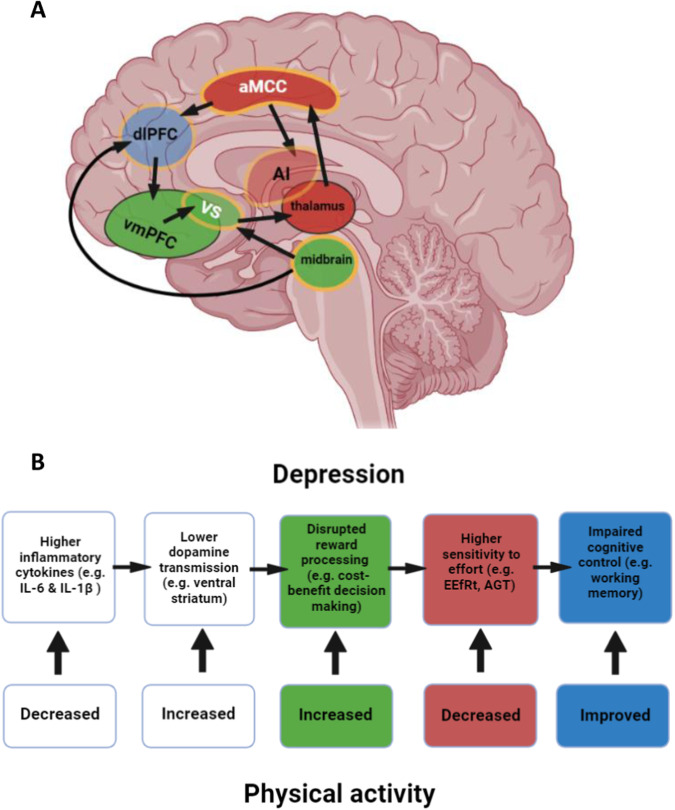
Depression is the leading cause of disability worldwide, exerting a profound negative impact on quality of life in those who experience it. Depression is associated with disruptions to several closely related neural and cognitive processes, including dopamine transmission, fronto-striatal brain activity and connectivity, reward processing and motivation. Physical activity, especially aerobic exercise, reduces depressive symptoms, but the mechanisms driving its antidepressant effects are poorly understood. Here we propose a novel hypothesis for understanding the antidepressant effects of exercise, centred on motivation, across different levels of explanation. There is robust evidence that aerobic exercise decreases systemic inflammation. Inflammation is known to reduce dopamine transmission, which in turn is strongly implicated in effort-based decision making for reward. Drawing on a broad range of research in humans and animals, we propose that by reducing inflammation and boosting dopamine transmission, with consequent effects on effort-based decision making for reward, exercise initially specifically improves ‘interest-activity’ symptoms of depression—namely anhedonia, fatigue and subjective cognitive impairment - by increasing propensity to exert effort. Extending this framework to the topic of cognitive control, we explain how cognitive impairment in depression may also be conceptualised through an effort-based decision-making framework, which may help to explain the impact of exercise on cognitive impairment. Understanding the mechanisms underlying the antidepressant effects of exercise could inform the development of novel intervention strategies, in particular personalised interventions and boost social prescribing.
Overview
The claims and statistics of this paper haven’t been checked yet.
Free: it reads the open-access text and checks the first 5 claims that cite a source we can check. Create a free account to check every claim.
Integrity signals
Registry
Cites
Statistics
Figures
Verification
Claims the paper makes
The claims and statistics of this paper haven’t been checked yet.
Free: it reads the open-access text and checks the first 5 claims that cite a source we can check. Create a free account to check every claim.
Claims other papers make about this one
Each is checked against this paper’s own text: does it say what the citing paper says it does?
In the citing paper
“The mechanism of the antidepressant effect of exercise is not precisely known, and is likely multi-factorial, with alterations in neurotransmitters, inflammatory cytokines, neuroendocrine pathways, dopamine processing, oxidative stress, neuroplasticity, reward processing, body image, self-efficacy, functional independence, and many other pathways likely operative [455]”
From Global consensus on optimal exercise recommendations for enhancing healthy longevity in older adults (ICFSR) (2025) · cites this paper as [455]
Self-check
Percentages, sums and reported differences re-computed from the paper’s own numbers.
The self-check needs the paper’s full text.
Citations
Cites
Items 201–213 of 213
Costello, H., Yamamori, Y., Reeves, S., Schrag, A. E., Howard, R. J., & Roiser, J. P. (2023) · Journal of Neurology Neurosurgery & Psychiatry · doi:10.1136/jnnp-2022-330790 · Cited by 34 · cited 3×
“In patients with Parkinson ’ s disease, anhedonia and apathy are negatively correlated with striatal dopamine transporter binding, especially as neurodegeneration progresses [11].”
BackgroundSelf-citationExploring the efficacy of psychotherapies for depression: a multiverse meta-analysis
Plessen, C. Y., Karyotaki, E., Miguel, C., Čihařová, M., & Cuijpers, P. J. (2023) · BMJ Mental Health · doi:10.1136/bmjment-2022-300626 · Cited by 31
Marchetti, I., Shumake, J., Grahek, I., & Koster, E. H. W. (2018) · Journal of Affective Disorders · doi:10.1016/j.jad.2018.04.064 · Cited by 28 · cited 1×
“Cognitive control is impaired in depression [77, 78] which may be in part due to changes in motivation - cognitive control is typically experienced as effortful [75] which could explain why people with depression avoid exerting cognitive control.”
BackgroundDotson, V. M., Gradone, A. M., Bogoian, H. R., Minto, L. R., Taiwo, Z., & Salling, Z. (2021) · Journal of the International Neuropsychological Society · doi:10.1017/s1355617721000710 · Cited by 23
Armbruster‐Genc, D., Valton, V., Neil, L., Vuong, V., Freeman, Z., Packer, K. C., Kiffin, M. J., Roiser, J. P., Viding, E. M., & McCrory, E. J. P. (2022) · Neuropsychopharmacology · doi:10.1038/s41386-022-01284-7 · Cited by 23
Self-citationThe effect of physical activity on anhedonia in individuals with depressive symptoms
Sun, C., Wang, Y., Fang, Y., He, Y., Wang, X., So, B. C. L., Shum, D., & Yan, C. (2021) · PsyCh Journal · doi:10.1002/pchj.485 · Cited by 20
Padin, A. C., Wilson, S. J., Bailey, B. E., Malarkey, W. B., Lustberg, M. B., Farrar, W. B., Povoski, S. P., Agnese, D. M., Reinbolt, R. E., Wesolowski, R., et al. (2019) · International Journal of Behavioral Medicine · doi:10.1007/s12529-019-09778-3 · Cited by 19 · cited 1×
“One challenge with using exercise as a treatment for depression may be that for many patients, their symptoms can make it more dif fi cult to engage with exercise, due to low motivation [161 – 163], fatigue [161, 162], or low mood [161, 162, 164, 165].”
BackgroundEffects of an acute bout of physical exercise on reward functioning in healthy adults
Wardle, M. C., Lopez-Gamundi, P., & LaVoy, E. C. P. (2018) · Physiology & Behavior · doi:10.1016/j.physbeh.2018.07.010 · Cited by 18 · cited 1×
“…session, healthy individuals who had been running for more years exhibited increased willingness to exert effort, with the opposite pattern in those who had been running for fewer years [192], suggesting that fi tness level interacts with the acute effect of physical exercise on effort sensitivity.”
BackgroundLakes, K. D. (2012) · PubMed · Cited by 17
Crum, J. E., II, Ronca, F., Herbert, G., Funk, S. G., Carmona-Cejudo, E., Hakim, U., Jones, I. L., Hamer, M., Hirsch, J., Hamilton, A. F. D. C., et al. (2022) · Frontiers in Neuroergonomics · doi:10.3389/fnrgo.2022.806485 · Cited by 17 · cited 1×
“Consistent with this hypothesis, acute exercise alters PFC function and this varies depending on the level of depressive symptoms [202].”
BackgroundSelf-citationMaron, E., Eller, T., Vasar, V., & Nutt, D. (2009) · The Journal of Clinical Psychiatry · doi:10.4088/jcp.08l04477 · Cited by 14
Long-term effects of vaccination on attentional performance
Nicoletti, R., Porro, C. A., Brighetti, G., Monti, D., Pagnoni, G., Guido, M., Rubichi, S., & Franceschi, C. (2004) · Vaccine · doi:10.1016/j.vaccine.2004.04.008 · Cited by 7 · cited 1×
“Further, chronic in fl ammation is thought to result in cognitive impairment and is associated with poorer cognitive control in depression [123 – 125].”
BackgroundApathy and Motivation: Biological Basis and Drug TreatmentPreprint
Costello, H., Masud Husain, B., & Roiser, J. P. (2023) · doi:10.31234/osf.io/m3vjy · Cited by 4
Self-citation
Research works printed but not linked: 2
- American Psychiatric Association. Multiaxial assessment.DSM-IV-TR: diagnostic and statistical manual of mental disorders. 2002 Washington, DC American Psychiatric Association
- Rock PL Roiser JP Riedel WJ Blackwell AD Cognitive impairment in depression: a systematic review and meta-analysis Psychol Med 2014 44 2029 40 10.1017/S0033291713002535 24168753 · DOI · Paper page
Cited by
Izquierdo, M., de Souto Barreto, P., Arai, H., Bischoff-Ferrari, H. A., Cadore, E. L., Cesari, M., Chen, L.-K., Coen, P. M., Courneya, K. S., Duque, G., et al. (2025) · The Journal of nutrition, health and aging · doi:10.1016/j.jnha.2024.100401 · Cited by 273
Immuno-metabolic depression: from concept to implementation
Penninx, B. W. J. H., Lamers, F., Jansen, R., Berk, M., Khandaker, G. M., Picker, L. D., & Milaneschi, Y. (2024) · The Lancet Regional Health - Europe · doi:10.1016/j.lanepe.2024.101166 · Cited by 171
“91 In the TREAD study investigating effects of an exercise intervention, higher TNF-a levels were associated with larger reductions in depressive symptoms.”
Gerber, M., Cheval, B., Cody, R., Colledge, F., Hohberg, V., Klimentidis, Y. C., Lang, C., Looser, V. N., Ludyga, S., Stults‐Kolehmainen, M., et al. (2025) · Physiological Reviews · doi:10.1152/physrev.00021.2024 · Cited by 73
Ye, M., Song, T., Xia, H., Hou, Y., & Chen, A. (2024) · International Journal of Nursing Studies · doi:10.1016/j.ijnurstu.2024.104912 · Cited by 54
From energy metabolism to mood regulation: The rise of lactate as a therapeutic target
Zhang, S., Xia, J., He, W., Zou, Y., Liu, W., Li, L., Huang, Z., Li, Q., Li, Q. X., & Liu, W. (2025) · Journal of Advanced Research · doi:10.1016/j.jare.2025.04.018 · Cited by 32
Metadata
- Authors
- Hird, E. J., Slanina-Davies, A., Lewis, G., Hamer, M., & Roiser, J. P.
- Affiliations
- University College London (GB)
- Corresponding author
- Hird, E. J.
- Venue
- Translational Psychiatry
- Published
- 2024-07-04
- Volume
- 14
- Issue
- 1
- Pages
- 273-273
- ISSN
- 2158-3188 (ISSN-L)
- PMC
- PMC11222551
- OpenAlex
- W4400307804
- Cited by
- 79
- References
- 213
- Citations by year
- 2026: 50 · 2025: 22 · 2024: 7
- FWCI
- 4.95
- Type
- journal article
- Language
- en
- Open access
- gold
- doi.org
- Licence
- cc-by
- creativecommons.org/licenses/by/4.0 (tdm)
- creativecommons.org/licenses/by/4.0 (vor)
- Locations
- Translational Psychiatry (publishedVersion, cc-by)
- PubMed Central (publishedVersion, cc-by)
- PubMed (publishedVersion)
- UCL Discovery (University College London) (submittedVersion, cc-by)
- DOAJ (DOAJ: Directory of Open Access Journals) (submittedVersion, cc-by-sa)
- PsyArXiv (OSF Preprints) (submittedVersion)
- PsyArXiv (OSF Preprints) (submittedVersion, public-domain)
- Funders
- Wellcome Trust (226777/Z/22/Z)
- Rosetrees Trust (PGL21/10005)
- UCLH Biomedical Research Centre
- Topics
- Health Sciences › Medicine › Pharmacology (medical) › Treatment of Major Depression
- Health Sciences › Medicine › Public Health, Environmental and Occupational Health › Physical Activity and Health
- Life Sciences › Neuroscience › Cellular and Molecular Neuroscience › Neurotransmitter Receptor Influence on Behavior
- Keywords
- physical activity, antidepressant effects, depression, motivation, effort-based decision making, reward processing, dopamine signaling, systemic inflammation, anhedonia, fatigue, cognitive impairment, cognitive control, frontostriatal connectivity, social prescribing, personalized interventions
- MeSH terms
- Animals, Decision Making, Depression, Depressive Disorder, Dopamine, Exercise Therapy, Humans, Inflammation, Motivation, Reward, Exercise, Cognitive Dysfunction
About these checks
Registry, retraction, Cites and statistics results are computed, not judged, with one exception: a printed reference that no index lists is read once by a model before it counts as a citation error. Claims are extracted by a model and kept only when their quote appears verbatim in the text; each cited source is then checked, with a model’s help, for whether it says what the claim relies on. Those verdicts can be wrong — read the claim’s quote and the cited source before relying on one.
Statistics and arithmetic are recomputed, not judged.
Confidence bands are shown only for fields calibrated on our annotated test set. None is calibrated yet, so no band is shown.
What counts as a claim ›How we measure confidence ›How we check this ›
Are you an author, or do you see a problem with this page? Request a review
Data sources
Bibliographic data: Semantic Scholar, OpenAlex, Crossref.
Contains information from the Semantic Scholar Academic Graph Datasets, made available under the ODC Attribution License (ODC-BY 1.0).
Semantic Scholar’s data is described in: Kinney, R., et al. (2023). The Semantic Scholar Open Data Platform. arXiv:2301.10140.
