

Detection of circulating tumour DNA is associated with inferior outcomes in Ewing sarcoma and osteosarcoma: a report from the Children’s Oncology Group
Open accessThe DOI matches its Crossref record; 38 of the 38 references it cites were found in a registry or an index.
Abstract
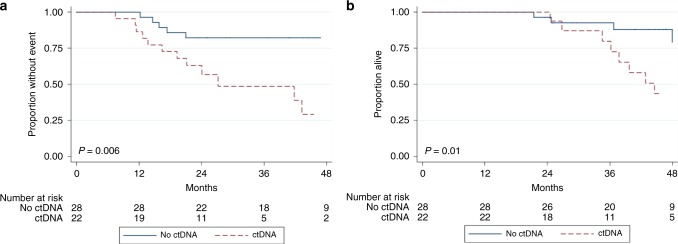
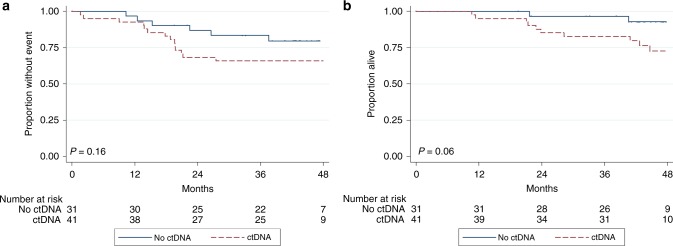
BACKGROUND: New prognostic markers are needed to identify patients with Ewing sarcoma (EWS) and osteosarcoma unlikely to benefit from standard therapy. We describe the incidence and association with outcome of circulating tumour DNA (ctDNA) using next-generation sequencing (NGS) assays. METHODS: A NGS hybrid capture assay and an ultra-low-pass whole-genome sequencing assay were used to detect ctDNA in banked plasma from patients with EWS and osteosarcoma, respectively. Patients were coded as positive or negative for ctDNA and tested for association with clinical features and outcome. RESULTS: The analytic cohort included 94 patients with EWS (82% from initial diagnosis) and 72 patients with primary localised osteosarcoma (100% from initial diagnosis). ctDNA was detectable in 53% and 57% of newly diagnosed patients with EWS and osteosarcoma, respectively. Among patients with newly diagnosed localised EWS, detectable ctDNA was associated with inferior 3-year event-free survival (48.6% vs. 82.1%; p = 0.006) and overall survival (79.8% vs. 92.6%; p = 0.01). In both EWS and osteosarcoma, risk of event and death increased with ctDNA levels. CONCLUSIONS: NGS assays agnostic of primary tumour sequencing results detect ctDNA in half of the plasma samples from patients with newly diagnosed EWS and osteosarcoma. Detectable ctDNA is associated with inferior outcomes.
Overview
The claims and statistics of this paper haven’t been checked yet.
Free: it reads the open-access text and checks the first 5 claims that cite a source we can check. Create a free account to check every claim.
Integrity signals
Registry
Cites
Statistics
Figures
Verification
Claims the paper makes
The claims and statistics of this paper haven’t been checked yet.
Free: it reads the open-access text and checks the first 5 claims that cite a source we can check. Create a free account to check every claim.
Claims other papers make about this one
Each is checked against this paper’s own text: does it say what the citing paper says it does?
The source backs part of the claim, not all of it — or backs it for a different population, condition or comparison.
In the citing paper
“Studies to date have demonstrated the prognostic impact of ctDNA in Ewing sarcoma (EWS), rhabdomyosarcoma, Wilms tumor (WT), and osteosarcoma (OS).14–18”
From Clinical Liquid Biopsy Testing for Detection of Actionable Genomic Alterations in Children and Young Adults With Advanced Solid Tumors on the GAIN Study (2026) · cites this paper as [14]
Experimental — accuracy not yet measuredThe source backs part of the claim, not all of it — or backs it for a different population, condition or comparison.
In the citing paper
“In contrast, broad plasma panels, CNA-based WGS, methylation-based assays, cfRNA approaches, and CTC-based strategies remain more exploratory or proof-of-concept in most sarcoma subtypes, particularly when applied to low-volume MRD or routine surveillance settings [ 25 , 26 , 27 , 28 , 29 , 30 , 31 , 32 , 33 , 34 , 35 , 36 , 37 , 38 , 39 ].”
From Signals Alongside Scans: A Genomics-Guided Framework for Liquid Biopsy in Bone and Soft-Tissue Sarcomas (2026) · cites this paper as [31]
Experimental — accuracy not yet measuredIn the citing paper
“In a Children’s Oncology Group cohort, ctDNA was detectable in more than half of newly diagnosed Ewing sarcoma and osteosarcoma cases, and detectable ctDNA was associated with inferior outcomes, particularly in localized Ewing sarcoma [ 31 ].”
From Signals Alongside Scans: A Genomics-Guided Framework for Liquid Biopsy in Bone and Soft-Tissue Sarcomas (2026) · cites this paper as [31]
In the citing paper
“At baseline, detectable ctDNA has been associated with adverse disease features in several sarcoma settings.”
From Signals Alongside Scans: A Genomics-Guided Framework for Liquid Biopsy in Bone and Soft-Tissue Sarcomas (2026) · cites this paper as [31]
Self-check
Percentages, sums and reported differences re-computed from the paper’s own numbers.
The self-check needs the paper’s full text.
Citations
Cites
Fast and accurate short read alignment with Burrows-Wheeler transform
Li, H., & Durbin, R. (2009) · Bioinformatics · doi:10.1093/bioinformatics/btp324 · Cited by 58,607
The Genome Analysis Toolkit: A MapReduce framework for analyzing next-generation DNA sequencing data
McKenna, A., Hanna, M., Banks, E., Sivachenko, A., Cibulskis, K., Kernytsky, A., Garimella, K., Altshuler, D., Gabriel, S., Daly, M., et al. (2010) · Genome Research · doi:10.1101/gr.107524.110 · Cited by 27,895
A framework for variation discovery and genotyping using next-generation DNA sequencing data
DePristo, M. A., Banks, E., Poplin, R., Garimella, K. V., Maguire, J. R., Hartl, C., Philippakis, A. A., del Angel, G., Rivas, M. A., Hanna, M., et al. (2011) · Nature Genetics · doi:10.1038/ng.806 · Cited by 11,456
Detection of Circulating Tumor DNA in Early- and Late-Stage Human Malignancies
Bettegowda, C., Sausen, M., Leary, R. J., Kinde, I., Wang, Y., Agrawal, N., Bartlett, B. R., Wang, H., Luber, B., Alani, R. M., et al. (2014) · Science Translational Medicine · doi:10.1126/scitranslmed.3007094 · Cited by 5,067
Liquid biopsies come of age: Towards implementation of circulating tumour DNA
Wan, J. C. M., Massie, C., Garcia-Corbacho, J., Mouliere, F., Brenton, J. D., Caldas, C., Pacey, S., Baird, R., & Rosenfeld, N. (2017) · Nature Reviews Cancer · doi:10.1038/nrc.2017.7 · Cited by 2,809
Bielack, S. S., Kempf-Bielack, B., Delling, G., Exner, G. U., Flege, S., Helmke, K., Kotz, R., Salzer-Kuntschik, M., Werner, M., Winkelmann, W., et al. (2002) · Journal of Clinical Oncology · doi:10.1200/jco.2002.20.3.776 · Cited by 2,393
Germline Mutations in Predisposition Genes in Pediatric Cancer
Zhang, J., Walsh, M. F., Wu, G., Edmonson, M. N., Gruber, T. A., Easton, J., Hedges, D., Ma, X., Zhou, X., Yergeau, D. A., et al. (2015) · New England Journal of Medicine · doi:10.1056/nejmoa1508054 · Cited by 1,345
Grier, H. E., Krailo, M. D., Tarbell, N. J., Link, M. P., Fryer, C. J. H., Pritchard, D. J., Gebhardt, M. C., Dickman, P. S., Perlman, E. J., Meyers, P. A., et al. (2003) · New England Journal of Medicine · doi:10.1056/nejmoa020890 · Cited by 1,328
Self-citationLink, M. P., Goorin, A. M., Miser, A. W., Green, A. A., Pratt, C. B., Belasco, J. B., Pritchard, J., Malpas, J. S., Baker, A. R., Kirkpatrick, J. A., et al. (1986) · New England Journal of Medicine · doi:10.1056/nejm198606193142502 · Cited by 1,204
Scalable whole-exome sequencing of cell-free DNA reveals high concordance with metastatic tumors
Adalsteinsson, V. A., Ha, G., Freeman, S. S., Choudhury, A. D., Stover, D. G., Parsons, H. A., Gydush, G., Reed, S. C., Rotem, D., Rhoades, J., et al. (2017) · Nature Communications · doi:10.1038/s41467-017-00965-y · Cited by 1,051 · cited 2×
“ULP-WGS analysis was performed using the Broad Institute’s ichorCNA algorithm, with manual curation of results to confirm tumour percentages.(27) Previous studies demonstrate that ULPWGS can be used to identify ctDNA in patients with copy numberaltered tumours.”
MethodSelf-citation
Cited by
Items 101–149 of 149
Early Cancer Detection: What's Going on and What's Next
Carlo, E. D. (2026) · MedComm · doi:10.1002/mco2.70653 · Cited by 2
“…Australia, and New Zealand, as well as sites in Europe and the Middle East [ 167 ], is exploring liquid biopsy applications using ctDNA for pediatric cancer monitoring and early detection, including in patients with newly diagnosed Ewing sarcoma, osteosarcoma [ 168 ], and Wilms tumor [ 169 ].”
Novel biomarkers in bone sarcomas — diagnosis, treatment selection, and clinical trials
Czarnecka, A. M., Błoński, P. J., Chmiel, P., & Rutkowski, P. L. (2025) · Oncology in Clinical Practice · doi:10.5603/ocp.99779 · Cited by 2
“These findings were in line with previous studies, demonstrating that the detection of ctDNA is associated with worse outcomes in patients with osteosarcoma and Ewing sarcoma [103].”
ResultPromise and Perils of Precision Oncology for Patients With Pediatric and Young Adult Sarcomas
Church, A. J., Wakefield, C. E., Hetherington, K., & Shern, J. F. (2024) · American Society of Clinical Oncology Educational Book · doi:10.1200/edbk_432794 · Cited by 3
Liquid Biopsy for Spinal Tumors: On the Frontiers of Clinical Application
Tan, S. K., Bettegowda, C., Yip, S., Sahgal, A., Rhines, L. D., Reynolds, J. J., Lazáry, Á., Laufer, I., Gasbarrini, A., Dea, N., et al. (2025) · Global Spine Journal · doi:10.1177/21925682231222012 · Cited by 3
“UsingaNGS hybrid capture assay and an ultra-low pass whole-genome sequencing (WGS) assay, Shulman et al 67 also showed that more than half (53”
Anderson, M. E., Wu, J. S., & Vargas, S. O. (2020) · Clinical Orthopaedics and Related Research · doi:10.1097/corr.0000000000001208 · Cited by 2
“mary tumor and perhaps even in circulating tumor cells [10].”
BackgroundFischer, S., Creytens, D., Gijsels, S., Descamps, B., Lapeire, L., Hendrix, A., Sys, G. M. L., & Wever, O. D. (2024) · STAR Protocols · doi:10.1016/j.xpro.2024.102863 · Cited by 2
“Potential other applications include investigating liquid biopsy biomarkers such as circulating tumor DNA 13 and tumor-derived extracellular vesicles 14 to determine the detection limit of MRD and to monitor metastatic relapse.”
BackgroundUpdate in Solid Tumors of Childhood
Shrivastava, N., & O'Neill, A. F. (2023) · Springer eBooks · doi:10.1007/978-3-031-41542-5_25 · Cited by 2
Schieffer, K. M., Bajaj, R., Koo, S. C., Lavoie, J., Lopez-Terrada, D. H., Lu, X., Luo, M., Phung, T. L., Smolarek, T. A., Sutcliffe, M. J., et al. (2025) · Cancer Genetics · doi:10.1016/j.cancergen.2025.10.106 · Cited by 1
Laurence, V., Jehanno, N., Dureau, S., Mous, L., Claude, L., Ballet, S., Pierron, G., Gaspar, N., Brahmi, M., Valentin, T., et al. (2025) · British Journal of Cancer · doi:10.1038/s41416-025-03263-3 · Cited by 4
“Detection of circulating tumour DNA (ctDNA) in blood has emerged as a promising diagnostic and prognostic biomarker in ES [21 – 23], although it has not yet been integrated into routine clinical practice.”
A Needle in a Haystack: The Precision of Liquid Biopsy in Finding Bone Tumors
Nohra, A., Awad, G., Khoury, J., & Boutros, M. (2026) · Anti-Cancer Agents in Medicinal Chemistry · doi:10.2174/0118715206402501251117070031 · Cited by 1
Understanding and Overcoming Osteosarcoma Heterogeneity
Cho, S., Shelmidine, K., & Yustein, J. T. (2026) · Biomolecules · doi:10.3390/biom16060874 · Cited by 1
“Multiple studies have shown that the presence of pretreatment ctDNA is associated with inferior survival, particularly in localized OS [153–155].”
Zaninović, L., Bašković, M., Bojanac, A. K., & Ježek, D. (2023) · Turkish Archives of Pediatrics · doi:10.5152/turkarchpediatr.2023.23014 · Cited by 1
Reason, E. H., Aiduk, M. D., Nash, A. L., McDuff, S. G. R., Renner, D., Kollipara, R. K., Satta, S., Velichko, S., Kalashnikova, E. V., Rodriguez, A. A., et al. (2025) · Annals of Surgical Oncology · doi:10.1245/s10434-025-17851-3 · Cited by 1
“45 The presence of ctDNA was also associated with worse 3-year relapse-free survival (RFS) and overall survival (OS).”
Primary bone sarcomas: what’s hot and what’s not
Tsoi, K. M., Samuel, A., Jeys, L. M., Ashford, R. U., & Gregory, J. (2019) · Bone and Joint 360 · doi:10.1302/2048-0105.85.360723 · Cited by 1
Krumbholz, M., Eiblwieser, J., Ranft, A., Zierk, J., Schmidkonz, C., Stütz, A. M., Peneder, P., Tomazou, E. M., Agaimy, A., Bäuerle, T., et al. (2023) · doi:10.1158/1078-0432.c.6530670.v1 · Cited by 1
Roberts, H. J., Comeau, H., Klega, K., DuBois, S. G., Lazo de la Vega, L., Ceca, E., Mullen, E. A., Smith, G. A., Tukachinsky, H., Huang, R. S. P., et al. (2026) · JCO Precision Oncology · doi:10.1200/po-25-01125
Self-citationAlabid, I., Yousef, A. J., Patni, M. M., Aloti, R. A., Qassim, Z. A.-A. M., Alothman-Agha, A. A., Hamdy, H. A., Noury, F. M., & Abdelfattah, M. T. (2026) · Cells · doi:10.3390/cells15141271
“Shulman et al. [31] ctDNA was detectable in 53% of newly diagnosed Ewing sarcoma and 57% of osteosarcoma cases.”
InfluentialMattei, J. C., & Poitout, D. G. (2021) · Springer eBooks · doi:10.1007/978-1-4471-7501-8_12
Circulating Tumor Cells and ctDNA in Sarcomas
Jubelin, C., Cochonneau, D., Moranton, E., Muñoz-García, J., & Heymann, D. (2022) · Springer eBooks · doi:10.1007/978-3-030-93084-4_12
Breaking Up Isn't Hard to Do: Isolating Cell-free DNA Fragments in Osteosarcoma
Weiser, D. A., Hayashi, M., & Applebaum, M. A. (2023) · Clinical Cancer Research · doi:10.1158/1078-0432.ccr-23-0390
Wang, J., Guo, W., Wang, X., Tang, X., Sun, X., & Ren, T. (2023) · doi:10.1158/1078-0432.c.6532946.v1
Madanat‐Harjuoja, L. M., Klega, K. S., Lü, Y., Shulman, D. S., Thorner, A. R., Nag, A., Tap, W. D., Reinke, D. K., Diller, L., Ballman, K. V., et al. (2023) · doi:10.1158/1078-0432.c.6532641.v1
Self-citationAnderson, P. M., Ghisoli, M. L., Crompton, B. D., Klega, K. S., Wexler, L. H., Slotkin, E. K., Stanbery, L., Manning, L., Wallraven, G., Manley, M., et al. (2023) · doi:10.1158/1078-0432.c.6533209.v1
Self-citationMadanat‐Harjuoja, L. M., Klega, K. S., Lü, Y., Shulman, D. S., Thorner, A. R., Nag, A., Tap, W. D., Reinke, D. K., Diller, L., Ballman, K. V., et al. (2023) · doi:10.1158/1078-0432.c.6532641
Self-citationLeenanitikul, J. (2022) · Chula Digiverse · doi:10.58837/chula.the.2022.19
“ULP-WGS has been used to quantify tumor fractions (22-27) and estimate copy number alterations (28-31), etc.”
BackgroundMethodHan, J. E., & Cho, H. J. (2024) · Clinical and Molecular Hepatology · doi:10.3350/cmh.2024.0141
Navid, F., & Biegel, J. A. (2024) · Translational Pediatrics · doi:10.21037/tp-24-7 · Cited by 1
Richardson, S. A., Gulati, G., Harker, P. J. B., Redfern, A., Pearce, S. P., Karimpour, M., Hill, S. M., Makeev, V. J., Brennan, B., Lee, A. T., et al. (2025) · doi:10.1101/2025.04.25.25325254
“Although cfDNA was analysed for four different modalities in our study, there are additional modalities such as single nucleotide variants (SNVs) and fusion events 9–13 that could further improve a multi-modal liquid biopsy for EwS; for example, detection of STAG2 mutations may be prognostic 35 .”
Emergence of Liquid Biopsies in Pediatric Eye Cancers
Sirivolu, S., Xu, L., & Berry, J. L. (2025) · Springer eBooks · doi:10.1007/978-3-031-84655-7_7
Anderson, C. J., Hsu, J. H., Jagosky, M. H., Patt, J. C., Kneisl, J. S., & Steuerwald, N. (2025) · Clinical Orthopaedics and Related Research · doi:10.1097/corr.0000000000003633
Research Progress on MAZ in Malignant Tumors
Zhang, Y., Qin, Y., Gao, F., Shen, H., Hou, S., Zhang, M., Wu, H., & Mo, L. (2025) · Journal of Biosciences and Medicines · doi:10.4236/jbm.2025.1312021
Yang, H., Xiao, X., Zeng, L., Zeng, H., Zheng, Y., Wang, J., Li, G., Dai, W., He, Y., Wang, S., et al. (2024) · Figshare · doi:10.6084/m9.figshare.25139606
Neczypor, E. W., Reisert, H. D., Moore, K., Zeldin, E., Dubin, R., Battle, L., He, C., Hayashi, M., Weiser, D. A., & Applebaum, M. A. (2026) · npj Precision Oncology · doi:10.1038/s41698-026-01326-z
“This is consistent with prior studies, which have shown higher percentages of the ctDNA fraction at diagnosis in neuroblastoma (60%, range 3 – 99%, 100% detection) 28 compared to osteosarcoma (11%, range 5 – 58%, 57% detection) 15 .”
Liquid Biopsy in Pediatric Sarcoma
Abbou, S. D. (2022) · theses.fr (ABES) · doi:10.70675/6783aff3z3096z462czad38z46ccfca84203
Zhou, C., Li, J. J., Wang, Y., Cai, Z., Xu, Q., Wang, W., Wang, J., & Tang, X. (2026) · Materials & Design · doi:10.1016/j.matdes.2026.115992
Biomarkers for Diagnosis, Risk Stratification, and Immunotherapy of Pediatric Solid Tumors
Kościelniak, E., Janeway, K., & Gottschalk, S. M. (2026) · American Society of Clinical Oncology Educational Book · doi:10.1200/edbk-26-519040
Self-citationSurgical Management of Metastatic Pediatric Solid Tumors
Shaffiey, S. A., & Lautz, T. B. (2026) · Surgical Oncology Clinics of North America · doi:10.1016/j.soc.2026.05.005
Goodsell, K. E., Carter, J. A., Abrams, H. R., Mogal, H., Loggers, E. T., & Sharib, J. M. (2026) · Journal of Surgical Oncology · doi:10.1002/jso.70326
“For example, a sarcoma‐focused NGS assay identified ctDNA in more than half of patients and found that the detection of ctDNA at diagnosis was associated with worse 3‐year event free survival ( n = 94 patients with Ewing sarcoma) [147].”
Research on Pediatric Oncology
Metts, J. L., Raikar, S. S., Patel, K., Armstrong, A. E., & Dhir, A. (2026) · Springer eBooks · doi:10.1007/978-3-032-19175-5_26
Sarcoma metastasis: distinct biological principles beyond the carcinoma paradigm
Chevalier, N., Nathan, P. C., & Stamenkovic, I. (2026) · Cancer and Metastasis Reviews · doi:10.1007/s10555-026-10360-z
“Shulman et al. showed that detectable ctDNA in newly diagnosed Ewing sarcoma patients is associated with metastatic disease and poor outcome [93].”
Ultra-low-pass whole-genome sequencing of bile cfDNA in patients with biliary strictures
Rojo, C., Rullan, M., Sogbe, M., Herranz, J. M., Elizalde, M., Oyón, D., Vila, J. J., Purroy, A., Azkona, M., Marchese, F. P., et al. (2026) · eGastroenterology · doi:10.1136/egastro-2026-100425
“32 33–37 Moreover, pairing ULP-WGS with an open-source workflow such as ichorCNA—which estimates tumour fraction (TF) in addition to arm-level CNAs 26 —ensures transparency and reproducibility across centres.”
Molecular events underlying sarcoma development and progression: the diagnostic relevance
Wiśniewska, A., Sobczuk, P., & Rutkowski, P. (2026) · Expert Review of Molecular Diagnostics · doi:10.1080/14737159.2026.2733191
“The effectiveness and accuracy of this approach remain somewhat variable, with detection rates ranging from less than 10% for SS18:SSX1/2 in synovial sarcoma [101] to around 50% [102] or even over 80% [103] for EWSR1 translocations.”
Shulman, D. S., Klega, K. S., Chen, N., Buxton, A., Gohn, E., Sexton, S., Clinton, C., Tanhaemami, M., Cibulskis, C., Choy, E., et al. (2026) · Journal of Clinical Oncology · doi:10.1200/jco-26-00285
Self-citationHuang, G., Zhou, Y., Wang, H., & Xiucai, M. (2026) · Journal of bone oncology · doi:10.1016/j.jbo.2026.100803 · Cited by 2
“In osteosarcoma, early feasibility studies demonstrated detection of tumor-specific plasma alterations, while larger pediatric or osteosarcoma-containing cohorts linked ctDNA detectability or burden with tumor burden, response dynamics or inferior outcomes [21,24,32 – 35].”
Shishido, S. N., Chaudhary, S., Ward, I., Plascencia-Laija, C., Zdanowicz, A., Yellapantula, V., Mason, J. M., Hicks, J. B., Navid, F., & Kühn, P. (2026) · Cancers · doi:10.3390/cancers18193123
Li, Q. (2026) · Frontiers in Medicine · doi:10.3389/fmed.2026.1987146
“Exosomal PD-L1 and N-cadherin have been associated with pulmonary metastatic progression (34), while detectable circulating tumor DNA has correlated with inferior outcomes in osteosarcoma cohorts (35).”
Messina, D., Motassime, A. E., Maccauro, G., Santoro, A., Brancaccio, V., Oliva, M. S., Ziranu, A., & Vitiello, R. (2026) · Applied Sciences · doi:10.3390/app162010309
Metadata
- Authors
- Shulman, D. S., Klega, K., Imamovic-Tuco, A., Clapp, A., Nag, A., Thorner, A. R., Van Allen, E., Ha, G., Lessnick, S. L., Gorlick, R., Janeway, K. A., Leavey, P. J., Mascarenhas, L., London, W. B., Vo, K. T., Stegmaier, K., Hall, D., Krailo, M. D., Barkauskas, D. A., DuBois, S. G., & Crompton, B. D.
- Affiliations
- Harvard University (US)
- Dana-Farber Cancer Institute (US)
- Broad Institute (US)
- Nationwide Children's Hospital (US)
- The University of Texas MD Anderson Cancer Center (US)
- The University of Texas Southwestern Medical Center (US)
- University of Southern California (US)
- University of California, San Francisco (US)
- Children's Oncology Group (US)
- Corresponding author
- Crompton, Brian D.
- ORCID
- Venue
- British Journal of Cancer
- Published
- 2018-08
- Volume
- 119
- Issue
- 5
- Pages
- 615-621
- ISSN
- 0007-0920 (ISSN-L)
- 1532-1827
- PMC
- PMC6162271
- OpenAlex
- W2888384864
- Cited by
- 149
- References
- 38
- Citations by year
- 2026: 21 · 2025: 20 · 2024: 26 · 2023: 25 · 2022: 17 · 2021: 14 · 2020: 14 · 2019: 11 · 2018: 1
- FWCI
- 7.53
- Type
- journal article
- Language
- en
- Update notices
- correction (2019-03-18)
- Open access
- hybrid
- doi.org
- Licence
- cc-by
- creativecommons.org/licenses/by/4.0 (tdm)
- Locations
- British Journal of Cancer (publishedVersion, cc-by)
- Europe PMC (PubMed Central) (publishedVersion, cc-by)
- PubMed Central (publishedVersion, cc-by)
- PubMed (publishedVersion)
- eScholarship (California Digital Library) (submittedVersion)
- eScholarship (California Digital Library) (submittedVersion, cc-by)
- Funders
- Dr. Ha has a patent pending related to genomic technologies that is not directly related to this work.
- Dr. Stephen Lessnick holds patents relevant to the diagnosis of Ewing sarcoma
- Topics
- Health Sciences › Medicine › Oncology › Sarcoma Diagnosis and Treatment
- Life Sciences › Biochemistry, Genetics and Molecular Biology › Cancer Research › Cancer Genomics and Diagnostics
- Health Sciences › Medicine › Hematology › Acute Lymphoblastic Leukemia research
- Keywords
- circulating tumor DNA, Ewing sarcoma, osteosarcoma, prognostic factors, liquid biopsy, event-free survival, overall survival, pediatric bone tumors, hybrid capture sequencing
- MeSH terms
- Circulating Tumor DNA, Adolescent, Bone Neoplasms, Child, Child, Preschool, Female, Humans, Male, Prognosis, Retrospective Studies, Sarcoma, Ewing, Osteosarcoma, Biomarkers, Tumor, Cohort Studies, Survival Analysis, Sequence Analysis, DNA, High-Throughput Nucleotide Sequencing
About these checks
Registry, retraction, Cites and statistics results are computed, not judged, with one exception: a printed reference that no index lists is read once by a model before it counts as a citation error. Claims are extracted by a model and kept only when their quote appears verbatim in the text; each cited source is then checked, with a model’s help, for whether it says what the claim relies on. Those verdicts can be wrong — read the claim’s quote and the cited source before relying on one.
Statistics and arithmetic are recomputed, not judged.
Confidence bands are shown only for fields calibrated on our annotated test set. None is calibrated yet, so no band is shown.
What counts as a claim ›How we measure confidence ›How we check this ›
Are you an author, or do you see a problem with this page? Request a review
Data sources
Bibliographic data: Semantic Scholar, OpenAlex, Crossref.
Contains information from the Semantic Scholar Academic Graph Datasets, made available under the ODC Attribution License (ODC-BY 1.0).
Semantic Scholar’s data is described in: Kinney, R., et al. (2023). The Semantic Scholar Open Data Platform. arXiv:2301.10140.
