

Mkk4 and Mkk7 are important for retinal development and axonal injury-induced retinal ganglion cell death
Open accessPublished version of a preprint
The DOI matches its Crossref record; 82 of the 82 references it cites were found in a registry or an index.
Abstract
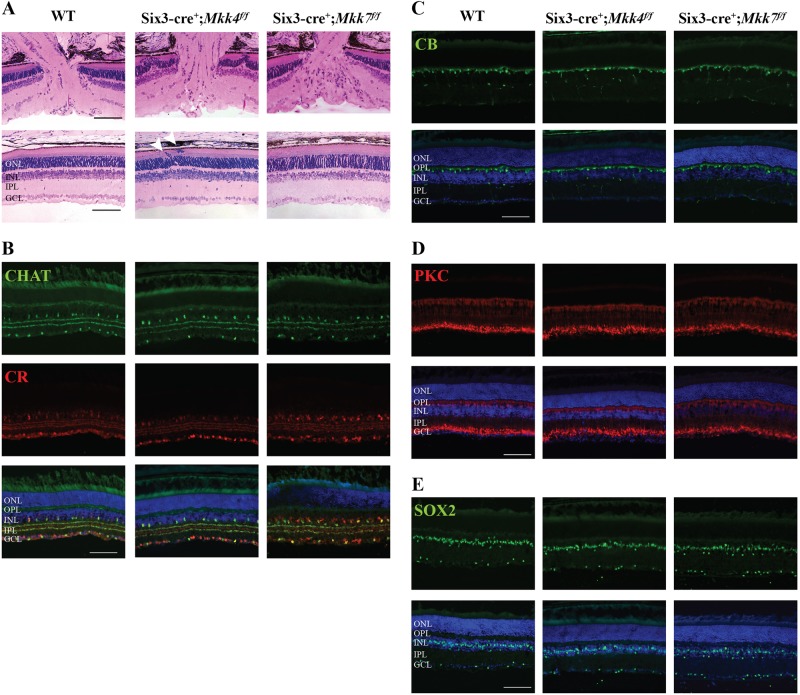
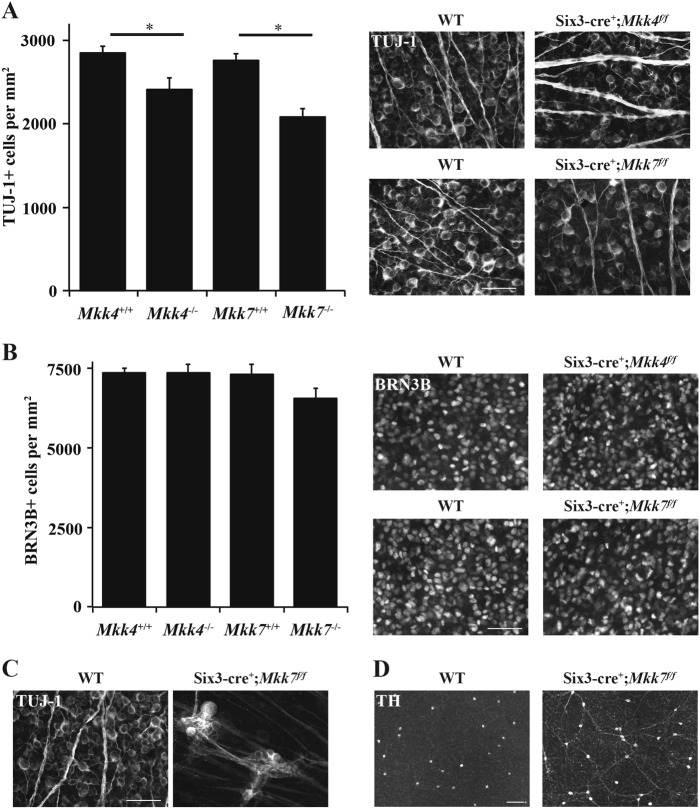
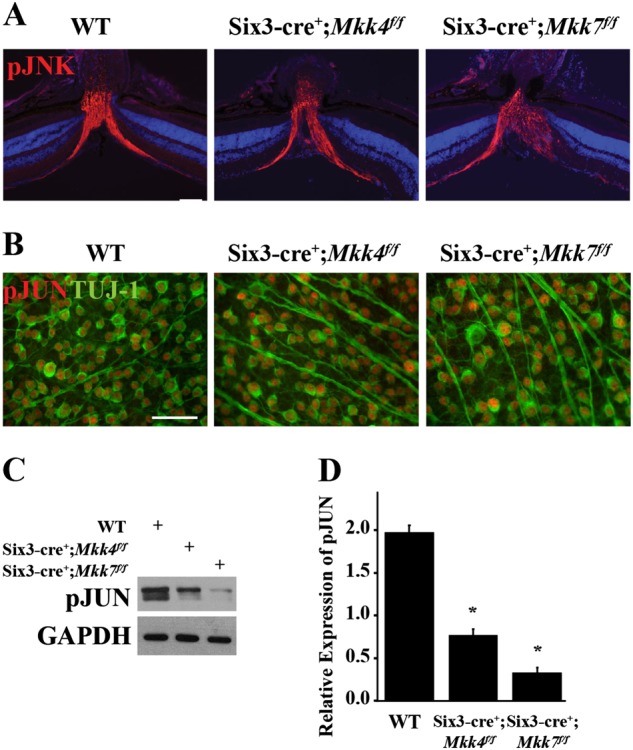
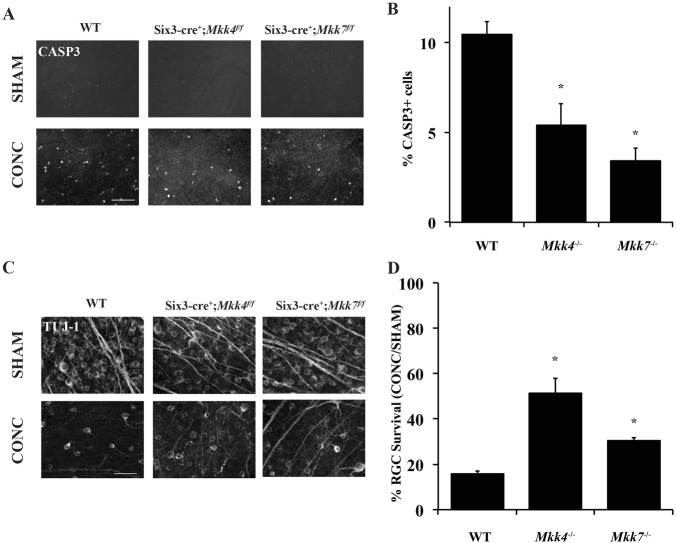
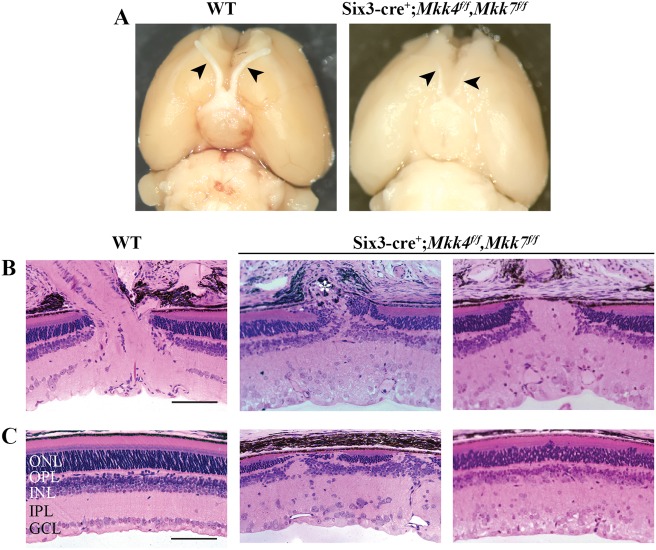
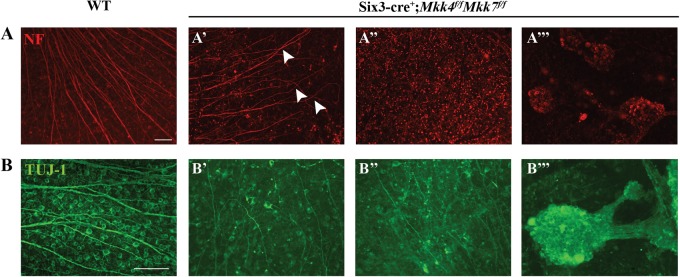
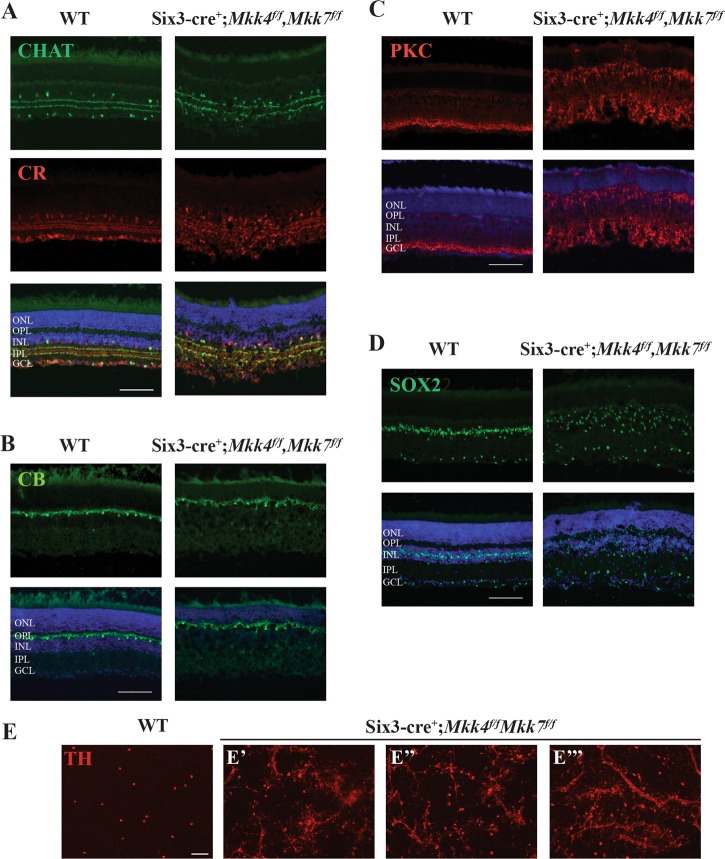
The mitogen-activated protein kinase (MAPK) pathway has been shown to be involved in both neurodevelopment and neurodegeneration. c-Jun N-terminal kinase (JNK), a MAPK important in retinal development and after optic nerve crush injury, is regulated by two upstream kinases: MKK4 and MKK7. The specific requirements of MKK4 and MKK7 in retinal development and retinal ganglion cell (RGC) death after axonal injury, however, are currently undefined. Optic nerve injury is an important insult in many neurologic conditions including traumatic, ischemic, inflammatory, and glaucomatous optic neuropathies. Mice deficient in Mkk4 , Mkk7 , and both Mkk4 and Mkk7 were generated. Immunohistochemistry was used to study the distribution and structure of retinal cell types and to assess RGC survival after optic nerve injury (mechanical controlled optic nerve crush (CONC)). Adult Mkk4 - and Mkk7- deficient retinas had all retinal cell types, and with the exception of small areas of disrupted photoreceptor lamination in Mkk4 -deficient mice, the retinas of both mutants were grossly normal. Deficiency of Mkk4 or Mkk7 reduced JNK signaling in RGCs after axonal injury and resulted in a significantly greater percentage of surviving RGCs 35 days after CONC as compared to wild-type controls ( Mkk4 : 51.5%, Mkk7: 29.1%, WT: 15.2%; p < 0.001). Combined deficiency of Mkk4 and Mkk7 caused failure of optic nerve formation, irregular retinal axonal trajectories, disruption of retinal lamination, clumping of RGC bodies, and dendritic fasciculation of dopaminergic amacrine cells. These results suggest that MKK4 and MKK7 may serve redundant and unique roles in molecular signaling important for retinal development and injury response following axonal insult.
Overview
The claims and statistics of this paper haven’t been checked yet.
Free: it reads the open-access text and checks the first 5 claims that cite a source we can check. Create a free account to check every claim.
Integrity signals
Registry
Cites
Statistics
Figures
Verification
Claims the paper makes
The claims and statistics of this paper haven’t been checked yet.
Free: it reads the open-access text and checks the first 5 claims that cite a source we can check. Create a free account to check every claim.
Claims other papers make about this one
Each is checked against this paper’s own text: does it say what the citing paper says it does?
The source backs part of the claim, not all of it — or backs it for a different population, condition or comparison.
In the citing paper
“Regarding the JNK activation pathway, the upstream kinases MKK4 and MKK7 have redundant and unique roles in molecular signaling that are important for retinal development, RGC maturation and the response to axonal injury signaling [ 24 ].”
From MAPK Pathways in Ocular Pathophysiology: Potential Therapeutic Drugs and Challenges (2023) · cites this paper as [24]
Experimental — accuracy not yet measured
Self-check
Percentages, sums and reported differences re-computed from the paper’s own numbers.
The self-check needs the paper’s full text.
Citations
Cites
Mammalian MAP kinase signalling cascades
Chang, L., & Karin, M. (2001) · Nature · doi:10.1038/35065000 · Cited by 5,111
Signal transduction by the JNK group of MAP kinases
Davis, R. J. (2000) · Cell · doi:10.1016/s0092-8674(00)00116-1 · Cited by 4,237
Pathological roles of MAPK signaling pathways in human diseases
Kim, E. K., & Choi, E.-J. (2010) · Biochimica et Biophysica Acta (BBA) - Molecular Basis of Disease · doi:10.1016/j.bbadis.2009.12.009 · Cited by 2,472
Dhanasekaran, D. N., & Reddy, E. P. (2008) · Oncogene · doi:10.1038/onc.2008.301 · Cited by 1,525
Cell differentiation in the retina of the mouse
Young, R. W. (1985) · The Anatomical Record · doi:10.1002/ar.1092120215 · Cited by 1,071
Wang, X., & Ron, D. (1996) · Science · doi:10.1126/science.272.5266.1347 · Cited by 883
Immunocytochemical analysis of the mouse retina
Haverkamp, S., & W�ssle, H. (2000) · The Journal of Comparative Neurology · doi:10.1002/1096-9861(20000814)424:1<1::aid-cne1>3.0.co;2-v · Cited by 710
Hansen, M., Hsu, A.-L., Dillin, A., & Kenyon, C. (2005) · PLoS Genetics · doi:10.1371/journal.pgen.0010017 · Cited by 541
Targeting dual-specificity phosphatases: Manipulating MAP kinase signalling and immune responses
Jeffrey, K. L., Camps, M., Rommel, C., & Mackay, C. R. (2007) · Nature Reviews Drug Discovery · doi:10.1038/nrd2289 · Cited by 533
Cell death during differentiation of the retina in the mouse
Young, R. W. (1984) · Journal of Comparative Neurology · doi:10.1002/cne.902290307 · Cited by 530
Cited by
Zhang, H., Shao, Y., Yao, Z., Liu, L., Zhang, H., Yin, J., Xie, H., Li, K., Lai, P., Zeng, H., et al. (2022) · Annals of the Rheumatic Diseases · doi:10.1136/annrheumdis-2021-221513 · Cited by 190
Axon injury signaling and compartmentalized injury response in glaucoma
Syc‐Mazurek, S. B., & Libby, R. T. (2019) · Progress in Retinal and Eye Research · doi:10.1016/j.preteyeres.2019.07.002 · Cited by 99
Self-citationMAPK Pathways in Ocular Pathophysiology: Potential Therapeutic Drugs and Challenges
Moustardas, P., Aberdam, D., & Lagali, N. (2023) · Cells · doi:10.3390/cells12040617 · Cited by 63
Park, J. G., Aziz, N., & Cho, J. Y. (2019) · Therapeutic Advances in Medical Oncology · doi:10.1177/1758835919875574 · Cited by 60
Remyelination protects neurons from DLK-mediated neurodegeneration
Duncan, G. J., Ingram, S. D., Emberley, K., Hill, J. Q., Cordano, C., Abdelhak, A., McCane, M., Jenks, J. E., Jabassini, N., Ananth, K., et al. (2024) · Nature Communications · doi:10.1038/s41467-024-53429-5 · Cited by 49
“We propose that effective remyelination of the axon improves neuronal survival by suppressing DLK-mediated signaling.”
Endothelin 1-induced retinal ganglion cell death is largely mediated by JUN activation
Marola, O. J., Syc‐Mazurek, S. B., Howell, G. R., & Libby, R. T. (2020) · Cell Death and Disease · doi:10.1038/s41419-020-02990-0 · Cited by 32
Self-citationMarola, O. J., Syc‐Mazurek, S. B., & Libby, R. T. (2019) · Cell Death Discovery · doi:10.1038/s41420-019-0220-4 · Cited by 30
Self-citationZhao, S., Xu, J., Zhang, W., Yan, W., & Li, G. (2021) · The Science of The Total Environment · doi:10.1016/j.scitotenv.2021.148437 · Cited by 29
Shi, P., Zhang, Z., Xu, J., Zhang, L., & Cui, H. (2021) · International Journal of Oncology · doi:10.3892/ijo.2021.5240 · Cited by 30
MKK4 Inhibitors—Recent Development Status and Therapeutic Potential
Katzengruber, L., Sander, P., & Laufer, S. (2023) · International Journal of Molecular Sciences · doi:10.3390/ijms24087495 · Cited by 26
Jones, J. H., Xin, Z., Himmelbauer, M. K., Dechantsreiter, M. A., Enyedy, I. J., Hedde, J. R., Fang, T., Coomaraswamy, J., King, K. W., Murugan, P., et al. (2021) · Journal of Medicinal Chemistry · doi:10.1021/acs.jmedchem.1c01458 · Cited by 20
Maes, M. E., Donahue, R., Schlamp, C. L., Marola, O. J., Libby, R. T., & Nickells, R. W. (2023) · Molecular Neurodegeneration · doi:10.1186/s13024-023-00659-8 · Cited by 19
“C57BL/6 J mice carrying dual floxed alleles of Mkk4 and Mkk7 were developed as previously reported [38].”
BackgroundMethodInfluentialSelf-citationA broad perspective on the molecular regulation of retinal ganglion cell degeneration in glaucoma
Tezel, G. (2020) · Progress in brain research · doi:10.1016/bs.pbr.2020.05.027 · Cited by 23
Pareek, A., Kumar, D., Pareek, A., Gupta, M. M., Jeandet, P., Ratan, Y., Jain, V., Kamal, M. A., Saboor, M., Ashraf, G. M., et al. (2024) · Heliyon · doi:10.1016/j.heliyon.2024.e32844 · Cited by 25
“As a result, it elicits cellular differentiation, proliferation, retinal development, maintaining cellular homeostasis, inflammatory cascades and even programmed cell death [42].”
Mitogen-activated protein kinase kinase 7 in inflammatory, cancer, and neurological diseases
Caliz, A. D., Vertii, A., Fisch, V., Yoon, S., Yoo, H., Keaney, J. F., & Kant, S. (2022) · Frontiers in Cell and Developmental Biology · doi:10.3389/fcell.2022.979673 · Cited by 16
Immunological and molecular basics of the primary open angle glaucoma pathomechanism
Samelska, K., Zaleska-Żmijewska, A., Bałan, B. J., Grąbczewski, A., Szaflik, J. P., Kubiak, A. J., & Skopiński, P. (2021) · Central European Journal of Immunology · doi:10.5114/ceji.2021.104328 · Cited by 18
“However, the deficiency of both Mkk4 and Mkk7 at the same time resulted in inappropriate RGC development [65].”
BackgroundPharmacological inhibition of the MAP2K7 kinase in human disease
Lacorazza, H. D. (2024) · Frontiers in Oncology · doi:10.3389/fonc.2024.1486756 · Cited by 12
Worenine Prevents Solar Ultraviolet–Induced Sunburn by Inhibiting JNK2
Xiao, J., Lü, H., Ma, T., Ni, X., Chang, T., Liu, M., Li, N., Lu, P., Ke, C., Qin, T., et al. (2022) · Frontiers in Pharmacology · doi:10.3389/fphar.2022.881042 · Cited by 12
Huang, Z., Huang, C., Ji, X., Zhou, W., Luo, X.-F., Liu, Q., Tang, Y., Gong, F., & Zhu, W. (2021) · World Journal of Stem Cells · doi:10.4252/wjsc.v13.i11.1797 · Cited by 10
Seese, S. E., Muheisen, S., Gath, N. N., Gross, J. M., & Semina, E. V. (2022) · Developmental Dynamics · doi:10.1002/dvdy.560 · Cited by 5
The evolution of JNK inhibition: A review on modern targeting strategies
Li, J., Cao, L., Yang, Y., Gao, Y., Li, B., Shao, N., Ran, Z., & Luo, L. (2026) · European Journal of Medicinal Chemistry · doi:10.1016/j.ejmech.2026.118787 · Cited by 3
TAK1 inhibition increases proliferation and differentiation of chick retinal cells
Carrillo, C., Ravi, V., Tiwari, S., Chernoff, E. A. G., & Belecky‐Adams, T. L. (2022) · Frontiers in Cell and Developmental Biology · doi:10.3389/fcell.2022.698233 · Cited by 4
Marola, O. J., Syc‐Mazurek, S. B., Yablonski, S. E. R., Shrager, P. G., John, S. W. M., & Libby, R. T. (2025) · Cell Death Discovery · doi:10.1038/s41420-025-02842-w · Cited by 3
“Individually, Mkk4 or Mkk7 deletion afforded signi fi cant but incomplete protection to RGC somas after CONC (42% and 17% protection, respectively) [39].”
InfluentialSelf-citationHuang, Z., Huang, C., Ji, X., Zhou, W., Luo, X.-F., Liu, Q., Tang, Y., Gong, F., & Zhu, W. (2021) · World Journal of Stem Cells · doi:10.4252/wjsc.v13.i11.1798
Huang, Z., Huang, C., Ji, X., Zhou, W., Luo, X.-F., Liu, Q., Tang, Y., Gong, F., & Zhu, W. (2021) · World Journal of Stem Cells · doi:10.4252/wjsc.v13.i11.1800 · Cited by 2
Liu, P., Liu, Y., Cheng, L., Bao, T., Li, J., Wu, J., Han, J., Li, T., & Zhang, D. (2026) · Journal of Enzyme Inhibition and Medicinal Chemistry · doi:10.1080/14756366.2026.2612805
“MKK4 exhibits approximately 50% sequence homology with its well-characterised homolog, MKK7 31 .”
Yablonski, S. E. R., Bishop, A., Lydon, S. D., Zhu, I., Wang, N., Marola, O. J., & Libby, R. T. (2026) · Experimental Eye Research · doi:10.1016/j.exer.2026.110929
Self-citationMitogen-activated protein kinase signaling and drug-induced liver injury: A molecular connection
Ezhilarasan, D., & Sharmila, M. (2026) · Hepatobiliary & pancreatic diseases international · doi:10.1016/j.hbpd.2026.08.009
Metadata
- Authors
- Syc-Mazurek, S. B., Rausch, R. L., Fernandes, K. A., Wilson, M. P., & Libby, R. T.
- Affiliations
- University of Rochester Medicine (US)
- Corresponding author
- Libby, Richard T.
- Venue
- Cell Death & Disease
- Published
- 2018-10-26
- Volume
- 9
- Issue
- 11
- Pages
- 1095-1095
- ISSN
- 2041-4889 (ISSN-L)
- PMC
- PMC6203745
- OpenAlex
- W2949576632
- Cited by
- 29
- References
- 82
- Citations by year
- 2026: 4 · 2025: 1 · 2024: 3 · 2023: 3 · 2022: 5 · 2021: 8 · 2020: 2 · 2019: 3
- FWCI
- 3.27
- Type
- journal article
- Language
- en
- Update notices
- correction (2019-01-25)
- Open access
- gold
- doi.org
- Licence
- cc-by
- creativecommons.org/licenses/by/4.0 (tdm)
- creativecommons.org/licenses/by/4.0 (vor)
- Locations
- Cell Death and Disease (publishedVersion, cc-by)
- bioRxiv (Cold Spring Harbor Laboratory) (acceptedVersion)
- Europe PMC (PubMed Central) (publishedVersion, other-oa)
- PubMed Central (publishedVersion, cc-by)
- PubMed (publishedVersion)
- DOAJ (DOAJ: Directory of Open Access Journals) (submittedVersion)
- Funders
- U.S. Department of Health & Human Services | NIH | National Eye Institute (EY018606, EY026301, EY007125)
- Research to Prevent Blindness (Unrestricted)
- Topics
- Health Sciences › Medicine › Ophthalmology › Glaucoma and retinal disorders
- Health Sciences › Medicine › Ophthalmology › Retinal Development and Disorders
- Life Sciences › Neuroscience › Cellular and Molecular Neuroscience › Nerve injury and regeneration
- Keywords
- MKK4, MKK7, c-Jun N-terminal kinase, MAPK signaling, retinal development, retinal ganglion cell death, optic nerve crush, axonal injury, retinal lamination, photoreceptors, dopaminergic amacrine cells, neurodegeneration, knockout mice
- MeSH terms
- Axon Fasciculation, Animals, Cell Survival, Mice, Inbred C57BL, Mice, Mutant Strains, Nerve Crush, Optic Nerve, Retina, Retinal Ganglion Cells, Signal Transduction, Proto-Oncogene Proteins c-jun, Cell Death, Optic Nerve Injuries, Amacrine Cells, MAP Kinase Kinase 4, MAP Kinase Kinase 7, Mice
About these checks
Registry, retraction, Cites and statistics results are computed, not judged, with one exception: a printed reference that no index lists is read once by a model before it counts as a citation error. Claims are extracted by a model and kept only when their quote appears verbatim in the text; each cited source is then checked, with a model’s help, for whether it says what the claim relies on. Those verdicts can be wrong — read the claim’s quote and the cited source before relying on one.
Statistics and arithmetic are recomputed, not judged.
Confidence bands are shown only for fields calibrated on our annotated test set. None is calibrated yet, so no band is shown.
What counts as a claim ›How we measure confidence ›How we check this ›
Are you an author, or do you see a problem with this page? Request a review
Data sources
Bibliographic data: Semantic Scholar, OpenAlex, Crossref.
Contains information from the Semantic Scholar Academic Graph Datasets, made available under the ODC Attribution License (ODC-BY 1.0).
Semantic Scholar’s data is described in: Kinney, R., et al. (2023). The Semantic Scholar Open Data Platform. arXiv:2301.10140.
