

The DOI matches its Crossref record; 33 of the 33 references it cites were found in a registry or an index.
A chemical approach for global protein knockdown from mice to non-human primates
Open accessAbstract
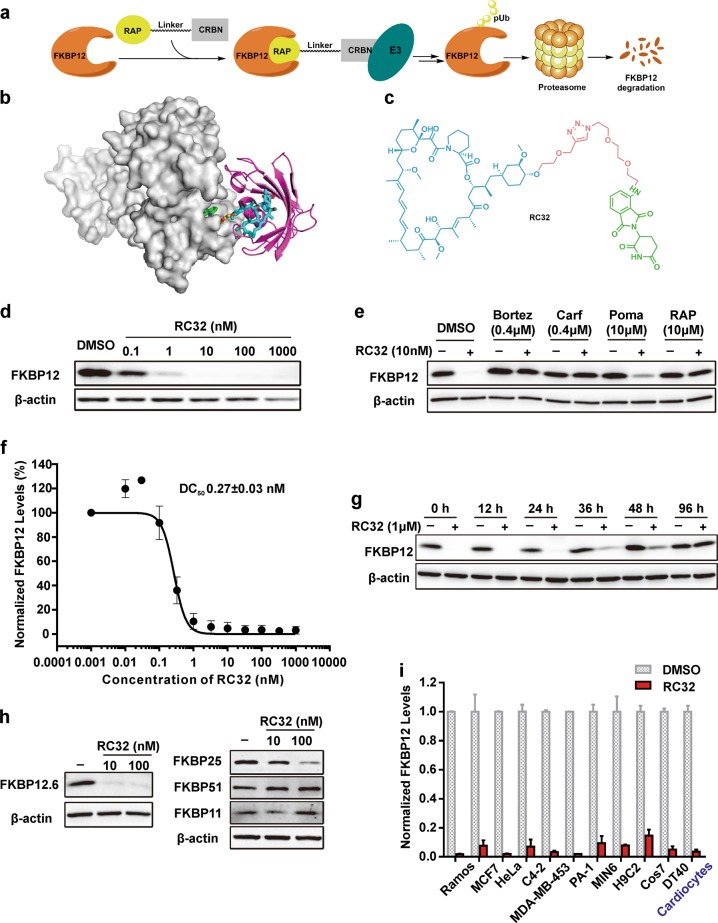
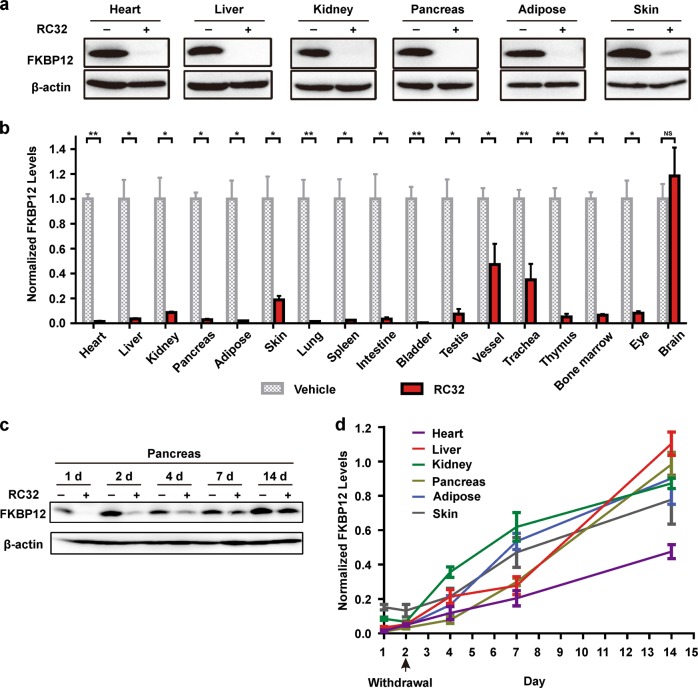
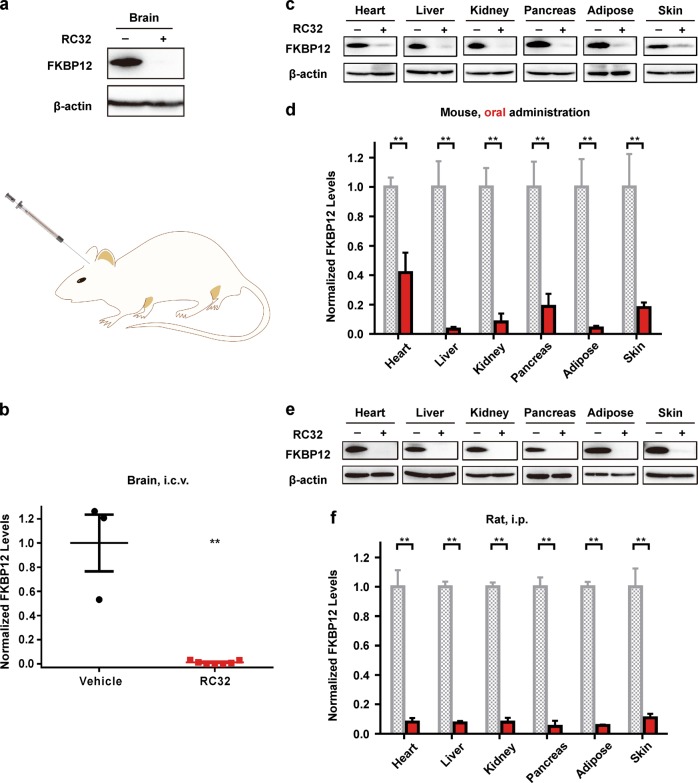
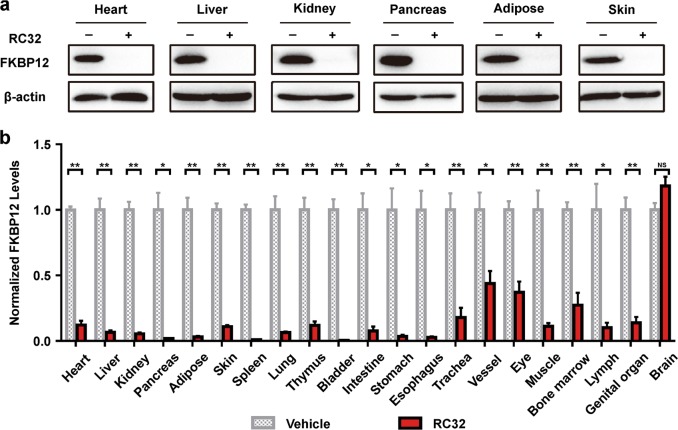
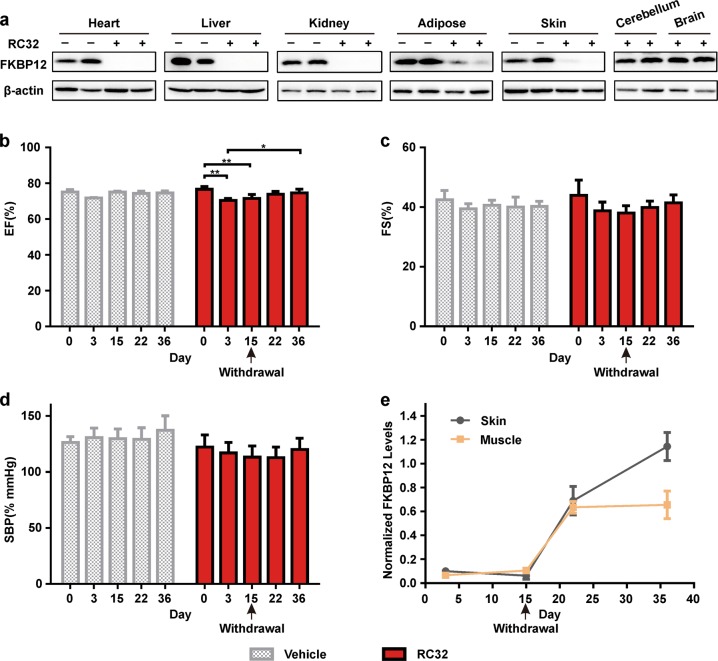
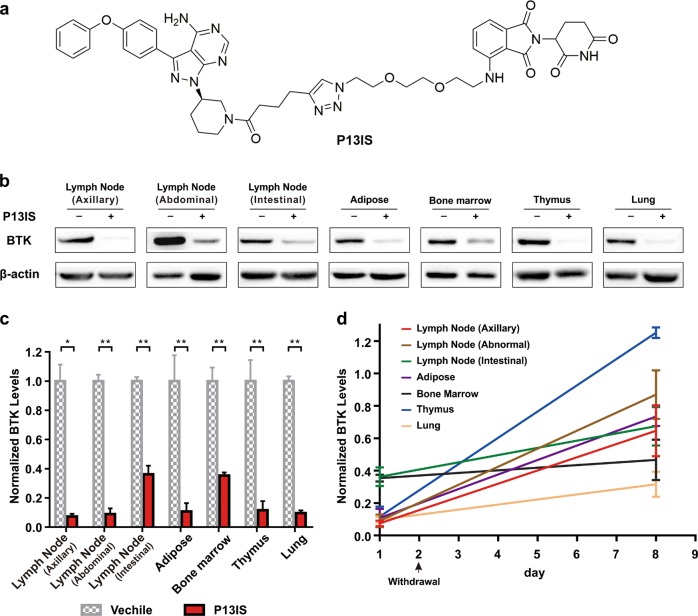
Although conventional genetic modification approaches for protein knockdown work very successfully due to the increasing use of CRISPR/Cas9, effective techniques for achieving protein depletion in adult animals, especially in large animals such as non-human primates, are lacking. Here, we report a chemical approach based on PROTACs technology that efficiently and quickly knocks down FKBP12 (12-kDa FK506-binding) protein globally in vivo. Both intraperitoneal and oral administration led to rapid, robust, and reversible FKBP12 degradation in mice. The efficiency and practicality of this method were successfully demonstrated in both large and small animals (mice, rats, Bama pigs, and rhesus monkeys). Furthermore, we showed this approach can also be applied to effectively knockdown other target proteins such as Bruton's tyrosine kinase (BTK). This chemical protein knockdown strategy provides a powerful research tool for gene function studies in animals, particularly in large animals, for which gene-targeted knockout strategies may remain unfeasible.
Overview
The claims and statistics of this paper haven’t been checked yet.
Run the check — free, no account needed. It reads the open-access text and checks the sources it cites.
Integrity signals
Registry
Cites
Statistics
Figures
Verification
Claims the paper makes
The claims and statistics of this paper haven’t been checked yet.
Run the check — free, no account needed. It reads the open-access text and checks the sources it cites.
Claims other papers make about this one
Each is checked against this paper’s own text: does it say what the citing paper says it does?
In the citing paper
“Preclinical and clinical studies have demonstrated multiple routes of administration, including oral 18 .”
From Targeted protein degradation: expanding the toolbox (2019) · cites this paper as [18]
Self-check
Percentages, sums and reported differences re-computed from the paper’s own numbers.
The self-check needs the paper’s full text.
Citations
Cites
Genome engineering using the CRISPR-Cas9 system
Ran, F. A., Hsu, P. D., Wright, J., Agarwala, V., Scott, D. A., & Zhang, F. (2013) · Nature Protocols · doi:10.1038/nprot.2013.143 · Cited by 11,133
Duplexes of 21-nucleotide RNAs mediate RNA interference in cultured mammalian cells
Elbashir, S. M., Harborth, J., Lendeckel, W., Yalcin, A., Weber, K., & Tuschl, T. (2001) · Nature · doi:10.1038/35078107 · Cited by 9,456
The new frontier of genome engineering with CRISPR-Cas9
Doudna, J. A., & Charpentier, E. (2014) · Science · doi:10.1126/science.1258096 · Cited by 7,062
Phthalimide conjugation as a strategy for in vivo target protein degradation
Winter, G. E., Buckley, D. L., Paulk, J., Roberts, J. M., Souza, A., Dhe-Paganon, S., & Bradner, J. E. (2015) · Science · doi:10.1126/science.aab1433 · Cited by 1,760
Vézina, C., KUDELSKI, A., & Sehgal, S. N. (1975) · The Journal of Antibiotics · doi:10.7164/antibiotics.28.721 · Cited by 1,691
Catalytic in vivo protein knockdown by small-molecule PROTACs
Bondeson, D. P., Mares, A., Smith, I. E. D., Ko, E., Campos, S., Miah, A. H., Mulholland, K. E., Routly, N., Buckley, D. L., Gustafson, J. L., et al. (2015) · Nature Chemical Biology · doi:10.1038/nchembio.1858 · Cited by 1,356
The dTAG system for immediate and target-specific protein degradation
Nabet, B., Roberts, J. M., Buckley, D. L., Paulk, J., Dastjerdi, S., Yang, A., Leggett, A. L., Erb, M. A., Lawlor, M. A., Souza, A., et al. (2018) · Nature Chemical Biology · doi:10.1038/s41589-018-0021-8 · Cited by 1,118
Niu, Y., Shen, B., Cui, Y., Chen, Y., Wang, J., Wang, L., Kang, Y., Zhao, X., Si, W., Li, W., et al. (2014) · Cell · doi:10.1016/j.cell.2014.01.027 · Cited by 1,033
Self-citationGenetic compensation: A phenomenon in search of mechanisms
El-Brolosy, M. A., & Stainier, D. Y. R. (2017) · PLOS Genetics · doi:10.1371/journal.pgen.1006780 · Cited by 829
Wehrens, X. H. T., Lehnart, S. E., Huang, F., Vest, J. A., Reiken, S. R., Mohler, P. J., Sun, J., Guatimosim, S., Song, L., Rosemblit, N., et al. (2003) · Cell · doi:10.1016/s0092-8674(03)00434-3 · Cited by 760
Cited by
Sorted by citations
Items 101–121 of 121
Mechanisms underlying dilated cardiomyopathy associated with FKBP12 deficiency
Hanna, A. D., Chang, T., Ho, K. S., Yee, R. S. Z., Walker, W. A., Agha, N. H., Hsu, C., Jung, S. Y., Dickinson, M. E., Samee, M. A. H., et al. (2024) · The Journal of General Physiology · doi:10.1085/jgp.202413583 · Cited by 3
Protein degradation induced by PROTAC molecules as an emerging drug discovery strategy
Koravović, M., Marković, B. D., Kovačević, M., Rmandić, M., & Tasić, G. (2022) · Journal of the Serbian Chemical Society · doi:10.2298/jsc211209027k · Cited by 2
Targeted Protein Degradation by Proteolysis Targeting Chimeras
Du, W. (2022) · Wiley eBooks · doi:10.1002/9781119627784.ch11 · Cited by 2
Targeted Protein Degradation Chemical Probes
Galdeano, C., & Barril, X. (2020) · Royal Society of Chemistry eBooks · doi:10.1039/9781839160745-00150 · Cited by 1
Advanced Targeting Systems for Tissue-Specific Drug Delivery
Nastasi, C. (2024) · Interdisciplinary cancer research · doi:10.1007/16833_2024_292 · Cited by 2
Degradation of Disease Related Proteins in Living Cells by Small Molecules
Ishikawa, M., & Hashimoto, Y. (2020) · Journal of Synthetic Organic Chemistry Japan · doi:10.5059/yukigoseikyokaishi.78.402
Makrozyklische FKBP51‐Liganden enthüllen einen transienten Bindungsmodus mit erhöhter Selektivität
Voll, A. M., Meyners, C., Taubert, M. C., Bajaj, T., Heymann, T., Merz, S., Charalampidou, A., Kolos, J., Purder, P. L., Geiger, T. M., et al. (2021) · Angewandte Chemie · doi:10.1002/ange.202017352
Time-dependent effect of FKBP12 loss in the development of dilated cardiomyopathy
Chan, J. A., & Munro, M. L. (2024) · The Journal of General Physiology · doi:10.1085/jgp.202413673
Targeted Protein Degradation of Metalloenzymes
O’Herin, C., & Cohen, S. M. (2025) · Wiley eBooks · doi:10.1002/0471266949.bmc303
Harnessing the power of traditional Chinese medicine for targeted protein degradation
Wu, Z., Zhu, B., Shou, Y., & Guo, H. (2025) · Elsevier eBooks · doi:10.1016/b978-0-443-21816-3.00011-7
Yang, L., Duan, H., Mao, X., Li, B., Che, J., & Dong, X. (2025) · Elsevier eBooks · doi:10.1016/b978-0-443-21816-3.00004-x
Wang, J., Liao, Q., Chen, G., Chang, Y., Nie, H., Lu, J., & Ye, R. D. (2026) · Acta Pharmaceutica Sinica B · doi:10.1016/j.apsb.2026.03.019
Self-citationLiu, Y. Y., Bi, Y., Wang, J., Yuan, Q., Rao, Y., Wang, F., Wang, S., & Ji, G. (2026) · Frontiers in Physiology · doi:10.3389/fphys.2026.1787427
Self-citationTay, B. Q., Soltau, C. P., Adams, M. N., Bottle, S. E., & Richard, D. J. (2026) · Biochemical Pharmacology · doi:10.1016/j.bcp.2026.118042
Guo, H., Savard, A., Manser, C., Dutta, K., Taylor, J. A., Rousseaux, M. W. C., Pozzi, S., Julien, J., Baird, S. D., & Gibbings, D. (2026) · Nature Biomedical Engineering · doi:10.1038/s41551-026-01774-9
Jalalypour, F., & Mercado, R. (2026) · bioRxiv (Cold Spring Harbor Laboratory) · doi:10.64898/2026.10.05.756765
BindingDB Entry 50019232: Development of Human Carbonic Anhydrase II Heterobifunctional Degraders.
BindingDB (2024) · UC San Diego · doi:10.7270/q2gx4gxp
BindingDB Entry 50018659: Developments of CRBN-based PROTACs as potential therapeutic agents.
BindingDB (2024) · UC San Diego · doi:10.7270/q27948wc
BindingDB (2024) · UC San Diego · doi:10.7270/q2x352pq
BindingDB Entry 50019409: PROTACs Targeting MLKL Protect Cells from Necroptosis.
BindingDB (2024) · UC San Diego · doi:10.7270/q2154ndd
Metadata
- Authors
- Sun, X., Wang, J., Yao, X., Zheng, W., Mao, Y., Lan, T., Wang, L., Sun, Y., Zhang, X., Zhao, Q., Zhao, J., Xiao, R.-P., Zhang, X., Ji, G., & Rao, Y.
- Affiliations
- Center for Life Sciences (CN)
- Chinese Academy of Sciences (CN)
- Tsinghua University (CN)
- Peking University (CN)
- Corresponding author
- Zhang, Xinyi
- Zhang, Xiuqin
- Ji, Guangju
- Rao, Yu
- ORCID
- Venue
- Cell Discovery
- Published
- 2019-02-05
- Volume
- 5
- Issue
- 1
- Pages
- 10-10
- ISSN
- 2056-5968 (ISSN-L)
- PMC
- PMC6361926
- OpenAlex
- W2914693193
- Cited by
- 118
- References
- 33
- Citations by year
- 2026: 8 · 2025: 13 · 2024: 12 · 2023: 11 · 2022: 12 · 2021: 21 · 2020: 30 · 2019: 11
- FWCI
- 6.12
- Type
- journal article
- Language
- en
- Open access
- gold
- doi.org
- Locations
- Cell Discovery (publishedVersion, cc-by)
- Europe PMC (PubMed Central) (publishedVersion, other-oa)
- PubMed Central (publishedVersion, cc-by)
- PubMed (publishedVersion)
- DOAJ (DOAJ: Directory of Open Access Journals) (submittedVersion)
- Funders
- National Natural Science Foundation of China (81573327)
- Topics
- Life Sciences › Biochemistry, Genetics and Molecular Biology › Molecular Biology › Protein Degradation and Inhibitors
- Physical Sciences › Chemistry › Organic Chemistry › Chemical Synthesis and Analysis
- Life Sciences › Biochemistry, Genetics and Molecular Biology › Molecular Biology › CRISPR and Genetic Engineering
- Keywords
- PROTACs, Bruton's tyrosine kinase, non-human primates, rhesus monkeys, Bama pig, oral administration, intraperitoneal administration, large animal model, gene function analysis
About these checks
Registry, retraction, Cites and statistics results are computed, not judged, with one exception: a printed reference that no index lists is read once by a model before it counts as a citation error. Claims are extracted by a model and kept only when their quote appears verbatim in the text; each cited source is then checked, with a model’s help, for whether it says what the claim relies on. Those verdicts can be wrong — read the claim’s quote and the cited source before relying on one.
Statistics and arithmetic are recomputed, not judged.
Confidence bands are shown only for fields calibrated on our annotated test set. None is calibrated yet, so no band is shown.
What counts as a claim ›How we measure confidence ›How we check this ›
Are you an author, or do you see a problem with this page? Request a review
