

The DOI matches its Crossref record; 51 of the 51 references it cites were found in a registry or an index.
Establishment of intestinal organoid cultures modeling injury-associated epithelial regeneration
Open accessAbstract
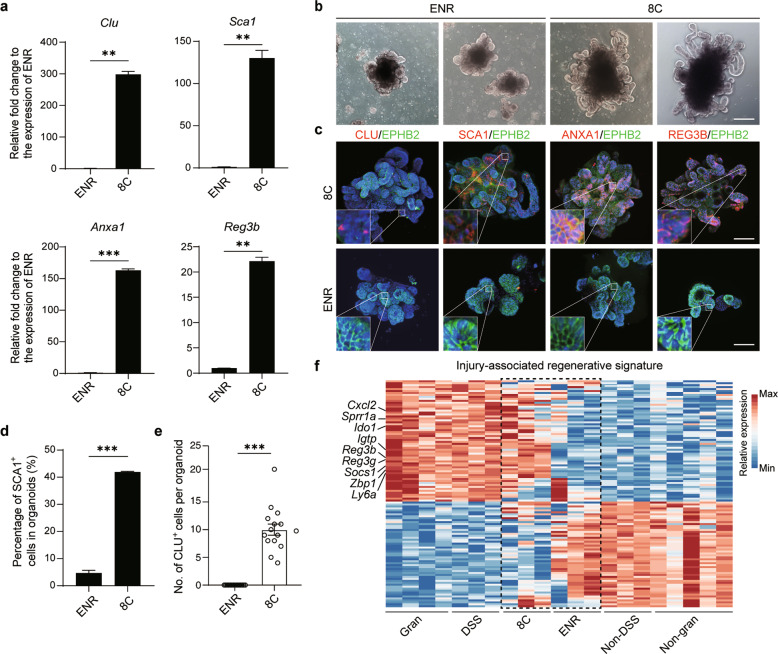
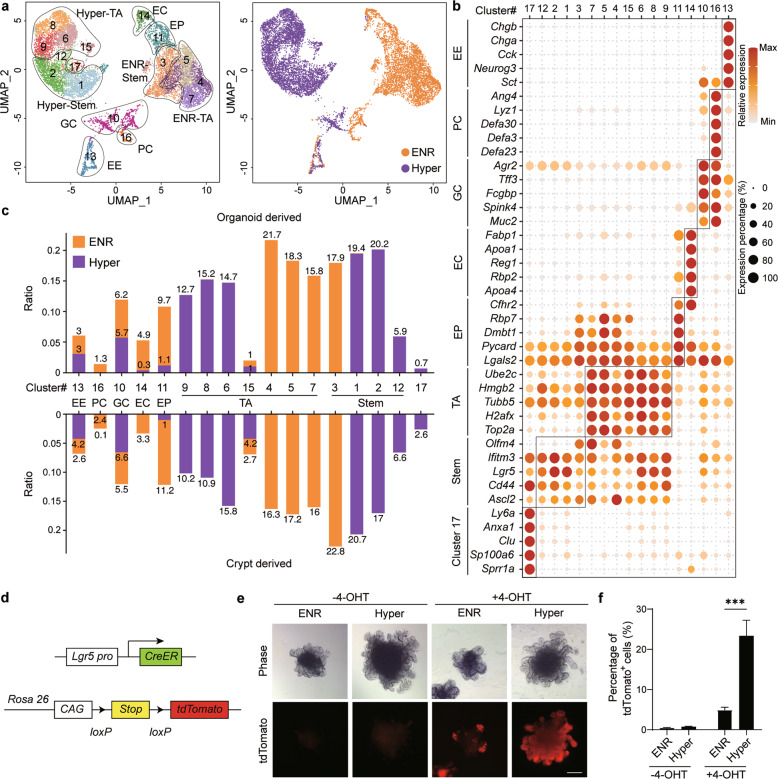
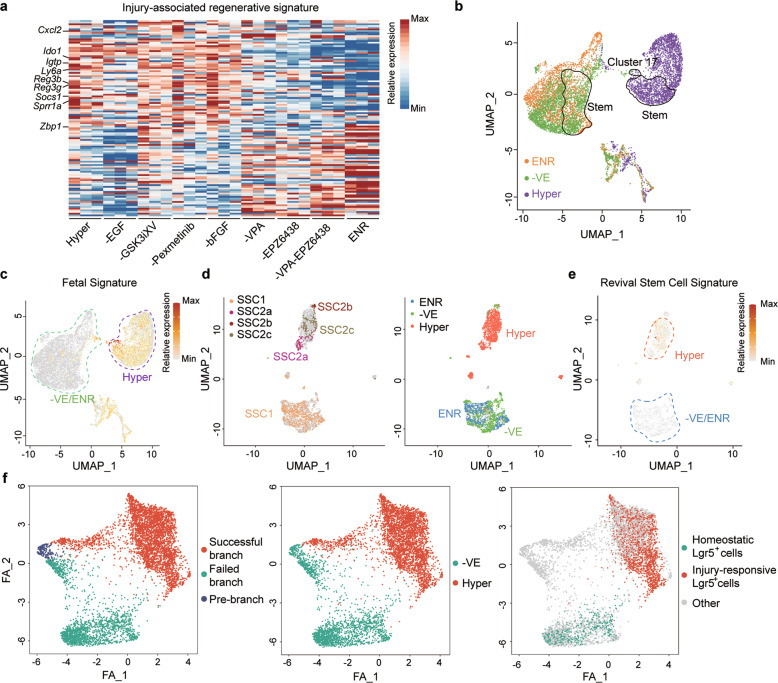
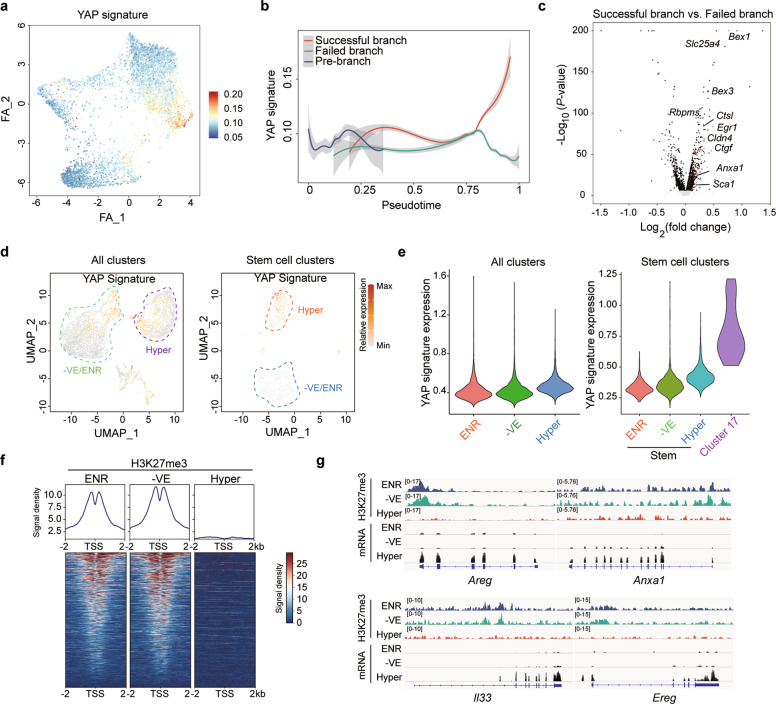
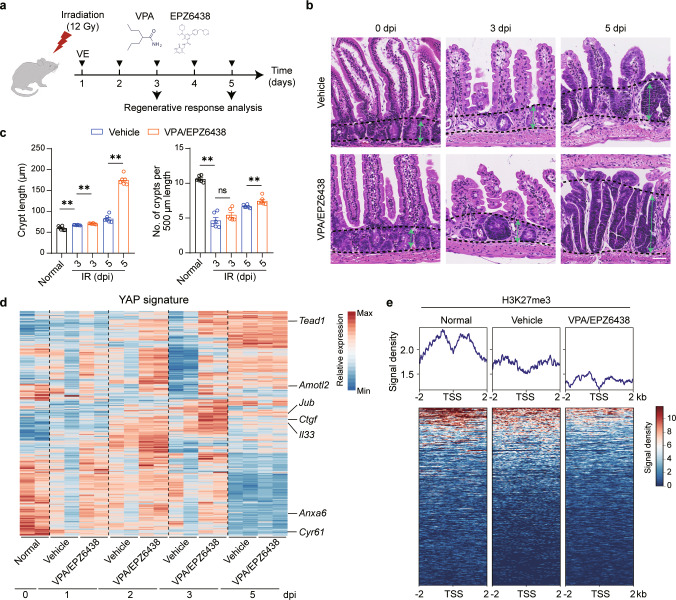
The capacity of 3D organoids to mimic physiological tissue organization and functionality has provided an invaluable tool to model development and disease in vitro. However, conventional organoid cultures primarily represent the homeostasis of self-organizing stem cells and their derivatives. Here, we established a novel intestinal organoid culture system composed of 8 components, mainly including VPA, EPZ6438, LDN193189, and R-Spondin 1 conditioned medium, which mimics the gut epithelium regeneration that produces hyperplastic crypts following injury; therefore, these organoids were designated hyperplastic intestinal organoids (Hyper-organoids). Single-cell RNA sequencing identified different regenerative stem cell populations in our Hyper-organoids that shared molecular features with in vivo injury-responsive Lgr5 + stem cells or Clu + revival stem cells. Further analysis revealed that VPA and EPZ6438 were indispensable for epigenome reprogramming and regeneration in Hyper-organoids, which functioned through epigenetically regulating YAP signaling. Furthermore, VPA and EPZ6438 synergistically promoted regenerative response in gut upon damage in vivo. In summary, our results demonstrated a new in vitro organoid model to study epithelial regeneration, highlighting the importance of epigenetic reprogramming that pioneers tissue repair.
Overview
The claims and statistics of this paper haven’t been checked yet.
Run the check — free, no account needed. It reads the open-access text and checks the sources it cites.
Integrity signals
Registry
Cites
Statistics
Figures
Verification
Claims the paper makes
The claims and statistics of this paper haven’t been checked yet.
Run the check — free, no account needed. It reads the open-access text and checks the sources it cites.
Claims other papers make about this one
Each is checked against this paper’s own text: does it say what the citing paper says it does?
The source backs part of the claim, not all of it — or backs it for a different population, condition or comparison.
In the citing paper
“Significant differences in morphology and functionality or even organoid formation efficiency depend on the different cells-of-origin of the culture or different cells in the organoid as well as different medium composition120,202–204.”
From Organoids (2022) · cites this paper as [120]
Experimental — accuracy not yet measuredThe source backs part of the claim, not all of it — or backs it for a different population, condition or comparison.
In the citing paper
“In that regard, a nice example was described by Fujii M et al. who demonstrated how refining of culture conditions could increase the diversity of differentiated cell fates in human small intestinal organoids120.”
From Organoids (2022) · cites this paper as [120]
Experimental — accuracy not yet measured
Self-check
Percentages, sums and reported differences re-computed from the paper’s own numbers.
The self-check needs the paper’s full text.
Citations
Cites
Fast and accurate short read alignment with Burrows-Wheeler transform
Li, H., & Durbin, R. (2009) · Bioinformatics · doi:10.1093/bioinformatics/btp324 · Cited by 58,607
Single Lgr5 stem cells build crypt-villus structures in vitro without a mesenchymal niche
Sato, T., Vries, R. G., Snippert, H. J., van de Wetering, M., Barker, N., Stange, D. E., van Es, J. H., Abo, A., Kujala, P., Peters, P. J., et al. (2009) · Nature · doi:10.1038/nature07935 · Cited by 7,204
Identification of stem cells in small intestine and colon by marker gene Lgr5
Barker, N., van Es, J. H., Kuipers, J., Kujala, P., van den Born, M., Cozijnsen, M., Haegebarth, A., Korving, J., Begthel, H., Peters, P. J., et al. (2007) · Nature · doi:10.1038/nature06196 · Cited by 5,687
Modeling Development and Disease with Organoids
Clevers, H. (2016) · Cell · doi:10.1016/j.cell.2016.05.082 · Cited by 3,196
Organogenesis in a dish: Modeling development and disease using organoid technologies
Lancaster, M. A., & Knoblich, J. A. (2014) · Science · doi:10.1126/science.1247125 · Cited by 2,931
Paneth cells constitute the niche for Lgr5 stem cells in intestinal crypts
Sato, T., van Es, J. H., Snippert, H. J., Stange, D. E., Vries, R. G., van den Born, M., Barker, N., Shroyer, N. F., van de Wetering, M., & Clevers, H. (2011) · Nature · doi:10.1038/nature09637 · Cited by 2,510
Snippert, H. J., van der Flier, L. G., Sato, T., van Es, J. H., van den Born, M., Kroon-Veenboer, C., Barker, N., Klein, A. M., van Rheenen, J., Simons, B. D., et al. (2010) · Cell · doi:10.1016/j.cell.2010.09.016 · Cited by 1,951
Directed differentiation of human pluripotent stem cells into intestinal tissue in vitro
Spence, J. R., Mayhew, C. N., Rankin, S. A., Kuhar, M. F., Vallance, J. E., Tolle, K. A., Hoskins, E. E., Kalinichenko, V. V., Wells, S. I., Zorn, A. M., et al. (2010) · Nature · doi:10.1038/nature09691 · Cited by 1,911
Phiel, C. J., Zhang, F., Huang, E. Y., Guenther, M. G., Lazar, M. A., & Klein, P. S. (2001) · Journal of Biological Chemistry · doi:10.1074/jbc.m101287200 · Cited by 1,758
A single-cell survey of the small intestinal epithelium
Haber, A. L., Biton, M., Rogel, N., Herbst, R. H., Shekhar, K., Smillie, C., Burgin, G., Delorey, T. M., Howitt, M. R., Katz, Y., et al. (2017) · Nature · doi:10.1038/nature24489 · Cited by 1,750
Cited by
Sorted by citations
Zhao, Z., Chen, X., Dowbaj, A. M., Sljukic, A., Bratlie, K., Lin, L., Fong, E. L. S., Balachander, G. M., Chen, Z., Soragni, A., et al. (2022) · Nature Reviews Methods Primers · doi:10.1038/s43586-022-00174-y · Cited by 1,082
Kim, S., Min, S., Choi, Y. S., Jo, S.-H., Jung, J. H., Han, K., Kim, J., An, S., Ji, Y. W., Kim, Y.-G., et al. (2022) · Nature Communications · doi:10.1038/s41467-022-29279-4 · Cited by 375
Mex3a marks drug-tolerant persister colorectal cancer cells that mediate relapse after chemotherapy
Álvarez-Varela, A., Novellasdemunt, L., Barriga, F. M., Hernando‐Momblona, X., Cañellas-Socias, A., Cano-Crespo, S., Sevillano, M., Cortina, C., Stork, D., Morral, C., et al. (2022) · Nature Cancer · doi:10.1038/s43018-022-00402-0 · Cited by 153
Organoids in gastrointestinal diseases: From experimental models to clinical translation
Günther, C., Winner, B., Neurath, M. F., & Stappenbeck, T. S. (2022) · Gut · doi:10.1136/gutjnl-2021-326560 · Cited by 145
Developments and Opportunities for 3D Bioprinted Organoids
Ya, R., Yang, X., Ma, Z., Sun, X., Zhang, Y., Li, W., Yang, H. S., Qiang, L., Yang, Z., Liu, Y., et al. (2021) · International Journal of Bioprinting · doi:10.18063/ijb.v7i3.364 · Cited by 131
Metadata
- Authors
- Qu, M., Xiong, L., Lyu, Y., Zhang, X., Shen, J., Guan, J., Chai, P., Lin, Z., Nie, B., Li, C., Xu, J., & Deng, H.
- Affiliations
- Peking University (CN)
- Capital Medical University (CN)
- Corresponding author
- Li, Cheng
- Xu, Jun
- Deng, Hongkui
- ORCID
- Venue
- Cell Research
- Published
- 2021-01-08
- Volume
- 31
- Issue
- 3
- Pages
- 259-271
- ISSN
- 1001-0602 (ISSN-L)
- 1748-7838
- PMC
- PMC8027647
- OpenAlex
- W3119003316
- Cited by
- 138
- References
- 51
- Citations by year
- 2026: 21 · 2025: 31 · 2024: 41 · 2023: 18 · 2022: 21 · 2021: 6
- FWCI
- 6.83
- Type
- journal article
- Language
- en
- Open access
- hybrid
- doi.org
- Locations
- Cell Research (publishedVersion, cc-by)
- PubMed Central (publishedVersion, cc-by)
- PubMed (publishedVersion)
- Greater South Information System
- Funders
- National Natural Science Foundation of China (31521004, 31871266, 2017YFA0103000, 31730059)
- Peking University
- Topics
- Life Sciences › Biochemistry, Genetics and Molecular Biology › Molecular Biology › Wnt/β-catenin signaling in development and cancer
- Health Sciences › Medicine › Gastroenterology › Digestive system and related health
- Health Sciences › Medicine › Oncology › Cancer Cells and Metastasis
- Keywords
- intestinal organoids, epithelial regeneration, intestinal injury, valproic acid, LDN-193189, RSPO1, Lgr5+ stem cells, epigenetic reprogramming, YAP signaling, tissue repair, single-cell RNA sequencing
- MeSH terms
- Animals, Benzamides, Biphenyl Compounds, Cells, Cultured, Colitis, Disease Models, Animal, Female, Intestinal Mucosa, Intestines, Male, Mice, Inbred C57BL, Mice, Transgenic, Morpholines, Organoids, Pyridones, Radiation Injuries, Regeneration, Stem Cells, Valproic Acid, Signal Transduction, Dextran Sulfate, Treatment Outcome, Culture Media, Conditioned, Tissue Culture Techniques, Mice
About these checks
Registry, retraction, Cites and statistics results are computed, not judged, with one exception: a printed reference that no index lists is read once by a model before it counts as a citation error. Claims are extracted by a model and kept only when their quote appears verbatim in the text; each cited source is then checked, with a model’s help, for whether it says what the claim relies on. Those verdicts can be wrong — read the claim’s quote and the cited source before relying on one.
Statistics and arithmetic are recomputed, not judged.
Confidence bands are shown only for fields calibrated on our annotated test set. None is calibrated yet, so no band is shown.
What counts as a claim ›How we measure confidence ›How we check this ›
Are you an author, or do you see a problem with this page? Request a review
